#JeSuisJuif

Noah Rayman discusses how last week’s attack on the Hyper Cacher supermarket is affecting Jewish communities in France:

The assault on the Kosher supermarket shook the Jewish community in France and abroad. As dual hostage situations unfolded, police ordered the closure of all shops in the tourist-filled Jewish neighborhood in central Paris, far from the supermarket under siege in the city’s east, according to the Associated Press. And ahead of the Sabbath Friday evening, the iconic Grand Synagogue of Paris was closed, USA Today reported.

The Jewish community in France, numbering more than 400,000, had already been on guard after an uptick in anti-Semitic violence in recent years, including the shooting of four people at the Jewish Museum of Belgium in May 2014, allegedly by a French Muslim man. After the attack on Charlie Hebdo on Wednesday, Jewish institutions were on maximum alert, the Jewish Telegraphic Agency reported. Volunteers joined police deployed by the French authorities to secure schools and religious sites.

Elliot Abrams wonders why there isn’t more sympathy for the Jewish victims:

Terrorism against French Jews is not new. In 2012 a terrorist murdered three schoolchildren and a rabbi at a Jewish school in Toulouse. There was no million-citizen march.

And suppose that last week’s terror attack in Paris had not aimed at Charlie Hebdo, but “only” killed four Jews–or eight or twelve, for that matter. Does anyone believe a million French citizens would be marching in Paris, with scores of world leaders joining them?

One is reminded of the synagogue bombing on Rue Copernic in Paris in 1980, after which Prime Minister Raymond Barre publicly declared that “A bomb set for Jews killed four innocent Frenchmen.” That shocking lack of solidarity– that definition of Frenchmen to exclude the Jews – does not seem to have been cured, and the French today appear to feel more solidarity with the journalists who were killed than with the Jews who were killed.

But Jeffrey Goldberg observes that the current French leadership has been taking the issue of anti-semitism seriously:

[French Prime Minister Manuel] Valls, who on Saturday declared that France was now at war with radical Islam, has become a hero to his country’s besieged Jews for speaking bluntly about the threat of Islamist anti-Semitism, a subject often discussed in euphemistic terms by the country’s political and intellectual elite. His fight, as interior minister, to ban performances of the anti-Semitic comedian Dieudonne (the innovator of the inverted Nazi salute known as the quenelle) endeared him to the country’s Jewish leadership, and he is almost alone on the European left in calling anti-Zionism a form of anti-Semitism.

“There is a new anti-Semitism in France,” he told me. “We have the old anti-Semitism, and I’m obviously not downplaying it, that comes from the extreme right, but this new anti-Semitism comes from the difficult neighborhoods, from immigrants from the Middle East and North Africa, who have turned anger about Gaza into something very dangerous. Israel and Palestine are just a pretext. There is something far more profound taking place now.”

And Adam Taylor holds out the #JeSuisJuif solidarity campaign on Twitter as evidence that the world isn’t ignoring those victims, though anti-semitism remains a real problem in France:

#JeSuisJuif began to trend after news spread about hostages being taken at the grocery store, which is called Hyper Cacher, or Hyper Kosher, in Porte de Vincennes. The attack took place at the start of the Jewish Sabbath, when the store was busy, and there were fears that other Jewish businesses in the area could be targets. Later, French President Francois Hollande described the hostage taking as an “anti-Semitic attack”

The attack comes at a fraught time for France’s Jewish community. Many French Jews have perceived a rise in anti-Semitism in the country in recent years. Reports of violence against Jews skyrocketed at the start of 2014, and things became worse over summer as a conflict in Gaza prompted anti-Israel protests that blurred the line with anti-Semitism. One survey by the New York-based Anti-Defamation League estimated that 37 percent of French people openly held anti-Semitic views – the highest number in Europe.

“Overlook Their Annoying Talk”

Harris Zafar reminds us that, whether dealing with specific insults or with the freedom of speech more generally, Muhammad’s teachings fly in the face of what modern-day Islamists purport to believe:

Islam does not support people who violently censor free speech. Freedom of speech is guaranteed in the MuhammadQur’an both through direct instruction as well as recalling how Muhammad was insulted to his face and never retaliated. The Qur’an records that he was called crazy, a victim of deception, a liar, and a fraud. Through this all, the Prophet Muhammad never retaliated or called for these people to be attacked, seized, or executed. This is because the Qur’an says to “overlook their annoying talk” and to “bear patiently what they say.” It instructs us to avoid the company of those who continue their derogatory attacks against Islam. There simply is no room in Islam for responding to mockery or blasphemy with violence.

But perhaps most pointedly, the Qur’an tells believers not to be provoked by those who seem to attack Islam, stating very clearly “let not a people’s enmity incite you to act otherwise than with justice.” This is supported by the actions of the Prophet Muhammad himself. When he was once returning from an expedition, an antagonist used insulting words against him. Although a companion suggested that the culprit be killed, the Prophet Muhammad did not permit anyone to do so and, instead, instructed they leave him alone.

Readers on Friday underscored that incident and the same overall point – which can’t be reiterated enough. So where did the practice of not depicting Muhammad come from? Amanda Taub voxplains:

According to [scholar Reza] Aslan, the Koran does not explicitly prohibit depicting the Prophet Mohammed, and there have been images of Mohammed, his family, and other prophets throughout history. “The history of Islam teems with images of the Prophet Mohammed. You see this in the 7th, 8th, 9th, 10th, 11th, 12th, 13th, 14th, 15th, 16th, 17th, 18th, 19th, and 20th centuries.”

Still, the idea that depictions of Mohammed are disallowed didn’t come out of nowhere. Islam, Aslan explained, like Judaism, is an iconoclastic religion that does not permit God to be anthropomorphized — that is, portrayed as a human being — and prizes textual scripture instead.

Over time, Islamic scholars extended that tradition to cover Mohammed and the other major prophets as well, and discouraged artists from depicting them in images. That has created a strong cultural norm against images of Mohammed, even in the absence of a religious law against them.

Back in 2010, Omid Safi passed along the above image, “one of the classic images of the Prophet Muhammad’s Heavenly Ascension”:

In my recent biography of the Prophet, I have taken care to produce about 20 of the pietistic and sacred images produced by Muslim artists over the centuries. These are as far from the Danish cartoon images as one can get: they are works of devotion, illuminated by faith, and imbued with a deep sense of love. There are other options available to Muslims than either accepting the Danish Cartoonist caricatures of the Prophet or responding in pure anger and hatred. One such answer is a return to the rich pietistic Islamic tradition of depicting the Prophet who was sent, according to the Qur’an, as a mercy to all the Universe.

The Muslim Heroes Of The Paris Attacks

You already know about Ahmed Merabet, the Muslim cop who died confronting the killers outside the Charlie Hebdo offices. But now there’s another Muslim hero to emerge from the mayhem this week:

A Muslim employee of a kosher grocery store in Paris is being hailed as a hero for hiding several customers in a walk-in freezer to save them from a violent gunman. Lassana Bathily, 24, led the others into the basement of his workplace, Hyper Cacher, when Amedy Coulibaly opened fire on Friday, according to French media. … “I opened the door, and several people came in with me. I turned off the lights, I turned off the freezer, and they got into the freezer,” Bathily told local station BFMTV.  “I told them to calm down, to not make noise. If he knows we’re here, he can come down and kill us.” …

The people he saved expressed profound gratitude after the violence was over, he said. “When they got out, they congratulated me,” Bathily told the station. “They said, ‘Honestly, thank you for having thought of that,’ and I said, ‘You’re welcome. It’s nothing, that’s life.

Never Forget The Muslim Victims Of Islamic Terrorism

Wednesday’s attack on Charlie Hebdo has already inspired a backlash against France’s Muslim community, with several incidents targeting mosques, businesses, and even individuals:

Three grenades hit a mosque in Le Mans, in the early hours of Thursday while in Aude, southern France, two gunshots were fired at an empty prayer room. A Muslim family in their car in Vaucluse came briefly under fire but escaped unharmed, and a mosque in Poitiers was daubed with graffitti saying “Death to Arabs”. In Villefranche-sur-Saône, an explosion blew out the windows of a kebab shop next door to the town mosque. …

Nourredine, a taxi driver, said the cold-blooded attack on Wednesday at Charlie Hebdo had left him very saddened and angry. It had reminded him of his home country, Algeria, in the 60s and 70s, he said, where “journalists were often the first to be targeted” by extremists. “But you know, we will become victims of this atrocity,” he said. “There is real stigmatisation in France. I love this country, really I do, but this stigmatisation, this amalgamation, this tarring all Muslims with the same brush – all it does is feed the extremists. It helps the Front National, the people who hate and fear Islam.”

This tweet says it better than anything else:

https://twitter.com/misshibhop/statuses/553603082425475072

H.A. Hellyer is dismayed that French Muslims are being called upon to condemn an act that, in the long run, stands to hurt them as much as anyone else:

While the attackers may claim to have killed in the name of the Prophet’s honor, they killed someone with the Prophet’s name in the process: a French policeman called Ahmed Merabet.

As a Frenchman, he was targeted by extremists; as a Muslim, his community is targeted by extremists worldwide; and as a French Muslim, his local community stands at risk of an anti-Muslim backlash. Muslim terrorists kill far more Muslims than non-Muslims, and far more Muslims than non-Muslims are fighting these extremists. The day of the Charlie Hebdo attack, several dozen Muslims were killed by radical extremists in Yemen. Many others die every day in Iraq and Syria. …

The disgraceful attacks on Charlie Hebdo may have further consequences, such as entrenching the false notion that Muslims and non-Muslims simply cannot coexist, or that civil liberties need to be rethought, with yet more powers given to the state, diminishing the commitment to human rights. That is merely giving the attackers a further victory, rather than honoring the loss of life that took place.

Merabet is being held up as a hero on Twitter with the hashtag #JeSuisAhmed:

“The story of Merabet’s confrontation with the Paris terrorists,” Jim Edwards writes, ” is turning out to be one of the most poignant in the whole affair”:

And it’s proof, if further proof were needed, that Muslims are much more frequently the victims of Islamic terrorism than Westerners are. According to the Global Terrorism Index, 80% of all the deaths from terrorism in 2013 were in Muslim-majority countries Iraq, Afghanistan, Pakistan, Nigeria, and Syria. Since 2000, only 5% of all deaths from terrorism have been in developed countries — although they have been among the deadliest. …

Merabet is the officer seen in the heartbreaking video of the shooters’ attack on the Charlie Hebdo office, as seen through a mobile phone from across the street. The worst part of the video — aside from the moment in which the gunmen finish him off with a shot to the head — is where Merabet, lying injured on the pavement, tries to raise his arms in surrender. He is clearly no threat to the gunmen. And they kill him anyway.

This is why, in John Cassidy’s opinion, the “clash of civilizations” narrative that some are trying to superimpose on this tragedy misses the point entirely:

But to interpret things in such black-and-white terms is to distort reality. Although Islam largely missed out on the Reformation and the Enlightenment, a point frequently made by its critics, it is far from a monolithic religion. And many ordinary Muslims, rather than being on the side of the jihadis, are taking up arms against them, and sometimes paying with their lives. In Iraq, the Iraqi, Kurdish, and Iranian soldiers battling ISIS are mostly Muslims. In Pakistan and Afghanistan, the government forces fighting jihadis are also almost all Muslims.

On top of this, most of the victims of jihadi atrocities are Muslims. In Iraq last month, more than eleven hundred people were killed in acts of terrorism and violence, including nearly seven hundred civilians. It’s fair to assume that almost all of them belonged to the Islamic faith.

Faces Of The Day

Police Storm Kosher Deli To End Hostage Situation

Residents return to their homes following the hostage situation at a kosher deli in Port de Vincennes in Paris, France on January 9, 2015. By Dan Kitwood/Getty Images. From a summary of today’s events on the Guardian live-blog:

• Two separate police raids in Paris and Dammartin-en-Goële killed the Charlie Hebdo gunmen and a third man, ending a three-day manhunt. Police found Chérif and Saïd Kouachi, wanted for murdering 12 people in Paris on Wednesday, and cornered them in a printworks office. … One hostage escaped unharmed in Dammartin-en-Goële.

Four hostages were killed and four wounded in the supermarket in Paris, where Amedy Coulibaly held civilians captive. Authorities believe Coulibaly and an accomplice killed a policewoman Thursday in southern France, naming her as Hayat Boumeddienne, and described her as “armed and dangerous” and at large.

In an interview before he was killed, Cherif Kouachi claimed that he was sent by al-Qaida in Yemen, as a defender of the prophet. In a separate interview, Coulibaly said that his attack had been ‘synchronized’ with the Kouachis’ Charlie Hebdo attack.

Where Death For Blasphemy Is The Norm

The staff of Charlie Hebdo were not the only people killed on Wednesday for blaspheming Islam. In Pakistan, 52-year-old Aabid Mehmood, a mentally disturbed man who had served two years in jail for claiming he was a prophet, was kidnapped and murdered – a sadly common occurrence in a country where blasphemy is a capital crime:

Mehmood was spared a death sentence, but he spent more than two years in prison. He was released several months ago because of his medical condition, said Muhammad Ayub, a local police official. On Wednesday, according to Ayub, unknown gunmen took Mehmood from his home and shot him in the head and chest before dumping his body. …

Thirty-eight people in Pakistan are serving life sentences or are on death row after being accused of blasphemy, according to Knox Thames, director of policy and research at the U.S. Commission on International Religious Freedom. Five of them were convicted in 2014, the same year that a high court upheld the death sentence for a Christian woman accused of defaming Muhammad during a 2010 argument with co-workers. For many blasphemy suspects, however, the real death sentence all too often comes at the hands of enraged mobs.

And just today, a liberal blogger in Saudi Arabia was publicly flogged for “insulting Islam”:

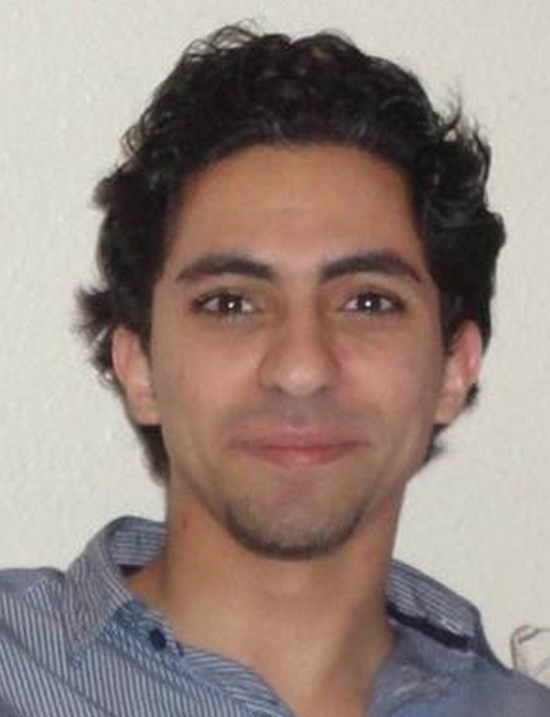
Screen Shot 2015-01-10 at 1.32.07 AM[Raif] Badawi, 30, was arrested in June 2012 and charged with offenses ranging from cyber crime to disobeying his father and apostasy, or abandoning his faith. He was sentenced to 10 years in prison, a fine of 1 million Saudi riyals ($266,666) and 1,000 lashes last year after prosecutors challenged an earlier sentence of seven years and 600 lashes as being too lenient. Witnesses said that Badawi was flogged after the weekly Friday prayers near Al-Jafali mosque as a crowd of worshipers looked on.

Badawi got off easy, in the sense that Saudi Arabia also considers apostasy a capital crime. So as bad as France’s blasphemy laws are, they’re nothing compared to many in the Muslim world. In the search for some constructive response to the Charlie massacre, Tomasky suggests we focus our ire on the latter laws:

[S]urely at least part of the reason that terrorists think it’s okay to kill people who blaspheme the Prophet is that too many Arab or Muslim states say it’s okay. It would be nice to see a concerted international effort to change these laws grow out of this week’s calamity.

At least Western governments like Ireland and Canada are getting that message:

Blasphemy laws are harshest and most common in the Muslim world, but aren’t exclusive to it. In the wake of Pussy Riot’s church performance, Russia’s parliament passed a new law mandating jail terms for insults to religion. Nearly a quarter of the world’s countries have blasphemy laws on their books, according to Pew, and one out of 10 bans apostasy. The Charlie Hebdo killings have already prompted some Western governments, notably Ireland and Canada, to announce that they will reconsider the blasphemy laws on their books. But in much of the world, governments, not terrorists, will continue to be the biggest threat to freedom of and from religion.

(Image of Badawi via a GlobalPost tweet)

Nous Sommes Charlie, But Do We Really Want To Be? Ctd

https://twitter.com/RaniaKhalek/statuses/553261940223778818

Update from a reader on the above image:

That cartoon looks bad, but if you understand the French, the meaning seems to me to be actually anti-racist. “La GPA” is “la gestation pour autrui,” or in English “surrogate motherhood.”  The point of the cartoon is that when wealthy white couples pay poor women of color to be their surrogates, they are exploiting them. The point is somewhat bluntly and crudely made, but not at all offensive to my sensibilities. Others may differ, I suppose.

Jordan Weissmann urges us not to be afraid to criticize Charlie Hebdo‘s over-the-top (and often lame) humor even as we stand in solidarity with the victims of Wednesday’s terror attack:

So what should we do? We have to condemn obvious racism as loudly as we defend the right to engage in it. We have to point out when an “edgy” cartoon is just a crappy Islamophobic jab. We shouldn’t pretend that every magazine cover with a picture of Mohammed is a second coming of The Satanic Verses.

Making those distinctions isn’t going to placate the sorts of militants who are already apt to tote a machine gun into a magazine office. But it is a way to show good faith to the rest of a marginalized community, to show that free speech isn’t just about mocking their religion. It’s hard to talk about these things today, when so many families, a country, and a profession are rightfully in mourning. But it’s also necessary.

In Arthur Chu’s viewCharlie often violated satire’s unspoken rule to “punch up, not down”:

I mean, Muslims in France right now aren’t doing so great. The scars of the riots nine years ago are still fresh for many people, Muslims make up 60 to 70 percent of the prison population despite being less than 20 percent of the population overall, and France’s law against “religious symbols in public spaces” is specifically enforced to target Muslim women who choose to wear hijab—ironic considering we’re now touting Charlie Hebdo as a symbol of France’s staunch commitment to civil liberties.

Muslims in France are clearly worse off overall than, say, Jean Sarkozy (the son of former president Nicholas Sarkozy) and his wife Jessica Sebaoun-Darty, but Charlie Hebdo saw fit to apologize for an anti-Semitic caricature of Ms. Sebaoun-Darty and fire longtime cartoonist Siné over the incident while staunchly standing fast on their right to troll Muslims by showing Muhammad naked and bending over—which tells you something about the brand of satire they practice and, when push comes to shove, that they’d rather be aiming downward than upward.

The firing of Siné indeed showed a shameful double standard. Jonathan Laurence’s concern is that the chorus of “je suis Charlie” will play into the hands of the far right and normalize nastiness toward Muslims:

When the shock and sadness recede, it will become apparent that despite hashtags to the contrary, not all French “are Charlie Hebdo.” Numerous Catholic and Muslim groups offended by their cartoonists regularly filed lawsuits for incitement of racial or religious hatred against the newspaper—including after they republished the Danish prophet cartoons. Despite the understandable temptation to enter into a clear-cut opposition of “us versus them,” we can only hope that other political leaders will emerge to urge caution and respect while rejecting the murderers with every fiber of their being. It would be an unfortunate irony, and a distortion of these satirists’ legacy, if “politically incorrect” became the new politically correct.

Dreher asks whether Americans would be so quick to say “je suis” if the victims were from an organization we were more familiar with:

I can’t speak for French sensibilities, obviously, but here in America, it’s easy for us on both the Left and the Right to join the Je suis Charlie mob, because it costs us exactly nothing. Nobody here knows what Charlie Hebdo stands for; all we know is that its staff were the victims of Islamist mass murder, of the sort with which we are all familiar. We know that this murder strikes at one of the basic freedoms we take for granted: freedom of speech, and freedom of the press. Feelings of solidarity with those murdered souls are natural, and even laudable.

But what makes it kitschy is that we love thinking of ourselves standing in solidarity with the brave journalists against the Islamist killers. When the principle of standing up for free speech might cost us something far, far less than our lives, most of us would fold. You didn’t see liberals wearing “I Am Brendan Eich” slogans; many on the Left think he got what he deserved, because blasphemers like him don’t deserve a place in public life. Nor did you see conservatives brandishing “I Am Brendan Eich” slogans, because they feared they might be next.

Hear hear. Beutler, for his part, doesn’t think we need to praise Charlie in order to stand against terrorism:

The massacre in Paris has awakened a liberal tendency to valorize all objects of illiberal enmity. If an Islamist kills a westerner for a particular blasphemy, then the blasphemy itself must be embraced. We saw something similar just last month when countless Americans, rightly aggrieved by the extortion of a U.S.-based movie company, became determined to find reason to praise a satirical film they would’ve otherwise panned. This is clearly not always the correct reaction to terrorism or extortion. Here, liberals can learn a lesson from Second Amendment absolutists who nevertheless condemn open-carry demonstrations in fast food restaurants.

Likewise, Drum objects to the Dish’s framing of decisions by the WaPo and other news outlets not to republish Charlie’s cartoons as “capitulations”:

Anyone who wishes to publish offensive cartoons should be free to do so. Likewise, anyone who wants to reprint the Charlie Hebdo cartoons as a demonstration of solidarity is free to do so. I hardly need to belabor the fact that there are excellent arguments in favor of doing this as a way of showing that we won’t allow terrorists to intimidate us. But that works in the other direction too. If you normally wouldn’t publish cartoons like these because you consider them needlessly offensive, you shouldn’t be intimidated into doing so just because there’s been a terrorist attack. Maintaining your normal policies even in the face of a terrorist attack is not “capitulation.” It’s just the opposite.

But the WaPo is a news organization, and these cartoons are at the heart of the news story of the Western world right now. News outlets can post the Charlie cartoons simply to show what all the fuss is about, without endorsing the images in the slightest. But as Dan Savage rightly asserts, they refuse to do so out of fear – the kind of fear that terrorists thrive on. The Dish, as it happens, has never posted anything from Charlie Hebdo outside the context of Islamists threatening or attacking them, mostly because their satire isn’t terribly good. Several years ago we posted a few cartoons from Carlos LaTuff before discovering that he’s a vile anti-Semite and that many of his cartoons reflect that (though not the two we posted), so we have since refused to feature any of his work. But if LaTuff became part of a news story like Charlie Hebdo has, we would certainly post his offending cartoons – like we did earlier this afternoon. Stephen Carter gets it right:

Many news organizations, in reporting on the Paris attacks, have made the decision not to show the cartoons that evidently motivated the attackers. This choice is sensibly prudent — who wants to wind up on a hit list? — but from the point of view of the terrorist, it furnishes evidence for the rationality of the action itself. Killing can be a useful weapon if it gets the killer more of what he wants. Terror seeks to raise the price of the policy to which terrorists object. In that sense it’s like a tax on a particular activity. In general, more taxes mean less of the activity. If you don’t want people to smoke, you make smoking more expensive. If you don’t want people to mock the Prophet Muhammad, you kill them for it. The logic is ugly and evil, but it’s still logic. …

The terrorist knows what scares us. He believes he also knows what will break us. Our short-run task is to prove rather than assert him wrong. In the long run, however, the only true means of deterrence is the creation of a new history, in which the terrorist is always tracked to his lair, and never gets what he wants.

Who Won’t Republish Charlie’s Cartoons? Ctd

A reader makes a good point:

In general, I completely agree with the notion that the offending cartoons are newsworthy and should be published (I recently changed my Facebook photo to the “kissing a Muslim man” Charlie Hebdo cartoon precisely to make that point). But I do want to call attention to one major difference about out about the various media outlets that Christopher Massie refers to. “Legacy” organizations have journalists working on the ground throughout the world while newer digital outlets generally don’t. I wouldn’t be surprised if the primary factor in the decision not to publish those cartoons was protecting the safety of  reporters and safeguarding their ability to continue reporting from around the globe.

If BuzzFeed and Slate had journalists and photographers on their payroll working in Riyadh, Jakarta, or Damascus, I’m not convinced those organization would be so quick to reprint the offending images. It’s a heck of a lot easier to post a cartoon of a crying Mohammed when you’re in Manhattan than if you’re working for a news bureau in Cairo.

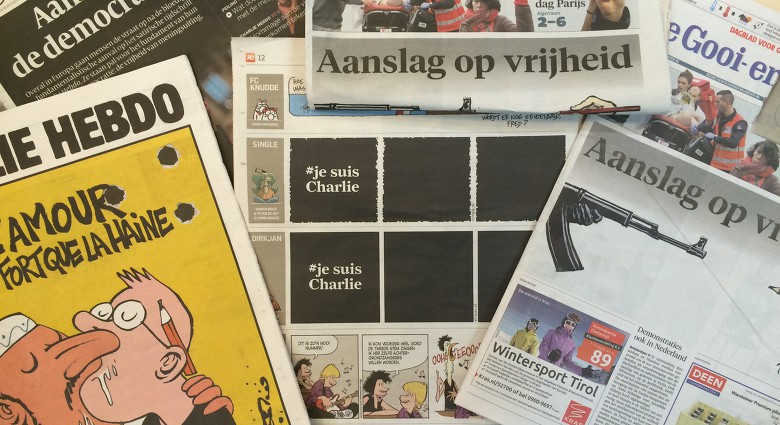
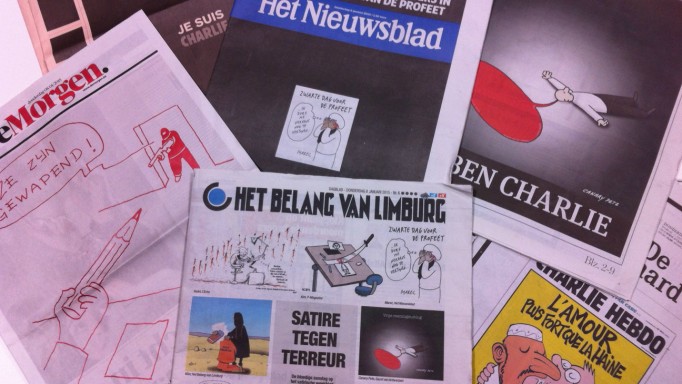
Update from a Dutch reader:

I have to call bullshit on that. Here are some Dutch front-pages from the day after:

dutch

And Flemish front-pages:

flemish

So plenty of Dutch and Flemish newspapers had Charlie cartoons on their front-pages, and all had them inside. And from Germany:

german

And here’s a slideshow of other front-pages from around the world. You think those papers have no international correspondents?

Not publishing insulting religious cartoons is a typical American problem. I read a comment somewhere in the Dutch or Flemish media that suggested that since America is so much more religious than Europe, mockery of religion in general is a no-go area in the US. And that’s true. There is no serious mockery of religion in the US. Bill Maher may be the exception to that rule, and see how much crap he gets for it. The sharpest criticism of religion comes from Stephen Colbert, a devout Catholic himself.

Remember the mess when South Park wanted to show Muhammed in an episode? No-go, said Comedy Central.

Though Matt and Trey were able to get away with this crap-fest in lieu of Muhammed:

Another reader points to a notable exception in the US:

I hate to burst the first reader’s bubble about legacy new orgs, but Bloomberg News has reporters all over the world and in the places the reader mentioned, and it published every one of the “offensive” cartoons. Here’s the main one I’m thinking of, and other images have run with various stories Bloomberg writers have covered on different aspects of what’s going on.

And as we noted earlier, the WaPo did in fact publish a Charlie cover featuring Muhammed, in the opinion section. Money quote from Fred Hiatt:

I think seeing the cover will help readers understand what this is all about.

Precisely.

Les Limites De La Liberté

B60MfNeIgAAnudL-540x272

Judah Grunstein discusses how France’s conception of “free speech” differs from the more robust American version:

Both France and America make the sanctity of free speech a core principle. But at various times over the past 14 years that I have lived here in France, I have been called on by my American friends to “translate” just what the French mean by “free speech.” In particular, they have been perplexed by the willingness to place limits on speech and, relatedly, religious expression here. This first became visible in the context of the law against wearing veils in public schools and government buildings. More recently, it arose when the government banned the one-man show of the ostensible comic Dieudonné, due to offensive jokes about the Holocaust and gas chambers.

Put simply, in France, racist and anti-Semitic speech, as well as historical revisionism regarding the Holocaust, is illegal, as is all speech that can be considered an incitement to hate. That is something that very few Americans understand—or approve of.

Jonathan Laurence notes a crucial caveat to France’s hate-speech protections: they’re not extended to Muslims:

The last lawsuit to be filed against Charlie Hebdo in 2014 was declared ineligible only because Islam doesn’t qualify for the special legal regime that criminalizes blasphemy against Christianity and Judaism in the Alsace region. And the British Muslims in 1989 wanted authorities to invoke British blaspehemy laws, not the shar’ia, to sanction Salman Rushdie’s novel – but there too Islam did not qualify for protection.

Greenwald calls out hypocrisy among those defending Charlie Hebdo on the basis of free speech, and passes along some cartoons – of which the one above is the least offensive – that he suspects we would not be so quick to defend:

[I]t’s the opposite of surprising to see large numbers of westerners celebrating anti-Muslim jews_image081-540x702cartoons – not on free speech grounds but due to approval of the content. Defending free speech is always easy when you like the content of the ideas being targeted, or aren’t part of (or actively dislike) the group being maligned.

Indeed, it is self-evident that if a writer who specialized in overtly anti-black or anti-Semitic screeds had been murdered for their ideas, there would be no widespread calls to republish their trash in “solidarity” with their free speech rights. In fact, Douthat, Chait and Yglesias all took pains to expressly note that they were only calling for publication of such offensive ideas in the limited case where violence is threatened or perpetrated in response (by which they meant in practice, so far as I can tell: anti-Islam speech).

The Dish, of course, is an equal opportunity republisher of trash, as long as it’s relevant and newsworthy. In a sharp post, Sullum argues that France’s hate speech laws indirectly enabled Wednesday’s violence:

I am not saying yesterday’s massacre can be blamed on France’s hate speech laws. Although at least two of the perpetrators were born and raised in France, there is no evidence that they cared about the content of these statutes or that they needed any additional justification beyond their own understanding of Islam. But it is hypocritical and reckless for a government that claims to respect freedom of the press to criminalize images and words based on their emotional impact. Although such laws are defended in the name of diversity and tolerance, it is the opposite of enlightened to invite legal complaints aimed at suppressing offensive messages.

Instead of facilitating censorship by the sensitive, a government truly committed to open debate and freedom of speech would make it clear, in no uncertain terms, that offending Muslims (or any other religious group) is not a crime. Sacrilege may upset people, but it does not violate their rights. By abandoning that distinction, avowed defenders of Enlightenment values capitulate to the forces of darkness.

On the other hand, as Luke O’Neil notes, there’s plenty of free speech hypocrisy to be found right here in the USA:

[T]he self-professed most patriotic citizens in this country harp on our military’s presence in countries like Afghanistan and Iraq, insisting that, if not for these brave soldiers, the very foundation of our culture—our speech freedoms—would collapse overnight. Yet those who question the unwavering justness of any action by the American military are often invited to shut their mouths, or given directions to the nearest port of exit. It wasn’t that long ago that entertainers like the Dixie Chicks were being roundly denounced and taken off the air for having the temerity to question our country’s wars.

Nick Gillespie is sad to say that he “will not be surprised if the Charlie Hebdo massacre has the effect of increasing support for hate-speech laws in the United States “:

Many Americans who don’t particularly care about freedom of speech may look on the carnage and conclude it makes sense to avoid such scenes by stifling expression. Social Justice Warrior types will take another long look at Jeremy Waldron’s 2012 book, The Harm in Hate Speech, and gussy up their interest in controlling thought and social interactions with philosophical language and social-scientific “rigor.” Conservatives, sniffing out a possible way to screw liberals and libertarians, may rediscover The Weekly Standard’s case for censorship and decide, hell, it makes a lot of sense. Aren’t Christians the folks who are picked on in America and treated unfairly by the media and intellectuals? It’s always “Piss Christ” and never “Piss Mohammed,” right?

Which makes it more important not simply to show solidarity with the dead and wounded in France but to rehearse the arguments for unfettered trade in ideas and speech.

Update from a reader, who remarks on the cartoon seen at the top of the post, created by the anti-Semitic Carlos LaTuff:

This is a completely false equivalency, and really gets to the heart of the cultural gap at play. To secularists like the cartoonists at Charlie Hebdo, Mohammed is a man like any other, he is no prophet, he is aggrandized by a religion, and is therefore a legitimate target of satire, just like the the Pope, or Jesus, or even the Dalai Lama if one is so inclined. The Holocaust was systematic genocide based on religion/ethnicity. I’m not saying that jokes against the Holocaust should be off limits, there should be no limits.

A better choice would be a “Cartoons of Jesus, or Moses, or John the Baptist” in the place of the “Cartoons of Holocaust.” (If you did, you would be as likely to find the Westerner laughing at both. Unless it is Bill Donahue, who is incapable of laughter.) You simply cannot equate the murder of millions to making fun of a religious figure. One is a group of real human beings. The other is an idealized version of a person who claimed God spoke to him in a cave.

The reason for drawing Mohammed is less about a specific set of religious beliefs, it is about, (forgive me), forbidden fruit. Don’t tell me not to take a taste of that apple, or draw that picture. There is something wonderfully defiant in the human spirit when told we cannot have, or do something. I’m grateful to the cartoonists who were killed for having that spirit, and expressing it.

Slaughtered For Satire, Ctd

Several more readers sound off on the tragedy at Charlie Hebdo:

Your reader offers up a rather boilerplate “liberal” or “Ben Affleckian” response to a terrorist attack: the reasons the perpetrators gave for the attack are not the “real” reasons for it, but enhanced-15542-1420644588-9rather lack of education, poor treatment, alienation, etc.  While I do believe that these factors can play a role in radicalization, they do not explain the attack on Charlie Hebdo.  In fact, while claiming to be searching for “the whole story” or at least “the central one,” your reader fails to recognize the predominate and most obvious cause of the horrendous attack: religious dogma.

In fact, the reader seems to go out of his way to avoid mentioning religion at all.  He characterizes the cartoons (or other’s hypothetical opinions of the cartoons) as “racist slurs” (Islam is not a race) and the attack itself as “political violence.”  Now, Islamism, like all theocracy, is indeed partly political.  But it is also religious.  If this were political violence, why wasn’t the target political?  If the cause was poor education, strict immigration policies, and under representation in government, why not target a school or a government building?

No, this act of terror was religious violence.

The gunmen shouted “God is great” as they murdered journalists and artists.  They did so because their religious dogma states that anyone who insults or depicts the prophet Muhammad deserves death.  Islamists do not seem to mind free speech when that speech is used to disparage Christians, Jews, gays, or other infidels.  They only mind when someone breaks the rules of their religious dogma.  Any attempt to frame the whole story, or the central story, of the Charlie Hebdo attacks which does not mention religious dogma is inane, hypocritical, and self-defeating.

Another reader:

I have seen some of Charlie Hebdo‘s cartoons over the years and found some of them amusing, some of them repulsive. More than a few of them I’ve found out-and-out racist, and worse. I’ve thought they were racist against precisely people who, in French society, are the down-and-out, the outcast. It’s the kind of satire which I think can be ugly because it targets not the powerful, but the powerless. On balance, I don’t particularly care for Charlie Hebdo.

But I was reading about the people killed, and in particular the cartoonists, and I found myself weeping for a style, a tradition, a discourse: for human people murdered before they were done exploring what it means to live, to love, to laugh. I haven’t liked their cartoons, not always. But they have a style their own. A rhythm their own. A life their own. They are art in a tradition, a tradition whose contributors will now never contribute again to its growth, its development. People grow up. I grew up in the South and occasionally said or did things which were racist, and worse. I sometimes targeted the powerless, not the powerful. And I am thankful I have yet to be murdered for it, thankful that I had a chance to try again, to be again, to live again, to speak again.

To murder for free expression, even repugnant free expression, is irreligious blasphemy. It denies the person who you think is atrocious, the person who you think is abhorrent, the person who you think is blasphemous, and it denies them the opportunity for redemption. If you believe that God will stand at the end of time in judgment on all humanity, you owe your fellow human beings the chance to redeem themselves in the arc of time, in the arc of their life, to live to a ripe old age, to have a million moments, a million chances, to redeem where they have fallen short. You owe it to them. If your religion demands you kill, then you worship a weak God indeed, a God who has no business standing in judgment over anyone.

Along those lines, another reader highlights “a hadith (saying of the Prophet (p.b.u.h)) narrated by Abu Hurayrah”:

I heard the Apostle of Allah (p.b.u.h) say – “There were two men among the Banu Isra’il (the Jews) who were striving for the same goal.  One of them would commit sin and the other would strive to do his best in the world.  The man who exerted himself in worship continued to see the other in sin.  He would say to the other “refrain from it”.  One day he found him sinning and again said to him “refrain from it”.  The other responded – “Leave me alone with my Lord.  Have you been sent as a watchman over me?”.  The one who exerted himself in worship replied – “I swear by Allah, Allah will not forgive you, nor will He admit you to paradise”.

Then their souls were taken back (they died) and they met together with the Lord of the Worlds. Allah said to the man who had striven hard in worship – “Had you knowledge about Me or power over that which I had in My hand?” Allah said to the man who sinned – “go and enter paradise by My mercy.” He said about the other “Take him to hell”.

Abu Hurayrah said – “By Him in Whose hand my soul is, he (the man who exerted himself in worship) spoke a word (when he judged his partner to be hell bound) by which this world and the next world of his were destroyed.”

The Kouachi brothers judged the staff of Charlie Hebdo without knowing anything about what was truly in their hearts.  Perhaps if they understood their faith a little better, if they knew the above hadith, they would not have been moved to barbarism and murder of a magazine staff that never actually physically harmed a muslim, or prevented muslims from practicing their faith.  If Charlie Hebdo‘s publications offended them, perhaps they should have heeded their Quran:

“The true servants of the Merciful One are those who walk on the earth gently, and when the foolish ones address them, they simply say “peace be to you”” (Surah Al-Furqan; verse #63)

“Repel evil with that which is better and then the one who is hostile to you will become as a devoted friend” (Surah Fussilat; verse #34)

I am not saying the staff of Charlie Hebdo was foolish or evil, just pointing out that if the Kouachi brothers felt they were, their faith provided them with a radically different way to deal with them than the one they chose … a choice which led to the murder of twelve innocent people including a muslim (Ahmed Merabet – the cop they so casually shot in the head).

As Michel Houellebecq said in the Paris Review interview you linked to yesterday: “the most obvious conclusion is that jihadists are bad muslims”.