Fighting Ebola On Multiple Fronts

hptm6ebnfpwdnxj1o5dy (1)

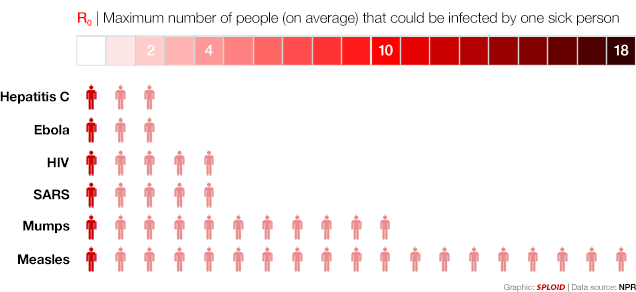
With cases in Texas and Spain raising alarms about potential Ebola outbreaks in the US and Europe, it’s worth remembering, as the above chart illustrates, how slowly the virus spreads relative to other contagious diseases, and therefore how unlikely a major outbreak is in a developed country with proper sanitation and extensive healthcare infrastructure. It’s also worth remembering that the situation in West Africa is, and will remain, far worse. In an interview with Julia Belluz, epidemiologist Lina Moses outlines why the number of Ebola cases there is probably underreported:

The cultural and socioeconomic setting have an impact on case counts. So do basic emotions. The chain of events for reporting cases has been interrupted by the fact that some Ebola victims go underground for fear of being taken away from their families. Imagine being the mother of a son who you think might have Ebola. You know your child might die, and you know that if you call authorities, he will most certainly die alone, far away from you, in an isolation ward where you can’t console him. Do you call that hot-line? “Communities are so afraid, so distrustful about what’s going on,” says Moses. “It’s hell. It’s devastating to the social fabric in communities, in towns and villages.”

This is compounded by denial about the disease. Though denial is less prevalent now, more than six months into the epidemic, for a period at the beginning — when Ebola emerged for the first time ever in West Africa — people just didn’t believe it was real.

Danny Vinik relays the scientific community’s worst fears:

[T]here’s a long-term concern, too, that Ebola will become endemic to West Africameaning it will be there forever with small outbreaks occurring frequently.

In September, the World Health Organization’s Ebola Response Team warned of such an outcome in the New England Journal of Medicine. “[W]e must therefore face the possibility that EVD (Ebola virus disease) will become endemic among the human population of West Africa, a prospect that has never previously been contemplated,” they wrote.

Many other health experts share their concerns. “That’s our biggest fearthat it will be endemic,” said Howard Markel, a medical historian at the University of Michigan. “That’s where you worry there will be little pockets of Ebola, whether in human beings or in bats or other animals, and that we’ll have little outbreaks or big outbreaks for years to come.”

Turning to the US, Laurie Garrett reiterates the need for a quick diagnostic test:

Such an assay would help quell the rising panic in the United States, prevent passage of laws that could be viewed as discriminatory against people of color and/or Africans, and provide nearly instantaneous hospital diagnosis. Rather than rattling the nerves of hundreds of Dallas parents afraid to return their children to classrooms visited by Duncan’s youngest contacts, public health officials could simply test the Duncan clan and assure the public that none are carrying Ebola.

Several tests are now in development, but the wheels of discovery, clinical testing, and federal approval require greasing. A point-of-care assay must be at the absolute top of the Ebola-control innovation agenda. Although compassion might dictate that the search for a treatment is of greater importance, the fact is that no tool — short of a 100 percent effective vaccine — can slow the spread of Ebola quite so dramatically. And though a vaccine may eventually emerge from the R&D process sometime in 2015, a rapid diagnostic could be in commercial production before Thanksgiving (with proper greasing of financial and regulatory wheels). Finger-prick tests for Ebola are in development now at Senova, a company in Weimar, Germany; at a small Colorado company called Corgenix; and at California-based Theranos.

And Jesse Singal touches on the challenges of fighting Ebola panic in the digital age:

Experts have actually known for a while that Ebola was going to show up in the U.S. Ever since the scope of the West African epidemic became clear, said [Columbia University epidemiologist Abdulrahman] El Sayed, American public-health officials have been hammering home the same message: “’There is gonna be an Ebola case here, but there’s probably not going to be a transmission.’” But before experts can effectively explain this, they first have to face down the biggest, scariest images of the disease lodged in the public’s imagination thanks to both fictionalized accounts and sensationalistic news coverage. “You have to address everybody’s worst fears before you can have a logical conversation about it,” said El-Sayed.

Update from a computational biologist:

That chart giving R0 values for various pathogens is kind of misleading, since it leaves off an important virus that most people are familiar with: influenza. R0 for influenza varies from around 1.0 to 2.4, i.e. right around the value for this Ebola outbreak. That doesn’t stop influenza from spreading everywhere pretty much every year and causing pandemics when novel strains appear. Ebola outbreaks can be brought under control because its transmission can be interrupted easily, not because its R0 is low.

Ebola Gets Partisan

And right-wing radio takes paranoia to new depths:

Boer Deng, a sane person, praises US officials for preempting panic:

As of now at least, hysteria has not gripped the local public en masse. It can be tricky to convey gravity but avoid undue alarm in a health situation, but [Jack] Herrmann [of the National Association of County and City Health Officials] says much has been learned from dealing with the H1N1 flu outbreak. The key is to be “proactive in keeping people informed and telling them what you know, what you don’t know, and if you don’t know something, when you will,” he says.

A number of questions remain unanswered by the CDC, like what measures will be taken with travelers from West Africa going forward, and what further international efforts this will spur. But so far, the news from Texas is heartening: Whether or not the best approach was taken when initially handling the current Ebola case, the CDC’s “Keep Calm and Carry On” public health message has generally been heeded.

But Matthew Continetti thinks Americans should be afraid:

I … believe it is entirely rational to fear the possibility of a major Ebola outbreak, of a threat to the president and his family, of jihadists crossing the border, of a large-scale European or Asian war, of nuclear proliferation, of terrorists detonating a weapon of mass destruction. These dangers are real, and pressing, and though the probability of their occurrence is not high, it is amplified by the staggering incompetence and failure and misplaced priorities of the U.S. government. It is not Ebola I am afraid of. It is our government’s ability to deal with Ebola.

Margaret Hartmann notes other figures on the right who share this view:

Over the past few days, Republican lawmakers have been sharing some terrifying thoughts about the Obama administration’s Ebola response. “It’s a big mistake to downplay and act as if ‘oh, this is not a big deal, we can control all this,'” Senator Rand Paul warned. “This could get beyond our control.” … Republican senator Jerry Moran is one of several Republicans calling on the president to appoint an Ebola czar. He told BuzzFeed that even lawmakers are having a hard time figuring out who to talk to. “I don’t think there is a person in charge,” he said. “And I don’t think there is a plan internationally to bring the folks together to combat this.”

And Brian Powell catches Laura Ingraham peddling bad science:

After news outlets reported the discovery of an Ebola patient diagnosed in the United States, radio host and Fox News contributor Laura Ingraham hosted Dr. Elizabeth Vliet to inform listeners about the disease. Vliet used the platform to accuse President Obama of “underplaying the risk” of Ebola and suggested the disease could be transmitted through the air, an opinion that runs contrary to widespread medical opinion. To make her case, Vliet cited a debunked study from 2012 that studied transmission of the virus between pigs and monkeys.

Charles Pierce is alarmed by this sort of irresponsible journalism:

What we had in the AIDS epidemic was political opportunism married to what became obvious ignorance. What we are seeing now, promulgated by a conservative bubble machine that has built a self-sustaining universe around itself, is political opportunism married to an active campaign of disinformation.

Josh Marshall chimes in:

There’s a new meme emerging on the right which I’ve noticed in the last 24 hours. It goes like this: The ‘government’ or President Obama promised Ebola wouldn’t or couldn’t get to the United States. But now it’s here. So people, the argument goes, are rightly worried that the ‘government’ is lying to them or isn’t telling them the whole story. In other words, when you see the next ignoramus on Fox News jonesing on about how he’s not going to be a patsy for the virology elite, that’s the story.

I’ve now heard it on Fox, in National Review and a few other outlets. It’s hard for me to tell whether this is simply lying about what various officials including the President have said, ignorance of how contagious diseases (and particularly Ebola) work or just a blase willingness to fan hysteria. Unfortunately it seems like all three.

The Crime Of Ebola Transmission

Allahpundit considers Liberia’s plans to prosecute Thomas Eric Duncan:

Should Duncan be prosecuted? Ace worries that if you throw jail time into the mix, Liberians who fear they might have Ebola will panic and become more determined to conceal their symptoms, putting the people around them at risk. I can understand that as a matter of Liberian domestic policy; you want people to feel as comfortable as possible in reporting their symptoms so that you can treat them (and isolate them) ASAP. But you also don’t want them getting on planes, and the prospect of jail time if they decide to fly when they fear they might be infected would deter that. No? What am I missing here?

Oh, by the way, Duncan did tell the staff at the hospital in Dallas that he’d just come from Liberia when he first showed up sick to the ER last week. They sent him home with antibiotics.

Scott Neuman points out that Duncan may have actually been less than forthcoming:

Officials at Texas Health Presbyterian Hospital now say Duncan wasn’t honest with them either. When asked if he had been around anyone who had been ill, Duncan told them he had not.

Adam Chandler puts the prosecution in context:

As West African countries battle the largest Ebola outbreak on record, the notion of pursing criminal charges against a man who claims he wasn’t exposed to the virus may come off as wasteful, if not extreme. Given that thousands of people continue to move between the borders of West African countries, Liberia’s intention to prosecute Duncan for traveling to the United States with Ebola—unwittingly or not—also rings a little hypocritical.

But as Jens David Ohlin of Cornell University Law School contends, the prosecution of Duncan may have less to do with what he did (or did not) do and more with the precedent his case could set.

“Liberia is probably anxious about maintaining travel connections to the United States and other countries,” Ohlin told me. “And countries have probably felt comfortable keeping air connections with Liberia so long as protocols for screening passengers are in place.” He added that were Liberia to ignore this potential breach of its screening process, it would ultimately convey that “these protocols are worthless.”

The War On Ebola

Clint Hinote finds it “striking… how similar this struggle [against Ebola] is to counterinsurgency operations”:

Counterinsurgencies are long-term struggles. Systemic problems usually drive the creation of the insurgency in the first place, and until these underlying issues are addressed, the insurgency will simmer, sometimes mutating and reappearing later. The best counterinsurgency efforts address the root causes of the insurgency over time.

This fight against Ebola must also be a long-term effort, especially among the health care institutions within the affected countries. These have been decimated, and they must be rebuilt with the expertise and capacity to provide an acceptable level of care for the population. If this does not happen, the disease will return. There is a real fear among health experts that the disease will become endemic, existing in perpetuity among humans, mutating and spreading within the vulnerable population. If this tragic development is to be prevented, a long-term commitment to building health care infrastructure and institutions will be needed.

Rachel Kleinfeld argues that “ISIS and Ebola have the same root cause: failed governance”:

Liberia and Sierra Leone have been heralded in the West as success stories, countries that rebounded from devastating civil wars to rebuild their states. Liberia, particularly, has been showered with World Bank and other donor money thanks to its widely trusted president, Ellen Johnson Sirleaf. But under her, and in Sierra Leone, lies a broadly rotten apparatus of cronyism and patronage that has resulted in favoritism in public services and general government incapacity. Locals in remote villages see this, even if Western donors at Davos and the Clinton Global Initiative do not. And therein lies the formers’ distrust for their governments, which can now be measured in the spread of disease.

The West similarly thought it could buy and counsel a functional Iraqi military. Billions of U.S. dollars and years of our military troops’ lives were poured into twinning, training, providing equipment and mentoring Iraqi troops. But no amount of equipment and tactical training could build a military with the esprit de corps to fight when the country’s leadership marginalizes and betrays an entire portion of the population. The individuals could be well-trained, but the institution itself was rotten.

However, Adam Taylor suggests that the Texas Ebola case might help African patients:

Americans already seem well aware that helping other nations with their health problems can help Americans — a 2013 Kaiser Family Foundation poll found that 68 percent of respondents felt that spending money on improving health care in developing countries would help protect Americans from infectious diseases such as SARS, bird flu and swine flu.

However, it was only two weeks ago that the United States announced it would be sending 3,000 troops to West Africa to help fight Ebola. It was a big move, expected to cost $750 million in the next four months, but it came only after criticism from African leaders at what they saw was a delay in the mobilization of the United States’ considerable resources. Remember, for countries such as Liberia, Sierra Leone and Guinea, this Ebola outbreak has been a problem since December, and they have struggled to contain it on their own.


Ebola Makes It To America, Ctd

Texas Hospital Patient Confirmed As First Case Of Ebola Virus Diagnosed In US

Abby Phillip covers how health officials are “tracing” those who’ve been in contact with America’s first Ebola patient, who has been identified as Thomas Eric Duncan:

“We are working from a list of about 100 potential or possible contacts and will soon have an official contact tracing number that will be lower,” Texas Department of State Health Services spokeswoman Carrie Williams said in a statement. “Out of an abundance of caution, we’re starting with this very wide net, including people who have had even brief encounters with the patient or the patient’s home. The number will drop as we focus in on those whose contact may represent a potential risk of infection.”​

A second individual, who Duncan had contact with, is currently under observation. Amanda Taub enumerates the resources the US has to prevent Ebola from doing the same damage it’s done in parts of Africa:

[T]he health care systems in the three worst-affected countries are so poor that basic equipment, including even latex gloves, is often not available.

Daniel Bausch, an associate professor at the Tulane University School of Public Health and Tropical Medicine who is working on the Ebola response, told Vox that “if you’re in a hospital in Sierra Leone or Guinea, it might not be unusual to say, ‘I need gloves to examine this patient,’ and have someone tell you, ‘We don’t have gloves in the hospital today,’ or ‘We’re out of clean needles’ — all the sorts of things you need to protect against Ebola.”

In the United States, this just isn’t a problem. We have plenty of gloves, needles, PPEs, and other equipment. And if a hospital ran out and needed more, our reliable transportation infrastructure would make it possible to replenish the necessary supplies quickly.

By contrast, Benjamin Wallace-Wells focuses on the medical slip-up that delayed the diagnosis of Duncan:

During that first visit, an emergency nurse asked him whether he had traveled anywhere recently, a question meant to screen for Ebola exposure, and Duncan replied that he had just come from Liberia. “Regretfully that information was not fully communicated” to the rest of the medical team, the hospital chief executive said today, and Duncan was sent home, with a diagnosis of a “low-grade fever from a viral infection.” By the end of the weekend, he was back.

You have to feel for that nurse, and that medical team. Dallas officials are now monitoring five children for Ebola exposure who “possibly had contact with [Duncan] over the weekend.” If the nurse had successfully communicated the news about Duncan’s recent trip from Liberia to the rest of the medical team, he surely would have been in the hospital through the weekend, not at home near those children or anyone else.

Jonathan Cohn analyzes those diagnostic missteps, calling them “a mystery”:

The big question is why he was sent home in the first place.

Weeks ago, the Centers for Disease Control distributed guidelines to health care providers and hospitals, including instructions for early detection of the disease. Under those guidelines, medical professionals should suspect and test for Ebola when patients who have been to affected countries show symptoms, such as a fever over 101.5 degrees Fahrenheit, vomiting, or muscle pain. At that point, under the guidelines, it’s up to the doctors whether to keep and isolate the patient, or to let the patient leave while under some kind of monitoring.

Laurie Garrett expects Ebola diagnoses to only get harder:

The window for stopping hospital spread of diseases like Ebola is going to close as soon as the flu season begins, when feverish patients are commonplace. Influenza has yet to slam America for the 2014-2015 season, and that is fortunate. Once ERs and doctors’ offices get swamped with influenza sufferers — feverish, achy, exhausted — spotting Ebola cases will be complex and perhaps impossible in the absence of a rapid diagnostic test.

Arthur Caplan argues that the fixation on patient privacy could allow Ebola to spread:

Why do we need to know how [America’s first Ebola patient] got to the hospital? Because Americans have no idea–none–about what to do if they have the symptoms of Ebola or suspect someone might. Flu season is here. Should everyone with flu-like symptoms in Dallas, Atlanta or other cities where Ebola patients have been cared for run to the E.R.? Isn’t it a good idea to get a flu shot so you lessen the chance of thinking you have Ebola. This is what the CDC needs to explain. If your family member comes here from a country with Ebola and gets very ill you should do what—call 911, call the police, call the CDC, call a taxi to the closest hospital, go to a particular hospital with an isolation unit, stay home and let someone come and get you, go alone or with help?

And Belluz searches for a parallel to the Texas case:

While the Texas patient is the first-ever diagnosed with Ebola in America, several travelers have brought similarly deadly viruses to the US in the past and didn’t give them to anyone.

There have been four cases of Lassa hemorrhagic fever, a viral infection common in West Africa, here. This isn’t surprising since Lassa infects up to 300,000 people in Africa each year, which makes it a lot more common than Ebola. Like Ebola, Lassa isn’t easily spread — only through contact body fluids — so, reassuringly, there were no secondary cases here.

We’ve also had one case of Marburg, another hemorrhagic fever, imported to the US in a traveler from Uganda. Again, the patient didn’t transmit the virus to anyone else.

Our complete Ebola coverage is here.

(Photo: A general view of Texas Health Presbyterian Hospital Dallas where a patient has been diagnosed with the Ebola virus on September 30, 2014 in Dallas, Texas. By Mike Stone/Getty Images)

Ebola Makes It To America, Ctd

Sara Stern-Nezer and Aliza Monroe-Wise insist that “even if you were on that September 19th flight from Liberia to Dallas and shook the hand of America’s ‘patient zero,’ your risk of transmission remains relatively small.” Julia Belluz looks at how fast Ebola spreads:

A mathematical epidemiologist who studies Ebola wrote in the Washington Post, “The good news is that Ebola has a lower reproductive rate than measles in the pre-vaccination days or the Spanish flu.” He found that each Ebola case produces between 1.3 and 1.8 secondary cases. That means an Ebola victim usually only infects about one other person. Compare that with measles, which creates 17 secondary cases.

If you do the math, that means a single case in the US could lead to one or two others, but since we have robust public health measures here, it probably won’t go further than that.

Jonathan Cohn doesn’t see how we could have prevented the Dallas case:

According to the CDC, the infected traveler to the U.S. had no symptoms when he arrived in the U.S. on Saturday, September 20. A temperature test at a U.S. airport wouldn’t have picked up anythingand that would have been true for at least another four days, because it wasn’t until Wednesday the 24th that he started to feel sick and run a fever.

Public health experts I consulted quickly on Tuesday thought that was entirely predictable, given that Ebola has a long asymptomatic period of up to 21 days. Short of putting all travelers from affected areas into quarantine for three weeks, they said, airport screening isn’t likely to do much. “The idea is misguided,” said Howard Markel, a professor of medicine and communicable diseases at the University of Michigan and author of When Germs Travel. “It would not have worked in the case of an asymptomatic person. Airport screeners look for obvious signs, such as high fever and other visible or measurable signs of illness.”

Rebecca Leber analyzes the CDC’s “textbook response to public health news that has the potential to incite mass panic”:

“Great uncertainty without guidance and support increases unhelpful behavior in a crisis,”  Dr. Barbara Reynolds, now director of public affairs at the CDC, wrote in a 2011 blog post. She notes that panic itself is a rare behavior. “From a psychological point of view, panic is best used to explain a behavior that is irrational or counter to a person’s survival.”

But Jesse Walker thinks it’s the press, rather than the public, that is most prone to panic:

Everyday citizens tend to keep their heads in situations like this. As I wrote half a decade ago, when the purported panic on the horizon involved swine flu, “It’s easy to find examples of public anxiety, with every hypochondriac in the country fretting that the cold his kid always catches this time of year was actually the killer flu. But panic? Where’s the evidence of that?” Going through a series of stories that were supposed to show flu hysteria, I was underwhelmed. … In Dallas right now, the chances that people will start stampeding in the streets is far, far smaller than the chances that scare-mongering coverage will make it harder to get good information.

Our complete Ebola coverage is here.

Ebola On The Move

Ebola cases

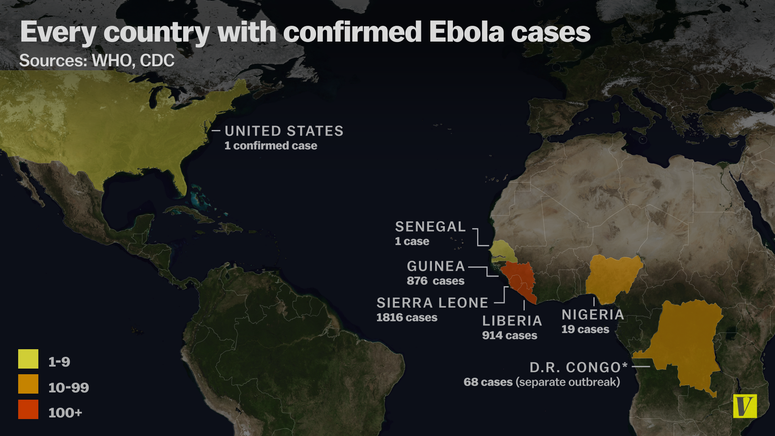
The disease poses a limited threat to America, but Michael Osterholm anticipates it spreading to other parts of Africa:

We know how the disease will likely spread in the months ahead.

Each year, thousands of young West African men and boys are part of a migratory work population not too dissimilar from U.S. migrant farm workers. Crop-friendly rains wash over West Africa from May to October, forming the growing season. These young men typically help with harvesting in their home villages from August to early October, but afterward head off for temporary jobs in artisanal gold mines in Burkina Faso, Mali, Niger and Ghana; cocoa nut and palm oil plantations in Ghana and Cote d’Ivoire; palm date harvesting and fishing in Mauritania and Senegal; and illicit charcoal production in Senegal, Mali, Cote d’Ivoire, Ghana, Burkina Faso and Niger.

This migration is about to begin, even for young men whose villages have been recently hit by [Ebola virus disease (EVD)]. These workers find daily laborer jobs at $5 per day, half of which they remit to their families back home. Like their ancestors before them, they use little-known routes and layovers through forests to avoid frontier checkpoints. They usually have ECOWAS ID cards, providing free passage to all the member states of the Economic Community of West Africa States. It takes one to three days to travel from the EVD-affected countries to these work destinations. There is no need for Ebola to hop a ride on an airplane to move across Africa: It can travel by foot.

He wants massive international mobilization against Ebola:

The first critical mistake public-health officials often make amid such outbreaks is failing to consider another black-swan scenario. At the moment, they are focused only on meeting the vaccine need in the three affected countries. If this virus makes it to the slums of other cities, the epidemic to date will just be an opening chapter. Africa contains more than a billion people, and is growing faster than anywhere else in the world. If world leaders don’t make it a priority now to secure up to 500 million doses of an effective Ebola virus vaccine, we may live to regret our inaction. It’s that serious.

Securing 500 million doses of an effective Ebola virus vaccine is going to require a partnership between government and vaccine manufacturers that puts it on the same footing as our response to an emerging global influenza pandemic. This will require mobilizing people and resources on a massive scale—it has to be the international community’s top priority.

Follow all our Ebola coverage here.

(Map from Julia Belluz)

Ebola Makes It To America

Ebola Quiz

As we noted yesterday, a man who flew from Liberia to Dallas has been diagnosed with Ebola. Kent Sepkowitz examines the precautions we’d taken:

The Dallas case is breaking some of our ironclad assumptions. The CDC has a well-considered algorithm that places those returning from the three endemic West Africa countries—Sierra Leone, Guinea, and Liberia—into a measure of extra vigilance if and only if the person has had exposure to a known case of Ebola. Per the press conference, the Dallas case had no such exposure. He was not a health-care worker treating patients, nor was he from a family battling active disease. Of course, more facts may emerge that contradict today’s story—but today’s facts, if they hold up, mean that yesterday’s assumptions are no longer correct. Liberia may indeed be enough of a hotbed of Ebola that anyone arriving from the area will need to be considered for extra vigilance.

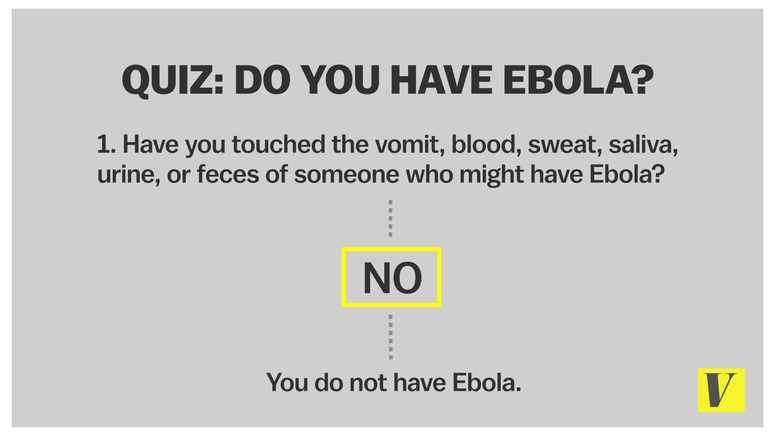
Ezra recommends calming down and taking the quiz seen above:

On average, Guinea spends $32 on health care per-person, per-year. Liberia spends $65. Nigeria spends $94. The United States spends $8,895.

That money buys trained health workers, disease investigators, isolation wards, fever screening, protective gear, and much more. That money buys advanced hospitals all across the country, and labs that can quickly test for the disease, and the ability to do contact tracing and follow-up visits on a tremendous scale. That money also buys public-health officials with long experience combatting infectious diseases — both here and in other countries.

Susannah Locke imagines best and worst case scenarios:

The best-case scenario for the United States is that a patient traveling from West Africa realizes that they might possibly have Ebola as soon as they start feeling sick. Everyone else makes sure not to come in contact with this person’s bodily fluids. And the outbreak ends with just one patient. Hopefully, that’s how this Texas case will end.

The worst-case scenario, meanwhile, is that an Ebola patient comes to America, is ill for days, and comes in contact with a lot of people before anyone realizes that something unusual is going on. That would be much worse. But even in that case, it’s still much less likely that Ebola will get farther one city or town. “I don’t think we’ll have a serious public health threat in any of the developed countries,” Osterholm told mein July. The real problems are for countries like Guinea, Liberia, and Sierra Leone that don’t have the resources to contain the outbreak quickly.

Margaret Hartmann explains the next steps in our response:

The challenge now is to find everyone the Dallas patient came into contact with and begin monitoring them as well. The “contact tracing” process is how Nigeria managed to eliminate its Ebola outbreak. After identifying one Ebola patient who arrived at the Lagos airport in July, Nigerian officials were able to find 72 people he might have infected. By tracing their contact, they found a pool of 894 people potentially infected with Ebola. Eight people died, including the first patient, but the rest have been cleared.

CDC director Thomas Frieden, like the White House, has urged Americans to stay calm. Abby Haglage summarizes his statement. An important part:

Asked how many people the patient came in contact with, Frieden estimated fewer than five. “Handful is the right characterization,” he said. “We know there were family members who came in contact, and there may be other community members, but we will cast the net wide.”

And Olga Khazan cracks open the history books:

At arrival gates, border protection officers keep their eyes peeled for passengers who show signs of fever, sweating, or vomiting. They also try to confiscate any monkey meat or other bushmeat that passengers might have in their luggage.

In some ways, our approach to keeping scary diseases outside of our borders hasn’t changed much since the Middle Ages. As Defense One‘s Patrick Tuckerexplained, when the Black Death was mowing down Europeans, the Doge of Venice instructed so-called “Guardians of Health” to board arriving ships and check the crew for inflamed lymph nodes. Those considered suspect weren’t permitted to dock for 40 days—quaranta giorni. Ever since, “quarantine” has been the way to keep newer plagues from spreading once they reach our shores.

Update from a reader:

You lauded the role HealthMap played in breaking the news of Ebola outbreak before WHO. From Kalev Leetaru’s article you highlighted: “Much of the coverage of HealthMap’s success has emphasized that its early warning came from using massive computing power to sift out early indicators from millions of social media posts and other informal media.” Unfortunately, that is not quite accurate. HealthMap is not quite a “success” here, as you can see from this Foreign Policy story.

Going Viral

Kalev Leetaru considers the role that online data – even blogs – could have in halting diseases like Ebola:

It turns out that monitoring the spread of Ebola can teach us a lot about what we missed — and how data mining, translation, and the non-Western world can help to provide better early warning tools.

Earlier this month, Harvard’s HealthMap service made world headlines for monitoring early mentions of the current Ebola outbreak on March 14, 2014, “nine days before the World Health Organization formally announced the epidemic,” and issuing its first alert on March 19.  Much of the coverage of HealthMap’s success has emphasized that its early warning came from using massive computing power to sift out early indicators from millions of social media posts and other informal media.

As one blog put it: “So how did a computer algorithm pick up on the start of the outbreak before the WHO? As it turns out, some of the first health care workers to see Ebola in Guinea regularly blog about their work. As they began to write about treating patients with Ebola-like symptoms, a few people on social media mentioned the blog posts. And it didn’t take long for HealthMap to detect these mentions.”

The unfortunate flip side:

But there was some great news today:

Update: Some not-so-great breaking news:

Meanwhile, Maryam Zarnegar Deloffre assesses the latest US role in combatting the Ebola epidemic – boots on the ground:

Last week, President Obama announced the deployment of the U.S. Africa Command (AFRICOM), which will set up a joint force command in Liberia to coordinate the activity of 3,000 U.S. forces; expedite the transportation of equipment and supplies; and train an estimated 500 health-care workers per week. …

The AFRICOM and UNMEER missions are not your typical militarized humanitarian intervention. Defining the Ebola crisis as a human security issue is a game changer. There is no conflict in the West African countries most heavily affected by Ebola (at least not yet), thus the security threat highlighted by the UNSC is a threat to people and their humanity — the right to life with dignity. Humanity is a universal principle, one that transcends and orders all the other humanitarian principles, one that NGOs, states and international organizations can all get behind. Viewed through this lens, it is no wonder that NGOs, such as Doctors Without Borders, that typically refuse to work with national militaries are calling on militaries to provide logistical support to address the Ebola epidemic.

Ezra, in an interview with the director of the CDC, underscores the connection between West Africa and the US:

Ezra Klein: One thing that has been striking here is the degree to which weak health-care systems in poor countries can be a real threat to rich countries. How should we think about that?

Thomas Frieden: Yes. We are all at risk. But it’s not health systems so much as public-health systems. Do you have a system in place to find when there’s a cluster of unexpected illness, whether it’s Ebola or MERS or SARS or the next HIV? Do you have a system in place to get the lab tests done? Do you have trained disease investigators?

This is not going to come by creating some great global entity to do all this for us. We need to build the capacity of countries to find, stop, and prevent global health crises. We are all vulnerable to the weakest link in the chain. And it is not that expensive to strengthen those links. But it does mean you need to train public-health workers. It does mean you need a lab-reporting network. It means you have more than a public-health system you pull out in case of emergencies. It means you have one you’re using every day to fight disease, and so you can scale it up in the event of an emergency.

Follow all our Ebola coverage here.

How You Can Die From Ebola Without Getting It

weekly_ebola_cases_SL.0

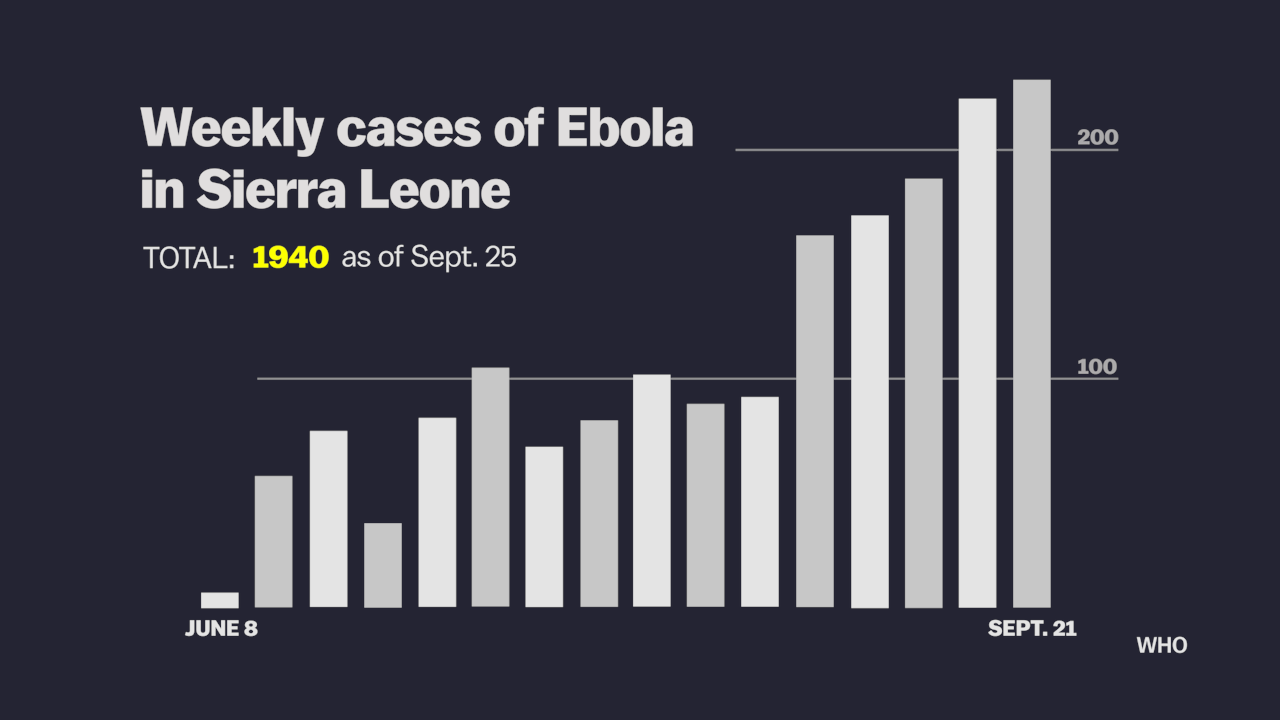
Julia Belluz explains that Sierra Leone is “imposing mandatory lockdowns on its citizens.” She provides the above chart showing the extent of the devastation:

The districts where Ebola is believed to be moving fast — Port Loko, Bombali, Moyamba — are now isolated. People won’t be able to leave their homes or go to school or work. During these periods, government and public-health officials will go door to door, educating people about Ebola and trying to identify patients who should be brought to containment facilities. Officials in Sierra Leone are worried that many Ebola victims are either going underground or simply unable to access care. And the death toll continues to surge — with nearly 600 estimated Ebola deaths in Sierra Leone this year.

Adam Taylor sees “numerous signs that pregnant women in Liberia, Sierra Leone and Guinea could be dying due to Ebola without ever getting the disease”:

Maternity hospitals are fearful of taking women in due to the risk of catching Ebola from a sick patient. That fear is understandable. Hundreds of health-care workers have been infected with Ebola recently, and many were infected by the patients they treat.

Bruce Aylward, assistant director-general for polio and emergencies at the World Health Organization, said that at first, most health workers who died were people working in “poorly run Ebola treatment centers.” However, as the disease spread, it began to affect the broader health community. “Now, if you look at [health-care workers infected with Ebola], they’re somebody who is delivering a baby in a clinic that had nothing to do with Ebola,” Aylward explained. The shift has affected both local and foreign doctors: Rick Sacra, one of the American doctors who contracted Ebola, was treating pregnant women in Liberia when he became infected (he has since made a full recovery).

Worse still, the fear of Ebola infection at medical facilities cuts both ways. Many pregnant women who need treatment are too scared to head to a health center, fearing a visit to a medical facility will actually increase their chance of catching Ebola. In countries where maternal mortality rates are so high than almost one out of every hundred women die, such a lack of treatment can have a deadly impact.

We featured one of those women here.