The Ebola Outbreak Gets Worse

The World Health Organization (WHO) has upgraded the severity of the crisis:

The World Health Organization has declared the Ebola outbreak in West Africa a public health emergency of international concern on Friday. The organization is encouraging global coordination to prevent the spread of both the disease and of “fear and misinformation,” according to Keiji Fukuda, the organization’s Assistant Director-General. “This is an infectious disease that can be retained,” he said, noting the region’s poor conditions and need for help. “It’s not a mysterious disease.”

Susannah Locke asks, “So what does that actually mean?”:

Technically, it means that the WHO committee thinks the outbreak is a public health risk to other nations and that the outbreak might be in need of an international response. Those are the general criteria for the PHEIC category. This does not, however, mean WHO will go in and fix everything in the Ebola fight. The declaration itself comes with recommended things that various nations should do, but it doesn’t automatically come with funding, gloves, aid workers, or any of the other resources that the exceptionally poor nations with Ebola need to actually do those things.

Abby Haglage makes clear the scale of the problem:

It’s already an unprecedented outbreak, CDC Director Dr. Tom Frieden says, and the number of infected and killed by Ebola will likely soon outnumber all other Ebola outbreaks in the past 32 years combined. According to the CDC, there have already been more than 1,700 suspected and confirmed cases of Ebola in West Africa, and more than 900 deaths—numbers that Frieden later called “too foggy” to be definitive. Ken Isaacs, the vice president of Program and Government Relations for Samaritan’s Purse, painted an even bleaker picture. According to the World Health Organization, West Africa has counted 1,711 diagnoses and 932 deaths, already, which could represent only a small fraction of the true number. “We believe that these numbers represent just 25 to 50 percent of what is happening,” said Isaacs.

On a more cheerful note, Ronald Bailey predicts a future where such outbreaks have been all but eliminated:

Advances in fields like genomics, proteomics, reverse vaccinology, synthetic biotechnology, and bioinformatics are exponentially improving the knowledge of researchers about how pathogens and the human immune system interact. All of the tools involved with identifying pathogens and producing treatments like monoclonal antibodies and vaccines will continue to fall in price and become more ubiquitous. Thus will compounding therapies become ever faster and cheaper. Long, complicated, and expensive clinical trials overseen by hypercautious regulators will no longer be required for validating the safety and effectiveness of targeted, rationally designed therapies. A couple of decades hence, infectious diseases will still strike, but any patient with a fever will be tested, her infection immediately identified, and a personalized treatment regimen crafted just for her will be administered. We may reach a time when epidemics and pandemics are ancient history.
A Cure For Ebola? Ctd

Brian Till objects to the disparity between the treatment American Ebola patients Nancy Writebol and Kent Brantly are receiving, including an experimental antibody therapy called ZMapp, and the little to no care afforded African patients:

The inequality in care couldn’t be starker. When a doctor and aid worker from the United States are stricken with a horrific disease, an erstwhile unknown cure is sent from freezers at the National Institutes of Health in suburban Washington, D.C., to a hospital on the other side of the world, and a Gulfstream jet outfitted for medevac is arranged to deliver them to one of the world’s premier medical centers. But when two Liberian nurses working at the same hospital are stricken with the same disease, they are treated with the standard of care that other affected Africansthose lucky enough to receive any medical attention at allhave been afforded for the past seven months: saline infusions and electrolytes to keep them hydrated. …

The Obama administration has not said whether it will allow ZMapp to go into production. Mapp Biopharmaceuticals published a statement to their website late Monday stating that the company is working “with appropriate government agencies to increase production as quickly as possible.” (An executive at BioProcessing, a Kentucky firm that produces at least one component of ZMapp, told an industry publication last August that his company can produce the proteins for ZMapp in two weeks.)

A TPM reader with a background in bioethics speculates about why the experimental drug was given to these two aid workers, and no, it’s probably not because they’re white:

It’s hard to overstate how unusual it is for a drug at this stage of development to be given to humans.

This CNN piece suggests that they’ve only tried it on eight macaques so far. That’s a small number; they’d normally do significantly more testing in primates (or some other good animal model) before moving on to humans. Then when they did move to humans, they’d begin by testing for safety, then do various complicated further tests on larger numbers of people, and only then, if it had proved to be safe and effective, would they be able to apply for FDA approval.

This means, first, that this probably wouldn’t have been considered a “treatment” yet, just a promising lead. But second: trying a drug at this stage on humans has serious ethical risks. You’d want to be really, really sure that the people in question had given informed consent, and that that informed consent included their being absolutely clear that this drug not only might not work, but that it might actually be harmful to them. You’d want to be sure that they understood what it means for a drug to be at this preliminary stage of testing, and that they fully appreciated the fact that they were taking a huge gamble. … I think that this (along with the fact that the drug seems to require careful handling of the sort that would best be provided in a serious hospital, and the fact that there seems to have been only a limited amount of the drug available) would argue strongly in favor of trying the drug first on doctors, and specifically doctors who understand how much of the normal testing process was being bypassed, and what that meant.

Julia Belluz deflates the ZMapp hype, pointing out that just because the two Americans who received the drug appear to be doing well so far, that doesn’t prove anything about its efficacy:

[T]his drug has never undergone testing in people, only monkeys. The data on the efficacy of ZMapp in monkeys has never even been published. Studies on similar drugs are not entirely confidence inducing, either. In this study, two of the four monkeys given monoclonal antibodies 48 hours after exposure to Ebola survived. In this second study, the animals had a 43 percent survival rate when given the drug cocktail after the onset of symptoms. So even though the treatment of monoclonal antibodies decreased the mortality rate — if given close to exposure of the illness —  scientists haven’t moved past these tiny animal studies to testing in actual people.

Mapp Biopharmaceuticals is also just one of some 25 labs in seven countries working on these antibody cocktails for Ebola, and none of them have entered a phase one trial in humans, according to the journal Science. For this reason Dr. Martin Hirsch, a Harvard virologist, told Vox, “It’s too premature to say that the patients being treated miraculously improved.”

Olga Khazan explains why scientists are looking for an ebola treatment rather than a vaccine:

Vaccines don’t work that well in fast-moving epidemics. There are a few things you can do with a vaccine once an outbreak starts. One is immunizing healthcare workers and the families of infected patients. Sometimes doctors try “ring vaccination,” or targeting residents of villages on the perimeter of the outbreak in an attempt to isolate and quash it.

But most vaccines take a few weeks to provide immunity, and even then, they don’t always control the disease’s spread. Donald Allegra, chair of infection control at Newton Medical Center in New Jersey, remembers trying to halt the advance of measles in a Cambodian refugee camp in the 1970s. “We vaccinated 10,000 kids, but didn’t have an effect on the outbreak,” he said. “Vaccines and acute outbreaks don’t work very well together.”

Why Is This Ebola Outbreak Different From All The Other Ones? Ctd

Jason Koebler surveys the ongoing chaos as overwhelmed health workers struggle to contain the ebola outbreak:

“Every report I’m getting from the ground has health workers in a state of fear, and they’re feeling a siege from populations who despise and loathe them,” said Laurie Garrett, a senior fellow for global health at the Council on Foreign Relations who won a Pulitzer Prize for her on-the-ground reporting on the ebola outbreak in Zaire in 1996, on a conference call this morning. “They’re saying ‘we are terrified, we are exhausted, we want to leave, can someone take over?’” … Problem is, there aren’t many people who can take over. Already, more than 60 healthcare workers have died from the disease, and the countries’ governments haven’t been very successful at shepherding their people—who have never seen the disease before, often don’t speak the same language as relief workers, and don’t fully grasp what’s going on—to treatment facilities.

That’s why you have things like riots outside of health care clinics and patients making escapes from ebola quarantine centers. Healthcare workers have been called “cannibals” by protesters, and Garrett said that workers she’s talked to have been accused of cutting patient’s arms off and selling them on the black market. In other words, the situation is fairly out of control, and it doesn’t look to be getting better anytime soon.

Debora MacKenzie, Philippa Skett and Clare Wilson offer their take on why this epidemic has been so severe:

The overriding factor could be urbanisation.

In the past, village outbreaks remained small, unless people went to hospitals. “Population size and high mobility make it hard to do contact tracing,” says Peter Walsh at the University of Cambridge. Cities provide more chances to spread the virus, something that may also have enabled the spread of HIV. According to the African Development Bank, the continent has had the world’s highest urban growth rate for 20 years, and the proportion of Africans living in cities will rise from 36 per cent to 60 per cent by 2050.

Other factors also favour the virus. Justin Masumu of the National Institute for Biomedical Research in Kinshasa, Democratic Republic of the Congo, found that the increase in Ebola outbreaks since 1994 is associated with changes in forest ecosystems due to deforestation, which displaces bats. The part of Guinea where this outbreak started has been largely deforested. What’s more, wars in Liberia and Sierra Leone, and corruption in Guinea, have caused poverty, says [Tulane public health professor Daniel] Bausch, leading people to migrate for work and spread the virus further. It has also caused widespread mistrust of officials, even in public health – just when Africa’s cities need them most.

Julia Belluz outlines the worst-case scenario:

Even if the outbreak didn’t move across any other country border, intensification within the already affected areas is the most immediate health threat. “The worst-case scenario is that the disease will continue to bubble on, like a persistent bushfire, never quite doused out,” said Derek Gatherer, a Lancaster University bioinformatician who has studied the evolution of this Ebola outbreak. “It may start to approach endemic status in some of the worst affected regions. This would have very debilitating effects on the economies of the affected countries and West Africa in general.”

This dire situation could come about because of a “persistent failure of current efforts,” he added. “Previous successful eradications of Ebola outbreaks have been via swamping the areas with medical staff and essentially cutting the transmission chains. Doing that here is going to be very difficult and expensive. We have little option other than to pump in resources and engage with the problem using the tried-and-tested strategy—but on a scale previously unused.”

But Tara C. Smith emphasizes that the chances of an ebola outbreak in the US remain extremely low:

Ebola is a virus with no vaccine or cure. Any scientist who wants to work with the live virus needs to have biosafety level 4 facilities (the highest, most secure labs in existence, abbreviated BSL-4) available to them. We have a number of those here in the United States, and people are working with many of the Ebola types here. Have you heard of any Ebola outbreaks occurring here in the United States? Nope. These scientists are highly trained and very careful, just like people treating these Ebola patients and working out all the logistics of their arrival and transport.

Second, you might not know that we’ve already experienced patients coming into the United States with deadly hemorrhagic fever infections. We’ve had more than one case of imported Lassa fever, another African hemorrhagic fever virus with a fairly high fatality rate in humans (though not rising to the level of Ebola outbreaks). One occurred in Pennsylvania, another in New York just this past April, a previous one in New Jersey a decade ago. … How many secondary cases occurred from those importations? None. Like Ebola, Lassa is spread from human to human via contact with blood and other body fluids. It’s not readily transmissible or easily airborne, so the risk to others in U.S. hospitals (or on public transportation or other similar places) is quite low.

A Cure For Ebola?

Kent Brantly and Nancy Writebol, the American ebola patients now being treated in the isolation unit at Emory University Hospital, received an experimental treatment while still in Liberia that may have saved their lives. James Hamblin looks into just what this “top-secret serum” is:

[It’s] a monoclonal antibody. Administration of monoclonal antibodies is an increasingly common but time-tested approach to eradicating interlopers in the human body. In a basic monoclonal antibody paradigm, scientists infect an animal (in this case mice) with a disease, the mice mount an immune response (antibodies to fight the disease), and then the scientists harvest those antibodies and give them to infected humans. It’s an especially promising area in cancer treatment.

In this case, the proprietary blend of three monoclonal antibodies known as zMapp had never been tested in humans. It had previously been tested in eight monkeys with Ebola who survived—though all received treatment within 48 hours of being infected. A monkey treated outside of that exposure window did not survive. That means very little is known about the safety and effectiveness of this treatment—so little that outside of extreme circumstances like this, it would not be legal to use. [Sanjay] Gupta speculates that the FDA may have allowed it under the compassionate use exemption.

John Timmer has more on the treatment:

Fortunately, Mapp [Biopharmaceutical, the drug company working on zMapp,] has been publishing papers describing its progress on an Ebola treatment as it went along, so it’s possible to understand how the therapy was developed and how it operates.

Despite its fearsome behavior, Ebola is a fairly simple virus, with only seven genes. The gene that is essential for the virus to attach to human cells, called Ebola glycoprotein, has been identified previously. Antibodies that stick to this protein would be expected to block infection of new cells and target any virus circulating in the blood stream for destruction. The problem appears to be that an effective antibody response comes too late for the patients. (The virus also takes steps to tone down the immune response.) Mapp decided to do the immune system’s job for it by making antibodies that can then be injected into infected individuals to perform the same function. The challenges are making the right ones and making enough of them.

Shirley Li notes that zMapp isn’t the only experimental ebola treatment out there:

So why ZMapp, of all the experimental solutions to Ebola, of which there are many? Perhaps it comes down to Mapp’s recent successes: The NIH included Mapp in its $28 million five-year grant awarded to five companies to research Ebola further in March. A press release dated July 15, 2014 revealed that Defyrus, a private life sciences biodefense company based in Canada, had partnered with Mapp’s San Diego-based commercialization partner firm Leaf Biopharmaceutical Inc., to push the ZMapp serum’s clinical development. And just last week, the Defense Threat Reduction Agency announced it awarded a contract to Mapp to continue development of the serum.

Still, fighting Ebola means a multi-pronged attack. While Mapp’s method focuses on eradicating the disease after infection, the NIH has been working on preventing it in the first place. In the NIH’s case, it’s working to promote development of antibodies within the subject, instead of injecting them from an outside source that survived Ebola.

Steven Hoffman and Julia Belluz blame the lack of an effective ebola treatment until now on the way pharmaceutical companies prioritize their R&D:

Ebola will continue to move through Africa — this time, and again in the future — not only because of the viral reservoirs and broken health systems specific to the continent. There are much larger issues at play here. Namely, the global institutions we designed to promote health innovation, trade, and investment perpetuate its spread and prevent its resolution.

This shouldn’t be news. Most all of the money for research and development in health comes from the private sector. They naturally have a singular focus — making money — and they do that by selling patent-protected products to many people who can and are willing to pay very high monopoly prices. Not by developing medicines and vaccines for the world’s poorest people, like those suffering with Ebola. Right now, more money goes into fighting baldness and erectile dysfunction than hemorrhagic fevers like dengue or Ebola.

Follow all of our ebola coverage here. Update from a reader:

In the past I have been very critical of your coverage and thoughts on scientific matters; it’s incredibly frustrating to see published opinions littered with “rookie mistakes” from people who lack scientific training. As someone who is highly educated in these matters and has to compete for diminishing public funds, I have no tolerance for the long history of scientific inaccuracy from the media.

Having said that, your coverage of the Ebola epidemic has been pleasantly accurate and appropriate. I especially appreciate you highlighting Steven Hoffman and Julia Belluz’s article. They highlight a searing problem in our current research system; research priorities go towards profitable markets. The federal government is supposed to offset that, but thanks to the current batch of Republicans, worthwhile funding opportunities are going unfunded.

A colleague of my boss recently received a perfect score on a federal grant, but it did not get funded. There was nothing wrong with the grant scientifically, conceptually, or practically; they just ran out of money. The big problem is that funding opportunities aren’t growing while the scientific community is expanding. This has led us to the current ultra-competitive environment where there is no lack of sound ideas, projects, and causes that can directly be addressed and make real, lasting impacts on people’s lives.

But there’s no profit there, so Big Pharma researches ED, makes boner pills instead, and sleeps on beds of cash while poor people die of Ebola. “And the beat goes on…”

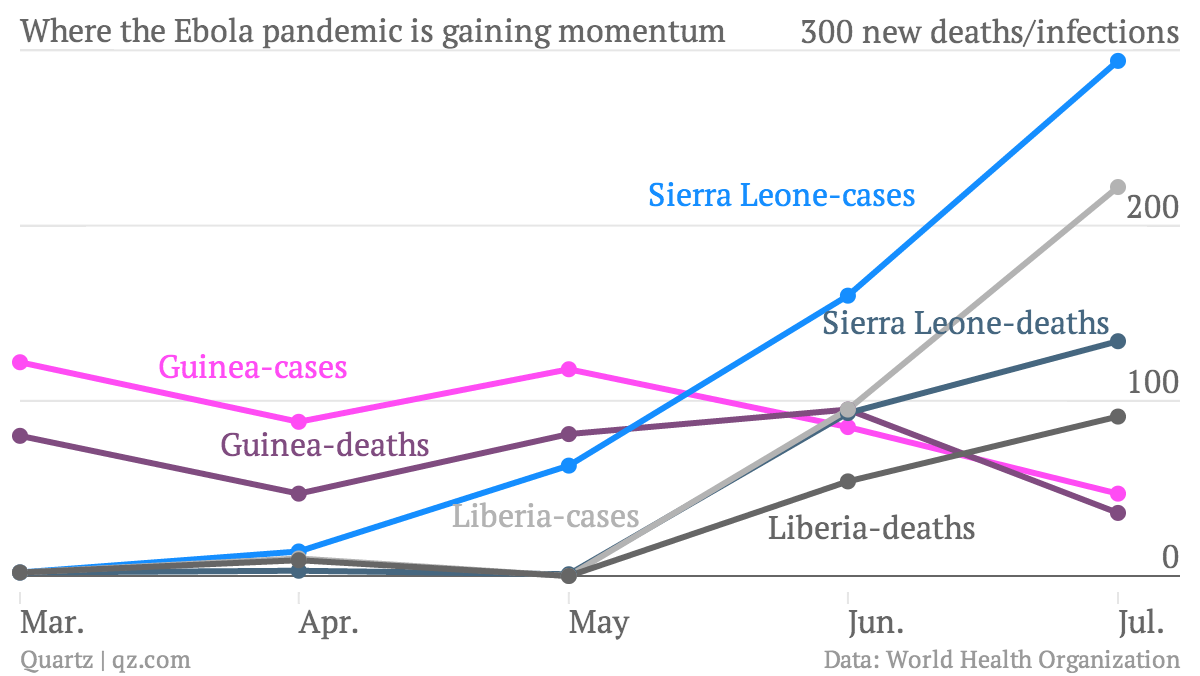
Why Is This Ebola Outbreak Different From All The Other Ones?

where-the-ebola-pandemic-is-gaining-momentum-guinea-cases-guinea-deaths-sierra-leone-cases-sierra-leone-deaths-liberia-cases-liberia-deaths_chartbuilder

Gwynn Guilford looks into it:

[A]s viral public health menaces go, Ebola should be easy to contain. Unlike airborne viruses like, say, swine flu, it’s not exactly sneaky. Ebola is spread only when infected bodily fluids come into contact with someone’s mucus membranes or open cuts. And it tends to broadcast the risk of infection pretty clearly; the symptoms include vomiting, diarrhea and, in some cases, hemorrhaging of mucus membranes. That made Ebola relatively easy to contain when it flared up in remote forests of central and eastern Africa, which are sparsely populated. But this new pandemic is a totally different story …

Why is that?

For one, Sierra Leone, Guinea and Liberia all have dreadful medical infrastructure. Sierra Leone has a single laboratory capable of Ebola testing. Earlier this week, Monrovia, Liberia’s capital, ran out of hospital space to quarantine Ebola patients. And that’s in its biggest city, where infrastructure is most robust. In other parts of Liberia, as well and in Guinea and Sierra Leone, hospitals simply aren’t available, according to data from Afrobarometer, a survey group.

Furthermore, Julia Belluz adds, a shortage of medical workers means many patients are not identified:

Ebola specialists believe one of the key reasons this outbreak has spread so far is because of the shortage of health-care personnel to deal with it: if you don’t have enough people on the ground doing the labor-intensive job of tracing the contacts of positive patients and ensuring they are identified before becoming ill too, each missed case is the new beginning of more human-to-human spread. Those missed cases are what worries Tarik Jasarevic, a World Health Organization worker on the ground in Guinea. He says that because of the geographic dispersal of the current outbreak—the demand for so many specialists in a relatively rare disease over several countries—mobilizing people and getting systems in place to care for everyone is problematic.

The doctors caring for ebola patients are also getting sick and dying:

Since the disease is transmitted through direct exposure to bodily fluids—from vomit to blood and sweat—health-care workers are advised to wear face masks, goggles, gowns and gloves while caring for patients. The trouble is, health workers in the developing-country context—especially those working in some of the poorest countries on earth, where the disease emerged this time—don’t always have access to this protective gear.

It’s important to note that they are also the ones who have died in this outbreak. Of the 60 deaths so far, none involved foreign workers (though two Americans are currently battling the virus, and one is a doctor). Foreign aid agencies such as Doctors Without Borders—which apply stringent precautions for all their health personnel—have never lost members of their teams to Ebola. So the problem this time is as much about size of the outbreak as it is about resources.

Patient Zero? Not So Fast

Dr. Kent Brantly, a US citizen who contracted ebola in Liberia, was evacuated to Emory University Hospital in Atlanta on Saturday for treatment in a special isolation unit. His colleague Nancy Writebol is also expected to arrive there this week. The usual suspects are busy fearmongering:

But Susannah Locke defuses fears:

Transmission of Ebola will be prevented using standard protocols, and health officials say that the two pose very little risk to the general public. Even if there were some terrible, unforeseen accident with one of these patients, Ebola wouldn’t be likely to spread very far. First, Ebola doesn’t jump from person to person through the air, but through close contact by touching bodily fluids such as sweat, vomit, or blood. The outbreak in West Africa is so severe for a number of key reasons, including a lack of resources, inadequate infection-control measures, and mistrust of health workers. The United States, by contrast, has far better public-health infrastructure. And that makes all the difference.

And Emory is taking every precaution to ensure that those fears aren’t realized:

[Dr. Bruce Ribner, the head of the unit,] went on to explain that Emory would be providing what he called “supportive care,” which consists of “carefully tracking a patient’s symptoms, vital signs and organ function and taking measures, such as blood transfusions and dialysis, to keep him or her as stable as possible.” “We just have to keep the patient alive long enough in order for the body to control this infection,” he explained. In the meantime, Brantly and Writebol will be separated from healthy people by a plate-glass window, and communication with non-medical personnel will mostly happen via intercom and telephone.

So, for now, it seems that Donald Trump and those who share his concerns don’t have much to worry about. At the very least, it seems that the people in charge of handling Ebola’s new American presence are being significantly more careful than the CDC was with that anthrax.

Kent Sepkowitz outlines the logic behind the evacuation:

[W]ith the move, the CDC, or whoever made the decision, is betting that high-tech American care using Ebola-inexperienced medical staff is better than not-so-high-tech care with remarkably experienced staff. This high-low discordance often is seen in tropical medicine. For example, many are taught in medical school that the best place to be treated for severe malaria is not the tertiary care medical palace on the American hill where a case is seen every year or two but the run-down clinic in the local country where malaria is as common as a stubbed toe and the staff knows every trick of the trade.

For Ebola treatment, though, I suspect the decision is correct: Writebol and Brantly are better off here. Much about the disease and its related conditions, called collectively the “viral hemorrhagic fevers,” is not well studied for the very reason a patient is being flown home. The resources simply are not available to articulate and record, to take extra blood, and to perform additional X-rays—all necessary to fully define any disease.

The Danger Of Ebola

Michael Specter puts the latest outbreak in perspective:

Ebola is truly deadly, but the many lurid headlines predicting a global pandemic miss a central point. In its epidemic reach, Ebola is often compared with H.I.V. But they are nothing alike. H.I.V. has killed at least thirty million people, mostly by spreading quietly, burrowing into the cells it infects, and then, at times, lurking for years before destroying the immune system of its host. Ebola’s incubation period is between two and twenty-one days long. The virus kills rapidly. There is nothing insidious about it.

Ebola won’t kill us all, but something else might. Like everything living on Earth, viruses must evolve to survive. That is why avian influenza has provoked so much anxiety; it has not yet mutated into an infection that can spread easily. Maybe it never will, but it could happen tomorrow. A pandemic is like an earthquake that we expect but cannot quite predict. As [Spillover author David] Quammen puts it, every emerging virus “is like a sweepstakes ticket, bought by the pathogen, for the prize of a new and more grandiose existence. It’s a long-shot chance to transcend the dead end. To go where it hasn’t gone and be what it hasn’t been. Sometimes the bettor wins big.”

He’s right, of course, and it is long past time to develop a system that can easily monitor that process. If we don’t, the next pandemic could make Ebola look weak.

Three experts in disease control combat bad reporting on Ebola:

The desire of the international media to attract viewers has led some careless journalists to focus almost exclusively on the fear-invoking mode of death from the disease. While it may increase their ratings, it lets the real culprits off the hook. Limited health infrastructure, insufficient numbers of trained health workers, too few fully equipped labs, and not enough education and preventative epidemiology are the sad realities that push this scourge on. The image of a victim coughing up blood creates stigma instead of engaging international viewers with the true and preventable human tragedy in these communities. It also distracts from one of the more disturbing facts associated with this outbreak, which is how wealthy communities feel content to live in a world where society spends more on eliminating wrinkles than with basic health infrastructure that could, among many other things, help quench an outbreak like the one we’re currently experience in West Africa.

Kliff covers attempts to create a vaccine:

[Professor Daniel] Bausch says that the obstacle to developing an Ebola vaccine isn’t the science; researchers have actually made really great strides in figuring out how to fight back against Ebola and the Marburg virus, a similar disease.

“We now have a couple of different vaccine platforms that have shown to be protective with non-human primates,” says Bausch, who has received awards for his work containing disease outbreaks in Uganda. He is currently stationed in Lima, Peru, as the director of the emerging infections department of Naval Medical Research Unit 6.

The problem, instead, is the economics of drug development. Pharmaceutical companies have little incentive to pour research and development dollars into curing a disease that surfaces sporadically in low-income, African countries. They aren’t likely to see a large pay-off at the end — and could stand to lose money.

The Worst Ebola Outbreak In History, Ctd

Keating looks at why the current epidemic has been so severe:

As political scientist Kim Yi Dionne notes, a number of factors have combined to make this the most deadly Ebola outbreak in history, and most of them are political rather than biological.

For one thing, none of these countries has experienced an outbreak of the disease before, so knowledge of it is low. For another, the fact that it’s spread to multiple countries makes a coordinated response more difficult. (Liberia has now shut almost all of its borders.) As Dionne notes, all three countries have poor health infrastructure, due in part to years of civil war in Liberia and Sierra Leone. Liberia has just .014 doctors per 1,000 people, and a common joke is that JFK Medical Center, Monrovia’s main hospital, has long had the unflattering nickname “Just For Killing.”

Which is why a major Ebola outbreak in America is unlikely. Olga Khazan tries to determine how this outbreak started:

Researchers still don’t know the exact cause of this particular outbreak, but it might have to do with the local practice of eating bats for food, according to Jonathan Epstein, an epidemiologist at EcoHealth Alliance. “It’s unclear whether it occurred due to butchering a bat, exposure to bat bodily fluids, or eating some food or fruit that was contaminated by saliva, urine, or feces from the bat, which may contain Ebola virus,” he said. Pig farms in Africa also often attract bats, which also may have been a cause.

Once the infected person begins to show symptoms—flu-like aches, nausea, and vomiting—local customs continue to play a big role. There aren’t enough doctors or supplies available to treat all the Ebola patients in the area, but even if there were, many locals are suspicious of Western medicine.

John Herrman reflects on the West’s detachment from these kinds of diseases:

I’ll read almost anything about infectious diseases, and in retrospect, most of this reading was cold and sociopathic. Richard Preston’s The Hot Zone was an escapist thriller; The Great Influenza was an apocalyptic period piece; The Coming Plague was an engrossing feat of science fiction world-building, about a planet that contrives, almost at random, new and hideous microscopic monsters to destroy sophisticated life, and that will not give up until it has succeeded. Nature finds a way, a narrator intones, except that this narrator is a doctor who has spent her whole life watching people die in pain and confusion, and I’m just sort of dozing off, because I’ve been reading too long and it’s time for bed.

This is of course an insane way to read about deadly diseases. It is also standard in areas of the world where these rare viruses feel utterly remote. It provides comfort that your incidental version of civilization at least shields you from the most vividly horrific diseases.

An Ebola vaccine is still at least a few years away:

There are quite a few preventative vaccines in development, with three to five that have been shown to completely protect nonhuman primates against Ebola. Some of these vaccines require three injections or more and some require just a single injection. Most of them are being funded by the U.S. government, so they’re in various stages of development, but none of them are ready to be licensed.

The hang-up point with these vaccines is the phase I trials in humans. That’s where scientists get frustrated because we know these vaccines protect animals and we don’t quite understand the regulatory process of why things can’t move faster. I can’t give you an answer as to why it’s taking so long.

The Economist maps current and former Ebola hot-spots. All the Dish’s coverage of the latest epidemic is here.

The Worst Ebola Outbreak In History

Ebola Deaths

We’re in the midst of it:

The outbreak is unprecedented both in infection numbers and in geographic scope. And so far, it’s been a long battle that doesn’t appear to be slowing down. The Ebola virus has now hit four countries: Sierra Leone, Guinea, Liberia, and recently Nigeria, according to the country’s ministry of health. The virus — which starts off with flu-like symptoms and often ends with horrific hemorrhaging — has infected 1,201 people and killed an estimated 672 since this winter, according to the numbers on July 23 from the World Health Organization.

Dish alum Gwynn Guilford is alarmed by the spread of Ebola to Lagos:

So far, Ebola has been confined to Guinea, Sierra Leone, and Liberia—war-torn and largely rural west African countries. But Lagos is different; not only is it Africa’s biggest city, with 21 million people. It’s also one of the world’s most densely populated. And perhaps scariest of all, it’s a center for international travel—meaning that if it’s not contained, the virus could easily go global. [Patrick] Sawyer’s was the first-ever recorded case of Ebola in Nigeria, according to the Nigerian Tribune.

So far, the Nigerian government’s efforts to contain it inspire little confidence.

The Bloomberg editors call for a Pan-African response to the outbreak:

There is a reservoir of talent elsewhere in Africa — the doctors, nurses, epidemiologists, lab technicians and administrators in Uganda, Republic of the Congo, Democratic Republic of the Congo and Gabon who have been through this and know how to handle Ebola. By organizing teams of them to help with the current epidemic and pass their skills on to their counterparts in Guinea, Sierra Leone and Liberia, the World Health Organization could establish a pan-African partnership that central and east Africa could, in turn, rely on down the road.

International donors such as the U.S. and the European Union could help fund and provision the African teams. They could enlist the help of international mining companies present in Guinea, which have certainly extracted value from these countries and have both a humanitarian and an economic interest in stability and ending the epidemic.

Ishaan Tharoor finds that one “of the continuing challenges is getting local populations to abide by the edicts of government authorities and foreign health workers.” A reason this has proven difficult:

The hysteria caused by the spread of Ebola has led also to the spread of rumor and conspiracy theories. Angry crowds have accused foreigners of bringing the virus in their midst: In April, the threat of violence forced [Paris-based medical NGO] MSF to evacuate all its staff from a treatment center in Guinea. In Sierra Leone, which has the largest number of Ebola cases at present, thousands protested over the weekend outside the country’s main Ebola treatment facility in the eastern city of Kenema.

Police had to disperse the crowd with tear gas and a 9-year-old was injured in the leg by a police bullet, Reuters reports. The demonstration was sparked, the news agency claims, by a rumor spread in a nearby market that the disease was a ruse used to justify “cannibalistic rituals” being carried out in the hospital.

Abby Haglage explains that a “full 42 days (double the potential incubation time of the disease) without any new infected are needed before the CDC can declare the outbreak officially over”:

“The concern is the outbreak can be reseeded much like a forest fire with sparks,” says [Stephan] Monroe [of the CDC]. “Until we can identify and interrupt every chain of transmission, we won’t be able to interrupt the outbreak,” he says, reinforcing the need to track those who may have come in contact with carriers. “Until we get all the fires put out, there’s still a possibility that it will reignite.”

Ebola Is Back, Ctd

In an analysis of nearly 40 years of “lessons learned” since the first Ebola outbreak, Laurie Garrett stresses the importance of avoiding infected animals:

[T]he index case – the initial person contaminated with the Ebola virus – is usually a hunter or villager who recently spent time deep in a tropical forest and came into contact with an animal carrying the virus. In Yambuku, the index case was a hunter; in Kikwit he was a charcoal-maker who spent a week burning wood in the forest to sell in town; in a prior West African outbreak, the index case was a family that killed and ate an ailing chimpanzee. Stopping the spread must include cutting off contact between forest animals and human beings, especially tropical fruit bats that harbor the virus without harm to themselves, and the monkeys and apes that eat the bats or fruit that they chew on, contracting Ebola in the process.

Unfortunately, climate change makes it increasingly difficult for humans to maintain that distance:

Across Africa, typically shy bat species pollinate the trees of the rain forests as they nocturnally scour for fruit. As the heat increases in the upper canopies of forests, due to climate change, and as humans increase their logging operations, the bat populations are now under great stress. When distressed by such environmental changes, animals are more likely to venture near human habitation in search of food, and come down from the upper tiers of forests into tree levels filled with predatory monkeys and chimps.

Recent Dish on the new outbreak here. Update from a reader: “For the record, contrary to the suggestion in the video you posted, there is no ebola outbreak in Canada.”