Democrats For War With Iran, Ctd

https://twitter.com/JeffreyGoldberg/status/421715207652515840

Sargent is concerned about the growing support for a new Iran sanctions bill, which threatens to derail negotiations:

The basic storyline in recent days has been that the pro-sanctions-bill side is gaining in numbers, while the anti-sanctions-bill side hasn’t — even though the White House has been lobbying Dems very aggressively to back off on this bill, on the grounds that it could imperil the chances for a historic long-term breakthrough with Iran. As Josh Rogin puts it, “the White House’s warnings have had little effect.”

We’re very close now to the 60 votes it needs to pass. The Dem leadership has no plans to bring it to the floor, but there are other procedural ways proponents could try to force a vote. And if the numbers in favor of the bill continue to mount, it could increase pressure on Harry Reid to move it forward. Yes, the president could veto it if it did pass. But we’re actually not all that far away from a veto-proof majority. And in any case, having such a bill pass and get vetoed by the president is presumably not what most Democrats want to see happen.

Steve Benen adds:

Congress passed sanctions to entice Iran to come to the table, and Iran came to the table. Pressure from sanctions was intended to encourage Iran to reach a deal, and Iran reached a deal. If Congress could resist the urge to destroy its own success – new sanctions would derail all talks, force Iran from the table, and tell the world the United States isn’t serious about peaceful solutions – real progress could move forward.

Ryan Cooper thinks Democratic senators, like sanctions-supporter Cory Booker, are making a mistake:

It may seem to Booker et al. that dynamiting sanctions is the smart political play, given the strength of AIPAC and other neoconservative groups. Or it could be that he really believes this stuff: Booker has long been strongly pro-Israel, and has key rabbinical allies with similar views. Or perhaps he hasn’t grasped the danger yet. As Peter Beinart has pointed out, the anti-war left has never been very good at teaching politicians to head off conflicts in the making, as opposed to punishing them for it after the fact.

Regardless of the reason, Booker and company are making a serious error if they think that the anti-war left is dead forever, or that they’ll pay no price if they manage to successfully sabotage these negotiations.

Weigel points out that all the Senate Democrats facing tough reelection campaigns have supported new sanctions on Iran. On Friday, Trita Parsi looked at the situation from Iran’s perspective:

Khamenei supports Rouhani’s diplomacy not because he agrees with it, but because he has turned it into a win-win for himself. As long as he patiently waits till the talks either succeed or collapse due to American foul play – courtesy of senators Menendez and Kirk – he will strengthen his position both internationally and domestically.

If diplomacy succeeds, he will take credit for it. If diplomacy fails as a result of American sabotage, he will claim vindication. His mistrust of the West will have proven correct, as will his line that Iran’s interest is best served by resisting rather than collaborating with the West. Iran’s moderates and pragmatists will once again be pushed to the margins of Iranian politics. Rouhani will be weakened and momentum will shift back to Khamenei and the hardliners.

My take here.
Democrats For War With Iran

The Senate is full of them. The list of Democratic Senators who favor a march to war with Iran rather than allowing the current negotiations to proceed unhindered is here. I note a few remarkable members of the war chorus: Michael Bennet of Colorado – a key Obama supporter; Cory Booker of New Jersey (ditto); Mark Warner of Virginia; Richard Blumenthal of Connecticut; Ben Cardin of Maryland; and, of course, Chuck Schumer of New York. All of these Democrats are in favor of humiliating the president of the United States and refusing to allow him to pursue negotiations without being trumped by deliberate, pre-meditated sabotage.

I wonder how many of their Democratic constituents really want them to sabotage their own president’s negotiations to avoid what would otherwise be a relentless march toward another war in the Middle East? Do these Democrats seriously want war as the only option with Iran’s newly emergent moderate government? Do they want to do to Obama what no Republicans did with Reagan over his rapprochement with the Soviet Union? Do they really want to sabotage a negotiation years in the making, created by crippling sanctions, and now possibly about to bear fruit? Why on earth can they not wait until the final deal is done, if it is?

Teetering Between Peace And War

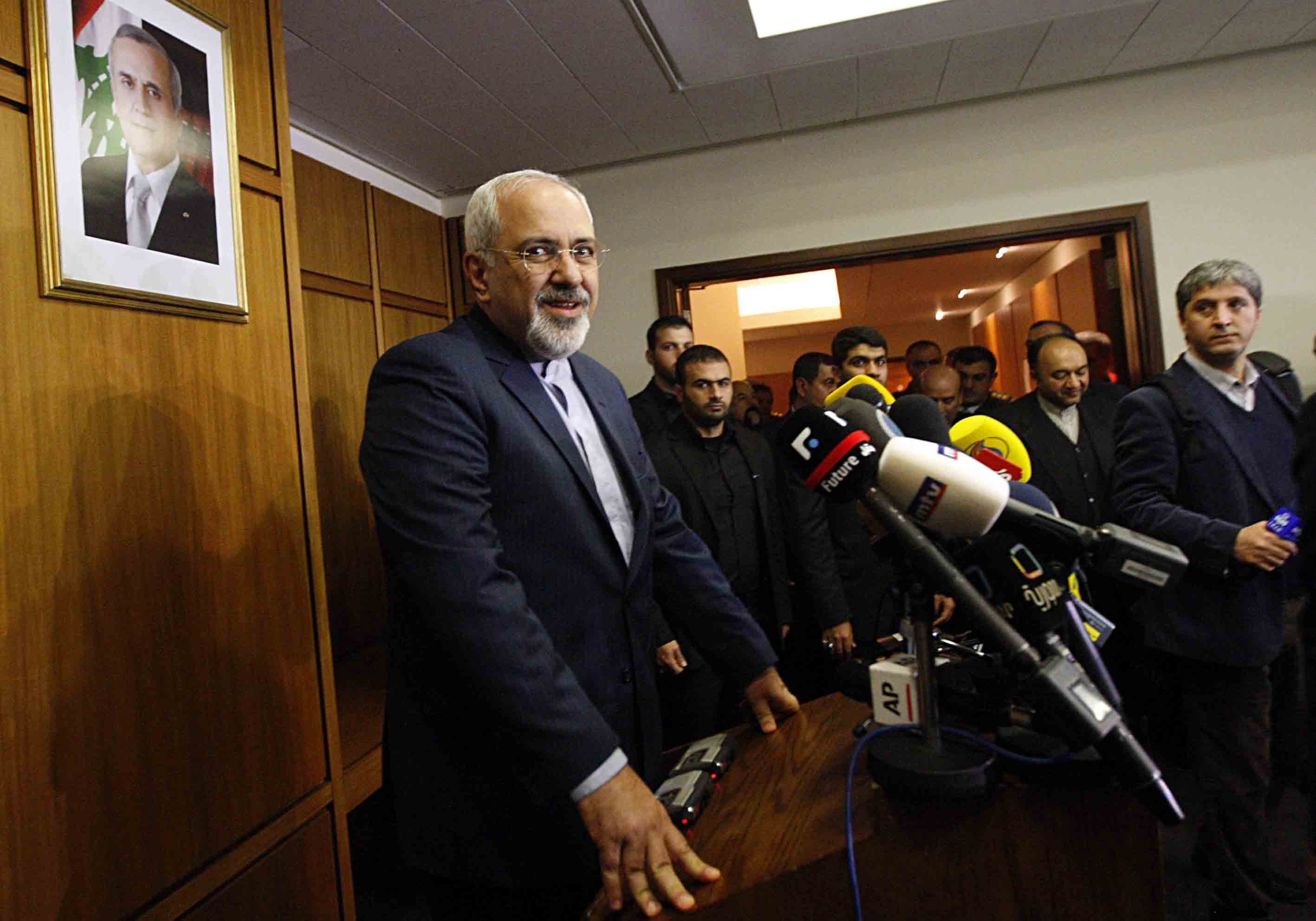
Javad Zarif

The striking thing about the long and delicate rapprochement with newly empowered moderate forces in Iran is how far from the national conversation it is. There are few heated TV debates; Twitter is relatively quiet; the blogosphere sits in two camps of near calcified intellectual hostility; only AIPAC slouches forth from time to time to threaten negotiation-ending new sanctions in the Senate.

And yet we have had two breakthroughs since the last elections in Iran: first the actual interim agreement between the major powers and Iran, and now a secondary practical deal to begin ramping down Iran’s nuclear program starting January 20. That second deal was announced around lunchtime today. All of it appears to be reversible at any point if one of the parties does not appear to be living up to its side of the bargain:

Giving details about the deal, Deputy Foreign Minister Araqchi told state television that each party’s commitments would be implemented “in one day”. “After the first step is taken, then in a short period of time we will again start our contacts for resumption of negotiations for the implementation of the final step.” He added: “We don’t trust them. … Each step has been designed in a way that allows us to stop carrying out our commitments if we see the other party is not fulfilling its commitments.”

It would be foolish to try and glean clues from nuances in public statements, but I don’t find the lack of trust to be a deal-breaker. The honesty about such a lack of trust is what gives the deal a chance to work. But the more fearful and reactionary factions in both countries’ legislatures are doing their best to unravel the detente. In Iran, a big majority of the parliament appears recklessly willing to sanction new uranium enrichment of up to 90 percent (allegedly for powering submarines); in the US, the Senate is also brandishing possible new sanctions that would end the detente if enacted, and require humiliating concessions Iran will never agree to. But neither legislature has yet acted – and the positioning and jockeying may be an inevitable part of what president Obama has claimed is only a 50-50 chance of success.

I don’t have any illusions about parts of the Iranian regime, or about Israeli hopes to scuttle any accord in favor of another unpredictable and polarizing war in the Middle East.

But I do think that this opening – if it is handled right – could avoid an avoidable conflict, open up many new options for US foreign policy in the Middle East, and empower pragmatism in both the US and Iran to mutual advantage. From Afghanistan to Iraq, the US and Iran have cooperated before and can cooperate again. The two peoples are natural allies; and the more the people of Iran get to taste the benefits of ending the brinksmanship and polarization and terror-mongering of their religious extremists, the more possibility there will be for more engagement.

There should be no permanent enemies in world affairs; just the pursuit of permanent interests. This time, we’re close to a rare alignment between Washington and Tehran, Obama and Rouhani. The only serious alternative to this deal, if containment has been ruled out by Obama, is a war. We’d be crazy not to hope it doesn’t come to that.

(Photo: Iranian FM Javad Zarif holds a press conference upon his arrival in Beirut, Lebanon, January 12,2014. By Bilal Jawich/Anadolu Agency/Getty Images.)

Iranian Modern

Bustling scenes from Tehran in 1971:

Hrag Vartanian suggests the Tehran of 45 years ago looked a lot like the Abu Dhabi of today:

It may be hard for us to image the larger cultural renaissance that was taking place in Iran after the Second World War, when the CIA-backed coup in 1953 toppled Iran’s democracy and installed in its place the Shah, who in a major push for modernization invested in culture and tried to open up the country to the world. The internationally renowned Shiraz Arts Festival, one of his regime’s initiatives, welcomed such luminaries as Peter Brook and Robert Wilson from the West, and helped revive local interest in folk music. Epic productions in 1971 celebrated the history of Iran and the Shah’s achievements, and the Iranian elite was not secretive about their huge appetite for luxury and art of all types. By 1977, Iran even had an impressive center of modern art, Tehran’s Museum of Contemporary Art, which still contains a fantastic collection of works by Kandinsky, Duchamp, Pollock, Bacon, Warhol, and countless others standard bearers of Western modernism.

There are curious parallels between Shah-era Iran and the Arab Gulf states today, with their investment in culture (replete with global events, Shiraz Festival vs. Sharjah Biennial) and a lurking specter of severe human rights abuses, but what differentiates them is that Iran had a rich network of native institutions and a more developed art history upon which a modern identity was built.

Meanwhile, Ryan McCarthy visits the country’s Kish Island, another relic from the Shah’s rule that was once meant to be a Vegas-style resort:

In 1989, dismayed by the lack of international tourists, the government declared Kish Island a free zone. This new status meant there would be no taxes, no visas required to enter, and a more lax enforcement of moral laws. Women are allowed to wear their hijabs with a generous amount of hair showing, and swimming (although gender-segregated) and dancing are encouraged. All of these activities are verboten in most other parts of the country.

It didn’t work:

The whole island stands as a monument to another era. The closest thing you can get to liquor on Kish is a “non-alcoholic malt beverage.” I thought it would be a good idea to drink one ironically, but after my first sip I realized I would have to be drunk to continue downing the stuff, which tasted like rusty metal and artificial flavoring. Quite the paradox.

The dearth of international tourists created an eerie, abandoned feel to the place. The shipwreck known as “Greek Ship” is one of Kish’s most popular attractions and photo-op sites, just beating out the empty building in the shape of a ship.

The Big Picture On Iran

Beinart focuses on it:

One day, I suspect, the people obsessing about the details of an Iranian nuclear deal will look a bit like the people who obsessed about the details of the Intermediate-Range Nuclear Forces treaty between the U.S. and U.S.S.R. in 1987. In retrospect, what mattered wasn’t the number of ballistic and cruise missiles each side dismantled. What mattered was ending the cold war. …

In December 2001, before the Bush administration called Tehran part of the “axis of evil,” Iran proved a crucial partner in the Bonn Conference that forged a post-Taliban government in Afghanistan. “This experience,” suggests Seyed Hossein Mousavian, who ran the Foreign Relation Committee of Iran’s National Security Council from 1997 to 2005, “can serve as a blueprint for a new collaboration on Syria.”

Let’s hope so, because although America’s leaders sometimes romanticize our half-century-long standoff with Moscow, cold wars are brutal, ugly things. Ending America’s cold war with Iran would deny Iran’s regime a key pretext it uses to repress domestic dissent. And it would increase the chances of ending a war in Syria that should shame the world. That’s what’s really at stake in the nuclear negotiations America and Iran will pursue in 2014.

Can Congress Derail The Iran Deal?

Rosa Brooks claims that the law isn’t clear:

In fact, it’s an open constitutional question whether Congress can impose mandatory sanctions on a foreign state over the president’s strong objection. Congress has the power to regulate foreign commerce, but the president is vested with executive power and is the sole representative of the United States vis-a-vis foreign states. Just as the congressional power to declare war does not prevent the president from using military force in what he views as emergencies — whether Congress likes it or not — the congressional power to regulate foreign commerce can’t force the president to implement sanctions that would undermine a time-sensitive executive agreement if doing so, in the president’s view, would jeopardize vital national-security interests.

Any congressional efforts to completely eliminate the president’s foreign-affairs discretion could lead to a constitutional showdown, which Congress would almost certainly lose. If Congress passed new sanctions legislation that the president believed would undermine the deal with Iran, he could veto it; if Congress mustered up the two-thirds majority needed to overcome a veto, the president could simply refuse to implement the sanctions. The courts would be unlikely to side with Congress because, traditionally, they have viewed such disputes as “political questions” best resolved through the ballot box.

In other Iran commentary, Fareed argues that the new deal is “not a seismic shift”:

Many imagine that this is the start of a rapprochement between the U.S. and Iran, which would fundamentally change the geopolitical landscape. It could place the U.S. on the side of the Shi’ite powers, Iran and Iraq, in the growing sectarian divide in the region. It could alter the balance of power in the world of oil–Iran’s reserves are second only to Saudi Arabia’s in the region.

Iran’s foes should relax. This is an important agreement, but it is an interim deal on Iran’s nuclear program. It is not even a final deal, which will be much harder to achieve. And it is not the dawn of a historic new alliance. Washington remains staunchly opposed to Iran on many issues, from Tehran’s antagonism toward Israel to its support for Hizballah to its funding of Iraqi militias. The Islamic Republic, for its part, remains devoted to a certain level of anti-Americanism as a founding principle of its existence. The two countries are still fundamentally at odds.

In 1972, Richard Nixon and Mao Zedong, spurred by powerful geopolitical forces, made a massive break with the past and ushered in a new era. The Iran deal does not have that feeling to it. It is more like an arms-control treaty between the U.S. and the Soviet Union, in which two wary adversaries are finding some common ground.

The Timeline On A Final Iran Deal

It’s more relaxed than the press reports would have you believe:

Most news stories cite Obama and Kerry as saying Geneva is a six-month arrangement. However, the text of the agreement notes that the deal is “renewable by mutual consent.” And lest that line is viewed as a throwaway to placate Tehran, the text specifically notes that the parties “aim to conclude negotiating and commence implementing” the final agreement “no more than one year after the adoption of this document.”

In other words, negotiators did not agree on a hard deadline to reaching agreement on the final deal, approving just an aspirational goal that it will be achieved a year from now. The administration probably welcomed this additional wiggle room to avoid a situation in which negotiations are deadlocked and it is cornered into admitting that the diplomacy had failed, forced the White House to consider unattrative alternatives.

On the surface, it stands to reason that Iran has an interest in getting a final deal as quickly as possible. After all, the most punishing economic sanctions remain in place under the “first step” deal and Obama promised renewed vigilance in sanctions enforcement when he announced the Geneva accord. But with the signing of this deal, the perception of leverage will begin to tilt away from Washington and toward Iran, which may want to see how this deal improves its regional standing before it heads into talks for a final agreement.

Meanwhile, Fisher analyzes a new Khamenei letter:

What makes this letter significant is not just that Khamenei is blessing the deal, but that he’s giving Rouhani some political cover in Tehran. This suggests, and is surely meant to broadcast as much, that Khamenei not only supports the deal so far but that he supports it sufficiently that he’s willing to publicly pressure Iranian hard-liners to get behind it.

It can be easy for Americans to forget that Iranian politics are complicated and noisy. Khamenei is the ultimate authority but only when he’s willing to use that power, which is only true sometimes.

The Hot Air Of Iran Hawks

Drezner warns them against freaking about the Iran deal. He observes that “the only thing going ballistic on this deal accomplishes is demonstrating your utter unreasonableness on negotiations with Iran”:

Now the key words in that last sentence are “going ballistic.”  I’m not saying you should love the deal.  You distrust both Iran and the Obama administration.  I get that.  The thing is, you’re distrusting the wrong agreement.  This is an interim deal that is easily revocable in six months if a comprehensive deal falls apart.  Objecting to this deal now does nothing but erode your credibility for future moments of obstructionism if a comprehensive deal is negotiated.

Seriously, game this out.  Let’s assume you implacably oppose the negotiations going forward.  If the deal holds up — and before you laugh, consider that Netanyahu is now describing the much-derided-at-the-time Syria deal as a “model” to follow — then you’ve undermined your reputation before the really big negotiations start.  So whatever justified opposition you might have to such a deal will be largely discredited.  On the other hand, if the deal falls apart — and there’s a decent chance of that — then you’ll get blamed for obstructionism for reflexively opposing it from the get-go.

Larison explains the lockstep opposition of Iran hawks:

Drezner may be right that Iran hawks would retain more credibility with everyone else if they held their fire for a later, comprehensive agreement, but among other Iran hawks they would lose credibility if they endorsed any deal with Iran. So they denounce the current deal, and they will denounce future agreements in the same terms, because they really are opposed to diplomatic engagement with Iran all together. Besides, Iran hawks have raised the bar so high on what it means to be “tough” on Iran that they are stuck defending ludicrous positions that they were compelled to adopt to confirm their status as a hard-liner.

Drum is on the same page:

The sad truth is that supporting the interim deal, even tentatively, is a lose-lose proposition for most Republican politicians these days. They don’t care about you or me or the Beltway consensus. They care about the base. And the base has no interest in seeing Satan make a deal with the devil.

Iran’s Economy Is Already Improving

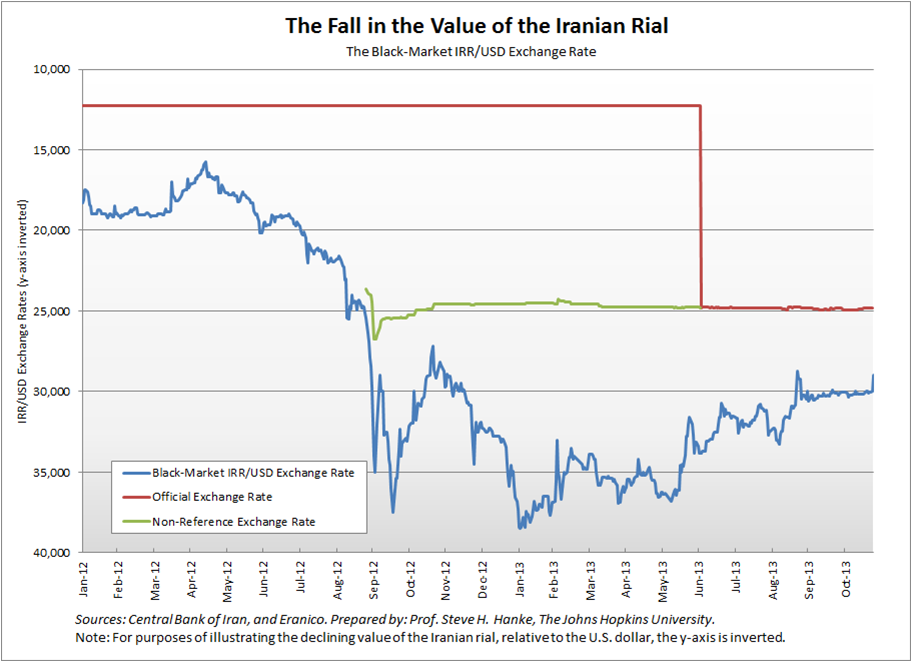
Iran Exchange Rate

Steve Hanke finds that Iran’s currency is stabilizing:

In light of the rial’s recent stability, I have delisted the rial from my list of “Troubled Currencies,” as tracked by the Troubled Currencies Project. For starters, the rial no longer appears to be in trouble. And, on a technical note, implied inflation calculations are less reliable during sustained periods of exchange rate stability.

That said, we must continue to pay the most careful and anxious attention to the black-market IRR/USD exchange rate in the coming months. Like the P5+1 agreement, Rouhani’s economic progress in Iran is tentative and likely quite fragile. Since the black-market IRR/USD is one of the only objective prices in the Iranian economy – and perhaps the most important one of all – it will continue to serve as an important weather vane, as the diplomatic process continues, and as Iran’s economy gradually moves into a post-sanctions era.

A Deal With Iran: Blog Reax

Obama’s remarks last night:

Fred Kaplan approves of the agreement:

The Iranian nuclear deal struck Saturday night is a triumph. It contains nothing that any American, Israeli, or Arab skeptic could reasonably protest. Had George W. Bush negotiated this deal, Republicans would be hailing his diplomatic prowess, and rightly so.

Juan Cole weighs in:

The only question here is whether the agreement is in American interests. It is. Ever more severe sanctions increasingly risked war with a country three times as big geographically and 2.5 times as populous as Iraq (the American occupation of which did not go well). That danger is now receding, which can only be a good thing. And if negotiations and UN inspections can indeed succeed in allowing Iran a civilian enrichment program while forestalling a weapons program, it is a breakthrough for the whole world and an important chapter in the ongoing attempts to limit proliferation.

Jonathan Tobin, predictably, is against the deal:

It must be conceded that the chances that this agreement will make it less likely that Iran will eventually reach its nuclear goal are not zero. It may be that Iran has truly abandoned its goal of a weapon, that it will negotiate in good faith and won’t cheat, and that there are no secret nuclear facilities in the country even though just about everyone in the intelligence world assumes there are. If so the world is safer, and many years from now, the president will go down in history as a great peacemaker worthy of a Nobel Prize. But since that scenario rests on a series of assumptions that range from highly unlikely to completely far-fetched, the only possible reaction to the deal from sober observers must be dismay. In exchange for measures that only slightly delay Iran’s nuclear progress that don’t come even close to putting them into compliance with United Nations resolutions on the nuclear question, the administration has begun the process of lifting sanctions on Iran. Even more seriously, it has, in effect, normalized a rogue regime that is still sponsoring international terrorism, waging war in Syria, and spewing international sanctions, while effectively taking any threat of the use force against Tehran off the table.

Jennifer Rubin, no surprise, also opposes the deal:

The loopholes and fallacies are huge and obvious. Iran must only dismantle connections to enrich over 5 percent (“dismantle the technical connections required to enrich above 5%.”), allowing these to be plugged right back in after six months.  Arak was not set to go online until next year anyway so promises not to move it online are meaningless. And most of all, the time and effort it takes to enrich from 5 to 20 percent is slight compared to enrichment up to 5 percent which is unabated.

That the deal could have been worse is of little consolation. What matters is what it fails to do and that it points the way toward consent to Iran’s nuclear enrichment program.

Mitchell Plitnick pushes back on these sort of complaints:

There is only one reason to oppose this deal and that is that, whether with weapons of war or sanctions that will lead to a full-blown humanitarian catastrophe in Iran, an all-out attack on Iran with the hope of regime change is what this is really about. The conclusion is inescapable—if you oppose this deal, you are looking for a lot more than the neutralization of Iran’s ability to construct a nuclear weapon.

Christopher Dickey’s take:

There may yet be a war intended to bomb Iran back to the pre-nuclear age, and maybe even to try to change the regime. But it’s ever less likely that the United States will fight it. As the polls show, Americans don’t see why they should, and if this negotiating process moves forward, there’s no reason they ought to.

Uri Friedman looks beyond the immediate agreement:

[W]hat’s arguably a bigger deal, and what’s been overshadowed in all the coverage of the haggling over this interim pact, is just how momentous these last several months have been for U.S.-Iranian relations. Since Iranian President Hassan Rouhani took office this summer, the two countries have engaged in the highest-level talks since the 1979 Iranian Revolution, first through a meeting between Zarif and Secretary of State John Kerry, and then through a phone call between Rouhani and President Obama (the two had previously exchanged letters). Zarif has also pioneered a new approach to speaking directly to the American people, turning to social-media outlets like Twitter and YouTube to defend, in English, Iran’s positions at the Geneva negotiations.

The way the news cycle works these days, we take it for granted that Kerry is now in Geneva celebrating a diplomatic breakthrough with Zarif. But the frenzied diplomacy this fall has truly been exceptional.

Michael Crowley considers the possible longterm consequences:

It’s worth thinking about the long path Obama has trod to get here. When he ran for president in 2008, Obama’s rivals warned he couldn’t be trusted to deal with a nuclearizing Iran. Hillary Clinton would brand him “irresponsible and naïve” for saying he’d meet with Iran’s leader. John McCain later called that a sign of his “inexperience and reckless judgment.”

Six years later, Obama’s Iran policy has the potential to reshape the Middle East and define his legacy. If it proves a success, historians might compare it to Richard Nixon’s breakthrough with China.

Martin Longman adds:

Those who preferred Obama to Clinton because of the distinction in their positions on the authorization to use military force in Iraq now have something concrete to point to, to argue that electing Obama would lead to a more peaceful world than would electing Clinton.

Ben Smith and Miriam Elder’s bottom line:

Now [Obama has] earned the foreign policy legacy he campaigned on. And now perhaps the Norwegians can feel a bit more confident about their hasty reward.