Yes We Can

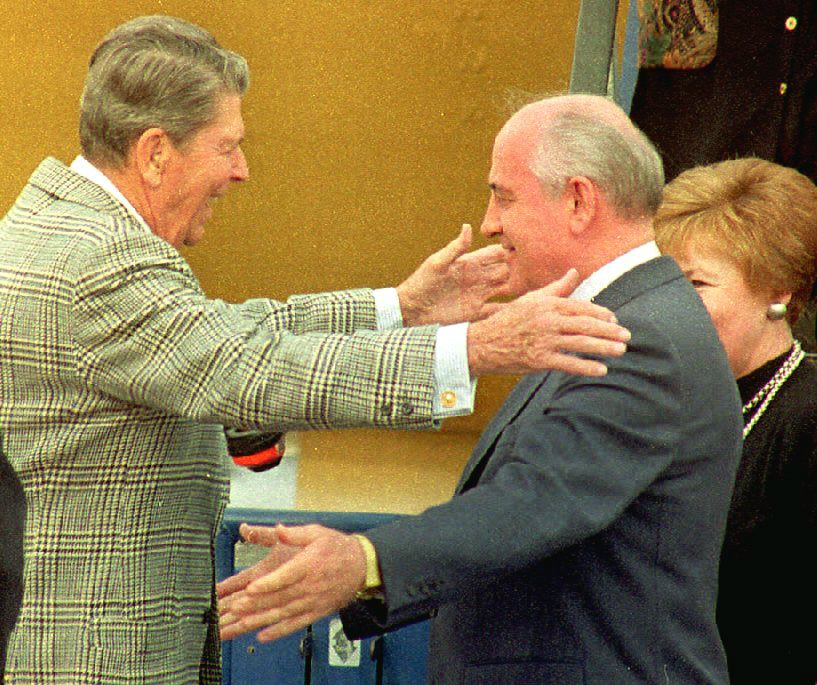
Former U.S. President Ronald Reagan (L) greets for

Beinart encourages Obama to follow in Reagan’s footsteps:

[T]he same “Reaganites” who will bash Obama for compromising with Rouhani once bashed Reagan for compromising with Gorbachev. As late as December 1987, Charles Krauthammer was writing that “the fundamental misconception about Gorbachev is that he has somehow broken the ideological mold.” Until virtually the day the Soviet empire collapsed, Rep. Dick Cheney was calling glasnost a fraud. In 1988 George Will accused Reagan of having “accelerated the moral disarmament of the West … by elevating wishful thinking [about Gorbachev] to the status of public policy.” When Reagan brought the intermediate missiles deal to Congress for ratification, a right-wing group called the Anti-Appeasement Alliance took out newspaper ads comparing Reagan to Neville Chamberlain.

Yes, those political struggles were easier for Reagan because he hailed from the political right. But that wasn’t the only reason he triumphed over the “Reaganites” who now take his name in vain. He triumphed because he had the moral imagination to envisage a relationship beyond confrontation and war. Musing in late 1987 about the opponents of his nuclear deal, Reagan declared that “some of the people who are objecting the most … whether they realize it or not, those people basically down in their deepest thoughts have accepted that war is inevitable.” Because Reagan refused to accept what others considered inevitable, he achieved one of the greatest successes in the history of American foreign policy. Now it’s Obama’s turn to imagine a future that his critics cannot and to have the guts to make it real.

Obama’s careful speech at the UN today did not sound like Reagan’s dreamy optimism toward Gorbachev at Reykyavik – another moment when neoconservatives denounced Reagan as aggressively as they will surely denounce any diplomacy with Iran. It was designed to express caution – too much caution, in my view. Money quote:

I don’t believe this difficult history can be overcome overnight – the suspicion runs too deep. But I do believe that if we can resolve the issue of Iran’s nuclear program, that can serve as a major step down a long road toward a different relationship – one based on mutual interests and mutual respect.

I understand the delicacy. But what Rouhani needs is what Gorbachev needed – a big gesture – or the nit-pickers and nay-sayers and militarists in both countries will once again seize the initiative.

(Photo: Former US President Ronald Reagan greets former president of the former Soviet Union Mikhail Gorbachev upon his arrival in the US. By Mike Nelson/AFP/Getty Images.)

AIPAC Readies To Kill Outreach To Iran

In our latest video from NIAC founder Trita Parsi, he explains that, if Rouhani hopes to maintain his power, his diplomatic efforts must ultimately improve Iran’s economy:

 
Near the end of the video, Parsi wonders if Congress will stand in Obama’s way. You think? Eli Lake talks to Israel’s proxies on the Hill:

If Obama seeks to take advantage Rouhani’s outreach, he will need support from a Congress that appears unconvinced about the new Iranian president’s charm offensive. One House staff member who spoke to The Daily Beast Monday said Iran would need at the very least to suspend uranium enrichment to stop legislators from moving a new sanctions bill aimed at the regime’s nuclear program. A memo released last week from the American Israel Public Affairs Committee, a pro-Israel group that has made Iranian sanctions a centerpiece of its lobbying efforts since the 1990s said, “The international community should only consider sanctions relief if Iran complies with United Nations Security Council (UNSC) resolutions that require suspending its nuclear activities. Any such relief must be commensurate with the extent of Tehran’s actions.”

Which means that the Greater Israel lobby will do all it can to prevent any conceivable deal that could ensure Iran’s right to peaceful nuclear energy – the sine qua non of any breakthrough. Which means they aim to kill diplomacy to get the war they have been wanting for more than a decade. In this sense, AIPAC is the American equivalent of Iran’s Revolutionary Guards in terms of scuppering any possibility of genuine peace, by refusing to treat Iran as anything but a pariah state. Israel, meanwhile, sits on a couple hundred nuclear missiles aimed in part at Iran. But that inconvenient truth cannot be uttered on Capitol Hill.

Yesterday, Parsi detailed the very limited window Rouhani has for success, as well as how he thought the US should tackle this new opportunity for rapprochement.

Our full Ask Anything archive is here.

Meep Meep Watch

Screen Shot 2013-09-11 at 4.47.16 AM

David Corn echoes a lot of what I’ve been arguing about Obama’s trajectory at this point in his second term. Politico-style pageview-grabbers keep talking about a “lame duck” while the GOP keeps talking as if Obamacare, which only truly gets going next month, is already fatally wounded. McCainiacs talk as if getting Putin to take ownership of preventing further use of chemical weapons in Syria is some kind of defeat for the US – which it is only if you truly want another Middle East War. And in Washington, Obama’s solid refusal to jump into negotiations over the defunding of Obamacare or the debt-ceiling has allowed the Republicans to organize themselves into a Dick Cheney hunting expedition. After Syria, moreover, there is the first real chance of a deal with Iran over its nuclear program along the lines of Assad’s sudden volte-face. The long term strategy of sanctions and an open hand is bearing fruit.

None of this will please Maureen Dowd. And yes, of course, much can still go awry. Politics requires nimbleness of action and steadiness in strategy. But when I watch Karl Rove laying into Congressional Republicans, and Bill Kristol, in panic-mode, calling for Israel to strike Iran, I can’t help but smile. This terrible strategic president, this useless schmoozer, this aloof, Washington inadequate has a lot of foes back on their heels right now.

That doesn’t happen entirely by accident.

What A Deal With Iran Would Look Like

68th Session Of The United Nations General Assembly Begins

Kenneth Pollack outlines it in a must-read. How far the US should be willing to go:

Rouhani may ultimately need more than the removal of the multilateral sanctions. He may need the U.S. to pledge, as we did to Cuba after the 1962 Missile Crisis, that we will not invade or otherwise try to overthrow the Iranian regime. He may need a commitment from the international community to help Iran develop its nuclear energy sector, which can be done by providing lightwater reactors that would not significantly bolster Iran’s ability to build nuclear weapons. He may also need economic support from international financial institutions like the World Bank and the IMF. He might even want to try to bring Iran into the World Trade Organization, although that seems unlikely given Khamenei’s insistence that the WTO is a subversive organization whose requirements would undermine the Islamic regime. The United States and our allies ought to be ready and willing to agree to any or all.

Amen. But the resistance from the Greater Israel lobby will be intense, as will opposition from Christianists and the 20th Century faction in the GOP, like McCain and Butters. Hence the president’s remark in his UN speech right now about how “the roadblocks may prove to be too great.” But Obama needs to drop some of his caution and defensiveness on this – and embrace the “Yes We Can” of his 2008 campaign. Those of us who supported him back then in the wake of neoconservative catastrophe dreamed of a moment like this one. He must not let it pass.

How Juan Cole understands Iran’s nuclear program:

Ali Akbar Salehi, the head of the Atomic Energy Organization of Iran, has confirmed that Iran has turned 40% of its stock of high-grade LEU into fuel rods for the medical reactor. Once made into fuel rods, the material cannot be weaponized. So Iran only has 140 kilograms left of the 19.75% enriched uranium left. That isn’t enough for a bomb even if Iran knew how to make one and had the facilities to do so, which it doesn’t. Salehi says that Tehran intends to turn the rest of the stock into fuel rods, as well. Iran has in fact been feeding these fuel rods into the medical reactor and not stockpiling the high grade LEU, which is how you would expect them to act if they were in fact only interested in fuel, not bombs. Long time readers know that I have held since the middle of the last decade that Iran does not want an actual bomb, but rather only wants a breakout capacity like that of Japan– the ability to construct a bomb in short order if they faced an imminent existential threat. Such a breakout capacity would be almost impossible to forestall, since it mainly depends on know-how, which is widespread. But if Iran and give solid evidence that it has no active weapons program, that might be enough for a deal.

(Photo: U.S. President Barack Obama addresses the U.N. General Assembly on September 24, 2013 in New York City. By John Moore/Getty.)

Ask Trita Parsi Anything: How To Seize A Deal With Iran

In our first video from the founder and president of the National Iranian American Council, he outlines how he thinks the Obama administration should tackle Iran’s nuclear program:

From his bio:

Trita Parsi is the founder and president of the National Iranian American Council and an expert on US-Iranian relations, Iranian foreign politics, and the geopolitics of the Middle East. He is the author of Treacherous Alliance: The Secret Dealings of Iran, Israel and the United States and ​A Single Roll of the Dice – Obama’s Diplomacy with Iran, and has contributed articles on Middle East affairs to the New York Times, WaPo, Wall Street Journal, and many others. He is also a frequent guest on CNN, PBS’s Newshour, NPR, the BBC and Al Jazeera. You can follow him on Twitter here.

Our full Ask Anything archive is here.

Obama’s Moment Of Truth With Iran

IRAN-POLITICS-EXPERTS-ROWHANI

In what strikes me as another death-knell for neoconservatism, Ken Pollack, a key supporter of the Iraq military intervention, draws the line at Iran. He wants a real deal on nukes or containment – and his arguments are solid (of course, I’ve made them myself for years now). First off, a mere air-strike wouldn’t do much but delay Iran’s nuclear program – which, if Iran were attacked, they would almost certainly re-start with even more vigor and pride than before. Second, a strike would empower all those forces and factions in Iran, like the Revolutionary Guards, that seek deeper and deeper religious conflict. Third, the strikes would not be the end of a conflict, but merely the beginning:

The Iranians almost certainly would retaliate. They might fire missiles at American bases in the Middle East, or persuade allies like Hezbollah and Palestinian Islamic Jihad to fire rockets at Israel. But my biggest fear is that they would embark on a prolonged terrorist campaign against Americans, including attacks on the homeland. The Iranians have said as much, and the United States intelligence community believes that they have expanded their capacity to do so since their failed attempt to kill the Saudi ambassador to the United States in 2011.

You want another wave of Jihadist terrorism in the US? Do what Netanyahu and Kristol want. But Pollack also notes that if the US struck, and Iran retaliated with terror strikes, the conflict would inevitably escalate:

I fear that if we started using force in the belief that we could keep it limited, we would either fail and find ourselves facing an enraged, nuclear Iran, or be dragged into another large-scale, protracted war in the Middle East. Containment is hardly a perfect policy, but I see the costs and risks as more easily mitigated than those of war.

But a serious deal would obviate both bad options, help us out with Afghanistan, empower the Green Movement, and allow us to put more pressure on Greater Israel to return to its proper 1967 borders, with land swaps. Win-win-win – and a way out of our long Middle East entrapment. Fred Kaplan implores the administration to think big:

For years, many have noted that the problems in the Middle East are so intricately related that it would be hard to solve each on its own. Obama may have before him a rare convergence of events, factors, and forces where at least some of those problems can be dealt with simultaneously. He has a remarkable chance to pull the gold ring. Maybe it will prove to be the diplomatic equivalent of the Maltese Falcon, the stuff that dreams are made of. But maybe it could be the real deal. Either way, it’s worth grabbing at the chance.

My feelings entirely. Omid Memarian profiles Rouhani:

Tehran’s former mayor, Gholamhossein Karbashchi, who met with Rouhani both before and after the June election, told the Daily Beast that Rouhani throughout his political life “has tried to control extremism and radicalism among the Iranian political forces.” The three words to best define Rouhani are “disciplined, rational, and convincing,” according to the former mayor who says that Rouhani is meticulous in both form and manner. “He pays serious attention to his clothes and appearance,” says Karbaschi, adding that the president is known for his verbal skills. “Sometimes he defeats his opponent through jokes and humor. He is an intelligent and expert orator, never interrupts anyone, and pays close attention.”

Walt examines the challenges ahead:

The United States and Iran may begin direct discussions and explore lots of options, yet ultimately end up unable to cut a deal. That effort will be complicated by the opposition from hard-liners on both sides, who will look for any opportunity to toss a monkey wrench into the process. So a lot depends on how well you think Obama and Rouhani can control the domestic politics in their respective countries and explain to the relevant stakeholders why a deal would be better for nearly everyone.

My guess is that Rouhani will have an easier time than Obama will, in part because Obama will face potent opposition from Israel, its supporters in the United States, and countries like Saudi Arabia. These actors would rather keep Washington and Tehran at odds forever, and it’s a safe bet that they will do everything they can to run out the clock and thwart this latest attempt to turn a corner in the troubled U.S. relationship with Iran.

Remember Bill Kristol’s outrageous call last week for Israel to strike Iran to pre-empt the US president. Jeffrey Goldberg, on the other hand, thinks Israel can play a constructive role:

Netanyahu’s role is to play bad cop to what I hope will be Obama’s ambivalent cop. One of the dangers of the coming weeks is that the White House will become so excited by the prospect of a resolution to the nuclear issue that it ends up making a bad deal, one that allows Iran to retain at least some capability to manufacture nuclear weapons. Or Iran’s negotiators might find themselves unpleasantly surprised by the extent of the Obama administration’s demands, and ultimately balk.

… Rohani, assuming he’s sincere, doesn’t have much time. The hardliners in the Revolutionary Guard Corps are lying in wait. It would be premature for the U.S. to lift sanctions now, before anything substantive has happened. But it would also be a mistake to be too rigid.

(Photo of Rouhani by Behrouz Mehri/AFP/Getty Images)
The Rouhani Op-Ed

It can be read here. Fisher annotates it. One highlight:

We and our international counterparts have spent a lot of time — perhaps too much time — discussing what we don’t want rather than what we do want. This is not unique to Iran’s international relations. In a climate where much of foreign policy is a direct function of domestic politics, focusing on what one doesn’t want is an easy way out of difficult conundrums for many world leaders. Expressing what one does want requires more courage.

This section is very promising. Rouhani is subtly drawing attention to the fact that both American and Iranian politics include hard-liners who oppose detente, and that for the two countries to end decades of enmity would require not just international diplomacy but domestic political change as well. It’s good news that Rouhani sees this, for two reasons. First, he will have to take on the hard-liners in his own government to see detente through. And, second, he will have to be prepared for the possibility that some members of the U.S. government may attempt to undermine peace; it’s helpful if he’s aware that such people don’t necessarily act on behalf of the entire United States.

Michael Rubin wants more proof that Iran is serious:

[T]he White House should not be afraid to take ‘yes’ for an answer. And here history provides some paths for Iran to demonstrate its sincerity. After decades of pursuing war with Israel, Anwar Sadat offered a dramatic gesture to Israel—and flew to Jerusalem—to demonstrate his commitment to peace. Perhaps if Rouhani is serious that “gone is the age of blood feuds,” he can make as dramatic a gesture, or at least something that commits him to peace far more than a Washington Post opinion editorial.

Paul Pillar’s perspective:

The new Iranian administration has opened a door to a better relationship, and one better for the United States, about as widely as such doors ever are opened. The United States would be foolish not to walk through it.

Rapprochement With Rouhani? Ctd

Abbas Milani tries to decipher the new Iranian president:

How far will Rouhani’s new spirit  guide him? Just far enough to stabilize  a despotic regime? Or will he change the nature of the government? Unfortunately,IRAN-POLITICS-EXPERTS-ROWHANI U.S. policy does a poor job of anticipating both scenarios. On the one hand, sanctions are far too blunt. They have injured the regime, which is good, but they have also weakened the forces for democracy. A number of important political prisoners recently signed a letter explaining how sanctions have exacted a terrible cost on the average Iranian—and reinforced the conservative claim that negotiations with the Americans are futile.

Untargeted sanctions create the impression that the Americans are hardly sincere in wishing the best for the Iranian people. But there’s another, very different problem posed by U.S. policy. Iranians are nervous that progress on a nuclear deal will win the Iranians so much international goodwill that the regime will feel emboldened to brutally crack down even further. The United States must reassure the Iranian people that their human rights are not up for negotiation. A more nuanced U.S. policy will put Rouhani’s pragmatism to the test: Is he the real moderate deal, or do his flashy robes conceal more sinister intentions?

Yes, but we shouldn’t hope for too much. Getting a verifiable deal on transparent nuclear power and opening up the economy is enough for now. We have seen what so many Iranians want for their country. We need patience while they chart their own destiny. Laura Secor encourages Obama to meet with Rouhani:

The hopes now carrying Rouhani to American shores are as big as they are fragile. For thirty-four years, the United States and Iran have regarded each other balefully across what has seemed an unbridgeable divide. The flexibility required of both sides to reach each other across that chasm without losing their footing might be heroic indeed. But a handshake—the first between the Presidents of Iran and the United States in more than three decades—would be a great start.

Bloomberg’s editorial also supports engagement:

Whether President Barack Obama meets with Rohani at next week’s UN General Assembly — the White House hasn’t ruled out the possibility — or the U.S. engages Iran in some other fashion, Iran’s recent overtures are too intriguing to ignore.

Earlier Dish on Rouhani’s overtures here.

Kristol Calls For Israel To Attack Iran – Soon

It’s a remarkable screed in the Weekly Standard, a reminder that behind the urbane, calm exterior that we saw on CNN the other night, there is a dangerous, radical extremist within. As the US and Iran show signs of rapprochement, as the chance for testing Rouhani’s sincerity emerges, Kristol urges Israel to scupper any potential deal by pre-emptively launching an attack. He starts with yet another Hitler analogy, accusing Obama of appeasement and Rouhani of deception. It’s 1938 for about the twentieth time in the last couple of decades. But this time, unlike the 1930s, there’s hope:

As Iran moves closer to nuclear weapons, undeterred by the West’s leading power, a 21st-century tragedy threatens to unfold. Unless. Unless a dramatis persona who didn’t exist in 1936 intervenes: Israel. Ariel Sharon once famously said that Israel would not play the role of Czechoslovakia in the 1930s. Nor will it play the role of Poland. Despite imprecations from the Obama administration, Israel will act. One prays it will not be too late.

It is a strange course of events, heavy with historical irony, that has made the prime minister of Israel for now the leader of the West. But irony is better than tragedy.

This American is calling for a foreign government to ignore the American president and disrupt his foreign policy by an act of pre-emptive war. I guess I shouldn’t be surprised. And yet the shock still stings.