Saddam In Shia Clothing?

In a lengthy retrospective on America’s complicated relationship with Prime Minister Maliki, Ali Khedery illustrates how that relationship began warmly, soured over time, and got us where we are today:

Maliki never appointed a permanent, parliament-confirmed interior minister, nor a defense minister, nor an intelligence chief. Instead, he took the positions for himself. He also broke nearly every promise he made to share power with his political rivals after they voted him back into office through parliament in late 2010.

He also abrogated the pledges he made to the United States. Per Iran’s instructions, he did not move forcefully at the end of 2011 to renew the Security Agreement, which would have permitted American combat troops to remain in Iraq. He did not dissolve his Office of the Commander in Chief, the entity he has used to bypass the military chain of command by making all commanders report to him. He did not relinquish control of the U.S.-trained Iraqi counterterrorism and SWAT forces, wielding them as a praetorian guard. He did not dismantle the secret intelligence organizations, prisons and torture facilities with which he has bludgeoned his rivals. He did not abide by a law imposing term limits, again calling upon kangaroo courts to issue a favorable ruling. And he still has not issued a new and comprehensive amnesty that would have helped quell unrest from previously violent Shiite and Sunni Arab factions that were gradually integrating into politics.

In short, Maliki’s one-man, one-Dawa-party Iraq looks a lot like Hussein’s one-man, one-Baath Party Iraq.

Eli Lake blames that relationship for the White House’s failure to take action when the ISIS threat emerged six months ago:

The problem for Obama was that he had no good policy option in Iraq. On the one hand, if Obama had authorized the air strikes Maliki began requesting in January, he would strengthen the hand of an Iraqi prime minister who increasingly resembled the brutal autocrat U.S. troops helped unseat in 2003. Maliki’s heavy handed policies—such as authorizing counter-terrorism raids against Sunni political leaders with no real links to terrorism—sowed the seeds of the current insurrection in Iraq.

But while Obama committed to sell Maliki’s military nearly $11 billion worth of advanced U.S. weaponry, he was unwilling to use that leverage in a meaningful way to get him to reverse his earlier reforms where he purged some of his military’s most capable leaders and replaced them with yes men. As a result of this paradox, the Iraq policy process ground to a halt at the very moment that ISIS was on the rise.

Recent Dish on Maliki’s role in precipitating the present crisis here and here.
Kurdistan’s Moment? Ctd

1-RiWG5YRrbfl6XSLtmVbmEQ

Ranj Alaaldin has the latest on the Kurds, who, in taking and holding Kirkuk against the ISIS onslaught, “may have won a historic battle for what has been described as both the crown jewel and Jerusalem of Kurdistan”:

It can now secure its economic independence from Baghdad. Control of Kirkuk also means the Kurds have the economic lynchpin for an independent state, should that be a desired option in the future.

Arab Iraq may still try to retake the province, but it is too focused on turning Baghdad and the Shia south into a fortress. Its preoccupation with Isis and the broader Sunni Arab insurgency means that, at best, Arab Iraq can hope the Kurds will still settle the status of Kirkuk through Article 140 of the Iraqi constitution, which provides for a referendum on the status of the province. That would be wishful, as well as futile, thinking. Baghdad not only has a weakened hand, but the demographics in the province and realities on the ground considerably favour the Kurds.

Some might argue that the Kurds no longer share a border with an internationally recognised sovereign state but with a dangerous coalition of jihadists and unpleasant Sunni Arab militant forces. That misses the bigger picture.

The Sunni insurgency is occupied with powerful Shia enemies to the south; their resources are limited; they are divided among themselves and they lack the capacity to fight the experienced Peshmerga. Furthermore, Baghdad was never really in control of the Sunni Arab heartlands that border Kurdistan. Long before recent events, those heartlands constituted a safe haven for militants and jihadist groups. The threat is real, but nothing new for the Kurds.

Simon Tisdall considers how regional actors might respond to Kurdish statehood:

[O]il exports depend largely on a pipeline through Turkey, which opened this year. Faced by political developments in Irbil it dislikes, it would be an easy matter for Ankara to turn off the tap. Turkey has been fighting Kurdish insurgents in its south-east region for decades. It has always been assumed it would oppose Iraqi Kurdish independence, fearing a knock-on effect at home.

But that perception has gradually changed since 2003 amid heavy Turkish commercial investment in northern Iraq. High-level political contacts with the KRG are now routine, while Ankara’s relations with Baghdad have soured. It may be that Turkey will ultimately prefer a stable, friendly new border state free of extremists (of any hue) that is also an energy supplier and trading partner. “If Barzani does push for independence, he’s gambling that the Turks will concede that, one, KRG oil deals are more valuable than KRG statehood is dangerous, and two, that Kurds are still a valuable buffer zone vis-a-vis Iran,” said analyst Lee Smith.

Set against this prospect is the likelihood that, assuming he survives the civil war, Syria’s president Bashar al-Assad will revert to his former anti-Kurdish policies. Iran, similarly fearful of domestic unrest, remains deeply hostile to Kurdish aspirations.

Meanwhile, Dov Friedman and Gabriel Mitchell investigate the sketchy Kurdish-Israeli oil transaction that came to light a few weeks ago:

If Israel received Kurdish oil with the intention of storing it, two scenarios are plausible. In the first, Israeli companieswith government consentpurchased the oil because the price was simply too good to pass up. Currently, Israel receives most of its 280,000 barrels-per-day from Azerbaijan, Russia, and some undisclosed sources. Since Kurdish oil arrived at a substantial discountdue to the Kurds’ eagerness to sell and the shallowness of the marketIsraeli companies may have purchased and stored the oil for domestic consumption. If Kurdish oil develops into a reliable source, Israel gains negotiating power in its future energy contracts. And if Kurdistan’s relations with the Iraqi government continue to devolveor if Iraq continues its descent into violent chaosthe Kurds may substitute access to Basra’s ports for an Israeli route to the Red Sea, via the Trans-Israel pipeline between Ashkelon and Eilat, and onward to the lucrative, energy-thirsty markets of Asia.

In the second scenario, the sale of Kurdish oil may be technically correct yet effectively misleading. Israel may be storing the oil because the Kurds have not yet found an end buyer. The money transferred to KRG accounts at Halkbank would then mean Israel has either informally loaned KRG money or Israel has assumed the liquidity risk of the Kurdish oil shipment. Both scenarios suggest that the Kurdish-Israel relationship has matured significantly.

Previous Dish on the prospect of an independent Kurdistan here.

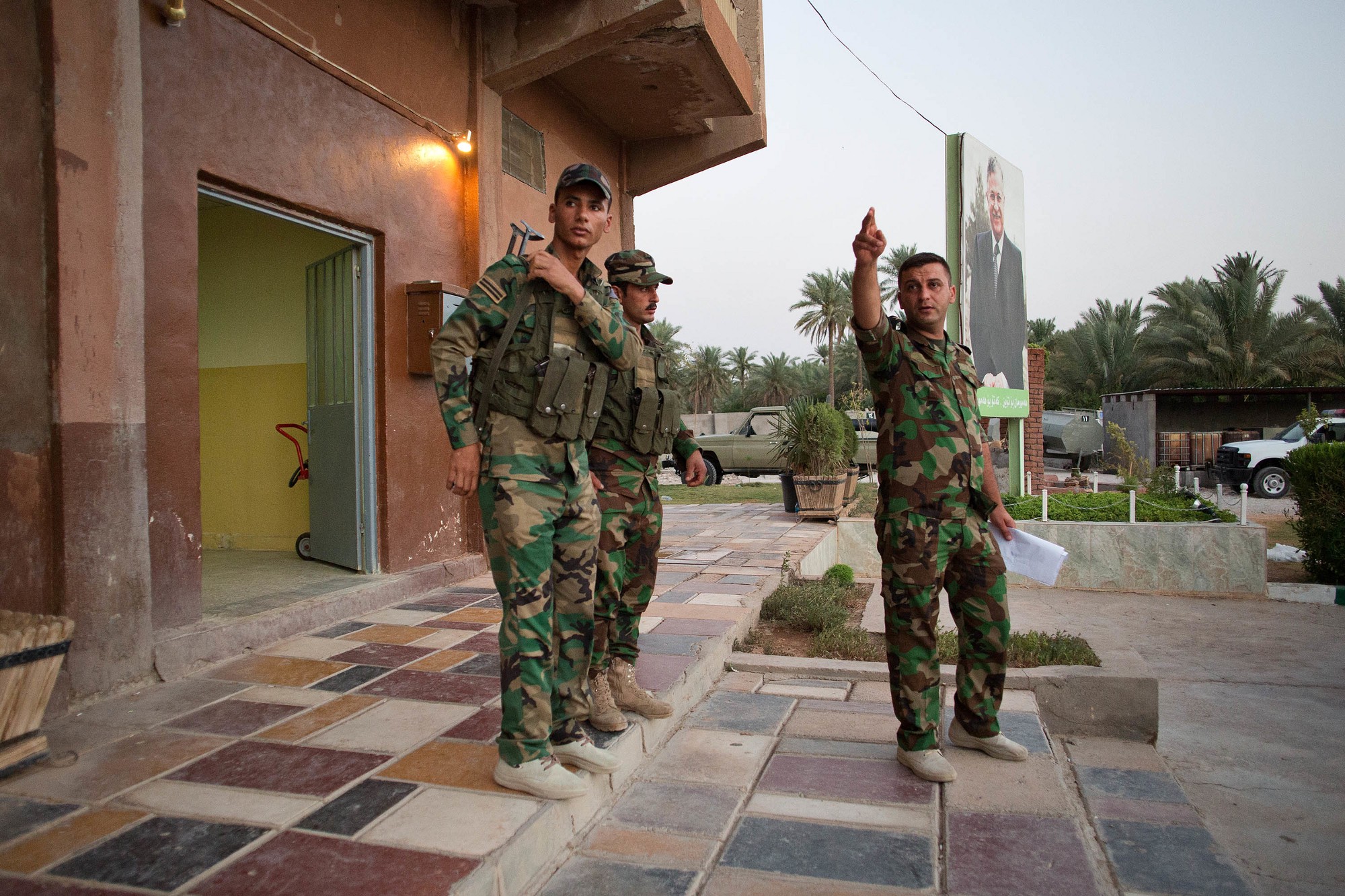
(Photo: A peshmerga NCO directs soldiers to their guard posts at the headquarters in Khanaqin. By Matt Cetti-Roberts, from this photo essay on the Kurdish fighters.)

A Water War In The Desert, Ctd

John Vidal argues that “the outcome of the Iraq and Syrian conflicts may rest on who controls the region’s dwindling water supplies”:

“Rebel forces are targeting water installations to cut off supplies to the largely Shia south of Screen Shot 2014-07-03 at 11.21.52 AMIraq,” says Matthew Machowski, a Middle East security researcher at the UK houses of parliament and Queen Mary University of London. “It is already being used as an instrument of war by all sides. One could claim that controlling water resources in Iraq is even more important than controlling the oil refineries, especially in summer. Control of the water supply is fundamentally important. Cut it off and you create great sanitation and health crises,” he said[.]

Isis now controls the Samarra barrage west of Baghdad on the River Tigris and areas around the giant Mosul Dam, higher up on the same river. Because much of Kurdistan depends on the dam, it is strongly defended by Kurdish peshmerga forces and is unlikely to fall without a fierce fight, says Machowski. Last week Iraqi troops were rushed to defend the massive 8km-long Haditha Dam and its hydroelectrical works on the Euphrates to stop it falling into the hands of Isis forces. Were the dam to fall, say analysts, Isis would control much of Iraq’s electricity and the rebels might fatally tighten their grip on Baghdad.

Previous Dish on the water angle of the Iraq conflict here.

No, ISIS Is Not Al-Qaeda, Ctd

In fact, Aaron Zelin argues, the rise of the Islamic State is pretty bad news for the leading jihadist brand:

The Islamic State hopes to put al Qaeda and its branches in the unenviable position of having to reconcile with the reality of the new caliphate, or oppose it and therefore be viewed by global jihadis as hindering the caliphate project and showing its true nature as a sectarian organization that is not working for the best interests of Muslims. That strategy, however, is a gamble: It could open the Islamic State up for an even bigger fall if it does not follow through on its promise to fight enemies on all fronts, and if it fails in governing newly captured areas. There is already insurgent and noncombatant resistance to the Islamic State’s gains in both Syria and Iraq, so the group therefore has a thin needle to thread.

Jihadists’ reactions to the Islamic State’s re-establishment of the caliphate have so far been mixed.

There are signs that al Qaeda in the Arabian Peninsula foot soldiers are excited about the alleged caliphate coming to fruition, while many within the Nusra Front are condemning it and sarcastically making fun of it, calling it a Twitter Caliphate. Maldivian jihadists in Syria under the banner of Bilad al-Sham Media have released a rebuke, arguing that the announcement strays from the true Islamic way of establishing a caliphate, and noting that it needs to have broader support. Most importantly, a number of top jihadist sheikhs, such as Hamid bin Ali and Hani al-Siba’i, have rebuked the announcement. The key Syrian Islamist rebel groups and Islamic bodies also rejected the Islamic State’s reestablishment of the caliphate.

Dettmer relays the fears of Western security agencies that al-Qaeda may try to reassert itself in the Jihadi rivalry by staging a big attack:

U.S. officials say the Obama administration is preparing to ramp up airport security and has requested Western allies do the same as concerns mount that suicide bombers are in the late stages of planning attacks on American- and European-bound commercial flights. A senior European security official told The Daily Beast there are fears as well that jihadists recently returned from fighting in Syria with al Qaeda affiliate Jabhat al-Nusra are conspiring to detonate bombs on railways and buses in major European capitals such as London and Paris.

It looks like it will be a long, difficult summer for travelers as, at a minimum, the rivalry between terror groups for top-dog status will be felt in the form of longer security lines at airports and a further proliferation of inconvenient rules about what you can carry on a plane.

And another victory for fear. Let’s just hope NSA is listening in all the right places. Previous Dish on the fraught relationship between ISIS/IS and al-Qaeda here.

Kurdistan’s Moment? Ctd

The president of Iraqi Kurdistan, Massoud Barzani, has announced plans to hold a referendum on independence:

[A]nnouncing a Kurdish independence vote during an interview with the BBC, Barzani said a referendum would only confirm what is clear already—namely that Iraq has been “effectively partitioned now” following the territorial gains by the self-declared Islamic State (IS), formerly known as ISIS, the al-Qaeda offshoot which has proclaimed an Islamic caliphate in Iraq and Syria. He added: “Are we supposed to stay in this tragic situation the country’s living? It’s not me who will decide on independence. It’s the people. We’ll hold a referendum and it’s a matter of months.”

The Kurdish leader’s remarks drew a sharp denunciation from the central government in Baghdad, which dubbed the planned referendum unlawful. But with Iraq’s security forces in disarray and unable to roll back the Sunni insurgency, there is little Baghdad can do to stop the Kurds from breaking away, unless it receives grater military assistance from Iran.

One of the factors allowing Barzani to make this bold move is that Turkey has softened its longstanding opposition to an independent Kurdistan. Marc Champion puts this down to next month’s presidential election, in which incumbent Erdogan may need Kurdish votes to secure the mandate he’s looking for:

May’s local elections were a dry run for the presidential race, in that both Erdogan and his opponents turned the polls into a referendum on him. Erdogan’s ruling Justice and Development Party won 43 percent of the vote, a good result but not the majority he needs to win the presidency in the first round. The two main opposition parties together won 44 percent.

The even split between Erdogan and the main opposition means that Turkey’s Kurds will be the kingmakers. For them, any concern over Erdogan’s authoritarian bent pales next to securing an independent Kurdish state in Iraq and a better deal for themselves in Turkey. Erdogan is letting them know he is the man to deliver both.

Goldblog urges Obama forcefully to champion the cause of Kurdish “liberation”:

For two decades, the Kurds have shown themselves to be the most mature and responsible entity in Iraqi politics, which is one reason American officials are panicked by the thought of their permanent departure. A Kurdish exit will promote instability, the thinking goes. But what the region has now isn’t stability. What’s there, among other things, is an institutionalized injustice, an injustice at times exacerbated by U.S. policy. …

The Kurdish leadership is far from perfect; corruption is a serious problem, and Kurdish parties are incompletely committed to democratic ideals. But the Kurdish autonomous zone is Switzerland compared to the rest of Iraq, and the rest of the neighborhood.

But Adam Taylor warns that the situation is more complicated than it looks:

The Baghdad government has vocally opposed a referendum (“The government doesn’t accept anything outside the constitutional way, which was voted on by the Kurds,” an adviser to Maliki has told Bloomberg News) and the vast majority of non-Kurdish Iraqis also oppose it. …

Even the Kurdish people don’t necessarily represent a united front. Kurdish groups in other countries, notably Turkey’s Kurdistan Workers’ Party (PKK), have long called for a united Greater Kurdistan rather than separate states. Even Iraqi Kurds aren’t as united as it might appear, with much of the country split between the Kurdistan Democratic Party and the rival Patriotic Union of Kurdistan, both of whom operate their own security forces (the two parties fought a three-year civil war in the 1990s but have a power-sharing agreement now).

Previous Dish on the prospect of an independent Kurdistan here.

Does Anyone Give A Shit About Iraq?

Not the Iraqis:

The much-anticipated session of the country’s parliament started on Tuesday with enough members in attendance to ensure the nomination of a speaker would go ahead. However, the meeting quickly descended into farce, with Sunnis and Kurds using an unscheduled recess to withdraw their legislators, ensuring the session collapsed.

And not Americans:

So far, the growing crisis in Iraq has not drawn strong interest from the American public. As Sunni militants extend their control of large swaths of Iraq, 25% say they are paying very close attention to the growing violence and political instability in Iraq.

Young Americans – the ones we could send to die for a battle between Sunnis and Shi’a – have twice as much interest in the World Cup as in Iraq. And yet the hegemon staggers onward …

Washington And Tehran’s Eleven-Dimensional Chess Game

In an interview with Chotiner on Iran’s role in the Iraq crisis, Vali Nasr argues that Iraq now has a stake in the Iranian nuclear negotiations:

[I]t could hurt Iraq first of all if the U.S. and Iran stop talking to each other altogether and there’s no more positive momentum in the process. It’s much more difficult to say, “ok let’s forget about this gargantuan issue on which we failed, let’s focus on this other issue.” So you’re gonna make it much more difficult. The nuclear issue has now become the pivot of U.S.-Iran relations: It either creates an environment in which they can have constructive engagement more broadly, or not. Iran is going to follow its own policy, completely separate from the United States. But the irony is, unlike Syria, in Iraq, Iran’s independent policy is much more in line with the United States’, whereas in Syria they were clearly on opposite sides. …

But Nader Hashemi argues that there is “no connection whatsoever” between the nuclear and Iraq/Syria tracks when it comes to American-Iranian relations:

For 35 years, the two sides have been so distant. Getting to a nuclear deal—if we can actually get there—will be a huge accomplishment. I don’t think it necessarily means that there is going to be an agreement on any other regional issues.

Now it’s pretty clear that because of what’s happening in Iraq today there is a convergence of interests between the US position and the Iranian position. They both want to see ISIS defeated. You’re even seeing, for the first time, American senators saying, “Look, during World War II we allied ourselves with Stalin to defeat Hitler, maybe we can do the same thing in the context of Iraq.”

I don’t see anything coming of that. The United States may, at most, just look the other way while Iran’s Revolutionary Guards play a role.

That’s my hope as well. It seems blindingly obvious to me that, if the president wants ISIS to fail, the last thing on earth he should be doing is funding or training their “moderate” allies. What he should be doing is shifting toward Assad in the Syrian civil war by not arming the rebels. Assad, after all, is the main force taking on the Jihadist loons. Les Gelb is as smart as ever on this:

Instead of capitalizing on Mr. Assad’s anti-jihadi instincts, the Obama team now proposes to do what it has resisted doing for almost three years — to send hundreds of millions of dollars in arms aid for the Sunni rebels battling the Assad government. This move has American priorities backward. It will turn Mr. Assad away from the jihadis in Iraq, and back to fighting American-backed rebels in Syria.

The greatest threat to American interests in the region is ISIS, not Mr. Assad. To fight this enemy, Mr. Obama needs to call on others similarly threatened: Iran, Russia, Iraqi Shiites and Kurds, Jordan, Turkey — and above all, the political leader with the best-armed forces in the region, Mr. Assad. Part of the deal would need to be that the Syrian regime and the rebels largely leave each other alone.

Hashemi’s colleague Danny Postel adds that the nuclear talks actually hindered Washington from engaging Iran more actively on Syria:

Kenneth Roth, the Executive Director of Human Rights Watch, has argued that the United States might have been able to work with Iran and Russia to nudge the Assad regime at least on humanitarian issues—allowing food and medicine in to besieged areas, for example. But because of the nuclear negotiations, the U.S. was not willing to push either Russia or Iran on anything related to Syria, because getting that nuclear deal done is so precarious, it faces such opposition in both the US Congress and among the hardliners in Iran, and this might be the only chance, with a reformist in Tehran, and a liberal in Washington, maybe in a generation, when this could happen.

One of the senior Iranian foreign policy leaders, a former nuclear negotiator, said that had the United States bombed Assad last summer after he used sarin gas in Damascus, that Iran would have broken off the secret nuclear negotiations that were taking place in Oman.

In a wide-ranging interview the Dish linked to last week, Tom Ricks expressed doubts about US-Iran cooperation on Iraq, because Iran has already gotten pretty much everything it wants out of its neighbor:

I think Iran has played the long game very well and in 2002 and 2003, they faced the ugly prospect of having American surrogate states, American supported states, on their western border and eastern border. And they have managed, through diplomacy and through the Revolutionary Guard’s actions, to ensure that that didn’t happen. I’m told that they basically went around and threatened a lot of Iraqi politicians in recent years. “You mess with us, and you may leave with an accident.” I’m told that they paid a lot of people a lot of money to ensure that the Status of Forces Agreement would never pass the Iraqi parliament. And I think Iran has achieved its goals. It doesn’t want to control Iraq. And if it winds up with control of a Shiite rump state and all of Iraq’sor most of Iraq’snon-Kurdish oil, that’s not a bad deal for Iran.

To Be A Christian In The “Islamic State”

Well, you may be able to imagine. Andrew Doran and Drew Bowling report on the plight of Mosul’s terrified Christians:

On June 23, the Assyrian International News Agency reported that ISIS terrorists entered the Iraqi Refugees in Erbilhome of a Christian family in Mosul and demanded that they pay the jizya (a tax on non-Muslims). According to AINA, “When the Assyrian family said they did not have the money, three ISIS members raped the mother and daughter in front of the husband and father. The husband and father was so traumatized that he committed suicide.”

Although few reports from ISIS-occupied Iraq can be corroborated, the group’s record of torture chambers, public executions, and crucifixions lends credibility to nightmarish accounts from the ground. Since the fall of Mosul, a litany of evils has replaced the liturgies of the Christians there: a young boy ripped from the arms of his parents as they ran from the ISIS advance and shot before their eyes, girls killed for not wearing the hijab.

Small wonder that since the fall of Mosul, tens of thousands of defenseless civilians have fled the ISIS onslaught, including the region’s Christians, whose presence on the Nineveh plains dates back to the earliest centuries of Christianity. Most have left their homes with nothing but the clothes on their backs.

Meanwhile, some Iraqi Christians are turning to Putin as a possible savior:

“Russia proved through history that it’s the only defender of Christians,” said Ashur Giwargis, who heads the Assyrian Patriotic Movement (APM), which for two years has energetically lobbied the Kremlin to support an independent Assyrian Christian state in northern Iraq. Until recently, the Beirut-based exile and his colleagues, who are scattered among the global Iraqi diaspora, had little to show for their efforts, but in January, as Western-Russian tensions escalated over Ukraine, Giwargis was summoned to Moscow to meet government officials. …

There are few assurances that Russia—which is already held in low regard by much of the Arab World for its stance on Syria—will further jeopardize its relations across the region by throwing its weight behind Iraq’s Christians. Nor, for that matter, does APM’s courting of Putin necessarily command serious support among many Iraqi Christians, of whom only 10-15 percent favor its pro-active approach, according to several church officials.

But the APM’s fishing for alternative patrons is illustrative of the tremendous anger many Eastern Christians feel towards the West for its perceived indifference to their plight.

(Photo: A Iraqi girl fleeing from the city of Mosul arrives at a Kuridish checkpoint. ISIS has captured major roads and town in central Iraq. June 12, 2014. By Sebastiano Tomada/Getty Images.)

Kurdistan’s Moment? Ctd

The president of Iraqi Kurdistan, Massoud Barzani, has indicated that the Kurds intend to remain in control of Kirkuk, which peshmerga forces occupied earlier this month to defend it from the jihadist scourge:

Speaking at a press conference on June 27 with British Foreign Secretary William Hague in the Kurdish region’s capital, Irbil, Barzani said Kirkuk’s status “now is achieved.” Hague was visiting Irbil as part of a trip to Iraq aimed at convincing Iraq’s Shi’ite, Sunni, and Kurdish political leaders to bridge their differences. Britain and the United States are both urging the creation of a national-unity government that is “inclusive” and can quell sectarian tensions threatening to pull the country apart.

Barzani’s remarks, meanwhile, have fueled concerns that it may already be too late to patch up the divisions within Iraq. Kirkuk — an ethnically diverse city in northern Iraq — is part of disputed territory in northern Iraq that the Iraqi Kurds have wanted to incorporate into their autonomous region for decades. Successive governments in Baghdad have refused to put the oil-rich territory under the exclusive control of authorities in the Kurdish autonomous region. Such a move is also opposed by the city’s Arab, Assyrian, and Turkoman populations.

Meanwhile, the cause of Kurdish independence has found a supporter in Bibi Netanyahu:

In a speech to a Tel Aviv thinktank, Netanyahu said that the rise of both al-Qaida-backed Sunni extremists, as well as Iranian-backed Shia forces, had created the opportunity for “enhanced regional cooperation”. He said Jordan, which is facing a growing threat of spillover from conflict in neighboring Iraq and Syria, and the Kurds, who control an oil-rich autonomous region of northern Iraq, should be bolstered. “We should … support the Kurdish aspiration for independence,” Netanyahu told the thinktank, going on to call the Kurds “a nation of fighters [who] have proved political commitment and are worthy of independence”.

Israel has maintained discreet military, intelligence and business ties with the Kurds since the 1960s, seeing in the minority ethnic group a buffer against shared Arab adversaries.

Recent Dish on Kurdistan here, here, here, and here.

The Definition Of IS Is …

Apparently it’s just “the Islamic State” now, not “ISIS”:

IS announced Sunday it was establishing a “caliphate” — an Islamic form of government last seen under the Ottoman Empire — extending now from Aleppo in northern Syria to Diyala province in eastern Iraq, the regions where it has fought against the regimes in power. In an audio recording distributed online, the group declared its chief Abu Bakr al-Baghdadi “the caliph” and “leader for Muslims everywhere”. Henceforth, the group said, he is to be known as “Caliph Ibrahim” — a reference to his real name.

Though the move may not have immediate significant impact on the ground, it is an indicator of the group’s confidence and marks a move against Al-Qaeda — from which it broke away — in particular, analysts say. The caliphate is “the biggest development in international jihad since September 11”, said Charles Lister of the Brookings Institution in Doha, referring to the Al-Qaeda attacks on the United States in 2001.

J.M. Berger reads into this lofty declaration:

The pronouncement of the caliphate is sure to be wildly controversial on religious grounds, but ultimately it could cut either way.

The backlash may harden the pro-AQ segment of the global jihadist movement against ISIS, especially with the announcement’s flat-out demand that all other jihadist groups are religiously obligated to pledge loyalty to ISIS. But it will also generate some enthusiasm from foot soldiers and different segments of the global movement that see ISIS as a rising star. …

On the other hand, Muslims worldwide are likely, on the whole, to react negatively to the pronouncement. The question here is how many currently nonviolent radicals will jump toward ISIS and how many will jump away from it. Again, this is a high-risk, high-reward scenario for ISIS. It could reap considerable benefits, but the backlash could be severe.

Juan Cole ridicules the announcement, pointing out that the abolition of the caliphate 90 years ago has meant precisely nothing to the vast majority of the world’s Muslims, who aren’t likely to care any more for “Caliph Ibrahim” than for Abu Bakr al-Baghdadi:

The Egyptian Muslim Brotherhood developed the institution of the Supreme Guide, which under President Muhammad Morsi in 2012-2013 developed theocratic aspirations. The Supreme Guide, Muhammad Badie, proved conspiratorial and controlling, and Morsi proved compliant. The vast majority of Egyptians were annoyed by this grandiosity, and they overthrew the Muslim Brotherhood government. Badie is in danger of being executed. I think that the Egyptian elite has gone too far in persecuting Muslim Brothers and branding them terrorists, mind you, and the death sentence on Badie is a human rights violation. But I’m just pointing out that calling yourself Supreme Guide and getting the loyalty of a sectarian group is no guarantee of worldly success. And the Brotherhood is way more important the the ‘Islamic State.’

This Baghdadi ‘caliphate’ thing is doomed, as well.

Morrissey is also dismissive, but he sees a strategic purpose:

At any rate, the declaration of the caliphate has less to do with statehood or global leadership than it does with local competitors. Zawahiri may get annoyed, but he’s not really the main target of this declaration. It’s meant to warn competing militias in the areas ISIS already controls that either they’re with Baghdadi, or they’re against him. ISIS wants no competition in arms inside of their existing footprint or adjacent to it, and will target any other networks that don’t fall in line. That’s where the infighting will occur.

Charles Lister, on the other hand, thinks it’s a pretty big deal:

The impact of this announcement will be global as al-Qaida affiliates and independent jihadist groups must now definitively choose to support and join the Islamic State or to oppose it. The Islamic State’s announcement made it clear that it would perceive any group that failed to pledge allegiance an enemy of Islam. Already, this new Islamic State has received statements of support and opposition from jihadist factions in Syria – this period of judgment is extremely important and will likely continue for some time to come. …

Geographically, ISIS is already fully operational in Iraq and Syria; it has a covert presence in southern Turkey, appears to be establishing a small presence in Lebanon; and has supporters in Jordan, Gaza, the Sinai, Indonesia, Saudi Arabia and elsewhere. This could well be the birth of a totally new era of transnational jihadism.