The Ever-Expanding ISIS, Ctd

As far as Joel Wing can tell, the jihadists and their allies have effectively conquered Anbar province:

Radio Free Iraq, which has been keeping track of the security situation in Anbar estimated that up to 85% of the province is now under insurgent control. It is important to note that while the Islamic State has done plenty of fighting in Anbar there are several other major groups involved as well, such as the Baathist Naqshibandi and its Military Councils, Jaysh al-Mujahadeen, many tribes, and others. Together they have made the security forces chase them across Anbar, while seizing town after town.

Just as the Iraqi forces collapsed in Ninewa and parts of Kirkuk and Salahaddin in June, it has done the same in much of Anbar. The border crossings with Syria and Jordan are now under insurgent control, along with much of the area around Fallujah. The militants are now attempting to seize the remaining towns and cities between those two points such as Ramadi, Haditha, and Hit. The security forces, allied tribes, and the militias were already doing a bad job in holding the province before the June offensive started. They have repeatedly gone into the same towns again and again, but then leave allowing the insurgents to move right back in. Now they are fleeing like they have in the rest of the country.

Jordan claims that its border with Iraq is secure, but Jamie Dettmer fears that a third front is about to open up … in Lebanon:

Iraqi Shia militiamen who were in Syria assisting Bashar Assad’s forces mostly in the Damascus suburbs reportedly are returning home to try to battle the Sunni advance against the Shia-dominated government of Prime Minister Nouri al-Maliki.  One fighter told AP: “We took part in the fighting in Syria. But now the priority is Iraq.”

The Shia militiamen’s exodus from the fight in Syria – some estimates put their number as high as 30,000 – will leave a gap in the Assad war machine. Firas Abi Ali, an analyst with the risk assessment consultancy IHS, says Hezbollah will likely fill the gap left by Shia militiamen returning to Iraq. But he believes the withdrawal won’t be accomplished quickly, since ISIS controls the land routes, and the departure as it unfolds probably will “reduce the ability of the Syrian government to mount new offensives and place it on the strategic defensive.”

So, for ISIS and Sunni militants there is now every reason to increase the pressure in Lebanon on Iran-backed Hezbollah. And the signs are that they are.

Meanwhile, Lake and Rogin report that ISIS is trying to take over the Balad airbase, Iraq’s largest:

Of course, even if ISIS were to gain control of Balad, there is no guarantee its fighters would know how to operate or maintain the aircraft that are stored there. But an ISIS takeover of Balad would be significant nonetheless. As NBC News reported Tuesday, Iraqi officers say without air support they are on an equal footing with ISIS fighters.

Jessica Lewis—the research director for the Institute for the Study of War and a former U.S. Army intelligence officer who served in Iraq—told The Daily Beast, “It would mean that ISIS can beat the best that the Iraqi Army can muster, not just the northern units that have been ignored. It would mean strategic defeat for the Iraqi Army.”

Re-Living The Iraq War, Ctd

A reader writes:

So I was re-reading your edited volume of your Iraq War blogging, “I Was Wrong“, and came across this passage:

Maybe in a decade or so, we’ll see the real fruits of this noble, flawed experiment. I’m still hoping.

That was June 15, 2004, almost precisely 10 years ago. Sometimes you just have to whistle.

I don’t want to sound like I’m being overly harsh or having fun at your expense. To your andrew-sullivan-i-was-wrong-covercredit, you’ve been infinitely more candid about how the Iraq debacle changed your views on foreign policy than most writers, and you have enough self-awareness and self-respect to avoid the self-parodying broken-record schtick that Kristol, Feith, Wolfiwitz, Cheney, et al are currently inflicting upon us all.

But that being said, I have to look back at that sentence and highlight the word “experiment.” It didn’t occur to me on the first reading last fall, but that word sticks out now. It sounds as if Sullivan circa 2004 honestly viewed the invasion, decapitation, and military occupation of another nation as a fit activity for trial-and-error, can’t-make-an-omelet-without-breaking-a-few-eggs kind of thinking. And I am appalled. It’s an attitude right out of the 19th Century: old-fashioned imperialism coated with a veneer of respectable justification.

Maybe it’s time to just retire the terms “neoconservative” and “interventionist” altogether. Imperialism and colonialism should be called by their proper names.

More reader discussion over “I Was Wrong” here.

The “Simplification” Of The Issues

Refugees Fleeing ISIS Offensive Pour Into Kurdistan

Every now and then, a blast of cold sanity greets the world. At least that was my reaction reading Tom Ricks respond to the idea that if Obama had somehow been able to leave 10,000 troops in Iraq, all would now be well. Au contraire:

That’s nonsense. If we had the force there, what we’d be doing now is facing this question: Do we retreat ignominiously and get the troops out of the country, or do we use them in a wayor do we find ourselves forced to use themin a way we don’t want to, supporting Maliki without reservation? Or do they just sit there inside their camp gates and everybody mocks the Americans for doing nothing?

So I think by not having troops on the ground there it greatly simplified the issues for the United States and actually gave the United States more leverage rather than less, because clearly Obama does not simply want to act on Maliki’s behalf. I think Obama sees Maliki more at fault here than he does the Sunnis.

Exactly. But what does it mean to say that we now have a “simplified” set of issues? Here’s what I think: we have a real fork in the road here.  Only the deranged believe the Iraq war was anything but a disaster. But the question now is: will further intervention make already-horrible matters worse or slightly better?

My best bet (and, of course, I could be wrong) is that it will make matters immensely worse, entangling us in a completely lose-lose scenario from which we have only just extricated ourselves. I can’t see how we intervene neutrally; I can’t see how Iraq can be put back together again without some kind of sectarian and national catharsis; and I don’t think the US should be taking a position – and an inconstant one at that – in the epochal Sunni-Shia battle that goes back centuries. In fact, I think it’s verifiably insane that we should even think of taking such a position.

So what are the obvious costs of staying out? The main one is the danger posed to the US by a Jihadist haven in Sunni Syria and Iraq. But do we have a real grasp of that danger? Recall that – thanks to Obama – the chemical weapons threat has been removed from the table, just in time. Do they want to come find us here? Well, Mr al-Baghdadi has so threatened, but not even Dick Cheney thinks he’s ready to attack the US yet. Americans who have gone on Jihad in Syria? You bet. And if we don’t have extremely close monitoring of them, we need to.

But we’ve seen from the past that terror attacks can just as likely come from Jihadist servicemembers as well as troubled Boston teens from the Caucasus. Deciding that the religious fanatics in Syria are an imminent threat to the US – as opposed to all the other possible imminent threats – makes little sense to me, given that they currently have their hands extremely full preparing to face off against Shiite militias on their sacred soil. Perhaps that’s why the Cheneys have been going around doing their mushroom cloud act again. It’s only if you’re scared shitless will you do the kind of radical re-invasion of Iraq that Cheney is – yes he is – advising.

But what if we refuse to be scared shitless? What if we take a deep breath and see the resilience of Islamist terror as something we have little control over, as the Middle East enters a convulsive new era – except to exacerbate it by invasion, torture and, after a certain point, drones. What if we treat other people’s civil wars as if they are other people’s civil wars? If the Saudis and the Iranians want to get in each others’ faces, why should we insist on getting in between them, and inevitably failing anyway? The key for us to make sure WMDs are not in any equation to prevent any real catastrophe – which is why the agreement with Iran is more important now than before. If we can do that – and we’re almost there – it seems much saner to wait and see than rush in and regret.

The deeper debate is between those of us who long to see the US with a much, much lighter footprint in that hellish region, see energy independence as a real opportunity to pivot away for good, and get on with more pressing needs at home, and more relevant questions abroad – and those who see the US as an indispensable hegemon in the Middle East for ever. Check out Dick Cheney yesterday on the Hugh Hewitt show – a hathos-fest if ever there was one:

[ISIS’] long term goal and objective appears very much to be that of driving the U.S. out of the Middle East. That’s very high on their list of priorities. And remember, that was Osama bin Laden’s objective when he came here and hit us on 9/11, to drive the U.S. out of the Middle East. Obama’s policies, in effect, have been taking us in that direction.

Well, he’s not wrong there, is he? But I bet you if you asked the average even Republican voter, they’d say that’s a thoroughly good thing. And they’d say that in part because the Bush-Cheney administration was a virtual crash-course in its merits. Trillions of dollars, hundreds of thousands of death, thousands and thousands of wounded or traumatized soldiers … and for what? You think Iraq’s Shiites have the slightest fondness for us? You think the invasion and occupation helped American power projection across the globe? You think it won over the hearts and minds of the Arab or Muslim worlds?

What Osama bin Laden wanted, it seems to me, was to bait the West into a direct fight on Muslim soil. That immediately elevated the cause of jihad, internationalized it, galvanized a generation of religious fanatics, and, even better for the radicals, broke a country in the heart of the Middle East so that sectarian violence could be exploited for further radicalization. Obama’s great achievement has been to steer the US, so far as possible, away from taking that poisoned bait. Cheney’s achievement was to fall for it, hook, line and sinker.  I say this as someone who also took the bait – with good intentions and in good faith, but blinded by trauma and ignorance. The choice we face is really between those two long-term strategies for surviving the Islamist wave. I favor Obama’s. I favor the future over the past.

(Photo: Kurdish soldiers with the Peshmerga keep guard near the frontline with Sunni militants on the outskirts of Kirkuk, an oil-rich Iraqi city on June 25, 2014 in Kirkuk, Iraq. By Spencer Platt/Getty Images)

About Those 300* Military Advisers

A small detail adds some context:

Two Iraqi advisers to Mr. Maliki said there would be more than 1,000 American private security guards coming to Iraq to protect the 300 military and intelligence advisers that will be here to help the Iraqi government fight ISIS, far more Americans than previously acknowledged. One adviser said the number of private guards would reach 1,700.

And the beat goes on.

The Best Of The Dish Today

Glastonbury Festival - Day One

A reader emailed today and included the following passage from DFW’s famed Kenyon Commencement speech that resonated with me as we all try to come to terms with the decisions we have to make in Iraq:

[A] huge percentage of the stuff that I tend to be automatically certain of is, it turns out, totally wrong and deluded. I have learned this the hard way, as I predict you graduates will, too.

Here is just one example of the total wrongness of something I tend to be automatically sure of: everything in my own immediate experience supports my deep belief that I am the absolute centre of the universe; the realest, most vivid and important person in existence. We rarely think about this sort of natural, basic self-centredness because it’s so socially repulsive. But it’s pretty much the same for all of us. It is our default setting, hard-wired into our boards at birth. Think about it: there is no experience you have had that you are not the absolute centre of. The world as you experience it is there in front of YOU or behind YOU, to the left or right of YOU, on YOUR TV or YOUR monitor. And so on. Other people’s thoughts and feelings have to be communicated to you somehow, but your own are so immediate, urgent, real.

This is not a matter of virtue. It’s a matter of my choosing to do the work of somehow altering or getting free of my natural, hard-wired default setting which is to be deeply and literally self-centered and to see and interpret everything through this lens of self. People who can adjust their natural default setting this way are often described as being “well-adjusted”, which I suggest to you is not an accidental term.

Now think of cable news or the instant web cacophony; think of “winning the morning”; think of all the certainty I convey on this blog every day. What I’ve been striving for in this space since the Iraq War began is a way to think about the world that is less about ME and to grasp the realities of global politics in a way that is less about US. What I pray for is an America that is “well-adjusted.”

Posts worth revisiting today: Internet addiction in China and in a brilliant music video; Republican sectarian warfare after Mississippi; another Windsor-fueled breakthrough for marriage equality; and the mental health of animals and Uruguayan football players.

The most popular post of the day was Raging Against Obama – And History; followed by The Whoring Just Keeps Getting Worse, on the latest low in “sponsored content.”

Many of today’s posts were updated with your emails – read them all here.  You can always leave your unfiltered comments at our Facebook page and @sullydish. 15 19 more readers became subscribers today. You can join them here – and get access to all the readons and Deep Dish – for a little as $1.99 month.

See you in the morning.

(Photo: People walk through the site at Worthy Farm in Pilton on the eve of the first day of the 2014 Glastonbury Festival on June 24, 2014 in Glastonbury, England. Gates opened today at the Somerset dairy farm that plays host to one of the largest music festivals in the world. Tickets to the event, which is now in its 44th year, sold out in minutes even before any of the headline acts had been confirmed. The festival, which started in 1970 when several hundred hippies paid £1, now attracts more than 175,000 people. By Matt Cardy/Getty Images.)

ISIS’s Frenemies

In a lengthy and penetrating look into the Syrian roots of the current conflict in Iraq, Rania Abouzeid discusses ISIS’s fraught relations with other militant groups:

ISIL couldn’t work with others in Syria, so how long before it turns on, or aggravates, its new Iraqi allies? ISIL’s code of conduct for Mosul’s Nineveh province, posted just two days after insurgents seized the area, provides one indication. Its repressive rules are the SYRIA-CONFLICT-NUSRAsame as those it has enforced in Raqqa: obligatory prayers five times a day in mosques; women must dress modestly (i.e., in a balloon-like black cloak and face-covering veil) and should only leave their homes in emergencies; and all shrines should be destroyed, among other edicts. Unlike Nusra, it hasn’t learned to prioritize the importance of gaining popular support.

But the fate of ISIL is far from the only question. Will Nusra and other Syrian rebel groups try to make some sort of large-scale move against ISIL positions in Syria now that the group is preoccupied in Iraq? Will Nusra lose members to a group whose Islamic state is increasingly taking shape? How will Zawahiri react? He is unlikely to capitulate to ISIL, but nor can he much criticize a group that is implementing the ultimate goals of his own organization. Could al Qaeda try to prove its relevance through new attacks? Does it still have the capability?

Will Saletan breaks down how ISIS violates all of Osama Bin Laden’s rules for Jihad:

Bin Laden was a theocratic fundamentalist, but he cautioned his allies to avoid the “alienation from harshness” that was “taking over the public opinion.” The worst offender was Somalia’s al-Shabab. In a 2011 letter, Bin Laden urged Atiyah to “send advice to the brothers in Somalia about the benefit of doubt when it comes to dealing with crimes and applying Shari’a, similar to what the prophet (PBUH) said, to use doubts to fend off the punishments.”

When ISIS captures a city, it follows this rule at first. But soon, the nice-guy act disappears. The group seizes property and humanitarian aid. It executes Christian and Muslim “apostates.” Two days after taking Mosul, Iraq’s second largest city, ISIS banned booze and cigarettes, instructed women to stay home, and announced that government employees who failed to repent would be put to death. This behavior antagonizes Sunni fighters who have collaborated with ISIS. “In some areas that ISIS has taken they are killing our people, they are imposing their Islamic laws on us,” one tribal leader told the New York Times. “We do not want that.”

(Photo: A Turkish fighter of the jihadist group Al-Nusra Front, bearing the flag of Al-Qaeda on his jacket (C-back), holds position with fellow comrades on April 4, 2013 in the Syrian village of Aziza, on the southern outskirts of Aleppo. By Guillaume Briquet/AFP/Getty Images.)

Did McCain Unwittingly Help Fund ISIS?

Steve Clemons nails the compulsive interventionist for his enthusiastic support of various Sunni powers backing the insurgency against Assad in Syria:

“Thank God for the Saudis and Prince Bandar,” John McCain told CNN’s Candy Crowley in January 2014. “Thank God for the Saudis and Prince Bandar, and for our Qatari friends,” the senator said once again a month later, at the Munich Security Conference. McCain was praising Prince Bandar bin Sultan, then the head of Saudi Arabia’s intelligence services and a former ambassador to the United States, for supporting forces fighting Bashar al-Assad’s regime in Syria. McCain and Senator Lindsey Graham had previously met with Bandar to encourage the Saudis to arm Syrian rebel forces.

And where did that support end up? Clemons fingers former Saudi intelligence chief Prince Bandar bin Sultan for funding ISIS, which he suspects was the reason Bandar resigned that post in February:

As one senior Qatari official stated, “ISIS has been a Saudi project.” ISIS, in fact, may have been a major part of Bandar’s covert-ops strategy in Syria. The Saudi government, for its part, has denied allegations, including claims made by Iraqi Prime Minister Nouri al-Maliki, that it has directly supported ISIS. But there are also signs that the kingdom recently shifted its assistance—whether direct or indirect—away from extremist factions in Syria and toward more moderate opposition groups. …

Like elements of the mujahideen, which benefited from U.S. financial and military support during the Soviet war in Afghanistan and then later turned on the West in the form of al-Qaeda, ISIS achieved scale and consequence through Saudi support, only to now pose a grave threat to the kingdom and the region.

Drum believes the moral of this story holds regardless of whether Clemons’ suspicions are correct:

Clemons’ piece is vaguely sourced, and Saudi Arabia has strongly denied accusations that it has supported ISIS. Nonetheless, it’s a fairly commonly held view, and it certainly demonstrates the dangers of trying to pick sides in Middle East conflicts. The US may have been doing its best to support the FSA, but that doesn’t mean our allies are doing the same. Unfortunately, there are inherent limits to just how precisely you can pinpoint aid in conflicts like this, and that means the possibility of blowback is never far away. That sure seems to have been the case here.

If the Saudis are backing ISIS, which he is quite sure they are, Peter Lee spitballs about what their endgame might be:

Anbar sheiks and local Ba’athists have, I would expect, a pretty clear-eyed understanding that ISIS will treat them well only as long as it is in ISIS’ interests to do so.  Al Qaeda in Iraq, after all, became an onerous and resented burden in Anbar, which the sheiks were able to shed through the “Anbar Awakening” i.e. death squads a go go a.k.a a JSOC/Sons of Iraq joint operation.

So I speculate that the cooperation of local non-jihadist anti-Maliki Sunnis with ISIS is predicated on the understanding that Saudi Arabia is condoning and endorsing the ISIS campaign, with the idea that once a “government of national unity” i.e. government with a Sunni veto is installed in Baghdad, or the whole country just fragments into de facto and increasingly de jure Sunni, Shi’a, and Kurdish zones, the Gulf states will step up in financial and security matters to avoid ISIS completely filling the resultant political and economic vacuum.

And in some ways, it seems to me, the only people who can truly defeat ISIS are Sunni Iraqis, just as they were the only ones, with help from JSOC, who could have defeated al Qaeda in Iraq, after the US invited them in. If we leave well alone, these various forces could fight to a new and more stable equilibrium – after intensifying the conflict even more.

Jihad 2.0, Ctd

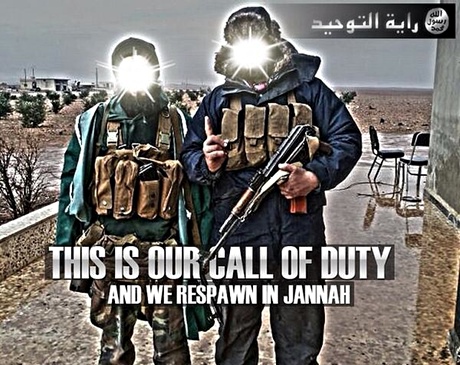
An Isis propaganda photograph.

Patrick Kingsley looks into the success of ISIS’s online propaganda:

Thousands of their Twitter followers installed an app – called the Dawn of Glad Tidings – that allows Isis to use their accounts to send out centrally written updates. Released simultaneously, the messages swamp social media, giving Isis a far larger online reach than their own accounts would otherwise allow. The Dawn app pumps out news of Isis advances, gory images, or frightening videos like Swords IV – creating the impression of a rampant and unstoppable force.

And it works, Iraqis say.

When Isis stormed Mosul, Iraqi soldiers fled their posts, apparently aware that they would face a gruesome fate if they were captured while on duty. “The video was a message to Isis’s enemies,” says Abu Bakr al-Janabi, an Isis supporter in Iraq who claims to have knowledge of the group’s media operations. “It’s Isis saying to them: look what will happen to you if you cross our path. And it actually worked: a lot of soldiers deserted once they saw the black banners of Isis.”

Canadian-born ISIS fighter “Abu Usamah” describes how the group puts skilled recruits from the West to work, including in its media department:

[W]hen prospective members do arrive on the Syrian front, he says ISIS places them into skill-specific trades supporting their overall war machine. In other words, there are fighters, there are thinkers, and there are even propagandists for the outfit now carving out a new state in northern Iraq and Syria.

For example, I asked him about the super-stylized ISIS videos of battle highlights, which are both horrifying in content and impressive in production value. It’s a far cry from the grainy videos Osama Bin Laden issued during the invasion of Afghanistan in 2001. “We have a large media department and Doula [ISIS] doesn’t allow people with skills to enter the front lines,” Abu Usamah said. “If you’re an engineer, doctor, or in the case of a graphic designer, etc you are placed in a position suited to your skill set. Many underestimate the strength and organization of this state, many just think of us as bloodthirsty barbarians which is FAR from the truth.”

Meanwhile, enterprising retailers in Indonesia and Turkey are rolling out ISIS swag:

(Top image: ISIS propaganda)

Reality Check, Ctd

Screen Shot 2014-06-24 at 2.56.59 PM

Yesterday I posited that Obama’s sudden downward turbulence in the polls was almost certainly about Iraq. Sure was:

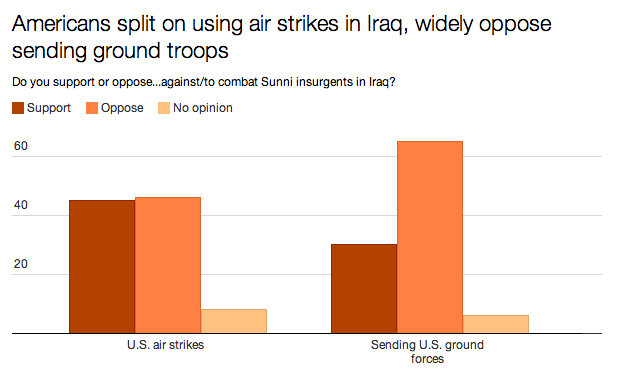
President Obama receives his worst marks yet for handling the situation in Iraq, with 52 percent disapproving and strong negative sentiment now outpacing strong approval by 2 to 1 (34 to 17 percent) in a new Washington Post-ABC News poll. Asked whether the U.S. should launch air strikes against Sunni insurgents, 45 percent support and 46 percent oppose that idea. Fifty-eight percent of Republicans support air strikes, compared with 44 percent among Democrats and 41 percent of independents. The gap between men and women is just as large and extends across party lines. Men support air strikes by a 54 to 40 percent margin, while women oppose them by 52 to 38 percent.

Nearly two-thirds of the public, however, opposes sending U.S. ground forces to combat insurgents, including at least six in 10 Democrats, Republicans and independents. No demographic or political group in the poll expresses majority support for deploying ground troops, while opposition surges to above 70 percent among those over age 50 and post-graduates.

Flagging yet another new poll, Aaron Blake remarks on the partisan gap:

A new CBS News/New York Times poll on Iraq suggests that the American people are quite uncertain about what should be done amid the rise of the al-Qaeda-inspired group ISIS. Perhaps most notably, though, there is little urgency among Democrats or independents to get involved, suggesting that any push for further involvement will be spurred in large part — yet again — by the political right.

The poll shows majorities of Democrats (51 percent) and independents (55 percent) believe that the United States does not have the responsibility to do something in Iraq, while 52 percent of Republicans say it does. Similarly, majorities of both Democrats (60 percent) and independents (56 percent) say the violence in Iraq doesn’t raise the threat of terrorism against the United States. Six in 10 Republicans say it does increase the threat.

Waldman ponders why Obama’s approval numbers keep sinking when he and the public agree on pretty much everything:

While you can quibble about the wording of a question here or there, the overall picture is one of a public that would like to help, so long as it doesn’t involve much direct risk to our personnel, but still doesn’t think what we do is going to make much of a difference. That certainly sounds like a description of where the President himself is at the moment.

So why doesn’t he get more credit for being on their side? We can stipulate that there is literally nothing Obama could do that would satisfy most Republicans; when he says he intends to do exactly what they want, they simply change what they want, since agreeing with him on anything is psychologically intolerable for so many of them. But what upsets most Americans, I suspect, is that we’re being forced to think about Iraq at all. To the American public, the place is a black hole, sucking all our good intentions and sacrifice and money and attention into its miasma of chaos. They hear that there’s an army of Sunni extremists rampaging through the country, then see that Muqtada al-Sadr’s Shiite followers are mobilizing in response (remember when they were the bad guys?), and they can’t figure out how anything we could do would possibly stop this nightmare.

Which is where I am – except I’ve come to a more non-interventionist position overall since 2003. Drum’s take:

In other words, Iraq is like the economy: it doesn’t really matter what the president is doing. If the economy is good, the public approves of his performance. It it’s bad, they disapprove.

But Larison isn’t letting Obama off the hook:

As I’ve said before, Obama sets himself up to fail by trying to take the “lead” in crises and conflicts that the U.S. doesn’t know the first thing about resolving. The mismatch between rhetoric and action has been a persistent problem for this administration. For instance, Obama has made unnecessary declarations about the legitimacy of other leaders and governments (e.g., “Assad must go”) that would seem to require much more aggressive policies than he or the public would be prepared to support. As a result, his policy is judged against the much higher standard that he unwisely set for the administration. Pursuing more ambitious hawkish goals with limited means puts Obama in a bad position at home as well, since it invites attacks from hawks that always want the U.S. to “do more” without giving anyone else something that they can fully support.

I agree. But in his actions, Obama has been more eloquent. Maybe it’s impossible for a US president to resist giving the impression that he is somehow able to do anything about vast, complicated upheavals thousands of miles away, but at some point we need one who will say so more definitively.

The Best Of The Dish Today

Queen Elizabeth II And Duke Of Edinburgh Visit Northern Ireland

Goldblog and the Dish – in some strange solstice convergence – are on (roughly) the same page again with respect to Iraq. Jeffrey fisks Elliott Abrams’ deranged piece in Politico called “The Man Who Broke The Middle East.” As an insight into the hermetically sealed neocon mindset, Abrams is always worth reading. As an insight into, you know, reality, not so much. Anyway, a great fisk, Goldblog! Money quote:

In reference to a “contained” Iran, I would only note that Iran in 2009 was moving steadily toward nuclearization, and nothing that the Bush administration, in which Elliott served, had done seemed to be slowing Iran down. Flash forward to today—the Obama administration (with huge help from Congress) implemented a set of sanctions so punishing that it forced Iran into negotiations. (Obama, it should be said, did a very good job bringing allies on board with this program.) Iran’s nuclear program is currently frozen. The Bush administration never managed to freeze Iran’s nuclear apparatus in place. I’m not optimistic about the prospects for success in these negotiations (neither is Obama), but the president should get credit for leading a campaign that gave a negotiated solution to the nuclear question a fighting chance.

Think of the careful and global coalition Obama assembled to isolate Iran on the nuclear question – Russia, France, Britain, the US, China all on the same page, leading to a successful preliminary agreement and coming to a conclusion soon on the second (or maybe not). Now remember Walter Russell Mead’s contention that

There is also the question of whether the earnest White House types who have piled up such a disastrous record in the Middle East could negotiate their way into a used car lot, much less handle a complex negotiation involving Russia, Iran, Assad, and a bunch of other canny operators.

Blogger, please. And notice one of Mead’s more hysterical moments of criticism – when Obama decided against striking Syria in favor of Putin’s offer to coordinate the extraction of all of Syria’s WMDs. Yesterday, the final shipment left Syria’s shores. We were all told this would never happen. It just did. Now ask yourself: if Obama had bombed Assad, do you think those chemical weapons would now be secure? And if they were still in Syria, with ISIS raging nearby, we’d have a real international crisis, wouldn’t we? Dick Cheney’s nightmare – Jihadists with WMDs – would be one step closer to reality. But, thanks to Obama (and not Bush) the threat of those WMDs from Syria has evaporated, and Iran’s nukes could be next. Without invading anywhere or torturing anyone.

I’m still trying to figure out how Rebekah Brooks was acquitted today, but the shoe that really dropped was the news that Scotland Yard will soon be formerly interrogating Rupert Murdoch himself about the widespread criminality on many of his papers over a long period of time.

Today, we also witnessed America’s initiation into the loss and grief of the World Cup; wondered if NATO expansion had made Europe less secure; noted the sudden lurch downward in Obama’s approval ratings; and continued the greasy, bacterial thread on grocery bags (now with GIFs!).

The most popular post of the day was Spurious Correlations from May (a gem); next up was my fisking of Walter Russell Mead, Raging Against Obama – And History.

Many of today’s posts were updated with your emails – read them all here.  You can always leave your unfiltered comments at our Facebook page and @sullydish. 15 more readers became subscribers today. You can join them here – and get access to all the readons and Deep Dish – for a little as $1.99 month. One subscriber writes:

It’s seriousness and sanity that Dishniks like me crave and value. Not for nothing, in other words, that you call them “Mental Health Breaks.” They feel like an intrinsic part of the sanity of The Dish, not a luxury option or frill. I’m going to get your brutal, naked self-examination of your position on the Iraq War, but I also get sloths as beards (and groan-worthy reader updates about beavers).

I skip over most but not all of your religion-themed posts (as one might expect from an atheist), but I’ll stop to marvel at the ingenuity of the VFYW contestants along the way. Then you’ll write something mildly infuriating about social constructionism or whatever it is you mean by “post-modernism” and I’ll begin a tart retort in high dudgeon, only to be side-tracked by one of your insightful assessments of the sanity of Obama … or by some shameless beagle-bait (you could do more of that, actually). And so I’ll be reminded once again that my redoubtable dudgeon switch can be safely disengaged. Dishness achieved once again; we now return you to your regularly scheduled program.

Which will continue in the morning; see you then.

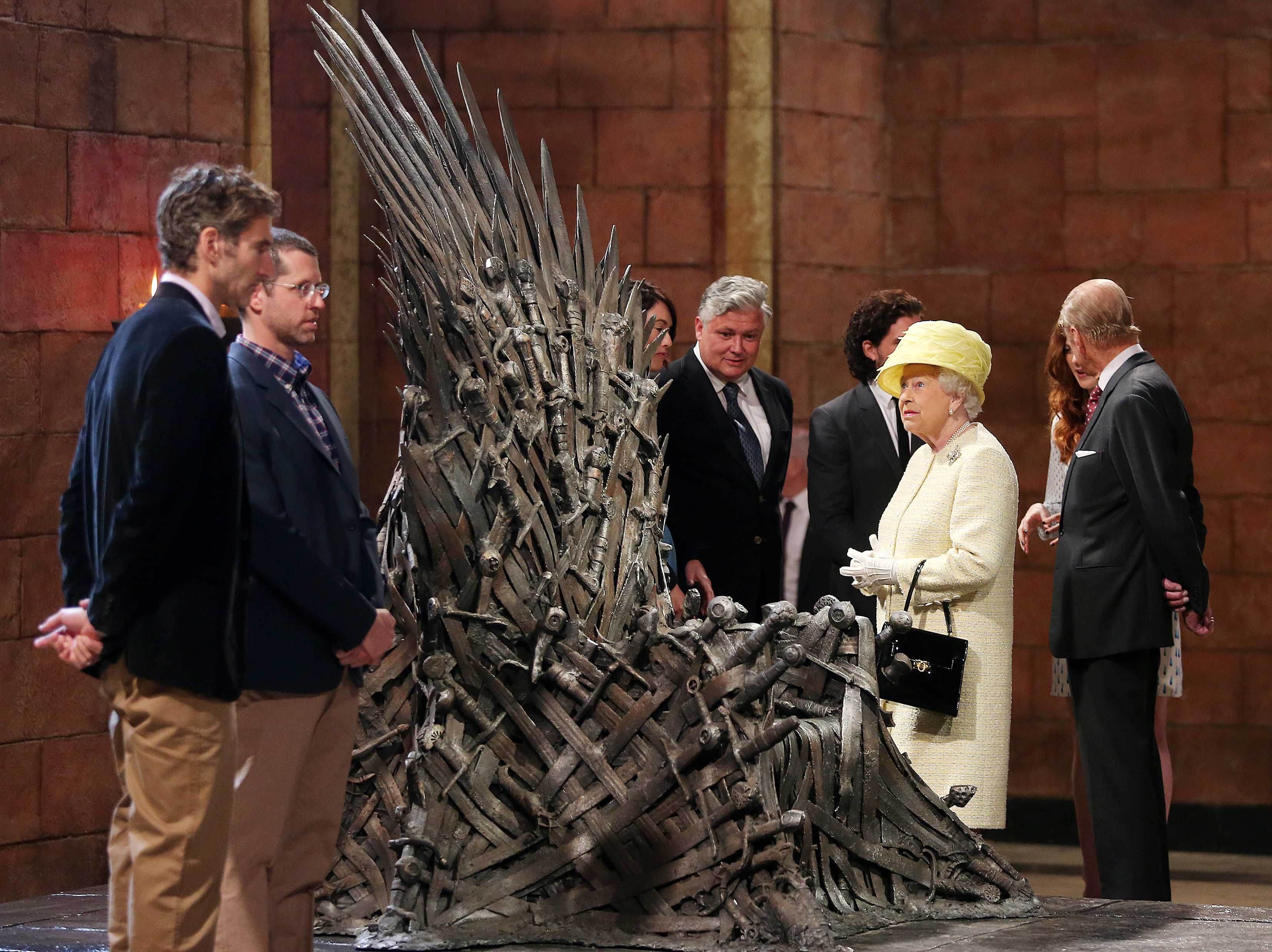
(Photo: Queen Elizabeth II meets cast members of the HBO TV series ‘Game of Thrones’ Lena Headey and Conleth Hill as she views some of the props including the Iron Throne on the set of Game of Thrones in Belfast’s Titanic Quarter on June 24, 2014 in Belfast, Northern Ireland. By Jonathan Porter – WPA Pool/Getty Images.)