Micah Zenko calls out Obama’s strategy against ISIS as another example of “political leaders presenting totally unrealistic and implausible end states”, which has been a hallmark of US counterterrorism since 9/11:
Given that two administrations have failed to achieve their end states of defeating the Taliban and al Qaeda and its affiliated organizations, we should be extremely doubtful of the Obama administration’s strategic objective of destroying IS or its ability to threaten the United States or any of the world’s 1.6 billion Muslims. Furthermore, it is difficult to ascertain what the Obama administration has learned from the total failure to eliminate the Taliban and al Qaeda and all affiliates. Based upon White House statements, it appears that its sole lesson from the post-9/11 era is to avoid massive ground invasions, and to emulate the policies from Yemen and Somalia, which again, according to U.S. government data, have not worked.
On Friday, Pentagon spokesperson Rear Admiral John Kirby was asked how IS would be destroyed, beyond airstrikes and supporting partners on the ground. He replied: “It also is going to take the ultimate destruction of their ideology.” If this is truly the ultimate pathway for IS’s destruction, then it was strange that it did not appear anywhere in President Obama’s strategy speech. Furthermore, altering the interpretation that others hold of a religious ideology is something that governments are really bad at.
A million amens to that. Meanwhile, Allahpundit responds to the CIA’s pessimism about arming the Syrian rebels:
Increasingly, I think this whole arm-the-rebels plan is just a perfunctory mad-libs answer to an obvious question about O’s ISIS strategy.
Everyone understands that we can put a hurt on them from the air; we can probably also pull together a force in Iraq between the Iraqi army and the peshmerga to push ISIS back into Syria. But what happens then? If the plan is to destroy them, how do we get them once they’re back inside their home base and hunkered down in Syrian cities? We don’t. In reality, we’re practicing a containment strategy, the first step of which is to shove ISIS out of Iraq and the second step of which is to drone their key leaders and terror camps once they’ve returned to Syria. Destroying ISIS will be left to the Shiites who are really motivated to do it, be it Assad, Iran, Hezbollah, or, most likely, Shiite militias from Syria and Iraq. This FSA pipe dream is less an actual plan than a rhetorical one, so that O has an out-of-the-box answer handy when someone asks him “Who’s going to fight our battle in Syria?” What’s he supposed to say, “Shiite death squads”? That may be the correct answer but it’s not a politic one.
Discussing the CIA’s recently revised estimate of how many fighters ISIS has, which rose dramatically from 10,000 to somewhere between 20,000 and 31,500, Carl Bialik points out how hard it is to count them:
Intelligence experts outside the CIA cast some doubt on the precision of the estimate. Michael O’Hanlon, a senior fellow at the Brookings Institution, a centrist think tank in Washington, said even the wide range of numbers may understate the uncertainty in the count. “I’d say the estimates are no better than +/- 50%,” O’Hanlon said in an email. Anne Stenersen, a research fellow at the Norwegian Defence Research Establishment in Kjeller, Norway, said the accuracy of the estimates depends on the CIA’s sources. “For a country like Afghanistan, I would trust their estimates because they have access to many different sources on the ground,” Stenersen said in an email. “In Iraq/Syria and for a group like ISIS, it is really hard to know where they get their numbers from, and how reliable they are.”
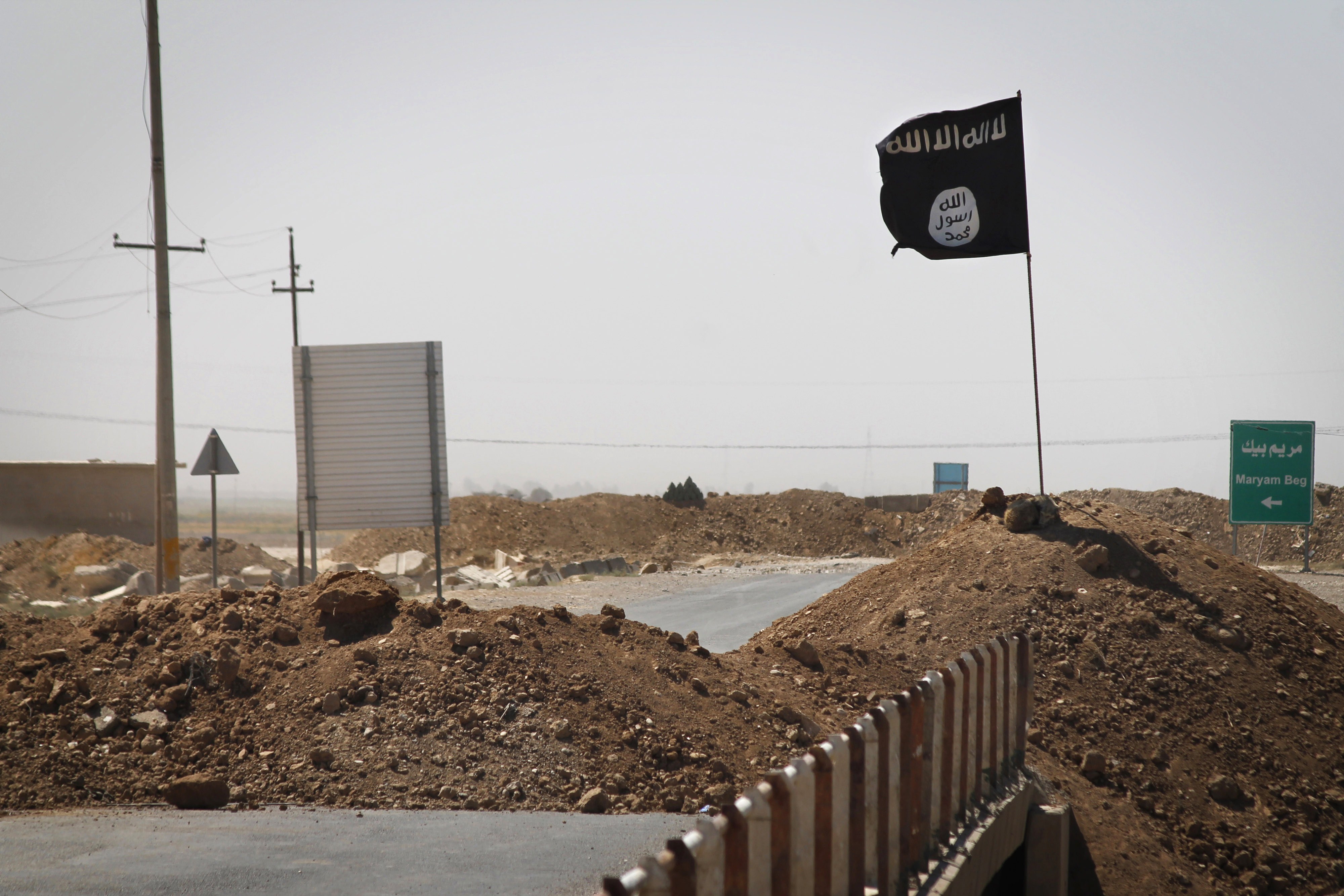
(Photo: A flag of the Islamic State (IS) is seen on the other side of a bridge at the frontline of fighting between Kurdish Peshmerga fighters and Islamist militants in Rashad, on the road between Kirkuk and Tikrit, on September 11, 2014. By JM Lopez/AFP/Getty Images)
Murtaza Hussain introduces the jihadists’ latest propaganda innovation, which looks to court fans of the Grand Theft Auto video game series:
A new video purportedly released by supporters of the group to Arabic language news media appears to show Islamic State, or ISIS, propaganda mocked up in the style of the popular “Grand Theft Auto” franchise. The video shows footage of explosions, sniper rifle attacks and drive-by shootings all rendered in the style of the GTA series. Arabic commentary included as subtitles contain quotes along the lines of targeting U.S. forces and “the Safavid Army”, a reference to Iranian or pro-Iranian forces. They also show images of an assault rifle riddling a police car full of bullet holes — a scene that would not be altogether unfamiliar to Grand Theft Auto players. …
Though the new video appears to constitute a trailer, there’s no indication yet that a real, playable game is in the offing anytime soon. Nonetheless, coupled with the group’s release yesterday of a new propaganda trailer directed at the United States, it appears that the ISIS media war is continuing to evolve in new and weird directions.
But the viewer is clearly meant to understand that the “real, playable game” is available only in Iraq and Syria. At least, that’s what Jay Caspian Kang suspects:
The similarities between ISIS recruitment films and first-person-shooter games are likely intentional. Back in June, an ISIS fighter told the BBC that his new life was “better than that game Call of Duty.” Video-game-themed memes traced back to ISIS have been floating around the Internet for months, including one that reads, “THIS IS OUR CALL OF DUTY AND WE RESPAWN IN JANNAH.” (“Respawn” is the gamer word for reincarnate.) Another ISIS video, as the Intercept notes, looks like a deliberate homage to Grand Theft Auto. Audio clips that sound much like ones in Call of Duty have been spliced into other ISIS videos. Many of the ISIS recruitment videos are dedicated to showcasing rocket launchers, mines, and assault rifles, as if to say, “If you join us, you’ll get to shoot these things.” …
In their recruitment of Western jihadis, ISIS has used a broad, pop-culture-laden campaign that seems to be aimed at turning what once might have been a radical religious message into something more worldly. During the World Cup, an ISIS Twitter account posted an image of a decapitated head with the message “This is our football, it’s made of skin #WorldCup.” That ISIS would try to access Western kids through such avenues speaks to a deep cynicism that discards the religious and the political for adrenaline and gore.
A day after Iraqi PM Haider al-Abadi ruled out allowing the US to re-station ground forces in his country, Juan Cole observes that the country’s Shiite militias, widely considered proxies of Iran, are also warning against American intervention:
Hamza Mustafa reports from Baghdad that Hadi al-Amiri, head of the Iran-backed Badr Corps, warned that the American plan is to take credit for the victories of the Iraqi armed forces and the popular militias. He called for a rejection of the plan and dependence solely on Iraqi military and paramilitary to defeat ISIL. … The Bloc of the Free (al-Ahrar) led by Shiite cleric Sayyid Muqtada al-Sadr called on al-Abadi to reject the US plan. Muqtada al-Sadr warned the US against trying to reoccupy Iraq and threatened, “If you return, we will return.” This was a reference to his Mahdi Army, which had subsided in importance after the US withdrawal. Muqtada boasted that the militia had inflicted heavy casualties on US troops and forced the US out. He also said that if the Mahdi Army “Peace Brigades” discovered an American presence in any province where they were fighting ISIL, they should immediately withdraw from the fight.
His conclusion:
It is difficult to tell how serious these militia leaders’ pronouncements are, since they might be attempting to save face with their followers even as they benefit from the US air cover. On the other hand, Asa’ib Ahl al-Haqq actually did in the past kidnap US troops, and the Mahdi Army fought them tooth and nail in spring of 2004, inflicting high casualties on them. Since President Obama’s air campaign requires Special Ops forces like Navy Seals or Green Berets to be on the ground with the Iraqi Army, they should apparently watch their backs. The people they are trying to help against ISIL don’t seem to appreciate their being there. And many of them seem to prefer Iran’s help.
So there are indigenous forces against ISIS that are telling us: we’ve got this. And we’re over-ruling them. Eli Lake, on the other hand, interprets these statements as evidence that Iran is working against us, noting that Tehran itself opposes US involvement in the conflict on the ground:
[Mohammad] Javad Zarif, Iran’s foreign minister, told an audience at the Council on Foreign Relations on Wednesday evening that Iran provides the militias with help organizing, some weapons, and military advisers. He also stressed they were disorganized. Nonetheless, Zarif said that any U.S. ground presence in Iraq would likely spur opposition. “The problem also when it comes to the United States is that the presence of foreign forces in any setting creates domestic opposition and domestic resentment,” he said. “And it is best, whether we support this or not—and we certainly do not support anybody engaging in anything that would complicate the situation—is to allow the Iraqis to fight this.”
Phillip Smyth profiles the resurgent Shiite militias, which he calls “highly ideological, anti-American, and rabidly sectarian organizations” and nearly as much of a security problem as ISIS itself:
Shiite militias have embedded themselves within the structures of the Iraqi government, which has become far too reliant on their power to contemplate cracking down on them. Together, they have committed horrifying human rights abuses: In early June, Shiite militias along with Iraqi security forces reportedly executed around 255 prisoners, including children. An Amnesty International report from June detailed how Shiite militias regularly carried out extrajudicial summary executions, and reported that dozens of Sunni prisoners were killed in government buildings. …
The growing power of these militias is a sign that, despite Maliki’s removal as prime minister, the Iraqi government remains beholden to deeply sectarian forces. These militias have generally retained their operational independence from Baghdad, even as they exploit the country’s nascent democratic system to gain support through their domination of official bodies. They are not simply addendums to the state — they are the state, and do not answer to any authority in Baghdad, but only to their own clerical leaders or Tehran.
All the same, Ben Fernandes argues that cooperating with Iran against ISIS carries fewer risks than not cooperating with Iran:
The current U.S. strategy to defeat ISIS unintentionally incentivizes Iran to build a nuclear weapon by increasing Iran’s perception of external threats and a need for the protection afforded by the possession of nuclear weaponry. The U.S. intent to arm “moderate” Sunni groups in Syria to fight ISIS will simultaneously (if inadvertently) increase the “Sunni threat” to Iran and Iranian allies like the Assad regime. Iran perceives all Sunni groups in the Levant as threatening regardless of a Sunni group’s views of the United States as the enemy. Just as Saddam Hussein prioritized potential threats from Iran and internal dissidents far above the threat of external attack from the United States, Iran acts similarly towards internal dissidents, Saudi Arabia, and other Sunni groups vis-à-vis the United States.
ISIS credibly threatens regional stability, Iranian interests, U.S. interests, Iraq, and many others. As such, there may be a way to find common ground with Iran in the fight against ISIS. Iran will not become a reliable U.S. partner, but can be a transactional partner for specific issues of mutual interest just as the U.S. partnered with the Soviets in World War II. A grand U.S.-Iran bargain over Syrian governance, ISIS, Iranian nuclear weapons, and sanctions may be more practical than dealing with each of these issues in sequence, per the current “ISIS first” approach discussed in GEN Dempsey’s testimony.
I’m a huge admirer of Roger Cohen’s writing – and can appreciate many of the thoughts percolating in his latest column on what he sees as a disintegration of the world order. He manages to cite Scottish independence, the rise of ISIS, and the devolved powers to Eastern Ukraine – and even Ebola! – as part of a trend toward dissolution and anarchy.
But when I look at all the developments he is citing, I don’t really see anything that new. Take Iraq – please. What we are witnessing is the second major Sunni revolt since they were summarily deposed from power by the United States in 2003. How is this new? The Sunnis have long since believed in their bones that Iraq is theirs by right to govern. They despise the Shiites now running the show. The entire construct of Iraq in the first place was designed on the premise of permanent Sunni rule over the majority. That rule necessarily had to be despotic – as all attempts to permanently deny rights to a majority in the country must be.
So we removed the despot – as we did in Libya – and we have an ongoing power-struggle that is a continuation of the same power struggle Iraq has been hosting since time immemorial. I mean look at that map on the right, from Wiki on the current division of power and land in Iraq. Does it look familiar? It looks like every map of Iraq’s sectarian divide since time immemorial. And we think we will change that by air-strikes?
My fear is that the catastrophic error of 2003 will never lead to a stable state, because the Sunnis will never tolerate or trust majority Shiite rule. Yes, we bribed them enough to switch sides temporarily in the “surge”. But they knew we’d leave; and they knew what they had to do when we did. The only conceivable way to avoid such a scenario would be to stay in Iraq indefinitely – but that too is untenable, for both the Iraqis and for us.
The Beltway nonetheless decided – against all the evidence – that the surge had worked, that sectarian passions had subsided, and that a multi-sectarian government would be able to overcome the profound rifts in Iraqi society that have always been embedded in its DNA. We were sold a bill of goods – by Petraeus and McCain and the other benign imperialists. They have spun a narrative that Iraq was “solved” in 2009 – and that the absence of US troops led to subsequent failure. But they flatter themselves. We never had any real reason to believe these sectarian divides had been overcome – and after a decade of brutal and traumatizing mutual slaughter, why on earth would they be?
Iraq was unraveled in 2003; in my view, it has thereby become the battle-ground for the simmering, wider Sunni-Shiite civil conflict that has also been a long-running strain in the region. Our own solipsistic focus on ISIS as another al Qaeda against us – again the narrative of the utterly unreconstructed neocon right and the pious interventionist left – misses this simple fact. We cannot see the forest for our own narcissistic tree.
When you look at Russia and Ukraine from the same historical perspective, the unraveling meme also seems unpersuasive. Russia is a proud and ornery and mysterious country. It has gone from global super-power to regional neo-fascist state in a matter of decades. Its sphere of influence has retreated from the edge of Berlin to the boundaries of Ukraine, which it simply controlled for an extremely long time.
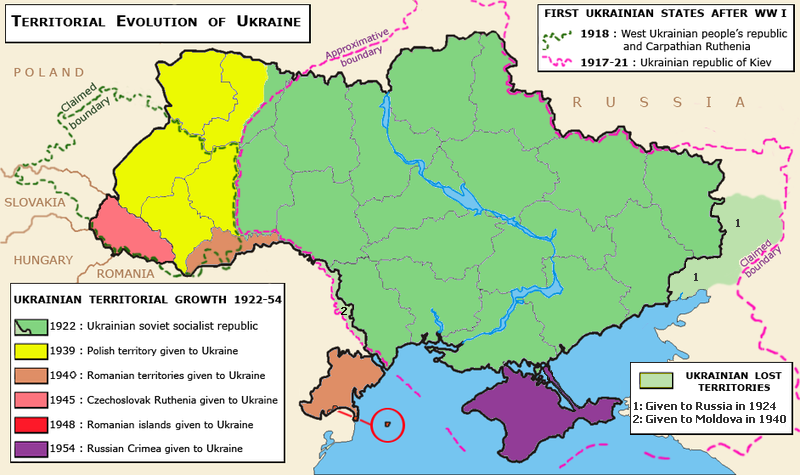
Ukraine has never existed as an independent country for very long; as you can see from another Wiki map on the left, it is itself a cobbled together mix of land lost to Russia, gained from Poland and Czechoslovakia and Romania. It was “given” the Crimea by the Soviets only in 1954. And throughout, Russia has obviously been its big brother, with a deep belief in its right to dick around with its near-abroad (a similar historic belief to the Sunnis faith in their own right to rule).
And what is sometimes lost in all this is that the last pro-Russian leader of the country was democratically elected and then deposed by a revolution from the European-centered populations of the West of the country. Russia did not start this; it reacted to a sudden, revolutionary loss of a pliant neighbor. Anyone with any inkling of Russian history would know what would happen next. I’m not defending Putin’s military and pseudo-military aggression. I am saying that the resolution reached this week – with significant autonomy for the Eastern, Russian-speaking provinces together with a new trade pact with the EU is a perfectly logical way to resolve this. And if Scotland demands outright independence, who could deny the East Ukrainians for wanting more autonomy?
Then Scotland. I don’t know what will happen – and, yes, the term “unraveling” is the most apposite in this case. But what the campaign has shown is that the unraveling has already taken place, that the desire for self-government and the disdain for the Westminster elites have combined to make the current arrangement anachronistic. But that kind of change – conducted democratically and peacefully – is not the same thing as an undoing. It is an adjustment to an emergent, new reality. And it increases democracy in the UK, rather than diminishing it.
What I’m saying is that America is in great danger of over-reacting to all these things, and blundering into new errors because of a generalized anxiety about declining relative US power, and PTSD from 9/11 in which every Jihadist in a hummer with a knife and a social media presence is imminently going to come over here and slit our collective throats. So my “hysteria” about this new, unknowable, fast-escalating rush to war is actually the opposite. It’s really a call to calm down, to breathe deeply, to stop reacting to the news cycle like neurotic lab-rats and to remember history – ours and theirs. And to carry on.
I thought Obama was the man to sell this message. But he has been overwhelmed by the collective freak-out. Maybe he’ll regain his composure, keep this war limited and contain these loons for others, with much more at stake, to fight. Or maybe American amnesia will take hold again – and the Jacksonian impulse will once again trump every rational attempt at a foreign policy that isn’t always doomed to repeat the errors of the past. From the way things are going, it’s America’s own history of Jacksonian violence against outsiders that will prevail. We believe we are immune from history – that it can be erased, that what matters is just the latest news cycle and the political spin that can be applied to it. But history will have – and is having – the last word.
Aki Peritz and Tara Maller want to know why ISIS’s use of rape and sexual slavery as weapons of war isn’t getting more press:
The Islamic State’s (IS) fighters are committing horrific sexual violence on a seemingly industrial scale: For example, the United Nations last month estimated that IS has forced some 1,500 women, teenage girls, and boys into sexual slavery. Amnesty International released a blistering document noting that IS abducts whole families in northern Iraq for sexual assault and worse. Even in the first few days following the fall of Mosul in June, women’s rights activists reported multiple incidents of IS fighters going door to door, kidnapping and raping Mosul’s women.
IS claims to be a religious organization, dedicated to re-establishing the caliphate and enforcing codes of modesty and behavior from the time of Muhammad and his followers. But this is rape, not religious conservatism. IS may dress up its sexual violence in religious justifications, saying its victims violated Islamic law, or were infidels, but their leaders are not fools. This is just another form of warfare.
Even women and girls who escape these horrors still face sexual exploitation in refugee camps. Chandra Kellison reports on what she observed while working with Syrian refugees in Lebanon this summer:
Three-quarters of those displaced in Lebanon are women and children who have lost a family member to war and remain vulnerable inside and outside of their new community. A generation of Syrian kids have the far-away gazes of battle-hardened soldiers returning from war. Displaced girls, especially, face the triple jeopardy of war, domestic violence and attacks from neighboring men. Only the immediate threat of war diminishes during the journey from Damascus to Beirut. Their new normal is neighbors, single women, engaging in survival sex with a series of resourceful men and widows pretending to call husbands who are really dead, all in a bid to seem less vulnerable to kidnappers, harassers, and attackers in their Lebanon. …
Not even the most fertile imagination could have conjured a better monster-in-the-dark than IS. The Brothers Grimm could not compete with stories spreading from city to city of savages that force children to use severed heads as soccer balls. By comparison, the terror caused by IS had reduced the perceived danger of a few opportunists who punch down the dignity and emotional integrity of refugee women and girls through offers that cannot be refused, because the needs of their families are too dire.
Juan Cole argues that containment is the superior strategy for answering the challenge posed by ISIS, noting that “the most effective campaigns in which the US air force has been involved have been more or less defensive”:
A minimalist, defensible position for the US could have been to say that the US will intervene aerially to ensure that Erbil and Baghdad don’t fall, but that recovering the Sunni Arab areas that Nouri al-Maliki had alienated was up to Iraqi politicans and forces. And a minimalist strategy could have simply ignored the Syrian side of the border. It is true that ISIL has a big base in Raqqah and uses its Syrian assets to support its operations in Iraq. But ISIL successes in Iraq were in any case not mainly military but rather political. Since this is so, the military position of ISIL in Syria isn’t really so central to its taking of Mosul, Tikrit, etc. Nor would holding Raqqah help it to hold Mosul if Mosul turned against it.
The US was very good in the Cold War at containing Stalinism but very bad at defeating a guerrilla group like the Vietcong. It was the former that mattered in the end.
He’s right. And I say that not from any ideological position, but simply by observing US policy failure this past decade. To try and do the same thing again when it didn’t work before is the mark of insanity.
Meanwhile, former congresswoman Jane Harman wants to go to war with the ideology of extremism rather than the terror groups themselves:
What’s much more challenging is to confront—and defuse—the ideologies that underpin these groups. The jargon for this is “countering violent extremism” (CVE), a crucial part of the strategy that’s underfunded and hard as all get-out to accomplish. If we lump both al Qaeda and ISIL into one bucket labeled “terror,” we’ll never pull it off.
An example: The State Department recently put out an exceptionally violent video that used some of ISIL’s own promotional materials. The point was to highlight that Abu Bakr al-Baghdadi’s thugs kill Muslims—which is an important point to make. Osama Bin Laden cautioned ISIL’s ancestor, al Qaeda in Iraq, that its slaughter of fellow Muslims made for bad optics. But what might have worked against al Qaeda won’t necessarily work against this new enemy. ISIL glamourizes violence, the notion that its caliphate is worth dying and killing for. The group celebrates death. We need to undermine that pitch with a positive narrative, not amplify its negatives.
Paul Pillar cautions against returning to “war on terror” rhetoric:
Names matter, even if it is not so much the term itself but associated concepts that dominate public discourse and thinking. To the extent that efforts to curb the expansion of ISIS are thought of as War on Terror II, this has unfortunate effects, including the mistaken belief that seizure of territory in the Middle East constitutes a terrorist threat to the United States, and insensitivity to counterproductive effects of the use of military force.
The Obama administration isn’t calling its effort War on Terror II, because it does not want to be seen as copying the approach and the mistakes of its predecessor. Whatever the administration’s motives, eschewing the war metaphor is good for public understanding. What the United States is doing against ISIL is a continuation—albeit more intensively for right now, because of the public alarm—of counterterrorism that has been going on for a long time and, unlike wars, will not end.
And J.M. Berger and Jessica Stern find it“hard to escape the feeling that our policies still come from the gut, rather than the head”:
Bin Laden once said, “All that we have to do is to send two mujahideen to the furthest point east to raise a piece of cloth on which is written al Qaeda, in order to make the generals race there.” Abu Bakr al-Baghdadi, the emir of ISIL, may be counting on just that response, and for the same reason—to draw the United States into a war of supreme costs, political, economic and human.
A limited counterterrorism campaign may insulate us from those costs, but it is not likely to be sufficient to accomplish the goals laid out by the president. ISIL is a different enemy from al Qaeda. It has not earned statehood, but it is an army and a culture, and more than a traditional terrorist organization. Limited measures are unlikely to destroy it and might not be enough to end its genocidal ambitions. Our stated goals do not match our intended methods. Something has to give—and it’s probably the goals.
Could the messaging get any worse? Eli Lake and Josh Rogin wonder how the president will maintain his light-touch approach to fighting ISIS when his people, specifically his top military brass, keep hinting that they favor a more direct intervention:
The internal dissent is likely to intensify with Obama’s choice of John Allen to lead the international campaign to persuade U.S. allies to pony up troops, money, and arms for his new war. Allen, a retired general beloved by Washington’s neoconservatives, has called for a robust U.S. war against ISIS since June. Obama and Allen sat down together Tuesday at the White House. Soon after he retired in 2013, Allen took a veiled shot at his old and now new boss, observing that in the wake of Obama’s withdrawal from Iraq, “the body count is going up, the bloodletting is going up.”
As the details of the president’s new war plan leak out this week, many of Allen’s former colleagues and lawmakers wonder whether the president’s new special envoy will be able to convince Arab and European states to get behind a strategy they see as amounting to a half-measure.
Friedersdorf points out that if Obama didn’t want his administration going off-message and calling for more war, he shouldn’t have staffed it with hawks:
That momentum would build behind war is no fluke. What else did Obama expect when he staffed his entire administration with hawkish Iraq War proponents? Any attempt to measure the momentum for war must include Defense Secretary Chuck Hagel calling ISIS “beyond anything we’ve ever seen,” heated rhetoric from Secretary of State John Kerry, and Vice President Joe Biden vowing that the United States will follow ISIS “to the gates of hell.” Former Secretary of State Hillary Clinton has also been a prominent hawk. This is not a surprise. Obama elevated a faction of hawkish Democrats, despite purporting to believe that they all favored a “stupid” war. Little wonder that elites seem so overwhelmingly in favor of intervention.
Mark Thompson thinks Dempsey’s statement yesterday was telling:
[W]hile he caveated what he told the panel about the escalating fight with the Islamic State in Iraq and Greater Syria, his message was clear: if the U.S.-led effort to defeat ISIS and oust it from its self-proclaimed Islamic State straddling the Syrian-Iraq border falls short, Dempsey will go back to the Oval Office and ask Obama for a green light to send at least a limited number of American ground-combat forces to help get the job done.
What was striking was how he delivered the message. Pentagon officials are forever saying they won’t speak in “hypotheticals”—things that might happen in the future—yet Dempsey dropped an atomic what-if into his opening statement. “If we reach the point where I believe our advisers should accompany Iraq troops on attacks against specific ISIL targets,” he said, “I’ll recommend that to the President.”
And to Zack Beauchamp, it indicates that our commitment in Iraq and Syria could easily snowball:
Obama has final say on America’s Iraq policy and is free to reject Dempsey’s “recommendation” to send troops into combat. Given the president’s wariness about ground wars after George W. Bush’s Iraq War and Afghanistan, and his own consistent promise to the American public, he might reject any plan to send US troops into a direct combat mission. But here’s the third thing: this war is escalating quickly. We went from a targeted mission to protect American citizens in Kurdistan and save Iraqi Yazidis from genocide to a full-scale mission to destroy ISIS in both Iraq and Syria in the span of, roughly, a month. Despite his promises, Obama did indeed consider sending ground troops into combat to rescue Yazidis trapped on a mountain.
Internal pressure from leading advisers like Dempsey could very well push the president towards even larger escalations. So, too, could the internal logic of war.
And Obama appears as if he is a spectator to this dangerous escalation – not someone strongly tamping it down. I fear he has lost control of events – by attempting to appease them.
Yishai Schwartz offers up one, arguing that the president’s approach to ISIS has been perfectly coherent, and not just a reaction to the beheading videos or polls:
Obama began ramping up interventions in Iraq well before these murders, and he did so in response to substantive strategic realities. It was in mid-June that Islamic State militants routed the far larger and better-equipped units of the Iraqi army. Only days later, reports began to surface that President Obama had offered air strikes in support of the Iraqi military, but made them conditional on Prime Minister Nouri al Maliki’s resignation. On August 7, IS militants seized the crucial Mosul Dam.
The same day, profound humanitarian and strategic considerations forced President Obama to compromise somewhat on pressuring Maliki, as he authorized his first air strikes to protect the besieged Yezidi population and to bolster buckling Kurdish forces. Around the same time, the U.S. began to build the international coalition against IS that would emerge weeks later. On August 15, Maliki finally caved to international and internal pressure and stepped aside, and on August 17, American forces helped the Kurds retake the Mosul dam. All of this occurred well before the video of Foley’s murder went online.
This chain of events does not look like a sudden reversal after pressure from post-beheading opinion polls. It looks like a roadmap to war …
I guess you can take this to be reassuring – if you believe in a sustained, perpetual US war in Iraq (currently a war that has lasted from 1990 – 2014). Schwartz’s reading of the chronology is also problematic:
a steadily deteriorating strategic situation, an expressed American willingness to strike predicated on the meeting of a condition, the fulfilment of the condition …
But a clear-eyed assessment of the actual situation does not lead many to believe that IS was about to take over all of Iraq. If it were, do you think Turkey would be hanging back? In fact, its capture of Mosul may well have been its high watermark – unless Americanizing the war gives IS a new lease on life. Then “the meeting of a condition”. I think that refers to getting rid of Maliki. But that was not the condition. The condition was a unified, multi-sectarian government in Iraq – which was the point of the “surge” as well. It never happened under the surge – which is why it failed; and it hasn’t happened even as these loons have come close to Baghdad.
Today, the Iraqi parliament could not confirm the new prime minister’s nominations for the defense and interior ministries – the two that really count, and the two that are still a function of Iraq’s permanent sectarian divides. So as the US president commits this country to war in defense of “Iraq”, the same “Iraq” is so divided it cannot form the government that Obama explicitly said was a prerequisite. Which means it was not a prerequisite. It was more bullshit for an open-ended war with no Plan B that had already been decided upon.
To me, that does not seem something that we elected Obama to do. Au contraire. I will add a couple more points: General Dempsey today filled in the blanks for what happens after the current “strategy” fails:
“My view at this point is that this coalition is the appropriate way forward. I believe that will prove true,” he said. “But if it fails to be true, and if there are threats to the United States, then I of course would go back to the president and make a recommendation that may include the use of U.S. military ground forces.”
You heard that right. And the neocon chorus will continue to fight for another invasion of Iraq – and why not Syria? – as you can see from this classic disingenuous editorial from the Washington Post. Or check out John Boehner, who wants to relive 2003 – 20011 all over again:
“I just think that if our goal here is to destroy ISIL, we’ve got to do more than train a few folks in Syria and train a few folks in Iraq and drop some bombs,” Boehner told reporters Tuesday morning in the Capitol. “I just don’t know that it’s enough to achieve the objective the president announced.”
Neither John Boehner nor the neocons at the Washington Post actually call for ground troops – Obama has allowed them to cavil and complain from the sidelines, without getting them to vote for a new war – but you can see the general drift. The Beltway never truly believed it had screwed up in Iraq – bloviators like McCain actually believe the Iraq war was a success! – and so the notion that a new Iraq War would be obviously a terrible thing does not truly occur to them. This is the price we pay for there being no accountability in Washington – the very war criminals and ideologues that gave us that catastrophe now want to repeat the entire thing, by fanning the flames of panic and hysteria.
[Last Wednesday’s] speech, which was clearly intended to alter the perception of helpless incompetence, merely reiterated the ad hoc approach to Iraq that his administration has pursued since early June. There may be good reasons to go to war against ISIS, but no one has actually articulated them. Are we protecting Erbil and American personnel? Undertaking a humanitarian mission? Fighting evil? Helping the Free Syrian Army? Assisting Washington’s regional allies against the ISIS threat? No one knows, but we are nevertheless turning the aircraft carriers into the wind. This is no way to go to war.
The disheartening aspect of this episode is that the White House’s instincts were initially correct: Foley’s beheading, that of Steven Sotloff, and most recently the murder of David Haines may be horrible, but they are not very good reasons to commit the United States to the conflict in Iraq and inevitably, Syria—two countries that are likely to be at war with themselves for decades. That may be unavoidable, but before the United States leaps in, policymakers should actually develop a strategy. In other words, identify realistic national goals and determine what resources are necessary to achieve those aims. I am not sure anyone has articulated those goals yet, which means that we are still at step one.
I know many of youdisagree. But I fear this is Obama repealing a core pillar of his candidacy and presidency. And there is nothing we can do about it. The Congress has effectively abdicated its democratic responsibility – and Obama is happy about that. So sit back, get some popcorn, and watch successive emperors extend that AUMF into perpetuity. And if you think the Iraq Wars from 1990 – 2014 have been a great success, what’s not to love about that?
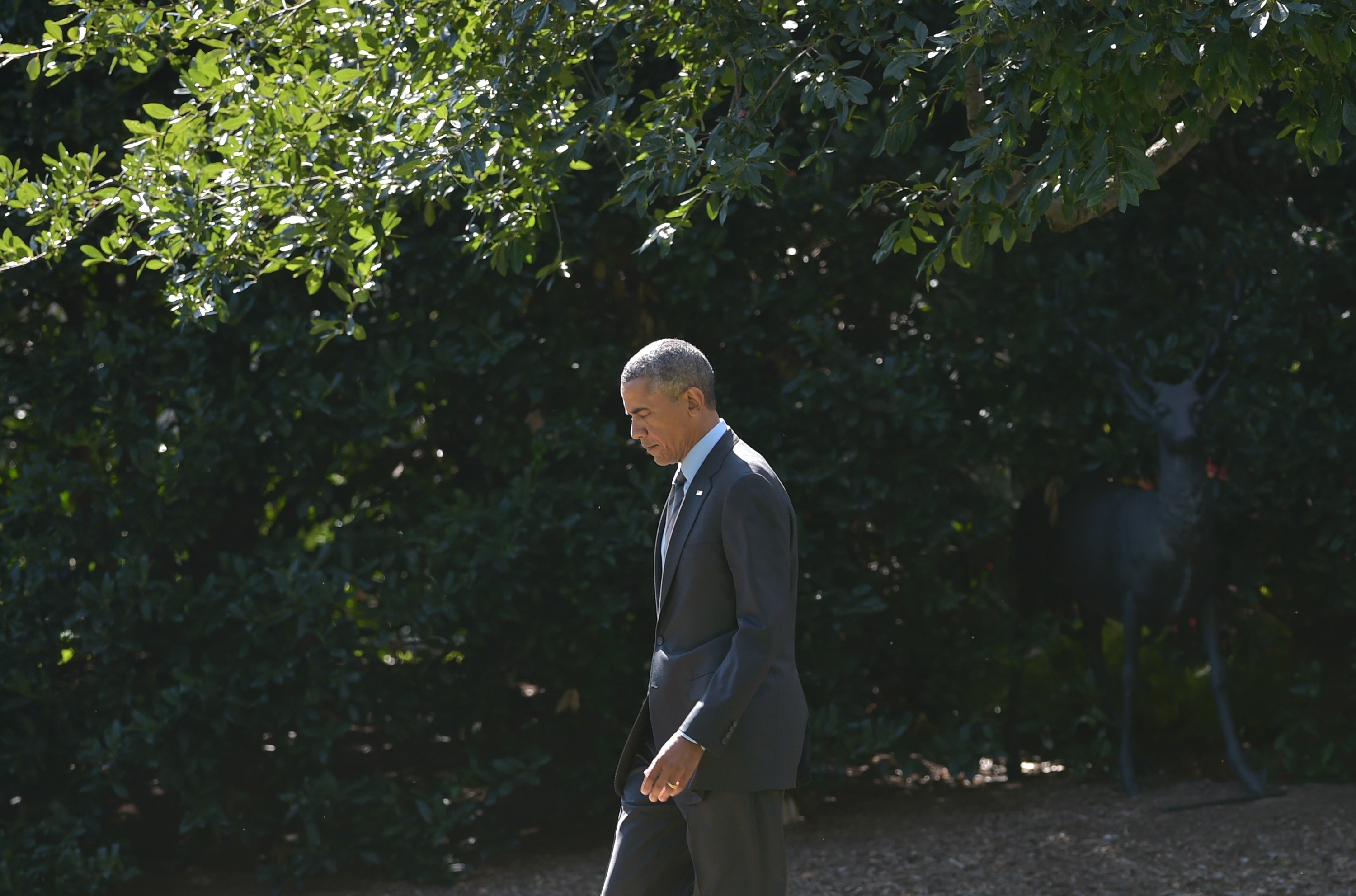
(Photo: US President Barack Obama makes his way to board Marine One on the South Lawn of the White House on September 12, 2014, in Washington, DC. Obama is heading to Baltimore, Maryland to visit Fort McHenry and to attend a fundraiser. By Mandel Ngan AFP/Getty Images.)
The in-tray has been brimming with backlash over my criticism of the president on Iraq. I’m glad to air it – and it’s made me think hard about it again. And this email stung a little – but made me laugh:
[The above] commercial popped into my head after reading you on Obama, and I thought to myself, “I swear it’s Andrew, bless his hysterical heart.”
I share every one of your concerns regarding Obama‘s initiative against ISIS, and yet there is a word in my thoughts that you, as far as I am aware, haven’t mentioned and that president Obama mentioned only once in his speech and in a passing way: genocide.
By both word and deed, ISIS has unequivocally declared its intent to exterminate any and all non-Sunni (and eventually non-Salafist) persons that it can. ISIS has clearly shown itself committed to a level of atrocity far above any usual sectarian blood-letting. They may well have the capacity to kill in numbers that rival Rwanda, perhaps even the Nazis. This thought disrupts my inclination to stand back. Don’t we suffer remorse over past genocides we failed to act against? Can we do much to stop this one? Probably not. Does that take away the moral burden to try? Probably not.
That simple lesson is as follows: American military force to pummel Jihadists from the skies can create as much terror as it foils. Our intervention can actually backfire and make us all less safe. How many Jihadists, for example, did the Iraq War create? Our intervention gave al Qaeda a foothold in Iraq and then, by creating a majority Shi’a state for the first time, helped spawn Sunni support for the Caliphate.
It’s not fair to compare an invasion, followed by nearly a decade of occupation and so-called “nation-building,” to the air campaign and soldier training that Obama is waging against ISIS. For one thing, there’s a great deal of support from Arab nations in the region and moderate Muslims around the world. Yes, we’re doing their dirty work, to some extent. But because that work doesn’t entail our soldiers traipsing through their streets – and since they’ve asked for our help, it’s a totally different dynamic.
In short, we’re the good guys to moderate Muslims who are repulsed by ISIS. As for the extremists who like ISIS, well … we’re never going to win them over anyway, and maybe a show of force will have a deterrent effect on their enthusiasm for ISIS propaganda.
This issue is much too serious to play the strawman game where you ridicule the notion of this kind of intervention eradicating extremism. However strong the president’s language was last week, no one actually thinks this is the cure for Sunni-based violent extremism. It’s merely a way to prevent genocide, empower moderates in the region, and, over the long-term, advance the idea that we aren’t driven entirely by oil interests and imperialism.
And you’re right that it probably won’t be an unqualified success, but one thing I respect about this administration, which I thought you respected as well, is that it takes on issues where the likelihood of complete victory is remote, because they know that any progress is better than doing nothing. It was true with the stimulus. It was true with health care reform. It was true with gay marriage. And it’s true in Iraq.
I take our reader’s point. I would cavil with the idea that “we’re the good guys to moderate Muslims who are repulsed by ISIS”. We have no evidence of that. We have a hell of a lot of evidence that our interventions – especially bombing Sunni areas from the skies – can backfire and alienate the very people we are trying to support. And the idea that, at this point, Iraqis view the US as anything other than a blight on what was once their country seems too naive for me. Another reader:
Were you opposed to Obama‘s campaign to degrade and defeat al-Qaeda’s leadership? No; you kind of liked it. Although Islamic State is apparently not actively targeting the U.S. at this very moment, I see no difference between IS and al-Qaeda in terms of their long-term threat to the Homeland. I think we would be negligent to let them grow in strength unchallenged. The job to degrade them is incredibly difficult and we may fail. We may make it worse if we kill too many civilians again. But I don’t believe ISIS will go away or change their plans if we ignore them. I don’t believe that they will be grateful if we leave them alone to commit genocide or enslavement. Obama could have punted on ISIS, but he didn’t. He is taking seriously and doing the best he can.
Obama is not stupid or craven or cynical or excessively politically motivated. I think he is sad and tired. His vision of humanity and historical progress has taken a beating. The Arab Spring turned out to be pretty disappointing. There are tens of thousands of young Muslim men in ISIS that are objectively evil and inhumanly cruel to innocent and helpless fellow human beings. It is hard not to get depressed about human nature. He is being forced to cough up his legacy of disengagement in Iraq.
The Ferguson incident has revealed that race relations remain fraught in this country despite his attempts to transcend the prejudice and hatred. Both blacks and whites blame him for not doing the right thing (whatever that is). Hispanics think that he is a traitor for delaying on immigration reform. Meanwhile, his approval rating is in the toilet, the Senate is likely to fall to the Republicans, and his last two years may be completely stymied. His supporters have fled. This is the reward he gets for being cool-headed, thoughtful, rational, measured, and brave. Almost everything going wrong is not his fault. Of course he makes a few mistakes now and then, like getting photographed golfing at the wrong time or wearing the wrong suit or saying he isn’t done yet making a strategy. If I were him I would feel mighty, mighty unappreciated.
Andrew, you were the one who could envision the potential of Obama and explain it to the world. That is how I became a reader of your blog in December 2007. You need to try to get back into his head and appreciate what he is up against and why Obama still matters. I still trust him more than anybody I can think of to be leading our country.
One more:
I am an Obama voter, a Dish subscriber, and generally find your take on national and world events well reasoned, thoughtful, and principled. But when it comes to your position on US military action against ISIS, you seem to be over-compensating for your past mistake in supporting the Iraq war.
I am certainly no psychologist (I am an attorney), but I think it is fair to say that you carry tremendous guilt for supporting the Iraq war (I mean, you dedicated an entire Deep Dish e-book to how wrong you were and how awful you feel about it). Certainly, much of America is war weary – rightfully so – but your skepticism and doom-and-gloom take in particular seems to carry more guilt than your typical rational and reasoned analysis.
For what it’s worth, I was against the Iraq war before it become the mainstream popular opinion. I have a pretty good BS-meter, and I knew the pretense for a war in Iraq was a farce from the get-go. It was, and remains, an utter catastrophe. The untold human, financial, and political cost will not truly be known for decades. But you know what? I support this latest fight against ISIS.
Imagine being the President of the United States, Andrew. Even though you campaigned on ending “dumb” wars, and drew down the wars in Afghanistan and Iraq, your absolute, number one constitutional priority as president and commander-in-chief remains: the safety and security of the American people. A large group of well-funded and trained terrorists have taken over swaths of land in the Middle East, brutally maiming and killing innocent civilians along the way. They have publicly declared their intention to attack the US. In essence, they have declared war on America. While they are not large enough, nor capable enough, to actually carry out such an attack at this time, they are only growing, receiving more money, and training more fighters.
As president of the most powerful nation on earth, you have quite a number of options, but they basically boil down to two: You can either take military action or not. I am sorry to be the one to break this to you, Andrew, but there is no president, current, past, or future, that would ever sit back and let such a threat grow to the point of carrying out an attack on America. Certainly not in the post-9/11 world we live in. And you know what? That’s how someone in charge of our security should act. It is the responsible thing to do.
You want to be a violent terrorist organization and declare war on America? Well, now your going to have deal with those consequences. You’re going to be extinguished. And if ISIS is systematically degraded and destroyed, particularly with support from allies and Middle East partners, that will be the right message. The United States, and the world, will have zero-tolerance for this. Zero. Fucking. Tolerance.
The President did not try and BS us by hyping the immediate threat to the homeland; he told us a reality that a war-weary America did not want to hear: that this is the approach you have take with violent fanatics. It is an unfortunate reality that we have to respond to violence with violence, but this is the world we live in. Perhaps there will be a paradigm shift someday when I’m old and grey, and that won’t be the case anymore, but in the meantime, I support this president to uphold his constitutional duty – dealing with these violent fanatics who will never be part of the civilized world the only way they should be dealt with: extermination.
Update from a reader, who notes something that can’t be reiterated enough:
Your reader who wrote this is completely wrong:
Imagine being the President of the United States, Andrew. Even though you campaigned on ending “dumb” wars, and drew down the wars in Afghanistan and Iraq, your absolute, number one constitutional priority as president and commander-in-chief remains: the safety and security of the American people.
The presidential oath states:
I do solemnly swear (or affirm) that I will faithfully execute the Office of President of the United States, and will to the best of my Ability, preserve, protect and defend the Constitution of the United States.
His number one priority is not the safety of Americans; it’s to uphold the Constitution. And the last time I checked, that means letting Congress declare war.
Ali Murat Yel defends Turkey’s reluctance to join the war coalition against ISIS:
Public opinion in Turkey holds that a Muslim cannot be a terrorist and any terrorist cannot be a Muslim. In other words, terrorism and Islam cannot be reconciled. This public conviction is certainly the real attitude of the President Recep Tayyip Erdogan who has formed the Alliance of Civilizations with Spain against the expectation in some quarters of a “clash of civilizations” and has been trying to restore peace with different ethnic groups in Turkey. The President himself and the majority of Turkish people believe that terrorism could be defeated intellectually not through waging war on them.
Turkish foreign policy has been formed on the principle of “zero problems with neighbors” because we believe that stability in the region would only bring more peace and wealth. … Instead of an external military operation the local politicians and people should come together and find their own solution according to their own realities and circumstances. Outsiders cannot understand all the local realities like the ethnic origins, sectarian divisions, or the political or ideological power structures of these peoples. Turkey, finally, does not want to be in the position of going to war in another, neighboring Muslim country.
Sanity! But we, thousands of miles away, know better. Amos Harel takes a look at the background role Israel is playing:
Despite the growing concern, it should not come as a surprise that the Netanyahu government has not yet taken any immediate steps against IS. The government has only announced that the organization would be considered illegal in Israel and the Palestinian territories, and decided to focus intelligence-gathering on the group’s activities in Syria and Lebanon. But while IS might not present an imminent threat at home, Netanyahu has been extremely eager to aid the Arab world in the battle against the group. Last week, the prime minister confirmed media reports that Israel was supplying intelligence to the new anti-IS international coalition. Jerusalem no doubt has useful information to contribute: For decades, it focused on acquiring first-rate intelligence about events in Syria, which it considered its toughest enemy.
Michael Crowley turns to Saudi Arabia, the linchpin of the coalition, and what King Abdullah al-Saud brings to the table:
While Saudi money has long helped nurture a fundamentalist Sunni doctrine that inspires groups from al Qaeda to Boko Haram, Islamic radicalism has come to threaten the king as well. … ISIS seems to have raised the king’s anxiety another notch, however. He has banned Saudis from traveling to join the fight in Syria, lest they return to threaten his regime. Last month Saudi authorities arrested dozens of suspects linked to ISIS — including members of an alleged cell plotting attacks within the country. But Abdullah wields a potent weapon in his defense: his influence over Saudi Arabia’s religious leaders. The king has a symbiotic relationship with his kingdom’s hardline clerics, whose words hold sway far across the Muslim world.
But Simon Henderson suspects that the Saudis will prefer to play both sides:
Despite the diplomacy of recent days, which suggests an emerging coalition that includes Saudi Arabia and will take on the fighters of the Islamic State in Iraq and perhaps Syria, the House of Saud will likely continue to try to balance the threat of the head-chopping jihadists, while also trying to deliver a strategic setback to Iran by overthrowing the regime in Damascus. From a Saudi point of view, the move of IS forces into Iraq contributed to the removal of Nouri al-Maliki in Baghdad, whom they regarded as a stooge of Tehran. Despite official support by Riyadh for the new Baghdad government, many Saudis who despise Shiites probably regard IS as doing God’s work.
Which is why this really is whack-a-mole. The administration, meanwhile, is engaging in linguistic contortions to explain how we’re not “coordinating” with Iran or Syria even if we’re talking to them and perhaps sharing intelligence:
“Coordinating means we talk directly to [the] Syrian Air Force and coordinate our attacks against ISIS with their operations against ISIS,” Christopher Harmer, an analyst with the Institute for the Study of War, told Foreign Policy, using one of the Islamic State’s acronyms. “That’s not happening, won’t happen.” But “deconflicting,” Harmer explained, means that the United States will monitor where the Syrian aircraft are flying and stay out of their way, thus avoiding any potential skirmishes. “That way we don’t accidentally intrude on their operations, or they on ours,” he said.
Harmer said the United States and Iran followed this protocol during the 2003 invasion of Iraq. “The U.S. did not coordinate with Iran, but Iran definitely deconflicted their normal military operations to avoid any unwanted interaction with the U.S., particularly in the Persian Gulf,” he said. In that case, Harmer said, the Iranian Navy held back patrol boats that had often harassed U.S. Navy ships in the Strait of Hormuz. “They backed way down off of their normal operations in order to deconflict with the U.S. operations,” Harmer said.
But Jacob Siegel rightly worries that Iran could become our shadow enemy in Syria:
As Iran showed in the last war in Iraq, when it armed and backed insurgent groups fighting U.S. forces, having a common enemy, as Saddam Hussein once was, won’t prevent Tehran from trying to counter American influence in the Middle East. For Iran, the question is what comes after ISIS. In Iraq there is already a Shia-led government in Baghdad broadly aligned with Tehran. But in Syria, where Shia are a minority, a post-ISIS future threatens to freeze Iran out.
To defeat ISIS, the U.S. is relying heavily on Sunni coalition partners to give its aims local legitimacy and ensure that constructing the post-ISIS political order won’t fall solely to America. Fearing the loss of its power, Iran could try to destabilize U.S.-led efforts in Syria, causing a protracted conflict that would weaken the allied participants. Alternately, if Tehran resigns itself to Assad’s ouster, it may seek other means to maintain its influence in Syria. One option would be controlling the political transfer of power from Assad, to ensure that the new government installed in Damascus remains receptive to Iranian interests. Then there’s the real long shot: that Iran reaches a détente with its Sunni rivals and accepts a power-sharing arrangement rather than a client state in Syria.
(Chart of Middle Eastern relationships viaThe Economist)



 The Dish