Dissents Of The Day I

A reader succinctly sums up a common sentiment in the in-tray:

Give the president some time and see how this works out.  I can’t believe that after six years of meep meep, you keep freaking out like this.

Another adds, “Is it too much of a cliché to say Keep Calm and Know Hope?” Another:

Really disappointed in your attacks on Obama. So far, his actions against IS(IS) have been President Obama Delivers Statement On Situation In Iraqquite successful. Most of the Yazidis are off the mountain and receiving food and medicine rather than a horrible death, the same for the Shia community of Amerli.  IS’s march towards the Kurdish capital of Irbil, a rare success story in the region, has been stopped. IS have lost control of the Mosul Dam, which controls the region’s water and electricity supply and if destroyed would unleash a tsunami over a huge area. Maliki’s been replaced in Iraq. All this without generating any real outrage against America.

Some of the rhetoric about destroying IS may be way unrealistic, but I think his actions have been careful and effective. I think Obama will stall and partially reverse what was an alarmingly rapid expansion of this frightening group, and at an acceptable price ensure the Middle East becomes a little less awful in a situation when doing nothing would see it become a lot more awful. Doesn’t that deserve our support?

Another reader:

As for “war,” calm down. We’re going for containment.  ISIL is not ten feet tall, they’ve lost repeatedly when faced by peshmerga or Iraqi forces backed by US air power.  If Mr. Obama really meant to obliterate ISIL, we’d be talking Marines, not air power supporting the locals. So this is containment to be followed we hope by ISIL making a hash of things in their territory and eventually being nibbled to death by Baghdad and the Kurds and Assad and even the Free Syrian Army.  Al-Baghdadi’s only possible winning move is against Mecca and Medina, and if we block that effectively, he’ll wither over time.  If ISIL attacks the US or Europe we have their home address and we have lots of bombs.  None of this is good, but neither is it time to panic.

Mr. Obama played a bad hand about as well as it could be played.

Another switches metaphors:

As always, I think we underestimate Obama when it comes to playing foreign policy chess.  Remember how it looked like Syria was an utter disaster for him a year ago?

But he achieved his objective, near complete destruction of Assad’s chemical weapons.  I think his long game in the current situation is this: continue a punishing air campaign against ISIL while ramping up intelligence to thwart more videos of Americans being murdered and prodding reluctant allies to step up.  In two months (the extent of his authority, according to the War Powers Act and after the elections), he’ll go to Congress for further authorization.  Then the hot potato is in their laps.  They can’t punt it then – the whole country will be watching.   If the allies have started to roll ISIL back, the chorus for further escalation might be defeated.  If they haven’t, it still might – a lot of Republicans AND Democrats resent our having to clean up other country’s messes alone.

But much more importantly, the decision won’t be made by an imperial president.  It will be made by the recently elected representatives of the people – and that, I think, is Obama’s real objective.

Another references our most recent Email of the Day:

“My gut reaction was that this wasn’t the guy I voted for – what happened to that guy?” What is it about Americans that they constantly delude themselves that the Candidate is ever going to bear any relation to the Office-holder? When junior Senator Barack Obama was running for President in 2008, he had no access to classified information, comparatively little information about the world beyond the borders, and absolutely no information whatsoever about the nature of the threat or of other national security interests in the REAL WORLD. Which is why, incidentally, Mitt Romney quit talking about Benghazi after he was officially the Republican nominee – because if you were reading the papers, you read that the day AFTER the Republican convention ended he got his first, albeit limited, classified intelligence briefing.  

The President of the United States is not, cannot be, and should not be expected to be, the “same guy” as the candidate for the office of President of the United States.  Get over it already. 

Another questions the idea that the president should have a set strategy on ISIS:

Isn’t it possible that the reason Obama did not give a long-range detailed plan for how to deal with ISIL is that he has learned that war in the Middle East is very fluid and constantly changing?  If so, then he is the smartest one in the room, because he is not predicting anything.  He is taking an action (which will have a military effect on ISIL) while basically saying, “Let’s see what’s going on in six months before we choose our next step.”  Maybe the Iraqi government will be more solid; maybe the Kurdish troops will be better trained; maybe our relationship with Iran will be stronger because of a mutual enemy … who knows what will be.  Obama is taking his usual centrist approach and saying let’s see what’s happening later before we decide our next step.

Or as another puts it:

Obama’s proposed path occupies a more flexible, middle ground between the extremes of the neocon’s “shock and awe,” total-war argument and your new “do nothing,” burn-and-rebuild position.

Another round of dissents coming soon.

(Photo by Chip Somodevilla/Getty Images)

Can America “Destroy” ISIS?

Tomasky wishes Obama would treat Americans like grownups and admit that we can’t eradicate the evil embedded in ISIS:

We’ve been trying to destroy Al Qaeda for 13 years now. We have not. We will not. And we will not destroy ISIS. We can’t destroy these outfits. They’re too nimble and slippery and amorphous, and everybody knows it. So why say it? Why not say what we hopefully can do and what we should do: contain it. We have contained Al Qaeda. Some of the methods have been morally problematic (drone strikes that sometimes kill innocents, etc.), but the methods have worked. Al Qaeda, say the experts, is now probably not in a position to pull off a 9/11. Containment is fine. It does the job. But no, I guess a president can’t say that. A president has to sound like John Wayne. It’s depressing and appalling.

Steve Chapman explains why, in his view, the war against ISIS is unlikely to succeed:

The United States is not incapable of fighting reasonably successful wars. It did so in the 1991 Iraq war, the 1999 Kosovo war and the 1989 invasion of Panama. In each case, we had a well-defined adversary in the form of a government, a limited goal and a clear path to the exit. We generally fail, though, when we undertake open-ended efforts to stamp out radical insurgents in societies alien to ours. We lack the knowledge, the resources, the compelling interest and the staying power to vanquish those groups.

The Islamic State is vulnerable to its local enemies—which include nearly every country in the region. But that doesn’t mean it can be destroyed by us. In fact, it stands to benefit from one thing at which both Obama and Bush have proved adept: creating enemies faster than we can kill them. We don’t know how to conduct a successful war against the Islamic State. So chances are we’ll have to settle for the other kind.

In fact, Ishaan Tharoor notes, the one time we managed to “destroy” a major terrorist outfit, it came back … as ISIS:

The closest the United States has come to destroying a terrorist organization like the Islamic State was when it subdued the al-Qaeda insurgency that led to its rise. A U.S. counteroffensive in 2008, aided by a coalition of Sunni tribal militias, beat back al-Qaeda in Iraq; Baghdad, for a brief moment, seemed to be showing the political will to better accommodate Iraq’s Sunni majority regions. But those gains didn’t hold and, in the chaos of Syria’s civil war, units that once belonged to al-Qaeda in Iraq reemerged as the Islamic State.

The irony is unwelcome for a raft of reasons: The Islamic State is far more powerful than its predecessor, boasting as many as 31,500 fighters, according to new estimates from the CIA. That includes an influx of radicalized European nationals, as well as opportunistic defectors from other Syrian rebel groups. The United States does not have the boots on the ground as it did during its occupation in Iraq; nor is it certain that the Obama administration or the Iraqi government can call on the same Sunni militias that helped first push back al-Qaeda in Iraq.

Barack Obama, Neocon?

image001 (1)

In Obama’s reluctance to refer to his military operation against ISIS as a war, Uri Friedman reads an implicit embrace of the notion of perpetual war:

The distinctions between war and peace, of course, have long been murky (think America’s “police action” in Vietnam during another seemingly endless conflict: the Cold War). And few declarations of war are as clear as, say, those issued during World War II. Obama, moreover, has been careful to present his counterterrorism measures as limited to specific groups in specific places that pose specific threats to the United States—rather than, in his words, a “boundless ‘global war on terror.’” But over the course of his presidency, these efforts have expanded from Pakistan and Yemen to Somalia, and now to Iraq and Syria. “This war, like all wars, must end,” Obama declared at National Defense University.

[Last] week, the president set aside that goal. Thirteen years after his predecessor declared war on a concept—terror—Obama avoided explicitly declaring war on the very real adversary ISIS has become. All the same, U.S. soldiers are now going on the offensive again in the Middle East. What is the nature of their enemy? Is it peacetime or wartime? After Wednesday’s speech, it’s more difficult than ever to tell.

Allahpundit thinks Obama has adopted the same logic Bush used to justify invading Iraq in 2003:

He’s spent six years using, and even expanding, the counterterror tools that Bush gave him, but not until now did he take the final step and adopt Bush’s view of war itself.

Obama isn’t responding to an “immediate” threat against the U.S. in hitting ISIS; he’s engaging in preemptive war to try to neutralize what will, sooner or later (likely sooner), become a grave strategic threat. It’s like trying to oust the Taliban circa 1998 for fear of what terrorists based in Afghanistan might eventually do to America — or, if you prefer, like ousting Saddam circa 2003 for fear of what he might eventually do to America with his weapons program. Obama’s going to hit ISIS before cells nurtured in their territory hit us, and good for him. But let’s not kid ourselves what this means: If, as Conor Friedersdorf says, Obama’s now willing to preemptively attack a brutal Iraqi enemy for fear of what he might do down the line to America and its interests, he should have also supported the war in Iraq in 2003.

Former Bush advisor William Inboden unsurprisingly depicts that shift as the president waking up to reality:

It is often forgotten today, but in President Jimmy Carter’s last year in office he developed an assertive policy towards the Soviet Union including a major defense buildup, support for rebels fighting the Soviets in Afghanistan, and suspending any further arms control agreements. Carter adopted these policies after the many traumas of 1979, culminating in the Soviet invasion of Afghanistan, made him realize that the previous three years of his Cold War policies had been naïve and weak. Six years into his presidency, perhaps President Obama has now arrived at a similar “Carter moment” and realizes that with just over two years left in his administration, he needs to make a similar shift.

Americans Support Strategy They Know Won’t Work

Screen Shot 2014-09-15 at 11.55.24 AM

Aaron Blake flags a new poll showing lackluster public confidence that Obama’s approach to ISIS will work, even though most support military action against the group:

This vote of no/little confidence, without a doubt, owes in part to the tough situations in the two Middle Eastern counties the United States has attempted to stabilize over the past decade: Afghanistan and Iraq. Given those experiences, it’s not surprising that Americans would be pessimistic about succeeding against the Islamic State.

But Obama’s persistently low approval rating on foreign policy suggests that it’s also in large part because people doubt he’s up to the task. Polls have repeatedly shown that people don’t think Obama is tough enough. This is an extension of that.

Philip Klein observes that Americans want ISIS destroyed but don’t want to make too many commitments or sacrifices to that end:

A Wall Street Journal poll found that an overwhelming 74 percent of Americans favored at least air strikes against the Islamic State. But before seizing on this as evidence that Americans are now on the side of the uber-hawks, it’s telling that just 34 percent supported sending combat troops. Another way of thinking about this is that Americans don’t like it when the bad guys are kicking the U.S. around on the world stage and the president doesn’t seem to have any sort of plan to do anything about it. But that doesn’t necessarily mean that, in actuality, they are willing to do whatever it takes to stop the bad guys. …

The reality is that if Americans don’t want to bear the costs, they will have to tolerate a certain level of chaos in the world and the insecurity that comes along with it. On the other hand, if they want the U.S. to project strength and leadership abroad — and to aggressively respond to threats against American interests — there’s no way to do it on the cheap.

Daniel McCarthy names this shallow popular hawkishness as the main reason Obama warmed up to the idea of bombing Iraq again:

Obama resorts to bombing because our pundits demand that he “do something.” Leaving Iraq to its own devices, to suffer, burn, and ultimately rebuild, is too cruel, and ISIS with its spectacular propaganda videos makes a great cable news bite and social-media campaign. It’s evil, it’s scary, it’s on YouTube, so what are we going to do about it? Obama would be weak and callous if he did nothing. That he can’t actually do much that matters in the long run is unimportant—our humanitarian urges and Islamophobic fears will be satisfied as long as we get some kind of action right now. So we bomb.

There’s no political risk in bombing, as there is in putting “boots on the ground.” There won’t be too many body bags shipped home to Dover AFB to trouble voters. What’s more, bombing can be of any intensity political conditions demand: if John McCain is howling louder than usual on “Meet the Press,” just drop a few more bombs. That shows you’re a real leader.

Obama’s New War: Dumb Dumb Dumb Dumb Dumb

President Obama Addresses The Nation To Outline Strategy On ISIS

As you are by all accounts aware, the US now faces its deadliest foe, its most terrifying enemy – the likes of which we have never seen – in the deserts of Iraq. If we do not send ground troops into that country again, we will all die at home, says Butters. 90 percent of the country think we are directly threatened by the new Caliphate. And far from calming the hysteria, our leaders have fanned it.

Very few people in political leadership have laid out what this group is actually capable of, what the limits of its potential are, or examined the contingent reasons behind its recent sudden advance. It has been framed as an abstract but vital fight against “pure evil” – a rubric the originator of the phrase “axis of evil” knows more about than most. Here’s a must-read on reality:

Despite its territorial gains and mastery of propaganda, the Islamic State’s fundamentals are weak, and it does not have a sustainable endgame. In short, we’re giving it too much credit.

Consider the fall of Mosul, which catapulted the impression that the group is a formidable force able to engage on multiple fronts simultaneously and overpower a U.S.-trained army that dwarfs its size. In reality, it was able to gain such vast territory because it faced an impotent opponent and had the help of the broader Sunni insurgency. The Iraqi army, lacking professionalism and insufficiently motivated to fight and die for Sunni-dominated Mosul, self-destructed and deserted. The militants can be credited with fearlessness and offensive mobility, but they can hardly be said to have defeated the Iraqi army in combat. At the time, Islamic State militants represented less than 10 percent of the overall Sunni insurgency. Many other Sunni groups helped to hold territory and fight off Iraq’s Shiite government and Iranian-backed militia forces …

The Islamic State’s capture of Sinjar in the northern province of Nineveh further added to perceptions of its dominance and helped precipitate Washington’s decision to carry out airstrikes in Iraq. But that episode was also misinterpreted. Kurdish forces were not only taken by surprise, but since they had only recently filled the vacuum in Sinjar left by Iraq’s fleeing army, they were stretched too thin and poorly equipped to sustain a battle outside their home territory. Lacking ammunition and other supplies, they conceded the territorial outpost and retreated within their borders in Iraqi Kurdistan.

Read the whole thing. IS is already over-stretched, and the regional powers who are actually threatened by it, have been slowly mobilizing against it. All of that was happening before Obama decided to Americanize the conflict. Immediately, there is less incentive for the regional actors to do the work themselves, and IS now has a global legitimacy – the US president is now its chief enemy! – it can leverage for further recruits.

Those Sunni recruits are likely to come from the region, especially if Shiite forces from Baghdad, Tehran and Damascus are its foes. But more importantly, this titanic global struggle will create and foster indigenous, Jihadist terror in the US in response to the war. The only terror attacks we have suffered since 9/11 have been these kinds of attacks. And we just incentivized them.

Let me be clear. I have no illusions about Jihadism or the evil of ISIS. I passionately oppose everything they stand for in every single respect. I abhor their brutality, their twisted version of religion, their pathetic neuroses disguised as faith, their inability to cope with the modern world, and their foul theocracy. But everywhere this kind of extremism has flourished in the Middle East – think of al Qaeda’s failed attempt to turn Jordan – has collapsed because the vast majority of Muslims – like anyone anywhere – do not want to be governed by these murderous loons. That’s why al Qaeda distanced itself. Zawahiri knows that the Caliphate’s path is self-defeating in the end.

So we had a chance to allow that process to take place, to see regional actors be forced to confront it, to allow natural alliances – temporary and durable – form in that region. But a couple of videos and we lost our shit. I am not a pacifist. I do not oppose all wars. What I am opposed to is a dumb war. What I am opposed to is a rash war. A war based not on reason but on passion, not on principle but on politics.

If that sounds familiar, you’re not wrong. But that was a different person at a different time. And we will all live with the consequences of his capitulation to panic.

(Photo: U.S. President Barack Obama delivers a prime time address from the Cross Hall of the White House on September 10, 2014.  By Saul Loeb-Pool/Getty Images.)

Is The Anti-ISIS Coalition Coalescing?

The Obama administration is now saying that “several” Arab countries will participate in an air war against ISIS but won’t say which:

Secretary of State John Kerry, speaking from Paris, declined to say which states had offered to contribute air power, an announcement that White House officials said could await his return to testify in Congress early this week. State Department officials, who asked not to be identified under the agency’s protocol for briefing reporters, said Arab nations could participate in an air campaign against ISIS in other ways without dropping bombs, such as by flying arms to Iraqi or Kurdish forces, conducting reconnaissance flights or providing logistical support and refueling. “I don’t want to leave you with the impression that these Arab members haven’t offered to do airstrikes, because several of them have,” one State Department official said.

Ian Black considers the interests of our likely partners, saying Arab support is symbolically important but might not be that helpful:

Military capability is not a problem: Saudi Arabia, the UAE and Qatar together have hundreds of advanced fighter aircraft, though the six-member Gulf Cooperation Council (GCC) has next to no experience of coordination. Politically, however, fighting with the US would require greater determination than they have yet shown to tackle the jihadis who have sent shockwaves across the region.

Offers of help – most likely from the Emiratis and Saudis – attest to the gravity of the situation. Washington may be cautious given that the Iraqi military has extensive experience of working with the US but none with the Gulf states. The UAE is the most assertive country in the GCC and recently sent jets to Egypt to bomb Islamist targets in Libya. But the more reluctant royals in Riyadh may prefer to be told they can make a more useful contribution in counter-extremism messaging, bankrolling Iraqi tribes or training Syrian rebels.

The administration continues to insist that Iran will not be part of our anti-ISIS coalition, but Jack Goldstone argues that we need them in this fight:

If Iran can be persuaded to adopt a similar role in Syria to the role it is already accepting in Iraq—assent to an inclusive, majority-led but minority-respecting regime, with the United States playing an active role in supporting the military forces of the government—and therefore to withdraw its active support of Assad, Iran can align itself with the broader Sunni coalition that President Obama is seeking to back a political solution in Syria. Creating such an alignment will be incredibly difficult, but it could bring huge benefits to the entire Middle East. Beyond the immediate crisis of ISIL in Syria and Iraq, co-operation between the United States and Iran, and between Iran and Sunni states in the region, in supporting inclusive states in both Syria and Iraq could help to reduce the Sunni-Shia rifts that have kept the region in turmoil.

Khamenei claims we actually did invite Iran into the coalition, but he turned us down:

“Right from the start, the United States asked through its ambassador in Iraq whether we could cooperate against Daesh,” Iran’s supreme leader Ali Khamenei said in a statement on his official website, using the Arabic acronym for IS. “I said no, because they have dirty hands,” said Khamenei, who has the final say on all matters of state in the Islamic Republic. “Secretary of State (John Kerry) personally asked (Iranian counterpart) Mohammad Javad Zarif and he rejected the request,” said Khamenei, who was leaving hospital after what doctors said was successful prostate surgery.

At the same time, Allahpundit doesn’t see how we realistically dismantle ISIS in Syria without Assad’s help:

[I]t’s not Americans who are going to be fighting street to street in ISIS’s Syrian capital, Raqqa. That’s so far afield politically from what Obama promised on Wednesday night, it’s hard to believe voters would ever tolerate the casualties. It’s also hard to believe any “moderate” rebel force will be strong enough within the next, say, five years to do that fighting for us. If anyone’s going to do it, it’s going to be — ta da — Assad’s troops, with Iranian backing. Right? And that assumes that Assad will have the means and motive for reconquering cities in Syria now held by ISIS. If the U.S. can hem ISIS in to a few strongholds like Raqqa, maybe Assad will be content to leave them alone there while he re-consolidates power in the rest of the country. Why, we might even end up with U.S. and Syrian air assets bombing Raqqa in tandem informally. Either way, to truly “destroy” ISIS, there’s bound to be some sort of quiet coordination with Assad at some point.

By way of explaining its reluctance to participate in this war, Adam Taylor takes a look at Turkey’s complicated relationship with ISIS:

Turkey’s entanglement with the Islamic State goes deeper than the hostages, however. Turkey shares a long border with Syria, and some towns in southern Turkey ended up becoming staging grounds for Islamist rebel fighters, including the Islamic State, in the early days of the Syrian war. Ankara tolerated their presence, apparently believing that anything bad for Bashar al-Assad’s Syrian regime was good for Turkey.

They were wrong. As Anthony Faiola and Souad Mekhennet reported for The Post this year, Turkey did eventually crack down on the Islamist fighters, but only after things began to go bad for Turkey: Last year,  the border town of Reyhanlı was hit by a wave of bombings that were blamed on the Islamic State, and there are fears that the extremist group might try further to provoke and destabilize Turkey.

And Rami Khouri is skeptical of the entire coalition-building endeavor:

Announcing a coalition before its members are on board is an amateurish way of operating, because it makes the local players – Arab governments of already mixed legitimacy in this case – look like hapless fools who snap to attention when an American gives the order. Washington is correct to say that a combination of effective local military action and inclusive domestic political systems are required for progress in destroying ISIS, in Iraq especially. I lack confidence in this aspect of the American approach because it is foolhardy to expect that such important requirements can be forged quickly and in the heat of battle – after the U.S. has just spent a full decade and trillions of dollars in Iraq trying but failing to achieve precisely those two important goals. We can even see some counterproductive consequences of the U.S. legacy, such as rampaging ISIS troops taking from the retreating Iraqi security forces the fine arms and equipment that Washington had provided.

How Do You Solve A Problem Like ISIS?

A military approach alone won’t do the trick, Zack Beauchamp argues, emphasizing the extent to which Obama’s strategy depends on political factors largely outside his control:

Even assuming the Iraqi and Syrian rebel forces can be made strong enough to take on ISIS in purely military terms, there’s a list of everything that needs go right — politically — for Obama’s strategy to work out:

  1. The Iraqi government needs to stop repressing and systematically disenfranchising Sunnis. It also needs to accommodate their demands for positions of power in government in perpetuity, so ISIS doesn’t just pop back up after the US leaves.
  2. The US must avoid sending the signal that it’s coordinating with Iran, which would put it on the Shia side of a sectarian war.
  3. Syrian rebels armed and trained by the US don’t simply take their new weapons and defect to ISIS or Jabhat al-Nusra, the local al-Qaeda affiliate.
  4. US airstrikes and US allied military campaigns need to avoid killing large numbers of civilians, which could cause a pro-ISIS popular backlash.
  5. If the US actually does manage to demolish ISIS’s control on territory, it needs to ensure that neither Syrian President Bashar al-Assad nor al-Qaeda simply take over the land that ISIS has vacated.
  6. The United States has to do all of this without deploying ground troops or otherwise getting caught in a bloody, brutal quagmire.

For the outcome to end well, every single one of these events must go the right way. There’s a reason that one US General told the Washington Post that the new campaign in Syria is “harder than anything we’ve tried to do thus far in Iraq or Afghanistan.” Given how those wars ended up, that’s a pretty ominous comparison.

Deborah Avant also considers ISIS a fundamentally political challenge:

The US has done better at managing crises to roll back attacks in the Middle East. It has not been as successful translating these short-run gains into positive steps toward inclusive governance. Furthermore, US anointment in Iraq and Afghanistan has led to leaders with little legitimacy and little attention to US concerns. The last thing the US wants to do is to intervene in a way that pushes the various anti-government rebels in Iraq (and/or Syria) together with ISIS against perceived US puppets. Though less may not be enough, I agree with Joshua Rovner that less is more when it comes to US presence in the Middle East. A broad strategy involving many others is a good idea. Doing that under the mantle of an American coalition is not. A plan with the US in a supporting, background role has best chance for long run success.

Beyond that, however, what will the US and its allies do about the malaise upon which al-Baghdadi and others have been able to capitalize? … Messages about global citizenship, human security, and an inclusive global politics seemed to evince more hope in the 1990s – perhaps for good reason. The shreds of a hopeful message visible in parts of the Arab Spring have blown into hiding. The US talks more about how to combat extremism than about what might replace it.  Though some audiences in the US believe that America holds the keys to the future, many across the world do not.

Haters Be Calling This War A “War”

How dare we. State Department spokeswoman Marie Harf tries to spin how dropping bombs on two countries to destroy an entity that has yet to attack the US doesn’t count as a preemptive war:

Allahpundit watches the clip:

Preventing a dangerous enemy from hitting the U.S. by hitting him first sounds pretty preemptive-y to me. If I understand her correctly, the reason this isn’t preemptive war a la Bush is because it isn’t war, period. A war is something you engage in against a nation-state; we don’t recognize ISIS’s caliphate, ergo, they’re just a bunch of terrorists and preemptive war against terrorists is simply counterterrorism. I think that’s why you’re seeing such a moronic sustained effort today among White House mouthpieces to avoid using terms like “war” and “victory,” with Harf refusing even to accept “war on terrorism” as a label at the beginning of the video [above]. (Obama himself never once described the new “effort” against ISIS as a “war” [Wednesday] night, by the way.) The parallels here to 2003 — preempting a threat to the U.S. by overthrowing a brutal regime in the heart of Iraq — are too obvious and too politically uncomfortable to adopt Bush-era terms like “war” and “preemption” too. And of course, the more you talk about it as a new “war,” the more the public’s left wondering why an Article I declaration of war by Congress is unnecessary.

Asawin Suebsaeng catches John Kerry making the same claim:

“If somebody wants to think about it as being a war with [ISIS], they can do so, but the fact is that it’s a major counterterrorism operation that will have many different moving parts,” Kerry said Thursday on CNN. “I don’t think people need to get into war fever on this,” he told CBS News’ Margaret Brennan. … It is true that this latest round of airstrikes and other actions against ISIS is not a war in the classic sense. It isn’t as flashy or big-budgeted as past wars, and significantly fewer boots are on the ground. It is not a war in the sense that war has not been declared, but by that standard, the one that Kerry fought in (that disastrous one that served as the basis of three Oliver Stone movies) wasn’t a war, either.

Froomkin interprets the attitude Obama projected in his Wednesday night address:

This was not going to be a huge deal, he indicated. He called it an “effort,” not a war, and stressed that “this effort will be different from the wars in Iraq and Afghanistan. It will not involve American combat troops fighting on foreign soil.” There was no talk of shock and awe; what Obama had in mind was a ”counterterrorism campaign” that “will be waged through a steady, relentless effort.” And Obama’s lack of any specificity regarding the scale of the effort, the timing, goals for partner participation, or any kind of metrics for success was either cover for him not really having a viable plan — or a brilliant rhetorical strategy to keep open the option of ratcheting everything back once the hysteria passes. Or both.

Mary Ellen O’Connell underlines that in international law, the kind of preemptive defensive operation the Obama administration envisions is still illegal:

Late last month, Yale law professor Harold Koh, the former legal adviser in Obama’s State Department, asserted that the United States had the right to attack ISIL under international law to “to avert humanitarian disaster and to protect U.S. nationals and vital interests.” But international law is clear: The right to use force in self-defense arises following a significant armed attack against a country when more such attacks are likely. The use of force in self-defense must target the territory of the state responsible for those attacks. The United States has faced only one such situation under current law: It occurred on Sept. 11, 2001, and led to the war against Afghanistan, which gave safe haven to Osama bin Laden and the al Qaeda forces that orchestrated and carried out the 9/11 attacks. There simply is no right under international law to resort to major military force to avert humanitarian disasters or to protect nationals or “interests.”

Indeed, the administration is trying to claim authority for this operation under the 2001 AUMF that opened the way for the war in Afghanistan. That’s transparently illegal too, but Massimo Calabresi doubts that will make a difference:

If Obama is breaking the law, don’t expect much to come of it in the short term. The consequences of Obama’s legal interpretation, beyond his own discomfort, are not likely very great. The Bush administration showed the bar for legally constraining presidential counterterrorist actions is high, and even when it is surmounted there are little or no penalties. Politically, the president has nothing to fear: no matter how angry they are about the new effort against ISIS, the left wing of Obama’s party isn’t going to impeach him, and the right won’t either, at least not for going after Islamic extremists. In the long term, perhaps Obama’s legal legerdemain will boost those who want to come up with new, clearer legal frameworks for international counterterrorism operations. But for now Obama, like Bush before him, seems determined to act without them.

And that scares the crap out of Jonathan Hafetz:

Going to war against ISIL through the rubric of the AUMF has significant implications. Among them is the deterioration of the levers of democratic accountability for waging armed conflict in an age of global terrorism. It suggests not only the relative ease with which the United States will go to war, but also the way in which new military actions are subsumed under a more generalized war against extremist groups. War is becoming increasingly open-ended, while also more able to avoid democratic checks, as each successive military operation gets subsumed within an existing–and ever growing–conflict. War doesn’t end; it just expands, all without the friction that the separation of powers is designed to provide.

Why Obama Launched Another War

President Obama Marks Anniversary Of September 11th Attacks At The Pentagon

I wish I could say that my fears have abated somewhat since returning from vacation and finding the country in a bout of total hysteria over ISIS. No, I know I have no legs to stand on when it comes to hysteria, and may be over-reacting to Obama as badly as the country seems to have over-reacted to ISIS.

But consider the following facts as they have emerged this week. The key element of any intervention – as argued by the president – is that we have clear regional allies on the ground. We don’t. The Turks are AWOL; the Saudis claim they will train some Sunni forces to fight ISIS (drawing Iran into bolstering its balancing Shiite force); the European allies are not joining the military air campaign; and the Arab world is deeply suspicious – even when faced with a movement almost every government there despises. Even Jordan refuses to say publicly it is in the fight – and Jordan may be one of the most vulnerable Sunni dictatorships out there.

So let’s be clear: we have waded into a war alone. We seem to regard the ISIS problem far more seriously than anyone in the actual region. We are therefore Americanizing this war almost as soon as it begins, which means that almost everyone in the region will be hoping for our defeat. The hatred for America is deeper than the fear of ISIS:

Even in Baghdad and across Syria, where the threat from ISIS is immediate, reactions were mixed. Members of Iraq’s Shiite majority cheered the prospect of American help. But many Sunni Muslims were cynical about battling an organization that evolved from jihadist groups fighting American occupation. “This is all a play,” said Abu Amer, 38, a government employee, who withheld his family name for his safety. “It is applying American political plans.”

So this is almost a text-book example of the dumb war Obama was elected to avoid. It vitiates everything he has said through his candidacy and presidency. Its potential consequences are utterly opaque and we have no exit plan in the wake of our defeat. And yes – there is no war in the Middle East that leads to victory. It is always some kind of version of defeat.

So you have to ask yourself why. This is a calm and smart president who has just launched a war with no provision for its cost, no end-date, no Congressional authorization, no troops on the ground who can really do the work, and no reliable allies. The worst possible reason is an emotional response to the beheadings and enormous political pressure before the mid-terms. If that’s why he acted, he deserves our contempt. But there is another reason that deserves to be taken seriously. Jeffrey Goldberg puts it this way:

The only possible way to slow ISIS’s progress, and to possibly reverse it in some more-than-negligible way, is to provide air cover and intelligence and logistics support to our hapless allies on the ground. A second reason: President Obama was careful not to speak of an imminent or specific ISIS threat to Americans, because none currently exists. But it is not implausible to argue that a Qaeda-inspired group of limitless cruelty and formidable financial resources, one that has an omnibus loathing for “infidels,” and one that has thousands of members who hold passports from countries that participate in the U.S. visa waiver program, poses a non-trivial threat to American civilians.

The first objective – containing it in Iraq – was underway before this new and open-ended war. It had modest success – although it also precipitated the bait of the beheadings, which gave us this new wave of war. See how things evolve? So the second one is the most plausible. Obama is scared that minimalism won’t be enough, that ISIS could grow in strength, that a new Caliphate could be the final result of a war to bring secular democracy to the Middle East.

So he is acting out of fear. He believes that if you hit ISIS more comprehensively now, you can perhaps keep it at bay. No such threat can be left to fester. If you’ve heard of this kind of mindset before, you’re not wrong. It’s Dick Cheney’s one percent doctrine all over again. In abandoning what he said just last year about unwinding the war machine, Obama holds that the United States must be constantly at war, bombing and drone-striking other sovereign nations in order to prevent terrorist enclaves from becoming more dangerous over time – even when they have made no direct threat to the US, even though they are consumed by their own regional conflicts. But even Cheney was forced to go to the Congress to get authorization. Obama will have no truck with that. This new emperor assesses the threat himself, makes decisions later, and informs us that, whatever we believe, we are now at war again. If no-drama Obama has caved to this kind of hysteria and over-reaction, then what future president will ever be able to stand firm and unwind the cycle? If the un-Cheney Obama has just endorsed a Cheney-like idea of what the executive branch can do on its own, he has all but assured us that a future Republican or Clinton will have a solid precedent to conduct war as if they were emperors.

I can’t believe I have to say this in the Obama era:

the only way the blight of this modern-medieval bloodlust can be turned back is if the Muslim world does it. If we do it, it comes back again more potently, fueled by hatred of the distant empire. If we do it, it gains strength. We may bomb it into some kind of submission, but it will only come back, like a virus, mutated and stronger. Why on earth do you think we are confronting ISIS anyway? It’s because we destroyed the country of Iraq, allowed al Qaeda a foothold, and ISIS exploited the shift to Shiite power in Iraq by becoming al Qaeda’s more brutal successor.

In fact, by intervening, we make a possible regional resolution of these centrifugal forces less likely. By meddling, we could postpone a potential resolution of this long, difficult struggle as the Arab Muslim world tries to come to terms with the modern world. We are actually forestalling a possible Arab future by conflating it with a fight against American intervention.

I’m trying not to despair. I know plenty of you will mock me for over-reacting. And maybe I am and this lack-luster, transparently pointless move is just a gesture to reassure a nervous public and Obama will prevent this whole thing from metastasizing. I sure hope so. I sure hope that by some miracle, this will have some effect. I hope that the Iraqis put behind their sectarian hatred and unite against these fanatics. I hope the people subjected to this new Caliphate rebel against its insanity and evil. I hope this new front doesn’t lead to a wider Shiite-Sunni war or to the collapse of the critical nuclear negotiations with Iran. I hope the president hasn’t just put out a sign to ISIS that says: “You want a war? Come and Fight America.”

But this blog was transformed on 9/11, and has been a searching, grueling attempt to find a way out of that terror and out of the huge errors we made thereafter. Obama, for me, was the only man able to get us there. And he has folded – and you can see he knows it by the wan, listless look on his face. His presidency may well now be consumed by this new war and be judged by it – just like his predecessor’s. And all because when Americans are faced with even the slightest possibility of future terror, they shit their pants and run to daddy.

You know a country gets the future it deserves. And ours may have just gotten a lot darker.

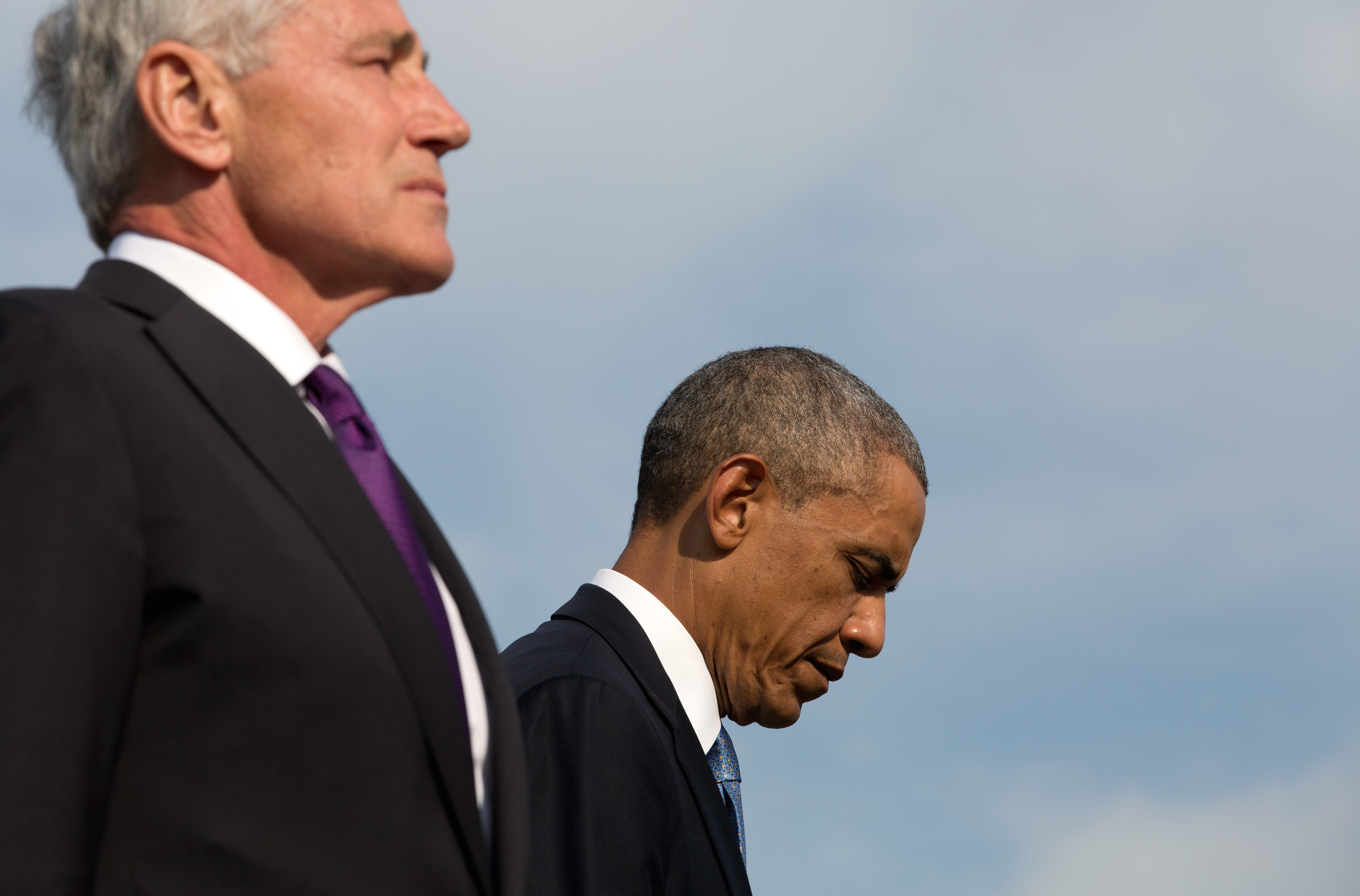
(Photo: U.S. President Barack Obama bows his head, as Defence Secretary Chuck Hagel looks on, during a ceremony to mark the 13th anniversary of the 9/11 terrorists attacks at the Pentagon Memorial on September 11, 2014. By Martin H. Simon-Pool/Getty Images)

The Problem With Partners, Ctd

John Kerry - Recep Tayyip Erdogan

Thomas Seibert scrutinizes Turkey’s reluctance to commit to anything beyond a “passive role” in the war on ISIS:

Officially, Turkey argues it has to keep its operations low-key because a more active posture would endanger the life of 46 of its citizens held hostage by ISIS. The jihadists kidnapped the Turks and three of their Iraqi colleagues when they overran the Turkish consulate in the northern Iraqi city of Mosul in June. Ankara says it is trying to secure the hostages’ release, but has ordered a news blackout that makes it difficult to assess where those efforts stand. …

Even without the hostage situation, Ankara would face difficult options. Turkey could take part in Western strikes against ISIS and risk a backlash from the jihadists themselves and other Islamist groups in the region. Or Turkey could refuse to have anything to do with the strikes, angering its Western allies and being a mere spectator despite its ambition to become a regional leader. Faced with that choice, Ankara appears to have decided to muddle through, officially joining the alliance against ISIS, but keeping out militarily.

Shane Harris expects the US to depend heavily on Jordan, particularly its intelligence service:

Jordanian intelligence “is known to have networks in Iraq which date from 2003 [the year of the U.S. invasion] forward,” said Robert Blecher, the acting program director for the Middle East and North Africa at the International Crisis Group. “The Jordanians have good connections and have tapped them before,” Blecher added. They’ll have to do so again. But it’s not just Jordan’s spying prowess that the United States needs. Jordanian intelligence also has ins with Iraqi Sunni tribes aligned with the Islamic State. …

The Jordanians are also likely to provide logistical support to the American air campaign, which has so far launched more than 150 strikes against Islamic State fighters, vehicles, and artillery using drones and manned aircraft. (The CIA now says that the militant group has recruited as many as 31,500 fighters, up from an earlier estimate of 10,000.) Blecher said that Jordan has allowed the U.S. military to use its air bases throughout the past decade, though Jordanian officials are reluctant to acknowledge that. [Former Jordanian foreign minister Marwan] Muasher said the country will likely lend logistical support but that he didn’t envision a role in direct military operations.

Adam Taylor and Rick Noack round up some international reax to Obama’s speech. They notice that Egypt is also toeing the noncommittal line:

Perhaps in response to Obama’s speech, Egypt’s Egyptian Foreign Minister Sameh Shokri called Thursday for a global strategy for dealing with extremists. However, when a diplomat was asked whether Egypt would cooperate with Obama’s strategy against Islamic State, they offered a vague reassurance. “Cairo will discuss every effort which can be made by the alliance to eradicate the phenomenon of extremist groups in the region,” the unnamed diplomat told Asharq Al-Awsat.

Ed Krayewski is dismayed to see our allies abandon their own national security commitments and let America do most of the work:

Countries like Turkey and Saudi Arabia have given varying degrees of support to the virulent strains of Islam that feed extremists like those in ISIS. Yet ISIS is hardly a puppet. Whether they decide to move north to Turkey or south to Saudi Arabia will be a decision over which those two countries will likely have no influence. But why bother treating ISIS like a national security threat when the United States is doing it for you?

Saudi Arabia, Turkey, other nations in the region, Arab and otherwise, are all threatened by ISIS in a way the United States isn’t, and in a way I think their leaders intrinsically understand they’re not being threatened by other countries in the region despite the official propagandas. Though the U.S. is the worldwide leader in military spending, these countries have spent decades building their militaries. They ought to make the decision to use them or not, to work with other countries in the region or not, and not have those decisions deferred by U.S. action from afar.

Likewise, Rosa Brooks argues that we should step back and let our local “partners” fight this war themselves:

Obama says the United States will “lead” a coalition against IS, but the United States should instead step back and let other regional actors assume the lead. They have a strong incentive to combat IS (an incentive we undermine when we offer to do the job for them), and the common threat of IS may even help lead to slightly less chilly relations between Iran and Saudi Arabia (though I won’t hold my breath). Other Middle East powers also have greater ability than we do to understand local dynamics, not least of which because many share a common language with IS or with other actors in the mix. The Kurds and the Jordanians may need some U.S. help to protect their own territory, and other states may need intelligence or other forms of logistical assistance. But we can provide such support to any of our allies and partners without putting ourselves front and center in the effort to combat IS.

Keating notes that other than Russia, none of our rivals seems to have a problem with us bombing Syria—even the Damascus regime itself is signaling that they’re OK with it:

Another interesting wrinkle is the ramifications of this Amerian operation for Assad’s backers in Moscow. Russian Ambassador to the U.N. Vitaly Churkin said today that if the United States bombed Syrian territory “without the Syrian government’s consent,” it would “complicate international operations and will pose problems for Russia as well as for many other countries respecting international law, including China.” But Russia may be the only country bothered by Obama’s campaign. It appears the Syrian government isn’t going to object too much to the operation. China, which has concerns about its own citizens cooperating with ISIS, seems likely to offer quiet support. Even Iran seems finally to have found an American war in the Middle East it can get behind.

Judis isn’t impressed with Obama’s stated strategy for a number of reasons, one of which is that it ignores Iran:

In trying to answer IS’s challenge in Iraq, the United States needs Iran’s cooperation. Obama didn’t mention Iran at all in his speech but instead referred to “Arab” countries and even to the NATO countries that he claims are going to join the anti-IS coalition. Arab countries are imporant, and one NATO country, Turkey, also is.  But Iran is crucial. It’s the main backer of the Shiite Iraq government and of Assad.  What, at this point, is the American strategy toward working with or against Iran in the region?  And what can be done to ease relations between Iran and Saudi Arabia, which would be important to resolving conflicts in Iraq and Syria? How much bearing do the nuclear talks, which seem to have stalled, have on the possibility of cooperation with Iran in the region?

And the way Tom Ricks sees it, our perforce partnership with Iran is really the only news here:

I think the Iraq war is best seen as one continuous conflict since the Iraqi invasion of Kuwait in the summer of 1990. I remember getting on the Metro that morning, seeing the headline, and thinking, “Hey, we’re gonna go to war.” And so we did, with an air campaign followed by a short ground campaign. When that was over, we went back to several years of air campaigning, complemented by some covert operations on the ground. Then, in 2003, we had another major ground campaign. It was supposed to last a few months, but instead lasted 8 years. And now we are back to an air war, probably again supported by occasional covert ops. The biggest difference I can see is that where once some Americans said we were doing this to prevent Iran from gaining influence, now we are working alongside the Iranians in Iraq.

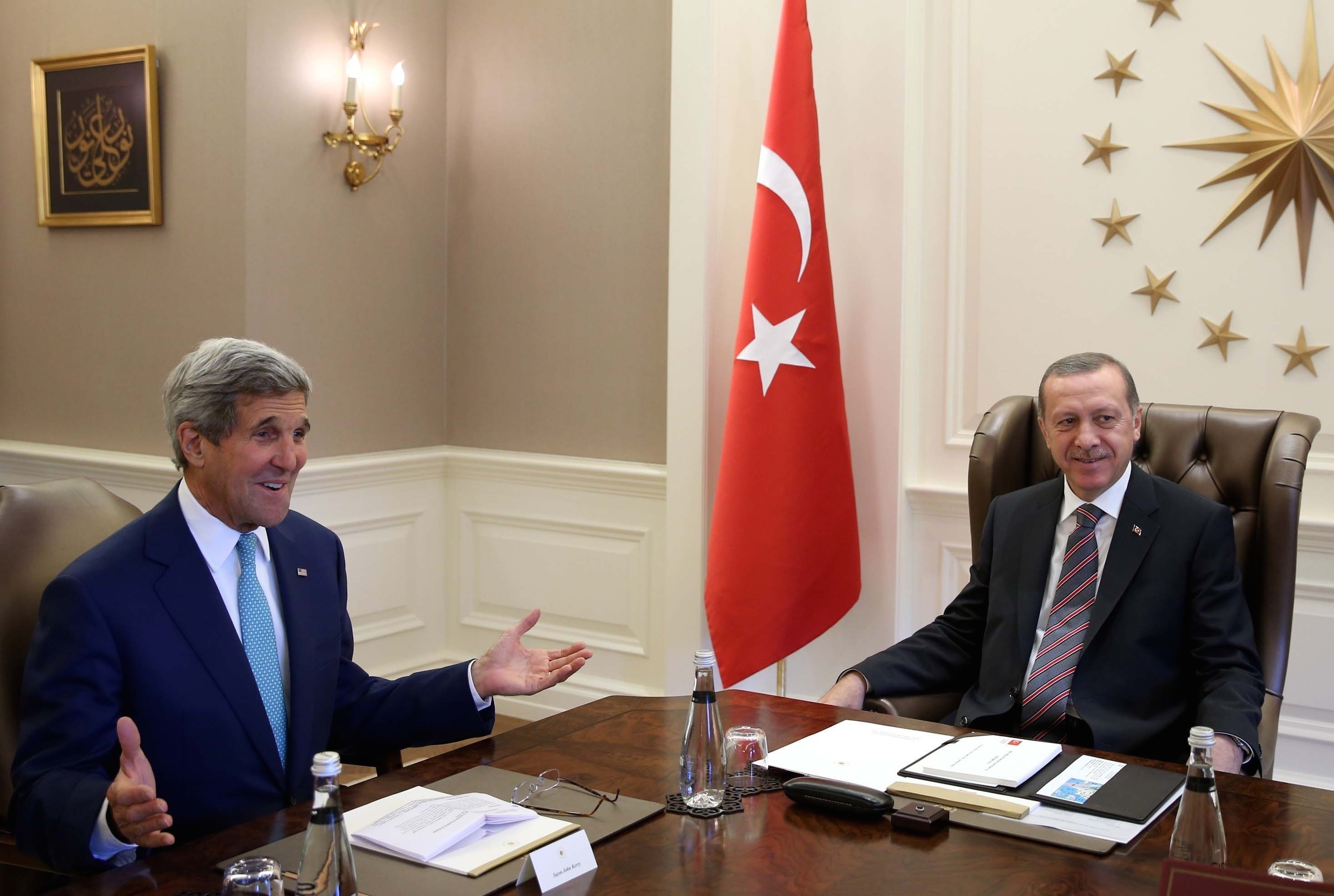
(Photo: U.S. Secretary of State John Kerry (L) meets Turkey’s President Recep Tayyip Erdogan (R) during Kerry’s official visit at Cankaya Palace in the capital Ankara, Turkey on September 12, 2014. By Kayhan Ozer/Anadolu Agency/Getty Images)