The Ground War To Come

IRAQ-CONFLICT

Larison suspects that it’s inevitable:

Escalation was always very likely, because that has been the pattern in U.S. interventions over the last twenty-five years. Obama already demonstrated in Libya that the U.S. would go far beyond the original stated goals of an intervention, and he is now on record saying that his greatest regret about the Libyan war was that the U.S. didn’t follow it up with a post-war military presence. That should be something to bear in mind when you next hear Obama pledge that there won’t be any American ground forces in combat in this new war. That’s why we should have expected this from Obama, but what made escalation even more likely is that our current political culture and foreign policy debate don’t really permit the U.S. to limit itself to small, achievable goals when it uses force overseas. That is especially true once administration officials irresponsibly stoke public fear about a group being an “imminent threat to every interest we have.” Sooner or later, the mismatch between the administration’s alarmist rhetoric and the initial “limited” action was going to be fixed by adopting a more aggressive policy.

Rich Lowry, for one, is ready to send in the infantry:

ISIL has occupied an enormous amount of territory in Iraq and Syria, including major population centers. That is why it declared a caliphate and why it has unprecedented resources. To defeat it, this territory must be taken back and it is unlikely to happen exclusively from the air—especially in the cities. It will take ground forces.

We hope to work with proxy forces, but they are motley groups that will almost certainly need vetting and advising by special operators working closely with them on the ground. But the president ruled out American ground forces. The cynical interpretation is that he is hoping to do enough against ISIL to satisfy domestic political opinion and keep the terror group at bay until he can hand off an incomplete campaign to his successor, who will be left with the difficult choice of whether to truly defeat ISIL.

James Jeffrey agrees that Obama was wrong to rule out boots on the ground:

[S]ometimes local forces are not enough. U.S. troops have capabilities they cannot approach, beginning with the crucial combat multipliers: “speed” and “decisiveness.” The commitment of even a few U.S. troops with actual ground combat missions signals credibility and seriousness. Such a troop presence can integrate rival local forces (as U.S. joint platoons did with the Kurds and Iraqi Army in 2010-2011), prevent friendly atrocities against civilians, and shape the goals of ground combat.

Still, local forces in Iraq and Syria should be the first choice, with commitment of our ground troops only an emergency contingency. Once in combat they introduce entirely new risks beyond those of drones or F-18 strikes, Special Forces trainers, and Navy SEALs. These risks begin with casualties. Ground combat is bloody.  While overall casualty rates are down from Vietnam, thousands have died in each of America’s last two wars, and tens of thousands have suffered serious wounds.

And Dov Zakheim argues that they’re necessary to hold the coalition together:

It is one thing to offer funds or training facilities, which Saudi Arabia is apparently willing to provide. It is quite another to deploy troops. Whether the Saudis, Emiratis, Jordanians, and others will be ready to do so absent American leadership on the ground is at best an open question. It is true that America led a coalition “from behind” in Libya. But that coalition did not commit ground troops; apart from very small numbers of European special forces, it was the Libyan rebels who provided the overwhelming majority of troops conducting operations on the ground against Muammar al-Qaddafi.  Moreover, the aftermath of that conflict hardly was a showpiece for coalition operations: Libya is now virtually a failed state.

Morrissey implies that Americans would come around to embrace another land war in the Middle East if only the president had the courage to give us one:

[I]t’s true that a move to send ground troops to deal with ISIS would create a large amount of political backlash, and would also call into question Obama’s endgame strategy in Afghanistan — even more so that ISIS has. If the American public won’t back a decision to put combat troops back into Iraq, then it would take a President willing to go it alone politically at home to give that order, and clearly that’s not the case with Obama. However, a lack of progress against ISIS will play badly for Obama too, and it will sap the resolve of Americans to see the job through to victory. We may end up looking weaker than we do now, especially if we can’t even get our traditional allies on board for just the 30,000-foot tactical decisions.

Highlighting some of the characteristics of the classic neocon freakout over ISIS, Chait observes that among this crowd, there’s no such thing as too much force:

The nub of neoconservatism is a belief that the only possible strategic failure is the insufficient use of military force. This is more of an atavistic reflex than a cogent form of thought. Cruz assails Obama, “Instead he suggested targeted attacks and focuses frankly on political issues that are peripheral from the central question of how we protect America from those who would take jihad to our nation.” Targeted is bad. Political is bad. Protecting is good. Here is [Jennifer] Rubin’s response:

[Obama] insisted, “This strategy of taking out terrorists who threaten us, while supporting partners on the front lines, is one that we have successfully pursued in Yemen and Somalia for years.” But if the Islamic State, which occupies vast territory and is highly trained and very well organized, than I suppose it won’t work.

That is not even an English sentence. Nonetheless, the underlying impulse is clear enough.

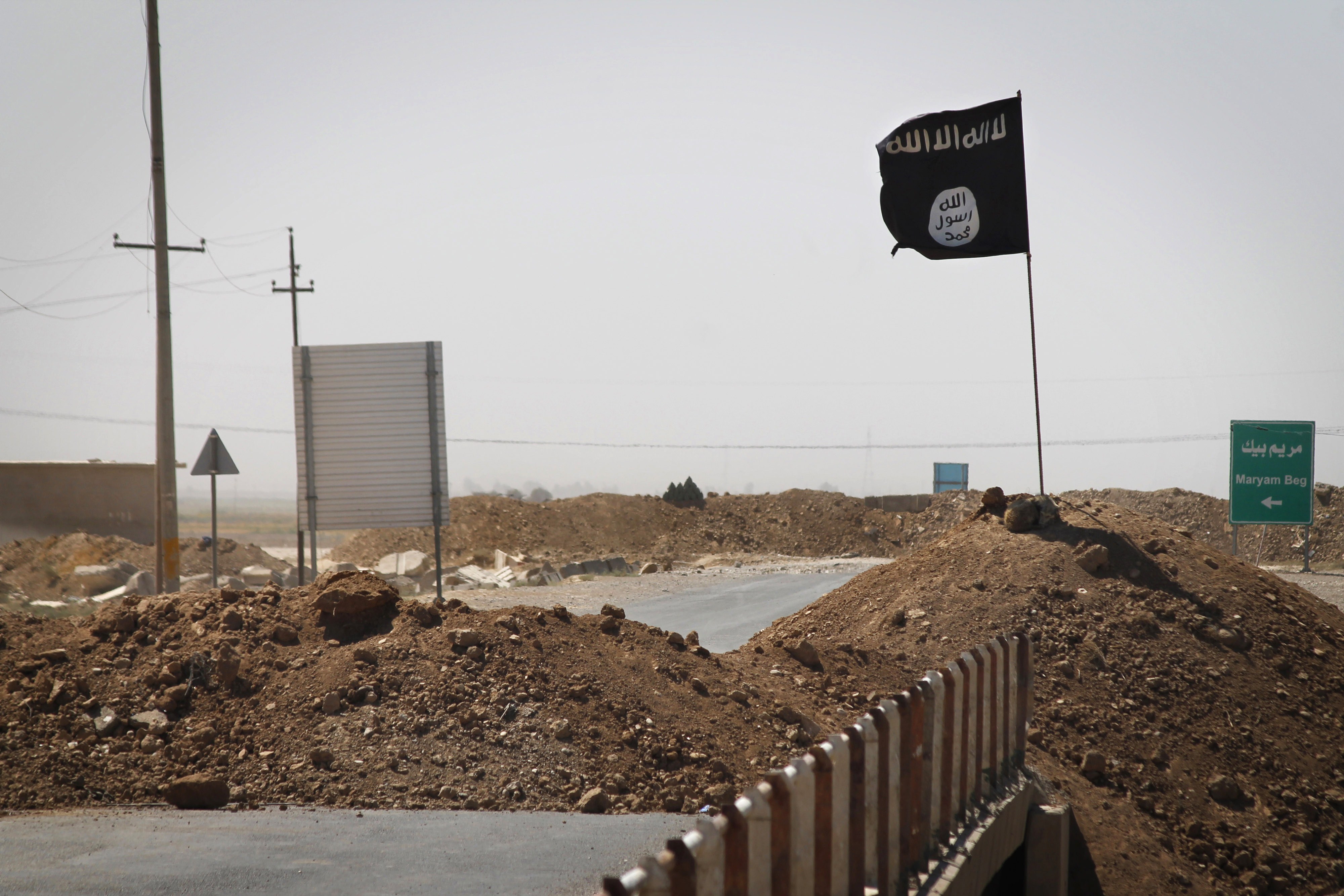
(Photo: A flag of the Islamic State is seen on the other side of a bridge at the frontline of fighting between Kurdish Peshmerga fighters and Islamist militants in Rashad, on the road between Kirkuk and Tikrit, on September 11, 2014. By JM Lopez/AFP/Getty Images)

Threat Inflation And The Case For War, Ctd

Beinart takes the MSM to task for swallowing the government’s line on the ISIS threat:

Many publications have uncritically accepted Secretary of Defense Chuck Hagel’s claim about the number of Americans who have gone to fight with ISIS—a figure that New America Foundation terrorism expert Peter Bergen argues is dramatically exaggerated. Other media commentary simply assumes that if Westerners go to fight with ISIS in Iraq or Syria, they’re destined to attack Europe or the United States. But that’s not true. Bergen notes, for instance, that of the 29 Americans who have gone to fight with the Somali jihadist group al-Shabab, none have tried to commit terrorism against the United States. One reason is that many of them ended up dead.

Press coverage of ISIS often ignores the fact that, in the past, the group has not targeted the American homeland. Jihadist groups, even monstrous ones, don’t inevitably go after the United States. Al-Qaeda began doing so as part of a specific strategy.

Keating stresses that for the most part, “the much-discussed threat of ISIS’s international fighters returning to their home countries to carry out attacks has been theoretical”:

As David Sterman pointed out in an analysis for the New America Foundation this week, “no one returning from or seeking to join a Syrian jihadist group has even been charged with plotting an attack inside the United States.”

Moner Mohammad Abu-Salha, the Florida man who returned to the U.S. for a time after training in Syria in 2012 and was under surveillance by the FBI, tried but failed to recruit friends to the cause, and eventually returned to Syria where he carried out a suicide bombing. If anything, greater U.S. involvement in the conflict will make ISIS—a group that until recently was most concerned with local territorial gains—more rather than less likely to target U.S. interests and citizens.

That’s what makes Yglesias uncomfortable with the way Obama talked up the threat on Wednesday night:

Public opinion always matters in politics and therefore in policymaking, but the fact of the matter is that the American people have this a bit mixed up. The beheadings are not the most alarming thing ISIS did this summer (try taking Mosul or genocidal violence against religious minority groups) and the rise of ISIS isn’t even the summer’s most alarming foreign policy crisis (try Russia’s invasion of Ukraine and apparent probing of Estonian and Finnish borders). There is no good reason for the United States to take maximal action against ISIS, not least because none of our potential partners in the region are going to.

Alarmist rhetoric and a policy of wise restraint make odd bedfellows. If the US catches some lucky breaks (or ISIS some bad ones) it may all work out for the best. But Obama’s speeches are writing checks his policy can’t necessarily cash. And eliminating ISIS’ ability to occasional kidnap westerners who travel into the conflict zone is much more difficult than eliminating its ability to capture new Iraqi cities or threaten major oil fields. If another shoe drops in a bad way, there is enormous risk that the president has set the country up for a cycle of unwise escalation.

The Best Of The Dish Today

New York Commemorates 13th Anniversary Of September 11th Attacks

So we now discover that Turkey will not participate in the coalition against ISIS. Turkey will not go to war against an Islamist insurgent group that controls territory on Turkey’s own border. They are scared of what ISIS will do to 49 hostages seized in Mosul:

Ankara is therefore reluctant to take a stronger role in the coalition against ISIS militants in apparent fear of aggravating the hostage situation. “Our hands and arms are tied because of the hostages,” the official told AFP. Turkey can open Incirlik Air Base in the south for logistical and humanitarian operations in any US-led operation, according to the official who stressed that the base would not be used for lethal air strikes. “Turkey will not take part in any combat mission, nor supply weapons,” he said.

So the only Muslim country in the coalition assembled in Wales is just doing humanitarian stuff. That’s how dire they believe the threat from ISIS is – and they live next door! Without Turkey, we are left with the Saudis on one side and the Iranians on the other. In other words, a Shiite-Sunni alliance against extremist Sunnis. That sounds like a strategy that won’t end in tears, doesn’t it? And notice who’s really on the hook now: the US, as always. The Brits too – for all their harrumphing – also won’t conduct air-strikes.

The Congress, under these circumstances, should demand a vote and tell the president no. If you agree, call your representative.

On another note – and because you are Dishheads and because the great Joe McGinniss is dead, I feel obliged to link to this story on the latest reality show brawl involving the entire Palin clan (except for Trig who, you might have noticed, has disappeared from the public eye the moment he wasn’t politically useful to bolster Palin’s pro-life credentials). This blog-post about the ill-fated party is priceless:

Just about the time when some people might have had one too many, a Track Palin stumbles out of a stretch Hummer, and immediately spots an ex-boyfriend of Willow’s. Track isn’t happy with this guy, the story goes. There’s words, and more. The owner of the house gets involved, and he probably wished he hadn’t. At this point, he’s up against nearly the whole Palin tribe: Palin women screaming. Palin men thumping their chests. Word is that Bristol has a particularly strong right hook, which she employed repeatedly, and it’s something to hear when Sarah screams, “Don’t you know who I am!” …

As people were leaving in a cab, Track was seen on the street, shirtless, flipping people off, with Sarah right behind him, and Todd somewhere in the foreground, tending to his bloody nose.

And, for some reason, we’re still listening to that crackpot John McCain on foreign policy. Seriously, after Palin and Iraq, does he have no shame left? Do TV’s bookers?

Today, I broke ranks with a president I still want to support and I still admire – because I sincerely believe this latest pragmatic pirouette is dangerous to our national security, and terribly damaging for the process to slowly move away from anti-terror over-reach. We aired the bullshit legal rationale for the war; and demanded a simple answer to why we are doing this again – and expanding its scope to Syria. Readers had their say about last night’s speech here.

Plus: a classic beard of the week; a defense of Britishness as an inclusive nationality; and continued our thread on domestic violence and #whyistayed. The most popular post of the day were my live-blog of the speech last night and A Pragmatism Too Far? Many of today’s posts were updated with your emails – read them all here.  You can always leave your unfiltered comments at our Facebook page and @sullydish. 20 more readers became subscribers today. You can join them here – and get access to all the readons and Deep Dish – for a little as $1.99 month. Gift subscriptions are available here. Dish t-shirts and polos are for sale here. A reader writes:

After six months of reading your site, the frustration of not being able to read below the fold got to me and I finally subscribed. I read The Economist for the hard news and you for the unique insights you bring to current news. I consider myself a Terry Pratchett humanist and I often find myself in both agreement and vehement disagreement with you, often within the same story. Please keep up the good work.

The Dish team will as well. I’m on my way to Portland, Oregon, to speak at the International Cannabis Business Association at the Oregon Convention Center. I’ll be speaking at 9.30 am PST on Saturday, if you want to say hi.

I gotta rush for the plane now … so see you in the morning.

(Photo: A woman places flowers in the inscribed names along the edge of the North Pool Memorial site during observances at the site of the World Trade Center on September 11, 2014 in New York City. By Justin Lane-Pool/Getty Images)

Accounting For The Caliphate

Howard J. Shatz has been studying the finances of ISIS and its precursors since 2006. He offers perhaps the most comprehensive view we’ve seen so far of how the group spends its money:

ISIL historically has paid its members (yes, it maintains payroll sheets) based on a flat monthly rate per person and then additional fixed amounts for each wife, child and dependent unmarried adult woman in the household. In Anbar, Iraq, the rate was $491 per year in 2005 and 2006, and then about $245 per year per dependent; the rate was similar in Mosul in 2007 and 2008. These payments to family are meant to continue if the ISIL member is captured or killed—a primitive form of life insurance. If enough members are captured and killed, however, these costs start to mount.

ISIL also pays rent for its members in some cases—payments that might be bonuses to high-performing members, although we cannot be sure—and medical expenses for some members and their families. In the past, the group has sometimes hired lawyers to help get captured members out of jail. And it runs safe-houses and has to buy equipment. Guidelines published by a predecessor of the group say that expense reimbursements should be filled out in triplicate and explain where each copy goes within the organization. We don’t know for sure whether ISIL today is making money or even breaking even, but at least in Anbar from 2005 to 2006, the money was being spent as fast as it came in.

His takeaway:

Even if ISIL is making $3 million per day—at the higher end of the various estimates out there—then it makes slightly more than $1 billion per year. Just to be conservative, in case ISIL is doing more business than we’re aware of, let’s double that to $2 billion per year. Although exact totals are difficult to find, in 2013, before ISIL’s advance, the Iraqi government spent far more than $2 billion per year running the governorates ISIL now controls, including salaries to civil servants, other costs of service provision and investment spending. That means ISIL likely isn’t keeping up the same level of service that the Iraqi government once did. True, ISIL need not maintain that level—it hardly rules with the consent of the governed. But it’s not only a problem that those under its rule can rebel, as happened in 2007 and 2008; with the exception of oil, the group’s continued revenue-raising also depends on there being enough money to skim and extort from the economy, and this requires some minimum level of services and economic activity.

Email Of The Day

A reader writes:

I write this from the perspective of one who didn’t participate in politics before Barack Obama, but I voted for him twice.  I’m part of that “Obama coalition” that political writers like to talk about – a “creative class” member, family man, early 40s, white, with deep skepticism toward American politics and outright disdain for the two major political parties.

Watching the president last night made me think two things.  First, my gut reaction was that this wasn’t the guy I voted for – what happened to that guy?  Second, it made me think more deeply about why I had supported him in the first place.  Sure, the idea of a black president was interesting to me, but that really had very little to do with my vote.  I also didn’t vote for Obama out of fear of Sarah Palin’s lunacy or John McCain’s warmongering (though both were certainly compelling reasons).  No, he was different. We didn’t vote for Obama because we hated or feared the other side, and that is actually something that makes him different from most of the milquetoast candidates the two parties typically put forward (and are already planning to put forward in 2016).

I think the disappointment in Obama stems in part from the fact that most of us who voted for him did so affirmatively.

We actually voted for Obama, not against McCain or Palin or Romney or Ryan.  We voted for the guy he ran as – a profoundly intelligent, intellectually independent, thoughtful man who insisted on treating the public like adults and who, on issue after issue, self-consciously refused to be responsive to whatever the Beltway shouting about. In short, he decided he wanted to be president on his own terms.

Obama knew he couldn’t control events, obviously, but he certainly could control himself – and his composed, sober, longer view of the churn of day-to-day issues conferred an inherent dignity upon himself.  The political class and some in the media didn’t always “get it”, still breathlessly chasing after the latest big story, trying to “win the hour”, etc.  But Obama’s poised refusal to go along (remember how he used to deride what he called “cable chatter”?  I sure do…) was a major dog whistle for people like me. I saw the president acting the way I wanted him to act. That was the guy I elected.  The guy who wouldn’t play along with all the bullshit, who would insist that we actually deal with both policy and politics based on facts, reasoning, and long-term strategy.

This can seem mundane, but for people like me who have watched Obama closely over the years, that’s what we liked and what we voted for.  I work in a corporate job with mostly conventional Fox-news Republican types, and time and again over the years, every argument they make bounces off me like Teflon.  It was always so easy to see how they had to mischaracterize Obama in order to effectively criticize him.

Not anymore.

Last night’s speech looked transparently political. OK, so Obama goofed and said we didn’t have a strategy, a rhetorical blunder that handed the Republicans a short-term tactical advantage in the midterm elections … so, after enough Democrats bitched about it, he goes on TV to announce a strategy.  The actual content was secondary to the fact of the speech itself.  That’s just not the guy I voted for.  It also lacked any actual strategic thinking – what are we going to do, who’s going to help us do it, how long, costs, risks and mitigants.  It was a political errand dressed as a speech, which frankly was one of the things I despised most about George W Bush.

It is sad to see Obama fall this far.  Furthermore, beyond even the inadequate content of the speech or the stench of midterm politics behind it, didn’t anyone bother to think of how the speech elevates ISIS around the world?  I admit they’re extremely violent and completely incapable of being deterred.  But they’re what – 30,000 guys?  A primetime presidential address gives them stature, legitimacy … which can only help them strengthen their hold on those they already have, and recruit even more.  How does that serve a real strategy to defeat them?

This is not the guy I voted for.  I remembered thinking this during the first debate with Romney, and now I’m thinking it again.  Is he checked out?  What happened?  Last night was a failure not only for Obama himself, but his political and policy teams.  Every president is surrounded by people for whom part of their responsibility is to not let the president look ridiculous.  Where are THOSE people?

The president looks like a solitary, adrift figure to me, a guy who may have already written off these next couple of years.

The Problem With Partners

Obama Meets With Iraqi Prime Minister Nouri al-Maliki At White House

In contrast to the right’s caricature of Obama as a president too feckless to stand up to our enemies, Benjamin Wallace-Wells posits that his real quandary is “whom the United States might trust — the problem of friends”:

The futile hunt for friends characterized the long Obama withdrawals from Afghanistan and Iraq. In Syria, the long, pained, ultimately failed search for a tolerable proxy in the opposition precluded any American involvement, a hesitation that now looks like the biggest foreign-policy error of Obama’s presidency. During the Gaza conflict, Obama was far cooler towards Israel than his predecessors have been. If you want to hang back from the front lines, to hover overhead and urge your friends to the front lines, then the question of exactly who those friends are becomes crucial. ISIS, in its radicalism and its cartoonish barbarism, solved the enemy problem for Obama. It hasn’t completely solved the matter of the friends. Obama spoke confidently about the new, “inclusive” government that Iraqis had formed “in recent days.” Given the long history of sectarian animosity and slaughter in Iraq, it seems worth wondering whether this new coalition of a few days duration will hold under the pressures of a war.

Afzal Ashraf calls the decision to rely on regional partners “the most immature and risky part of the US strategy”:

Middle Eastern countries have spent billions on their defence capability but have shown a remarkable reluctance to deploy it beyond quelling mostly unarmed civilian rebellions. A history of petty squabbling and so little experience of political cooperation or joint military operations further reduces their potential impact. If the anti-Iranian attitude of the Saudis and other Gulf states is not checked before any troops from those countries arrive in Iraq then there is a danger of sparks flying if they come into contact with the Iranian military “advisers”, who appear to be advising very close to the frontline. Increasing efforts to remove President Assad from power in Syria is probably the greatest strategic flaw. Identification and maintenance of a single clear aim is a maxim of strategic success. If defeating Isis is the main aim of this strategy then why complicate an already difficult task by simultaneously engineering regime change in Syria?

Bobby Ghosh makes the easily overlooked point that Arab leaders who join this war will have to sell their publics on it as well:

The template for the coalition against IS should be the international effort in 1991, marshaled by another US secretary of state, James A. Baker III, to drive Saddam Hussein’s forces from Kuwait. The presence of many Arab nations was not only vital for the military strategy, it also prevented Saddam from portraying the conflict as a battle between Islam and the West. Kerry will no doubt invoke the Baker coalition in his conversations with Arab officials in Riyadh.

But as effective as the 1991 military campaign was, many Arab people felt no sense of ownership over the victory. Their leaders had not sought their approval, and had failed to explain why it was necessary to join non-Arab armies to eject Saddam from Kuwait. This explains why Saddam remained popular among Arabs long after his defeat in Kuwait. It also allowed Osama bin Laden to portray the 1991 campaign as an unholy alliance between Arab elites (mainly the Saudi royal family) and the Western “crusaders.”

Turkey, for its part, is already signaling that it wants no part in combat operations, while the UK and Germany also appear to be bowing out of the air campaign. That doesn’t comfort Daniel Larison:

The lack of Turkish cooperation will presumably make the air campaign more difficult and therefore make it last even longer. The more striking thing about this is that the U.S. is going back to war in the region and still cannot count on support from its sole NATO ally in the region. That draws attention to one of this war’s basic flaws: the U.S. is taking the regional threat from ISIS more seriously and doing more to oppose it than many of the regional states that have far more to lose. The U.S. has allowed itself to be pulled into a new, open-ended war for the sake of “partners” that are contributing little or nothing to the war.

Ed Morrissey also finds it troubling:

[W]hat does this say about Obama’s strategic preparation? Did he bother to check in with the Brits and the Germans before pledging his “broad coalition of partners” last night? It would appear not, and that Obama just assumed that they would follow whatever plan he laid out last night. Obama could have framed the Syrian phase separately as a uniquely American security concern and set expectations properly. Instead, it looks as though Obama and his political team wrote a speech without building the necessary commitment from allies to allow them to be part of a united front on global security.

There’s also that niggling matter of finding an acceptable partner in the chaos of the Syrian civil war. Keating complicates that question, reminding us that the task of dividing the belligerents into “good guys” and “bad guys” is not nearly as clear-cut as we’d like it to be:

While the Syrian civil war may once have been viewed as a fight between Assad’s regime and “the rebels,” it’s now much more complicated than that. The major groups now fighting for territory and political influence within Syria include (but are not necessarily limited to): the government; ISIS; the Western-supported Free Syrian Army; the al-Qaida-affiliated Jabhat al-Nusra; the Kurdish PYD, which has gained control of significant territory in areas near the Turkish border; and the Islamic Front, an umbrella group of Islamist groups distinct from both the “moderate” rebels of the FSA and the hardline jihadists in ISIS and Nusra. The last group on that list has gotten relatively little attention, but recent events show it could be critical. A bombing in northern Syria decimated the leadership of Ahrar al-Sham, a long-established and well-organized rebel group that was one of the primary organizers of the Islamic Front alliance.

And Thomas Pierret and Emile Hokayem make a fresh case against allying with Assad:

Given its lack of homegrown manpower, the regime has owed its survival to auxiliaries in the Alawite-dominated National Defense Forces—an evolved, more sophisticated version of the shabbiha militias—and foreign Shia fighters from Iraq and Lebanon. As in Iraq, this has further alienated the Sunnis, with the difference that in Iraq, at least, these militias are entirely homegrown. This is the point of the argument where those who favor working with Assad point out that defeating the Islamic State will require deploying ground troops in large number—and in the very regions that Assad’s forces have intensively pummeled since 2011. Here’s the rub: Local populations in these areas, crucial to the success of any counterterrorism effort, are unlikely to cooperate with their recent oppressor. Sending pro-Assad sectarian forces back into the Islamic State’s safe haven in northern and eastern Syria would only lead to more communal violence—but almost certainly not victory.

(Photo: Former Iraqi Prime Minister Nouri Al-Maliki (L) shakes hands with U.S. President Barack Obama in the Oval Office at the White House November 1, 2013 in Washington, DC. By Olivier Douliery-Pool/Getty Images)

Dick Cheney Was Right About Iraq All Along

Really, he was! That is, if we point to 1991, when he said this:

What kind of government? Should it be a Sunni government or Shi’i government or a Kurdish government or Ba’athist regime? Or maybe we want to bring in some of the Islamic fundamentalists? How long would we have had to stay in Baghdad to keep that government in place? What would happen to the government once U.S. forces withdrew? How many casualties should the United States accept in that effort to try to create clarity and stability in a situation that is inherently unstable? I think it is vitally important for a President to know when to use military force. I think it is also very important for him to know when not to commit U.S. military force. And it’s my view that the President got it right both times, that it would have been a mistake for us to get bogged down in the quagmire inside Iraq.

But the new narrative emerging as Cheney pursues his “told you so” comeback tour is that he was right all along about how he had won the Iraq war and then Obama lost it. Weigel plumbs the depths of the derpitude:

Boy, the phrase “all along” is asked to do some heavy from-the-knees lifting there. All along? The timer starts four years after the start of the Iraq war, and two years after Cheney insisted, pre-surge, that Iraqi insurgent groups were in their “last throes”? Yes, that’s the new rule.

We are to analyze the situation of 2014 by crediting the Bush administration not for the Iraq war, but for post-surge Iraq. This has been the argument since 2011, when the Obama administration failed to extend the three-year status of forces agreement that (to the satisfaction of hawks) Bush had handed to him. The theme at the time, as Charles Krauthammer put it, was that Obama was“handed a war that was won,” and he blew it.

Dreher has no time for such nonsense:

Three out of four Americans in 2011 wanted the president to withdraw all US troops from Iraq. Read the Gallup poll; how soon, and how conveniently, we forget. You cannot keep US soldiers in a hopeless war with 75 percent of the country against that policy. Gallup’s poll numbers show that even though the percentage of Americans in 2014 who believe total withdrawal was the right thing is down to 61 percent, that’s still a strong majority. President Obama did what the Iraqis would allow him to do — it’s their country, after all — and what the American people wanted him to do.

This Bush prophecy business is b.s. through and through. It’s important to say that now, because Dick Cheney, one of the principal architects of one of the worst disasters in US foreign policy and military history, is now making an “I Told You So” tour, back in Washington (a standing ovation at AEI!) spreading his wisdom to appreciative conservative audiences. It’s like they let Bernie Madoff work on Wall Street again, or returned the FEMA portfolio to Brownie.

The Case For War: Known Unknowns

Frum points to one big question the president didn’t address in last night’s speech:

The question before the nation is, “What is the benefit of this war to America and to Americans?” That was the question the speech left unanswered. And the ominous suspicion left behind is that the question was unanswered because it is unanswerable—at least, not answerable in any terms likely to be acceptable to the people watching the speech and paying the taxes to finance the fight ahead.

But Daniel DePetris can think of a few more:

President Obama announced that the United States will be getting far more involved in Syria’s civil war—accelerating the U.S. train-and-equip program for moderate Syrian rebels who are fighting on two fronts (against ISIL and Bashar al-Assad) and whose capabilities pale in comparison to the Islamic State.  If Congress agrees to the president’s request, $500 million will be available for the Defense Department as seed-money to supplement the smaller training program that the Central Intelligence Agency has reportedly been running for over a year.

Yet the question must be asked: is it too late for U.S. assistance to make a difference?

The Free Syrian Army is perhaps at its most fragile point since Syria’s civil war began, and the moderates have been begging for heavy U.S. military equipment for years now.  Will $500 million be enough money, and if not, is the president willing to double down on his strategy and expend more taxpayer funds to improve its chances of success?

Byron York lists ways things could go wrong:

[W]hat if the Iraqi government turns out to be not as inclusive as the president hopes, at the same time that the U.S. military is deeply involved in the fight against the Islamic State? “One of [the dangers] is that the Iraqi government fails to come together in any meaningful way,” Peter Wehner, a former Bush White House official, said in an email exchange. “It may be that the government comes together but the country does not. That is, the Shia-Sunni split is impossible to repair, at least at this moment. It may be that a new government is formed but the leader himself is weak, or too sectarian, or too incompetent to wage an effective war against ISIS. It may be that the president increases our commitment in Iraq, but (unlike George W. Bush with the surge) not enough. The danger is that having re-engaged in Iraq, we don’t succeed.” The bottom line is that — by the president’s own reasoning — if a genuinely inclusive government fails to materialize, the U.S. mission, no matter how far-reaching, will fail.

Fred Kaplan is relatively supportive of Obama’s approach but shares that concern:

Obama made very clear that this battle requires active participation by the Saudis, Turks, and Europeans. But the roles and missions haven’t yet been outlined; the commitments aren’t quite carved in concrete. The plan has a chance of succeeding in Iraq because the new government, formed by Haider al-Abadi, seems inclusive, embraced by Sunnis and Shiites, for the moment—but it could fall apart with the bombing of a single mosque or a marketplace, and then what? Will it look like the Americans are advising and bombing on behalf of a Shiite regime? Will the other Sunni nations back away, fearing the association?

Tomasky tries to strike an optimistic note:

There are a thousand ways it can go wrong. But what if it goes right? And how about—here’s a crazy thought—we all hope that it does? And not for Obama’s sake: This gambit will certainly—certainly—define his foreign-policy legacy, but it’s not for that reason that we should hope it all works. It’s for the sake of Iraqis and Syrians, and ultimately, for us. Obama didn’t communicate every aspect of this fight effectively in the speech, which was too short and too vague. But the goals are the right ones. It’s a strategy, and he didn’t wear a tan suit.

In Cassidy’s view, the address signified Obama relinquishing his foreign-policy realism:

President Obama, long a reluctant warrior, has committed the United States to a risky and open-ended military campaign, the ultimate consequences of which are difficult to predict. Confronted with popular outrage at the beheadings of James Foley and Steven Sotloff, and political opponents keen to exploit any hint of weakness or indecision, the realist has relented. … In pledging to “ultimately destroy” ISIS, he adopted the maximalist language of John McCain and Dick Cheney. Once a President issues pledges of this sort, he has an enormous incentive to try to follow through on them, even if that involves further military escalation. The President, who only last year, at West Point, talked about winding down the “war on terrorism,” has come a long way in a short time.

John Dickerson wonders what that means in terms of the broader debate over American power and foreign policy:

The president didn’t just start a new military phase of the war on terrorism; he started a new round in the foreign policy conversation. He was brought to office by a war-weary nation. Now the polls suggest the nation is tired of him. For the moment that means the country is looking for a more assertive foreign policy. Whether that is a permanent new condition depends on future violence and success. But at the moment the incentive is for most politicians to make declarations of strength to distinguish themselves from the unpopular incumbent. The presidential candidates in 2016 will be particularly emboldened, since they traditionally run as an antidote to the perceived deficiencies of the current occupant. That’s certainly the way Sen. Barack Obama won office. If his overcorrection was born in his simplistic response to the deficiencies of his predecessor, then judging by the way this current foreign policy debate is going so far, it likely contains the seeds of the next overcorrection.

Michael Scherer thought Obama’s tone of “I can handle this” was well-chosen:

Chances are good the U.S. will win the military fight, and the spooks seem optimistic at the moment about preventing another homeland attack in retribution. But there will also be a cost. Another goal of his second term was to wind down the eternal conflict his predecessor called the “war on terror.” Now that won’t happen anytime soon. The war against the Islamic State of Iraq and Greater Syria, which Obama described as neither Islamic nor a state, will be a long one. As with past painful conflicts, there is no end date, and no clear metric on which to declare victory. He said he will “degrade and ultimately destroy” the threat. But the destroy part could very well come years after he leaves office.

Walter Russell Mead accuses the president of revealing his strategy to the enemy:

As it happens, we agree with the President that American ground troops aren’t the answer to our ISIS problems, and if by some ghastly mischance we ended up in the Oval Office we would be no more eager to send ground forces into this war than he is. But we wouldn’t want our enemies to know that—and we would also be aware that war is, above all other things, unpredictable. You take that first step and you just don’t know what comes next. If things don’t go as planned, the President could find himself in a position where all those “no ground troops” pledges could haunt him; certainly many of his critics will begin to rake him over the coals about the number of advisers and others that he must now inevitably send into harm’s way.

It’s a sign of the President’s tone deafness (and also substance deafness) when it comes to the military that he just doesn’t seem to get this. Telling the enemy that you are going to be out of Afghanistan by date X, or that you won’t put more than Y thousand troops in the country, or that you won’t put any boots on the ground makes life much, much easier for the bad guys. Indeed, in most wars this is exactly the kind of information that the enemy is most eager to get—this is why there are spies.

And to Matt Duss, the speech reflected Obama’s overarching foreign policy principle that “American power is demonstrated not by acting impetuously and demanding that others fall in line, but by working to develop and strengthen international consensus on a range of issues, and then mobilizing that consensus behind cooperative action”:

This is clearly not going to satisfy those in Washington who believe that American leadership is best shown through the application of ordnance and deploying of troops. “By [the] end of [the] speech, POTUS powerfully embraces cause of ‘freedom’ but commits only another 475 troops to the cause,” tweeted the Washington Institute for Near East Policy’s Robert Satloff. Well, the Bush administration embraced the cause of freedom, and committed over 100,000 troops to the cause. And one of the reasons Obama was up there speaking last night is because we’re still cleaning up the mess. Speaking of Bush, I should mention that one thing that George W. Bush got right about the Middle East is that illegitimate, unaccountable, undemocratic regimes empower extremists.

A Pragmatism Too Far?

It’s extremely hard to reconcile the events of the past month or so with the rationale of the Obama presidency. And that’s what makes this capitulation to hysteria so profoundly depressing. I can see the simple pragmatism behind it: the president under-estimated the strength and tenacity of these maniacs, and feared they could make further gains, plunging the region into a new turmoil. The media and the elites all jumped into full metal panic mode and created a powerful momentum for action. In fact, the elite consensus in favor of attacking ISIS was, until last night, at least, eerily reminiscent of the elite consensus in favor of going to war in Iraq in 2003 – without the year or so of debate. If US-ATTACKS-9/11-ANNIVERSARY-OBAMAyou’re Obama, you do not believe you can really solve this problem, but you need to do something, both to stave off possible disaster, to guard against potential ISIS expansion, and to try and rescue the Iraqi “state” one more time. So you rely on air-power, you corral the Saudis to help train and fund Sunni opposition to ISIS, you funnel some arms to the “moderate” Syrian rebels … and hope for the best.

What this misses in its flexibility is that it comes at the cost of profound incoherence. Presidencies need a grand narrative if they are to succeed. Obama’s was a simple one: to slowly rescue the US from the economic and foreign policy nadir that Bush-Cheney bequeathed us. We would slowly climb back out of the hole of fiscal recklessness and financial corruption into a saner, calmer period of slow but steady growth. We would slowly de-leverage from counter-productive over-reach in the war on Islamist terrorism. We would end two wars. We would begin nation-building at home – in the form of universal health insurance and badly needed infrastructure improvement. Above all, we would not be jerked back and forth by Islamist fanatics abroad, seeking to chart a course of steady strategic retrenchment.

Now, of course, this was never going to be a linear path. I feared back in 2009 that withdrawing from Iraq might look a lot like withdrawal from Vietnam. That it took place without a bloodbath or national humiliation was a triumph of optics and luck and bribery. But I was never under any illusion that the “surge” had succeeded in its own terms. We had no guarantee that Iraq would not return almost instantly to the sectarian distrust, hatred and violence that have been integral to its existence for decades. Kurdistan could work – but the rest remains ungovernable, except by tyranny and terror. And so yet another spasm of Shi’a-Sunni violence seemed inevitable to me. But at least, we would no longer be sitting in the middle.

I don’t buy for a second the lame idea that if the US had kept a residual force there – despite Baghdad’s express wishes – we would have avoided the current turmoil. We couldn’t control or end it with a hundred thousand of the best-trained troops in the world. What chance would 10,000 advisers have to counter the weight of history and the cycle of revenge? So there would come a point at which Iraq would implode again and the US might be tempted to intervene. I naïvely thought no sane American, after the Iraq War, would ever support that. I foolishly believed we would not be able to instantly erase – like an Etch-A-Sketch – all that we so painfully learned in that catastrophe.

What I under-estimated was the media’s ability to generate mass panic and hysteria and the Beltway elite’s instant recourse to the language of war. I believed that Obama was stronger than this, that he could actually resist this kind of emotional spasm and speak to us like grown-ups about what we can and cannot do about a long, religious war in the Middle East, that doesn’t threaten us directly. But he spoke to us like children last night, assuming the mantle of the protective daddy we had sought in Bush and Cheney, evoking the rhetoric he was elected to dispel.

What the president doesn’t seem to understand is that this dramatic U-turn isn’t just foolish on its own national security terms; it is devastating to him politically. He is now playing on Cheney’s turf, not his own. His core supporters, like yours truly, regarded our evolution from that Cheney mindset one of Obama’s key achievements – and he tossed it away last night almost casually. He committed himself and us to a victory we cannot achieve in two countries we cannot control with the aid of allies we cannot trust. And, worse, he has done so by evading the key Constitutional requirement that a declaration of war be made by the Congress. He is actually relying on the post-9/11 authorization of military force against al Qaeda in Afghanistan to wage war in Syria (in violation of international law) and in Iraq.

This is not just a betrayal of a core principle of his presidency – a restoration of normality – it is a rebuke to his own statements. This is what the president said last year:

We cannot use force everywhere that a radical ideology takes root; and in the absence of a strategy that reduces the wellspring of extremism, a perpetual war — through drones or Special Forces or troop deployments — will prove self-defeating, and alter our country in troubling ways.

His speech last night was an argument for doing exactly what he said we should not do a year ago. He has made no attempt to explain why he has completely changed his mind – except to react emotionally to a vile off-shoot of another Sunni insurgency in Iraq. This does not only mean his administration no longer has a coherent narrative, it also means he is utterly hostage to forces abroad he cannot control. His refusal to go to Congress for a prolonged open-ended campaign in Syria is also utterly inconsistent with his decision a year ago to go to Congress before even considering punitive air-strikes in response to Assad’s use of chemical weapons.

If he believed he needed to go to Congress for that limited engagement, how on earth can he argue with a straight face that he does not need to now? It makes no sense – and no one in the administration has been able to make a persuasive case for this walking contradiction.

That seems to me to leave us with a small chance to nip this in the bud. I believe that the administration needs to get direct authorization from the Congress to re-enter the Iraqi theater and enter the Syrian one by October 7 – 60 days since the first air-strike. Again, this is completely consistent with Obama’s previous positions. We have to break the war machine’s ability to do what it will without any constitutional checks upon it. We need to demand a full debate and a serious declaration of war. We are, after all, planning at least a three-year campaign in Syria, without the Syrian government’s approval, and in violation of international law. How can we do that without direct Congressional authority – especially when the administration has declared that ISIS is not a threat to the homeland?

Maybe there are enough Democratic and Republican skeptics in the Senate to force a vote. Even if they lose, such a vote would at least force these cowards to own a war they are acquiescing in, to share the full responsibility and face the voters, and to be subsequently accountable for its failures or modest success. And if an open-ended war against an entity that has not attacked the US or plans to do so is not something that the Congress should approve, then we really are an empire, and not a republic.  We are an empire with an executive branch that controls war and peace, that launches covert and overt wars, that keeps the US on permanent offense across the globe, creating as much terror as it prevents, and entangling us in one more sectarian vortex of fickle friends and mortal foes.

I refuse to cave into depressed acquiescence to this machine, even as it has now captured the one president who promised to restrain it. The only way to do this is to build a strong campaign – not least among Obama supporters – that no war be continued past October 7 without full Congressional debate and formal authorization.

Are we able to prevent the US from entering another nightmarish engagement in a part of the world that rewards no one?

Repeat after me: Yes. We. Can.

(Photo: US President Barack Obama stands at the Pentagon in Washington, DC, September 11, 2014, for a moment of silence marking the 13th anniversary of the 9/11 attacks on the United States. By Jim Watson/AFP/Getty Images.)

Congress Isn’t Doing Its Job

enator Lindsey Graham (R-SC)

Obama is claiming, dubiously, that he has the unilateral authority to fight ISIS. Even if that were true, Drum sees good reason to get Congressional approval:

If Obama is truly serious about not sending combat troops into ISIS-held areas in Iraq, then let’s get a congressional resolution that puts that in writing. Let’s get an authorization for war that spells out a geographical area; puts a limit on US troop deployments; and specifically defines what those troops can do. … It forces the president to explicitly request an escalation and it forces Congress to explicitly authorize his request. At the very least, that prevents a slow, stealthy escalation that flies under the radar of public opinion.

Why Andrew Napolitano wants Congress involved:

[W]ar often has surprise endings and unexpected human, geopolitical, and financial consequences. A debate in Congress will air them. It will assure that the government considers all rational alternatives to war and that the nation is not pushed into a costly and bloody venture with its eyes shut. A congressional debate will compel a written national objective tied to American freedom. A prudent debate will also assure that there will be an end to hostilities determined by congressional consensus and not presidential fiat.

Rand Paul, for one, is speaking up:

“It doesn’t in any way represent what our Constitution dictates nor what our founding fathers intended,” Paul, a likely 2016 presidential contender said on Fox News. “So it is unconstitutional what he’s doing.

“He should have come before a joint session of Congress, laid out his plan—as he did tonight—and then called for an up or down vote on whether or not to authorize to go to war,” Paul added. “I think the President would be more powerful [and] the country would have been more united.”

But Keating won’t be surprised if Obama chooses to go it alone:

It’s certainly valid to argue that just because ISIS have proven themselves to be more Kobe than jayvee, it doesn’t mean that airstrikes in Syria are a prudent policy. And there’s a good debate to be had about the role of Congress in authorizing military action in an age of asymmetrical threats and drone warfare. But let’s not kid ourselves: Shooting first and asking Congress later has become the rule, not the exception.

(Photo: by Melina Mara/The Washington Post via Getty Images)