Dissents Of The Day II

But first, a reader “couldn’t resist making a few alterations to ‘Bill O’Reilly’s Dumb Plan to Defeat ISIS’”:

oreilly

But many readers think I’m the one being dumb by comparing Obama to Bush:

Andrew, you really let your emotions dictate your judgement.  I mean REALLY. Let’s start by clearing something up, this isn’t a war.  It is a military operation.  There is a difference. You wrote: “It is true we are not sending in 140,000 troops into another country. We are sending almost none…” Ok cool, so can you stop calling it a “war” please?  You’re sensationalizing this in the same manner Fox News does.

To my more important point, the first time I heard the name ISIS was on The Dish earlier this summer.  Those early stories you posted were about ISIS killing thousands of people and burying them in mass graves.  You remember that right?  If so, then what the fuck is the problem?  Dude, they’re killing shitloads of people and they’re not going to stop.  Ok?  Can you please stop acting like some Ron Paul college kid?

It’s not a war; it’s just a kinetic military operation that just dropped a huge amount of bombs on another sovereign country! It’s not dead; it’s just pining for the fjords! Dude, of course it’s a fucking war. Sometimes I wonder if Americans would regard it as a mere “military operation” and not a “war” if another country started carpet-bombing Atlanta. You think? Another reader:

That headline – Is Obama Pulling A Bush? – is a tremendous insult to your readers. Obama isn’t embarking upon regime change; he’s hoping to tamp down a rogue organization through airstrikes. That’s a compelling difference. We’re not completely destabilizing an existing government and forming a new one from scratch; we’re providing cover while an effete government refreshes itself politically.

If that were all the differences, it would be enough to find the equating of these wars insulting. But also, the White House isn’t using The New York Times, the Secretary of State and the United Nations to employ a bait-and-switch this time. There’s no setting up of an all-powerful bogey man to discredit rebuttals. This time, the ISIS situation is pretty clear to anyone who can tune into 60 Minutes or Newshour.

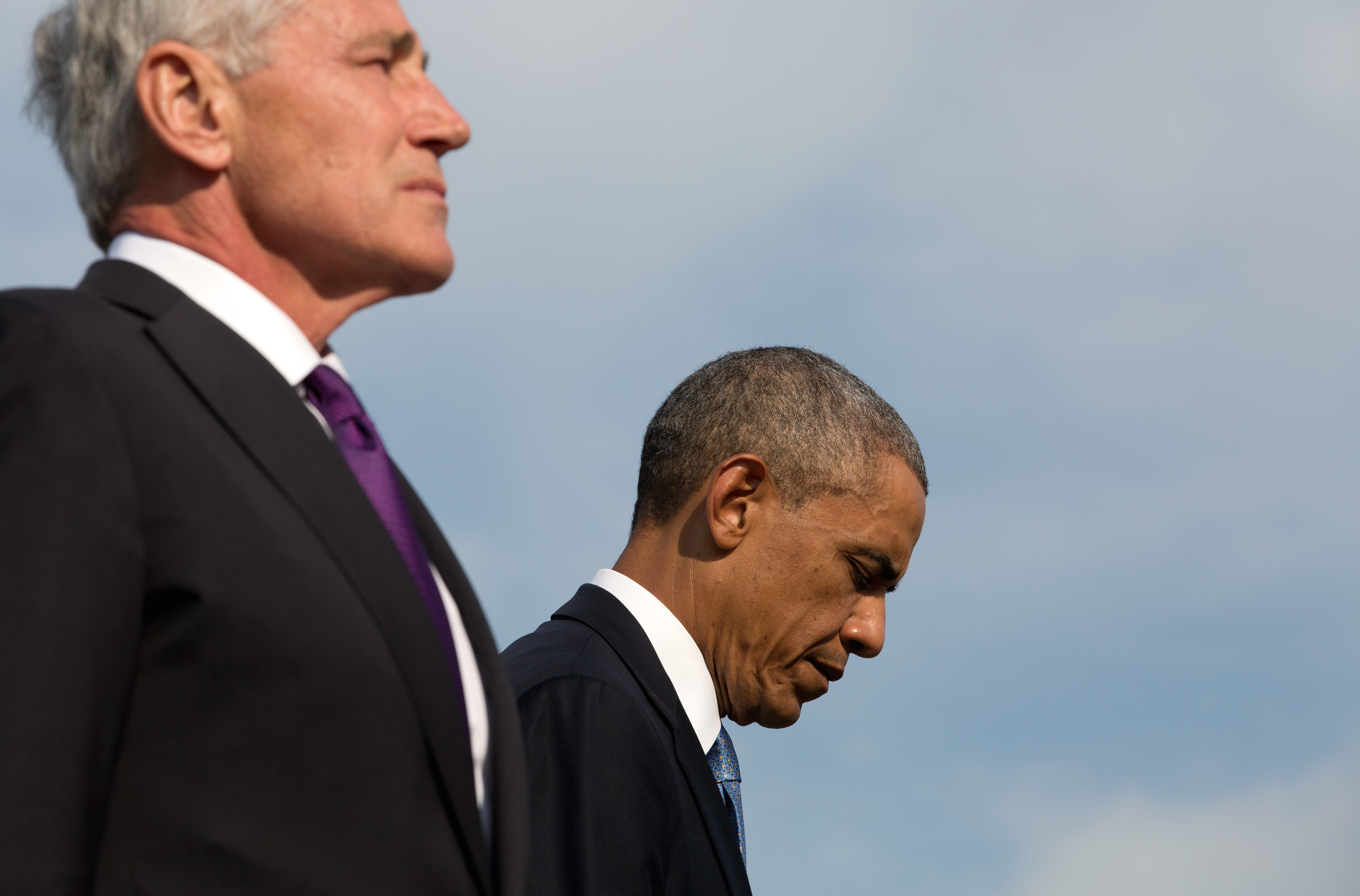
Let me take those points one by one. Obama did explicitly callfor “regime change” in Syria, the country we are now President Obama Marks Anniversary Of September 11th Attacks At The Pentagonbombing, and is now training and arming some Syrian rebels who are the dictator’s foes. As for the notion that we are “providing cover while an effete government refreshes itself politically” – really? The core problem in Iraq is that we replaced a Sunni minority’s despotic rule with a Shiite government backed by militias after a period of extraordinary sectarian blood-letting between the two. Despite a new prime minister, there are very few signs that the government in Baghdad has achieved anything like a “refreshing”.
It still does not command the trust of the Sunnis, cannot fill its interior and defense ministries because of sectarian division, and its army, after huge sums spent on it by the US, turned and fled when it came to operating in Sunni areas. This is the core issue – and we have not resolved it, and we have gone to war without settling that core question. I don’t know how many times the US is going to support a counter-insurgency campaign by a government without broad legitimacy and still hope for success. But at this point, one might have a smidgen of hope that we have learned something from the past. But it appears we haven’t.

Another reader:

I wonder how you can veer between Obama’s Nobel comments you posted the other day and your desire to criticize this campaign against ISIS as a panicked fool’s errand. There is evil in the world. ISIS planned a genocide of an ethnic minority in Iraq, kills en masse (villages, police cadets), rapes and enslaves young women, beheads innocent journalists, an aid worker and now a hiker – but this is none of our business. When does it become our business? What about that Nobel speech and evil that cannot be negotiated with and tramples our most cherished values? What country is still the most admired in the world because of those values? And if we don’t act on them, what does it say about us?

Ah, but that is sentiment and we’re dealing in hard realities here. This is not our fight. They are not an imminent threat, you say. How far do you let these people go and grow before it qualifies as your “imminent threat”? I’d like to see the punditry offer constructive solutions instead of constantly criticizing.

You’ve never underestimated Obama. Why begin now?

The Syrian war killed 200,000 people and we stayed out – for good reasons. Why was my reader not demanding a new war in Syria before now? The only answer is the rise of ISIS, and its grotesque media strategy. And my deeper point is simply this: even if we should do something to counter this kind of evil, what if there’s nothing we can actually do that doesn’t make the situation worse in the medium and long-term? What if we are indeed helpless to do anything other than direct Jihadist terrorism more squarely at the US and the West? Another points out:

Look at what Obama’s already accomplished.

Avoiding the slaughter of thousands of innocent Christians who were stranded with almost certain death at their doorstep, but for our air strikes. Of course if he was 100% determined to wipe ISIS out, then he’d have to send in troops, but my thinking is that by kicking things off in this manner, he’ll massage the other countries in the area to actually provide the ground troops. He realizes the US doesn’t support sending troops in – yet – so is doing what he can with air strikes.  Maybe with a few more American beheadings they just might support them. And I would too.

I still hope the other countries figure out a way, since they’re more directly involved, but if they don’t? You’d be fine with just sitting back and watching ISIS keep up their derangement?

In a word, yes. I do not believe ISIS can sustain itself for very long. No such group has managed to do such a thing before without its own insanity and brutality creating a backlash. We have just swallowed their hype – and elevated them in the eyes of the Arab and Muslim world. You have to remember: however disgusting ISIS is, the Arab-Muslim world will always regard the US as worse. Always. Another sees a long game:

How exactly do you ask someone to fix a problem that cannot be fixed?  You buy time.  And that is precisely what Obama is doing. He is slowing the Islamic State, stopping their forward movement, and spending his time behind the scenes working with all the nations in that area to get them to deal with it.  Because that is the only solution that works.

It is messy.  It is not clear.  It is not guaranteed in any way to be successful.  But it is responsible, and what a clear thinking leader does when there isn’t a better option. Isolationism is no better than neoconservatism or being an interventionist; they are all extremes and wrong.  Reality requires, in my view, the ability to modulate between the two poles when assessing and dealing with current circumstances.  A “doctrine”, as Bush had, is the scariest and worst possible method of dealing with this as it implies that there is a universal strategy that will fix the situation … like when you heard that we would be greeted as liberators – because the doctrine says so.

That’s by far the most potent criticism I’ve yet read. I can only say that I hope my reader is right. Another puts me on the couch:

Your rhetoric on this “reckless” war and implicit and explicit suggestions that what’s happening now is no better or different than 2002-03 all over again have mostly been off-base at best and an embarrassment at worst, and if I was an armchair psychologist, I’d say it’s some weird attempt at atonement for your (admitted) idiocy with respect to the invasion of Iraq. Oops, too late.  I said it.

In any event, stop, breathe, and try to take a more balanced look at what’s going on.

Another adds:

I read the e-book collection you put together – “I Was Wrong” – and it was hysterical between 2001-2003. Don’t fall into that rabbit hole again.

Earlier dissents here. And more to come.

(Photo by Getty)
Dissents Of The Day I

A reader quotes from the Lincoln quote I quoted:

This our Convention understood to be the most oppressive of all Kingly oppressions; and they resolved to so frame the Constitution that no one man should hold the power of bringing this oppression upon us. But your view destroys the whole matter, and places our President where kings have always stood.

Except that now we have a volunteer army and the draft doesn’t exist. So the “Kingly oppression” only falls on those who choose to put themselves at the mercy of a dysfunctional executive branch.  Bring back the draft and I suspect we will suddenly find this argument rather ubiquitous.

Another notes:

The quote you printed was not from Lincoln when he was Commander-In-Chief; it was a letter to William Herndon regarding the Mexican war … when Lincoln was a congressman. Lincoln actually felt a little different later when he was president. This evolution happens to eventual presidents, as you know.

(As an aside, Herndon, Lincoln’s closest confidant, was my great, great, great uncle, and was always known as “Uncle Billy” in my family.)

Another remarks on that evolution:

Certainly this Congressman Lincoln should be more rightly compared to a Senator Obama – a much more liberal man who denounced the Cuban embargo and then goes on as president to renew it for the sixth time in a row; or a man who can denounce the very concept of the Iraq war and then as President go on to bomb Libya, Iraq, and Syria. So maybe Obama has a little more Lincoln in him than at first glance.

More readers reassert the parallels between Obama and Lincoln:

You know, of course, that Lincoln‘s Congress never declared war on the Confederates in order to weasel around international law. For the Union to declare war would have meant recognition of the Confederate States of America as a sovereign nation. In the fight against ISIL, who are we to declare war against?

Also, in an earlier post, you stated that Bush “procured a clear declaration of war from the Congress” – that didn’t happen! Also, back to the Lincoln quote, there is no invasion of Syria!

Your sky-is-falling reaction to these airstrikes (quagmire! mission creep! Bush-like!) is really disappointing.

Another gets into more detail over Lincoln’s war:

You cited Lincoln for his statement of constitutional restraint.  Have you read his history?  Lincoln stands as one of our great presidents (I put only Washington above him) because of his capacity to wrestle with moral and civic complexity and almost always come out right.  But keep in mind what he unilaterally determined as necessary in order to deal with the tick-tock of an existential crisis, from the suspension of habeas corpus (find me something more constitutionally fundamental than that) to the imposition of martial law in unaligned border states (the state of Missouri was still under martial law when Lincoln died.)

On balance, though, we are deeply grateful to Lincoln for doing what had to be done.  He was willing to personally commit the sins necessary for the nation’s salvation.

In the present crisis, we have the president confronted with a rapidly growing force of genocidal malevolence with genuinely global implications – and this time around it’s indeed a crisis that is open and actual.  We also have a Congress that may well have buried itself to a new depth of partisan triviality.  In the meanwhile, in lieu of any other nation or entity that is capable, we are the world’s last resort against the horrors that the worst angels of our nature are capable of.

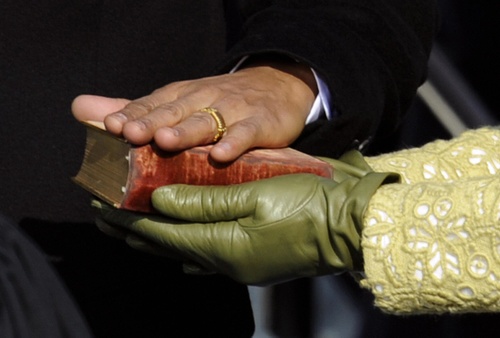
(Photo: Barack Obama’s hand lies on a Bible owned by President Abraham Lincoln as he is sworn in as the 44th US president on January 20, 2009. By Timothy A. Clary/AFP/Getty Images)

A Terrorist Brand War

Vera Mironova worries that’s what we have on our hands:

The only way for Al-Qaeda to get back to the top of the list of terrorist organizations would be to outbid ISIS on its own field (excessive brutality), to prove that they are still the reigning terrorist organization. This does, unfortunately, look to be the plan of the Al-Qaeda. Although they have co-existed with the Yemen government for years, this “peace” however was shattered on August 9th in the southern Yemeni province of Hadramawt, when fourteen military personnel were brutally slaughtered for no reason. A group of armed men stopped and boarded a civilian bus, identified the military personnel, and proceeded to slit their throats. Following in the ISIS traditions, the armed men identified themselves as Al-Qaeda in Arabian Peninsula, videotaped the mass slaughter and published it online.

Although it is hard to predict the future, evidence would suggest that we can expect to see even more brutality in Middle Eastern conflict while Al-Qaeda tries to regain its title. And after the last incident in Hadramawt, Yemeni government pressed Al-Qaeda to look for a “refuge” in other Middle Eastern countries, like Syria and Iraq, the current strongholds of the ISIS. Therefore, the return of Al-Qaeda to the top of the list of terrorist organizations, an extremely violent scenario, is possible.

Is Obama Pulling A Bush?

United Nations Hosts World Leaders For Annual General Assembly

Tomasky insists no:

The first and most important difference, plainly and simply: Obama didn’t lie us into this war. It’s worth emphasizing this point, I think, during this week when Obama is at the United Nations trying to redouble international support to fight ISIS, and as we think back on Colin Powell’s infamous February 2003 snow job to Security Council. Obama didn’t tell us any nightmarish fairy tales about weapons of mass destruction that had already been destroyed or never existed. He didn’t trot his loyalists out there to tell fantastical stories about smoking guns and mushroom clouds.

The evidence for the nature of the threat posed by the Islamic State is, in contrast, as non-fabricated as evidence can be and was handed right to us by ISIS itself: the beheading videos, and spokesmen’s own statements from recruitment videos about the group’s goal being the establishment of a reactionary fundamentalist state over Iraq, Syria, Jordan, and Lebanon. That’s all quite real.

The in-tray has been full of similar sentiments. My response is: sure, so far as it goes. But Tomasky’s argument doesn’t go very far. And the way in which Obama supporters have lamely acquiesced to this reckless war fomented by a dangerous executive power-grab is more than a little depressing. It strikes me as uncomfortably close to pure partisanship. I can’t imagine them downplaying the folly of this if a Republican president were in charge.

Sure, we are indeed not being grotesquely misled this time about non-existent WMDs. But we are going to war despite the fact that ISIS is no more a direct threat to the United States than Saddam was – arguably much less, in fact. We have no answer this time to the unanswered question last time: what if our intervention actually galvanizes Islamist extremism rather than calming it? And the Arab coalition that Tomasky cites as evidence that this war is a far less American-centric one than 2003 has some issues when you confront reality. Here’s the latest:

Jordan said that “a number of Royal Jordanian Air Force fighters destroyed” several targets but did not specify where; the Emirati Ministry of Foreign Affairs said that the air force “launched its first strikes against ISIL targets” on Monday evening, using another acronym for the Islamic State. American officials said that Saudi Arabia and Bahrain also took active part in the strikes, and that Qatar played a “supporting” role.

This may be important window-dressing, but window dressing it still is. It sure isn’t close to the coalition George H W Bush assembled in 1990 – and it’s much smaller than George W Bush’s coalition in 2003. More to the point, the key element of any successful strategy will be the position of the Sunni Arab tribes – and they are still sitting on the sidelines. Turkey is AWOL so far. And the fact that the Arab states do not want their contributions to be broadcast more widely reveals the depth of the problem. Obama has Americanized the problem. Once you do that, the regional actors get even more skittish, because the only common thing for so many of the populations represented by these autocrats is loathing of the United States. This is the Arab world. The US will never get anything but hatred and cynicism and contempt from it.

Then there’s the question of authorization.

George W Bush got a few Security Council resolutions (if not the final, vital one). Obama hasn’t even bothered – he’s bombing a sovereign nation without even feigning a request for formal authorization. GWB – against Cheney’s wishes – procured a clear declaration of war from the Congress. Obama seems to have decided that he is more in line with Cheney’s views of executive power than George W Bush’s – and has blown a hole so wide in any constitutional measures to restrain the war machine that he has now placed future presidential war-making far beyond any constraints. If that isn’t an outright abandonment of almost everything he has said he stands for, what would be?

Bush’s war had a vague and utopian goal: the establishment of a multi-sectarian democratic republic in Mesopotamia. He had close to no plans for the occupation; and no real understanding of how quixotic a project he was promoting. Obama’s goals are just as quixotic – “ultimately destroying” ISIS from the air alone – and he has no Plan B for failure. Bush tried to defeat a Sunni insurgency with a multi-sectarian government in Baghdad. It never happened – and we had to bribe the Anbar tribes instead, and, even then we needed 100,000 troops to keep the lid on the whole thing.

Obama says he is fighting a Sunni insurgency with a broadly based Baghdad government – but replacing Maliki has led to no such thing. There is still paralysis in Baghdad over the interior and defense ministries, no cross-sectarian national entity to take the fight to ISIS, and the real risk of a Shiite government actually reinforcing the Sunnis’ sense that the US and the Shiites are now intent on persecuting them even further. That makes the prospects for this attempt at pacification even worse than in 2006.

And look: I think Obama is sincere in doing what he can with the Baghdad mess; but we have to be crazy to buy this line of argument in counter-insurgency at this point in history. We are fighting a Sunni insurgency on behalf of a Shiite government and a near-independent Kurdistan, a fight which might well empower Iran and even Assad. This is about the worst formulation for this struggle as one could come up with. It does not bring Sunnis into the struggle; it may well keep them out.

Of course I wish I didn’t have to write this. And it is, of course, true that we are not torturing prisoners with the sadism and insanity of the Cheneyites. It is true we are not sending in 140,000 troops into another country. We are sending almost none – but to achieve the same result! To do the same thing we did last time and hope for a better outcome is the definition of insanity. But to do the same thing with even less of a chance to achieve it takes things to a new level of incoherence.

This is an illegal war, chosen by an unaccountable executive branch, based on pure panic about a non-existent threat to the United States, with no achievable end-point. Apart from all that, it’s so much better than Bush, isn’t it?

(Photo: Obama holds a bilateral meeting with Prime Minister of Iraq Haider al-Abadi during the 69th United Nations General Assembly in New York City on September 24, 2014. By Allan Tannenbaum-Pool/Getty Images.)

Better Reasons To Drop Bombs In Syria

Douthat identifies a few:

To the extent that these strikes have a limited military objective that either connects directly to the Iraqi front (by denying the Islamic State a secure rear) or targets groups plotting more actively against the United States, they trouble me much less than a more open-ended strategy in which we seek to conjure up a reliable ally (“you know, whatever the Free Syrian Army ever was,” to quote a U.S. official in Filkins’ piece) to be our well-armed boots on the Syrian ground.

Or put another way:

The idea that we can somehow hope to defeat ISIS outright in Syria, where we currently have no real allies capable of winning a war or securing a peace, without first seeing the Islamic State pushed back or defeated in Iraq — itself probably a long-term project — seems like the height of folly, and a royal road to another quagmire or bloody counterinsurgency campaign. But the possibility that strikes in Syria might modestly help our existing allies in Iraq seems at least somewhat more plausible, with a more limited worst-case scenario than a full-scale Syrian intervention if they don’t ultimately do much good.

But Larison fears that our limited involvement won’t stay limited:

Every step along the way, the administration has set down restrictions on what it would be willing to do, and it then cast those restrictions aside within days or weeks of imposing them. The administration is currently saying that there won’t be American forces on the ground engaged in combat, but as we should know by now every statement like this is entirely provisional and can be revoked at any time. Furthermore, because the administration persists in the lie that the 2001 AUMF covers this military action, it is very doubtful that the president will seek Congressional authorization for this war even if the war involves U.S. ground forces. I very much hope that Obama doesn’t yield yet again to the pressures in favor of escalation, but there is no reason to think that he will be able to resist them indefinitely.

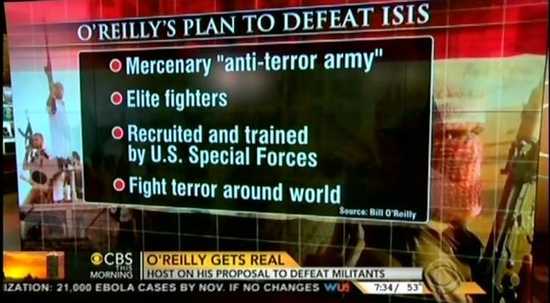
Bill O’Reilly’s Dumb Plan To Defeat ISIS

Oreilly

Oy vey:

[O’Reilly] knows advocating for American troops to take up the fight themselves is extremely unpopular. O’Reilly, problem solver that he is, has a solution: “elite fighters who would be well paid, well trained to defeat terrorists all over the world.” Since that worked so well in Iraq last time around. What we need is more Blackwater. In the O’Reilly fantasy, the 25,000-person force would be English-speaking, “recruited by the USA and trained in America by our special operations troops,” and dubbed “the Anti-Terror Army,” because the Avengers is already taken.

Allahpundit dismantles O’Reilly’s pipe dream:

The flaw is that there’s no obvious next step if the mercenaries succeed in routing ISIS from Raqqa and eastern Syria. Who takes over and rules that half of the country if that happens? Assad? He’ll butcher the Sunni civilians there and the Sunnis know it. A new sectarian rebellion against the regime would spring up overnight. Some sort of multinational Sunni force of Saudi, Turkish, and Jordanian troops? Iran will never let the Saudis have that kind of foothold, and besides, none of those countries want the headache of pacifying radicalized Sunni Syrian civilians. NATO doesn’t want it either, of course; an army of western peacekeepers would be even more culturally estranged from Syrian Arabs than a multinational Sunni force would.

The theoretical virtue of Obama’s “arm the Syrian moderates” plan is that if the moderates were to defeat ISIS, they’d be comparatively well positioned to take over as rulers of eastern Syria. They’re natives and they’re Sunnis; they’re probably acceptable to the locals. But of course, the moderates aren’t going to defeat ISIS, which puts us back at square one.

(Image via Barbara Morrill)

A Hundred Thousand Displaced

TURKEY-SYRIA-KURDS-REFUGEES

The Guardian explains how this state of affairs came to be:

The border region of Kobani, home to half a million people, has held out for months against an onslaught by Islamists seeking to consolidate their hold over swaths of northern Syria. But in recent days, Isis extremists have seized a series of settlements close to the town of Kobani itself, sending as many as 100,000 mostly Kurdish refugees streaming across the border into Turkey. “I don’t think in the last three and a half years we have seen 100,000 cross in two days,” the representative for the UN refugee agency (UNHCR) in Turkey, Carol Batchelor, told Reuters. “So this is a bit of a measure of how this situation is unfolding, and the very deep fear people have about the circumstances inside Syria and, for that matter, Iraq.”

A Kurdish commander on the ground said Isis had advanced to within 9 miles (15km) of Kobani. A Kurdish politician from Turkey who visited Kobani on Saturday said locals told him Isis fighters were beheading people as they went from village to village. “Rather than a war this is a genocide operation … They are going into the villages and cutting the heads of one or two people and showing them to the villagers,” Ibrahim Binici, a deputy for Turkey’s pro-Kurdish People’s Democratic party (HDP), told Reuters.

Juan Cole marvels, “I lived to see the day when thousands of Kurds take refuge in Turkey”:

For anyone who knows the history of the Turkish government’s dirty war against Kurdish separatists in the 1970s and 1980s, it is a startling reversal to see Syrian Kurds flooding for refuge into Turkey. The influx was not smooth and Turkish security did at points try to stem it. But actually Turkey has something like a million Syrian refugees already.

The Kurds have since halted ISIS’s advance, it seems. Meanwhile, Aki Peritz doubts the US has the political will to defeat ISIS:

[I]t remains unclear whether America has the popular stamina to take on this group for what clearly will be a years-long struggle. The latest polling from the New York Times and CBS News show clear majorities approving airstrikes against ISIL fighters in both Iraq and Syria, but only 48 percent of Americans are in favor of training and providing military equipment to rebels in Syria—the fighters who would actually have to hold the ground presumably vacated by ISIL. Congress may have given President Obama the green light to arm the rebels, but it’s not clear the American people are behind him.

As the United States expands its air campaign and put more “advisers” on the ground in and around Iraq, will Americans continue to support this effort – and probable casualties? After all, without sustained public support, any extended military campaign is doomed to fail. And people are anxious about the lengthy time horizon: Some 83 percent of Americans are either “very concerned” or “somewhat concerned” with a long and costly involvement in Iraq and Syria.

Josh Rogin and Eli Lake examine the administration’s “mission to build an ISIS-killing army in Syria”:

Many lawmakers don’t see how training 5,000 Syrian rebels a year, assuming trustworthy, vetted brigades can be found, can defeat an ISIS army that the CIA estimates may already have 31,000 fighters and growing. “The goal is not to achieve numerical parity with ISIL, but to ensure that moderate Syrian forces are superior fighters trained by units,” Hagel said.

Even some lawmakers who support the plan don’t believe the administration’s claims that the Syrian rebels will only fight ISIS after being trained by the U.S., rather than focusing on their real enemy, the regime of Syrian President Bashar al-Assad. After all, that’s what the FSA is saying openly it plans to do.

Larison rolls his eyes:

No one seriously thinks that arming and training a few thousand rebels will make much of a difference or do much good, but it is the relatively risk-free option (for Americans) that provides a temporary sop to insatiable hawks while also providing cover for fence-sitters that want to be considered “serious” on foreign policy without having to take big political risks by backing more aggressive measures. Finally, many members of Congress endorsed this policy just so that they could get it off the agenda before the elections, so majority support in Congress for arming Syrian rebels may be shown to be illusory much sooner than we might have guessed.

(Photo: Syrian Kurds wait near Syria’s border at the southeastern town of Suruc in Sanliurfa province, on September 20, 2014. Tens of thousands of Syrian Kurds flooded into Turkey on Saturday, fleeing an onslaught by the jihadist Islamic State group that prompted an appeal for international intervention. By Bulent Kilic/AFP/Getty Images)

An Actual War On Women, Ctd

Ariel Ahram goes deep in exploring ISIS’s use of sexual violence, arguing that it represents “as much an undertaking in state-making as in war-making”:

The power to control or manipulate sexual and ethnic identity is a key component of all state power. In the Middle East, the regulation of sexual relations is often used as a means to create or reinforce ethno-sectarian boundaries.

In the 19th century the Ottoman authorities prohibited marriage between Shi’i men and Sunni women in the provinces of Iraq for fear that Shi’i Iranians were gaining a demographic foothold in the region. Since Islamic law privileges male prerogative over children, the move was meant to block the propagation of Shi’ism within the Ottoman domain. Marriage of Shi’i women to Sunni men was still permitted, since the children of such a union were deemed Sunni. Saddam Hussein took similar measures in the 1970s and 1980s. In late 1970s, in the immediate wake of the Islamic Revolution in Iran, the government moved to deport some 40,000 people deemed to be of “Iranian” (i.e., Shi’i) origins.  Thousands of families were interned in prison or prison camps for months, where they were subject to rape and torture, before being transported to the border. …

ISIS’s violence is a heinous crime of war, but also represents a particular form of statecraft. At first glance, it might appear that these practices, though justified by selective interpretations of Islamic law, serve only to satisfy prurient sexual urges. Much like its manipulation of water and oil resources, though, ISIS’s use of sexual and ethnic violence has both ancient and modern antecedents. By selectively reinforcing, creating, and severing ties of kinship, these violent practices can affect bonds of loyalty and obedience far more substantially than the simple distribution of resource rents.

The Collapse Of Arab Civilization?

That’s how Hisham Melhem characterizes the decades-long series of crises that led to state failure in the Arab heartland and the rise of ISIS:

Arab civilization, such as we knew it, is all but gone. The Arab world today is more violent, unstable, fragmented and driven by extremism—the extremism of the rulers and those in opposition—than at any time since the collapse of the Ottoman Empire a century ago. Every hope of modern Arab history has been betrayed. The promise of political empowerment, the return of politics, the restoration of human dignity heralded by the season of Arab uprisings in their early heydays—all has given way to civil wars, ethnic, sectarian and regional divisions and the reassertion of absolutism, both in its military and atavistic forms. With the dubious exception of the antiquated monarchies and emirates of the Gulf—which for the moment are holding out against the tide of chaos—and possibly Tunisia, there is no recognizable legitimacy left in the Arab world.

And in his view, neither Arab nationalism nor Islamism is a viable solution, being both “driven by atavistic impulses and a regressive outlook on life that is grounded in a mostly mythologized past”. He concludes:

The Islamic State, like al Qaeda, is the tumorous creation of an ailing Arab body politic.

Its roots run deep in the badlands of a tormented Arab world that seems to be slouching aimlessly through the darkness. It took the Arabs decades and generations to reach this nadir. It will take us a long time to recover—it certainly won’t happen in my lifetime. My generation of Arabs was told by both the Arab nationalists and the Islamists that we should man the proverbial ramparts to defend the “Arab World” against the numerous barbarians (imperialists, Zionists, Soviets) massing at the gates. Little did we know that the barbarians were already inside the gates, that they spoke our language and were already very well entrenched in the city.

Thirteen Years Of Strategery

IRAQ-CONFLICT

Micah Zenko calls out Obama’s strategy against ISIS as another example of “political leaders presenting totally unrealistic and implausible end states”, which has been a hallmark of US counterterrorism since 9/11:

Given that two administrations have failed to achieve their end states of defeating the Taliban and al Qaeda and its affiliated organizations, we should be extremely doubtful of the Obama administration’s strategic objective of destroying IS or its ability to threaten the United States or any of the world’s 1.6 billion Muslims. Furthermore, it is difficult to ascertain what the Obama administration has learned from the total failure to eliminate the Taliban and al Qaeda and all affiliates. Based upon White House statements, it appears that its sole lesson from the post-9/11 era is to avoid massive ground invasions, and to emulate the policies from Yemen and Somalia, which again, according to U.S. government data, have not worked.

On Friday, Pentagon spokesperson Rear Admiral John Kirby was asked how IS would be destroyed, beyond airstrikes and supporting partners on the ground. He replied: “It also is going to take the ultimate destruction of their ideology.” If this is truly the ultimate pathway for IS’s destruction, then it was strange that it did not appear anywhere in President Obama’s strategy speech. Furthermore, altering the interpretation that others hold of a religious ideology is something that governments are really bad at.

A million amens to that. Meanwhile, Allahpundit responds to the CIA’s pessimism about arming the Syrian rebels:

Increasingly, I think this whole arm-the-rebels plan is just a perfunctory mad-libs answer to an obvious question about O’s ISIS strategy.

Everyone understands that we can put a hurt on them from the air; we can probably also pull together a force in Iraq between the Iraqi army and the peshmerga to push ISIS back into Syria. But what happens then? If the plan is to destroy them, how do we get them once they’re back inside their home base and hunkered down in Syrian cities? We don’t. In reality, we’re practicing a containment strategy, the first step of which is to shove ISIS out of Iraq and the second step of which is to drone their key leaders and terror camps once they’ve returned to Syria. Destroying ISIS will be left to the Shiites who are really motivated to do it, be it Assad, Iran, Hezbollah, or, most likely, Shiite militias from Syria and Iraq. This FSA pipe dream is less an actual plan than a rhetorical one, so that O has an out-of-the-box answer handy when someone asks him “Who’s going to fight our battle in Syria?” What’s he supposed to say, “Shiite death squads”? That may be the correct answer but it’s not a politic one.

Discussing the CIA’s recently revised estimate of how many fighters ISIS has, which rose dramatically from 10,000 to somewhere between 20,000 and 31,500, Carl Bialik points out how hard it is to count them:

Intelligence experts outside the CIA cast some doubt on the precision of the estimate. Michael O’Hanlon, a senior fellow at the Brookings Institution, a centrist think tank in Washington, said even the wide range of numbers may understate the uncertainty in the count. “I’d say the estimates are no better than +/- 50%,” O’Hanlon said in an email. Anne Stenersen, a research fellow at the Norwegian Defence Research Establishment in Kjeller, Norway, said the accuracy of the estimates depends on the CIA’s sources. “For a country like Afghanistan, I would trust their estimates because they have access to many different sources on the ground,” Stenersen said in an email. “In Iraq/Syria and for a group like ISIS, it is really hard to know where they get their numbers from, and how reliable they are.”

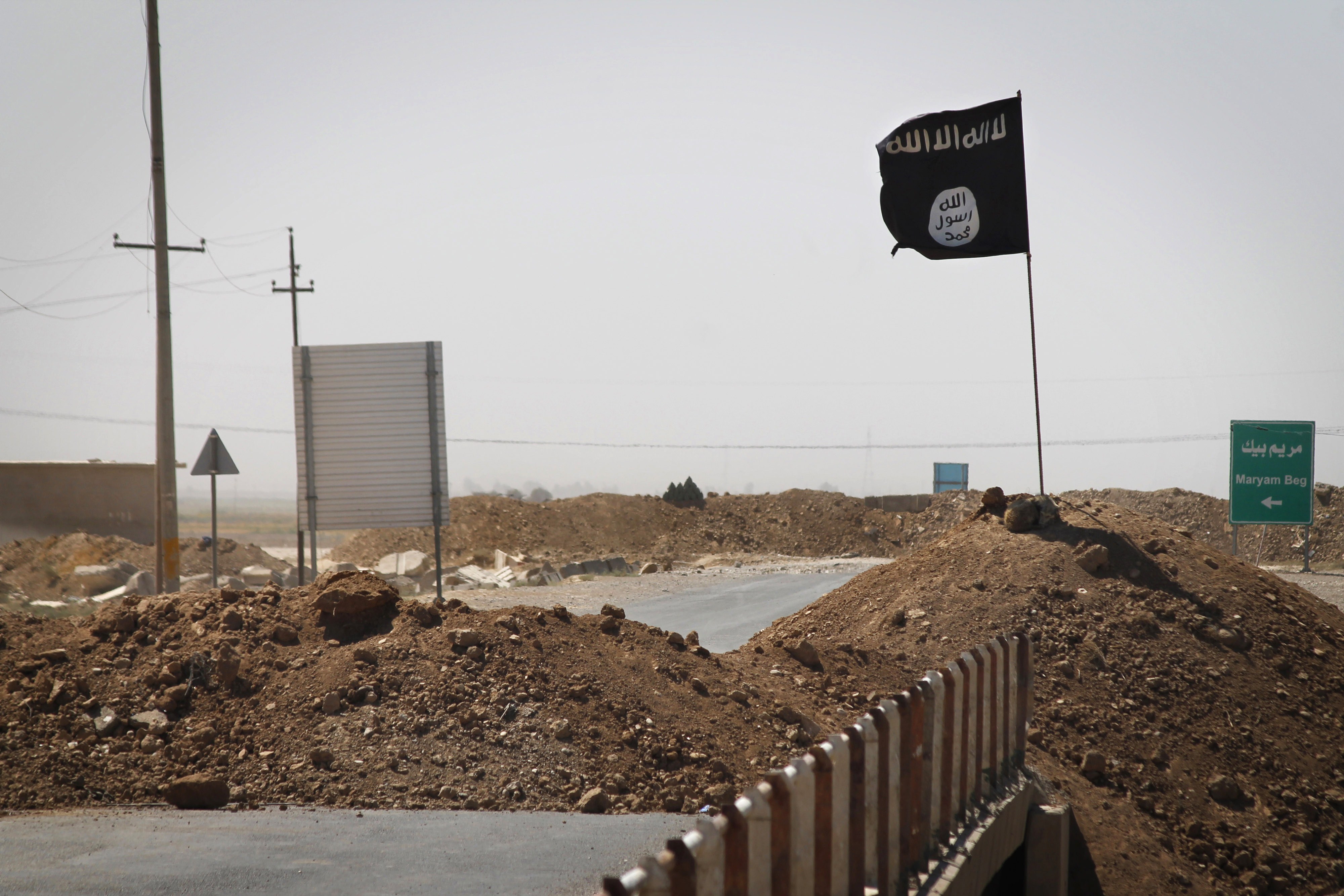
(Photo: A flag of the Islamic State (IS) is seen on the other side of a bridge at the frontline of fighting between Kurdish Peshmerga fighters and Islamist militants in Rashad, on the road between Kirkuk and Tikrit, on September 11, 2014. By JM Lopez/AFP/Getty Images)