Elias Groll and Simon Engler round up some of the worst offenders, like Oklahoma Senator James Inhofe:
“ISIS, they are really bad terrorists, they’re so bad even al Qaeda is afraid of them,” Inhofe told a local Fox station last month. “They’re crazy out there and they’re rapidly developing a method of blowing up a major U.S. city and people just can’t believe that’s happening.”
Perhaps Inhofe is right, [counterterrorism chief Matthew] Olsen is wrong, and Islamic State militants are indeed plotting an attack right now inside America’s borders. American intelligence officials have certainly been wrong before about the threat posed by terror groups, and the Islamic State has alarmingly large numbers of fighters with American passports who could return to the U.S. to carry out strikes here at home. But the phrase “rapidly developing a method of blowing up a major U.S. city” goes far beyond what experts inside and outside of government say about the group’s capabilities. There is no substance here, only speculation likely designed to inspire fear and drum up support for military action.
Weigel examines the partisan implications of threat inflation:
Here’s the current paradox. The Obama administration—most reliably Chuck Hagel and John Kerry—is describing ISIS in apocalyptic terms. According to Kerry, ISIS is “an ambitious, avowed genocidal, territorial-grabbing, Caliphate-desiring quasi-state.” Their goal is not really to downplay what ISIS can actually achieve, or to reflect the intelligence analysis that ISIS poses little threat to (ugh, this term) “the homeland.” It’s to avoid a Syria-style rebellion in Congress and assemble a coalition of Arab partners in the Levant.
But Democrats do not benefit, domestically, from the hype. Just today, New Hampshire U.S. Senate candidate Scott Brown challenged Democratic Sen. Jeanne Shaheen to secure the border and sign on to legislation that would revoke the citizenship of American ISIS fighters. “If anyone (including ISIS) can cross our borders at any time, with anything in their possession, then Washington has no control over our nation’s security from terrorist attack,” said Brown. That statement sounds like incoherent heebie-jeebie-ism if you listen to intelligence assessments. Current estimates peg the total number of Americans who might have gone to Iraq and Syria for ISIS at fewer than 100. The threat of such an American, if he returned, is not that he’d cross an unprotected border with a knife between his teeth and jihadism on his mind. It’s that he’d use his American passport at a normal TSA checkpoint.
Yishai Schwartz offers up one, arguing that the president’s approach to ISIS has been perfectly coherent, and not just a reaction to the beheading videos or polls:
Obama began ramping up interventions in Iraq well before these murders, and he did so in response to substantive strategic realities. It was in mid-June that Islamic State militants routed the far larger and better-equipped units of the Iraqi army. Only days later, reports began to surface that President Obama had offered air strikes in support of the Iraqi military, but made them conditional on Prime Minister Nouri al Maliki’s resignation. On August 7, IS militants seized the crucial Mosul Dam.
The same day, profound humanitarian and strategic considerations forced President Obama to compromise somewhat on pressuring Maliki, as he authorized his first air strikes to protect the besieged Yezidi population and to bolster buckling Kurdish forces. Around the same time, the U.S. began to build the international coalition against IS that would emerge weeks later. On August 15, Maliki finally caved to international and internal pressure and stepped aside, and on August 17, American forces helped the Kurds retake the Mosul dam. All of this occurred well before the video of Foley’s murder went online.
This chain of events does not look like a sudden reversal after pressure from post-beheading opinion polls. It looks like a roadmap to war …
I guess you can take this to be reassuring – if you believe in a sustained, perpetual US war in Iraq (currently a war that has lasted from 1990 – 2014). Schwartz’s reading of the chronology is also problematic:
a steadily deteriorating strategic situation, an expressed American willingness to strike predicated on the meeting of a condition, the fulfilment of the condition …
But a clear-eyed assessment of the actual situation does not lead many to believe that IS was about to take over all of Iraq. If it were, do you think Turkey would be hanging back? In fact, its capture of Mosul may well have been its high watermark – unless Americanizing the war gives IS a new lease on life. Then “the meeting of a condition”. I think that refers to getting rid of Maliki. But that was not the condition. The condition was a unified, multi-sectarian government in Iraq – which was the point of the “surge” as well. It never happened under the surge – which is why it failed; and it hasn’t happened even as these loons have come close to Baghdad.
Today, the Iraqi parliament could not confirm the new prime minister’s nominations for the defense and interior ministries – the two that really count, and the two that are still a function of Iraq’s permanent sectarian divides. So as the US president commits this country to war in defense of “Iraq”, the same “Iraq” is so divided it cannot form the government that Obama explicitly said was a prerequisite. Which means it was not a prerequisite. It was more bullshit for an open-ended war with no Plan B that had already been decided upon.
To me, that does not seem something that we elected Obama to do. Au contraire. I will add a couple more points: General Dempsey today filled in the blanks for what happens after the current “strategy” fails:
“My view at this point is that this coalition is the appropriate way forward. I believe that will prove true,” he said. “But if it fails to be true, and if there are threats to the United States, then I of course would go back to the president and make a recommendation that may include the use of U.S. military ground forces.”
You heard that right. And the neocon chorus will continue to fight for another invasion of Iraq – and why not Syria? – as you can see from this classic disingenuous editorial from the Washington Post. Or check out John Boehner, who wants to relive 2003 – 20011 all over again:
“I just think that if our goal here is to destroy ISIL, we’ve got to do more than train a few folks in Syria and train a few folks in Iraq and drop some bombs,” Boehner told reporters Tuesday morning in the Capitol. “I just don’t know that it’s enough to achieve the objective the president announced.”
Neither John Boehner nor the neocons at the Washington Post actually call for ground troops – Obama has allowed them to cavil and complain from the sidelines, without getting them to vote for a new war – but you can see the general drift. The Beltway never truly believed it had screwed up in Iraq – bloviators like McCain actually believe the Iraq war was a success! – and so the notion that a new Iraq War would be obviously a terrible thing does not truly occur to them. This is the price we pay for there being no accountability in Washington – the very war criminals and ideologues that gave us that catastrophe now want to repeat the entire thing, by fanning the flames of panic and hysteria.
[Last Wednesday’s] speech, which was clearly intended to alter the perception of helpless incompetence, merely reiterated the ad hoc approach to Iraq that his administration has pursued since early June. There may be good reasons to go to war against ISIS, but no one has actually articulated them. Are we protecting Erbil and American personnel? Undertaking a humanitarian mission? Fighting evil? Helping the Free Syrian Army? Assisting Washington’s regional allies against the ISIS threat? No one knows, but we are nevertheless turning the aircraft carriers into the wind. This is no way to go to war.
The disheartening aspect of this episode is that the White House’s instincts were initially correct: Foley’s beheading, that of Steven Sotloff, and most recently the murder of David Haines may be horrible, but they are not very good reasons to commit the United States to the conflict in Iraq and inevitably, Syria—two countries that are likely to be at war with themselves for decades. That may be unavoidable, but before the United States leaps in, policymakers should actually develop a strategy. In other words, identify realistic national goals and determine what resources are necessary to achieve those aims. I am not sure anyone has articulated those goals yet, which means that we are still at step one.
I know many of youdisagree. But I fear this is Obama repealing a core pillar of his candidacy and presidency. And there is nothing we can do about it. The Congress has effectively abdicated its democratic responsibility – and Obama is happy about that. So sit back, get some popcorn, and watch successive emperors extend that AUMF into perpetuity. And if you think the Iraq Wars from 1990 – 2014 have been a great success, what’s not to love about that?
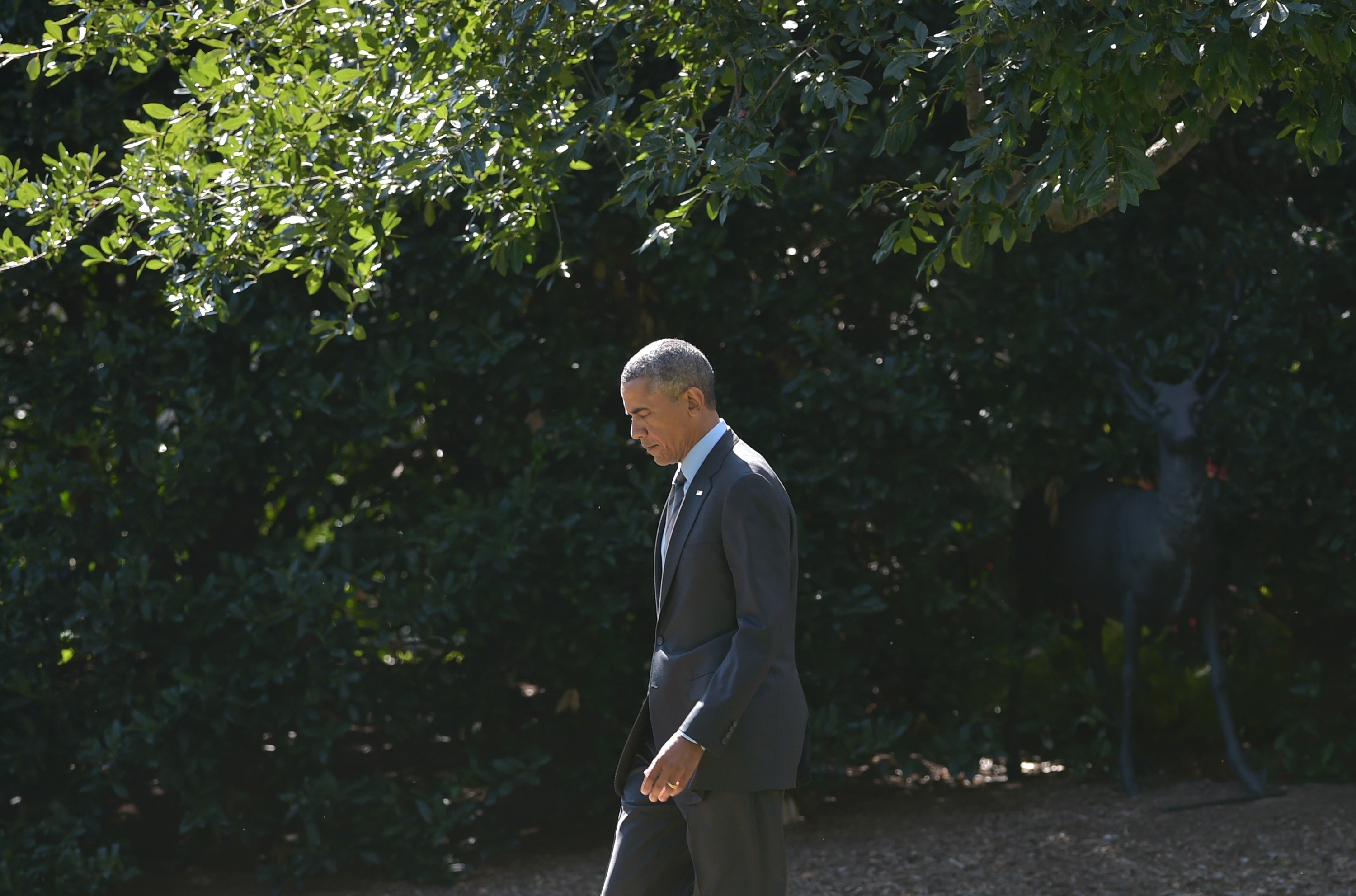
(Photo: US President Barack Obama makes his way to board Marine One on the South Lawn of the White House on September 12, 2014, in Washington, DC. Obama is heading to Baltimore, Maryland to visit Fort McHenry and to attend a fundraiser. By Mandel Ngan AFP/Getty Images.)
The House is working on an authorization to arm the “moderate” Syrian rebels:
The House Armed Services Committee has drafted an amendment to grant authorization to the President to arm and train Syrian rebels opposed to the Islamic State of Iraq and Greater Syria (ISIS). There are some strings attached, including requiring that the Pentagon report to Congress 15 days before it plans to train and equip the rebels, and provide subsequent updates to relevant committees every 90 days. The language will be included as an amendment to a government funding bill that needs to pass Congress by the end of the month to avert a partial government shut down. Rep. Patrick McHenry (R-N.C.), a key member of the House GOP whip team, said the amendment will pass this week.
But these “moderates” we’re supposed to be counting on seem to be on their last legs, to the point that a major American support group for them disbanded last month:
On August 19, the Syrian Support Group, which had previously arranged a few shipments of nonlethal aid to the Free Syrian Army, sent a letter to donors explaining why the group was shutting its doors. “Over the last year, the political winds have changed,” the letter read. “The rise of ISIS and Jabhat al-Nusra [an Al Qaeda-affiliated opposition force in Syria] and the internal divisions among rebel forces on the ground have complicated our efforts to provide direct support.”
The letter noted that “more significant support” was heading to the FSA from Saudi Arabia, Qatar, the United States, and other governments. But rivalries and rifts within the opposition had impeded the overall effort. “It was difficult to keep things going with the changes in the FSA and its Supreme Military Council and the advent of ISIS,” says Majd Abbar, who was a member of the Syrian Support Group’s board of directors. “It made our operations extremely difficult.”
Syrian rebels and jihadists from the Islamic State have agreed a non-aggression pact for the first time in a suburb of the capital Damascus, a monitoring group said on Friday. The Syrian Observatory for Human Rights said the ceasefire deal was agreed between IS and moderate and Islamist rebels in Hajar al-Aswad, south of the capital. Under the deal, “the two parties will respect a truce until a final solution is found and they promise not to attack each other because they consider the principal enemy to be the Nussayri regime.” Nussayri is a pejorative term for the Alawite sect, an offshoot of Shiite Islam to which President Bashar al-Assad belongs.
Perhaps this was all anticipated by the Obama administration and others—indeed, it does help explain the apparent desire of John McCain and Lindsay Graham to go to war with the entire region. But it doesn’t speak well for the idea that anyone who encounters IS understands immediately the organization must be destroyed at any cost lest or the world will come to an abrupt end.
And Allahpundit predicts that our de facto role as Assad’s air force will bring ISIS and Syrian rebel militias closer together, not drive them apart:
If ISIS’s grip begins to loosen in Sunni areas of Syria as the U.S. pounds them from the air, what are “moderates” more likely to do? Join with their hated enemy, the Shiite Assad, in stamping out ISIS, at which point Assad might turn around and attack the “moderates”? Or join with ISIS and fend off Assad in the name of keeping Iran’s Shiite death squads from cleansing those Sunni areas? Arguably, the more effective we are in damaging ISIS, the greater the risk that our “moderate” partner will turn on us and join the battle against the de facto U.S./Assad alliance. [Richard] Engel sees it coming. Does the White House?
It would appear not. Even though it’s bleeding obvious.
The in-tray has been brimming with backlash over my criticism of the president on Iraq. I’m glad to air it – and it’s made me think hard about it again. And this email stung a little – but made me laugh:
[The above] commercial popped into my head after reading you on Obama, and I thought to myself, “I swear it’s Andrew, bless his hysterical heart.”
I share every one of your concerns regarding Obama‘s initiative against ISIS, and yet there is a word in my thoughts that you, as far as I am aware, haven’t mentioned and that president Obama mentioned only once in his speech and in a passing way: genocide.
By both word and deed, ISIS has unequivocally declared its intent to exterminate any and all non-Sunni (and eventually non-Salafist) persons that it can. ISIS has clearly shown itself committed to a level of atrocity far above any usual sectarian blood-letting. They may well have the capacity to kill in numbers that rival Rwanda, perhaps even the Nazis. This thought disrupts my inclination to stand back. Don’t we suffer remorse over past genocides we failed to act against? Can we do much to stop this one? Probably not. Does that take away the moral burden to try? Probably not.
That simple lesson is as follows: American military force to pummel Jihadists from the skies can create as much terror as it foils. Our intervention can actually backfire and make us all less safe. How many Jihadists, for example, did the Iraq War create? Our intervention gave al Qaeda a foothold in Iraq and then, by creating a majority Shi’a state for the first time, helped spawn Sunni support for the Caliphate.
It’s not fair to compare an invasion, followed by nearly a decade of occupation and so-called “nation-building,” to the air campaign and soldier training that Obama is waging against ISIS. For one thing, there’s a great deal of support from Arab nations in the region and moderate Muslims around the world. Yes, we’re doing their dirty work, to some extent. But because that work doesn’t entail our soldiers traipsing through their streets – and since they’ve asked for our help, it’s a totally different dynamic.
In short, we’re the good guys to moderate Muslims who are repulsed by ISIS. As for the extremists who like ISIS, well … we’re never going to win them over anyway, and maybe a show of force will have a deterrent effect on their enthusiasm for ISIS propaganda.
This issue is much too serious to play the strawman game where you ridicule the notion of this kind of intervention eradicating extremism. However strong the president’s language was last week, no one actually thinks this is the cure for Sunni-based violent extremism. It’s merely a way to prevent genocide, empower moderates in the region, and, over the long-term, advance the idea that we aren’t driven entirely by oil interests and imperialism.
And you’re right that it probably won’t be an unqualified success, but one thing I respect about this administration, which I thought you respected as well, is that it takes on issues where the likelihood of complete victory is remote, because they know that any progress is better than doing nothing. It was true with the stimulus. It was true with health care reform. It was true with gay marriage. And it’s true in Iraq.
I take our reader’s point. I would cavil with the idea that “we’re the good guys to moderate Muslims who are repulsed by ISIS”. We have no evidence of that. We have a hell of a lot of evidence that our interventions – especially bombing Sunni areas from the skies – can backfire and alienate the very people we are trying to support. And the idea that, at this point, Iraqis view the US as anything other than a blight on what was once their country seems too naive for me. Another reader:
Were you opposed to Obama‘s campaign to degrade and defeat al-Qaeda’s leadership? No; you kind of liked it. Although Islamic State is apparently not actively targeting the U.S. at this very moment, I see no difference between IS and al-Qaeda in terms of their long-term threat to the Homeland. I think we would be negligent to let them grow in strength unchallenged. The job to degrade them is incredibly difficult and we may fail. We may make it worse if we kill too many civilians again. But I don’t believe ISIS will go away or change their plans if we ignore them. I don’t believe that they will be grateful if we leave them alone to commit genocide or enslavement. Obama could have punted on ISIS, but he didn’t. He is taking seriously and doing the best he can.
Obama is not stupid or craven or cynical or excessively politically motivated. I think he is sad and tired. His vision of humanity and historical progress has taken a beating. The Arab Spring turned out to be pretty disappointing. There are tens of thousands of young Muslim men in ISIS that are objectively evil and inhumanly cruel to innocent and helpless fellow human beings. It is hard not to get depressed about human nature. He is being forced to cough up his legacy of disengagement in Iraq.
The Ferguson incident has revealed that race relations remain fraught in this country despite his attempts to transcend the prejudice and hatred. Both blacks and whites blame him for not doing the right thing (whatever that is). Hispanics think that he is a traitor for delaying on immigration reform. Meanwhile, his approval rating is in the toilet, the Senate is likely to fall to the Republicans, and his last two years may be completely stymied. His supporters have fled. This is the reward he gets for being cool-headed, thoughtful, rational, measured, and brave. Almost everything going wrong is not his fault. Of course he makes a few mistakes now and then, like getting photographed golfing at the wrong time or wearing the wrong suit or saying he isn’t done yet making a strategy. If I were him I would feel mighty, mighty unappreciated.
Andrew, you were the one who could envision the potential of Obama and explain it to the world. That is how I became a reader of your blog in December 2007. You need to try to get back into his head and appreciate what he is up against and why Obama still matters. I still trust him more than anybody I can think of to be leading our country.
One more:
I am an Obama voter, a Dish subscriber, and generally find your take on national and world events well reasoned, thoughtful, and principled. But when it comes to your position on US military action against ISIS, you seem to be over-compensating for your past mistake in supporting the Iraq war.
I am certainly no psychologist (I am an attorney), but I think it is fair to say that you carry tremendous guilt for supporting the Iraq war (I mean, you dedicated an entire Deep Dish e-book to how wrong you were and how awful you feel about it). Certainly, much of America is war weary – rightfully so – but your skepticism and doom-and-gloom take in particular seems to carry more guilt than your typical rational and reasoned analysis.
For what it’s worth, I was against the Iraq war before it become the mainstream popular opinion. I have a pretty good BS-meter, and I knew the pretense for a war in Iraq was a farce from the get-go. It was, and remains, an utter catastrophe. The untold human, financial, and political cost will not truly be known for decades. But you know what? I support this latest fight against ISIS.
Imagine being the President of the United States, Andrew. Even though you campaigned on ending “dumb” wars, and drew down the wars in Afghanistan and Iraq, your absolute, number one constitutional priority as president and commander-in-chief remains: the safety and security of the American people. A large group of well-funded and trained terrorists have taken over swaths of land in the Middle East, brutally maiming and killing innocent civilians along the way. They have publicly declared their intention to attack the US. In essence, they have declared war on America. While they are not large enough, nor capable enough, to actually carry out such an attack at this time, they are only growing, receiving more money, and training more fighters.
As president of the most powerful nation on earth, you have quite a number of options, but they basically boil down to two: You can either take military action or not. I am sorry to be the one to break this to you, Andrew, but there is no president, current, past, or future, that would ever sit back and let such a threat grow to the point of carrying out an attack on America. Certainly not in the post-9/11 world we live in. And you know what? That’s how someone in charge of our security should act. It is the responsible thing to do.
You want to be a violent terrorist organization and declare war on America? Well, now your going to have deal with those consequences. You’re going to be extinguished. And if ISIS is systematically degraded and destroyed, particularly with support from allies and Middle East partners, that will be the right message. The United States, and the world, will have zero-tolerance for this. Zero. Fucking. Tolerance.
The President did not try and BS us by hyping the immediate threat to the homeland; he told us a reality that a war-weary America did not want to hear: that this is the approach you have take with violent fanatics. It is an unfortunate reality that we have to respond to violence with violence, but this is the world we live in. Perhaps there will be a paradigm shift someday when I’m old and grey, and that won’t be the case anymore, but in the meantime, I support this president to uphold his constitutional duty – dealing with these violent fanatics who will never be part of the civilized world the only way they should be dealt with: extermination.
Update from a reader, who notes something that can’t be reiterated enough:
Your reader who wrote this is completely wrong:
Imagine being the President of the United States, Andrew. Even though you campaigned on ending “dumb” wars, and drew down the wars in Afghanistan and Iraq, your absolute, number one constitutional priority as president and commander-in-chief remains: the safety and security of the American people.
The presidential oath states:
I do solemnly swear (or affirm) that I will faithfully execute the Office of President of the United States, and will to the best of my Ability, preserve, protect and defend the Constitution of the United States.
His number one priority is not the safety of Americans; it’s to uphold the Constitution. And the last time I checked, that means letting Congress declare war.
Ali Murat Yel defends Turkey’s reluctance to join the war coalition against ISIS:
Public opinion in Turkey holds that a Muslim cannot be a terrorist and any terrorist cannot be a Muslim. In other words, terrorism and Islam cannot be reconciled. This public conviction is certainly the real attitude of the President Recep Tayyip Erdogan who has formed the Alliance of Civilizations with Spain against the expectation in some quarters of a “clash of civilizations” and has been trying to restore peace with different ethnic groups in Turkey. The President himself and the majority of Turkish people believe that terrorism could be defeated intellectually not through waging war on them.
Turkish foreign policy has been formed on the principle of “zero problems with neighbors” because we believe that stability in the region would only bring more peace and wealth. … Instead of an external military operation the local politicians and people should come together and find their own solution according to their own realities and circumstances. Outsiders cannot understand all the local realities like the ethnic origins, sectarian divisions, or the political or ideological power structures of these peoples. Turkey, finally, does not want to be in the position of going to war in another, neighboring Muslim country.
Sanity! But we, thousands of miles away, know better. Amos Harel takes a look at the background role Israel is playing:
Despite the growing concern, it should not come as a surprise that the Netanyahu government has not yet taken any immediate steps against IS. The government has only announced that the organization would be considered illegal in Israel and the Palestinian territories, and decided to focus intelligence-gathering on the group’s activities in Syria and Lebanon. But while IS might not present an imminent threat at home, Netanyahu has been extremely eager to aid the Arab world in the battle against the group. Last week, the prime minister confirmed media reports that Israel was supplying intelligence to the new anti-IS international coalition. Jerusalem no doubt has useful information to contribute: For decades, it focused on acquiring first-rate intelligence about events in Syria, which it considered its toughest enemy.
Michael Crowley turns to Saudi Arabia, the linchpin of the coalition, and what King Abdullah al-Saud brings to the table:
While Saudi money has long helped nurture a fundamentalist Sunni doctrine that inspires groups from al Qaeda to Boko Haram, Islamic radicalism has come to threaten the king as well. … ISIS seems to have raised the king’s anxiety another notch, however. He has banned Saudis from traveling to join the fight in Syria, lest they return to threaten his regime. Last month Saudi authorities arrested dozens of suspects linked to ISIS — including members of an alleged cell plotting attacks within the country. But Abdullah wields a potent weapon in his defense: his influence over Saudi Arabia’s religious leaders. The king has a symbiotic relationship with his kingdom’s hardline clerics, whose words hold sway far across the Muslim world.
But Simon Henderson suspects that the Saudis will prefer to play both sides:
Despite the diplomacy of recent days, which suggests an emerging coalition that includes Saudi Arabia and will take on the fighters of the Islamic State in Iraq and perhaps Syria, the House of Saud will likely continue to try to balance the threat of the head-chopping jihadists, while also trying to deliver a strategic setback to Iran by overthrowing the regime in Damascus. From a Saudi point of view, the move of IS forces into Iraq contributed to the removal of Nouri al-Maliki in Baghdad, whom they regarded as a stooge of Tehran. Despite official support by Riyadh for the new Baghdad government, many Saudis who despise Shiites probably regard IS as doing God’s work.
Which is why this really is whack-a-mole. The administration, meanwhile, is engaging in linguistic contortions to explain how we’re not “coordinating” with Iran or Syria even if we’re talking to them and perhaps sharing intelligence:
“Coordinating means we talk directly to [the] Syrian Air Force and coordinate our attacks against ISIS with their operations against ISIS,” Christopher Harmer, an analyst with the Institute for the Study of War, told Foreign Policy, using one of the Islamic State’s acronyms. “That’s not happening, won’t happen.” But “deconflicting,” Harmer explained, means that the United States will monitor where the Syrian aircraft are flying and stay out of their way, thus avoiding any potential skirmishes. “That way we don’t accidentally intrude on their operations, or they on ours,” he said.
Harmer said the United States and Iran followed this protocol during the 2003 invasion of Iraq. “The U.S. did not coordinate with Iran, but Iran definitely deconflicted their normal military operations to avoid any unwanted interaction with the U.S., particularly in the Persian Gulf,” he said. In that case, Harmer said, the Iranian Navy held back patrol boats that had often harassed U.S. Navy ships in the Strait of Hormuz. “They backed way down off of their normal operations in order to deconflict with the U.S. operations,” Harmer said.
But Jacob Siegel rightly worries that Iran could become our shadow enemy in Syria:
As Iran showed in the last war in Iraq, when it armed and backed insurgent groups fighting U.S. forces, having a common enemy, as Saddam Hussein once was, won’t prevent Tehran from trying to counter American influence in the Middle East. For Iran, the question is what comes after ISIS. In Iraq there is already a Shia-led government in Baghdad broadly aligned with Tehran. But in Syria, where Shia are a minority, a post-ISIS future threatens to freeze Iran out.
To defeat ISIS, the U.S. is relying heavily on Sunni coalition partners to give its aims local legitimacy and ensure that constructing the post-ISIS political order won’t fall solely to America. Fearing the loss of its power, Iran could try to destabilize U.S.-led efforts in Syria, causing a protracted conflict that would weaken the allied participants. Alternately, if Tehran resigns itself to Assad’s ouster, it may seek other means to maintain its influence in Syria. One option would be controlling the political transfer of power from Assad, to ensure that the new government installed in Damascus remains receptive to Iranian interests. Then there’s the real long shot: that Iran reaches a détente with its Sunni rivals and accepts a power-sharing arrangement rather than a client state in Syria.
(Chart of Middle Eastern relationships viaThe Economist)
A reader succinctly sums up a common sentiment in the in-tray:
Give the president some time and see how this works out. I can’t believe that after six years of meep meep, you keep freaking out like this.
Another adds, “Is it too much of a cliché to say Keep Calm and Know Hope?” Another:
Really disappointed in your attacks on Obama. So far, his actions against IS(IS) have been quite successful. Most of the Yazidis are off the mountain and receiving food and medicine rather than a horrible death, the same for the Shia community of Amerli. IS’s march towards the Kurdish capital of Irbil, a rare success story in the region, has been stopped. IS have lost control of the Mosul Dam, which controls the region’s water and electricity supply and if destroyed would unleash a tsunami over a huge area. Maliki’s been replaced in Iraq. All this without generating any real outrage against America.
Some of the rhetoric about destroying IS may be way unrealistic, but I think his actions have been careful and effective. I think Obama will stall and partially reverse what was an alarmingly rapid expansion of this frightening group, and at an acceptable price ensure the Middle East becomes a little less awful in a situation when doing nothing would see it become a lot more awful. Doesn’t that deserve our support?
Another reader:
As for “war,” calm down. We’re going for containment. ISIL is not ten feet tall, they’ve lost repeatedly when faced by peshmerga or Iraqi forces backed by US air power. If Mr. Obama really meant to obliterate ISIL, we’d be talking Marines, not air power supporting the locals. So this is containment to be followed we hope by ISIL making a hash of things in their territory and eventually being nibbled to death by Baghdad and the Kurds and Assad and even the Free Syrian Army. Al-Baghdadi’s only possible winning move is against Mecca and Medina, and if we block that effectively, he’ll wither over time. If ISIL attacks the US or Europe we have their home address and we have lots of bombs. None of this is good, but neither is it time to panic.
Mr. Obama played a bad hand about as well as it could be played.
Another switches metaphors:
As always, I think we underestimate Obama when it comes to playing foreign policy chess. Remember how it looked like Syria was an utter disaster for him a year ago?
But he achieved his objective, near complete destruction of Assad’s chemical weapons. I think his long game in the current situation is this: continue a punishing air campaign against ISIL while ramping up intelligence to thwart more videos of Americans being murdered and prodding reluctant allies to step up. In two months (the extent of his authority, according to the War Powers Act and after the elections), he’ll go to Congress for further authorization. Then the hot potato is in their laps. They can’t punt it then – the whole country will be watching. If the allies have started to roll ISIL back, the chorus for further escalation might be defeated. If they haven’t, it still might – a lot of Republicans AND Democrats resent our having to clean up other country’s messes alone.
But much more importantly, the decision won’t be made by an imperial president. It will be made by the recently elected representatives of the people – and that, I think, is Obama’s real objective.
“My gut reaction was that this wasn’t the guy I voted for – what happened to that guy?” What is it about Americans that they constantly delude themselves that the Candidate is ever going to bear any relation to the Office-holder? When junior Senator Barack Obama was running for President in 2008, he had no access to classified information, comparatively little information about the world beyond the borders, and absolutely no information whatsoever about the nature of the threat or of other national security interests in the REAL WORLD. Which is why, incidentally, Mitt Romney quit talking about Benghazi after he was officially the Republican nominee – because if you were reading the papers, you read that the day AFTER the Republican convention ended he got his first, albeit limited, classified intelligence briefing.
The President of the United States is not, cannot be, and should not be expected to be, the “same guy” as the candidate for the office of President of the United States. Get over it already.
Another questions the idea that the president should have a set strategy on ISIS:
Isn’t it possible that the reason Obama did not give a long-range detailed plan for how to deal with ISIL is that he has learned that war in the Middle East is very fluid and constantly changing? If so, then he is the smartest one in the room, because he is not predicting anything. He is taking an action (which will have a military effect on ISIL) while basically saying, “Let’s see what’s going on in six months before we choose our next step.” Maybe the Iraqi government will be more solid; maybe the Kurdish troops will be better trained; maybe our relationship with Iran will be stronger because of a mutual enemy … who knows what will be. Obama is taking his usual centrist approach and saying let’s see what’s happening later before we decide our next step.
Or as another puts it:
Obama’s proposed path occupies a more flexible, middle ground between the extremes of the neocon’s “shock and awe,” total-war argument and your new “do nothing,” burn-and-rebuild position.
Sulome Anderson checks in from Tripoli, the northern Lebanese town that has become a microcosm of the Syrian civil war and which today “seems to lie in ISIS’s shadow”:
Although the extremist and ultraviolent Sunni group has few open supporters here, the appearance of pro-ISIS paraphernalia and graffiti, the clash last month in the Bekaa, and the fact that Tripoli’s Sunni-majority population has a historical tendency toward radicalism, have raised worries that the group might gain a foothold here and send the city into a spiral of deepening violence.
Local tensions in Tripoli follow essentially the same ethnic lines as those in Syria’s war:
Sunni citizens largely support the increasingly fundamentalist Syrian opposition — ISIS being the most notoriously brutal of the groups fighting Syrian president Bashar al-Assad; meanwhile, the Alawites of the Jabal Mohsen neighborhood are overwhelmingly sympathetic to Assad’s regime (the Syrian leader is Alawite) and its Hezbollah allies. There are frequent and bloody gunfights between Jabal Mohsen and the Sunni district of Bab el-Tabbeneh, which border each other. Fearing violence would engulf Tripoli and potentially spread to other regions in Lebanon, the army moved in, establishing a security zone within the city limits last year. That hasn’t stopped the bloodshed, though, and the situation in Arsal triggered fresh clashes at the end of August, in which an 8-year-old girl was killed.
Also, the local Christian community is feeling threatened in a way it never has before:
Tripoli’s Christian population has been a bit skittish lately. Several churches were vandalized at the beginning of September, their walls spray-painted with ominous threats including “The Islamic State is coming” and “We come to slaughter you, you worshippers of the cross.” Crosses were allegedly burned in retaliation for the #BurnISISFlag social media movement, Lebanon’s version of the Ice Bucket Challenge, in which people have been posting videos and pictures of themselves setting fire to the group’s banner.
Father Samir Hajjar sits in the priest’s quarters of the city’s Syriac Orthodox Church, one of the buildings that was vandalized. He is measured about the incident, but admits it was worrying. “At first, we thought this could just be ordinary vandals, or the work of children,” he says. “I’ve been here 17 years, and no one bothers us. We respect our neighbors and they respect us. But this graffiti on the walls of all the churches, that’s not children’s work. They used stencils. It’s a serious matter.”
Tomasky wishes Obama would treat Americans like grownups and admit that we can’t eradicate the evil embedded in ISIS:
We’ve been trying to destroy Al Qaeda for 13 years now. We have not. We will not. And we will not destroy ISIS. We can’t destroy these outfits. They’re too nimble and slippery and amorphous, and everybody knows it. So why say it? Why not say what we hopefully can do and what we should do: contain it. We have contained Al Qaeda. Some of the methods have been morally problematic (drone strikes that sometimes kill innocents, etc.), but the methods have worked. Al Qaeda, say the experts, is now probably not in a position to pull off a 9/11. Containment is fine. It does the job. But no, I guess a president can’t say that. A president has to sound like John Wayne. It’s depressing and appalling.
Steve Chapman explains why, in his view, the war against ISIS is unlikely to succeed:
The United States is not incapable of fighting reasonably successful wars. It did so in the 1991 Iraq war, the 1999 Kosovo war and the 1989 invasion of Panama. In each case, we had a well-defined adversary in the form of a government, a limited goal and a clear path to the exit. We generally fail, though, when we undertake open-ended efforts to stamp out radical insurgents in societies alien to ours. We lack the knowledge, the resources, the compelling interest and the staying power to vanquish those groups.
The Islamic State is vulnerable to its local enemies—which include nearly every country in the region. But that doesn’t mean it can be destroyed by us. In fact, it stands to benefit from one thing at which both Obama and Bush have proved adept: creating enemies faster than we can kill them. We don’t know how to conduct a successful war against the Islamic State. So chances are we’ll have to settle for the other kind.
In fact, Ishaan Tharoor notes, the one time we managed to “destroy” a major terrorist outfit, it came back … as ISIS:
The closest the United States has come to destroying a terrorist organization like the Islamic State was when it subdued the al-Qaeda insurgency that led to its rise. A U.S. counteroffensive in 2008, aided by a coalition of Sunni tribal militias, beat back al-Qaeda in Iraq; Baghdad, for a brief moment, seemed to be showing the political will to better accommodate Iraq’s Sunni majority regions. But those gains didn’t hold and, in the chaos of Syria’s civil war, units that once belonged to al-Qaeda in Iraq reemerged as the Islamic State.
The irony is unwelcome for a raft of reasons: The Islamic State is far more powerful than its predecessor, boasting as many as 31,500 fighters, according to new estimates from the CIA. That includes an influx of radicalized European nationals, as well as opportunistic defectors from other Syrian rebel groups. The United States does not have the boots on the ground as it did during its occupation in Iraq; nor is it certain that the Obama administration or the Iraqi government can call on the same Sunni militias that helped first push back al-Qaeda in Iraq.
In Obama’s reluctance to refer to his military operation against ISIS as a war, Uri Friedman reads an implicit embrace of the notion of perpetual war:
The distinctions between war and peace, of course, have long been murky (think America’s “police action” in Vietnam during another seemingly endless conflict: the Cold War). And few declarations of war are as clear as, say, those issued during World War II. Obama, moreover, has been careful to present his counterterrorism measures as limited to specific groups in specific places that pose specific threats to the United States—rather than, in his words, a “boundless ‘global war on terror.’” But over the course of his presidency, these efforts have expanded from Pakistan and Yemen to Somalia, and now to Iraq and Syria. “This war, like all wars, must end,” Obama declared at National Defense University.
[Last] week, the president set aside that goal. Thirteen years after his predecessor declared war on a concept—terror—Obama avoided explicitly declaring war on the very real adversary ISIS has become. All the same, U.S. soldiers are now going on the offensive again in the Middle East. What is the nature of their enemy? Is it peacetime or wartime? After Wednesday’s speech, it’s more difficult than ever to tell.
Allahpundit thinks Obama has adopted the same logic Bush used to justify invading Iraq in 2003:
He’s spent six years using, and even expanding, the counterterror tools that Bush gave him, but not until now did he take the final step and adopt Bush’s view of war itself.
Obama isn’t responding to an “immediate” threat against the U.S. in hitting ISIS; he’s engaging in preemptive war to try to neutralize what will, sooner or later (likely sooner), become a grave strategic threat. It’s like trying to oust the Taliban circa 1998 for fear of what terrorists based in Afghanistan might eventually do to America — or, if you prefer, like ousting Saddam circa 2003 for fear of what he might eventually do to America with his weapons program. Obama’s going to hit ISIS before cells nurtured in their territory hit us, and good for him. But let’s not kid ourselves what this means: If, as Conor Friedersdorf says, Obama’s now willing to preemptively attack a brutal Iraqi enemy for fear of what he might do down the line to America and its interests, he should have also supported the war in Iraq in 2003.
Former Bush advisor William Inboden unsurprisingly depicts that shift as the president waking up to reality:
It is often forgotten today, but in President Jimmy Carter’s last year in office he developed an assertive policy towards the Soviet Union including a major defense buildup, support for rebels fighting the Soviets in Afghanistan, and suspending any further arms control agreements. Carter adopted these policies after the many traumas of 1979, culminating in the Soviet invasion of Afghanistan, made him realize that the previous three years of his Cold War policies had been naïve and weak. Six years into his presidency, perhaps President Obama has now arrived at a similar “Carter moment” and realizes that with just over two years left in his administration, he needs to make a similar shift.
Aaron Blake flags a new poll showing lackluster public confidence that Obama’s approach to ISIS will work, even though most support military action against the group:
This vote of no/little confidence, without a doubt, owes in part to the tough situations in the two Middle Eastern counties the United States has attempted to stabilize over the past decade: Afghanistan and Iraq. Given those experiences, it’s not surprising that Americans would be pessimistic about succeeding against the Islamic State.
But Obama’s persistently low approval rating on foreign policy suggests that it’s also in large part because people doubt he’s up to the task. Polls have repeatedly shown that people don’t think Obama is tough enough. This is an extension of that.
Philip Klein observes that Americans want ISIS destroyed but don’t want to make too many commitments or sacrifices to that end:
A Wall Street Journal poll found that an overwhelming 74 percent of Americans favored at least air strikes against the Islamic State. But before seizing on this as evidence that Americans are now on the side of the uber-hawks, it’s telling that just 34 percent supported sending combat troops. Another way of thinking about this is that Americans don’t like it when the bad guys are kicking the U.S. around on the world stage and the president doesn’t seem to have any sort of plan to do anything about it. But that doesn’t necessarily mean that, in actuality, they are willing to do whatever it takes to stop the bad guys. …
The reality is that if Americans don’t want to bear the costs, they will have to tolerate a certain level of chaos in the world and the insecurity that comes along with it. On the other hand, if they want the U.S. to project strength and leadership abroad — and to aggressively respond to threats against American interests — there’s no way to do it on the cheap.
Daniel McCarthy names this shallow popular hawkishness as the main reason Obama warmed up to the idea of bombing Iraq again:
Obama resorts to bombing because our pundits demand that he “do something.” Leaving Iraq to its own devices, to suffer, burn, and ultimately rebuild, is too cruel, and ISIS with its spectacular propaganda videos makes a great cable news bite and social-media campaign. It’s evil, it’s scary, it’s on YouTube, so what are we going to do about it? Obama would be weak and callous if he did nothing. That he can’t actually do much that matters in the long run is unimportant—our humanitarian urges and Islamophobic fears will be satisfied as long as we get some kind of action right now. So we bomb.
There’s no political risk in bombing, as there is in putting “boots on the ground.” There won’t be too many body bags shipped home to Dover AFB to trouble voters. What’s more, bombing can be of any intensity political conditions demand: if John McCain is howling louder than usual on “Meet the Press,” just drop a few more bombs. That shows you’re a real leader.





 The Dish