Hamas Against The World

frenemy

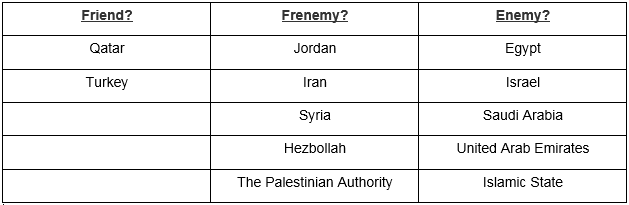
This table, drawn up by Adam Taylor, illustrates Hamas’ current relationships with other countries and actors in the Middle East. As you can see, the militant group has few close friends left, and its isolation is a major factor in how the latest Gaza war began and how it might end. In a substantial essay on the origins of the present crisis, Nathan Thrall attributes Hamas’ desperation in large part to the enmity of Egypt’s new leader:

As it became clear that unrest in Egypt wouldn’t lead to Sisi being ousted or to the return of the Brotherhood, Hamas saw only four possible exits. The first was rapprochement with Iran at the unacceptable price of betraying the Brotherhood in Syria and weakening support for Hamas among Palestinians and the majority of Sunni Muslims everywhere. The second was to levy new taxes in Gaza, but these couldn’t make up for the loss in revenue from the tunnels, and would risk stirring up opposition to Hamas rule.

The third was to launch rockets at Israel in the hope of obtaining a new ceasefire that would bring an improvement in conditions in Gaza. … The final option, which Hamas eventually chose, was to hand over responsibility for governing Gaza to appointees of the Fatah-dominated Palestinian leadership in Ramallah, despite having defeated it in the 2006 elections.

Recently, Hamas has been urging Hezbollah to open a second front in Israel’s north, but Robert Beckhusen explains why they shouldn’t get their hopes up:

Not only are Hezbollah’s troops better equipped and have significantly larger rocket stockpiles than Hamas, the Iran-backed militia has all of southern Lebanon to fight from. This gives it space to maneuver, retreat and lay ambushes against advancing Israeli armor. Its rockets also are numerous and deadly enough to force the evacuations of northern Israeli towns, as happened during the 2006 war with Israel.

But Israel could be reckoning that Hezbollah won’t be in any hurry to come to Hamas’s aid. There’s no way Hezbollah can afford to do that as long as it’s fighting in Syria. Right now, Hezbollah is bogged down in fierce warfare against the Al Qaida-affiliated Nusrah Front in the mountainous borderlands of Lebanon and Syria. Hezbollah currently is starving out rebels in the Syrian province of Qalamoun, and launched a new offensive with the Lebanese army this week towards the town of Arsal inside Lebanon.

The Best Of The Dish This Weekend

dish_kidpics

Nina Arrazello captions a wonderful little art series called Kiddie Arts:

like many children, Dutch artist Telmo Pieper drew imaginative, colorful, creative and not-always-so-anatomically correct creatures and characters when he was 4-years-old. For ‘kiddie arts’, Pieper has reincarnated the drawn works from his childhood as digital paintings, materializing them as realistic figures in intricate detail, vibrant hues and with computerized graphics. The result illustrates the quirky line scribbles as lifelike underwater animals, insects and architecture, each a bit awry in their structural and biological precision.

Love that whale.

I found myself tossing and turning all weekend from the horrible news of the last week. Today, another UN school was shelled in Gaza, killing ten, wounding many more, traumatizing countless others. These civilian deaths even in a place designated as a safe haven simply beggar belief. It is impossible to feel sympathy for either Israel or Hamas at this point. Hamas is daring Israel to kill more innocents; and Israel is eagerly obliging them. How many more children have to die to feed these zero-sum ambitions?

And it is in the wake of last week that I read Michael Oren’s piece on Zionism. As over 200 Arab children lie dead, Oren can’t contain his enthusiasm for the staggering success of the Jewish state. No reflection; no circumspection; just a long celebration until you get to this: “And there is the issue of Judea and Samaria—what most of the world calls the West Bank—an area twice used to launch wars of national destruction against Israel but which, since its capture in 1967, has proved painfully divisive.”

He means painfully divisive for Israelis. The views of the occupied do not merit any attention. And notice the reflexive victimology. This is not an area where the original inhabitants are ghettoized behind barbed wire and checkpoints, where Jim Crow exists alongside new and aggressively anti-Arab settlers, where millions of Israel’s inhabitants have no vote, and where a Russian emigré right off the plane has more rights than someone whose family has lived their for aeons. It is and always will be a existential threat that justifies permanent occupation and settlement, in direct contravention of the Geneva Conventions. This victimology is why when, in a war zone, a soldier is killed, the first word we hear from the Israelis is that he may have been “kidnapped”. Kidnapped? He was killed in battle. But even if Hamas had seized him, he would be captured in battle, not kidnapped. But that would require some sort of understanding that the enemy is also human, some kind of equal. And that seems to happen less and less. What you see in Gaza is Cheneyism fully realized.

Some relief from the Dish’s weekend: a church sign for the ages; Martin Amis’ plea for agnosticism for his friend Christopher Hitchens; why we hate the dentist; the evolution of dick crit; and the collapse of Catholic religious marriages.

The most popular post of the weekend was Why Sam Harris Won’t Criticize Israel; followed by Church Sign Of the Day.

Many of today’s posts were updated with your emails – read them all here.  You can always leave your unfiltered comments at our Facebook page and @sullydish. 23 more readers became subscribers this weekend – bringing us to 29,848. You can join them and get us to 30,000 subscribers here – and get access to all the readons and Deep Dish – for a little as $1.99 month. One writes:

Just upped my monthly to $4.20. Thanks again for all your hard work. The NYT and the Dish have been my go-to news sources for years. If you would only cut back on the Sunday god talk a bit, I would double my contribution. But that would be most un-Dish like, so keep doing what you do. It is appreciated.

See you in the morning.

Our Number One Ally Update

We discover that Israel was intercepting John Kerry’s phone calls during the Mideast peace negotiations – according to Der Spiegel. We also learn that prime minister Netanyahu’s responded to American pressure for an end to the mass killings of children thus:

In a phone call with US Ambassador to Israel Dan Shapiro about the breakdown of the short-lived UN- and US-brokered ceasefire between Israel and Hamas, Prime Minister Benjamin Netanyahu vented his anger, according to people familiar with the call. Netanyahu told Shapiro the Obama administration was “not to ever second-guess me again” and that Washington should trust his judgment on how to deal with Hamas, according to people familiar with the conversation. Netanyahu added that he now “expected” the US and other countries to fully support Israel’s offensive in Gaza, according to those familiar with the call.

Now give me that annual $3 billion, another $225 million for the Iron Dome, and shut the fuck up.


The Neocons Double Down On Gaza

As the brutality and slaughter in Gaza shocks the global conscience, there are a couple of options for the current American right. One might be to reconsider their lockstep support for anything Israel does, including its settlements, and perhaps observe that occupying Arab land and attempting to wipe out an insurgency tends not to go well for a Western power (see Iraq, etc.).  The other is to double down on everything, blame Hamas solely for the staggering suffering in Gaza – and call for yet more bombs, yet more shelling and yet more mass killing. Call the latter the Cheney option. As to the possibility that a campaign that would kill thousands more Gazans might spawn even deeper resistance, and ever more radical successors to Hamas, Continetti dismisses it:

Say Islamic Jihad replaced Hamas tomorrow. Would we be able to tell the difference? How would its rhetoric be more genocidal, its propaganda more manipulative, its aims more maximalist, its tactics more barbaric than what Israel experiences now? Would Islamic Jihad have two Palestinian Mickey Mouses exhorting schoolchildren to kill Jews, rather than one? …

Yes, there would be costs to regime change in the Gaza Strip. But the choice is not between a costly policy and a cost-free one. The choice is between the costs of removing a terrorist group from power and the costs of leaving it injured but able to fight another day. To prevent a fourth war, to bolster ties with the Sunni powers, to improve the chances of a two-state solution, to help the Palestinians, above all to secure Israel, the decision is clear. Destroy Hamas. End the war. Free Gaza.

Free Gaza from its own population? Because do you really think that, after what Israel has done to them, Gazans will choose the IDF over Hamas? It’s as brilliant an idea as re-invading Iraq (which many neocons also support). And it’s staggering to me that in order “to improve the chances of a two-state solution”, countless Gazan children have to die but not a single brick should be removed from the settlements in the West Bank. But the classic neocon view that in all fights, the only option is to up the ammo, seems sadly resurgent. Jonathan Tobin piles on:

Those who claim there is only a political solution to the problem fail to understand that in the absence of a military solution it won’t be possible.

Until something happens that will eliminate the Palestinian force that is determined to keep the conflict red-hot and is prepared to sacrifice their own people in order to advance that objective, there is no point to those who criticize Israel for not creating a Palestinian state. Though it has been blockaded by Israel, Egypt, and the international community since the 2007 coup that brought Hamas to power there, Gaza has functioned as an independent state for all intents and purposes since then. Its government’s sole objective has been to fight Israel, pouring its scarce resources into rockets, tunnels, and other military expenses while—despite Hamas’s reputation as a “social welfare organization”—doing virtually nothing to better the lives of its people. So long as it is allowed to stay in power that won’t change and, no matter how many cease-fires or negotiations John Kerry sponsors, peace will never happen.

Let’s note that the level of rocket fire from Hamas was at an all-time low in 2103 and 2014, and came back in force when Netanyahu launched a sweep of all Hamas sympathizers on the West Bank as revenge for a rogue unit that had killed three Israeli teens. The people who are just as responsible for keeping this conflict “red-hot” as Hamas are the Likudniks stealing more Palestinian land on the West Bank every day. In fact, they have a mutual interest in exactly this kind of extremism. Responding to Joe Scarborough’s change of heart, Allahpundit makes the same point:

I can understand being indifferent about which jihadi group runs Gaza or mildly preferring Hamas just because Israel has already collected so much intelligence on them. Better the devil you know than the devil you don’t. (Netanyahu himself apparently favors that approach.) If you take the “whatever comes next will be worse” logic to its ultimate conclusion, though, you’re forever left defending whichever bunch of degenerates is in charge at the time. Israel can’t oust Hamas because then Al Qaeda might take over; if Al Qaeda takes over, Israel can’t oust them or else ISIS might move in. If ISIS moves in, Israel can’t oust them or else a portal to hell will open in the ground and Hitler and Bin Laden will emerge from the earth to rule Gaza together. And so on.

Maybe, just maybe, Allahpundit will recall that al Qaeda did not exist in Iraq till the US invaded; and that ISIS has a direct line in its existence from that moment of chaos. We helped create Jihadism in Iraq by occupying it. Why one earth would Israel manage to suppress Jihadism in Gaza by the same tactics – except this time, by a permanent occupation?

The costs of never reviewing history is that you make the same mistakes again and again.

Where Are They Supposed To Go? Ctd

Palestinians taking shelter in an UN school in Gaza

Amy Davidson finds Netanyahu’s answer to that question deeply unsatisfying:

It would be a simple thing, Netanyahu suggests, for Palestinians to listen to the I.D.F.’s warnings—which come in the form of text messages and announcements and admonitions not to let someone Israel might target live in one’s home—and go. Civilians die, according to this logic, because they didn’t listen to Israel; they listened to Hamas. But there are not “plenty of places” that are safe; there may not be any.

There is, one would think, a special obligation for Israel to take care about the people in the shelters, because those children had gone where it sent them. What sort of calculus is involved in leaving one’s own home for a shelter that might still be hit, or maybe for one of the multigenerational homes in Gaza—where, perhaps, there’s also a second cousin who has something to do with Hamas? Does knowing that you are in danger put all of the burden on you? Does it make you the culpable one if you can’t, or don’t, get away? It may be practical to become a refugee—even to leave Gaza, if one can—but it’s not a gift or, necessarily, a credit to the one who warned you to go. And if Hamas is “making sure that they don’t go anywhere,” what use—practically or morally—are the warnings, not only to the Palestinians but to the Israelis who look to them for reassurance?

The warnings are a form of absolute self-absolution for the slaughter of children that will follow – let alone the unimaginable trauma that so many have experienced that will haunt and cripple them for life. Nothing Israelis are experiencing even comes close to this trauma. It defies any human being who sees it not to feel utter bewilderment at a country that carries on this bombardment from the vantage point of utter moral superiority. Do they not see the cruelty? The utter imbalance of power? Have they lost any human bearings?

Needless to say, the UN is furious at Israel for Wednesday’s shelling of an UNRWA school where 3,000 Gazans had sought shelter:

[U.N. Secretary-General Ban Ki-moon] said that the United Nations had provided Israeli military authorities with the precise location and coordinates of the shelter 17 times during the conflict, including a few hours before the attack. Ban’s deputy secretary-general, Jan Eliasson, said that the United Nations found mortar fragments from Israeli shells at the scene of the strike that pointed to Israeli responsibility. “They were aware of the coordinates and exact locations where these people are being sheltered,” Ban said. “I condemn this attack in the strongest possible terms. It is outrageous. It is unjustifiable. And it demands accountability and justice.”

The remarks were uncharacteristically harsh for the U.N. chief, who has been working closely with Israel, the Palestinians, the United States, and other foreign leaders to hammer out a cease-fire plan that would guarantee Israel’s security while relieving the plight of Gazan civilians, who have borne the brunt of suffering in the conflict.

Washington, meanwhile, somehow managed to condemn the shelling without blaming Israel for it:

“The United States condemns the shelling of a UNRWA school in Gaza, which reportedly killed and injured innocent Palestinians – including children – and UN humanitarian workers,” the White House said. “We are extremely concerned that thousands of internally displaced Palestinians who have been called on by the Israeli military to evacuate their homes are not safe in UN designated shelters in Gaza. We also condemn those responsible for hiding weapons in United Nations facilities in Gaza. All of these actions, and similar ones earlier in the conflict, are inconsistent with the UN’s neutrality. This violence underscores the need to achieve a cease-fire as soon as possible.”

Beauchamp tallies the mass displacement that has resulted from the conflict:

About a quarter of the population of the Gaza Strip may have been displaced during the ongoing fighting between Israel and Hamas, according to a United Nations Office for the Coordination of Humanitarian Affairs (OCHA) tally. That is very, very bad — both in humanitarian and political terms. ….

This matters even beyond the immediate dangers and pains of displacement; after the fighting stops, it’s not just a matter of putting displaced persons back in their homes. For one thing, their homes might be destroyed. But even for those whose homes are intact, returning may not be so simple. Patricia Weiss Fagen, a former senior fellow at Georgetown’s Institute for the Study of International Migration, writes that displaced persons “lacked safety, economic opportunities, and essential services” and “may continue to live as strangers and second-class citizens even when they return to their original homes.” The upshot, according to Fagen, is that long-term relief efforts, and not just short-term humanitarian aid, are necessary to help refugees.

(Photo: Palestinian children taking shelter in Salahaddin school in Gaza City are seen on July 31, 2014. Nearly 1900 Palestinians, who escaped from cities of Shujaya and Beit Hanoun under heavy Israeli shelling, live in Salahaddin school. By Onur Coban/Anadolu Agency/Getty Images)

Ceasefire

What was supposed to be a 72-hour ceasefire in Gaza was broken almost as soon as it started. Haaretz has live updates on the status of 2nd Lt. Hadar Goldin. Goldblog fears the conflict is about to get worse:

It is too early to say anything definitive about the Hamas decision to apparently break the ceasefire and attack an Israeli position, except that if it is true, as reports indicate, that Hamas militants came through a tunnel and carried underground and back into Gaza a live Israeli captive, then this moment could represent not another terrible, dispiriting incident in a terrible, dispiriting mini-war, but a fairly decisive turning point in which all swords are unsheathed.

This is assuming—as seems probable, but not 100 percent certain—that this raid is even what the Hamas leadership wanted (for what it’s worth, its leaders, at the moment, seem to be owning this raid, suggesting that they are indeed doubling down in their war on Israel). If the events of earlier today happened as initial reports depict, then Israel will consider this incident an engraved invitation from Hamas to launch something close to a full-scale invasion of Gaza.

Keating also sees the soldier’s capture as a potential game changer:

A few days ago, it seemed possible that Israel might be on the verge of simply declaring its military goals accomplished and pulling out. But rescuing a prisoner likely being held somewhere underground in Gaza is going to take a lot longer than simply destroying tunnels. The violence seems likely to continue for some time now, and a long-term reoccupation of Gaza—a scenario called for by some senior Israeli officials—now seems a lot more likely than it did a few days ago.

This iteration of the long-running Israel-Hamas conflict seemed as if it was likely to end with cease-fires and a return to the grim status quo after a few weeks, like previous iterations in 2008 and 2012 had. But it’s starting to look like we’re witnessing something much worse.

Furthermore, holding a prisoner gives Hamas newfound leverage:

[F]or militant groups like Hamas, one captured Israeli soldier is vital currency. Israel rebukes Hamas for not accepting the offer of ceasefires brokered by outside parties, but the ceasefires on offer did nothing to satisfy Hamas’s longstanding demands regarding the release of Palestinian prisoners (including some who were re-arrested after being freed in the exchange for Shalit), the loosening of border controls in heavily blockaded Gaza and the payment of salaries to some 40,000 public employees in Gaza. … Hamas was not in a particularly strong position to win any of its demands — that is, until it claimed to have captured another Israeli soldier.

But Saletan senses that Israeli mission creep was already underway:

First the IDF was just going to hit Gaza from the air. Then it went in on the ground, but Israel assured everyone that the target was just the tunnels. Then Hamas killed a bunch of Israeli soldiers in a surprise attack, and Israel retaliated with widespread shelling. This week, the Israeli air force has been hitting 100 to 200 targets a day. How does that fit a campaign against tunnels? The strikes are on suspected weapon storage sites and “homes of terrorists.” Israel keeps moving the goal post, redefining the conditions that would meet its vague objective of “sustainable quiet.” That’s the beginning of mission creep. Where does it end?

Of course, Netanyahu can do more or less whatever he wants, considering that support for the war among Israeli Jews is practically unanimous:

The Israel Democracy Institute, a non-partisan Israeli think tank and polling outfit, conducts a monthly poll of Israelis on peace and security issues. Unsurprisingly, July’s poll focused on the war in Gaza. It asked Jewish Israelis (Israeli Arabs were not polled), during both the air and ground phases of the campaign, whether they thought the Israeli operation was justified. It also asked whether they thought the Israeli Defense Forcers were using too much, too little, or the right amount of force.

The results are staggering. An average of 95 percent of Israeli respondents say they think the operation is “completely” or “moderately” justified. About 80 percent say it is “completely” justified. For some perspective, about 72 percent of Americans supported the 2003 Iraq invasion when it was launched. Israeli discontent “spiked” — to about 7 percent — just before and at the launch of the ground invasion, on July 16–17. After the ground invasion was underway, on July 23rd, Israelis supported the war by a 97 to 2 margin.

That’s almost as unanimous as the US Congress.

(Update: This tweet that was originally embedded above indicated that the Israeli soldier is the grandson of the defense minister’s uncle, something reported by Channel 4 and passed along by Newsweek. But the Channel 4 piece now has no mention of the alleged familial tie, so we removed the tweet.)

The Best Of The Dish Today

This embed is invalid

The articles Lisa Goldman refers to above are as follows: “Beautiful Dream of Israel Has Become A Nightmare” by Gabor Mate; Liberal Zionism After Gaza, and The Liberal Zionists, by Jonathan Freedland; and Zionism And Its Discontents, by Roger Cohen. Here’s another decent human being and a friend, the legendary newsman, Jon Snow:

We can all heave a sigh of relief that a humanitarian cease-fire appears to be imminent.

On another matter related to the welfare of stranded children, I’m trying to get something straight. For the last couple of months, the right-wing noise machine has described the surge of refugee children at the border as a crisis of Biblical proportions. They have also excoriated all of president Obama’s executive actions on immigration. So now, after dismissing Obama’s request for $3.7 billion to deal with the refugee children, they cannot pass a bill to authorize even $659 million to take care of the crisis. And what do they urge president Obama to do instead? To take executive action to handle it! I swear I am not making this up. In Boehner’s words:

There are numerous steps the president can and should be taking right now, without the need for congressional action, to secure our borders and ensure these children are returned swiftly and safely to their countries.

So, yes, the president is once again damned if he does use his executive powers and damned if he doesn’t. And the Republican Congress has shown that it can pass nothing – even in the midst of what it has described as an epic crisis – because it is so divided within itself. The idea that these shambolic excuses for legislators should actually be rewarded with more seats this fall tells you something is deeply awry with the political system. This is a party fit for cable news and not for government.

Today, I engaged my friend Sam Harris on Israel, Hamas and Jihadism; noted new shifts in the Israel debate – not in Israel’s favor; had a frank and frisky conversation with Rich Juzwiak about sex, gay men and the Truvada future; and marveled once again at the seriously unsafe sex life of the octopus.

The most popular post of the day was Why Sam Harris Won’t Criticize Israel; followed by Deep Dish’s Andrew Asks Anything: Rich Juzwiak.

Many of today’s posts were updated with your emails – read them all here.  You can always leave your unfiltered comments at our Facebook page and @sullydish. 23 more readers became subscribers today to make our running total 29,843 – so close to 30,000 we can smell it. You can help us get there by subscribing instantly here – and get access to all the readons and Deep Dish – for a little as $1.99 month. Gift subscriptions are available here. Dish t-shirts and polos are for sale here. One new customer writes:

I have been a reader for longer than I can remember and an early subscriber, but I have never written in before. I enjoy reading the debate without ever feeling a need to jump in and add my views.  However, with the excitement of buying a polo, I couldn’t help myself.  We are meant to be on a strict budget at the moment, due to building work at home and holidays, but the suggestion that the next batch of shirts may not be such good quality has forced my hand – quite happily I should add.  I look forward to being able to proudly wear my polo around Seattle and being able to identify myself to those in the know.

Keep up the good work please.  The blog is great and goes from strength to strength.

See you in the morning.

The Shifting Israel Debate, Ctd.

Joe Scarborough – a former Republican member of Congress who has “always been a 100 percent supporter of Israel” – turns sharply against Netanyahu’s government:

Like Chait and many other American Jews on the left, Ezra Klein, who cares about Israel “personally, rather than abstractly”, has become more pessimistic about the Jewish state:

There’s an … argument that’s made by Israel’s supporters: that people like me, who write about our disappointment with Israeli policy, are “blaming Israel first.” But it’s not about blame. If interest in geopolitics was driven by outrage and horror Israel and Palestine would spend less time on the front page. The suffering there is immense, but the death toll is dwarfed by the slaughter in the Democratic Republic of Congo or Syria. I pay unusual attention to what Israel does because, for family and cultural reasons, I am unusually invested in Israel. Focusing on Israeli policy is a byproduct of focusing on Israel itself.

For these reasons, I used to write about Israel often. It felt, even a few years ago, that peace was a live possibility, that Israel had choices — and that some of them might even turn out well. But Israel seems to have made its choice, at least for now, and the results are painful to watch. I haven’t become less pro-Israel. But I’ve become much more pessimistic about its prospects, and more confused and occasionally horrified by its policies. My sense is that’s happened to Chait, too. I notice he writes about Israel less these days, also. My sense is it’s happened to a lot of us.

I’m sorry but I find this position pretty lame. What Ezra is suggesting is that when Israel does things you cannot really countenance, the correct response is silence or avoidance, because it just gets too personal, when you have family etc. But that’s been the whole problem with the American discourse about this for a while, what Peter Beinart called “an epidemic of not watching.” American Jewish liberals have been intimidated or censored themselves into silence, which has only made matters worse. The reason is the need to somehow credentialize yourself as “pro-Israel”, and any criticism is immediately interpreted as being “anti-Israel”. That’s essentially a loyalty test that impedes reasonable debate – and is designed to. Waldman rightly encourages everyone to step out of this credentializing and posturing:

Once you stop worrying about whether you’re pro-Israel or anti-Israel, you can judge the Israeli government’s decisions, developments within Israeli society, and other questions related to the country each on their own terms.

You can also make judgments about the conflict that are freed from the necessity so many feel to continually compare the Israeli government’s actions to Hamas’ actions, or the opinions of the Israeli public to the opinions of the Palestinian public, with the only important question being which side comes out ahead. Those comparisons end up dulling your moral senses, because they encourage you to only think in relative terms.

If you’re still stuck being pro-Israel or anti-Israel, you end up asking questions like, “Which is worse: for Hamas to put rockets in a school in the hopes that Israel will bomb it and kill a bunch of kids, therefore granting Hamas a momentary PR victory; or for Israel to bomb the school anyway, knowing they’re going to kill a bunch of kids?” If you’re pro-Israel, you’ll answer that Hamas’ action is worse, while if you’re anti-Israel, you’ll answer that Israel’s action is worse. But if you’re neither, then you’ll give the only moral answer, which is: who the hell cares which is worse? They’re both wrong. Questions like that end up only being used to excuse one side’s indefensible decisions.

Which is an apt description of some of the themes in Sam Harris’ recent post. Max Fisher also despairs of such comparisons, particularly when they fuel the desire to pin blame for civilian deaths exclusively on one party to the conflict:

The argument over moral responsibility for civilian Palestinians often makes a fundamental mistake by assuming that culpability is zero-sum: that either Israel is responsible because it uses unnecessarily overwhelming force in civilian areas or Hamas is responsible because it attacks Israel from within civilian communities. This fundamentally misses the point; both sides independently bear responsibility for the degree to which their tactics lead to civilian deaths. If one side abdicates that responsibility then this does not absolve the other. Both sides, by treating moral responsibility as zero-sum, are giving themselves permission to overlook their own role in driving up the civilian casualty rate, and thus continuing the killing.

Amen. Israel is responsible for these civilian deaths, but Hamas is deeply complicit. Noah Efron considers Israel a victim, as it were, of “moral bad luck”:

The very notion of moral luck seems paradoxical, because we are used to thinking that we are only morally accountable for things that we control. But that is not quite true. Like well-meaning American whites who never questioned segregation, sometimes we end up culpable for choices we never made.

Hamas is a factory of moral bad luck. Its leaders aim to trap Israel in situations from which only bad can come, either dead Israelis or dead Palestinians or both. They began their barrage of rockets on Israel because they knew Israel would respond, killing innocent Gazans, including kids, along the way. They unleashed their evil because they knew that Israel would, in response, unleash evil of its own. …

[W]e can conclude that there is no place for righteousness in the conflict. When we fight this war, as I think we have to, we must do so with grim knowledge that every violence done to civilians, and their homes and schools, is a tragedy in which we have a hand. Equally, those who piously condemn Israel should know that, were they in our position, they could scarcely act differently than we do.

I disagree with that, for reasons I’ve articulated for quite some time on the blog. And besides, Israel and Hamas are not sold separately. As Ishaan Tharoor reminds us, before it became a security threat, Israel helped the Islamist group grow:

To a certain degree, the Islamist organization whose militant wing has rained rockets on Israel the past few weeks has the Jewish state to thank for its existence. Hamas launched in 1988 in Gaza at the time of the first intifada, or uprising, with a charter now infamous for its anti-Semitism and its refusal to accept the existence of the Israeli state. But for more than a decade prior, Israeli authorities actively enabled its rise.

At the time, Israel’s main enemy was the late Yasser Arafat’s Fatah party, which formed the heart of the Palestinian Liberation Organization (PLO). Fatah was secular and cast in the mold of other revolutionary, leftist guerrilla movements waging insurgencies elsewhere in the world during the Cold War. The PLO carried out assassinations and kidnappings and, although recognized by neighboring Arab states, was considered a terrorist organization by Israel; PLO operatives in the occupied territories faced brutal repression at the hands of the Israeli security state. Meanwhile, the activities of Islamists affiliated with Egypt’s banned Muslim Brotherhood were allowed in the open in Gaza — a radical departure from when the Strip was administered by the secular-nationalist Egyptian government of Gamal Abdel Nasser.

And the beat goes on …

Why Sam Harris Won’t Criticize Israel

Israeli attack kills Palestinian kid in Jabalia Camp

It’s a very long piece – or, rather, a speech annotated with qualifications – an interesting way to put your thoughts down on a screen. And it’s well worth your while. The gist of it is that because Hamas is an almost text-book example of nihilist theocracy and Israel isn’t, Israel is on the right side of the defining struggle of our times – and so not a country Harris will criticize. A related, central point is that the use of human shields by Hamas puts them in an utterly different moral universe than the IDF, in whose interests it is not to kill Palestinian civilians.

This is a crude summary – for there are qualifications on so many points that the piece is almost an explosion of nuance. So, for example, in Sam’s view, Israel cannot be absolved from war crimes either; and should not even exist as a Jewish state. That last point is a pretty huge one – and it comes at the very start of the piece. But if Israel should not exist as a Jewish state, it should not exist at all. This is its core justification – and one of the issues the Israeli government has put at the center of any possible two-state solution. Get rid of the Jewishness of Israel … and you will soon have a Middle Eastern state pretty evenly divided between Jew and Arab and in which future immigration ISRAEL-PALESTINIAN-CONFLICT-GAZAwould easily tip the demographic balance toward Islam. And this is where, I’d argue, Sam’s argument begins to unravel almost as soon as it begins: because it is overwhelmingly an abstract statement of abstract principles which fails to account for history in all its particular twists and turns. So he ends up refusing to criticize a state he really doesn’t believe should exist and yet then goes on to criticize it quite potently. You can call that original if you want. But you might also call it incoherent.

Still, Sam is unquestionably right about the theocratic extremism and despicable anti-Semitism of Hamas and its allies. It is much more extreme and central to Hamas than theocracy and anti-Arab racism is to Israel. He’s right that Hamas’ preference for building underground tunnels for war rather than underground bomb shelters for civilians makes them complicit (though far from solely responsible) in the horrifying carnage of the last few weeks. He’s also right about the difference between what Israelis would do if they had all the power and what Hamas would do in the same boat. Israel, with overwhelming power, gives many Arab citizens political rights even as it has penned a huge number into segregated bantustans, curtailed their travel, blockaded them (in Gaza), and surrounded them with theocratic Jewish settlements in the West Bank. Hamas would, in contrast, just kill every Jew it could find as soon as it could. That is an important difference.

But that’s why I absolutely do not support Hamas, and never have. Nor is there any excuse for their war crimes. But the issue here is not one of a choice between Israel and Hamas; it’s between the possibility of a two-state solution and the Israeli government’s refusal to take any of the off-ramps toward it if they would curtail the bid to settle and annex the West Bank. Much of Sam’s argument would hold water if the Israelis had been in earnest about peace, and in earnest in supporting moderate Palestinian forces on the West Bank, and in earnest about taking Obama’s proposals seriously this past decade. But they haven’t been. Settlements are much more important to them than peace. And the settlements are motivated by exactly the kind of theocratic zeal that Sam normally opposes.

But the settlements – themselves a standing war crime under Geneva – do not figure prominently in Sam’s account. And when they do, he offers an unconvincing defense:

What would the Israelis do if they could do what they want? They would live in peace with their neighbors, if they had neighbors who would live in peace with them. They would simply continue to build out their high tech sector and thrive. [Note: Some might argue that they would do more than this—e.g. steal more Palestinian land. But apart from the influence of Jewish extremism (which I condemn), Israel’s continued appropriation of land has more than a little to do with her security concerns. Absent Palestinian terrorism and Muslim anti-Semitism, we could be talking about a “one-state solution,” and the settlements would be moot.]

This is delusional. It’s not just Palestinian terrorism and Muslim anti-Semitism that makes a one-state solution moot; it is embedded in the very meaning of Zionism. If Israel requires a Jewish majority to survive as a Jewish state, a one-state solution is anathema to it. And if all Israel wanted to do was have its tech sector thrive within (roughly) the 1967 borders, and embrace serious, US-backed security arrangements vis-a-vis Jordan, I’d be backing it to the hilt.

Instead, as Palestinian terrorism from the West Bank has declined drastically – the Israelis have intensified their theft of Palestinian land. Those settlements deeply hurt, rather than help, Israel’s security – because they alienate most of her allies, exacerbate bitterness and suspicion, and make the possibility of a two-state solution moot. You could secure the West Bank by military outposts if you wanted. But Israel is committed to engineering the demography of the place by settlements of religious fanatics of the sort Sam would usually excoriate. Netanyahu, we now know, would rather release hundreds of prisoners convicted of murdering Jews than remove a single brick from the West Bank settlements. It’s really not about security at all. It’s about race and religion in their ugliest zero-sum manifestations. Just because it isn’t as bad as Hamas doesn’t excuse it.

Then there is a really important point:

What do groups like ISIS and al-Qaeda and even Hamas want? They want to impose their religious views on the rest of humanity. They want to stifle every freedom that decent, educated, secular people care about. This is not a trivial difference. And yet judging from the level of condemnation that Israel now receives, you would think the difference ran the other way.

This kind of confusion puts all of us in danger. This is the great story of our time. For the rest of our lives, and the lives of our children, we are going to be confronted by people who don’t want to live peacefully in a secular, pluralistic world, because they are desperate to get to Paradise, and they are willing to destroy the very possibility of human happiness along the way. The truth is, we are all living in Israel. It’s just that some of us haven’t realized it yet.

Again, the abstractions obscure rather than clarify. We are not all living in Israel. Nor should any sane person want to be. In America, we are surrounded by two vast oceans and two unthreatening neighbors – about as different from Israel as it is possible to conceive. We have more space and land to accommodate religious, racial and cultural diversity than Israel could even dream of. We are not defined by one race or religion – but defined rather by a radical separation of church and state. In so far as we face Jihadist terror, we do so from a vastly more secure vantage point – and its victims since 9/11 have been mercifully sparse, suggesting a threat more manageable within our existing laws and arrangements than I, for one, ever thought possible.

And we have a real debate about how to confront Jihadist terror. In the Cheney years, we adopted the Netanyahu “shock and awe” approach – bomb, invade, terrorize and detain. Since then, we have adopted smarter, more surgical and political initiatives to help defuse it. One way to defuse it would be to resolve the Israel-Arab conflict along the only two-state lines that can work. The Israel-Palestine dispute is not the only thing galvanizing Jihadism, of course. But it remains one area where we have some leverage to effect change, and it is one area where our alleged ally has done all it can to prevent us.

I oppose Jihadism, in other words, as much as Sam. But what Israel is doing in the West Bank and the horrors it is inflicting on Gaza are almost designed to inflame, give credence to, and empower Jihadism in ways that will not only affect the Israelis. We are not all living in Israel. But if Sam gets his way, and ever more salt is rubbed into an ever rawer wound, we could be.

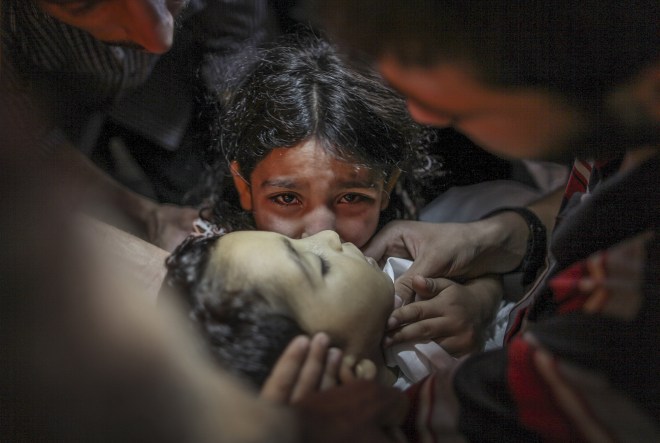
(Photos: Palestinian girl Ansam says goodbye to her little brother Sameh Junaid, killed in an Israeli cannon shot in the morning of Eid al-Fitr at Jabalia Refugee Camp as he was playing in the garden of his house on July 28, 2014 in Gaza City, Gaza. By Ali Hasan/Anadolu Agency/Getty Images; An Israeli soldier carries a shell as he and his comrades prepare their Merkava tanks stationed at an army deployment area along the border between Israel and the Hamas-controlled Gaza Strip on July 31, 2014. By Jack Guez/AFP/Getty Images.)
Can Israel “Win” This War? Ctd

Keating now believes that Israel declaring victory and withdrawing from Gaza unilaterally is more likely than a negotiated ceasefire:

Some members of the Israeli security Cabinet may support a long-term reoccupation of Gaza, but Prime Minister Benjamin Netanyahu probably isn’t one of them. There’s little public pressure in Israel to end the operation or accept an internationally proposed cease-fire, but it’s conceivable that things might be different if Netanyahu simply declared that Israel’s vaguely defined military goals had been accomplished and unilaterally pulled back Israeli troops. …

This scenario, of course, wouldn’t address the ongoing humanitarian catastrophe in Gaza or prevent violence from flaring up again in the future. And it certainly feels like a long shot at the moment. But compared with the alternative—the U.S., Egypt, Qatar, Turkey, the Palestinian Authority, and whoever else finally getting on the same page to establish a framework under which Israel and Hamas would agree to terms they’ve thus far found utterly unacceptable—it feels at the moment like the more likely way for this to finally end.

Although Netanyahu has claimed that the objective of the war is to neutralize Hamas once and for all, and some members of his government want him to go even further, the prospect of what happens if the Hamas government in Gaza is toppled leaves Israel in a bind:

Israel’s ideal outcome would be for Hamas to capitulate to Israel’s demands to disarm and reform into a defanged version of its current self—a troublesome but manageable part of a larger Palestinian political infrastructure. But if Hamas won’t bend, it might break, and that would be the worst possible outcome for Israel, said Aaron David Miller, a former Middle East negotiator now with the Wilson Center.

“Reform or regime change, that’s the central question,” he added. “An unanchored, unmoored, lawless Gaza in the hands of something like ISIS or Islamic Jihad, this proposition would be fundamentally worse than the one we inhabit and inherit now.” The problem with Netanyahu’s strategy, according to Miller, is that Netanyahu may never be able to achieve the ending to the war he’s looking for. He’s unlikely to get a capitulation by Hamas and he can’t afford to destroy its leadership. He also can’t accept a tie, as the 2012 ceasefire was widely viewed in Israel.

Whatever outcome Netanyahu chooses – and it is, in the final analysis, up to him –  Noah Millman is convinced that it won’t serve anyone’s interests in the long term:

Israel’s stated goals for this operation are partly military and partly political. The military goal is to destroy, or at least dramatically degrade, Hamas’s war fighting capabilities – destroy tunnels, rocket-launchers, kill or capture operatives, etc. The political goal is to get the people of Gaza to blame Hamas for the destruction wrought by the war, and turn against the organization and a strategy of armed confrontation with Israel. Leaving aside whether the political goal is likely to be achieved – I think the opposite effect is more likely – it should be clear, from the overwhelming preponderance of the decisions of the current Israeli government, just how limited its political horizon is. Israel does not have a strategy for settling the conflict. It has a strategy, good or bad, for managing the conflict within its current contours. Israel is fighting to preserve the status quo.

That’s the larger context within which the war is being fought. And that context has moral implications for how the war may be fought, inasmuch as we should not desire the status quo ante to be preserved, but the status quo amounts to imposed rule not merely without the consent of the ruled, but over the emphatic, furious, unequivocal refusal of that consent.

Previous Dish on what “victory” in Gaza would mean here and here.