Francis Emerges

Pope Francis Holds An Audience With Journalists And The Media

[Re-posted from yesterday]

If we leave legitimate questions about his past for a moment, can I pause to marvel at his present?

The reports of his press conference today suggest a radically new symbolism for the church. This kind of understanding of the diverse and multi-faith and multi-cultural modernity is something you would never have heard from Benedict XVI:

“Given that many of you do not belong to the Catholic Church, and others are not believers, I give this blessing from my heart, in silence, to each one of you, respecting the conscience of each one of you, but knowing that each one of you is a child of God. May God bless you.”

Respecting the conscience of each of you. That might seem to be the bleeding obvious – but it isn’t in the context of Benedict’s theological reign, which was far longer than his pontifical one. Benedict wanted to place conscience below revelation as authoritatively adjudicated by … himself. The central place of individual conscience established at the Second Council was left to wither in favor of a public, uniform religion. He seemed to me to want ultimately to restore the seamless cultural-political-religious unity of the Bavaria of his youth; and if the public square were empty, it had to be filled with religious authority. He tried. In the West, the public square moved in the opposite direction. He hunkered down, hoping for a smaller, purer church. What he got was a smaller one, but beset by scandal and internal division and a legacy of the most horrendous of crimes.

Francis seems to me to be taking the world as it is, but showing us a different way of living in it. These are first impressions, but there seems much less fear there of the modern world, much greater ease with humanity. And human beings like narratives – not opaque and ornate theologies. Jesus always spoke in simple stories and parables. And so today:

“Let me tell you a story,” [Pope Francis] said. He then recounted how during the conclave he had sat next to Cardinal Cláudio Hummes of Brazil, whom he called “a great friend.” After the voting, Cardinal Hummes “hugged me, he kissed me and he said, ‘Don’t forget the poor!’ And that word entered here,” the pope said, pointing to his heart.

“I thought of wars, while the voting continued, through all the votes,” he said as he sat on the stage in a hall inside the Vatican. “And Francis is the man of peace. And that way the name came about, came into my heart: Francis of Assisi.”

To see our two huge temptations today as war and massive inequality is, it seems to me, the Holy Spirit at work. We should remember St Francis’ pilgrimage to the Muslim authorities of his day. We should recall Saint Francis’ direct experience of the horror of war which changed his life. And then how that epiphany on the battlefield and as a prisoner of war led to Francis’ embrace of lepers as his most beloved, of a shack as the place he’d call home, and the giving away of his entire worldly goods – indeed even his own clothes – in order to be free in the spirit of Jesus’ true freedom.

Then this:

He had a couple of other thoughts for journalists, too. Reporting on the church is different from other contemporary matters, he said, because the church is essentially a spiritual organization that does “not fit into worldly categories.” “The church does not have a political nature,” he said.

We’ll see exactly what he means by that phrase in due course – he certainly involved himself in the political and social debates in his home country. But an emphasis on the centrally apolitical stance of Christianity, indeed on the fact that in core ways, Christianity is the antidote to the pursuit of power over others  … well, count me quietly elated. Again, of course, Saint Francis’ renunciation of power comes to mind. And his simplicity:

Instead of the usual formal blessing – standard practice at papal audiences – he said quietly, “God bless you,” and walked off the stage.

And didn’t get into his limo, preferring to walk on foot to his Vatican residence. In my own thoughts and prayers in this crisis of Christianity, I found myself returning to Saint Francis, as readers know. I think he is the saint the church turns to when it has truly lost its way, when it needs to be rebuilt humbly, painfully, from the current ruins.

If that is what happened in the heart of Bergoglio in the conclave, if the spirit of Francis entered his heart as a man of peace and tolerance and humility, as he says, then we have more than cause for optimism.

We have cause for real hope.

(Photo: A detail of the shoes of newly elected Pope Francis as he attends his first audience with journalists and media inside the Paul VI hall on March 16, 2013 in Vatican City, Vatican. The pope thanked the media for their coverage during the historic transition of the papacy and explained his vision of the future for the Catholic Church. By Franco Origlia/Getty Images.)
A Devoutly Catholic Heretic

Sam Tanenhaus profiles the Catholic essayist and historian Garry Wills, describing him as a “good Catholic who nonetheless has declared war not only on church elders but on the Vatican itself”:

When the sex abuse scandals erupted a decade ago, and others writhed in torments of apology or denial, Wills coolly explained that what seemed like desecrations of the faith were in reality outgrowths of its most hallowed rituals. “The very places where the molestation occurs are redolent of religion—the sacristy, the confessional, the rectory… The victim is disarmed by sophistication and the predator has a special arsenal of stun devices. He uses religion to sanction what he is up to, even calling sex part of his priestly ministry.”

To a non-Catholic like me, Wills was performing a heroic civic deed, prizing open the dank closet of alien experience. He had come not to condemn but to explain. But many believers were outraged, not least because Wills is “perhaps the most distinguished Catholic intellectual in America over the last 50 years,” as the National Catholic Reporter has put it. In his new book, Why Priests? A Failed Tradition, Wills is at it again, cataloguing church hypocrisies, false teachings, the litany of bloody crimes. “The great scandal of Christians is the way they have persecuted fellow Christians,” he writes, “driving out heretics, shunning them, burning their books, burning them.”

In a piece we linked to earlier this week, Wills hopes that Pope Francis will be “increasingly irrelevant, like the last two…a monarch in a time when monarchs are no longer believable”:

Catholics have had many bad popes whose teachings or acts they could or should ignore or defy. Orcagna painted one of them in hell; Dante assigned three to his Inferno; Lord Acton assured Prime Minister William Gladstone that Pius IX’s condemnation of democracy was not as bad as the papal massacres of Huguenots, which showed that “people could be very good Catholics and yet do without Rome”; and John Henry Newman hoped Pius IX would die during the first Vatican Council, before he could do more harm. Acton’s famous saying, “Power tends to corrupt, and absolute power corrupts absolutely,” was written to describe Renaissance popes.

Bergoglio And Torture, Ctd

One of those kidnapped and tortured Jesuits priests who some argue were abandoned by Pope Francis during the dirty war has come to the defense of the new Pope:

“It was only years later that we had the opportunity to talk with Father Bergoglio … to discuss the events,” Jalics said Friday in his first known comments about the kidnapping, which occurred when the new pope was the leader of Argentina’s Jesuits. “Following that, we celebrated Mass publicly together and hugged solemnly. I am reconciled to the events and consider the matter to be closed,” he said.

That doesn’t exactly exonerate Bergoglio on the facts but when the victim has reconciled with the alleged violator, and considers the matter closed, we can look forward rather than back.

Pope Francis vs Clerical Privilege

Cardinal Jorge Bergoglio Celebrates Tedeum in Buenos Aires

Garry Wills, whose new book against the priesthood has just come out, might find a strange ally in Pope Francis. In so far as the new Pope seems determined to tackle the untouchable, remote power of clericalism, he is exactly what the church needs to rid itself of abuses embedded in seeing priests as a caste apart, beholden to no-one. From an old, somewhat inspiring interview:

BERGOGLIO: Their clericalization is a problem. The priests clericalize the laity and the laity beg us to be clericalized… It really is sinful abetment. And to think that baptism alone could suffice. I’m thinking of those Christian communities in Japan that remained without priests for more than two hundred years. When the missionaries returned they found them all baptized, all validly married for the Church and all their dead had had a Catholic funeral. The faith had remained intact through the gifts of grace that had gladdened the life of a laity who had received only baptism and had also lived their apostolic mission in virtue of baptism alone. One must not be afraid of depending only on His tenderness… Do you know the biblical episode of the prophet Jonah?

Q: I don’t remember it. Tell us.

BERGOGLIO: Jonah had everything clear. He had clear ideas about God, very clear ideas about good and evil. On what God does and on what He wants, on who was faithful to the Covenant and who instead was outside the Covenant. He had the recipe for being a good prophet. God broke into his life like a torrent.

He sent him to Nineveh. Nineveh was the symbol of all the separated, the lost, of all the peripheries of humanity. Of all those who are outside, forlorn. Jonah saw that the task set on him was only to tell all those people that the arms of God were still open, that the patience of God was there and waiting, to heal them with His forgiveness and nourish them with His tenderness. Only for that had God sent him. He sent him to Nineveh, but he instead ran off in the opposite direction, toward Tarsis.

Q: Running away from a difficult mission…

BERGOGLIO: No. What he was fleeing was not so much Nineveh as the boundless love of God for those people. It was that that didn’t come into his plans. God had come once… “and I’ll see to the rest”: that’s what Jonah told himself. He wanted to do things his way, he wanted to steer it all. His stubbornness shut him in his own structures of evaluation, in his pre-ordained methods, in his righteous opinions. He had fenced his soul off with the barbed wire of those certainties that instead of giving freedom with God and opening horizons of greater service to others had finished by deafening his heart. How the isolated conscience hardens the heart! Jonah no longer knew that God leads His people with the heart of a Father.

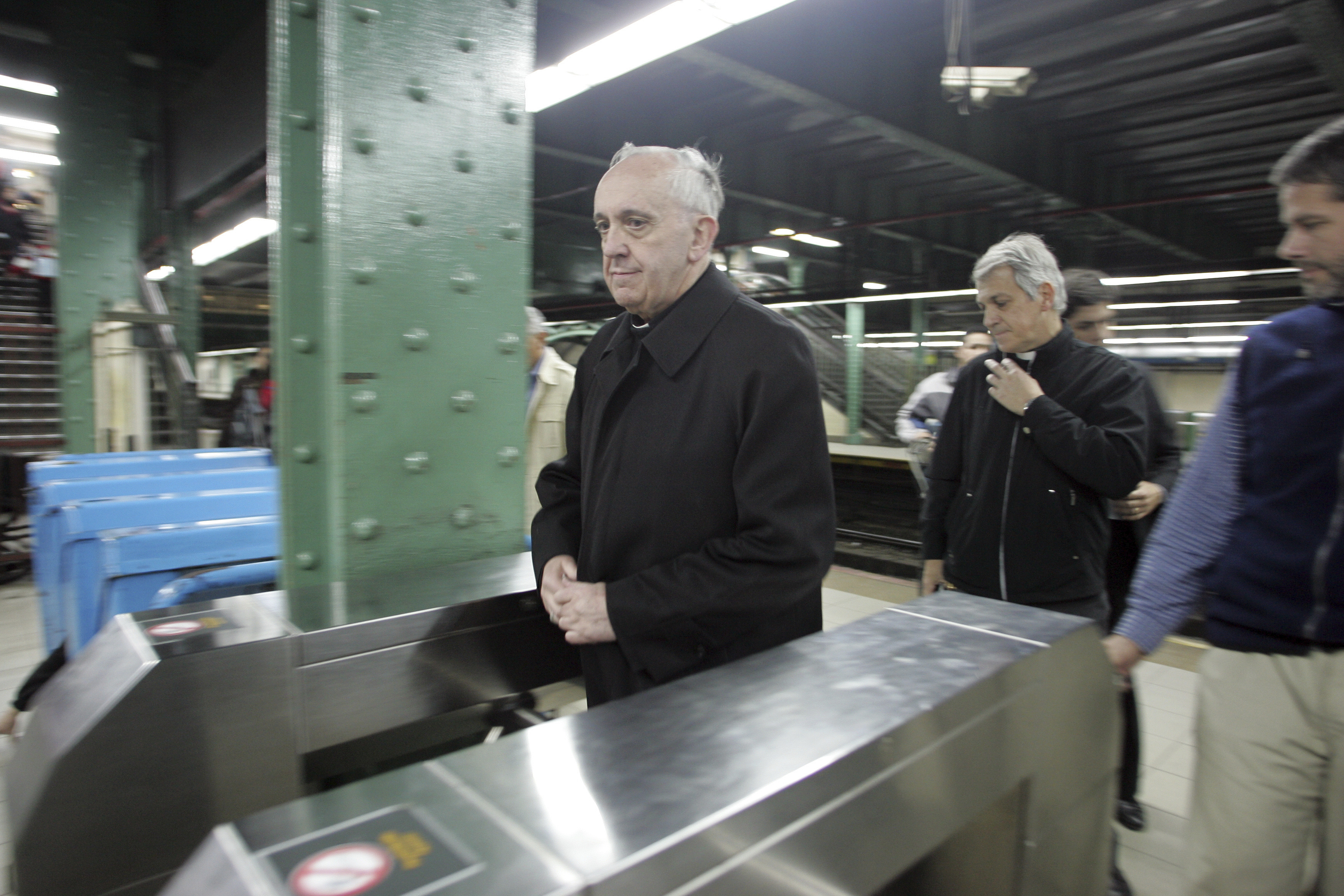
(Photo: Argentine Cardinal Jorge Mario Bergoglio takes the Line A of the undergournd prior to the celebration of the traditional Tedeum mass at the Metropolitan Cathedral on May 25, 2008 in Buenos Aires, Argentina. By Emiliano Lasalvia/LatinContent/Getty Images.)

Bergoglio And Torture

One version of the story has it that Bergoglio intervened to save two radical lefty Jesuit priests, who were kidnapped by the junta and eventually found, drugged, tortured and terrorized. Another version is that Bergoglio basically sold them out as radicals to the junta. In a must-read interview with Horacio Verbitsky, he finds a way to reconcile the two accounts:

During the research for one of my books, I found documents in the archive of the foreign relations minister in Argentina, which, from my understanding, gave an end to the debate and show the double standard that Bergoglio used. The first document is a note in which Bergoglio asked the ministry to—the renewal of the passport of one of these two Jesuits that, after his releasing, was living in Germany, asking that the passport was renewed without necessity of this priest coming back to Argentina.

The second document is a note from the officer that received the petition recommending to his superior, the minister, the refusal of the renewal of the passport.

And the third document is a note from the same officer telling that these priests have links with subversion—that was the name that the military gave to all the people involved in opposition to the government, political or armed opposition to the military—and that he was jailed in the mechanics school of the navy, and saying that this information was provided to the officer by Father Jorge Mario Bergoglio, provincial superior of the Jesuit company. This means, to my understanding, a double standard. He asked the passport given to the priest in a formal note with his signature, but under the table he said the opposite and repeated the accusations that produced the kidnapping of these priests.

Read the whole thing. It exonerates Bergoglio in some ways but it’s very depressing over all. One of the two tortured priests told Verbitsky he suspected that Bergoglio had actually been directly involved in the torture and interrogations – because they involved theological questions of some erudition:

Verbitsky: They were tortured. They were interrogated. One of the interrogators had externally knowings [sic] about theological questions, that induced one of them, Orlando Yorio, to think that their own provincial, Bergoglio, had been involved in this interrogatory.

Amy Goodman: He said that—he said that Bergoglio himself had been part of the—his own interrogation, this Jesuit priest?

Verbitsky: He told me that he had the impression their own provincial, Bergoglio, was present during the interrogatory, which one of the interrogators had externally knowledge of theological questions.

My italics. If the new Pope was present during the torture and interrogation of a Jesuit dissident, then we have just returned to the days of the Inquisition. I pray to God this isn’t true.

As Shy As Benedict?

Cardinal Jorge Bergoglio Celebrates Tedeum in Buenos Aires

The Pope is a man of few words outside the pulpit – according to this revealing profile first published in 2005:

Of course, there is that Trappist silence. His press secretary, a young priest, spends his time interpreting what the Cardinal does not say. The other part of his job is to turn down, on Bergoglio’s behalf, interviews or invitations to write articles. The Archbishop of Buenos Aires has almost no published work, and seems to become less visible with each passing year.

Well that last bit just changed a little. But I have to say that one of the more striking things about his appearance in Saint Peter’s Square was his unexpected request for silent prayer. He is about as hardline as one would expect from the current Curia on sexual and gender issues, and he ran the Jesuits under his command with an iron theological fist. But this doctrinal orthodoxy and demand of total obedience is balanced by a real record of pastoral care and symbolic servitude. From the same profile:

Cardinal Bergoglio regularly travels to the furthest ends of his three million-strong diocese to visit the poor. He wants them in the neediest barrios, in the hospitals accompanying Aids sufferers, in the popular kitchens for children. To take one example: when, last year, a number of young people died in a fire in a rock club tragedy, Bergoglio went to their aid in the middle of the night, arriving before the police and fire service, and long before the city authorities. Since the tragedy, one of his auxiliaries has a ministry to the family and friends of the victims, and has not been backward in criticising the government for its response to the tragedy.

(Photo: Argentine Cardinal Jorge Mario Bergoglio celebrates the traditional Tedeum mass at the Metropolitan Cathedral on May 25, 2008 in Buenos Aires, Argentina. By Emiliano Lasalvia/LatinContent/Getty Images.)

A New Pope: Your Thoughts

The Conclave Of Cardinals Have Elected A New Pope To Lead The World's Catholics

A reader writes:

I may be overly cynical, but the selection of this “First ever non-European” pope is underwhelming me.  It feels almost too well-crafted.  It is a perfectly sized micro-step towards progress that will keep the world’s press buzzing for some time.  It’s also about the safest pick you could imagine for a non-European.  It is still an old white guy from an Italian-influence Catholic country with a mature congregation.

Is this a big head fake?  The kind of seemingly, but not really, substantive move that is calibrated to allow the church to say “See! We modernized and became more inclusive!  The rest of you (women, gays) are just being churlish now. Bask in our progressiveness!”

Another snarks:

Best comment on the new pope that I’ve heard so far: Pope Francis – because when you need to hide a German, hire an Argentinian.

Another:

I think it is fair to assume Pope Francis is unlikely to change the Church’s teaching on birth control, gay rights, et al, but doesn’t bother me as a frustrated modern Catholic. The new pope’s humanity (something so lacking with Ratzinger), his opposition to clericalism, and the belief that he is an outsider ready to reform Vatican governance, suggests he could radically alter the make-up of the College of Cardinals during his tenure. Francis may not be the modernist reformer so many Catholics  desperately wish to see in the Vatican, but he may be the pope who aligns the chess pieces so such a reformer to follow him. That prospect alone gives me great hope for the Church.

There is one symbolic move Francis could make to greatly and quickly restore the Vatican’s credibility: Send Bernard Law home to deal with the consequences of what he let happen in the Boston Archdiocese.

I can deal with a church that is still behind the times on birth control and gay rights, as you’ve stated American Catholics are quite adapt at ignoring such doctrinal bollocks. What is unacceptable is protecting and enabling criminals who use the Church to torment children. Whatever else, if Francis can set a precedent that protecting pedophiles and protecting those who protect pedophiles will no longer be tolerated and can shift the College of Cardinals’ balance of power, his leadership will be a great leap forward for the Church.

Here’s hoping. Another:

I find this comment from a reader telling:

The Pope is the successor of the Apostle who was graced with faith, and still denied Christ, cowered in fear with the other male apostles in the upper room after Jesus’ death, and would have us still circumcising boys and eating kosher. Yet managed to serve God.

That is exactly the attitude that is the problem with the Catholic Church. “We are all sinners who are doing our best to humbly serve God.” I haven’t heard enough to pass judgment on what Bergoglio did or did not do during the Videla regime, but I do know that this sort of casual response makes it much easier for a non-believer such as myself to comprehend how the disease of child rape has become so pervasive inside the Church. The charge of colluding with fascist dictators to help inconvenient dissenters vanish into thin air is not to be shrugged off with fatuous comparisons to Peter the Apostle, and the suggestion that denying Christ for the sake of self-preservation is in any way comparable to what Bergoglio is accused of doing is insulting to human dignity.

I don’t know for certain if Bergoglio assisted fascists. I do know that the Catholic Church was very tolerant towards rightist regimes during the 20th Century: Franco in Germany, Salazar in Portugal, Pinochet in Chile, the Ustashe in the Balkans, not to mention the celebrating of Hitler’s birthday from the pulpit right up until 1945 in Nazi Germany.

Some of Hitch’s most convincing work was illustrating the direct link between Fascism and the Catholic Right, and his chapter on his time visiting Videla’s Argentina in his memoirs seems worth re-reading today. I wish he were here today to give us his take on Francis.

I can only speak for myself, but I think your reader’s dismissive attitude towards past misdeeds is precisely what the Church doesn’t need right now. I’m not big on infallibility, but I was hoping for the Catholic Church to put forward someone who could make a clean break from the hideous crimes and cover-ups. It’s early, I know, but right now I am not impressed.

I have to say my own skepticism is growing. But I do not want to pre-judge. The Dish will, however, try to get to the bottom of who he is and what he has done, in particular in relationship with the fascist junta.

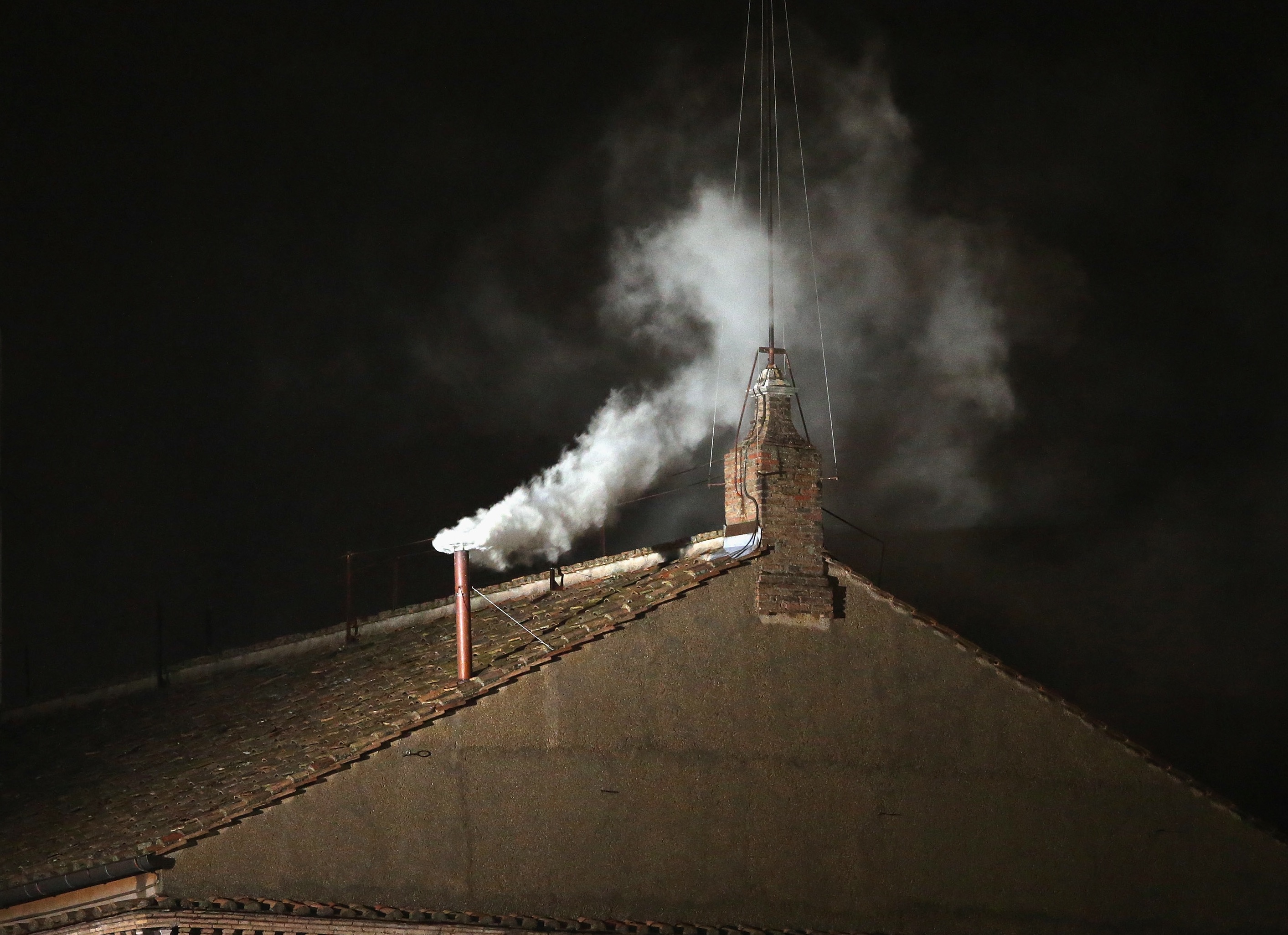
(Photo: White smoke emits from the chimney on the Sistine Chapel as a new Pope is elected on March 13, 2013 in Vatican City, Vatican. By Joe Raedle/Getty Images)

A Pope In Court?

It appears Francis – and not Benedict – may have to attend another court hearing to deal with a previous “crime against humanity” with respect to children under the Argentine dictatorship:

Tiempo Argentina is reporting that Bergoglio could be called to federal court to testify for the third time in a case involving crimes against humanity for his interaction with a pregnant woman named Elena de la Cuadra, and her husband, Hector Baratti, who were both kidnapped on February 23, 1977. According to Elena’s sister, Elena gave birth to a daughter who was then taken by Argentine authorities. At the time, Elena appealed to Bergoglio for help and received a letter saying that a bishop would intercede, but after a few months passed, the bishop reported that the baby had already been adopted by an important family and that the kidnapping could not be reversed. Despite the letter, Jorge Bergoglio has denied that he knew anything about kidnapped children until after the military dictatorship was overthrown.

Let me say on the record that I don’t believe that last statement. Which worries me.

The Pope For The Great Recession?

ITALY-VATICAN-POPE-CRIB FIGURINE

Partially because of his Latin American heritage, Michael Sean Winters expects Francis to be an advocate for the poor in an era of global economic disruption and turmoil:

Bergoglio and the other bishops in Latin America have been relentless in questioning and criticizing those who exercise power in ways that marginalize the poor. The criticism of capitalism is trenchant: He called the IMF’s efforts to squeeze interest payments out of a struggling Argentine economy “immoral.” Here, Bergoglio stands in continuity with Benedict whose criticism of modern capitalism never made headlines but was there for anyone who cared to look. Catholicism does not propose any specific economic or political systems, but it must always criticize whatever systems insult human dignity.

Philip Jenkins argues along the same lines:

Bergoglio is … clearly an heir to the strong tradition of social-justice activism in the Latin American church. Again, this owes much to his Argentine background. If Argentina was once regarded as a hemispheric success story in economic development, its history since the 1950s has been much grimmer, with systematic decline and repeated bouts of hyperinflation, reaching catastrophic dimensions during the crisis of 1999 to 2002. In consequence, people who regarded themselves as citizens of a prosperous near-European economy faced ruin, the annihilation of their savings, and the loss of their jobs and homes.

Naturally, having lived through such a disaster, Bergoglio has placed the church’s social mission front and center in ways that a European would regard as alarmingly radical. Even more than the last two incumbents, Francis I will speak forcefully and critically about neoliberalism and global economic exploitation.

(Photo: Crib figurines’ artist Genny Di Virgilio works on a figurine depicting Pope Francis, the day after he was elected on March 14, 2013 in Naples. By STR/AFP/Getty Images)

For The Record

The Hugh O’Shaughnessy piece we linked to yesterday – the most damning when it comes to Francis’ relationship with the military junta – has been corrected:

• This article was amended on 14 March 2013. The original article, published in 2011, wrongly suggested that Argentinian journalist Horacio Verbitsky claimed that Cardinal Jorge Bergoglio connived with the Argentinian navy to hide political prisoners on an island called El Silencio during an inspection by human rights monitors. Although Verbitsky makes other allegations about Bergoglio’s complicity in human right abuses, he does not make this claim. The original article also wrongly described El Silencio as Bergoglio’s “holiday home”. This has been corrected.”

We will surely hear more from Verbitsky, whose reputation is very good in Argentina.