And So It Begins … ?

mary-knots

One of the great question marks still hanging over Pope Francis’ tenure as Bishop of Rome is whether any actual doctrinal changes will occur. Damon Linker has a provocative and honest piece out wondering if “liberal” Catholics even care about doctrine any more – because so many have been content simply to celebrate the sharp transformation of tone in the Francis era and the new emphasis on Christianity as an urgent and empowering and demanding way of life. Money quote:

I had assumed all along that liberal Catholics wanted to liberalize Catholic doctrine — that they wanted to bring the church, as I wrote in TNR, “into conformity with the egalitarian ethos of modern liberalism, including its embrace of gay rights, sexual freedom, and gender equality.” But here was a liberal Catholic telling me I’d gotten it all wrong. The pope’s warm, welcoming words are “everything,” Trish said, because doctrine, including that covering contraception and divorce, is “useless.”

As someone who, to be honest, has been exhilarated this past year by the re-emergence of a genuine, living, breathing Christianity in the Vatican, I’m not in the same camp as “Trish”. But it also depends on what you mean exactly by doctrine.

If by doctrine, you mean the core tenets of the Creed I recite at Mass by heart (or at least used to until Benedict added all sorts of anal-retentive clutter), then I do not favor any changes in doctrine. I believe in what I say. Sometimes, of course, it is hard to believe something that is beyond my real understanding. I’ve thought about, meditated on, puzzled over and marveled at the doctrine of the US-JUSTICE-GAY-MARRIAGEIncarnation, for example – for me, the most radical of all Christianity’s improbable claims. I believe in it until I can’t, at which point, I embrace a mystery – what Pascal called “the use and submission of reason.” But I am utterly unworthy – morally and intellectually – to offer any real critique of these mysteries; and because I feel and know the living presence of Jesus in my own life, because that presence seems to me both human and divine, and because Jesus has rescued me so many times from myself and from the world, I accept what I cannot understand.

Then there are questions of morals. And readers know I find the natural law arguments that I have been told to believe in about human sexuality and the family to be both incoherent and unpersuasive precisely as “natural” law. (See the relevant chapters in Virtually Normal and The Conservative Soul.) I see Aquinas through the prism of our modern, and far deeper, knowledge of human biology and evolution and my own human experience as a homosexual in modernity. But over the decades I have written on this, I haven’t done more than ask the Church hierarchy to confront and grapple with what I see as incoherence, or cruelty, or anachronism in its sexual teachings. I have, for example, been passionate in backing equal civil marriage rights; but I have never made a case for including gay couples in the sacrament of matrimony, because I think we need a much deeper and slower and conscientious discussion before we think about that kind of change in a Supreme Court Hears Arguments On California's Prop 8 And Defense Of Marriage Acttwo-millennia-old faith. But, alas, both John Paul II and Benedict XVI not only forbade such a discussion but also enforced some of the most insulting and condescending views about who we homosexuals are, spoke about us as inherently drawn to evil by our very nature, and refused even to address us as fellow-Catholics or as fellow human beings.

But Francis has changed that. He famously sent out a questionnaire to all Catholics asking for our views on questions of the family, of sexuality, and of our actual lives in the modern world. It’s in preparation for a Synod later this year in Rome to air those very subjects – the kind of honest, real dialogue Benedict spent a lifetime squelching, stigmatizing and censoring. No one knows where it will lead. But the dialogue is as important as any result. It’s a start. Glasnost is returning to the church again.

And so when the leading Catholic theologians in Germany produce a response to the questionnaire that deeply challenges the rigid doctrines the hierarchy has deployed to understand and enforce sexual morality, it’s a sign of a real paradigm shift. Catholics are part of a faith that cherishes the life of the mind, that asserts that Christianity is fully compatible with reason until mystery intervenes, that in the beginning, as John has it, was logos. And logos was with God. And logos was God. With a Jesuit at the helm, that is arguably truer than ever.

So what do these theologians say? It turns out – quite something. The full document is embedded below. Some highlights:

In response to a question regarding the church’s teachings on the value of the family, for example, the theologians respond that the church’s teachings are “practically not accepted” and “often lacks in [their] relation to experience.” Continuing on that subject, the theologians also state that people “are not satisfied when the Church proposes only celibacy and marriage as legitimate forms of life … In the light of the Gospel, the question should be examined whether other forms of life could be relieved of the verdict of sin,” they state … Responding to questions on the church’s prohibition of artificial contraception, the theologians state that “even the most committed Catholics don’t perceive their practice of artificial contraception as a conflict with their involvement in the Church which might lead to changes in their sacramental practice.”

But what is the positive vision the theologians offer instead? I recommend reading the full document, but NCR has a great summary:

Moving to their proposal for a new paradigm of evaluating sexual acts, the theologians say the church needs to appreciate the nakedness and vulnerability people experience in their sex lives.

They state that such a paradigm would have at least three dimensions:

A caring dimension to “protect that which is fragile.” Marriage, the theologians state, “could then be understood as an institution that protects this fragility, not as an institution of obligation.”

An emancipatory dimension that “opens new perspectives when vulnerability has become violation … As an emancipatory ethics, Christian sexual ethics has to take the side of those who lose in relationships, the ones who are left and hurt to the core,” they state. “It rejects all forms of sexual violence.”

A reflexive dimension that “accepts vulnerability and counters the banalization and routinization of sexuality.” … “As a reflexive ethics of vulnerability, Christian sexual ethics know the ontological value of vulnerability,” they state. “The joy of intimacy can be experienced only when it is possible to be vulnerable without being violated.”

That last line is quite beautiful to me. Why? Because it sees just how fraught a sexual encounter must be for two human beings, and therefore how radical a form of mutual respect is required to allow it to be joyful. Yes: joyful. Instead of seeing sex as intricately bound up in sin, policed by doctrine, subject to rules first seriously devised in the thirteenth century, Catholics can see the intimacy and vulnerability of sex as requiring a kind of grace to remove from it all forms of power, exploitation, and disrespect. This is not the language of rights-based liberalism. It is the language of reason, experience and respect for the profound and great gift of sexuality and its capacity to emancipate us, to show us a way to truly care for one another, and to protect the vulnerable in an avenue of joyfulness.

It removes at once the instrumental view of sex-as-solely-procreation and replaces it with something – dare I say it? – more Christian.

I want to re-read and reflect on this document some more. I hope you do too.

German theologians respond to Vatican’s synod questionnaire

This embed is invalid

(Photos: Getty Images)

Bringing The Church Into Balance

Yesterday, the Pope appointed 19 new Cardinals, none of them Americans. Barbie Latza Nadeau reviews the picks:

Francis chose two new cardinals from Africa, two from Asia, two from North and Central America, and three from South America. Only two Europeans were chosen outside the Curial appointments. The cardinals’ primary responsibility is to vote for the new pope in a secret conclave held in the Sistine Chapel when a sitting pope dies, or, as in the case of Pope Benedict XVI, resigns.

Vatican spokesman Father Federico Lombardi said that the appointments of Bishop Chibly Langlois of Haiti and Archbishop Philippe Nakellentuba Ouédraogo of Burkina Faso underscored Pope Francis’s primary focus on ministering to the poor.

John Allen puts the choices in context:

With just under 70 million Catholics, the United States accounts for around six percent of the global Catholic total, meaning that it’s long been over-represented in the College of Cardinals relative to population.

With 11 cardinals under 80 and thus eligible to vote for the next pope, the United States has roughly ten percent of the world’s cardinal-electors. Both in 2005 and 2013, cardinals from the United States cast more ballots to elect the next pope than Brazil and the Philippines combined, despite the fact that those two nations together represent roughly four times the Catholic population of the United States.

Today’s announcement thus represents not only an acknowledgement of the church in the developing world, but also, arguably, a healthy reminder to Catholics in traditional Western powerhouses such as the United States of where they stand in terms of the Catholic footprint in the early 21st century.

Why Francis Matters, Ctd

Scores of readers over the holidays dove into the latest Deep Dish. “A mama from the It’s So Personal series” writes:

I couldn’t get through the Iraq war Deep Dish – it just made me go to a dark angry place and I could not go on – but, wow, did I love the piece on Pope Francis.  So much so that I explored Marian websites and even ordered a Novena for “The Untier of Knots”.  I have never done a Novena, as I’m an American Episcopalian, but the piece and Francis’ inspiration both really spoke to me. And I have some pretty thorny knots in my life right now.  Thanks for always expanding my world view.  I know everyone doesn’t love your Sunday postings, but I have to say I really get a great deal from them.  And I know Christmas is difficult for you, but you gave all of your readers a gift in this Deep Dish feature.

Another reader:

I became a subscriber just so I could read your deep dish on Pope Francis. The article was worth my $20.00. I kept going back to the sentence, “It is only in living that we achieve hints and guesses – and only hints and guesses – of what the Divine truly is.” Such a lovely, peaceful thought.

Another:

In your article about Pope Francis, which I enjoyed immensely, you wrote this:

Many of his followers, it is worth remembering, were often of his own well-to-do class, just as many early Christians were prosperous traders and businesspeople. It was not so much the experience of poverty that propelled them so much as the renunciation of their own wealth and power. This, observers sensed and recorded, gave them a liberation like no other.

I may understand one of the reasons that liberation was so desirable to that particular group of people.  Some time ago, Keith Humphreys wrote an article over at the Washington Monthly about Untier-Of-Knots-Cover-Imagetrying to fire a sub-par employee only to discover that the employee’s three-year-old daughter had just been diagnosed with leukemia.  As Humphreys put it:
What I concluded as an employer from experiences like these is that employer-based health insurance gives me far more power than I want or should have over the health of my employees and their families. Yes, I could just be a cold bastard and fire people like the employee in my fictional example, telling myself that if his daughter doesn’t like it she can complain to Adam Smith. But I’m not built that way and I don’t think most other employers are either. People who do their jobs badly may well deserve to be fired by their employers, but whether they and their families live or die should not also hang in the balance.

I could understand having a few brushes with that kind of power and seeking out some sort of liberation from it.  And I use the term “liberation” advisedly.  As Heinlein once noted (I think he did … can’t find the darn citation), buying into the idea that you have that power over others implicitly requires that you accept that someone else could have that power over you.  It’s literally liberating to reject the idea that any human can wield that kind of power.  You may be declining the opportunity to control someone else’s life, but in the process you’re freeing yourself.

Another reader dissents:

I’ve read/listened to the two new pieces in your new Deep Dish. I enjoyed the conversation with Dan Savage immensely. It was amusing to hear a discussion of the Campus Bar in Cambridge. I lived down the street and was a regular there for a number of years.

But I would caution you not to do too much early hero worship of Francis.

He’s moving away from the disaster of the conservative agenda of the last 30 years. It remains to be seen if he goes the distance. He’s made a good start with removing a theocon or two, but it remains to be seen if he addresses the institutional cover up of child abuse that has been Benedict’s Legacy. And he seems to be going forward with the instant canonization of JPII. I’m not a Catholic, so I’m not as involved in hoping there’s a home for gay people in the church. But in my judgment he’s only gotten “sucks a lot less than the last few” to his credit. Don’t canonize him at the beginning of his reign.

As another puts it, “Talk is nice, but rather cheap. Actions count, even in Catholicism.” I promise one thing: to be vigilant as a hawk on the child-rape question. Another reader sees “concrete changes to the Church already”:

11:00 mass on Sundays has been packed. We no longer can come 10 minutes late and expect to find seats all together. I think this is the Pope effect. My daughter and I love to see how our priest slips in a reference to the pope in every homily. He just loves him, and it’s obvious that having such an open-minded pope has enabled rank-and-file priests the freedom to say things they have wanted to say about the poor and our duty to help them, about God’s love for everyone, and how all are welcome to celebrate mass not just the pious and perfect. Your essay was an early Christmas present. Thank you. And thank you to your entire team for a fantastic year. Your blog is the only blog that I read religiously. I am actually looking forward to slapping down $100 for my renewal.

Another dissent:

In the same airborne news conference during which he made headlines for seeming to counsel against damning gay priests, he responded dismissively to a question about women’s ordination, stating bluntly, “That door is closed.” And then this, from his most recent interview:

When God meets us he tells us two things. The first thing he says is: have hope. God always opens doors, he never closes them. He is the father who opens doors for us. The second thing he says is: don’t be afraid of tenderness. When Christians forget about hope and tenderness they become a cold Church, that loses its sense of direction and is held back by ideologies and worldly attitudes, whereas God’s simplicity tells you: go forward, I am a Father who caresses you.

It just hurts.

Another is more hopeful:

I haven’t read your Deep Dish essay on Pope Francis, but I am looking forward to it.  I am writing mostly to express the odd reaction I have been having to the multiple quotes from Pope Francis you are posting on the blog. As a gay man who was raised in a strict Evangelical household in Oregon, my exposure to the Catholic church has been minimal other than a friend’s Catholic wedding. Starting in high school I consciously rejected my parents’ brand of faith (and politics), which later extended to all organized religion. It is not something I struggled much with after my teens and coming out nor thought much about since.

But recently, I have found myself tearing up when reading some the words of Pope Francis, and not the very-welcome passages relating to poverty and gays, but rather those that have to do with god’s love and hope, such as the one you posted here.

I don’t know if this is a part of me that has gone untouched since I left religion behind. It may also be that for the first time that I can remember someone is expressing religion and god in a manner that my family and their church never could which left me feeling cold and left out from what they were experiencing. Whatever it is, I feel like this Pope has awakened or touched something within me that I did not know I ever had or at least had let go of so long ago I forgot it ever existed. I don’t know if I’ll ever willingly go back to church, and if I did what that church would look like, but Francis has already affected me more than an ex-religious gay Northeast liberal ever would have expected possible. Thank you for your continued attention to this extraordinary Pope.

Another predicts:

This Pope will be the salvation of the Catholics, and a true leader to follow irrespective of your religious beliefs. At least someone you can listen to without that feeling of listening to someone from another century. Here’s a note from my dad, back in Kerala, India, who got a gift subscription of The Dish from me for Christmas. He is a Hindu, a Lord Krishna devotee, for the record. He read your deep dish on Francis and wrote me this:

yes, I read it son. i had not been a follower of these Papal messages or gospel for along time of the previouspopes, but from a recently published interview he gave to a  reporter, I understand that the present pope is much different than others, a down to earth one and that seems to auger well for mankind. Dad

So yes, the Pope’s message is reaching all corners of the world, and puts the Church and the Catholics in a fresh new perspective – a much needed light that might shake the cobwebs and the dust away.

One more reader:

I thoroughly enjoyed your essay on Pope Francis (and was glad I had chosen to subscribe). It called up a lot of emotion and thought and memories in me. I was once a Christian who converted to Catholicism (in the very year that John Paul II became pope) through coming to see it as the best historical vehicle of the gospel When Christianity became impossible for me (for oh so many reasons), I of course left the church. And I suppose I have ended up a “sort-of” Buddhist, in that the very basic teachings of the buddhadharma are what enabled me to go on living after the death of my 15-year-old son in a meaningless accident. You learn what is the truth for you when you are knocked flatter than you would ever think it possible to be knocked, and then you find a way to get up again and go on.

But what is so beautiful to me about the dharma is the way it allows me to look at someone like Francis and see a true bodhisattva – a true agent of truth a compassion – irregardless of what group they belong to. How marvelous for a new bodhisattva to appear as a pope! Who would have thought it? And as someone who once embraced the Catholic faith with a true passion and fierce devotion (until I was reborn into another life, as it were), it makes me glad to see what you see in Francis. How marvelous.

Previous thoughts from readers here.

The Pope Speaks; The GOP Flails

VATICAN-RELIGION-CHRISTIANITY-POPE-AUDIENCE

The new line, deployed against Pope Francis’ dismay at the materialism and ideological fixity of global market capitalism, is that the Pope was only referring to Argentina. Global capitalism in Argentina, according to the theocons and neocons, is so different than in the United States that Pope Francis’s critique is simply a regional one. In Argentina, he’s only referring to crony capitalism, entwined with government, combined with an entrenched lack of social mobility. If the Pope were to understand American capitalism better, he’d realize it was a truly free market, empowering social mobility, creating wealth and disseminating it on a massive scale. On CNN last week, that was essentially Newt Gingrich’s argument against the Pope’s Apostolic Exhortation (which I explore in considerable detail here).

A mega-rich donor to the American Catholic church is so offended by the Pope’s words on the importance of poverty that he is allegedly hesitant to pay for a large amount of the restoration of Saint Patrick’s Cathedral. Cardinal Dolan, the reactionary now left stranded by the new papacy, has struggled to rebut the implications of the Pope’s somewhat unequivocal words. Arthur Brooks, a Catholic running the American Enterprise Institute that favors torture, unfettered global capitalism, and pre-emptive war, makes the case as succinctly as he can:

Arthur Brooks … said he agrees that the pope’s beliefs are likely informed by his Argentine heritage. “In places like Argentina, what they call free enterprise is a combination of socialism and crony capitalism,” he said. Brooks, also a practicing Catholic who has read the pope’s exhortation in its original Spanish, said that “taken as a whole, the exhortation is good and right and beautiful. But it’s limited in its understanding of economics from the American context.” He noted that Francis “is not an economist and not an American.”

So America is so unlike Argentina that the Pope should not be taken seriously. The trouble with this assessment is that the Pope clearly was not restricting himself to Argentina in his Exhortation. His remit was much wider. Here’s a critical passage and it’s quite clear that the Pope is referring not to a single country but to the ideology of a global system, rooted in the economy of the United States and its unipolar power since the end of the Cold War:

The current financial crisis can make us overlook the fact that it originated in a profound human crisis: the denial of the primacy of the human person! We have created new idols. The worship of the ancient golden calf (cf. Ex 32:1-35) has returned in a new and ruthless guise in the idolatry of money and the dictatorship of an impersonal economy lacking a truly human purpose. The worldwide crisis affecting finance and the economy lays bare their imbalances and, above all, their lack of real concern for human beings; man is reduced to one of his needs alone: consumption. While the earnings of a minority are growing exponentially, so too is the gap separating the majority from the prosperity enjoyed by those happy few.

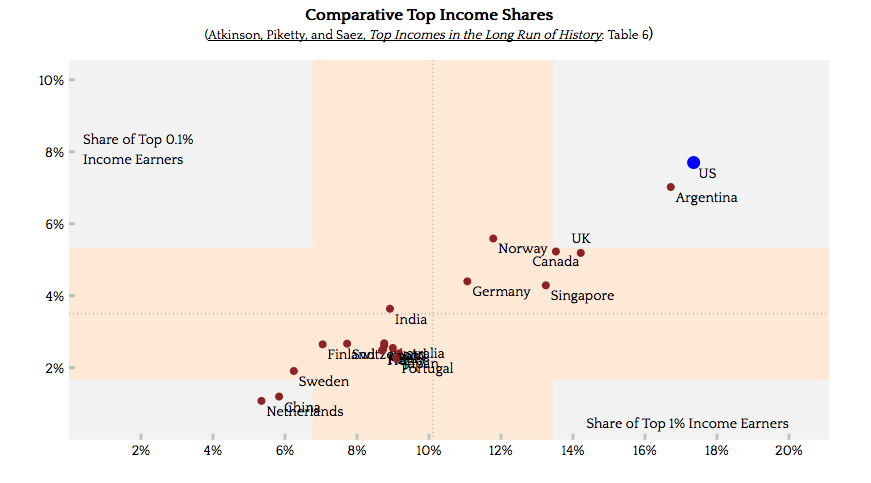
The question is: is this only true of Argentina and not of the US, as Arthur Brooks and Newt Gingrich claim? Let’s take a look at each countries’ one percent, and then the top 0.1 percent, and see how much of a country’s wealth they each represent. Here’s a graph from 2005 that shows where various countries fit on that scale:

Screen Shot 2014-01-02 at 10.27.20 AM

Funny, isn’t it, how utterly similar the US and Argentina are in terms of inequality? Since that date, the US’s top one percent have moved from earning around 17 percent to more than 20 percent.

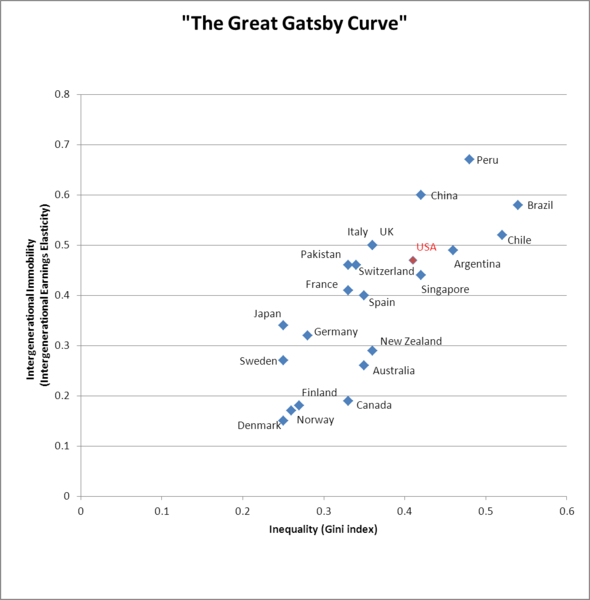
On the core question of social mobility, Argentina and the US are also very close together as the following chart shows:

590px-The_Great_Gatsby_Curve

So in terms of both income inequality and social mobility, the US and Argentina are basically the same country. So why does the Pope’s arguments apply only to Argentina and not to the US? I’m not an economist, so maybe there’s another dimension here that I’ve overlooked. As always, I’d be more than happy to post any correctives or clarifications to this basic reality. But right now, it seems to me that the Catholic right is simply wrong. Their American exceptionalism has morphed from a thoroughly admirable national pride at America’s achievements to a fixed and rigid idolization of a single country along with an idolization of wealth. Both, to put it mildly, are heresies. And perhaps the biggest impact of the new Pope on American politics will be more forthrightly denying the denialist, ideological right any Catholic crutch to peddle their snake-oil with.

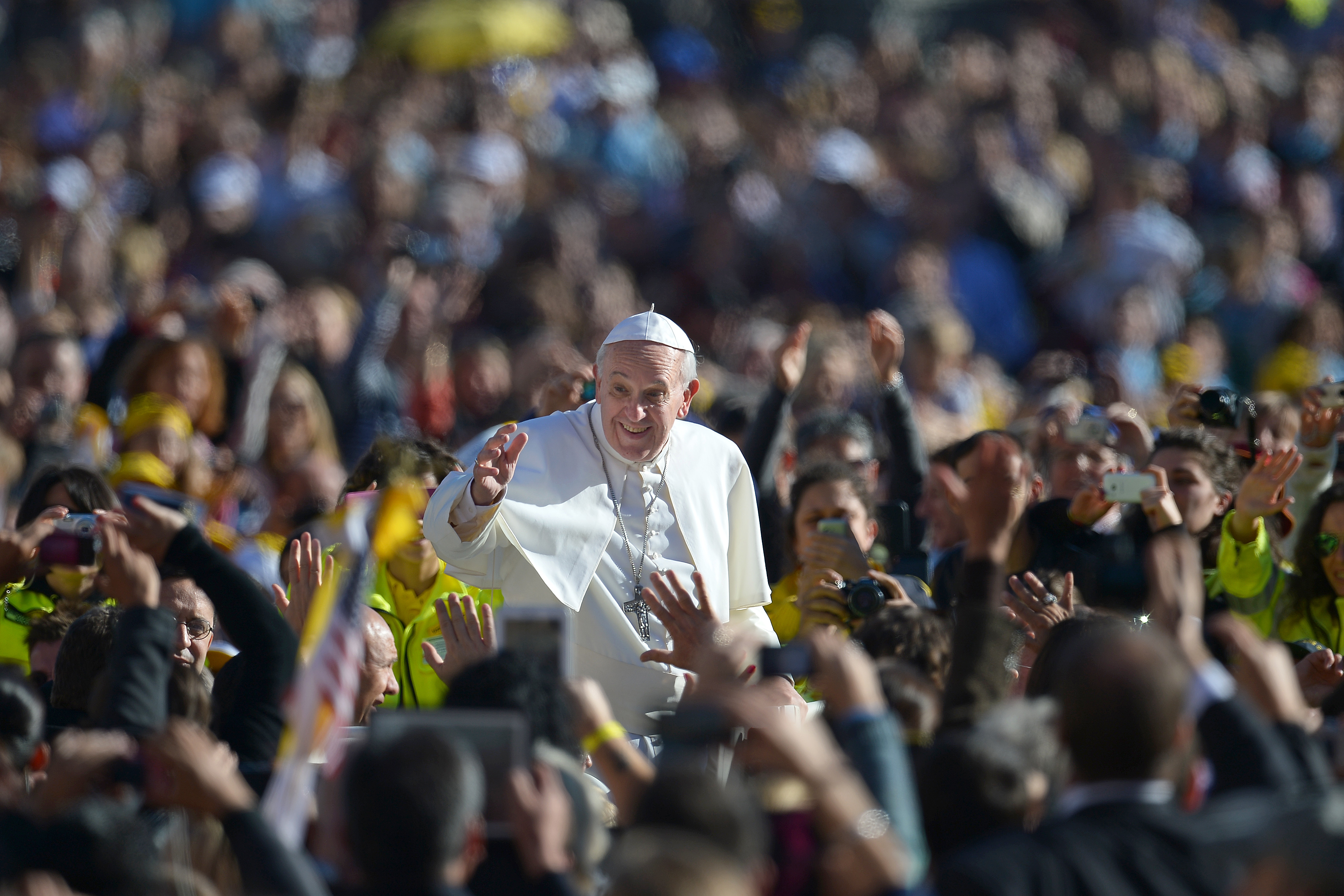
(Photo: Vincenzo Pinto/AFP/Getty)

Quote For The Day

“What I love about the pope is he is triggering the exact kind of dialogue we ought to be having. People need to get involved in their communities to make a difference, to fix problems soul to soul,” – Paul Ryan, in a Coppins profile that suggests the Randian is losing his Ayn.

I don’t see why one should be cynical about this. It seems completely sincere to me – and a sign of how powerful Pope Francis may yet be in shaping the global conversation.

Deep Dish #2: Why Francis Matters

[Re-posted from earlier today]

Subscribers are already digging into the latest Deep Dish offering, Untier Of Knots, my essay on Pope Francis released last night:

Thank you. Sublime. Beautiful. A gobsmacking refutation of fundamentalism and affirmation of what remains the best of Christianity.

Another:

This is a very fine essay on Pope Francis, I believe. Raised as a pastor’s son and steeped in the Protestant tradition, I am fairly ignorant of Catholic tradition, but I learned an awful lot here. I’m not one to kiss ass, and I’m an obsessively critical nit-picker, but this essay was profound and Untier-Of-Knots-Cover-Imagearticulate and intellectual without being elitist. This is a hard thing to craft. I appreciate your context on his Argentine history and the connection to St. Francis. I am very agnostic and not practicing these days, and am certainly not about to convert to Catholicism, but I have found some meaning and comfort in the humble tradition of discernment in the past year or so. I truly admire this man for humbly living out the Gospel, rather than perpetuating dogma and disconnection from the poor and the planet.

Isn’t it also something of an absurd blessing that a man such as this came into the Papacy, an institution encrusted with privilege, authoritarianism, and hypocrisy, as you and others have documented? By that I mean, in what other institution could such a man have this sort of platform and power today? We have a habit of ignoring, slandering, imprisoning, or killing off those who truly seek, speak, and act out this modus vivendi. I know he’s a man like you and me, and I don’t mean to elevate him to sainthood (something I’m deeply skeptical of), but I can’t think of any other way he could achieve this sort of stature without being dismissed as a crazy person, a phony intent on his 15 minutes of fame with serving-others publicity stunts, or a political ideologue.

I may only be restating your own arguments here, but anyway, I thank you for this essay and look forward to much more from Deep Dish! Keep up the good work.

Subscribers can read the Francis essay – and listen to my long, bawdy conversation with Dan Savage in the same issue – here. On the Dan podcast, another reader writes this morning:

Well, I loved it. The frankness, the fun, the openness, the charm, the filth … wonderful.

savage-podcastYou want me and Dan unplugged? It’s all here – on sex, love, gay history, lefties, marriage. Recording a podcast with someone who’s been a real friend for a long time – as opposed to someone, like Mikey Piro, whom I’d just met – was an eye-opener. It’s so easy to forget the microphone, because in so many chats over the years, there has never been one. Which is to say that there are probably passages in the podcast I really should regret. But it’s too late now.

A spot-on take from a subscriber:

I could listen to Dan Savage forever. He’s so fucking smart and clear-eyed. I’ve been reading him since I was a 20-something in Seattle when he first started his column. Like a lot of my peers, I was a reflexively homophobic straight guy. Not crazy, just more like, “I need to make sure nobody thinks I’m gay.” Through his column Dan stripped that shit right out of me. He even taught me how to eat pussy. Now I take pride in him as a representative of our generation. He is an American hero, embodying the best of this country: self determination, rebellion and humanity.

If you want access to the podcast and the essay, but haven’t yet subscribed to the Dish, you can do so [tinypass_offer text=”here”] for just $1.99/month. Another subscriber writes:

I don’t know if I’m approaching a spiritual crossroad, but the more I read your religious views, the more I feel something stir in me that wants what you describe. Maybe Pope Francis was what you’ve been waiting for, and I was waiting for you to find someone to share with me that I could relate to in a way other than as a representative of a cold, indifferent defender of authority. I had enough of that rammed down my throat for being gay in a fundamentalist Christian home and community.

The Advocate just named Pope Francis as their Person Of The Year, and in the past I would have objected on the grounds of Benedict’s legacy alone that such a selection was insane. But I could not do that with Francis. Like you said, Francis became very popular very fast and I just happened to be tuned in and watching, so I know the man is the genuine article. The doctrine hasn’t changed, but the emphasis of the Church certainly has.

And he’s the kind of guy you feel like patiently waiting on to untie all the knots. You can’t imagine him any other way than for his goodness. I try not to get emotionally wrapped up in people like him. When I do and then they stumble, I usually hit the pavement harder than they do. So I’m watching him like kids watch a scary movie; sort of peeping between my fingers during the scary parts and hoping for something good to happen.

I’ll try to be patient. I think he’s worth it.

I think he is too. Update from a few more readers:

I’m one of those non-Catholics who have been following Pope Francis with increasing astonishment and joy since I first saw him wash the feet of the prisoners at Casal de Marmo. I subscribed as soon as you announced the new Dish, and UNTIER OF KNOTS instantiates why I will be resubscribing. My hand is already aching a bit from copying long portions out into my notebook. I’m still living with this latest piece, re-reading it and savoring it, but want to take a moment to call attention to the earbud metaphor, which struck me as odd at the start of the paragraph but had won me over entirely, emotionally, by the time I got to the word “practice.” It’s really such a lovely thing you did there. Thank you.

Another:

As a lapsed Catholic and atheist, I was moved by your piece. It reminded me of the church I attended as a young boy with a dynamic young priest (Father Baxter) who attracted us with sports and made us love his church and become altar boys and thoughtful people. He was the first adult (after my father) to really have an impact, as he taught us about the love of Jesus and the tolerant message of the church of John XXIII. Yes, this was the Sixties and the talk of love was everywhere, but the atmosphere that pervaded was pretty darn close to what you described in your piece.

It wasn’t the god of the Old Testament, the judgmental god, but rather the God of Love, the Jesus God that loved me warts and all. Not the protestant god by any means, not the god of Robertson and Falwell et al. No fire and brimstone for us. Our God was a patient and understanding one, a God that deserves the capital G. We rarely heard talk of Hell or damnation, though we were surrounded by the French Catholic clergy of Quebec that practised that approach! Ours was an English Catholic parish serving mostly Italian immigrant children going to English Catholic schools in French speaking Quebec – talk about confusion!

What does this have to do with your piece on the pope? Well, obviously this is where your Deep Dish dive has brought me back to the future, I hope. Not that I am about to believe in god any time soon, but it did clarify for me the reason I have trouble listening to proselytizing atheists of the Dawkins type. No Grace, as you put it so well. No forgiveness, no understanding, no love – just pure materialism, pure ideology and condescension. They can only point to the evils of the church, none of which were practised at my church.

In fact, that teaching carried over to my later experience in college where I met my first full-blooded homosexual. He was one of my teachers, an American having fled the draft and attracted to Montreal’s gay culture. He made me think about homosexuality and conditioning that I, as an Italian immigrant’s child coming from a fairly macho culture, had never really confronted. We were not peculiarly cruel, and we didn’t use words like “fag” or “sissy” all that much, but we had the usual prejudices and attitudes. However, it seems that the teachings of Father Baxter had an effect, and I never felt threatened by my teacher and learned quite a lot from him. He took a few of us to a gay bar and introduced us to gay culture (well, a certain gay culture that you and Savage talked about in your podcast).

Why Do So Many Go Hungry?

Pope Francis recently commented on world hunger:

With all the food that is left over and thrown away we could feed so many. If we were able to stop wasting and start recycling food, world hunger would diminish greatly.

Pascal-Emmanuel Gobry argues with the Pope about the causes of hunger:

Here’s the thing: the reason why so many go hungry is not that people in the West throw away food. That’s just not the reason. The reason is not free market capitalism. The reason isn’t even socialism (or only marginally, these days). The main reason—and I’m pretty sure this is something all serious observers of this question would agree with—is quite simply corruption. Everyday corruption of functionaries. Corruption in the broader sense of war. Corruption. …

[I]f there is any institution in the world that should put this issue front and center, it’s the Catholic Church. First because, as I’ve said, it’s already well within the bounds of Tradition and flows naturally from the Gospel. Second, because it has a unique legitimacy and presence in doing so. Who else has both the moral language and the on-the-ground presence in so many of these countries to be able to denounce corruption forcefully and effectively? The World Bank? The UN? How much great would be done if, every day, every bishop in sub-Saharan Africa and India and other places saw his number one pastoral priority as denouncing and combatting corruption by government officials, instead of (I’m sorry) bloviating platitudes about wasting food? Isn’t this something the Vicar of Christ should exhort the other bishops to do?

The Year Of Francis

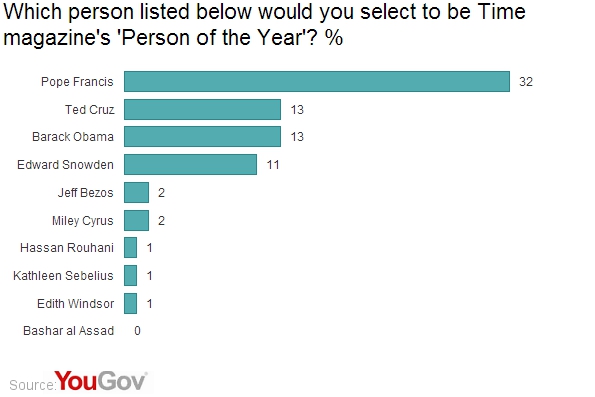
Americans agree with Time:

Person Of Year

Even The Advocate named Francis as their person of the year:

As pope, he has not yet said the Catholic Church supports civil unions. But what Francis does say about LGBT people has already caused reflection and consternation within his church. The moment that grabbed headlines was during a flight from Brazil to Rome. When asked about gay priests, Pope Francis told reporters, according to a translation from Italian, “If someone is gay and seeks the Lord with good will, who am I to judge?”

The brevity of that statement and the outsized attention it got immediately are evidence of the pope’s sway. His posing a simple question with very Christian roots, when uttered in this context by this man, “Who am I to judge?” became a signal to Catholics and the world that the new pope is not like the old pope.

Sean Bugg dissents, while I simply reel at the gay community’s embrace of a Pope. I mean: 2013 was a huge year for marriage equality – but also for gay-Catholic relations? What have I, what have I, what have I done to deserve this? Candida Moss is another Doubting Thomas:

[W]e have yet to see the kinds of doctrinal tinkering the media has attributed to him.

When it comes to the hot-button cultural issues that animate the Rush Limbaughs of the world, nothing has changed. Francis has been clear that the church’s position on abortion is not up for discussion, and he recently excommunicated Father Greg Reynolds of Melbourne, Australia, presumably for officiating at unsanctioned gay marriages. This pope may be extraordinarily compassionate, but he still enforces church order.

Damon Linker makes similar points:

Unlike his predecessors, Francis holds an apparently sincere belief in dialogue, bridge-building, conciliation, and the adjudication of differences. It seems important to him to appear cheery, tolerant, cosmopolitan. He has made respectful, open-minded statements about the members and beliefs of other Christian churches, as well as about Jews, Muslims, and even atheists.

But in every case where Francis has reached out to those who disagree with him, he has done so while indicating that his own beliefs grow out of Catholic bedrock. In the same airborne news conference during which he made headlines for seeming to counsel against damning gay priests, he responded dismissively to a question about women’s ordination, stating bluntly, “That door is closed.”

But Linker ends up softening his argument somewhat:

Even as Francis’s gestures make headlines, the Church does not think in terms of news cycles or election cycles, but rather in terms of centuries. A new Pope appoints the bishops, archbishops, and cardinals who will govern the Church of the future and in turn elect the next Pope, who will then make his own appointments, and so on, down through the decades. It may seem crazy to progressive Catholics that they’ll likely have to wait another 100 years for their Church to declare the use of condoms to be morally licit or to permit a woman to celebrate Mass. But something has to set the wheels of change in motion, and that just might be the modest but vital reform that Pope Francis ends up being remembered for most of all.

I think Damon is wrong about contraception. The highest authorities in the church argued exactly that almost fifty years ago – that condoms and the pill were licit. It was an over-reaching papacy that quashed it unilaterally. And undoing that over-reach is arguably the core goal of Francis’ pontificate.