“I think [Pope Francis] is a complicated man. And I wrote at the time of his ascension, because I knew something about his passion/compassion for the poor, that he should not simply be judged on where he stands on gay marriage or abortion, but that we evaluate him also and think about him and the fact that he lives a life of such humility. He wants to feel connected to those at the bottom. My qualm, right now, with the political left is that it is so taken over by sexual issues, sexual questions, that we have forgotten the traditional concern of the left was always social class and those at the bottom. And now we’re faced with a pope who is compassionate towards the poor and we want to know his position on abortion. It seems to me that at one point when Pope Francis said, “You know the church has been too preoccupied with those issues, gay marriage and abortion…” at some level the secular left has been too preoccupied with those issues,” – Richard Rodriguez.
Tag: Pope Francis
Exeunt The Theocons, Ctd
My take is here. Pierce praises the Pope’s latest actions:
This is smiling Pope Francis’s declaration of war against the legacies of the institutional theological reactionaries who preceded him in office. Both John Paul II and Benedict salted the world’s dioceses with hardbars like Bishop Raymond Burke, guaranteeing that their ideas would plague us long after they died or, in Benedict’s case, retired. Francis has wasted no time in rooting out these nasty walking land mines. Monkeying with the Congregation for Bishops is a serious business. It is a clear attempt to restructure the entire Church bureaucracy to fit your ideas, and it’s what good Pope John did 50 years ago.
Dreher’s view:
American conservative Catholics who defend Pope Francis keep saying that Francis is truly orthodox, despite the fact that the liberal US media love him. Maybe they’re right. But the further we go into this pontificate, the more I wonder if liberals understand something about Pope Francis that conservatives do not. The Advocate‘s editors, for example, probably don’t expect Francis ever to endorse same-sex marriage, or even gay sexuality; if they do expect this, they’re delusional. But they have every reason to hope that Francis will undermine the Church’s formal opposition to same-sex marriage and the broader gay-rights agenda. I think the Advocate made a savvy choice, frankly.
David Gibson look ahead:
In February, Francis will have two more important opportunities to make his mark: His Council of Cardinals will give him a blueprint for reforming the Curia, and a few days later, he will appoint his first batch of new cardinals — some of the men who may one day gather to elect Francis’ successor and chart a new course or follow the one he is laying out.
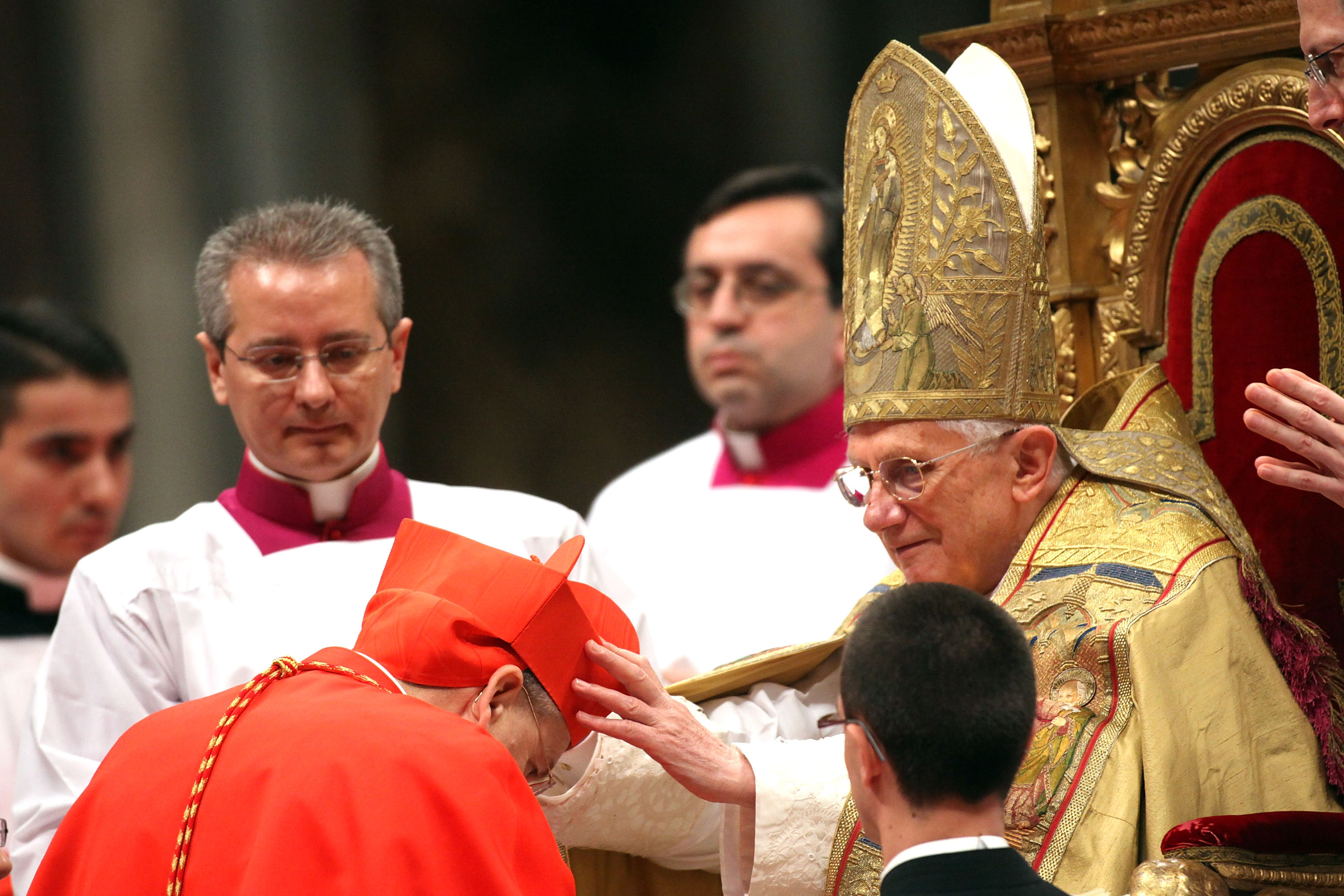
(Photo: New cardinal Raymond Leo Burke, Archbishop of St. Louis, receives the biretta cap from Pope Benedict XVI in Saint Peter’s Basilica on November 20, 2010 in Vatican City, Vatican. Burke was just removed from Pope Francis’ Congregation of Bishops. By Franco Origlia/Getty Images.)
Quote For The Day
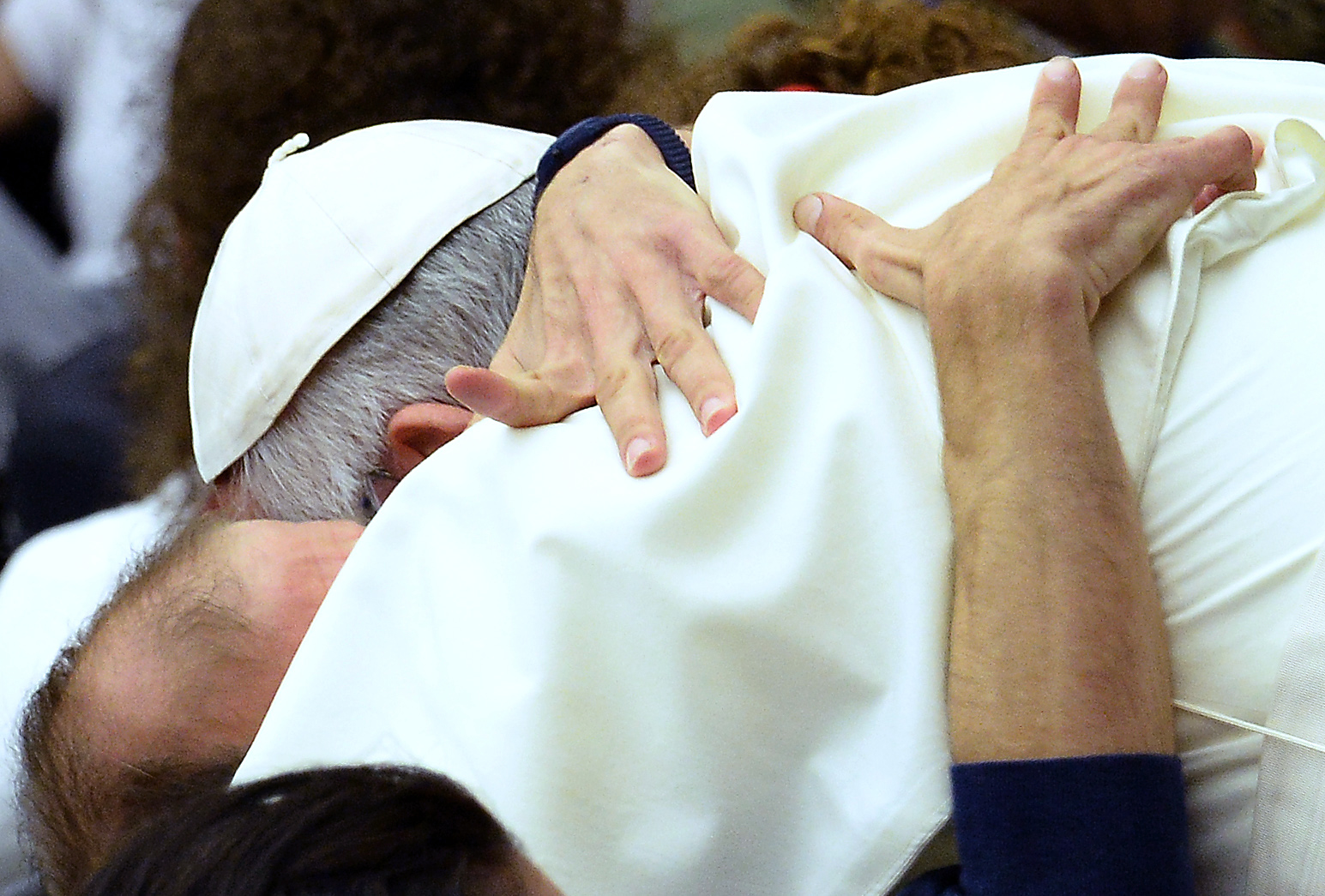
“When God meets us he tells us two things. The first thing he says is: have hope. God always opens doors, he never closes them. He is the father who opens doors for us. The second thing he says is: don’t be afraid of tenderness. When Christians forget about hope and tenderness they become a cold Church, that loses its sense of direction and is held back by ideologies and worldly attitudes, whereas God’s simplicity tells you: go forward, I am a Father who caresses you” – Pope Francis, from his most recent interview.
(Photo: Pope Francis hugs a disabled man during a meeting with the UNITALSI, the Italian Union responsible for the transportation of sick people to Lourdes and the International Shrines in Paul VI hall, at the Vatican, on November 9, 2013. By Filippo Monteforte/AP/Getty.)
The Message Of Francis
How E.J. Dionne Jr. understands the Pope:
As the leader of a church that has so long been viewed as dogmatic, hierarchical, and traditional, Francis bids to turn himself into a model of a kind of mystical humility that combines a spirit of moderation with intellectual openness and a radical understanding of what the primacy of the spiritual over the material means. Benedict issued a stern warning against a “dictatorship of relativism.” Francis seems worried about something else entirely.
“If the Christian is a restorationist, a legalist, if he wants everything clear and safe, then he will find nothing,” he has said. “Tradition and memory of the past must help us to have the courage to open up new areas to God. Those who today always look for disciplinarian solutions, those who long for an exaggerated doctrinal ‘security,’ those who stubbornly try to recover a past that no longer exists — they have a static and inward-directed view of things. In this way, faith becomes an ideology among other ideologies. I have a dogmatic certainty: God is in every person’s life.”
Thus is his one “dogmatic certainty” — a thoroughly undogmatic universalism more interested in shattering barriers than erecting them. It’s a very new approach to religion in the modern world, rooted in the oldest of doctrines.
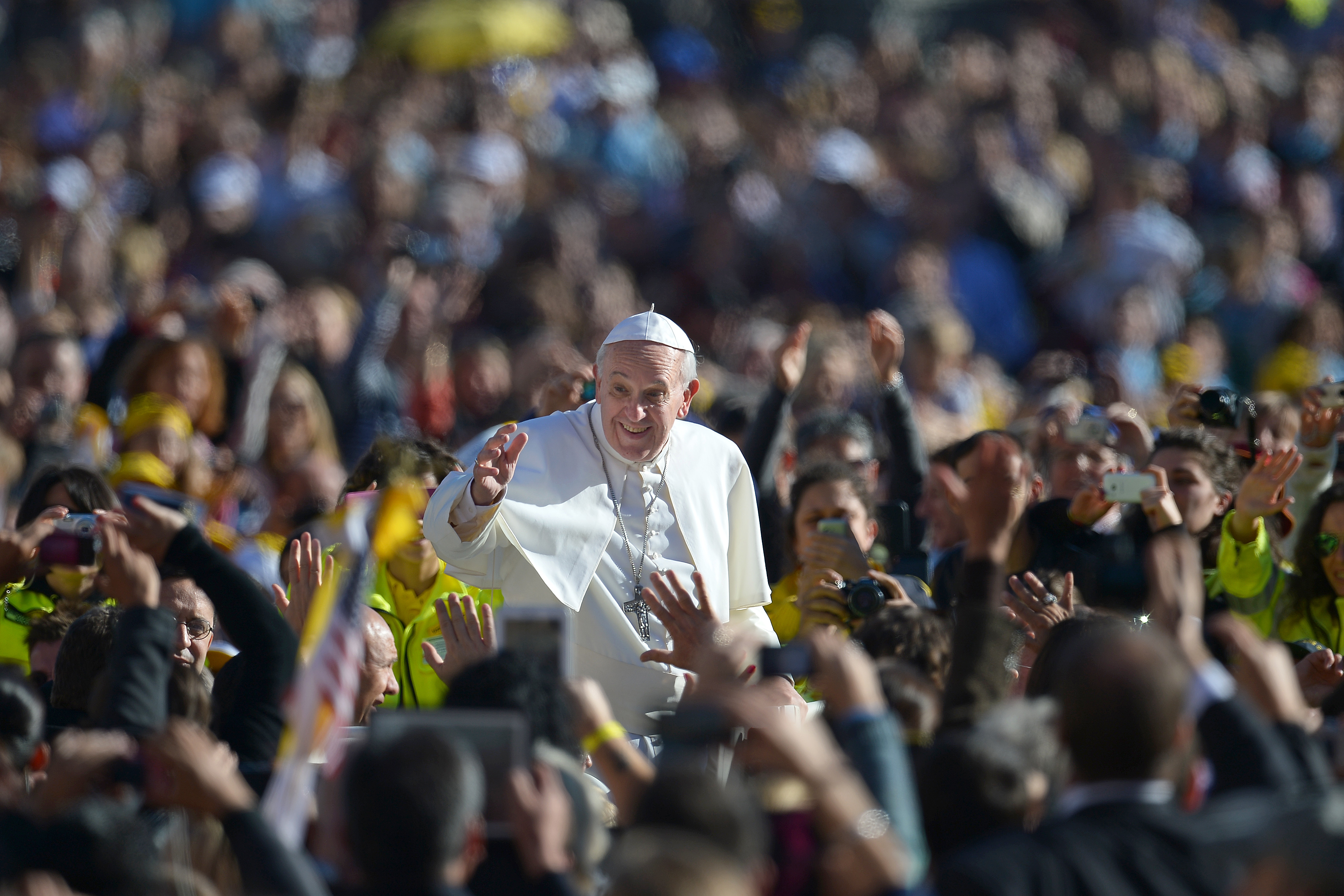
(Photo: Vincenzo Pinto/AFP/Getty Images)
“The Thing That Used To Be Conservatism”
Mark Shea takes on Fox News, Limbaugh and Drudge in their ignorant, stupid, malevolent attacks on Pope Francis. It’s a rocking rant.
A Pope Even Protestants Can Love
Reflecting on the way a number of evangelical heavyweights have praised Pope Francis, the Catholic commentator Raymond Arroyo explains the reasons behind the ecumenical admiration:
One is the great warmth, affection and magnetism of this man—Francis—and his willingness to allow the gospel to shape his ministry in a very profound and visual way. Additionally, the pressures of the culture we find ourselves in has, in a way, forced Catholics and Protestants together in a new way, where they realize that what divides them is far less than what unites them. … And when you hear a Pope stand up and talk about mercy, and forgiveness, and the broken hearts we all endure, and the need to push gossip aside and how destructive that can be in our lives, he’s getting down to the very granule level of faith that I think is appealing to the evangelical and Protestant mind.
The thing that has always impressed me about my evangelical friends—my in-laws are evangelicals, by the way—is their deep concern for the people in the pews next to them. And their willingness to go out of their own comfort zones to help those in their own community. And if the mainline churches and Catholicism have a problem, it’s that at times we can get very isolated. And though we check the boxes, we’re going to mass, we’re living our lives and we’re trying to be good people, extending that into our everyday lives can be a problem. Francis is calling people to allow that message to go deeper and to have personal reverberations in their own lives. I think that’s what they’re finding most appealing.
It’s also a very simple message. It’s a very blunt gospel, in some ways, which startles some people in the Catholic church. They go, “Wait a minute. What happened to the high theology? Where’s the graduate level exegesis here?” Francis isn’t that. I would argue that he’s boiling down the last two papacies with their the great messages and the intellectual heights that were scaled into a digestible message that the masses can absorb. And when I say “masses” I mean 99% of the people in the pews, whether they be Catholic or evangelical.
Who Is Matthew In The Calling Of St. Matthew?

Richard Beck ponders Caravaggio’s intentions:
Most think Matthew is the bearded man. It appears that he’s pointing to himself as if to say “Me?” in response to Jesus’s call. This theory is supported by two others works of which The Calling is a part, The Inspiration of St. Matthew and The Martyrdom of St. Matthew. In those paintings St. Matthew looks similar to the bearded man who is pointing to himself in The Calling.
And yet, some think Matthew is the young man on the far left of the painting, the one at the table hanging his head. The gesture of the bearded man, if you look at it, is plausibly pointing to the young man with the unspoken question now being “Him?”. If the young man is Matthew the painting is capturing the moment just before Matthew lifts his head from the table to look at Jesus.
Beck goes on to write that he believes Matthew is the bearded man, but prefers the “drama” of imagining it to be the young man, about to look up and meet the eyes of Jesus. Pope Francis’s perspective on the painting, which he discussed in an interview with America in September:
“That finger of Jesus, pointing at Matthew. That’s me. I feel like him. Like Matthew.” Here the pope becomes determined, as if he had finally found the image he was looking for: “It is the gesture of Matthew that strikes me: he holds on to his money as if to say, ‘No, not me! No, this money is mine.’ Here, this is me, a sinner on whom the Lord has turned his gaze. And this is what I said when they asked me if I would accept my election as pontiff.” Then the pope whispers in Latin: “I am a sinner, but I trust in the infinite mercy and patience of our Lord Jesus Christ, and I accept in a spirit of penance.”
(Image of The Calling of St. Matthew by Caravaggio, c. 1600, via Wikimedia Commons)
A Pope For The Whiskey Priests
A reader writes:
Your post quoting Francis’s wish for a “bruised, hurting and dirty” Church suddenly sparked a match in my head – the face of the Whiskey Priest, the protagonist from one of my favourite novels, Graham Greene’s The Power and the Glory. And all at once I put my finger on what it is that makes Francis so exciting – he is Greene’s pope. The priest of that novel is drunken, adulterous and self-destructive, weak and self-pitying. He is a “hollow man”, filthy and unshaven. But he is the greatest priest in all fiction because his is the church of the street, the church that will take you however awful or fallen or destitute you are. The church needs to hurt and fail too, if it is to properly care for a fallen people.
“It was too easy to die for what was good or beautiful,” reflects the priest. “It needed a God to die for the half-hearted and corrupt”. Even as an atheist teenager I remember being struck by this radically beautiful idea. I came to see two Catholic Churches in my head: the untouchable hypocritical Ratzingers caught up in that perfect web of procedure, and the repugnant filthy whisky priests seeing pity in all humanity. That Francis sees the ideal of the Church to be poor tells me he’s on the right track.
We will never get a whiskey Pope, I suppose, which is a shame. But something tells me Greene would have liked the idea of a hurting church and a Pope who washes the feet of convicts.
Quote For The Day
“While the earnings of a minority are growing exponentially, so too is the gap separating the majority from the prosperity enjoyed by those happy few. This imbalance is the result of ideologies which defend the absolute autonomy of the marketplace and financial speculation. Consequently, they reject the right of states, charged with vigilance for the common good, to exercise any form of control.
A new tyranny is thus born, invisible and often virtual, which unilaterally and relentlessly imposes its own laws and rules. Debt and the accumulation of interest also make it difficult for countries to realize the potential of their own economies and keep citizens from enjoying their real purchasing power. To all this we can add widespread corruption and self-serving tax evasion, which have taken on worldwide dimensions. The thirst for power and possessions knows no limits. In this system, which tends to devour everything which stands in the way of increased profits, whatever is fragile, like the environment, is defenseless before the interests of a deified market, which become the only rule,” – Pope Francis.
The Pope And The American Right, Ctd
Patrick J Deneen’s piece is very helpful. Money quote:
I think it is because of the left’s “narrative of disruption” [about Francis] that the right is panicked over Francis’s critiques of capitalism. These Vatican criticisms—suddenly salient in ways they weren’t when uttered by JPII and Benedict—need to be nipped in the bud before they do any damage.
The American right has gotten used to believing that Catholicism is cool because of its teachings on sex, abortion, homosexuality, marriage and contraception. And that has been a core feature of the theocon-neocon popular front this past decade or two. But it has always relied on ignoring or suppressing the critique of market capitalism that has long been embedded in Catholic social thought and was enunciated by John Paul II and Benedict XVI repeatedly. Just as the church challenges the left on some social issues, it deeply challenges the right on economic ones. I think it’s healthy that the right is now turning on this Pope. Catholicism is deeper, broader and more complex than any right or left political co-optation would have you believe.
 The Dish
