The Mistake Of Fighting Ebola Like A War

The US government’s response to the Ebola crisis in West Africa has relied primarily on the Pentagon, whose resources and logistical capabilities would seem to make it a good choice to lead such an operation. Alex de Waal, however, argues that military-run relief projects are less efficient and more costly than civilian efforts led by humanitarian professionals:

When Air Force planes carry out airdrops of emergency relief, they are invariably much more expensive and less effective than their humanitarian counterparts. Army engineers have the equipment to construct flood defenses or temporary accommodation for people displaced by fire or water, but there is invariably much wastage and learning on the job (by definition, too late). Experienced relief professionals can list many of the downsides of bringing in the military:

they utilize vast amounts of oversized equipment, clogging up scarce airport facilities, docks and roads; their heavy machinery damages local infrastructure; they use more equipment and personnel in building their own bases and protecting themselves than in doing the job; their militarized attitudes offend local sensibilities and generate resentment; and they override the decision-making of people who actually know what they are doing.

In the days after the Haitian earthquake in January 2010, the U.S. Army was efficient at clearing debris, setting up an air traffic control system, and getting Haiti’s ports and airport functional. One third of the emergency spending in Haiti was costs incurred by the military. (The costing includes only additional or marginal costs for the deployment.) When the army moved into other relief activities, such as general health and relief programs, even those marginal costs were disproportionately high. Trained for battlefield injuries, army surgeons weren’t skilled at treating the crush injuries common in an earthquake zone. In West Africa today, militaries are providing an important air bridge, given that commercial airlines have stopped flying. But the United Nations could do the job more cheaply and efficiently—if it had the resources.

The Best Hangover In Fiction? Ctd

Oktoberfest 2008

Continuing our discussion, a reader submits the following exchange from Dan Jenkins’s Life Its Ownself:

“How do you feel?”
“Like I’ve been et by a coyote and shit off a cliff.”

Another reader: “I would nominate Vera Charles in Mame, who stumbles down the stairs around, pulls aside a drape at the window and moans, ‘My God, that moon is bright.'” Many more below:

The following bit from Cheever’s Bullet Park isn’t written as well as Amis’s famous hangover description. But it’s more terrifying:

When the alarm rings he mistakes it for the telephone. Their children are away at school and he concludes that one of them is sick or in trouble. When he understands that it is the alarm and not the telephone he puts his feet onto the floor. He groans. He swears. He stands. He feels himself to be a hollow man but one who has only recently been eviscerated and who can recall what it felt like to have a skinful of lively lights and vitals. She whimpers in pain and covers her face with a pillow. Feeling himself to be a painful cavity he goes down the hall to the bathroom. Looking at himself in the mirror he gives a loud cry of terror and revulsion. His eyes are red, his face is scored with lines, his light hair seems clumsily dyed. He possesses for a moment the curious power of being able to frighten himself.

He soaks his face with water and shaves his beard. This exhausts his energies and he comes back down the hall to the bedroom, says that he will take a later train, returns to bed and pulls the blankets over his face to shut out the morning. She whimpers and cries. She then leaves the bed, her nightgown hooked up over her comely backside. She goes to the bathroom but she shuts her eyes as she passes the mirror. Back in bed she covers her face with a pillow and they both lie there, groaning loudly. He then joins her on her side of the bed and they engage in a back-breaking labor of love that occupies them for twenty minutes and leaves them both with a grueling headache.

He has already missed the 8:11, the 8:22, and the 8:30. “Coffee” he mutters, and gets out of bed once more. He goes downstairs to the kitchen. Stepping into the kitchen he lets out another cry of pain when he sees the empties on the shelf by the sink. They are ranged there like the gods in some pantheon of remorse. Their intent seems to be to force him to his knees and to wring from him some prayer. “Empties, oh empties, most merciful empties have mercy upon me for the sake of Jack Daniels and Seagram Distillers.” Their immutable emptiness gives them a look that is cruel and censorious. Their labels—scotch, gin and bourbon-have the ferocity of Chinese demons, but he definitely has the feeling that if he tried to placate them with a genuflection they would be merciless. He drops them into a wastebasket, but this does not dispose of their force.

He puts some water on to boil and feeling for the wall like a blind man makes his way back to the bedroom where he can hear his wife’s cries of pain. “Oh I wish I were dead,” she cries, “I wish I were dead.” “There, there, dear,” he says thickly. “There, there.” He sets out a clean suit, a shirt, a tie and some shoes and then gets back into bed again and pulls the blankets over his face. It is now close to nine and the garden is filled with light. They hear the schoolbus at the corner, sounding its horn for the Marsden boy. The week has begun its splendid procession of days. The kettle begins to whistle.

He gets out of bed for the third time, returns to the kitchen and makes some coffee. He brings a cup for them both. She gets out of bed, washes her face without examining it and then returns to bed. He puts on some underwear and then returns to bed himself. For the next hour they are up and down, in and out, struggling to rejoin the stream of things, and finally he dresses and racked by vertigo, melancholy, nausea and fitful erections he boards his Gethsemane—the Monday-morning 10:48.

Another good one:

I am a little slow on the trigger for this, but Kerouac’s descriptions in Big Sur should be on any short list of hangovers in fiction.  The following is taken from portions of chapters one and two:

The church is blowing a sad windblown “Kathleen” on the bells in the skid row slums as I wake up all woebegone and goopy, groaning from another drinking bout and groaning most of all because I’d ruined my “secret return” to San Francisco by getting silly drunk [….] instead of going thru smooth and easy I wake up drunk, sick, disgusted, frightened, in fact terrified by that sad song across the roofs mingling with the lachrymose cries of a Salvation Army meeting on the corner below “Satan is the cause of your alcoholism, Satan is the cause of your immorality, Satan is everywhere workin to destroy you unless you repent now” and worse than that the sound of old drunks throwing up in rooms next to mine, the creak of hall steps, the moans everywhere Including the moan that had awakened me, my own moan in the lumpy bed, a moan caused by a big roaring Whoo Whoo in my head that had shot me out of my pillow like a ghost.

And I look around the dismal cell [….] the rucksack sits hopefully in a strewn mess of bottles all empty, empty poor boys of white port, butts, junk, horror… “One fast move or I’m gone, ” I realize, gone the way of the last three years of drunken hopelessness which is a physical and spiritual and metaphysical hopelessness you cant learn in school no matter how many books on existentialism or pessimism you read, or how many jugs of vision producing Ayahuasca you drink, or Mescaline take, or Peyote goop up with — That feeling when you wake up with the delirium tremens with the fear of eerie death dripping from your ears like those special heavy cobwebs spiders weave in the hot countries, the feeling of being a bent back mudman monster groaning underground in hot steaming mud pulling a long hot burden nowhere, the feeling of standing ankledeep in hot boiled pork blood, ugh, of being up to your waist in a giant pan of greasy brown dishwater not a trace of suds left in it… The face of yourself you see in the mirror with its expression of unbearable anguish so haggard and awful with sorrow you cant even cry for a thing so ugly, so lost, no connection whatever with early perfection and therefore nothing to connect with tears or anything: it’s like William Seward Burroughs’ “Stranger” suddenly appearing in your place in the mirror — Enough! “One fast move or I’m gone.”

Another:

I think my favorite hangover description in fiction must be from Sir Henry at Rawlinson End by the late, great Vivian Stanshall. Sir Henry embodied all that was reactionary in the English aristocracy, taken to absurd extremes. Stanshall, a fascinating and sadly underappreciated character who died in 1995 and was perhaps the purest example of a Genuine English Eccentric, created the character and his equally odd extended family (including his loyal manservant “Scrotum, the wrinkled retainer”) for John Peel’s radio show. After a number of broadcasts and an LP or two, Sir Henry was immortalized on film by Trevor Howard. Stanshall’s mastery of numerous English dialects was put to good use here, as well as his wonderful Edward Lear-like facility with words. His work inspired Stephen Fry, among many others. Here’s a taste (transcribed from a broadcast):

“Filth Hounds of Hades!” Sir Henry Rawlinson surfaced from the blackness hot and fidgety. Fuss, bother, and itch. Conscious mind coming up too fast with the bends – through pack‑ice throbbing seas. Boom – sounders – blow‑holes – harsh croak – Blind Pews tip‑tap‑tocking for escape from his pressing skull. With a gaseous grunt he rolled away from the needle-cruel light acupuncturing his pickle-onion eyes, and with key-bending will slit-peered at the cold trench Florrie had left on her side of the bed. Baffling? At the base of his stomach – great swaddled hillock – was pitched a perky throbbing tent. This was so unusual he at first feared rigor mortis, but Madame Memory’s five lovely daughters jerked him to boggling attention. With grim‑mouthed incredulity he snatched for a riding crop and thrashed his impertinent member into limp submission. Bah! To Henry’s way of thinking, waking up was not the best way to start the day.

Another reader takes the thread in a new direction:

Screw the discussion about the best hangover in fiction. What about the best word for hangover in any language? The Latin for it is hard to beat: it’s crapula. Because, hey, that’s how you feel!

(Photo: Day 2 of the Oktoberfest beer festival on September 21, 2008 in Munich, Germany. By Johannes Simon/Getty Images)

Will Obama’s Numbers Bounce Back?

Richard Skinner scratches his chin:

Ultimately, Barack Obama’s approval rating just doesn’t move around that much.  It is striking, not for its lows, since most presidents have had periods in the 40s, but for its lack of highs.  He hasn’t experienced a rally, as was experienced by George W. Bush after 9/11 and George H. W. Bush during the Iraq War.  Nor has he presided over an economic boom, as Bill Clinton and Ronald Reagan did in their second terms.  Obama’s job approval hasn’t exceeded 60 percent since April 2009, or 55 percent since that July.

What does this mean for 2016?  I’m not sure.

I think it could be challenging for a Democratic presidential candidate to win under these circumstances, especially since the party has already controlled the White House for two terms.  Could Obama’s job approval increase?  The wave of good economic news suggests that it could happen; presumably, at some point, Americans will start feeling the improvements in their own lives.  Perhaps the international scene will calm down as well.  Maybe his approval rating will rise into the mid-40s or even the high 40s.  But is it too late?  All things being equal, presidents tend to see their approval ratings fall as their administrations age.   And Obama’s approval rating has shown a certain imperturbability.  Much like attitudes toward his most distinctive accomplishment, the public’s views of Obama may be built more on the rock of partisanship and ideology than on the sands of events.

Jonathan Bernstein is more optimistic:

It isn’t a common path for two-term presidents to improve after the last midterm. Then again most didn’t have an opportunity to have their best economic performance be in the final two years of their second terms. One advantage for Obama and the Democrats: Just as voters in 2010 blamed Democrats for hard times that began under Bush, people could have short memories again if good times return.

A lot of analysts are diving into the demographic data to figure out exactly how much of an advantage, if any, Democrats have in presidential elections because of the growing diversity of the electorate. My guess? Events over the next two years, and how they change the way people feel about Barack Obama, will matter a lot more than anything else.

Where “Family Planning” Is Deadly

India’s controversial population control policies are in the news again now that a dozen women have died and many others have fallen ill after undergoing surgical sterilization at a government-run camp:

The women were paid 600 rupees apiece, or almost $10, said Dr. Amar Singh Thakur, joint director of health services in the central Indian district of Bilaspur. One surgeon performed surgery on 83 women in the space of six hours on Saturday — meaning he could have spent only a few minutes on each patient, Dr. Thakur said. The women began to fall ill around five hours after being discharged, Dr. Thakur said, experiencing giddiness, vomiting and low blood pressure. Sixty-seven women are being treated for septic shock in hospitals, and four are in serious condition and on ventilators, he said.

India’s sterilization drives began as part of a national population control policy under Indira Gandhi in the 1970s and continue today on a state-by-state basis. David Whelan emphasizes just how creepy this is:

In India’s pursuit of the dream birth rate, human beings are reduced to whole numbers, children to fractions and fallopian tubes to mobile phones. It’s become a weird meta-game for states, where their total fertility rate (TFR) is ​calculated, aggregated, and ranked. Rajasthan declared it would it would ​sterilize 1 percent of its pop​ulation during 2011 in exchange for mobile phones and lottery tickets for cars, like the monstrous Santa Claus of eugenics.

Basic human rights go out the window. In 2012, a single surgeon, Dr. Rajendra Prasad, conducted 53 sterilizations in Bihar without the aid of, oh, ​such trifles as running water or sterilizing equipment. One woman was apparently three months pregnant and miscarried 19 days later. In Uttar Pradesh ​you can trade getting snipped for guns, which is perhaps the most cynical population control ever conceived: Prevent people from reproducing and assist them in killing each other. Give whoever came up with that one the fucking Nobel Peace Prize.

On top of the obvious moral issues at hand, Dhiraj Nayyar questions whether such programs are even effective:

In fact, India’s fertility rates have been declining sharply for reasons that have nothing to do with sterilization programs. In 1971, the Indian average was 5.1 children per woman. That figure declined to 4.5 in 1981 and 3.6 in 1991; it now stands at 2.4, just above the level (2.1) at which a population stabilizes. Over that period, there has been no marked increase in sterilization programs; the government has focused more on building awareness about family planning and disseminating contraception. What has changed, especially after economic liberalization in 1991, are the living standards, rates of urbanization and education levels of the population.

Filipa Ioannou touches on the class dimension of sterilization-based family planning programs, both in India and elsewhere in the developing world:

This sadly probably goes without saying, but: India’s sterilization initiatives are disproportionately pushed upon the relatively powerless rural poor. In 2012, 53 women were sterilized in a single two-hour period in the state of Bihar; the operations took place in a middle school without access to running water or sterilizing equipment. Bihar has the lowest per-capita income in India; as of the 2011 census, it also had the lowest literacy rate. In 2013, the state said it planned to open 13,000 sterilization camps—temporary field hospitals where procedures are performed en masse. And last year in West Bengal, the fifth poorest of India’s 29 states, more than 100 women were dumped unconscious in a field after a mass sterilization gone wrong at a hospital that could not accommodate their numbers. When questioned in parliament, health officials said that in the period from 2009 to 2012, the government paid compensation to families due to 568 sterilization-related deaths.

No Latin Mass For These Latin Masses

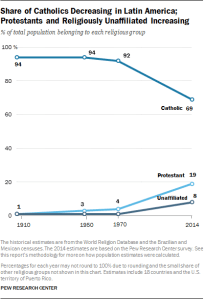
Michael Paulson discusses a new Pew survey showing the Catholic Church on the decline in Latin America, where evangelicals have made major inroads in recent years:

PR_14.11.13_latinAmerica-overview-18A sweeping new survey, conducted by the Pew Research Center, finds that 69 percent of Latin American adults say they are Catholic, down from an estimated 90 percent for much of the 20th century. The decline appears to have accelerated recently: Eight[y]-four percent of those surveyed said they were raised Catholic, meaning there has been a 15-percentage-point drop-off in one generation. The findings are not a total surprise — it has been evident for some time that evangelical, and particularly Pentecostal, churches are growing in Latin America, generally at the expense of Catholicism. But the Pew study, which was conducted by in-person interviews with 30,000 adults in 18 countries and Puerto Rico, provides significant evidence for the trend, and shows that it is both broad and rapid.

The region remains home to over 40 percent of the world’s Catholics, but the trend is unmistakeable. Adam Taylor adds:

Their reasons for leaving one Christian church and joining another are complicated:

Across the region, the report found, more than 80 percent of former Catholics who had joined the Protestant church did so because they were seeking a “personal connection with God,” while 69 percent said they enjoyed the new style of worship at their new church. Fifty-eight percent said they had converted after the church reached out to them, the report noted. Pew’s report also points to a smaller, yet still considerable, number of people who don’t profess a religion — the “unaffiliated.” These people tend to be younger than Catholics and Protestants and don’t necessarily see themselves as agnostic or atheist: Most just have “no particular religion,” the report notes.

Peter Blair illustrates how the selection of Pope Francis was partly to stem the tide:

[I]t’s possible to read much of Francis’s papacy so far as an attempt to appeal to Catholics and former Catholics in his home region. The friendly, personable style of communication, his closeness with evangelical leaders both before and after his election as Pope (Argentine evangelicals said Francis was “an answer to our prayers” upon his election), his forthright attitude towards the Devil, even his lukewarm or perhaps hostile attitude to Pope Benedict’s liturgical reforms—all of this is consistent with an attempt to stem a growing defection to Protestant churches.

Dissents Of The Day

Several readers push back against this post on the escalating US involvement in Iraq:

I watched that Daily Show interview, and I came away with the sense that Samantha Power basically won the exchange, and that Jon Stewart came off as obsessed with how the media has framed ISIS, rather than how the US government has seen the threat and dealt with it. The point that you think was Stewart’s strongest – that the rhetoric of ISIS being some sort of comic-book super villain who threatens our very existence is overblown – is simply beside the point in the real world. Power agreed with that point but also pointed out that ISIS still represents a real regional threat and a level of terrorist organization and military capacity we haven’t had to deal with before. Stewart agree with that, which basically makes his existential point moot.

It’s not as if the US can only fight “existential threats”. We can also fight significant regional threats, to keep them from every getting to that existential level.

It doesn’t matter if they never would anyway; they are still something that needs to be dealt with. And the lack of any ability of the regional powers to get their act together on their own to deal with ISIS is itself a strong argument for our involvement. The question left hanging as to why they can’t get their act together is of course important, but it’s also hard for a diplomat to honestly answer in public without offending the very people we are trying to get to work together. Power made oblique mentions of the sectarian issues involved, and that’s probably enough to point to the answers there. But the mere existence of those problem is itself a compelling reason for US involvement. Without us, for whatever embarrassing reasons, the regional powers wouldn’t get together to effectively fight and contain ISIS. So that in itself answers the question of why we need to get involved.

So, Stewart lost, and the fact that you think he won tells us all we need to know about why your view is losing this argument in general, on both sides of the aisle in Congress and in the Obama administration. You and Stewart are focused on vague “existentialist” arguments that the actual policy-makers are not terribly concerned about. Though one can always find a scary hyped quote from Butters to make fun of, it’s not how the actual policy is coming about.

Another reader:

I love the blog, love what you’re doing, loyal subscriber. But dude, you are overreacting on the ISIS front. You dropped the ball on the Iraq invasion and so did I, but you’re missing it here as well.

1) Was ISIS capable of taking Saudi Arabia, that’s the defining question. There’s almost certainly a strong 5th column for ISIS in the KSA, you’ve got long, desert borders, a Saudi military with no real combat experience, and ISIS would only have to take Mecca.

2) What would be the fallout from an ISIS take over in Saudi Arabia? Would the world’s economy be better off? Would Iran be more or less likely to create a nuclear weapon? How about our security when a major oil producer is an overt sponsor of terrorism?

3) If the threat is real, and serious, then how best to handle it? First, you want to use the minimal necessary force to contain the threat. In a crisis the first thing to do is stop it getting worse, right? Do you go storming in guns blazing? Well, sure, you could, but then you’re just reinforcing the passivity, the weakness of most local forces. You’ve taken on the responsibility and deprived the locals of same. How is that a good idea?

4) But you still want ISIS contained. So you do the minimum necessary: air power and a trickle of arms. You don’t take over, you just make sure your side doesn’t quite lose. Everything else is on the backs of the locals, so they are forced to step up, to mature.

5) ISIS is in a geographical box. The Kobani failure destroys their aura of invincibility. Contain, degrade, leave them to be nibbled to death by Kurds, Iraqis, Jordanians.

I think Obama’s got this. I think he’s right and you should re-examine your assumptions.

One more:

As will likely be pointed out by others, the great hole in your argument about the current US involvement in Iraq is this: “the decision to re-start the Iraq War last August.” Because as you correctly pointed out, the US invaded Iraq in response to 9-11 – despite the two having no connection at all – created the Sunni insurgency, and destroyed our moral authority by embracing torture.

But the US isn’t “re-starting” anything. We’re not invading a country under false pretenses. We are not creating a new insurgency. We are not operating prisons in Iraq (much less sites of torture). Instead, before last August, there was already a war going on – a Sunni jihadist war with Bathist/Alawite Syria, Shiite Iraq, and Sunni Kurdistan. Obama is not starting this war; he’s helping out two of the sides, Sunni Kurdistan and Shiite Iraq.  If Obama had done nothing, the war would still be going on.

And from a strictly selfish perspective, over 6500 Americans have died in Afghanistan and Iraq. But not one has died during this current war – because the US isn’t doing any fighting on the ground, and is not an occupying power.

But hey, Obama restarted the Iraq War. It’s exactly the same as what Bush did. That is a convenient thing to argue for someone immensely frustrated with the region, but it isn’t very true.  Just like conflating it with Vietnam. Really? But I guess we should just abandon the Kurds and let jihadist roam free, because of what Bush did and what you supported in 2003.

A National Eating Plan? Ctd

A reader exclaims:

Look! We almost had a national food plan – it got to the white paper stage.

Another reader:

This is a topic in which I am extremely interested and see the many challenges. In my mind, it is a fact that we are harming our health, the planet, animals, and the economy with the current SAD (Standard American Diet). So many places to go with this it’s hard to be succinct. First off, I agree with Bittman, Pollan, et al on the goal they are trying to achieve, but I have issues with the means. Anything like a “National Food Policy” coming from Obama will be derided immediately as nanny-state-ism by half the country. But there are pieces I think he should address anyway:

The corn and soy subsidies have got to stop. Why is our gov’t subsidizing the thing that is making us sick and costing us billions in health care costs (maybe trillions if you factor in other costs to the economy)? And while we’re at it, I have ZERO problem with government taxing heavily sugar-laden “foods”.

Food safety: Get the pesticides and chemicals out of our food (and our personal care products, while you’re at it). Most of the 80,000 the chemicals used in the US today have not been suitably tested by the EPA and these are creating tremendous hidden health and environmental  issues.

Regulations for meat producers for both food safety and animal rights should go forward. It SHOULD make meat more expensive and that’s OK. We should be eating much less meat anyway, so let the higher prices reduce consumption so it’s a win-win.

But secondly, maybe what these writers are really trying to achieve is this: get people talking about these issues to raise awareness. Maybe the government isn’t the sole answer to all these interrelated problems, but we can’t get the market to adjust unless people understand the problem and want to make changes.

Maybe Glenn Beck can help: I just read that he has health issues (an autoimmune disease) which he is treating with diet and lifestyle changes. Hopefully he’ll become a source for all his viewers on the benefits of healthy eating and lifestyle. We really need someone like him (i.e. from the other side of the aisle) to support this discussion to reach all those who say “keep your gov’t hands off my Big Gulp”.

Love, love, love that you have brought this issue to your website. Would love to see more.

Update from a reader with more:

In regard to your skepticism regarding the Pollan-Bittman reworking of national food policy, I would like to call to your attention an effort to actually do that, just not in a direction P-B would likely deem appropriate.

Rather than ever more micromanagement of the national diet, with longer lists of “bad” foods and shorter lists of “good” foods, my (small, non-profit, moms-in-sneakers) organization, Healthy Nation Coalition, is calling for a scaling back of the Dietary Guidelines for Americans so that they are focused on the acquisition of adequate essential nutritional (at one time the sole focus of federal dietary guidance).  Rather than continue a (failed) effort to prevent chronic disease through avoiding foods (eggs, whole milk, butter, gasp, even meat) that are wholesome and nourishing and expanding the recommendations to include views on sustainability (despite the fact that, as far as I can tell, no farmers sit on the Dietary Guidelines Advisory Committee), we think it would be a good idea if federal dietary recommendations stuck to clear, science-based advice that the public could actually use.

There’s been some media attention paid to this angle recently as well, and we think the folks in Washington might be ready to listen to an alternative to P-B.

Another:

Your reader asked: “The corn and soy subsidies have got to stop. Why is our gov’t subsidizing the thing that is making us sick and costing us billions in health care costs (maybe trillions if you factor in other costs to the economy)?” Easy answer: because these crops are grown primarily to beturned into meat at torture factories, and the government is devoted to heavily subsidizingAmerica’s extreme over-consumption of meat.

Subsidized fossil fuels are turned into artificial fertilizer; artificial fertilizer is turned into further-subsidized corn and soy; corn and soy are turned into meat – all in an extremely cruel, inefficient, and polluting process. We are eating fossil fuel products, and about half of the nitrogen in our bodies came from fossil fuels. It is outrageously unsustainable, but it is the only way to provide such vast quantities of cheap meat.

Gruberism And Our Democracy

In general, I tend to agree with Tyler Cowen that off-the-cuff remarks by academics at conferences should not be vulnerable to political use and abuse. We need spaces where we can riff and think out loud without being held responsible for every phrase. But then again, this is 2014, where nothing anyone has ever said or written can be forgotten if you have a dogged web researcher to root it out. And when those remarks come from someone who helped design and write the ACA, and speak to the way in which it was constructed and sold to the public, it’s a legitimate gotcha.

Of course, a large amount of what Gruber said is hardly unusual in Washington. Gaming the CBO scoring, framing the pros and cons in deceptive ways, making it easy for congressmen to vote for something without being hit by 30-second ads in the next election cycle: all this is part of messy governance. But Gruber’s remarks about the stupidity of the American electorate are so typical of a certain Democratic mindset they’re worth unpacking.

And as we noted earlier, Chait makes the point that Gruber really means ignorance rather than stupidity:

Very few people understand economics and public policy. This is especially true of Obamacare — most Americans are unaware of the law’s basic functions or even whether their state is participating. Since people know so little about public policy in general and health-care policy in particular, they tend to have incoherent views. In health care and other areas, they want to enjoy generous benefits while paying low taxes and don’t know enough details to reconcile those irreconcilable preferences. Gruber’s error here is that, by describing this as “stupidity” rather than a “lack of knowledge,” he moves from lamenting an unfortunate problem both parties must work around to condescending to the public in an unattractive way.

I actually think this makes it worse. The only reason Americans are ignorant about the ACA is that they were never clearly told what it was designed to achieve and how it would work. The debate was had among elites, using often technical language – who really knows what a vague “public option” means, for example? – and then sold to the public with either blanket reassurances (if you have an insurance policy, you can keep it) or terror stories about a government take-over (which it wasn’t). The reason for this failure by both sides to lay out the actual plan in ways anyone could understand was political. Neither side wanted a free-wheeling debate with unknown consequences; one was aiming for passage (something never achieved before), and the other was rooting for failure (for rank partisan reasons). Neither side was really interested in a real debate about the pros and cons.

This remains a huge disservice to democracy and it helps explain why our elites are so despised. I mean: why couldn’t Obama or leading Democrats actually make the simple case: we’re going to give subsidies to the working poor to get private health insurance and force insurers to take anyone regardless of pre-existing conditions. We’re going to make this affordable for the insurance companies by mandating that everyone get insurance, thereby including more young, healthy people in the risk pool to offset the costs of the sick. And we’re going to make sure that insurance is better than in the past, and is not subject to lifetime caps or getting booted off the minute you get sick.

That wasn’t that hard, was it?

Most people understand that there are trade-offs in life; most people have insurance of one sort or another and are cognizant of how insurance works – the bigger the pool the better. And to my mind, the trade-offs are worth it. If someone were willing to explain the ACA in simple, clear and honest terms, I think most Americans would back it. What’s maddening is that American politicians never speak this way. A proposal is either all honey or all vinegar. And each side assumes that that’s the only kind of argument Americans are prepared or able to understand. So, it isn’t really ignorance that’s the problem – because that can be fixed. It really is a cynical assumption of most Americans’ stupidity.

The Republicans are shameless in their deployment of this – tax cuts always good! no trade-offs ever! – but so too are the Democrats. There really is a mentality out there that sees politics as finding a way to deceive voters to give them what they need but for some inexplicable reason don’t actually want. They really do treat people as if they were stupid. If some smidgen of honesty could be used against a politician in a sound-bite, he’d prefer bullshit. The most obvious example was Obama’s categorical pledge that no one with insurance would ever be forced to change – even though the minimal benefits of an ACA plan were greater than those in many existing private sector plans. You can call this a lie – which it was – or you can call it a cheap dodge to get what you want with a little flim-flam. But no one would ever have said such a thing if they had bothered to make the good faith argument that change for the better requires some trade-offs, that some will benefit and others may take a hit. Obama pledged to be that kind of honest, straight-talking president. Often he is. On the most important domestic policy achievement of his presidency, he wasn’t.

I support the ACA; but I cannot support the kind of politics that made it happen. And I refuse to believe that a democracy has to operate this way for change to occur. Gruber’s arrogance and condescension are just meta-phenomena of this deeper dysfunction. Someone needs to treat Americans as adults again before this democracy can regain the credibility it so desperately needs to endure.

Singles And Onlies In China

Alexa Olesen explains why having only one child remains so common in China, despite the retracted policy:

China’s state-run news service Xinhua published an article Nov. 10 with the headline: “Why aren’t we seeing the expected baby boom?” The news agency said it had sent reporters fanning out in four provinces to ask why eligible couples were hesitating.

The respondents fell into three general categories:

those afraid to have a second kid, those who don’t want to, and those who just can’t decide. Among the “afraid” group was a 32-year-old IT worker in the rust belt city of Shenyang in northeast China who said he thought it would be too expensive to have a second child. “It’s easy to have another one, but it’s hard to raise them,” said the man who was only identified by his surname, Zhang.

Another man, surnamed Wang from Yantai, a coastal city in eastern China’s Shandong province, said it would be too exhausting to have another child and he was perfectly happy to just have his daughter. He was in the “don’t want” camp. Wang also told Xinhua he didn’t see anything wrong with raising an only child. “Our generation is all only children, and we’re doing just fine,” he said.

Representing the undecided camp was Wan Yan, a 36-year-old university lecturer who said she felt she was probably too old for a second child but hadn’t ruled it out yet. “If we can’t give the second child the best of everything, it would be very hard to commit to having another one,” she said.

Previous Dish on China’s child policy here. Meanwhile, Ben Richmond describes the country’s Singles Day holiday, comparing it with Black Friday:

It’s a young holiday, thought to date back only to 1993, when Nanjing University students picked November 11—11/11 is four singles, see?—as a sort of “anti-Valentine’s Day” where single people could buy things for themselves.

While, to me, that sounds like pretty much every day for a single person, it has blown up in China thanks to the backing of Alibaba. Since 2009 the ecommerce giant has used Singles’ Day as an excuse for a big one-day sale in order to get people buying stuff in their online Tmall—and it’s caught on. It took just 17 minutes of Singles’ Day for Alibaba to record a billion dollars in sales, according to CNBC. It took just an hour and eleven minutes to top $2 billion. According to Forbes, by just after midnight Beijing time, Alibaba was reporting that sales reached $9.3 billion, a 60 percent increase in revenue over just a year ago.

Alison Griswold adds:

The craziest thing about Singles Day is that its huge sales so far have been almost entirely driven by Chinese shoppers. What Alibaba is looking to do now is grow Singles Day from a Chinese phenomenon to a global one—an expansion that’s all the more important after Alibaba debuted on the New York Stock Exchange in mid-September. That IPO rang in as the biggest ever in the U.S. and investors across the world are watching closely to see if Alibaba can maintain its breakneck pace of sales growth.

Previous Dish on Singles Day here.

In GOP Shutout, Were Dem Voters Shut Out? Ctd

Why Not Vote

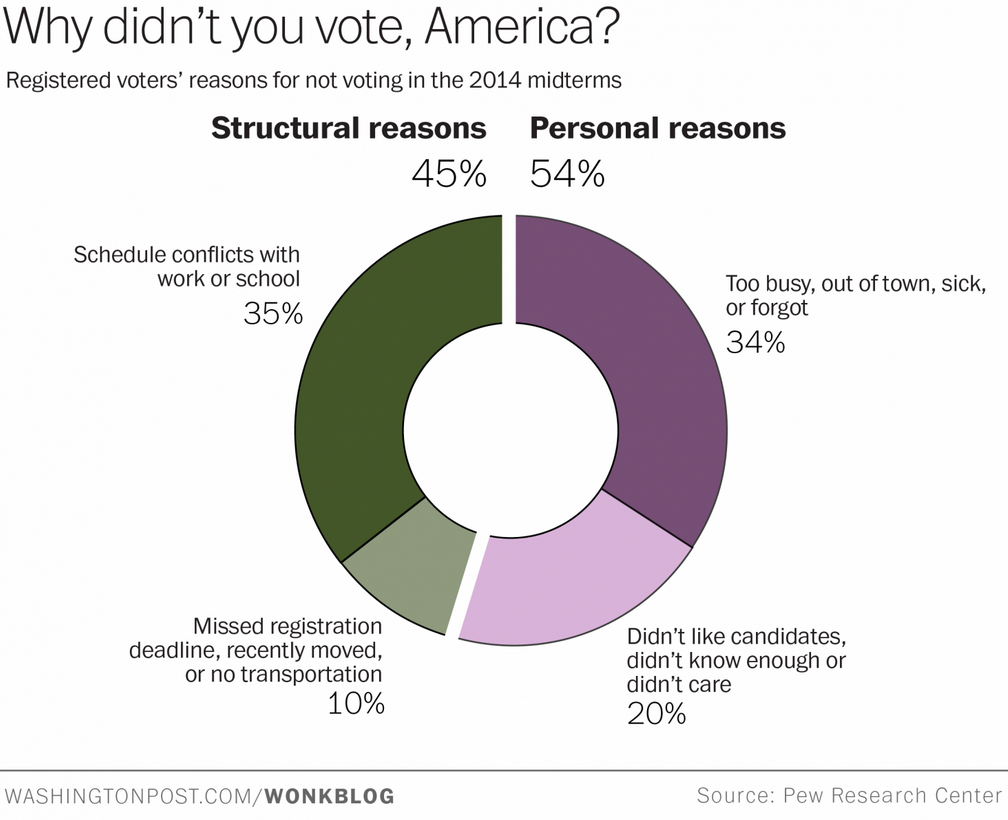
Christopher Ingraham passes along the above chart on Americans who didn’t vote:

Republican vote-suppression efforts have already received plenty of attention, and rightfully so – it’s an embarrassment that one political party sees a smaller electorate as the path to victory. But voters turned back at the polls represent at best a tiny fraction of the 10 percent who didn’t vote for technical reasons. Pew’s numbers suggest there’s a lot of work to be done to help the 35 percent of voters who couldn’t accommodate a trip to the polling place in their work or school schedules.

Frank Barry dismisses Wendy Weiser’s claim that voter restrictions suppressed so much Democratic turnout last week as to influence the outcomes of some close elections:

Weiser’s argument has been picked up by other voting-rights advocates and pundits, but it falls apart upon closer scrutiny. Even with seven fewer days, early voting in North Carolina increased this year compared with 2010 — by 35 percent. Statewide turnout also increased from the previous midterm election, to 44.1 percent from 43.7 percent. Even if turnout was lower than it would have been without the new voting law — something that’s impossible to establish — it was still higher than it had been in four of the five previous midterm elections, going back to 1994. In addition, based on exit polls and voter turnout data, the overall share of the black vote increased slightly compared with 2010.

Rick Hasen, an expert on election law, says he’s skeptical about Weiser’s analysis, and rightly so. When voting-rights advocates fail to include any balancing points in their discussion of the election, they undercut their credibility and give ammunition to Republicans who suspect that they are mostly interested in electing Democrats.