Senate Democrats Are In Hostile Territory

Senate Elections

Patrick J. Egan illustrates the advantage Republicans have in this year’s Senate races:

A good measure of the parties’ relative strength in the states holding Senate elections is the share of the state vote each earned in the most recent presidential election. The figure above plots (in blue) the Democratic share of the two-party presidential vote in the median state of those holding Senate elections from 1950 through 2014. For comparison, it also displays (in gray) the share of the national popular vote the Democrats received in the most recent presidential election. For most of the past six decades, these two trends tracked each other very closely: the parties’ relative strength in the set of Senate seats up for election was no different from their strength nationally. But that changed after the 2000 presidential election, in which the Republican Party’s dominance in the South emerged in full force.

His bottom line:

Simply put, this year’s Senate elections are unrepresentative of the nation to an extent that is unprecedented in elections held in the post-war era. So when we begin to sift through the results on Election Night, the number of Senate seats won and lost will tell us less than we might like about where the two parties stand in the minds of American voters.

Jonathan Cohn adds a qualifier:

Of course, it’s not simply geography that’s undermining Democratic strength this time around. If it were, Democrats wouldn’t be struggling to hold seats in places like Iowa, which Obama won. But the electorate for this Senate race is a lot more conservative than America as a whole. That has surely made a huge, and maybe decisive, difference.

Ben Highton highlighted the Republicans’ structural advantages back in February:

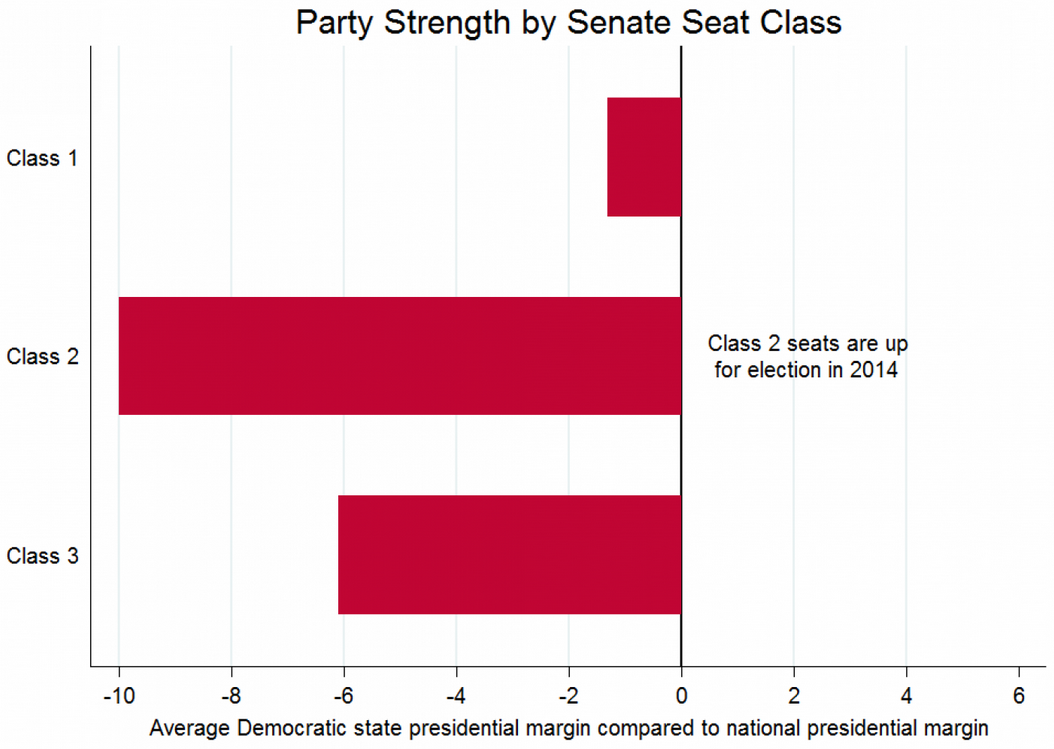
[T]he Senate treats states as equal – irrespective of population – and this gives the Republicans an advantage because on average, less populous states are more Republican than more populous ones.  What about the states that fall into each of the three Senate classes?  Compared to the national two-party presidential vote margin in 2012, class 2 states are 10 percentage points more Republican on average.  Of the three classes, this is the largest skew toward the Republicans.  The average margin in class 3 states is 6.1 points more Republican than the national presidential margin; and, the average margin in class 1 states is just 1.3 points more Republican.   Here’s a graph showing this:

Senate Seat Class

The Final Midterm Predictions

Silver gives Republicans a 76 percent chance of taking the Senate. But be prepared for a long night:

Even if Republicans win, the outcome may not be determined quickly. David Perdue, their candidate in Georgia, has gained in the polls — but the model still has the race going to a runoff about half the time. Louisiana will almost certainly require a runoff. Alaska’s vote may take days or weeks to count, as it has in the past. The FiveThirtyEight model — even with its optimistic forecast for Republicans overall — estimates there’s just a one in three chance that the election will be called for them on Tuesday night or early in the day on Wednesday. For Democrats, meanwhile, there’s almost no chance to win without going to “overtime;” the party will hope to extend the race for as long as possible.

There are two Republican wins, however, that could end the race quickly. Pay attention to races in North Carolina and New Hampshire. Both states have early poll-closing times (7:30 EST for North Carolina and 8:00 EST for New Hampshire) and a Republican win in either state would require Democrats to run the table in almost every other competitive race. But Republican wins would simultaneously indicate that the polls might be biased toward Democrats rather than against them, making a Democratic sweep the rest of the night very unlikely.

Cassidy’s guess is 53-47 for the GOP:

In a post on Friday, I pointed to evidence that late deciders appear to be breaking to the Republicans, particularly in the South. In states like Arkansas, Georgia, Kentucky, and Louisiana, that trend is clearly visible in the latest polls. Alarmingly for the Democrats, something similar may well be happening in Colorado and Iowa, two seats they currently hold. Of the ten battleground states, the Democrats’ best bets are now North Carolina and New Hampshire, where their candidates are holding on to narrow leads. Then there is Kansas, where the contest between Greg Orman, an independent businessman, and Pat Roberts, the three-term G.O.P. incumbent, remains a toss-up.

Sabato also forecasts 53-47. On the close races:

The Kansas race between embattled, weak Sen. Pat Roberts (R) and independent Greg Orman is perhaps the closest, most difficult-to-predict Senate race in the country. However, at the end of the day, a Republican has not lost a Senate race in this state since 1932. It may happen, but we just can’t pull the trigger and predict it. LEANS REPUBLICAN

We’ve been calling Georgia and Louisiana “Toss-up/Leans Runoff” in recent weeks because we expected both to eventually go to runoffs. Louisiana will, and Georgia might, but we now believe Republicans are favored to eventually win both. So we’re just going to call both LEANS REPUBLICAN going into Election Day: If both do in fact go to runoffs, then the Leans GOP ratings will apply, at least initially, to the overtime contests.

John Sides joins the chorus:

[W]hen we debuted Election Lab on May 5, we estimated at that point that the GOP had a 77 percent chance of winning and was predicted to win 53 seats.  We predict 53 seats again today.  The only change is that Michigan and Colorado are flipped relative to that earlier forecast.

Morrissey bets that a “Republican wave will run the table”:

And even if Republicans only manage to win six seats while not keeping Kansas, another dynamic will come into play, which is the desire to be part of a majority. Orman might end up caucusing with Republicans, although that seems temperamentally unlikely, but that’s not as true for Angus King of Maine. King endorsed Lamar Alexander in Tennessee last week, so he’s not hostile to the Republican caucus. If the GOP ends up with 51 or more seats, King may cut a deal to strengthen Republican numbers even further. Whether he’d do that in case the GOP wins only 50 seats is anyone’s guess, but the Maine Sun-Journal thinks that would be unlikely.

Waldman doesn’t expect a “wave,” much less a mandate, for the GOP:

If they manage to take the Senate, it will be because most of the incredibly close races this year tipped their way in the end. Which would undoubtedly be a victory, but it would be hard to argue that the GOP squeaking out wins in deep-red states in the South and adding a couple in swing states like Iowa or Colorado represents some huge shift in public sentiment. New polling data suggests that even if Republicans do take the Senate, we’re hardly looking at a “GOP wave.” The final pre-election poll from NBC News and the Wall Street Journal was released today, and it shows the two parties nearly deadlocked (46-45 in Republicans’ favor) in the generic ballot test among likely voters. Democratic voters’ interest in the campaign has risen to match Republicans’, and approval of the GOP as a party remains abysmal. There’s also evidence to suggest that turnout will be low.

Charlie Cook calculates that “a seven-seat gain would seem the most likely outcome for the GOP, with eight a bit more likely than six, but either highly possible.” What would qualify as a wave?:

The first test of the existence of a political wave is whether the benefiting party avoids losing many of its own endangered seats. The second is whether it wins an overwhelming number of the purple, competitive or, in this case, light blue Democratic-tilting but still endangered seats. So, if Republicans limit their own losses to just one of their own competitive seats (for example, Roberts in Kansas) and win at least three of the four key purple states (the open seat in Iowa and the three seats held by Democratic incumbents—Kay Hagan in North Carolina, Jeanne Shaheen in New Hampshire, and Mark Udall in Colorado), that starts qualifying as a wave. Just winning one or two out of the four neutral-site contests might well help the GOP secure the majority, but it hardly qualifies as a wave. These are seats where it is the political environment and President Obama, not the map itself, that are the cause of Democratic pain. Obama carried all four states in both 2008 and 2012; losses in these would mean voters who voted for him have officially reversed course.

The third test of a real wave is the ability of a party to pull off real upsets, knocking off incumbents who were not on the lists of first- or second-tier vulnerable seats. If, for example, someone like Mark Warner in Virginia, Al Franken in Minnesota, or Jeff Merkley in Oregon were to lose, that would be a wave in the sense of 1980, 1994, 2006, or 2008. These years saw wins that were way more than just a result of the map. There now appears to be little chance that any of these three will lose their races.

Update from a reader:

Cook says that Obama carried Iowa, North Carolina, New Hampshire, and Colorado in 2008 and 2012. This is not correct, as Mitt Romney won North Carolina in 2012.

Much Ado About A White President

When Zambian president Michael Sata died last Tuesday, his vice president, Guy Scott, stepped in to take his place until new elections are organized, thus becoming the first white head of state in a post-colonial African democracy. Alexander Mutale calls this “a remarkable moment” that “says a lot about this particular country’s remarkable success in navigating the complexities of post-colonial ethnic politics”:

Despite its temporary character, Scott’s appointment still marks a watershed for post-colonial Africa. It’s a sign of how Zambia has managed to move beyond the divisive racial politics that has dominated the continent for five decades — in sharp contrast to, say, neighboring Zimbabwe, where the colonial past still weighs heavily on the political present. Zambia’s unique position attests to the enduring legacy of its first post-independence leader, President Kenneth Kaunda, who strongly advocated policies that encouraged ethnic, religious, racial, and regional integration. Despite more than 70 different tribal groups, the country’s reputation for stability has made it something of a model for other African democracies.

Scott can’t run in the elections for Sata’s permanent successor because Zambia’s constitution requires that presidential candidates have Zambian-born parents. Scott’s parents emigrated from, well, Scotland, but if he were eligible, Stephen Chan doubts that voters would reject him simply on account of his race:

In fact, Scott would have made a very good president – and he would have been accepted by the voters, who would even have boasted about their taste for irony and the good race relations their country had accomplished. The world might raise its eyebrows, but this 90-day caretaker period will be a footnote in African history. A footnote, but a meaningful one nonetheless: even after an atrocious colonial history in which white rulers earned themselves an appalling reputation, Zambia is showing how a majority black nation can be rather more mature about these things than most of the old colonial powers.

Namwali Serpell rolls her eyes at how foreign media have made Scott’s race the headline of the story, noting that Zambians, by and large, have more important things on their minds:

Zambians have been more focused on another constitutional change, to electoral policy: from a simple majority to a “50% plus one vote” majority, with a run-off between two finalists if necessary. This makes a big difference in a democracy that evinces a true commitment to a multi-party system (the last election had 10 parties with statistically significant votes). With this kind of complexity, the wisest move on PF’s part is to allow white Guy Scott, the man least likely to run, to hold the reins until the real contenders have wrangled it out. What’s on people’s minds isn’t the colour of Scott’s skin; it’s which candidate PF will select among the range of other possible successors to Sata

This African scholar also downplays the race thing:

What Giving Gives You

Christian Smith and Hilary Davidson elaborate on their finding that “only 3 percent of American adults give away 10 percent or more of their income”:

We find a strong and highly consistent association between generous practices and various measures of personal well-being like happiness, health, a sense of purpose in life, and personal growth. In our book [The Paradox of Generosity] we discuss the various causal mechanisms that produce this association. While greater well-being can encourage generosity, practices of generosity also enhance well-being.

The causal mechanisms we identify involve everything from reinforcing positive emotions to developing a sense of self-efficacy to expanding social networks to increasing physical activity. Generosity, for example, often triggers neurochemical systems that increase pleasure and reduce stress. It also has the capability of reducing the maladaptive self-absorption that many ungenerous Americans experience. By giving away some of our resources for the well-being of others we can enhance our own. By clinging to what we have, we shortchange ourselves. …

Our interviews with Americans who do not practice generosity reveal that they are deeply unsettled by individual and social problems. Yet they do not think they have any obligation to respond, and even if they do, they feel inadequate to make a difference without sacrificing their ability to care for their own needs. Feeling vulnerable to broader societal problems, the instability of the marketplace, material scarcity, and the challenges that come with relational intimacy, they respond by hunkering down, either alone or with immediate family members, to simply try to weather the storm. They imagine other people as restrictions on their autonomy.

When The Right Fell For Ronnie

Last week marked the 50th anniversary of Ronald Reagan’s “A Time for Choosing” speech, which he gave on prime-time television in late October 1964 in support of Goldwater’s presidential campaign. Jeff Shesol takes us back to that pivotal speech, which made Reagan a darling of the conservative movement:

“I don’t have but one speech,” Martin Luther King, Jr., once said. “I don’t have but one message as I journey around this country.” Few of King’s contemporaries took this notion to heart more fully than Ronald Reagan.

Beginning in 1954, when Reagan became, in effect, the in-house motivational speaker for General Electric, he delivered, many hundreds of times, what was known as “The Speech.” From plant to plant, from one year to the next, Reagan honed his script, reshuffled his note cards, and updated his anecdotes, but his theme—the threat of an encroaching, expanding government—did not vary. It was less a speech than a sermon, as Reagan himself understood—a malediction against the evils of income taxes, federal spending, central planning, godless Communism, and government controls on commerce and freedom. “We’ll preserve for our children this, the last best hope of man on Earth, or we’ll sentence them to take the last step into a thousand years of darkness,” Reagan said. If there is such a thing as a feel-good jeremiad, Reagan invented it. … The Speech—rechristened, for that occasion, as “A Time for Choosing”—helped to define the G.O.P. and conservative politics for more than a generation.

Watch the whole speech here.

The State Of The Race In Kansas

Last night a reader wrote from the Sunflower State about being “beaten to a pulp … on my phone”:

Hey Andrew & Co., I don’t know if you’re getting any traffic/messages on this, but the robocalls here in Kansas are incessant, demoralizing, and one-sided … at least if my experience, and the experiences of my friends and colleagues, are any sort of indicator. I have used my mobile device to record four calls today – to my office phone. I work at a state university here in Kansas. Pat Roberts has decided to beat people into submission. Here’s Newt GingrichRand Paul, Ted Cruz [embedded above], and Dr. Milton Wolf (he was the biggest threat to Roberts during the primaries and was exposed for sharing autopsy photos on his Facebook account and blog … and making jokes about them).

Again, this is ONE WORK DAY … so far.

My message light has been blinking all morning, which means there are messages from the weekend and Friday night. I’m sure I have more. I averaged about one or two per evening last week, just before Halloween. Tim Huelskamp’s wife called one evening. I think that’s the only state candidate I’ve heard from – all the other calls have been stumping for Pat Roberts.

I can’t wait for Wednesday morning.

Join the club. Update from a reader with some crucial perspective:

I’ve worked on two Congressional campaigns and managed a state legislative campaign.

Every campaign manager with any sense knows robocalls have no effect whatsoever. This has been known, and proven over and over, for at least 10 years. Money quote:

Don Green, a political science professor at Yale, subjected robo-calls to 12 randomized experiments for his 2004 book “Get Out the Vote: How to Increase Voter Turnout.” The results, he says, were revealing. “These calls never raise voter turnout. They have no mobilization effect, and no persuasion effect either. What matters is whether they change the probability of voting, and robo-calls have proven they do not.”

Never. Raise. Turnout. No Persuasion Effect. Ever. Any campaign sending out even one robocall is wasting its money and hurting its own cause.

Previous reader dispatches from Massachusetts, South Dakota, and Texas.

We Might Be Over Ebola, But Ebola Isn’t Over

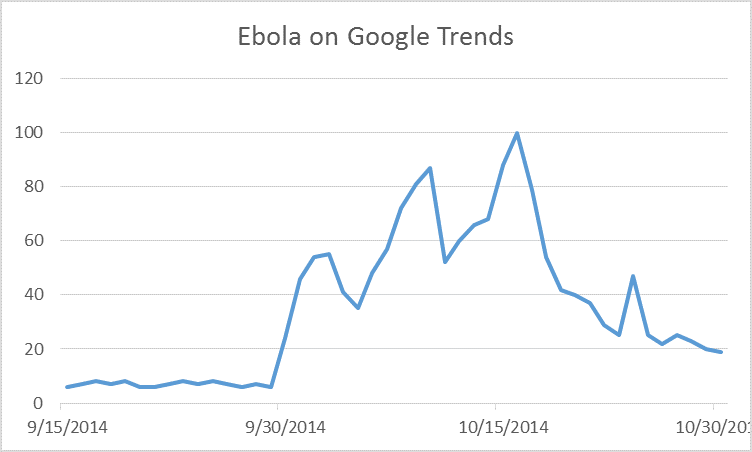
ebola-graph

Eric Posner offers the above chart as evidence that the furore over Ebola is dying down. But risk-communication experts Jody Lanard and Peter Sandman fear that Americans underestimate the still-serious risk of the outbreak reaching pandemic proportions in the developing world:

The two of us are far less worried about sparks landing in Chicago or London than in Mumbai or Karachi. We wish Dallas had served as a teachable moment for what may be looming elsewhere in the world, instead of inspiring knee-jerk over-reassurance theater about our domestic ability to extinguish whatever Ebola sparks come our way. We are glad that Dallas at least led to improvements in CDC guidelines for personal protective equipment and contact tracing, and belatedly jump-started front-line medical and community planning and training. But it doesn’t seem to have sparked the broader concern that is so vitally needed.

Americans are having a failure of imagination – failing to imagine that the most serious Ebola threat to our country is not in Dallas, not in our country, not even on our borders. It is on the borders of other countries that lack our ability to extinguish sparks.

Maryn McKenna seconds that:

Being someone who has a professional specialty of covering epidemics (HIV, the anthrax attacks, SARS, H5N1, H1N1, lots of smaller outbreaks), I reluctantly have to conclude: Lanard and Sandman are not being alarmist here.

Imagine that Ebola cannot be contained; think back to the events of this weekend; and then imagine that reaction multiplied thousands of times. It isn’t a big leap to the suspicion, disruption and expense that will then be triggered in response to any travelers from the region. From there, it isn’t much of a further leap to closed borders, curbs on international movement, disruption in global trade, cuts in productivity, even civil unrest and the opportunities that unrest offers to extremist movements. None of that is far-fetched, if Ebola is not controlled.

Michele Barry reflects on the systemic failures that allowed the outbreak to spiral out of control. From her perspective, “the solution to this Ebola crisis is not drugs, mass quarantine, vaccines, or even airdrops of personal protective gear”:

The real reasons this outbreak has turned into an epidemic are weak health systems and lack of workforce; any real solution needs to address these structural issues. When one physician or nurse is caring for forty to fifty patients, mistakes happen. WHO’s legally binding International Health Regulations (2005) requires wealthier countries to mobilize financial and technical support to help contain an outbreak such as Ebola, for which the Director General has called an international public health emergency.

Yet workforce scale-up has been disturbingly slow. NGOs like Médicins Sans Frontières were not equipped to deal with Ebola, and have been overwhelmed by the outbreak. Workforce volunteers for these NGOs have been slow to mobilize and fearful US hospitals have set up barriers by insisting that their employees taking unpaid leave or vacation time and then return to mandatory 21-day quarantines, often without pay.

But the governor of New York, for his part, has pledged to compensate any lost pay. Perhaps the federal government should step in with actual financial incentives – cash money – to encourage health workers still on the fence to head to West Africa.

“The Internet’s Ultimate Content Cannibal”

That’s how Marcus Wohlsen imagines the Facebook of the future, in light of David Carr’s revelations about the company’s recent overtures to publishers. Carr elaborates:

The social network has been eager to help publishers do a better job of servicing readers in the News Feed, including improving their approach to mobile in a variety of ways. One possibility it mentioned was for publishers to simply send pages to Facebook that would live inside the social network’s mobile app and be hosted by its servers; that way, they would load quickly with ads that Facebook sells. The revenue would be shared.

That kind of wholesale transfer of content sends a cold, dark chill down the collective spine of publishers, both traditional and digital insurgents alike. If Facebook’s mobile app hosted publishers’ pages, the relationship with customers, most of the data about what they did and the reading experience would all belong to the platform. Media companies would essentially be serfs in a kingdom that Facebook owns.

I, for one, welcome our new Internet overlords. (Just kidding). Wohlsen looks at the big picture:

Publishers likely will balk at ceding so much control to Facebook. But in the end, they may not have much choice. The arrangement might sound like a partnership at first, but it could end up like Amazon and the book industry. Book publishers may hate dealing with Amazon and resent its influence over their sales. But the last thing they would do is pull their books from Amazon. Thanks to its outsized leverage, Facebook’s ability to dictate terms to online publishers could wind up much the same.

Robert Montenegro considers the implications:

Now that Facebook has mastered mobile ad revenue while other sites have struggled, there may soon come a time where much of the content you access via Facebook will all be hosted on Facebook. We’re already seeing Mark Zuckerberg’s push to include more content within the site itself. The relatively new trending topics feature is an example, as well as how the mythical algorithm favors on-site content such as Facebook-hosted videos over those hosted by competitors such as YouTube, which is owned by Google. If only a few popular sites decide to give in to Facebook’s offer, Zuckerberg could ignite a major ad revenue war.

The Other Ukraine Votes

Close on the heels of a parliamentary election that handed a decisive victory to pro-Europe parties, separatist rebels held elections of their own this weekend in the “people’s republics” of Donetsk and Luhansk:

Election organizers declared that rebel leaders Alexander Zakharchenko and Igor Plotnitsky won sizable majorities in Donetsk and Luhansk respectively, reports Radio Free Europe. Both men have led rebel groups in the fight against the Ukrainian government in Kiev. But the elections have been controversial from the start, with Kiev and Western powers calling them a violation of a peace agreement drawn up in Minsk, Belarus, in early September. Under the Minsk agreement, Kiev would enact legislation that would grant Donetsk and Luhansk considerable autonomy, but under the auspices of Ukrainian law. Sunday’s elections do not comply with Ukrainian law, Kiev argues, and are therefore illegal.

Russia, predictably, endorsed the elections as legitimate today. Bershidsky notes just what a farce they were:

In Donetsk and Luhansk, people bring submachine guns to restaurants and polling stations alike. Since the rebels did not have access to electoral rolls, it was laughably easy to register as a voter. One woman apparently filled in the requisite questionnaires for a cow, putting down “Ear Tag MOO-123321, issued on 01.01.1998 by shepherd Semyon Ivanovich,” as identifying document, and received a number allowing her to cast a vote online. When the OSCE refused to observe the elections, a group calling itself the Association (or Agency, to hear its different members talk) for Security and Cooperation in Europe popped up conveniently and gave a press conference in Donetsk, praising the votes. The delegation consisted of far-right politicians from Austria, Belgium, Italy, France and several eastern European nations, as well as two Greek Stalinists.

But Linda Kinstler isn’t laughing:

The rebels, of course, claim that the elections were entirely legal under the provisions of the Minsk agreement. “It was said there [in the Minsk protocol] that we have the right to hold our own elections. The date was not specified,” Zakharchenko said on Sunday, RIA Novosti reports. It is abundantly evident that the Ukrainians had no plan for how exactly “early local elections in accordance with the Law of Ukraine” could possibly be held in rebel territory, just like it is also painfully clear that the government has no plan for how that territory will ever be re-integrated into the rest of the country.

Glenn Kates worries that the vote will embolden the separatists to escalate their conflict with Kiev:

Large swaths of separatist-controlled eastern Ukraine both blame Kyiv for the violence and hope their votes will bring stability to the region. But for the self-proclaimed separatist leadership and their backers in Moscow these two thoughts may paradoxically be a signal to continue fighting. Ukraine is unlikely to restore pension payments or energy provisions, which were cut off in the summer. Meanwhile, separatists will now have to back up the claims that they can govern without Kyiv by providing some of the resources that have been so sorely lacking. If claiming territories is seen as a way to do so and they believe any violence will be blamed on Kyiv, fighting, in a purely political sense, may not have a downside.

Sebastian Smith weighs Kiev’s options for dealing with the separatists at this point. As he sees it, the government can either choose to write off the breakaway regions and let them be Russia’s problem, or wage a costly war to restore control over them. Neither option is terribly palatable to Ukrainians:

Not many Ukrainians are ready for all-out war, says Glib Vyshlinsky, deputy director of GfK Ukraine marketing company in Kiev. “If you’re talking about fighting, with thousands of casualties being lost in order to win back these regions, then there is not support. Ukrainians are not such an imperial people as Russians and consensus will be against this,” he said. …

A GfK poll in September showed that 31 percent support a “bad peace,” including giving up some territory to Russia. Fifty four percent were for fighting on. One concrete sign that Ukraine’s government is preparing to sever at least some ties with the east is the suggestion from top ranking officials in recent days that gas supplies may be ended to rebel territories — which would turn to Russia for help. “Those announcements are trial balloons to test Russia,” said Taras Berezovets, head of Berta Communications in Kiev. “Russia doesn’t want to have to pay for Donbass.”

Florida’s Pot Polarization

Michael Ames fears Florida’s medical marijuana measure will fail tomorrow:

Florida was supposed to change the way the South thinks about medical marijuana. In late July, a full 88 percent of the state supported legalizing medical cannabis, and in early October 67 percent supported Amendment 2 specifically.* Instead, that wide margin has all but disappeared, and rather than join the 23 other states with similar laws on the books, the amendment appears to be bleeding support by the hour.

The governor’s race has hurt the amendment’s prospects:

Since it launched, Florida Republicans have suspected that [Amendment 2 backer John] Morgan’s campaign is actually an effort to pump voter turnout in an off-year election and help Crist eke out a win against incumbent Gov. Rick Scott.

Morgan denies he’s playing politics, telling the Tampa Tribune that he’s “not as smart or devious as they think I am.” And yet, when he hired a campaign manager, he picked Ben Pollara, an operative who describes himself as “one of the premier Democratic fundraisers in Florida.” Pollara served on President Obama’s 2012 National Finance Committee, was the state finance director for Hillary Clinton’s 2008 presidential bid, and has represented Democrats including Sen. Bill Nelson, Sen. Kirsten Gillibrand, and Rep. Debbie Wasserman Schultz.

“It has not been a bipartisan campaign,” says Pollara. “The opposition has been run entirely by Republican operatives and funded by Republican mega-donors.”

Ben Jacobs hears much the same:

Morgan has long been a power player in Florida politics and is closely tied to Crist, the former Republican governor now running as a Democrat to lead the state again. Despite Morgan’s deep pockets and political clout, the medical marijuana initiative, which was once considered a shoo-in to become law, looks increasingly less likely to pass the 60 percent threshold.

The problem, according to some Morgan detractors, is that the vote has been less a referendum on cannabis and more a referendum on Morgan, who is funding the ballot measure.

Christopher Ingraham is unsure what will happen:

Casino magnate Sheldon Adelson has poured $5 million of his own money into the opposition campaign, fueling it almost single-handedly. On the other hand supporters have raised about $8 million, roughly half of it from attorney John Morgan. While the fate of the other marijuana initiatives rests largely in the hands of young voters, Florida’s seniors may be the lynchpin here. Given the volatility of the polls it’s very difficult to predict how things will play out, but the 60 percent supermajority requirement represents a high bar for supporters of the measure.

Jon Walker looks at the latest polls:

The worst result is from the Tampa Bay Times/Bay News 9/UF Graham Center poll. It found 46 percent of likely voters planning to vote for Amendment 2 and 43 percent planning to vote against it.

The PPP poll found the measure will win majority support but below the threshold. Their final poll had the ballot measure getting 53 percent of likely voters and 41 percent planning to vote against it. The remaining 6 percent is undecided. Even if all the undecided in this poll decided to vote for it the measure would still come up just short of 60 percent.

The best final poll was from the Florida Chamber of Commerce Political Institute poll, but even that found the measure with 55 percent support to 40 percent opposed. Again just short of the very high threshold needed.