Over-Salt Of The Earth

Brian Merchant flags a study claiming that salt degradation “has caused tens of billions of dollars worth of damage, mars an area of cropland the size of Manhattan every week, and has hit nearly one-fifth of the world’s farmland so far”:

“Salts have damaging effects whether they are in excess amounts in the human body or in agricultural lands,” Manzoor Qadir, the lead author of an eye-opening new study on the subject, published by the United Nations’ Institute for Water, Environment and Health, told me in an email conversation. “If salt degradation goes on unchecked, more and more land will be highly degraded leading to wasteland,” he said. “Restoring such lands will not be economically feasible at all.”

Alison Bruzek provides more details:

Rainfall and irrigation systems designed for lots of drainage usually keep salt from building up in the soil. But as climate patterns shift and more farmers irrigate without sufficient drainage, evaporated salt is crusting on top dirt clumps around the world — especially in places like Central Asia. Normally, soil has anywhere from zero to 175 milligrams of salt per liter. Once that level exceeds 3,500 milligrams per liter, it’s next to impossible to grow anything, including major crops like corn, beans, rice, sugarcane and cotton. …

No one had really studied the economic impacts of salt-damaged land, says Qadir. But now that the UN Food and Agriculture Organization has projected that we need to produce 70 percent more food by 2050, the salinity problem is becoming a much higher priority issue. On the 1-to-10 scale of land sustainability problems, “erosion is an 8 … high-saline soils is a 2 problem,” Chuck Benbrook, research professor at the Center for Sustaining Agriculture and Natural Resources at Washington State University, tells The Salt in an email.

The Trappings Of Mourning

https://twitter.com/Paste_Design/status/526825773991079936

Hillary Kelly muses on an exhibit at the Metropolitan Museum:

Mourning clothesalong with other facets of griefwere highly regimented in Victorian England and nineteenth-century America. As the curator’s note explains, “Mourning through sartorial display, a duty chiefly assumed by women, followed a series of stages marked by changes in fabrics and colors.” Exacting codes defined which fabrics and colors were acceptable at particular stages of grief: For the first months after a death, only “lusterless” black dresses were acceptable. As time passedand for a widow one expected to wear mourning clothes for a full two yearsthe strictures slowly loosened, and the severity of the attire deceased.

The loss of such traditions has its drawbacks:

The mourning period is a nebulous and tricky thing to navigate in modern life. The boyfriend of a very close friend died in an accident the summer after our freshman year of college. The most agonizing conversations I remember having with her revolved around the expectations others placed on her grief rather than the death itself: When would she “get over it”? How long was she going to remain single? Did she ever think she’d get married? When she began dating another person, she confronted all kinds of unkind judgment from those who thought she’d “moved on” too quickly and wondered (yes, out loud) if she’d really loved the boyfriend who had died.

Would mourning clothes have helped her or hindered her? So often we think of the strictures of the Victorians as constraining, but there is a sense in which their very formal propriety feels appropriate and even comforting. If you exclude certain religious traditionssitting shiva, for examplein which the processes immediately following death are heavily prescribed and demand an explicit and relatively lengthy interruption of everyday life, modern grief is missing a sense of etiquette and deliberatenessa set of outward signs for the bereaved to use as signals.

No Relief For America’s Sickest State

Sarah Varney covers Mississippi’s experience with Obamacare:

“There are wide swaths of Mississippi where the Affordable Care Act is not a reality,” Conner Reeves, who led Obamacare enrollment at the University of Mississippi Medical Center, told me when we met in the state capital of Jackson. Of the nearly 300,000 people who could have gained coverage in Mississippi in the first year of enrollment, just 61,494—some 20 percent—did so. When all was said and done, Mississippi would be the only state in the union where the percentage of uninsured residents has gone up, not down.

Why has the law been such a flop in a state that had so much to gain from it? When I traveled across Mississippi this summer, from Delta towns to the Tennessee border to the Piney Woods to the Gulf Coast, what I found was a series of cascading problems: bumbling errors and misinformation; ignorance and disorganization; a haunting racial divide; and, above all, the unyielding ideological imperative of conservative politics. This, I found, was a story about the Tea Party and its influence over a state Republican Party in transition, where a public feud between Governor Phil Bryant and the elected insurance commissioner forced the state to shut down its own insurance marketplace, even as the Obama administration in Washington refused to step into the fray. By the time the federal government offered the required coverage on its balky HealthCare.gov website, 70 percent of Mississippians confessed they knew almost nothing about it.

Beutler finds it “all the more galling when you recognize that, for the time being at least, Mississippi is actually paying for this outcome”:

For the next couple years, the Medicaid expansion would cost Mississippi $0. … The combined effects of non-expansion are striking. State spending on Medicaid will grow faster next year in states that declined the expansion than in states that accepted it. As Kevin Drum wrote for Mother Jones on Monday, non-expansion states “actually prefer spending more money if the alternative is spending less but helping their own poor with medical coverage.”

Is $3-A-Gallon Gas Good News?

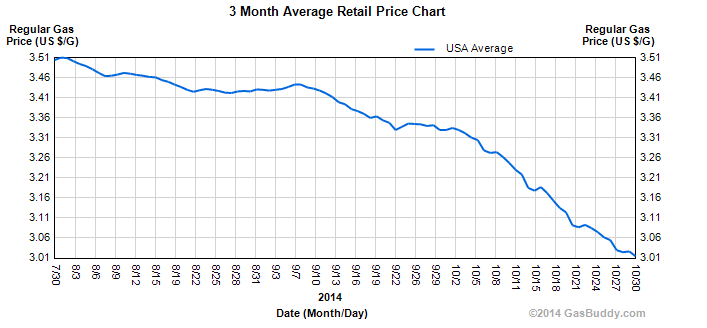
Screen Shot 2014-10-30 at 2.36.45 PM

Mataconis argues that overall, the ongoing decline in oil prices is a boon to the US and other advanced industrial nations:

Falling prices for oil will eventually filter through to the prices of the products derived from oil itself, including not only gasoline but also home heating oil and jet fuel. In the short and medium term, this would provide some relief for consumers and for companies that depend on transportation such as Wal-Mart, Amazon, airlines, and shippers such as UPS and Fed-Ex. If prices continue to fall, those benefits will become more apparent and could help to boost economic growth at least slightly, which would be good news for the jobs market and even tax revenues and the Federal Budget Deficit. Other nations that are oil dependent would likely experience similar benefits, which would be good news for areas like Europe where the economy seems to be slowing down a bit and for the world as a whole, which in turn would be good news for nations that are dependent on international trade, which is pretty much every major industrialized nation at this point.

Derek Thompson, who believes prices might fall even further, points out that some industries and regions will be hurt even as consumers celebrate:

It’s hard to say how the sliding price of gas will affect the United States, as a whole, because the economy is a messy mix of cities, industries, and consumers behaviors, each of which experience falling prices differently. In cities with lots of driving and not much energy production—e.g. throughout California—cheaper gas is simply good, the end. Three-buck gasoline gives back as much as $500 a year to the typical family with two cars, compared to the $4.50 gallons from a few years ago. But mining and energy jobs have been the fastest-growing sector of the labor market, and thinner profits for energy producers will hurt states like North Dakota and New Mexico, who have relied on energy exports to pay for new jobs and higher wages.

Jared Gilmour posits that the falling prices are “threatening to make costly US shale extraction uneconomic”:

Limited pipeline capacity and overproduction of natural gas in the Marcellus shale has pushed prices down, making it hard for producers to turn a profit. Drillers are taking on ever increasing amounts of debt to finance their operations. And there may not be as much shale oil and gas as the US government forecasts, according to a new report from the Post Carbon Institute, a California-based think tank that promotes sustainable energy. “Shale will be robust for the next four or five years, but because of declines at the well-level and field-level, it’s not sustainable in the medium and longer term,” says study author David Hughes in a telephone interview Tuesday. “Policymakers should be aware of that before they try to cash in on a bounty that may not exist ten or fifteen years down the road.”

But industry experts tell the WSJ that prices would have to fall quite a bit farther to endanger the shale industry:

Marianne Kah, chief economist of ConocoPhillips , said oil prices would need to fall to $50 a barrel “to really harm oil production” in U.S. shale basins. She said 80% of the American shale sector—in which ConocoPhillips is a major operator—is profitable at prices between $40 and $80 a barrel for benchmark West Texas Intermediate crude. Jason Bordoff, director of Columbia University’s Center on Global Energy Policy, said he believed prices would have to fall much further to put significant pressure on the U.S. energy boom. “I am not sure if $80 is enough,” he said. “You might need $60 or $65 to really see a stress test.”

(Chart via GasBuddy.com)

How Soon Can You Get An Ebola Shot?

Paul Howard monitors the progress drug companies and government agencies are making:

If Uncle Sam doesn’t shell out the money to help develop and then buy an Ebola vaccine, no one else will. The Defense Threat Reduction Agency (DTRA), the only other major investor in countermeasures for early-stage research, wrapped promising drugs such as ZMAPP in red tape, and seemed more interested in publishing academic papers than in actually helping companies develop products. Not surprisingly, the government is not an effective pharmaceutical company.

Still, nothing focuses the mind of government bureaucrats like a global health crisis unfolding in real time on cable-news networks. The government and private companies are now fast-tracking vaccine-development programs. The National Institute of Allergy and Infectious Diseases at the National Institutes of Health is collaborating on developing Ebola vaccines with GlaxoSmithKline and NewLink Genetics. GSK hopes to get data from early-stage safety testing soon. If the vaccine passes, GSK intends to run a large trial with health-care workers in Ebola-affected countries by early 2015, if not sooner.

Dr. Jesse Goodman, the former chief scientist of the FDA, discusses the inherent challenges in developing a vaccine:

These are complex vaccines that involve a live virus and you always have to have very well-controlled production. Cost is one factor: I think it’s hard to predict, but these are not going to be inexpensive to produce. However, many public health experts have said that if we have a safe and effective vaccine, the cost mustn’t get in the way of it reaching communities.

With all experimental treatments, including vaccines, it’s really important not to make presumptions that they will work. It would really be a shame if we’re not able to learn what works and what doesn’t, for the next outbreak or if this one continues over an even longer period. A vaccine could be a really important tool, but if we don’t have solid studies that show that it works and is safe, I think it would be really problematic just to immunize huge numbers of people with a vaccine we don’t understand.

Meanwhile, Alexandra Sifferlin highlights a major research project at Emory University in pursuit of an effective treatment:

Scientists at Emory’s Children’s Center for Drug Discovery have extensively studied the development of drugs for HIV that stop the replication of the virus in the body. The center provided breakthroughs for HIV drug development and, more recently, the development of a drug for Hepatitis C. The viruses, though different, have similar replicating mechanisms (viral RNA replication), and now they think they can do it for Ebola.

The team, led by director Baek Kim, is fast-tracking a program to screen a library of over 10,000 chemical compounds that can treat viruses at the molecular level to see if one or more of them may show promise with Ebola. “We need to start screening many, many compounds,” says Kim, anywhere from 500 to 10,000 of them—each of which will be evaluated one by one. Emory chemist Raymond F. Schinazi, who discovered compounds used in multiple very successful anti-HIV drugs, will be working with five to 10 virologists, chemists and biochemists to get the job done.

Labour Support Collapses In Scotland

According to a remarkable new survey:

The survey, by Ipsos Mori, found Labour is currently polling at just 23 per cent in Scotland which, if replicated in May, would see the party lose all but four of the 41 MPs it currently has north of the border. Such a result would make it next to impossible for Labour to win an overall majority in Westminster and form a Government after the next election.

Massie calls this “the most astonishing survey of Scottish political opinion in living memory”:

There will be two stories in Scotland next May.

On the one hand Labour will, as always, present the election as a contest between two possible outcomes: Prime Minister Cameron or Prime Minister Miliband. This has traditionally squeezed the SNP vote in Westminster elections and Labour are counting on it doing so again. A vote for the SNP is effectively a vote for David Cameron. If, as you say you do, you hate the Tories you have no choice but to vote for a Labour government. Sure, Labour may be uninspiring but, come on people, focus on the bigger picture.

Quite so, say the Nationalists. The bigger picture is bigger than Miliband vs Cameron. The SNP will argue that only the Nationalists can truly stand up for Scotland. Only the SNP will put Scotland first. The only way to advance Scotland’s interests is to send a large delegation of SNP MPs to Westminster. There they will hold Westminster’s feet to the fire. There they will hold the balance of power and wield their influence for Scotland’s advantage. You need not believe in independence to vote for the SNP. To vote, in effect, for Scotland. Labour’s difficulty, you see, is Scotland’s opportunity. (And a Tory government is better for the SNP than a Labour one.)

The thing about it – the thing that makes this election interesting and also dizzyingly unpredictable  – is that both of these stories, both of these arguments, are true.

Larison zooms out:

There are some lessons that other parties could learn from Labour’s recent travails. The most important lesson is that a party can neglect its core supporters for only so long before they give up and move on to an alternative. Taking support from any constituency or region for granted will eventually come back to haunt the party, and this can happen at the worst possible times. If a party is effectively representing the interests of its voters, it won’t keep suffering mass defections to its competitors.

A “Crisis” In US-Israel Relations?

There was a little kerfuffle yesterday as Goldblog reported on an Obama bigwig calling Bibi a “chickenshit.” My favorite bit of the column was this nugget:

“The Israelis do not show sufficient appreciation for America’s role in backing Israel, economically, militarily and politically,” Abraham Foxman, the head of the Anti-Defamation League, told me. (UPDATE: Foxman just e-mailed me this statement: “The quote is accurate, but the context is wrong. I was referring to what troubles this administration about Israel, not what troubles leaders in the American Jewish community.”)

Heh. But the more troubling aspect of the column is this idea that any obvious clash of views or interests between the US and Israel is some kind of “crisis”. It certainly isn’t a crisis for Obama or the US. Paul Pillar makes a good point (seconded by Larison):

Sweep aside the politically-driven fiction about two countries that supposedly have everything in common and nothing in conflict and instead deal with reality, and the concept of crisis does not arise at all.

Nor does it really matter if Netanyahu “writes off” Obama in his last two years.

Obama can get the critical nuclear deal with Iran without the Israelis and without the Congress, for that matter, and the deal will (and already has) made an Iranian nuclear bomb much less of a threat than it once may have been. With the Iranian threat neutralized, Netanyahu will have to find another excuse to justify his creeping annexation of East Jerusalem and the West Bank. But with the Iran issue bracketed, the Obama administration can adjust its UN veto in defense of Israel, expose it to greater international isolation over the occupation, and publish the official American view of what the borders of the future Palestinian state will be.

It was always Obama’s strategy to offer Israel and Netanyahu every chance to abandon its neo-colonial enterprise, to do everything possible to reassure Israel about its security (the Iron Dome/the security guarantees and arrangements proposed by Kerry), but, in the end, to pursue America’s core interests in the region, if Israel and its powerful lobby refuse to budge an inch.

I suspect the Israelis have under-estimated Obama’s steel in this regard; and they may be particularly foolish to write him off in his last two years, when a president often has more leeway in conducting foreign policy, when Obama’s long game is designed to reach a conclusion, and when the president has nothing left electorally to lose. If the end result is a tamed Iranian nuclear program and progress toward a real two-state solution, it will have been well worth waiting for, won’t it?

Know hope.

If The Democrats Hold The Senate

Ramesh imagines the GOP reaction:

Many conservatives … would argue that the party establishment had led them to ruin. The establishment largely got its way in the 2012 presidential primaries, and then got its way again in running an agenda-less general-election campaign. This time, Exhibit A for these conservatives would be the North Carolina Senate race, where the establishment candidate — Thom Tillis, the speaker of the state House — has persistently run a little behind his Democratic opponent. (Actually, that might be Exhibit B if Senate Minority Leader Mitch McConnell manages to lose in Kentucky.)

Conversely, a lot Republican officeholders might conclude that the Democratic attacks on them as uninterested in compromise and hostile to women had succeeded, and that they should accordingly move leftward.

Should the Democrats pull off an upset, Nate Cohn will look “to the challenges of modern polling as a big reason for the surprise”:

In 2010, the polls underestimated the Democrats in every competitive Senate race by an average of 3.1 percentage points, based on data from The Huffington Post’s Pollster model. In 2012, pre-election polls underestimated President Obama in nine of the 10 battleground states by an average of 2 percentage points.

A couple of elections in which polls tilt slightly Republican aren’t enough to prove anything. The polls have erred before, only to prove fine over the longer term. But the reasons to think that today’s polls underestimate Democrats are not based on just the last few years of results. They are also based on a fairly diverse set of methodological arguments, supported by extensive research, suggesting that many of today’s polls struggle to reach Democratic-leaning groups.

But liberals shouldn’t get too excited:

The biggest reason to be skeptical that the Democrats will fare better than the polls predict is the context: The Republicans probably have a large enough advantage to withstand another round of modest polling errors. Even if there is another three- or four-point error in Colorado, for instance, the result would be a dead heat in a race that on its own is not at all sufficient for Democrats to hold the Senate. And the Republicans could just as easily counter the effect of any polling error by winning undecided voters, who tend to disapprove of Mr. Obama’s performance — along with their incumbent Democratic senator, Mark Udall.

Even with the problems that polls have, the Republicans’ advantage is clear enough to make them favorites to win the Senate.


Views Differ On Meaning Of “Sexual Assault” Ctd

A reader comments on this post:

The excerpt from Elizabeth Nolan Brown quotes “increasing progressive activism around the idea that drunk people can’t give consent.” I’m troubled by this.  The fact is, people can (and do) give consent while intoxicated.  Intoxication does not render one a zombie or possessed by a demon.  In fact, many would argue that one’s words and actions while intoxicated reveal more of your true self than when sober (think of the guy who goes off on a racist tirade while drunk, but would never be caught saying those things out loud when sober).

The notion that a woman (or man) should be absolved of all responsibility for their sexual actions while drunk is preposterous.  Yet it seems that this is exactly what high school and college campuses are now telling their students.

But let’s look at it this way: If a female college student were to go to a frat party, get sloshed, and then – instead of climbing into bed with a frat guy – climbed into the driver’s seat of her car, took off and went on to kill someone with it, nobody would be suggesting that she was not responsible for her actions while drunk.  Why should her ability to make a judgment concerning sex while drunk be any different than if she drove a car?

Here’s another example: Let’s say a guy gets drunk and has sex with a woman without a condom and she gets pregnant.  Nine months later should he be absolved of his responsibility to provide for the child just because his judgment in deciding whether to use a condom was impaired at the time of intercourse?  Please.

Update from a reader:

The “increasing progressive activism around the idea that drunk people can’t give consent” runs smack into this reality (emphasis mine):

Typically, if either the victim or the perpetrator is drinking alcohol, then both are. For example, in Abbey et al. (1998), 47% of the sexual assaults reported by college men involved alcohol consumption. In 81% of the alcohol-related sexual assaults, both the victim and the perpetrator had consumed alcohol. Similarly, in Harrington and Leitenberg (1994), 55% of the sexual assaults reported by college women involved alcohol consumption. In 97% of the alcohol-related sexual assaults, both the victim and the perpetrator had consumed alcohol. The fact that college sexual assaults occur in social situations in which men and women are typically drinking together makes it difficult to examine hypotheses about the unique effects of perpetrators’ or victims’ intoxication.

That’s a problem. Unless, of course, the activists want to establish that men are supposed to be the guardians of helpless women’s virtue at all times, which doesn’t sound particularly progressive to me. In fact, it sounds … what’s the word I’m looking for … ah! Patriarchal.

At some point, today’s feminism and yesterday’s Victorianism will reach a perfect convergence. But the new feminists will have to impose their idea of male virtue by force of law.

QE, We Hardly Knew Thee

iUG0KbcZS9cc

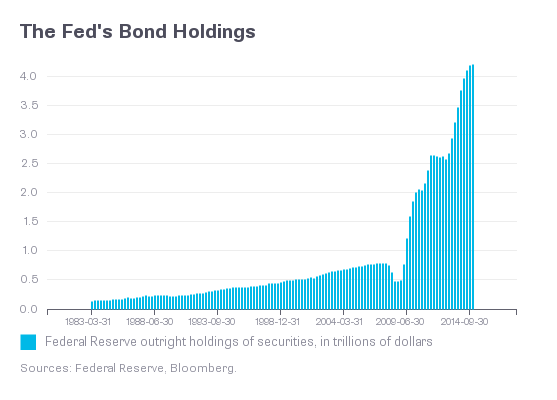
Yesterday, the Federal Reserve announced that it was halting the bond-buying program known as “quantitative easing”, the third round of which had begun in September 2012. While the Fed won’t divest itself of the more than $4 trillion in bonds it has accumulated, and has no immediate plans to raise interest rates, it won’t buy any more. Matt O’Brien fears that the Fed is sending the wrong signals as the economy remains lethargic:

The fact that it’s ending QE3 despite still-low inflation and still-high, though declining, unemployment, signals that the Fed is eager to return to normalcy. So does changing its statement from saying there’s a “significant underutilization of labor resources” to it “gradually diminishing.” The Fed, in short,  looks much more hawkish. And that’s not good, because, as Chicago Fed President Charles Evans explains, the “biggest risk” to the economy right now is that the Fed raises rates too soon.

QE isn’t magic — far from it — but it is, as Boston Fed President Eric Rosengren told me, “quite effective.” Especially at convincing markets that the Fed won’t raise rates for awhile, which is all it should be saying right now. Because the only thing worse than having to do QE is having to do QE again. The Fed, in other words, should do everything it can to make sure the economy lifts off from its zero interest rate trap before it pulls anything back. Otherwise, we might find ourselves back in the same place a few years from now.

Justin Wolfers stresses that this isn’t really “the end” of QE, since the assets the Fed holds will continue to have a stimulative effect:

Of course, the aspect of Wednesday’s Federal Reserve decision that has captured the most attention is its decision to stop purchasing further long-term securities. But don’t confuse this with a monetary tightening. It’s hanging on to the stock of securities it currently holds, and the Fed’s preferred “stock view” says that this is what matters for keeping longer-term interest rates low. By this view, the Fed’s decision to end its bond-buying program does not mark the end of its efforts to stimulate the economy. Rather, it is no longer going to keep shifting the monetary dial to yet another more stimulative notch at each meeting. The level of monetary accommodation will remain at a historical high, even if it is no longer expanding.

Over recent years, policy makers have also worked to lower long-term interest rates by shaping expectations about future monetary policy decisions, in a process known as forward guidance. Today’s statement continues this policy, repeating recent guidance that the Fed expects interest rates to remain low for “a considerable time.”

But Ylan Mui suggests that higher rates may not be as far off as promised:

The debate over when to raise rates, which has already begun, will prove tricky for the Fed — and likely the biggest challenge of Janet Yellen’s tenure since she took over as head of the central bank early this year. Fed officials, who have suggested that the move could come in the middle of next year, hope that it causes little disruption. But achieving that delicate balance is the most basic dilemma of central banking. If the Fed moves too soon, it could undermine the recovery. If it waits too long, it could breed the next financial bubble as investors take too many risks backed by the belief the Fed will always be stimulating the economy.

When Fed officials suggested in the past that they may withdraw stimulus from the economy faster than anticipated, markets have swooned and interest rates have popped up. That’s one reason central bank officials have been preaching patience in responding to the strengthening recovery — but some investors believe they will not be able to wait much longer.

The Bloomberg View editors revisit the debate over whether QE worked. They maintain that it was the right call:

Exactly how much QE has helped the economy remains a matter of debate. Former Fed Chairman Ben Bernanke said in 2012 that the Fed’s first two rounds may have boosted output by 3 percent and added more than 2 million jobs. In a more recent paper, San Francisco Fed President John Williams said such estimates were uncertain; he also noted the risks to the financial system posed by so large an intervention. Some believe QE has gradually diminishing effects; others that it has no positive effect at all.

Regardless, the gamble was justified. After the crash a persistent slump in demand hobbled the recovery and drove up long-term unemployment, threatening great and lasting economic damage. With inflation low, the risks of QE were small in relation to the possible gains. The benefits weren’t confined to the direct effects of the Fed’s purchases: Even more important, QE bolstered confidence that the central bank was willing to do everything in its power to revive the economy.

Danielle Kurtzleben also defends the program:

One key thing to consider with QE3 is the counterfactual — what would the economy have looked like had it never been put into place? One of the big benefits of QE3 was that it counteracted a Congress that insisted on holding back spending, even while the economy was sluggish. As Fed Chair, Bernanke was constantly chiding Congress for dragging on the economy, encouraging them to save deep spending cuts like those under sequestration for later.

So though 2013’s economic growth wasn’t exactly stellar compared to 2012’s, it’s important to consider how bad it could have been, says [economist Paul] Edelstein. “I mean, 2012 GDP growth was two and a quarter percent. 2013 comes, we have all the sequester-related spending cuts, and we have QE3. The result: GDP growth of two and a quarter percent,” he says. “Is two and a quarter percent good? Not really. But clearly again it could be a lot worse if we didn’t have fiscal drag.”