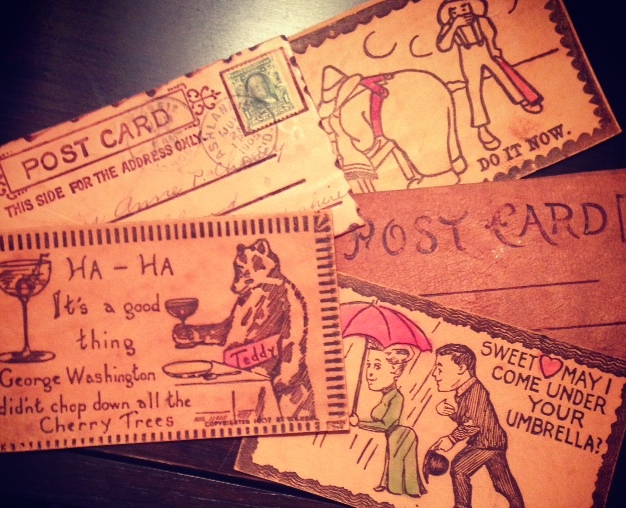
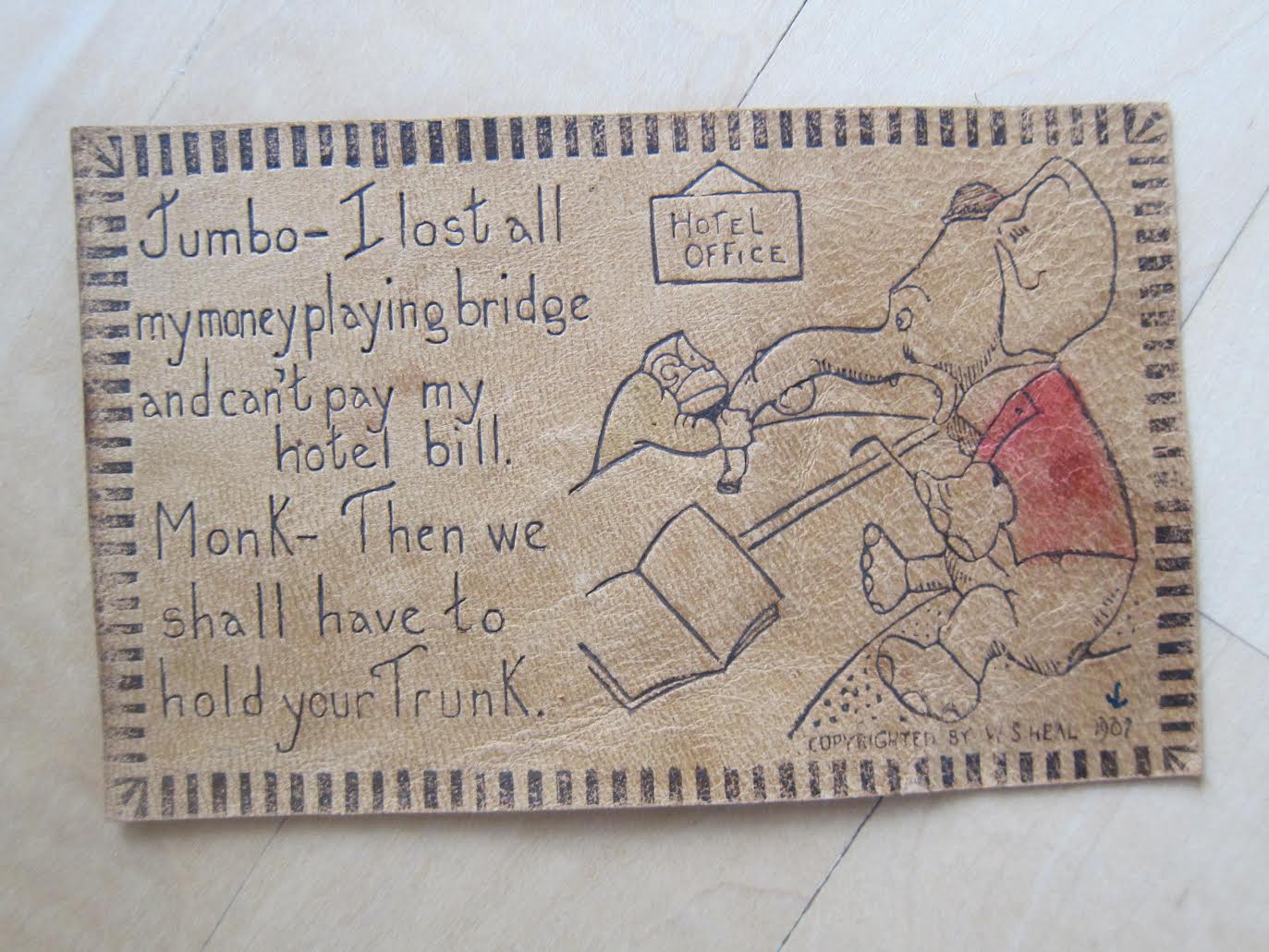
Leather postcards were first made in 1903. They were a novelty that appealed to tourists. When stitched together, they could be used as a pillow cover or wall hanging. The holes along the edge could also be used to attach fringe. The cards were made of deer hide and the pictures burned in. The U.S. post office banned leather postcards in 1907 because they jammed postage-canceling machines. Leather cards continued to be made as souvenirs until about 1910.
During the Victorian Era, the term pyrography was coined to describe the artistic use of fire to create graphics on numerous materials such as wood and leather.
It was particularly popular during the latter part of the 19th century for ladies to create hand crafts using this technique. This process was often also referred to as pokerwork. It is out of this interesting creative movement that grew a brief and exciting period in postal history.
Beginning in about 1904, leather postcards decorated using pyrography became a popular novelty in the United States. After a decade, though, the excitement diminished and the fad had nearly disappeared by 1915. Throughout their short appearance in our postal history, though, the leather postcard had great influence. Artists such as W. S. Heal created wildly successful cards that were often based on humor derived from period stereotypes. His cards of this genre, as well as those of other artists, are among the most highly sought after leather post cards available. Categories that prove very popular among collectors also include souvenir cards, vice or sin cards, puzzles, and cards that express affiliation with organizations. Other unique qualities, such as color and odd shapes or calendars, add to the desirability of these wonderful historic relics.
The range of subject matter within the field of leather post cards is great as has been noted, but so is the process. The cards can be as simple as a piece of leather burned by an individual in their own home to production line pieces stamped in a heat press. Some leather post cards are even inked, and not burned at all. Purists will seek their own niche within the various forms. As with any collectible, condition is important with regards to the field of leather post cards. Surprisingly, however, many fine examples were made into quilts and pillows. Holes are not uncommon in these rare cards.
The leather postcard is an overlooked, but significant, art form remaining from the arts and crafts period in America.
Update from a reader:
Have I heard of a leather postcard? Why yes … I just mailed one to a friend!
I love “real mail” and mail about 5 postcards/letters a day, so this was “bound” to happen.
(Photo of leather postcards from the Albany Rare Book Fair taken by Chris Bodenner)
John Ahlquist and Scott Gehlbach take down the study that claimed they did, pointing out that its limitations “are, in fact, numerous”:
Their estimates rely on a key question from the Cooperative Congressional Election Study: “Are you registered to vote?” Notably, this is not the same question as “Are you registered to vote in the United States?” In principle, non-citizens could be registered to vote only in their home country and respond affirmatively, and truthfully, to the question on the survey.
(Respondents are asked for the Zip code at which they are registered to vote, but this could be interpreted as the Zip code at which non-citizens receive absentee ballots from abroad. Mexico, for example, has allowed absentee voting by mail from abroad since 2005.) If this sounds outlandish, consider that 20 percent (15 out of 75) of those non-citizens claiming to be registered in 2008 were in fact verified as not being registered to vote in the United States. Another 61 percent (46 of 75) could not be matched to either a commercial or voter database. That leaves only 14 out of 75 non-citizen respondents claiming to be registered in 2008 who were in fact confirmed as registered to vote in the United States.
This raises a more general point: The Cooperative Congressional Election Study, which focuses on the behavior of citizens, is ill-suited to examine the behavior of non-citizens, who make up about one percent of the sample. One consequence of this is that the number of respondents who report that they are not citizens yet vote or are registered to vote is quite small in absolute terms: in 2010, for example, only 13 respondents — not 13 percent, but 13 out of 55,400 respondents — reported that they were not citizens, yet had voted. Given the ever-present possibility of respondent or coder error, it takes a bit of hubris to draw strong conclusions about the behavior of non-citizens from such small numbers.
Update from a reader:
In your follow-up to the post about non-U.S. citizens electing Al Franken, it maybe worth noting:
1. The authors of the original study say a follow-up will be posted at the Washington Post any day responding to critics.
2. I investigated the study, specifically looking at the question of whether the public should be worried that Democrats will win tight 2014 elections because of noncitizen voters. On a scale of 0 to 10, with 10 being absolutely true, 0 being wildly false and 5 being half-true, I rated this claim a 4, meaning slightly false. Study author Jesse Richman responded that he agreed.
He said two things your voters may be especially interested in that are a bit of a walk-back from his original post: “Noncitizen voting might tip one or two extremely close races but is unlikely to tip the balance in the Senate, and certainly not in the House.” And: “More work is needed. We view our study as the beginning of the process, not the definitive work on the question.” You can read his full email reply here.
Another note on the swift descent of ethical journalism. One concern I’ve repeatedly voiced is that at some point, corporations will simply dispense with “sponsored content” on existing publications and create newspapers and magazines for themselves. Since the Fourth Estate has already abandoned any pretense of being independent of advertizers for their content, it’s a small jump. And here comes Verizon with a new website:
The most-valuable, second-richest telecommunications company in the world is bankrolling a technology news site called SugarString.com. The publication, which is now hiring its first full-time editors and reporters, is meant to rival major tech websites like Wired and the Verge while bringing in a potentially giant mainstream audience to beat those competitors at their own game.
There’s just one catch: In exchange for the major corporate backing, tech reporters at SugarString are expressly forbidden from writing about American spying or net neutrality around the world, two of the biggest issues in tech and politics today.
Plus: a gorgeous video celebrating New York City and Paris.
The most popular post of the day was A Declaration Of War Against Francis; followed by Does The Self Exist? Many of today’s posts were updated with your emails – read them all here. You can always leave your unfiltered comments at our Facebook page and @sullydish. 24 more readers became subscribers today. You can join them here – and get access to all the readons and Deep Dish – for a little as $1.99 month. Gift subscriptions are available here. Dish t-shirts are for sale here, including the new “Know Dope” shirts, which are detailed here. Below are images for the general design and the DC-specific one (also available are ones for Oregon and Alaska – the two other states voting on legalization Tuesday):
The final email for the day comes from a veteran programmer. I’m going to give her the last word on the gamergate furore:
This is regarding your post about gamergate. I have been a very loyal reader of your blog for more than 10 years now and have been a subscriber for two. I have always dearly admired and respected you. I know this email is long and harshly worded in places, but please take the time to read it. It would mean a lot to me.
Your readers were right to warn you about not writing about that debate. At the very least, you should have researched the industry you were covering before making comments about it. Perhaps you did by reading some extremely lazy leftist writing on the subject (of which there is unfortunately much) or because you’ve been hanging out with Breitbart, who seems to be your ideological bedfellow in this – I don’t know.
[Ed. note: Professional details written here are being left out “because my identity will be easy to determine and it may put my life and that of my family in danger (this happened to other women for much less).] Whom I know is not especially important – the industry is so small that anyone who has been there for as long as I have knows all these same people. (Gamergate doesn’t quite see things that way and continues to weave conspiracy theories about it.) What I mean to convey is how personal all this is to me.
I don’t actually want to bring up the ludicrous “both sides have been bullied” quote, considering that only “one side” has received credible death threats that are being investigated by the FBI. [Ed. note: that “both sides” line was clarified in a follow-up post the reader may have missed.] I don’t mean to complain, because much like all of the mature nerdy adults I know, I’m over it, but I have to ask: do you honestly believe that only nerdy white males exist, that nerdy girls don’t get bullied? (I know I was!) I also had to then deal with not being taken seriously as a “fellow gamer” by the “gamer culture” whose end you’re lamenting for some reason (worry not, it will continue to thrive as is).
And you compare it to gay culture, as if there has ever been any actual or remotely comparable discrimination of gamers! Recall all the gamers who were murdered when they were caught holding hands in public while arranging for DS Download Play on their DSes!
Let’s take a moment of silence for the gamers who bought the latest Call of Duty: Modern Warfare only to be brutally beaten the next day for talking fondly about it in school! Let’s remember that time the arch-conservative Jack Thompson was preaching about the harm people who buy games do to society – wait wait, my bad … that was the game industry he was blaming for school shootings and the like. Andrew, forgive me, but you are off your rocker.
On the contrary, the multi-billion industry that is video games have catered to gamers to such a degree that it’s had some regrettable side effects. For instance, it is not uncommon for game creators to receive death threats for changing a game mechanic (in an effort to improve the experience for their audience)! It’s been happening for some time! Writers have been harassed to the point of quitting the games industry for including an optional homosexual romance in a popular game (Dragon Age 2). The anxiety and the terror I feel that the other shoe could drop at any minute, and that my life or that of my family could be in danger, is very real and has caused me a lot of anguish and stress.
The truth is, this is an audience that is so used to being treated with velvet gloves and getting their way, that manipulating the creators via threats is actually seen by some as a perfectly reasonable way to register a complaint. Short of the awful harassment that George Lucas must have suffered for “ruining childhoods” (not that I disagree he made some poor films), can you imagine any other creative medium with this kind of audience?
The developer who has been the real subject of gamergate for some time created a game about depression that was more an “interactive experience” (not unlike the old text adventure games of the early video games, ironically) and was not seen as a “real game” by those now in the gamergate movement. She was harassed well before her ex-boyfriend tried to ruin her life and career on the internet by airing their dirty laundry with that callous post. Why? Because there are people who don’t want developers to make games they don’t want to play and for them, simply ignoring these developers and their games won’t do. It’s as if Britney Spears fans went on a hateful rampage because they could not live in a world where Mary Timony was producing records, simply because Pitchfork chose to write about Mary’s releases every once in a while.
Let’s talk for a moment about Anita Sarkeesian. I support her work in spite of disagreeing with much of it, because I believe that if video games are ever to be a respected medium, acknowledged for meaningful cultural commentary (which I believe it very much deserves), it needs to have a rich tradition of critique and criticism – whether the critique is something everyone agrees with or not. However, no reasonable discussion can take place when Sarkeesian is being harassed and threatened with sexually violent murder. It so happens that the only video I ever found compelling of the many she has made is this one:
Analysis like yours strokes the hateful mob’s egos and reduces it entirely to what both the far left and Breitbart find intriguing: “a culture war”. Imagine how much progress could have been made about our environment or global warming if it hadn’t become part of the culture war. All this kind of politicizing does is force people to take sides that have no nuance, and I want no part in it. I happen to be a woman developer (already suspect for gamergate) who happens to make quirky games that people in that movement would hate but may refuse to ignore by harassing me (something I’m extremely worried about). Much as I have little respect for the left’s handling of this garbage, they actually stand up for my personal safety! They denounce these jerks when they see them, even if it’s with ridiculous academic language.
From everything I’ve seen, gamergate is an angry mob bent on bullying game creators into making something other than what they want to make. It is an angry mob bent on bullying journalists into voicing opinions other than those they have. They bully not by name-calling, rude words, or insults, but with threats of murder, rape, and school shootings. If your heart was in the right place, as it usually is, you should be condemning these asshole reactionaries. For the first time in my life, you’re talking about an issue that DIRECTLY affects me and my livelihood, and you’ve taken the bullies’ side, Andrew. It absolutely breaks my heart. Why, why, why can’t you call them on their shit?
For the record, this was the second paragraph of my post:
The tactics of harassment, threats of violence, foul misogyny, and stalking have absolutely no legitimate place in any discourse. Having read about what has happened to several women, who have merely dared to exercise their First Amendment rights, I can only say it’s been one of those rare stories that still has the capacity to shock me. I know it isn’t fair to tarnish an entire tendency with this kind of extremism, but the fact that this tactic seemed to be the first thing that some gamergate advocates deployed should send off some red flashing lights as to the culture it is defending.
See you in the morning.
(Photo: Competitors take part in the Tough Mudder London South in Winchester, England on October 25, 2014. The world-famous Tough Mudder is a military-style endurance event over 10-12 mile obstacle course designed to test all-around strength, stamina, teamwork, and mental grit. By Justin Setterfield/Getty Images)
Over the weekend, Charles C.W. Cooke urged Second Amendment activists to “consider talking a little less about Valley Forge and a little more about Jim Crow”:
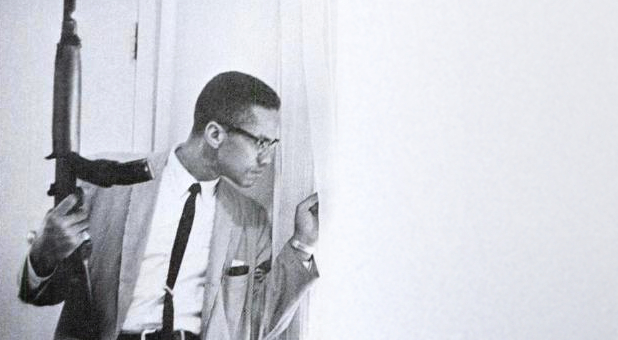
Malcolm X may have a deservedly mixed reputation, but the famous photograph of him standing at the window, rifle in hand, insisting on black liberation “by any means necessary,” is about as American as it gets. It should be celebrated just like the “Don’t tread on me” Gadsden flag. By not making that connection, the movement is losing touch with one of its greatest triumphs and forsaking a prime illustration of why its cause is so just and so crucial.
If you’re looking for a model of public engagement, it’s hard to do worse than “by any means necessary.” The slogan obliterates compromise — it doesn’t repel violence so much as demand it. And in the late 1960s era of romantic leftist rebellion, Weatherman and others delivered memorably, irrevocably, bloodily, on the promise. …
Ultimately, Cooke’s vision of welcoming blacks into the gun movement ends right where other visions of maximum gun rights end: before the trouble begins. The chief problem with the gun-rights movement is not that it makes distinctions based on race — although it does. The biggest problem is that it doesn’t make distinctions based on more meaningful criteria: mental soundness, personal responsibility, adequate training.
Update from a reader:
I wish that Francis Wilkinson explained further how Malcolm X and his defiance to white supremacy are so negative when it comes to gun rights. The way Wilkinson writes about Malcolm X makes it sound as ifit was within Malcolm’s control not to be oppressed by white America. The slogan “by any means necessary” didn’t obliterate compromise; white Americans lynching African Americans did that. White Americans beating, shooting, and drowning a child did that. A racist judicial system did that. White America obliterated compromise over and over and over again for generations, yet today it’s unquestioned when people describe Malcolm X as “a man with a deservedly mixed reputation.”
Malcolm X spoke the phrase “by any means necessary” in a speech announcing the creation of a new organization after he left the Nation of Islam. A larger quote helps fill in the context:
That’s our motto. We want freedom by any means necessary. We want justice by any means necessary. We want equality by any means necessary. We don’t feel that in 1964, living in a country that is supposedly based upon freedom, and supposedly the leader of the free world, we don’t think that we should have to sit around and wait for some segregationist congressmen and senators and a President from Texas in Washington, D. C., to make up their minds that our people are due now some degree of civil rights. No, we want it now or we don’t think anybody should have it.
Note that he was not holding a rifle while giving this speech. The image and speech are combined by many, including both Cooke and Wilkinson to paint a picture of Malcolm X as irrationally violent rather than someone focused on personal and community self preservation.
I agree with Wilkinson’s overall point about distinctions over meaningful criteria for gun rights, but I wish he would keep in mind why there ever was a radical black nationalist movement.
Previous Dish on gun rights in black America here.
Just to be clear here, just because a health-care worker takes time off of work to go volunteer in West Africa in fighting Ebola doesn’t mean that the institution they work for is also volunteering their away time hours. In most cases, the worker must still have accrued enough time off to actually take the vacation in question – and the employer rarely distinguishes between hours off spent sipping martinis in the Maldives and hours off spent replacing IVs in Liberia.
And while the state might reimburse them for the lost wages, that doesn’t mean their medical employer has to welcome them back after three weeks of leaving their workplaces understaffed and their coworkers overworked to fill up the slack. Treating it like the health worker should just be happy they got 21 free days off work is a bit ignorant, and assumes that health care workers are all able to gallivant off from their workplaces. Most workplaces have penalties for taking excessive time off that go well beyond merely suspending pay during the unapproved absence, and those penalties usually include being fired.
But that’s not true here; Cuomo today reassured Ebola volunteers that their jobs will be secure – and then some:
Mr. Cuomo, speaking at an event in Staten Island, noted that the Army was instituting even more restrictive measures on their personnel working in Ebola-infested regions, denying them even contact with their families–and promised New York would duplicate the military’s policy of compensating overseas workers for their time. “If [Mr. Obama]‘s critical of the quarantine, then he has to be highly critical of the Army’s policy,” Mr. Cuomo told reporters today.
“I agree with the president, whose point is, ‘don’t discourage medical workers.’ And that’s why we’ll go the added step of actually putting together a package which I don’t think any other state has done, and which I don’t think the federal government has done.” Mr. Cuomo said he and his aides were meeting with hospitals and other medical organizations to hammer out a package that would guarantee doctors traveling to the nations of Guinea, Liberia, Sierra Leone and the Republic of the Ivory Coast–where Ebola has now killed thousands–a continued income, benefits and job security. “I don’t believe that there is a clash between getting doctors to go to West Africa and an effective quarantine. I don’t believe one is the enemy of the other.
The governor also noted how the NYC area is the most dense in the US, especially compared to a place like Nebraska, “so I don’t know if one-size-fits-all works” regarding the CDC’s nationwide standards. More on the press conference here:
Most of the doctors who go are hospital employees. They tend to be emergency room doctors that go,” the governor said. “I’m asking the hospitals, you tell me: what package I need to put together to encourage medical workers to go and to do it in cooperation with the medical community because the doctors and nurses want to make sure their job are protected when they get back.”
And the fact that Ebola volunteers tend to be ER docs in close contact with trauma patients makes Cuomo’s at-home quarantine even more sensible. Update from a reader:
How does President Obama get to criticize state governors when his Department of Defense has a more stringent policy for service members who have had no contact with ebola patients at all? My peers and I (just getting back from Afghanistan and about ready to deploy again) were also pretty fucking upset with his poor discussion of what voluntary service to our nation is.
No discussion about this at all? I’m glad I’m getting out of the service after over a decade. When we fight ebola with the same force we fight ISIS we have completely lost our minds. When we use different meanings to define voluntary service in the military and in the medical field I feel like we’re leaning towards losing our soul as well.
As I told my friends earlier, I believe we are using the word science when we actually mean policy (or lack there of).
Reviewing Harold Holzer’s Lincoln and the Power of the Press: The War for Public Opinion, Garry Wills marvels at how the president deftly handled newspaper editors and reporters, noting that journalism in his day “was a dirty game by later standards, and no one played it better than Abraham Lincoln”:
As soon as Lincoln was elected he set about new dealings with the press. His inaugural address was secretly set in type by the editor of the Illinois State Journal, which had the sole firsthand report of his remarks at the train station as he left for Washington. Armed with the presidency, Lincoln famously tried to appoint cabinet members and military officers of as wide political variety as would cooperate with him. Holzer shows us something further—that he used patronage to recruit the loyalties of newspaper owners, editors, and reporters on a grand scale. Newspapering became the preferred path to becoming ambassador, port inspector, revenue collector, postmaster, and White House staffer—dozens and dozens of the ink-stained were brought in to save the Union.
Lincoln even kept wooing the stubbornly negrophobe editor James Gordon Bennett, of the New York Herald, making his son a navy lieutenant (how could the father not support a war his favored son was fighting in?). Lincoln helped a favored editor, John Wein Forney, move from the Philadelphia Press to set up the Sunday Morning Chronicle in Washington by securing for him the remunerative post of secretary of the Senate and giving the new paper government advertising accounts.
Myron Magnet riffs on a different display of Lincoln’s communication skills, his Second Inaugural. He notes the speech is given a close reading in Richard Brookhiser’s new book on Lincoln, Founders’ Son:
Brookhiser properly devotes an entire chapter to Lincoln’s Second Inaugural Address, which he rightly judges the greatest of his speeches—and (in my view) is perhaps the greatest speech ever made. In it, Brookhiser believes, Lincoln completed his lifelong search for a surrogate father, moving from the Founding Fathers to God the Father. To be sure, this speech, delivered on March 4, 1865, like the Gettysburg Address given some 15 months earlier, resounds with the poetry of the King James Bible, which a childhood friend of Lincoln’s sons’ remembered the president would often read after lunch in the White House, while the children played, “sometimes in his stocking feet with one long leg crossed over the other, the unshod foot slowly waving back and forth” as he kept time to the rhythm of the Elizabethan language’s stupendous music.
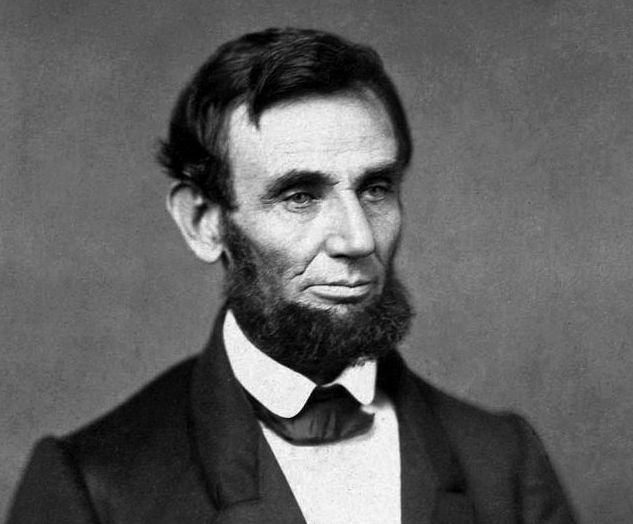
(Image: the first photograph taken of Lincoln after he was elected, 1861, via Wikimedia Commons)
Jed Kolko connects cities’ housing costs to the politics of their residents:
Looking across all 100 largest metros, the correlation between price-per-square-foot and 2012 vote margin was positive, high (0.63), and statistically significant. In fact, the only expensive red market was Orange County, CA, at $363 per square foot. There was a huge drop-off to the next-most-expensive red market—North Port-Bradenton-Sarasota, FL, at $150 per square foot.
There is a deep literature trying liberal residents to illiberal housing policies that create affordability crunches for the middle class. In 2010, UCLA economist Matthew Kahn published a study of California cities, which found that liberal metros issued fewer new housing permits. The correlation held over time: As California cities became more liberal, he said, they built fewer homes.
In the ongoing feud between the major publishing houses and Amazon, Yglesias has no sympathy for the publishers:
Wisdom on this subject begins with the observation that the book publishing industry is not a cuddly craft affair. It’s dominated by a Big Four of publishers, who are themselves subsidiaries of much larger conglomerates. Simon & Schuster is owned by CBS, HarperCollins is owned by NewsCorp, Penguin and RandomHouse are jointly owned by Pearson and Bertelsmann, and Hachette is part of an enormous French company called Lagadère.
These are not tiny, helpless enterprises. Were their owners interested in the future of books and publishing, they could invest the money necessary to make their own e-reading apps and e-book store and render Amazon entirely superfluous. But the managers of these conglomerates don’t really care. If they can get famous authors to lobby the government to stop Amazon from killing them for free, then they’re happy to take the free labor. But they don’t want to invest actual money and energy in competing with Amazon, they’d rather wring whatever remaining profit there is out of book publishing and dedicate the money to dividends or other industries they’re also involved in.
Matt goes as far as to suggest that publishers’ role as middlemen between authors and consumers has become superfluous in the digital age. Hear hear. But Evan Hughes isn’t having it:
A publisher’s list of books is in essence a risk pool, a term most often associated with health insurance. In the insurance business, the profits from the healthy people outweigh the big losses from the sick ones because the healthy outnumber the sick. In publishing, it’s the opposite, yet the underlying concept is the same. Most books lose money, but the ones that make money earn enough to cover all those novels that didn’t sell.
The publishing scenario that Yglesias is advocating is a world without health insurance. (Ironic, I know.) In a system without the publisher operating as middleman, where the author takes his life’s work and just posts it to Amazon, each book becomes a lonely outpost in the stiff winds of the marketplace, a tiny business that must sell or die. “So what?” Yglesias might say, because that’s the kind of ruthless neoliberal thinker he is. “If people didn’t buy the book, that’s just proof of its worthlessness.”
Yep, especially when the Internet allows anyone with the right voice to find an audience, however niche, to buy their book. And none of the money from those sales will get eaten up by the bloated middlemen of the publishing industry. But Guan Yang runs through some downsides of self-publishing:
A lot of work goes into publishing a book. Someone needs to edit the manuscript. The manuscript must be typeset and copy-edited. A cover has to be designed (most self-published books are terrible in this regard). The book needs to be marketed to readers, which can require producing ads and seeking out publicity. Paper books have to be printed, stored, shipped to distributors and bookstores, and sold; returns need to be managed. E-books have to be converted to various formats, ideally not just using automated tools.
Self-published authors can try to do all of these jobs themselves. Many attempt that, and it shows. Or they can outsource some or all of the tasks. When doing so, it’s best to use professionals who have tried to publish a book before. Maybe a team that’s used to working together. Perhaps the people even sit in the same building, so that they can quickly coordinate.
Congratulations: You have just re-created publishers, but without advances.
And without all the waste and inefficiency of many large publishing houses. Freelance copyeditors or cover designers can be found online for much less, and they are likely to be more receptive and flexible when it comes to the author’s needs. McArdle puzzles over another question Yglesias raises -whether the interests of authors align with those of their publishers:
If Amazon manages to kill most of the other outlets for books, it’s not clear to me that authors end up with more royalties and book sales. The distribution of royalties will certainly be different; some people who would have done well under the current system will end up losing out, while others who couldn’t get a major publisher interested in their product will end up making bank. But as a class, author interests might well be better aligned with those of four mega publishers than one mega retailer. Or might not; I haven’t seen a convincing case made either way.
Even assuming that we establish that Amazonian dominance might be bad for authors, we still have to answer another question: Why should anyone else care? Travelocity was bad for travel agents. Toyota was bad for General Motors. To which most people respond, “Gee, that’s too bad for you, isn’t it?” and happily go about their days. Why should authors be any different?
After conducting a voluntary survey of its student body, MIT reported this week that 17 percent of female students and 5 percent of male students had experienced sexual assault. But the university’s administration and the students surveyed seem to subscribe to different definitions of that term:
M.I.T. asked about several forms of unwanted sexual contact, from touching to penetration, “involving use of force, physical threat or incapacitation,” that it said clearly constituted sexual assault — the kind that 17 percent of undergraduate women and 5 percent of undergraduate men said they had experienced. In addition, 12 percent of women and 6 percent of men said they had experienced the same kinds of unwanted sexual contact, but without force, threat or incapacity — some of which, depending on the circumstances, can also be sexual assault. Yet when asked if they had been raped or sexually assaulted, only 11 percent of female and 2 percent of male undergraduates said yes.
There was a similar result on sexual harassment. Among undergraduate respondents, large majorities of men and women said they had heard sexist remarks and inappropriate comments about people’s bodies … But the number who described what had happened to them as sexual harassment was relatively small: 15 percent of undergraduate women, and 4 percent of men.
Their consciousness obviously needs to be raised – and pronto. “The university is clearly using a broader definition of sexual assault than its own students,” Batya Ungar-Sargon concludes:
Perhaps the discrepancy lies in the staggering 44 percent of incidents related to being incapacitated by drugs or alcohol, which some students don’t regard as assault.
It seems unlikely that students would underreport sexual assaults caused by force, or a weapon, or threats of physical harm. Eighty-three percent of respondents disagree with the statement that “An incident can only be sexual assault or rape if the person says ‘no.'” In other words, 83 percent of MIT students can distinguish between a nonverbal lack of consent, and sexual assault. If this is the case, why does the survey then disbelieve the female undergrads when only 10 percent say they have been sexually assaulted? To take the 17 percent of “unwanted” sexual behaviors and turn them into sexual assault, despite the 7 percent of female students included therein who do not believe they have been assaulted, is to remove the students’ very canny ability to distinguish the criminal from the unwanted.
After pointing out some problems with the survey’s methodology, Elizabeth Nolan Brown highlights a finding that she finds disturbing:
Contra the affirmative consent crowd, it doesn’t seem that a lack of respect or enthusiasm for obtaining sexual content is a big problem: 98 percent of females and 96 percent of males agreed or strongly agreed that it’s important to get consent before sexual activity. But students are confused about how alcohol and intoxication affect consent, which perhaps speaks to increasing progressive activism around the idea that drunk people can’t give consent. Only about three-quarters of respondents said they feel confident in their own ability to judge whether someone is too intoxicated to consent to sex. And more than half agreed that “rape and sexual assault can happen unintentionally, especially if alcohol is involved.”
I just want to repeat that one more time: Half of the MIT students surveyed think it’s possible to “accidently” rape someone. When you consider undergraduates alone, this rises to 67 percent. This is what we get when people push an idea that rape is really often a matter of consent confusion or a drunken misunderstanding and not something that one person (the rapist) intentionally does to another. This is exactly what those of us opposed to affirmative consent standards mean when we worry about it muddying the waters of consent and confusing the definition of rape.
Mark Leibovich fixates on the “bumpkinification of the midterm elections”:
Candidates themselves don’t deserve all the blame for their bumpkinizing. Much of that rests with the blizzards of money being blown from wealthy donors and super PACs to a growing oligarchy of media consultants, who typically live on the coasts and work for multiple candidates at once. In a D.C. twist, those bumpkins we see on our screens are often not even real bumpkins so much as some rich guy’s idea of what a bumpkin should be. One telltale signal is how familiar the props are — the livestock, the guns, the motorcycles, the dogs and, of course, the flannel. An ad for Rob Maness, a Louisiana Republican running for the Senate, features a trifecta: a gun, an airboat and an alligator.
In large part, this is what we have to show for the nearly $4 billion that is expected to be spent in this campaign, the most of any midterm election in history. “When you have this much outside spending, way too much of the advertising has no soul,” acknowledged Todd Harris, a partner at Something Else Strategies, who is based in Washington, far from his clients Ernst and McFadden. The people who are creating these spots, in other words, don’t have much connection to the state they’re working in.
Stephen Mihm points out that this has a long history:
Most [of the Founding Fathers] believed the best and the brightest would and should be in charge, and they naively believed that the populace — whom they privately referred to as “the rabble” — would be more than happy to be governed by their social and intellectual betters. It didn’t work out that way. Ordinary people versed in the revolutionary rhetoric of equality didn’t appreciate the condescension, and they pushed back. The novelist Hugh Henry Brackenridge captured the origins of “bumpkinification” in “Modern Chivalry,” a comic tale published between 1792 and 1797. In one scene, an office-seeker accuses his opponent of being seen holding a book. “I am innocent of letters as the child unborn,” the accused says proudly. “I am as ignorant as an ass.”
I wouldn’t want to excuse Washington consultants, but let’s not forget that responsibility is not zero-sum. Everybody who takes part in this is to blame. There are the candidates, who serve up a ten-course meal of drivel. There are the outside groups that swoop in and try desperately to distract and confuse. There are the reporters who decide that it’s really important that they write another ten stories about somebody’s chickens or somebody else’s “gaffe.”
But in the end, ultimate responsibility lies with the voters themselves. It is within their power to say to candidates, “Look, I’m upset about Congress’ inability to solve problems too, but the fact that you put on a flannel shirt and told me a story about the wisdom of your grandpappy does nothing to convince me you’ll actually be able to solve those problems.” They could do that. But they don’t.
Margaret Carlson spotlights an example of what Leibovich is talking about – the ad above from Iowa Republican Senate candidate Joni Ernst:
She’s closing out her campaign the way she began, reminding voters that she’s just a simple farm girl, albeit one who takes a tough line with pigs. In the same plaid shirt, the same dark vest, on the same hog farm, Ernest reminds people she’s not a snooty lawyer looking down her nose at Grassley. Standing in a sty, Ernst calls it a mess.
“It’s dirty, noisy, it stinks.” But she’s not talking about where she is. “I’m talking about the one in Washington.”
In a campaign devoid of policy prescriptions, but with plenty of free-floating rage at Washington, she may be expressing what voters think. This year, it may be the most vivid metaphor that wins elections.
There are still people who actually live in farm country and maintain the values he so cheerily derides. There are people working in factories and mills – at least those few who can still find jobs – and get up every day worrying about problems which probably seem quaint, if not fictional, to those who spend their lives living in Manhattan, D.C. or Hollywood.
If Joni Ernst does pull this off and win on Tuesday, the commentariat may have learned a valuable lesson. Advertisements featuring people working on farms, castrating hogs, emptying trash cans or nailing shingles on the roofs of homes actually do work, and not because the viewers are stupid bumpkins. It’s because real people would prefer to be represented in Congress by someone who understands and can relate to their own lives.



 The Dish

