So When Should We Start To Panic?

Poniewozik characterizes cable news coverage of the Ebola outbreak as a struggle between the “story” and the facts:

Thursday night, the facts were: Someone in New York City had Ebola. Dr. Craig Spencer, who had been volunteering with Doctors Without Borders treating patients in Guinea, had come back to Manhattan. He’d followed the accepted guidelines for self-monitoring, checking his temperature twice daily, and watching, per the medical organization’s guidelines, for “relevant symptoms including fever.” When he detected a fever that morning–before which, he would not have been infectious–he went to the hospital.

But then there’s the story! The story was that the day before Spencer went to the hospital, he went bowling! He rode in an Uber vehicle! He went jogging and ate at a restaurant and walked in a park. He rode the subway–the crowded subway! None of this, according to medical science on Ebola, presented a danger from a nonsymptomatic person. But it felt wrong in people’s guts. And that makes a better story.

But using data on the focus and tone of media coverage from the GDELT project, Kalev Leetaru calculates that the MSM has actually handled this story more responsibly than we think:

Only when the disease literally landed on American soil did it suddenly become news.  Yet, Ebola Viruscoverage of the disease has remarkably become less negative over the past seven months, transitioning from graphic descriptions of the disease’s symptoms to the “miraculous” interventions of modern medicine and stories of survival. As William Randolph Hearst famously noted, conflict sells newspapers; yet in the case of Ebola it seems that coverage has trended towards emphasizing recovery than end-of-the-world panic. Even the level of anxiety, while trending higher in news reports, has not spiraled out of control.

A reader feels that much of the media commentary has actually been too blasé:

More people have died so far this year from Ebola than the entire history of the Ebola (first known human case is 1976). Prior to last year, 1,590 people died from Ebola. So over the last 40 years and 24 outbreaks, we have had 1,590 deaths. We are already past 5,000 this year.

Ebola is extremely infectious (it takes a very small amount of the virus to infect you, as little as a single virus) but only moderately contagious. Because only poor people in Africa have previously died of Ebola, and in very small numbers when compared to other illnesses, Ebola hasn’t been studied at the level that rich person illnesses have.  This is why I’m less than fully convinced that researchers have enough information to be 99% sure about how contagious Ebola is at any stage of illness. There just are not that many data points, and those they have (with regards to humans anyway) are under less than ideal conditions.

So, is there some middle ground between full quarantine and partying like it’s 1999?  Maybe not locked in their house, but also not allowed to go to restaurants or bowling alleys or mass gatherings of people or use mass transportation systems?

For more on the devastating nature of the disease, and how it could spiral out of control, check out Richard Preston’s disquieting piece in The New Yorker. On the “extremely infectious” nature of Ebola:

Experiments suggest that if one particle of Ebola enters a person’s bloodstream it can cause a fatal infection. This may explain why many of the medical workers who came down with Ebola couldn’t remember making any mistakes that might have exposed them. One common route of entry is thought to be the wet membrane on the inner surface of the eyelid, which a person might touch with a contaminated fingertip. … In a fatal case, a droplet of blood the size of the “o” in this text could easily contain a hundred million particles of Ebola virus.

On its ability to travel through the air:

Khan worked long hours in the Ebola wards, trying to reassure patients. Then one of the nurses got sick with Ebola and died. She hadn’t even been working in the Ebola ward. The virus particles were invisible, and there were astronomical numbers of them in the wards; they were all over the floor and all over the patients.

There are two distinct ways a virus can travel in the air. In what’s known as droplet infection, the virus can travel inside droplets of fluid released into the air when, for example, a person coughs. The droplets travel only a few feet and soon fall to the ground. The other way a virus can go into the air is through what is called airborne transmission. In this mode, the virus is carried aloft in tiny droplets that dry out, leaving dust motes, which can float long distances, can remain infective for hours or days, and can be inhaled into the lungs. Particles of measles virus can do this, and have been observed to travel half the length of an enclosed football stadium.

Ebola may well be able to infect people through droplets, but there’s no evidence that it infects people by drying out or getting into the lungs on dust particles. In 1989, a virus known today as Reston, which is a filovirus related to Ebola, erupted in a building full of monkeys in Reston, Virginia, and travelled from cage to cage. One possible way, never proved, is that the virus particles hitched rides in mist driven into the air by high-pressure spray hoses used to clean the cages, and then circulated in the building’s air system. A rule of thumb among Ebola experts is that, if you are not wearing biohazard gear, you should stand at least six feet away from an Ebola patient, as a precaution against flying droplets.

And finally, on the volatility of the virus:

A sample of the Ebola now raging in West Africa has, by recent count, 18,959 letters of code in its genome; this is a small genome, by the measure of living things. Viruses like Ebola, which use RNA for their genetic code, are prone to making errors in the code as they multiply; these are called mutations. Right now, the virus’s code is changing. As Ebola enters a deepening relationship with the human species, the question of how it is mutating has significance for every person on earth.

Read the whole riveting piece here. (Preston wrote the 1994 bestselling book, The Hot Zone: The Terrifying True Story of the Origins of the Ebola Virus.) One more reader:

If you want to read the scary stuff about where Ebola could be headed, here it is (and the primary source for the article is here). If we can’t find the strength to help Africa contain this, it could get much, much worse for the rest of the world. We shouldn’t be worried about isolated cases showing up in NYC or Chicago or Dallas. We should be worried about Mumbai and Karachi and similar places with similar slum populations.

Follow all of our Ebola coverage here.

(Photo via Getty)
The Never-Ending Midterms

Last week, Harry Enten calculated a 47 percent chance that “we won’t know who controls the next Senate when the sun rises on Nov. 5.” Cassidy explains why:

All things considered, the Republicans remain favored to pick up the six seats they need for a majority. That’s what the polls are indicating, and so are the most of the mathematical forecasting models, which extrapolate from survey data. At this stage, however, it is perfectly possible that neither side will emerge from next Tuesday with victory sealed. Runoffs are likely in Georgia and Louisiana. We could have to wait until early January to find out who controls the upper chamber.

Enten examines the Georgia Senate race, which he estimates has a 70 percent chance of going to a runoff: 

We don’t have much polling evidence on which candidate might have the advantage in January. Besides how the campaign might evolve, we don’t really know who will vote in a runoff. No pollster, even those who have asked about the runoff, have tried to model the electorate in January. As I noted last week, there’s no really good precedent for a January runoff in a midterm election.

Alex Rodgers, on the other hand, figures that a Georgia runoff favors Republicans:

Republicans have won the past five statewide runoff contests by doing a better job turning out their base in the conservative-leaning state. In 2008—the last Senate runoff in the state—Republican Saxby Chambliss won the first ballot by three percent of the vote, and then a month later trounced his Democratic opponent Jim Martin in the runoff by 15 points. Republicans were boosted in part by the lower turnout, which was around 57 percent of the number of voters who cast ballots in the same Senate race a month earlier.

Aaron Blake imagines how these races will play out if they determine control of the Senate:

If that’s the case, these two states will be inundated with money from all over the country, and nobody will be able to escape the importance of their state’s runoff. And conversely, if the Senate majority isn’t at stake, these could turn into pretty sleepy contests.

The State Of The Race In Texas, Ctd

A reader flags the awful ad seen above:

After reading my fellow Texan’s rundown of this year’s elections, I thought you might be interested to know that Republican candidate for Lieutenant Governor, Dan Patrick, has been using ISIS as a weapon against his Democratic opponent, Leticia Van de Putte, in an attack ad this month. If I hadn’t already voted for Wendy Davis and Van de Putte, this ad, which I first saw this morning, would have surely energized me to vote AGAINST Dan Patrick. It’s almost comical how ridiculous the fear mongering is here. Almost. The Republicans in this state have zero shits to give anymore and, thanks to SCOTUS’s lack of a ruling on our new voter ID laws, that will likely continue through 2016.

Another Texan looks at the horizon:

There is some possible good news in this article.

What the rest of the country doesn’t understand is that a history of low voter turnout and a pathetic Texas Democratic Party organization has been as responsible for recent election results as the fact that, in some parts of the state, there are indeed voters who will elect Neanderthals like Louie Gohmert.  But 1/3 of the state’s population lives in six counties – Bexar (San Antonio), Dallas and Harris (Houston), El Paso and Tarrant (Fort Worth), and Travis (Austin).  Dallas, El Paso, and Travis are solidly “blue”.  Every county-wide elected official in Dallas is a Democrat.  Harris and Bexar are now purple, but turning bluer. The very popular, recently re-elected mayor of Houston is a lesbian.  Tarrant is the only reliably red county on this list.

There are 254 counties in the state.  I can think of 15-20 off the top of my head that have fewer people in them than my office building in downtown Dallas has in it on a typical day.  ALL THOSE PEOPLE VOTE, and they vote in primaries.  Increased turnout in the big cities and the Rio Grande Valley could make a huge difference.   Maybe Battleground Texas (which has been very active for over  a year) is having an impact.  And there is a genuine lack of enthusiasm for the GOP ticket.  Only the most partisan voters have bumper stickers and yard signs this year.

People I know back east are flabbergasted that Dallas, Texas is a reliably blue island in a sea of red suburban and rural counties, but it’s true.  Change is coming, slowly, but inevitably.

The Profile Of A White House Fence Jumper

Aaron Labaree sketches it out:

In a 1943 study of White House cases, Dr. Jay Hoffman noted, “It is the rule that these patients are, with certain notable exceptions, quiet, pleasant, congenial, cooperative and well-behaved. They accept their enforced hospitalization with a remarkable degree of passivity and frequently without even verbal complaint.” Typical cases have remained strikingly similar over the years. “People usually go to the White House to tell the president what God is telling them or to warn of some impending disaster,” says psychiatrist David Shore, who worked at St. Elizabeth’s in the 1970s and 80s. “In some cases, they think that they have come up with a great invention or performed some great deed and expect to be rewarded.”

Most are schizophrenic. Some are experiencing a temporary psychotic episode. A few are on drugs. The basic motivation—to accomplish great things or avert great danger by going right to the top—seems to have remained the same throughout the decades, although over the years, specific concerns have shifted. Case studies by a number of researchers provide snapshots both of the historical period in which they occurred, and of the delusions associated with them. Many of [Dr. Jay] Hoffman’s patients came to Washington to complain about pensions owed them from service in the First World War, to advise the president on how to steer the country out of the Depression, or to warn him about Nazi plots. …

Kevin Carr, the New Jersey teenager, told police that he had an appointment with the president to discuss the conflict in the Ukraine. And Omar Gonzalez, expressing a fear that may be inspired by global warming, said he’d come to warn the president that “the atmosphere was collapsing.” As Dr. Hoffman wrote back in 1943, “It is only the content of the delusion that changes during the years; the patient otherwise is essentially the same.”

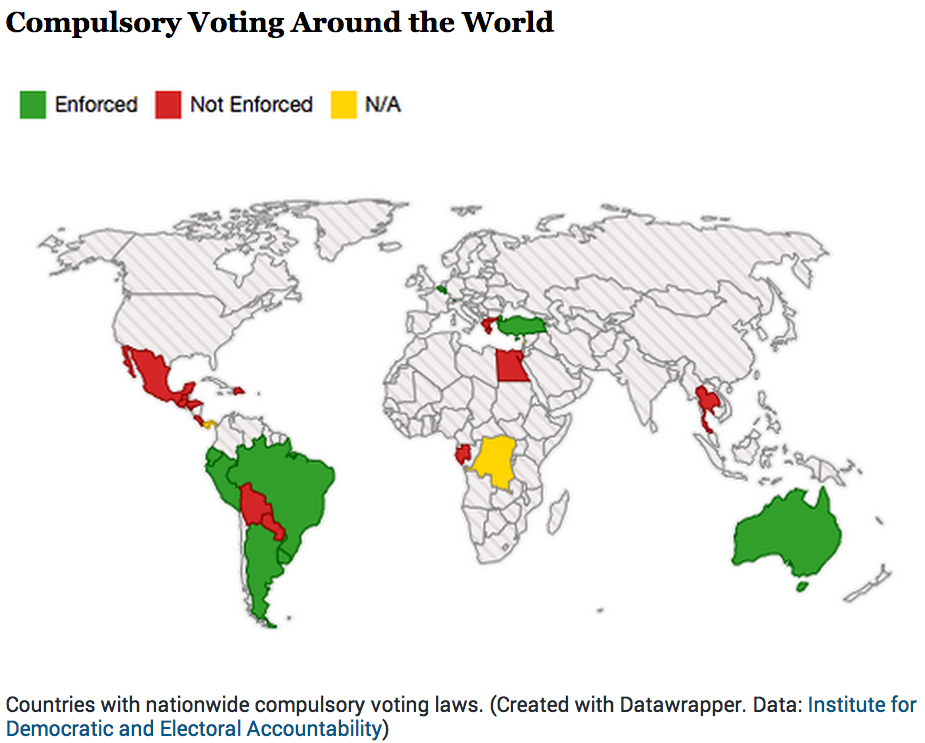
Where Not Voting Is A Crime

Mandatory Voting

Both Uruguay and Brazil voted over the weekend. Kathy Gilsinan focuses on the fact that those “countries have compulsory voting, under which failure to vote is punishable by a fine.” She looks at why these laws came about:

In a 2010 paper, Gretchen Helmke and Bonnie Meguid of the University of Rochester investigated the origins of compulsory voting laws and the factors that could motivate a ruling party to adopt them. Comparing countries that instituted mandatory voting laws with a random sample of countries that didn’t, they found support for the theory that “the more incumbents fear that they are losing the ability to get their own voters to the polls, the more appealing an antidote compulsory voting will be. In essence, the decision to adopt [compulsory voting] is based on the incumbent’s wager that abstaining voters are the equivalent of untapped supporters.”

Ruling parties in Western European and Latin American countries, the authors write, faced the rise of unions and workers’ parties as their countries industrialized during the late 1800s and early 1900s, when many of them implemented their compulsory voting laws. “During this period, the Left’s organizational ability to mobilize—and, in particular, turn out—its potential voters was increasingly perceived as being unmatched by other parties,” they write. Ruling parties, according to this theory, were essentially trying to get out the vote for a silent majority of what one Argentine official called “the rich and content” to protect their incumbency from the growing power of the leftist opposition.

Outsourcing Memory

Jim Davies looks at research into how cognition is distributed throughout the brain – and throughout some of our devices, too:

Think about how many memory aids we use: We jot down phone numbers, and keep count on our fingers. Cognitive scientists Wayne Gray and Wai-Tat Fu showed that using these aids is not very different to remembering facts and figures ourselves. They gave participants a task which required access to a lot of information while varying the difficulty of retrieving that information from a computer screen. They found that the participants decided between using the screen and their own memories in a way that minimized the effort involved, without privileging one source over the other. This suggested that externalized knowledge is accessed like any other memory, and that we treat “memories” on a computer screen just like memories in our head. Something to keep in mind the next time you wonder whether your phone is making you smarter or stupider.

Meanwhile, Clive Thompson considers how the “elderly have long been masters of devising clever tricks to compensate for mental failings, turning objects all around them into cognitive props”:

Medicine might be left on the kitchen table, its presence there a daily reminder that pills need to be taken. To-do lists on Post-it notes serve as scaffolds for their memory. If you’ve already lost cognitive function, and brain training can only go so far, you find other ways to cope. It might very well be that equally promising technology for our brains will augment rather than improve them. Already technology firms are developing methods to help the elderly by offloading memory and cognition, creating digital tools more sophisticated than oversize purses. The company Vitality, for example, has created GlowCaps, pill bottles that track when they’ve been opened. If users forget to take their pills on time, LEDs in the bottle cap might light up as a reminder; if it goes unopened for hours, the bottle sends an alert by email or text. A 2010 trial found that users of these smart bottles had a 98 percent rate of taking meds on time, compared with 71 percent in a control group.

Egg Freezing On The Company Dime, Ctd

Like a reader over the weekend, Pamela Mahoney Tsigdinos casts doubt on the efficacy of egg-freezing:

Lost in all the cheerleading about empowerment and liberating women from their biological clocks is a more buzz-killing, underreported set of facts, which women and families would benefit tremendously in understanding. The American College of Obstetricians and Gynecologists and the American Society for Reproductive Medicine (ASRM) do not endorse the use of egg freezing to defer childbearing. The ASRM’s decision to lift the ‘experimental’ label from this still young procedure in 2012 only applied to medically indicated needs, such as women with cancer.

Moreover, there is no long-term data tracking the health risks of women who inject hormones and undergo egg retrieval, and no one knows how much of the chemicals used in the freezing process are absorbed by eggs, and whether they are toxic to cell development. Furthermore, even with the new flash freezing process, the most comprehensive data available reveals a 77 percent failure rate of frozen eggs resulting in a live birth in women aged 30, and a 91 percent failure rate in women aged 40.

Meanwhile, The Economist flags a new IVF innovation that is “simpler for the patient” and “obviously cheaper than the established way of doing things.” In other assisted-reproduction news, Vanessa Vitiello Urquhart urges her fellow lesbians to take a less superficial approach at the sperm bank:

For lesbian couples, there’s no getting around the fact that children aren’t the offspring of both parents, so closely matching physical characteristics has little relevance. Instead, lesbians ought to seek a fuller picture of the donor while ignoring irrelevancies that could prejudice them. Personal essays would be a great alternative starting place for women who think there’s more to a man than how tall he is and whether he squeaked out a BA in communications.

While exact numbers are hard to come by, it’s clear that lesbians make up a huge portion of the market for donor sperm. A representative from one large, mainstream tissue bank told me that 40 percent of its clients are lesbian, and at least one sperm bank has made helping lesbian families conceive its primary mission. At Pacific Reproductive Services, which proudly advertises its lesbian ownership, the preferences of lesbian clients have already had an impact on the way donors are chosen. Since lesbians tend to be upfront about their children’s origins, they’re more open to the possibility that the kids might one day wish to contact their genetic fathers. This has led PRS to better serve its client base by focusing on recruiting as many “willing to be known” donors as possible—that is, men who have declared their willingness to be contacted by adult children. Founder Sherron Mills also told me that the geneticist at PRS had convinced her that diversity in ethnic background can make for healthier children. “Mix up your child!” she said, “When you dilute those genes, you have a healthier child.” …

Relying heavily on superficial appearance may have made sense for heterosexual couples seeking donated sperm three decades ago. For modern lesbian parents, those physical descriptions come with a lot of unnecessary baggage.

The rest of the egg-freezing thread can be read here.

The Lone Wolf Era?

To Jacob Siegel, last week’s attacks in Canada and New York are examples of the new model for terrorist violence in the West:

In recent years, terrorist networks have become more connected to a Western audience at the same time that they have become more physically cut off from the West. Effective counterterrorist measures have disrupted the planning that groups like al Qaeda use to coordinate large attacks, making it harder for them to communicate directly with cells inside Western countries. But with the Internet’s instantaneous web of connections, it’s become easier to reach individual Westerners who can be coaxed or coached into conducting their own attacks. The result is the lone wolves or stray dogs who may lack connections and experience but need only an Internet connection to find inspiration.

Clint Watts, a counterterrorism expert and senior fellow at the Foreign Policy Research Institute, says the current trend started almost a decade ago. The 9/11 model, where terrorist groups would “plan and train together before going to carry out an attack, became defunct around 2005 because counterterrorism pressure picked up so much in the West,” he said.

But David Gomez observes that the Ottawa shooter, Michael Zehaf-Bibeau, didn’t exactly fit the “lone wolf” profile:

His life was a train wreck of drugs and mental illness with little or no evidence of organization. While all current evidence points to the fact that Zehaf-Bibeau was most-likely acting alone and without direction, he does not appear to be a classic organized lone wolf. Rather he more closely resembles a spree killer who acts spontaneously, without a plan, attempting to kill as many people as possible in as short a time as possible. Zehaf-Bibeau was on a suicide mission with no expectation of survival, therefore no plan for escape. And as far as we know, he left no manifesto or explanation of his actions. In short, Zehaf-Bibeau was a disorganized murderer, acting out his fantasies.

Jeet Heer has additional thoughts on the attacks:

It’s natural to see terrorism and counter-terrorism as a drama of violence and retribution played out on the international stage. Both Zehaf-Bibeau and Couture-Rouleau certainly seem to have seen themselves as part of a similarly apocalyptic saga—Zehaf-Bibeau, in particular, was said by people at the shelter where he was staying in Ottawa to have spoken in his last days about the end of the world. But it’s worth remembering that Zehaf-Bibeau talked not just about an external battle but an internal struggle with demons, spiritual beings he felt had a real existence. That was a battle he was fighting in his own mind, which may have been the ultimate source of the violence that he inflicted on the world.

Even if Zehaf-Bibeau was more an unstable nut job than a jihadist ideologue, Ben Makuch observes that this hasn’t stopped Canadian jihadists on Twitter from claiming him as one of their own:

One Canadian ISIS militant who identifies himself as Muthanna al-Kanadi online, suspected to be Ahmed Waseem of Windsor, justified Zehaf-Bibeau’s alleged attacks by citing the newest Canadian war in Iraq as reason alone to expect retaliation. “What did Canada expect? they are a nation at war with Islam & is about to kill/bomb more Muslims,” he said in a recent tweet. “What did you want in return Hugs and Kisses?” The fighter, who appears to have been injured in recent engagements in Iraq fighting anti-ISIS forces, said the attack was evidence of a growing trend of domestic terrorism.  “I did say before that the Jihad of Yesterday was across the valley but the Jihad of Today is across your doorstep. #OttawaShooting #ISIS,” he said.

In any case, Stephen Walt hopes that Canadian Prime Minister Stephen Harper doesn’t make good on his promise of a macho response:

Whenever there is some kind of terrorist incident (including failed plots), politicians seem compelled to enact more extensive surveillance regimes and promise more assertive efforts to go after the bad guys, in order to show that they can’t be cowed. But unlike security measures enacted during conventional wars, which are normally lifted once the war is over, the various measures imposed since 9/11 remain firmly in place, even after years go by without another incident. Over time, these measures keep ratcheting up, because every now and then another incident will occur and whoever is then in power will feel they have to “do something,” too. It also reinforces the rhetoric of terrorism that increasingly dominates our public discourse and makes it harder to develop a coherent set of strategic priorities.

The Euro Zone Is Not Well

The Economist warns:

Now that German growth has stumbled, the euro area is on the verge of tipping into its third recession in six years. Its leaders have squandered two years of respite, granted by the pledge of Mario Draghi, the European Central Bank’s president, to do “whatever it takes” to save the single currency. The French and the Italians have dodged structural reforms, while the Germans have insisted on too much austerity. Prices are falling in eight European countries. The zone’s overall inflation rate has slipped to 0.3% and may well go into outright decline next year. A region that makes up almost a fifth of world output is marching towards stagnation and deflation.

Matt O’Brien suspects “there will probably be another grand bargain”:

The first one said that, if need be, the ECB would buy a country’s bonds in unlimited amounts to keep their borrowing costs low, as long as they did austerity. That last part is what got the Germans to support it, and they could try the same trick again. This time, they could say the ECB will buy each country’s bonds, in proportion to their economy’s size, as long as they make structural reforms. This is a catch-all phrase that basically means making it easier to fire people. When it’s too hard to do so, as it is in southern Europe, companies are wary about adding full-time workers and only hire young people for part-time ones instead. Germany attributes its own economic success, which is actually pretty overrated, to pushing through these kinds of unpopular changes a decade ago, and it’s obsessed with making the rest of Europe do the same. Maybe so much that it’d be enough for them to let the ECB save the euro again.

But there’s a less sanguine possibility. The ECB could keep not doing enough, Germany could keep blocking them from doing more, and Europe could keep stagnating. It’s their choice.

Did Non-US Citizens Elect Al Franken?

Jesse Richman and David Earnest used data from the Cooperative Congressional Election Study to estimate how many non-citizens may have voted in the 2008 and 2010 elections. Their findings suggest that these ineligible voters turned out in numbers large enough to swing some close races:

More than 14 percent of non-citizens in both the 2008 and 2010 samples indicated that they were registered to vote. Furthermore, some of these non-citizens voted. Our best guess, based upon extrapolations from the portion of the sample with a verified vote, is that 6.4 percent of non-citizens voted in 2008 and 2.2 percent of non-citizens voted in 2010.

Because non-citizens tended to favor Democrats (Obama won more than 80 percent of the votes of non-citizens in the 2008 CCES sample), we find that this participation was large enough to plausibly account for Democratic victories in a few close elections. Non-citizen votes could have given Senate Democrats the pivotal 60th vote needed to overcome filibusters in order to pass health-care reform and other Obama administration priorities in the 111th Congress. Sen. Al Franken (D-Minn.) won election in 2008 with a victory margin of 312 votes. Votes cast by just 0.65 percent of Minnesota non-citizens could account for this margin. It is also possible that non-citizen votes were responsible for Obama’s 2008 victory in North Carolina. Obama won the state by 14,177 votes, so a turnout by 5.1 percent of North Carolina’s adult non-citizens would have provided this victory margin.

The authors acknowledge that the CCES’s samples of non-citizen respondents are quite small (339 in 2008 and 489 in 2010) and that their extrapolated guesses are not exact. They express more confidence, however, in their claim that Franken was elected with illegal votes. Interestingly, they also find evidence that voter ID laws would not have prevented all of these non-citizens from voting, as “[n]early three quarters of the non-citizens who indicated they were asked to provide photo identification at the polls claimed to have subsequently voted”. Still, this will be enough for champions of voter ID laws on the right to claim that they told you so, as Allahpundit does here:

Obama winning a state illegally in a presidential election is bad but will be dismissed on grounds that it didn’t affect the overall result. Flip North Carolina to McCain’s column and it’s still a giant blowout. Franken winning a Minnesota seat illegally is a different ballgame. He was the 60th vote for ObamaCare. Replace him in the Senate with Norm Coleman and the law probably never passes. The authors are arguing overtly that health-care reform was made possible only by illegal votes. There are a bunch of races this year that could end up with whisper-thin margins of victory as well — Perdue versus Nunn in Georgia, Cassidy versus Landrieu in Louisiana, Tillis versus Hagan in North Carolina, even Gardner versus Udall in Colorado. If Democrats eke out victories in a few of those by a few thousand or even a few hundred votes, why would you believe after reading this study that those victories were fairly earned? And remember, as a Twitter pal points out, the numbers in the study are based on non-citizens who admitted to voting when asked. How many voted and were smart enough not to cop to it?

But 

[S]ome respondents might have mistakenly misreported their citizenship status on this survey (e.g. response error). For, as Richman et al. state in their Electoral Studies article, “If most or all of the ‘non-citizens’ who indicated that they voted were in fact citizens who accidentally misstated their citizenship status, then the data would have nothing to contribute concerning the frequency of non-citizen voting.” In fact, any response error in self-reported citizenship status could have substantially altered the authors’ conclusions because they were only able to validate the votes of five respondents who claimed to be non-citizen voters in the 2008 CCES.

It turns out that such response error was common for self-reported non-citizens in the 2010-2012 CCES Panel Study … To be sure, my quick analysis does not at all disprove Richman et al’s conclusion that a large enough number of non-citizens are voting in elections to tip the balance for Democrats in very close races. It does, however, suggest that the CCES is probably not an appropriate data source for testing such claims.

Meanwhile, Rich Lowry defends voter ID laws by turning to a GAO report suggesting “that the number of voters getting locked out by voter ID laws is diminishingly small”:

According to the GAO, in Kansas in 2012, 1,115,281 ballots were cast. There were 38,865 provisional ballots, and of these, 838 were cast for voter ID reasons. In Tennessee, 2,480,182 ballots were cast. There were 7,089 provisional ballots and of these, 673 were cast for voter ID reasons. In both states, about 30 percent of these voter ID-related provisional ballots were ultimately accepted. That means in Kansas and Tennessee, altogether about 1,000 ballots weren’t counted (and perhaps many of them for good reason), out of roughly 3.5 million cast. There you have it ladies and gentlemen, voter suppression! It is of such stuff that Jim Crow was made.

Chait dismantles this argument:

The GAO also studied the impact of vote restrictions in Kansas and Tennessee and found significant reductions in the African-American vote. Lowry says that the Republicans in those states “dispute the methodology,” and takes their side. What the dispute over methodology really shows is that the impact of one change in voting laws is extremely hard to prove. A natural response would be to fall back on the intuitive premise that raising the cost of voting reduces voting. But conservatives seem reluctant to apply their normal beliefs in markets to this question. …

Is it possible that some of the prospective voters who lacked the requisite identification did not show up at the polls at all? Lowry does not consider the possibility.

Emily Badger takes on another aspect of Lowry’s reasoning:

What stands out about this argument is the idea that any disenfranchisement would be OK, when a central rationale for voter ID laws in the first place is that any voter fraud is not. Researchers have repeatedly documented that voter fraud — especially of the kind that might be caught by ID laws — is exceptionally rare. The supporters of ID laws don’t always dispute this. But they often say, as Wisconsin Governor Scott Walker does here, that the scale of fraudulent voting is irrelevant[.] … If you’re absolutist about elections and feel that a single case of voter fraud averted by ID laws justifies their existence, then it doesn’t add up to also argue that any number of people disenfranchised by the creation of those laws is just the cost of protecting democracy.

Dahlia Lithwick sees a similar error at work in the way conservative judges have decided recent cases concerning Texas’s voter ID and abortion laws:

The 5th Circuit evinced a kind of Marie Antoinette approach to individual justice in these cases. When it shut down access to both voting and abortion in Texas, it indicated without precisely saying so that as long as citizens have fast cars and flexible work schedules, they are not burdened by Texas’ regulations. And seemingly there are no Texans without fast cars and vacation time in their view. At oral argument in the case about the shutdown of 20 Texas clinics, Judge Edith Brown of the 5th Circuit heard that abortion clinic closures would leave the Rio Grande area without any providers, forcing women who live there to drive 300 miles round trip to Corpus Christi. The judge sniffed, “Do you know how long that takes in Texas at 75 miles an hour? … This is a peculiarly flat and not congested highway.” …

It’s utterly baffling, this new math. Math that holds that seven incidents of vote fraud should push hundreds and thousands of voters off the rolls. Or that hundreds of thousands of women can be denied access to safe abortion clinics, supposedly to prevent vanishingly small rates of complications. I don’t know how we have arrived at the point where members of the judicial branch—the branch trusted to vindicate the rights of the poorest and most powerless—don’t even see the poor and powerless, much less count them as fully realized humans.