Ukraine Votes West, But What Next?

Fred Weir sums up the preliminary results of yesterday’s parliamentary election in Ukraine, where “the respective parties of President Petro Poroshenko and his ambitious prime minister, Arseniy Yatsenyuk, were the big winners, taking roughly 21 percent each”:

The results were a modest setback for Mr. Poroshenko, whose bloc held a commanding lead ahead of polling. He lauded the vote, noting that three-quarters of Ukrainians had endorsed Ukraine’s shift away from the Russian orbit and into Europe‘s. Preliminary results suggest that six parties cleared the 5 percent threshold to take up seats in Ukraine’s unicameral parliament. The liberal Self-Help party, based in western Ukraine and solidly pro-European, took around 11 percent. The ultra-nationalist bloc of Oleh Lyashko came in with just over 7 percent, and the party of fiery populist Yulia Tymoshenko got around 6 percent. One result that polls failed to predict was the surprising success of the east Ukraine-based Opposition Bloc, which pledged to defend the interests of east Ukrainians against Kiev‘s dictates. It received almost 10 percent of votes cast.

While this result represents a victory for pro-Western parties overall, as Weir mentions, it wasn’t the slam-dunk Poroshenko had hoped for, and it will require him to form a coalition with smaller parties and share power with Yatsenyuk, who is as much a rival to the president as he is a partner. For this and other reasons, Bershidsky cautions against getting too excited:

Yatsenyuk did better than expected and power-hungry Poroshenko did worse. That means the president suddenly has a political rival with more popular support than that of his own bloc — setting the two of them up for the kind of infighting that ruined Ukraine’s previous chance at economic and political revival 10 years ago.

Besides, Yatsenyuk, who will probably stay on as prime minister, has done nothing to demonstrate that he might have the stomach for the major spending cuts Ukraine needs, now that it faces a deficit of 10 percent to 15 percent of gross domestic product. A group of Western economists has recently called on the Kiev government to eliminate energy subsidies and shake up the pension system to reduce spending by 10 percent of GDP. After the obvious erosion of his support in the past six months, Poroshenko will be hesitant to allow this, and Yatsenyuk will be wary of jeopardizing his seemingly brilliant political prospects.

Emma Ashford isn’t quite ready to celebrate yet, either:

Until we know the final makeup of the new Rada, as well as which parties ultimately will form the coalition government, it’s difficult to assess how the results will impact the ongoing crisis. Many citizens in Crimea and the Donbas were indeed unable to vote, disenfranchising as much as 19% of the population. The overwhelmingly pro-Western nature of the parties elected may be a double-edged sword: it will be popular with Western politicians, but it is in part a reflection of the disenfranchisement of Eastern Ukraine, and will not be truly representative. Despite this, Russian leaders appear to have accepted the results, signaling, hopefully, a willingness to work with Kiev in the future. Whether any government will be able to tackle Ukraine’s myriad problems is unclear.

“Given these results,” Linda Kinstler predicts, “it will be difficult, but by no means impossible, for Poroshenko to begin to enact the reforms the Ukrainian people have been demanding for so long”:

A cadre of young activists, including former journalists Mustafa Nayyem, Sergey Leshchenko, and Svitlana Zalishchuk, are part of a new generation of politicians likely to secure seats in parliament; they helped drive the Maidan Revolution, and now they hope to carry out its aims, including changing the parliamentary system and eliminating diplomatic immunity. They have already encountered the corruption and shadiness endemic to Ukrainian politics, and have the stubbornness necessary to change it. Maybe they actually will: Sadovyi has already said that in exchange for joining Poroshenko’s coalition and giving the president the majority he badly needs, Samopomich will demand that Poroshenko awards ministerial posts to “the best industry experts” instead of to his “friends, acquaintances, and colleagues.”

Steven Pifer looks to the tasks ahead for the new Rada:

Once the coalition, prime minister and new cabinet are in place, they need to work with Mr. Poroshenko to tackle a daunting agenda of needed political and economic reforms, anti-corruption measures, overhaul of the judicial system and urgent changes to the energy sector. The distraction of the conflict in eastern Ukraine has absorbed most of Kyiv’s attention the past six months. Mr. Poroshenko also said that Ukraine needed a new parliament before it could undertake serious reforms. The president now has his new Rada. It is time to move. Urgent reforms are needed in the economic and energy sectors if Ukraine is to avoid becoming—some would say remaining—an economic basket case.

Previous coverage here.

Is Kobani A Distraction?

Over the weekend, ISIS launched a new offensive on the Syrian-Turkish border town, where Kurdish fighters are still holding on after six weeks under siege. While others have called Kobani ISIS’s Stalingrad or its Waterloo, Mark Thompson relays concerns “that the focus on saving Kobani is giving ISIS free reign elsewhere in its self-declared caliphate—that the U.S., in essence, could end up winning the battle while losing the war”:

“The U.S. air campaign has turned into an unfocused mess,” Anthony Cordesman of the Center for Strategic and International Studies wrote Friday. “The U.S. has shifted limited air strike resources to focus on Syria and a militarily meaningless and isolated small Syrian Kurdish enclave at Kobani at the expense of supporting Iraqi forces in Anbar and intensifying the air campaign against other Islamic State targets in Syria.”

Senator Joe Manchin, D-W.Va., expressed frustration that the Obama Administration believes its latest fight against ISIS will yield success when the wars in Afghanistan and Iraq didn’t. “We understand the definition of insanity: continue to do the same thing and expect something different to happen,” he said Sunday on CBS’s Face the Nation. “If we can contain them there, leave them there, I don’t know what else to do. They’re intent on destroying each other, and they’ve been doing it for 1,400 years.” The chattering classes are likewise not impressed by the fight for Kobani and the overall U.S. strategy against ISIS.

But Drum isn’t sure that we can judge the success of that strategy just yet:

The flip side of this is the obvious one: have patience. “Here we are not three months into it and there are critics saying it’s falling apart; it’s failing; the strategy is not sound,” Rear Admiral John Kirby, the Pentagon spokesman, said Friday. “The strategy is sound and it’s working and there’s no plans to deviate it from right now.” If we’re really engaged in a years-long battle against ISIS, then a few months here or there doesn’t matter much. And saving Kobani is not just a moral good, but can also demonstrate to others that ISIS is not some magical, unstoppable force destined to overrun Iraq. It’s just an ordinary group of guerrilla soldiers who can be defeated with determination and patience. Stay tuned.

Still, there are other battles going on. Dettmer calls attention to Aleppo, where commanders “from the Western-backed Free Syrian Army are calling on the United States to launch airstrikes that will help them halt Assad’s forces”:

Without such action, they fear, many of their surviving troops may be lured into the ranks of ISIS. The offensive has been building up since early October. Now, Syrian army units backed by Shia Muslim fighters from Afghanistan, Lebanon and Iran are poised to cut the one remaining land route into Aleppo used by mainly Sunni rebels to resupply their forces, ferry in reinforcements, and evacuate their wounded. If the Assad regime severs the Castillo Road, which connects the rebels with the Syrian countryside and Turkey, it would set the stage for a full-scale siege of rebel-held districts in the city. …

Rebel commanders express deep frustration with the U.S.-led coalition focusing airstrikes on the defense of the Kurdish town of Kobani in a bid to lift a month-long assault by ISIS militants. They argue that a siege of Aleppo, once Syria’s commercial hub, risks even greater ramifications, not only for the Obama administration’s objective to “degrade and defeat” the self-proclaimed Islamic State, widely known as ISIS or ISIL, but also for the course of the uprising against President Assad.

Meanwhile, fighting broke out over the weekend in northern Lebanon between the military and Sunni militants linked to ISIS:

The violence is the worst in months and has centered in Tripoli, an impoverished city of predominantly Sunni Muslims that has experienced regular unrest because of sectarian divisions over the three-year-old Syrian conflict. Ten soldiers and one civilian have been killed in the clashes, a Lebanese military spokesman confirmed in a text message, which also said soldiers had arrested 25 militants. The violence began Friday evening with militant attacks on army positions. More than a dozen troops also have been wounded in the fighting, and at least one has been reported kidnapped.

Tripoli’s Sunni and Shiite neighborhoods have served as a microcosm of the Syrian conflict’s sectarian dimension since the war began three years ago, playing host to frequent clashes. Walter Russell Mead stresses the human and social costs the Syrian war has imposed on Lebanon thus far. All things considered, it’s a bit of a miracle the country hasn’t fallen apart entirely:

In a country of less than 5 million, including some 500,000 Palestinian refugees, there are now 1.2 million registered Syrian refugees, with an unknown and possibly huge number of unregistered refugees. (Looking to hedge further exposure to the Syrian crisis and avoid a demographic disaster, Lebanon closed the border to refugees earlier this week.) To top it off, the alienation of Lebanon’s Sunnis has begun to affect even the national army, which has seen soldiers defect to join ISIS or al-Nusra. And even without the threat to morale that defections pose, the Lebanese army isn’t in the best of shape; it doesn’t have the financing to properly equip itself. … The small, poorly equipped, untested Lebanese army leaves Lebanon dangerously vulnerable to ISIS—and to the fast-growing threat from within its own borders.

As If Ebola Weren’t Bad Enough Right Now

Dan Hurley reports on a confusing new childhood illness:

More than 100 cases of a polio-like syndrome causing full or partial paralysis of the arms or legs have been seen in children across the United States in recent months, according to doctors attending the annual meeting of the Child Neurology Society. Symptoms have ranged from mild weakness in a single arm to complete paralysis of arms, legs, and even the muscles controlling the lungs, leading in some cases to a need for surgery to insert a breathing tube, doctors said.

The outbreak, which appears to be larger and more widespread than what has largely been previously reported by medical and news organizations, has neurologists and the Centers for Disease Control and Prevention scrambling to find out what is causing these cases and how best to treat it. “We don’t know how to treat it, and we don’t know how to prevent it,” said Keith Van Haren, a child neurologist at Stanford University School of Medicine. “It actually looks just like polio, but that term really freaks out the public-health people.” Instead, neurologists are now calling it acute flaccid myelitis: acute because it occurs suddenly, and flaccid because the affected limb or limbs become markedly weak.

Why Rand Matters

Georgia Senate Candidate David Perdue Campaigns With Sen. Rand Paul (R-KY)

The foreign policy speech Rand Paul gave late last week is well worth a read. I was having a conversation with an international relations scholar the other day, and when I asked her what her position now was, she said “realism, which these days usually means non-interventionism.” That’s exactly where I am and it seems to be where Paul now is:

After the tragedies of Iraq and Libya, Americans are right to expect more from their country when we go to war. America shouldn’t fight wars where the best outcome is stalemate.  America shouldn’t fight wars when there is no plan for victory. America shouldn’t fight wars that aren’t authorized by the American people, by Congress. America should and will fight wars when the consequences …intended and unintended … are worth the sacrifice.

Amen. I’m particularly glad he mentioned Libya: an almost textbook example of a well-intended, impulsive liberal internationalist intervention – we must prevent a massacre right now! – that led to far more deaths over the following months and years than it allegedly prevented. The critique also applies to the current, quixotic, and counterproductive attempt to control the civil wars in Syria and Iraq. But he also rightly maintains that “the Use of Force is and always has been an indispensable part of defending our country”:

The war in Afghanistan is an example of a just, necessary war. I supported the decision to go into Afghanistan after 9/11. I still do today. America was attacked by Al Qaeda, and there was a clear initial objective: dismantle the Taliban, and deny Al Qaeda safe haven. The invasion showcased the best of modern American military strength and ingenuity: we went in with Special Forces and heavy air power, and formed critical alliances. The Taliban were ousted from power, and Al Qaeda fled. We kept a limited force in Afghanistan to wage counterterrorism and we understood, at first, the limits of nation building in a country decimated by over 30 years of constant war.

​Only after our initial success did the lack of a clear objective give rise to mission creep.  Today Afghanistan is more violent than when President Obama came into office.

If I had to pick a president on foreign policy, this vision is far closer to my own beliefs about where we need to go than Clinton’s very twentieth-century interventionism and embrace of ra-ra American exceptionalism (i.e. we get to break all the rules we enforce on others).

Dougherty favorably contrasts Rand’s foreign policy vision with Ron Paul’s:

Ultimately, the senior Paul did not have a foreign policy. Instead, he had a series of protests against the federal government. They were often richly deserved, but rarely did they constitute a genuine alternative to the status quo.

Rand could have gone in this direction. And he has shown that he’s willing to take a protest to great lengths. Recall his popular filibuster against the use of drones in the United States, into which he folded criticisms of the Patriot Act and the presidential “kill list” that includes American citizens. But the younger Paul has decided that if he wants to be president, he better have a substantive foreign policy.

Antle III continues to dream big about Rand Paul’s potential to change the GOP on foreign policy. The needle Rand needs to thread:

[T]his foreign policy must command enough assent from governing elites that qualified professionals would exist to implement it in the event sympathetic politicians were elected. And it must be a foreign policy that could actually work, not one that waves away genuine national-security threats or pretends that United States could become Switzerland.

That means politically this foreign policy must be able to galvanize the biggest constituency for peace within the Republican Party—the libertarians, constitutional conservatives, and other noninterventionists who backed Senator Paul’s father in the last two presidential campaigns. At the same time, it must be accessible to a larger swathe of the Republican rank-and-file.

Part of that means joining the still-young Ron Paul movement with older Republican foreign-policy traditions that remained well within the party’s mainstream as recently as George H.W. Bush’s presidency.

Beauchamp rightly calls Paul’s speech “one of the most important speeches on foreign policy since George W. Bush declared war on Iraq”

Paul’s agenda has a lot more in common with Barack Obama’s view of the world than it does with, say, John McCain’s. But his speech very cleverly played up the criticisms of Obama, and minimized the points of agreement. That’s because the basic goal of the speech was to teach conservatives that they can oppose foreign wars and Democrats at the same time.

The real target of Paul’s speech were the neoconservatives: the wing of the GOP that believes that American foreign policy should be about the aggressive use of American force and influence, be it against terrorist groups or Russia. Paul’s unsubtle argument is that this view, dominant in the GOP, is a departure from what a conservative foreign policy ought to be.

His tactic for selling this argument is innovative. He’s reframed arguments with neoconservatives as arguments with Obama, banking on the idea that he can get everyday Republicans to abandon hawkishness altogether if they see Obama as a hawk.

Smart smart smart smart smart.

(Photo: Senator Rand Paul speaks on October 24, 2014. By Jessica McGowan/Getty Images)

Quarantanamo, New Jersey

https://twitter.com/ianbremmer/statuses/526762858739400704

Late Friday, governors Cuomo and Christie announced a mandatory 21-day quarantines for anyone arriving in the US through the Newark and JFK airports if they had direct contact with Ebola patients in Guinea, Liberia, or Sierra Leone. Cuomo blinked yesterday and relaxed the new rule for his state after strong objections from public health groups and the White House:

Originally, Cuomo and … Christie announced a joint initiative to require a governmental quarantine for 21 days for all health care workers flying into their states. Illinois soon followed suit. But under the new guidelines, Cuomo said returning health care workers can instead quarantine themselves in their homes for 21 days, and will receive at least two unannounced house calls from local health officials. The state will provide services like food and medicine if the health-care worker needs it. Health care workers will also monitor their symptoms, as has been the standard for the vast majority of people returning from work in the region. “If their organization does not pay for the three weeks, we will,” Cuomo said during a press conference Sunday night.

Christie has also walked back his order somewhat. Nurse Kaci Hickox, the first person subjected to the New Jersey quarantine order, is set to be released today and allowed to finish her quarantine at her home in Maine after threatening to take legal action against the state over her treatment:

The nurse’s treatment has drawn withering criticism from both public health officials and the nurse herself. At University Hospital in Newark, Ms. Hickox has been kept in an isolation tent with a portable toilet, but no shower or television. … Ms. Hickox called her treatment inhumane and castigated Governor Christie for saying she was “obviously ill” when she displayed no symptoms of Ebola.

Kent Sepkowitz calls these quarantine orders an overreaction that won’t do anything for public health:

Indeed, there is a consequence to Christie and Cuomo’s decision that endangers the safety of the rank and file of New Jersey and New York far more than it protects it. Searching for a bump in some internal poll or perhaps because it feels good to make a damn decision once in a while, the governors know but choose to ignore the obvious big fact: There is a larger crisis occurring in redoubts well beyond Trenton and Albany. Their move, though perhaps it plays well now, will have a desiccating impact on volunteerism; this in turn will make the African epidemic worse, which will make it more likely cases will appear in the United States, which will increase the risk of Ebola for John Q. Public as he wanders through Trenton and Albany, Brooklyn and Newark.

Cohn piles on:

It’s also an open question whether the quarantine reduces anxiety or intensifies it. That’s particularly true in this case, because Cuomo’s statements on Friday, at least as relayed by the press, left the impression that a non-symptomatic Ebola patient could spread the disease on the subwaythe very notion that public health officials had spent the previous 24 hours explaining wasn’t true. That’s one reason that officials from the Obama Administration, the CDC and the New York City Department of Public Health seemed not at all happy about Friday’s announcement. The other is that, based on what I’m reading in outlets like the Times and hearing from insiders, they weren’t so much consulted about the decision as informed of it at the last minute, as a fait accompli.

So does Josh Voorhees:

If Cuomo, a Democrat, and Christie, a Republican, do believe they’re acting in the public’s best interest, then they haven’t done their research. Public health experts have made it clear that quarantining asymptomatic individuals will do little if any good. More troubling is the risk of a cascade of unintended consequences that could make it more difficult to contain the virus in West Africa, where it has already claimed more than 5,000 lives and will likely claim thousands more.

At best, the bipartisan pair is giving in to the fears of a misinformed public. At worst, Christie and Cuomo—whose respective presidential ambitions are no secret—are capitalizing on those fears to score cheap political points by appearing to be guardians of their constituents’ safety. The chance to bolster their respective profiles appears too good for them to pass up, even if such gains are paid for by risking West African lives.

The orders might even be unconstitutional:

Lawrence Gostin, a law professor at Georgetown University who has been in touch with Hickox about her legal options, said he thought the quarantine order was illegal and unconstitutional. He noted that since you can’t catch Ebola from someone unless they are both infected and showing symptoms, Hickox poses no danger to the public. “The courts are very suspicious when you deny a whole class of people their liberty,” he said. “She’s being detained because she’s a member of a large class of people who happened to have been in the region.”

But Jazz Shaw is disappointed in Cuomo for backing off:

Having them stay at home is doable, but only if we have confidence that they actually will stay at home, rather than going out bowling, playing basketball and riding the subway. That will require monitoring, but the monitors need to look like bellhops more than prison bulls. It’s a tricky situation to be sure, but it could be handled. Sadly, it seems that Cuomo has left Christie hanging in the wind and will – as predicted – bend in the direction of Washington.

A Declaration Of War On Francis

VATICAN-RELIGION-CHRISTIANITY-POPE-UNITALSI

So this is why it took Ross Douthat so long to utter an opinion about the recent Synod on Family Life in Rome. He was weighing whether to call for schism! For the record: for all my questioning and concern about the direction Benedict XVI was taking the church, I never wrote a column that actually called for open revolt against him. The theo-conservative reaction to Francis reminds me a little of the wing of the GOP that simply cannot tolerate the give and take of democratic life, and as soon as a president of the other party is handily elected, and actually dares to enact a clear campaign pledge, declares the end of the republic!

But, of course, the Catholic church is not a democracy, so the analogy won’t work. But neither is it a dictatorship – least of all under this Pope who, from the very beginning, insisted that he was merely a bishop among bishops. And in Ross’s column, there is a clear assumption that his side of the debate owns the church, that any contrary views to his are an outrageous, treasonous and unprecedented attack on the institution itself, that any accommodation of mercy for those caught in the cross-hairs of the teachings on sex and marriage and family is somehow a “betrayal” of the core faith. Not a misguided idea – but a betrayal.

This is nonsense and panic, but it is a useful insight into the theo-conservative psyche. Notice the language used to describe a civil, rare and open debate of issues that the church is grappling with. This process – in which the theocons won on their core issues – is “a kind of chaos,” it’s “medieval” and “dangerous,” it sows “confusion.” It is as if these questions cannot even be debated (which was, of course, the view of John Paul II and Benedict XVI), as if faith itself is so fragile and so rooted in unquestioning blind obedience to a body of teaching that makes no distinction between central and more marginal issues, that any Pope that actually seeks to have a conversation about these questions is a threat to the church itself.

And what are these questions that are so dangerous to consider? That some divorced Catholics who sincerely want to be part of the life of the church should be allowed some participation in the sacraments; that a gay relationship should not be defined and condemned solely for its sexual nature – but can be appreciated for other virtues, such as mutual love and sacrifice; that doctrine should never be imposed without an option for mercy. These are not violations of the core teachings – that marriage is for life and must be always open to life; that non-procreative sex inside or outside marriage is always sinful – but attempts to acknowledge that human beings are involved here, and that exclusion and cruelty and contempt are not the only options for those following the teachings of Jesus.

But for Ross, it appears that mercy is an attack on inviolable truth, rather than its essential Christian complement. And it also appears that allowing the Vatican to reflect the actual debate going on among actual Catholics in our real lives is some kind of threat to the faith itself. Please. If your faith cannot admit of doubt, of debate, of conversation … then it is a white-knuckled faith in the religion of total certainty, rather than the calm faith of those who know we do not have all the answers to every pastoral question.

Ross seems to think, for example, that Francis is proposing an end to the idea that marriage should be monogamous and life-long. That’s just bizarre. What Francis is encouraging us to debate is not whether those whose marriages failed should be re-married in the church, but merely, depending on the circumstances, whether they can be allowed to participate in the full sacramental life of the church. What Francis is suggesting in another respect is that gay people’s real human lives and loves cannot be reduced to a psychological and moral “disorder.” You can see these suggestions as an attack on Jesus’ austere view that marriage is inherently life-long or it is nothing, if you really want. Or you can see this as a reflection of Jesus’ constant, persistent empathy with the sinner, love for the individual and mercy toward the flawed. I suspect most Catholics would instinctively see this as a function of the latter.

And Ross agrees that his is a minority view. Which explains a little of his rage.

For the first time in more than thirty years, the rigid traditionalists, who were always a minority of Catholics, had a Pope very much on their side. Their champion was Joseph Ratzinger who viewed even the Second Vatican Council as dangerously open to the currents of modernity and who, as John Paul’s doctrinal enforcer, ruined countless careers, and policed any error, and shut down any dissent to his understanding of orthodoxy. Many of us who disagreed did not throw a hissy fit, threaten schism, or call for open revolt. And we refused to do this even as our very identities were deemed inherently directed toward evil, as we were blamed for the violence sometimes directed against us, as we were blamed for the child abuse of pedophiles, as we had to endure the staggering hypocrisy and venality of a hierarchy that tolerated their peers’ rape of children but reserved their strongest condemnation for gay couples in committed relationships.

But we, it seems, are not the real Catholics. We are not the people who keep the church alive. We are somehow parasitical on the true believers. The real Catholics are

the people who have done the most to keep the church vital in an age of institutional decline: who have given their energy and time and money in an era when the church is stained by scandal, who have struggled to raise families and live up to demanding teachings, who have joined the priesthood and religious life in an age when those vocations are not honored as they once were. They have kept the faith amid moral betrayals by their leaders; they do not deserve a theological betrayal.

It’s an almost textbook case in which those who regard themselves as morally superior claim ownership of a church created … for sinners. There is a clear rebuke to that mindset:

So the last will be first and the first last, for the called are many and the chosen ones are few.

Let us leave such distinctions to God, shall we? And try to struggle together in a church which no faction owns and in which truth is always tempered with mercy and in which faith is always leavened with doubt.

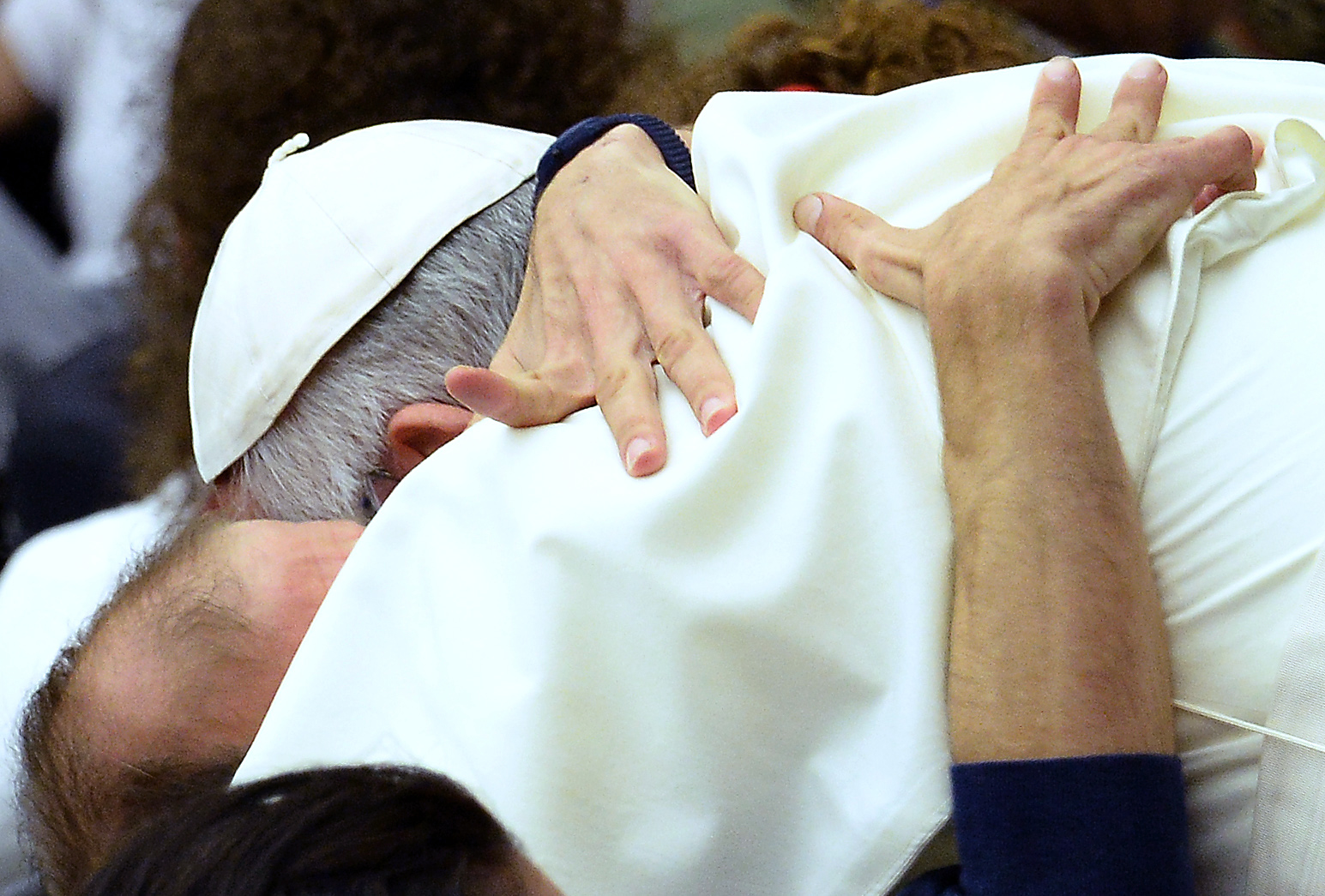
(Photo: Pope Francis hugs a disabled man during a meeting with the UNITALSI, the Italian Union responsible for the transportation of sick people to Lourdes and the International Shrines in PaulVI hall, at the Vatican, on November 9, 2013. By Filippo Monteforte/AFP/Getty Images.)

Down On The Democrats

The latest polling indicates that Americans want a GOP Senate:

According to a new NBC News/Wall Street Journal/Annenberg poll, a majority of likely voters – 52 percent – say they would like to see Capitol Hill controlled by Republicans, compared to 41 percent who favor the president’s party. (For registered voters, it’s 46 percent GOP and 42 percent Democrat-controlled.) While neither party can boast stellar approval ratings, those surveyed gave Republicans better marks when asked whether what they’ve heard, seen or read in the past few weeks has made them feel more or less favorable towards either party.

Aaron Blake highlights another poll, which shows that “congressional Democrats are facing their highest disapproval rating in at least the last 20 years, at 67 percent.” He later puts this finding in context:

To be clear, the Washington Post-ABC poll still shows a slight difference between the parties, with congressional Republicans viewed dimly by 72 percent of Americans, which is slightly worse than the record 67 percent who view Democrats dimly. And it is beyond question that the GOP’s continually poor image is holding it back from making what could be even bigger gains than it’s primed to make in the Nov. 4 elections.

But the gap between the two parties is shrinking, and there’s plenty of reason to believe the GOP’s image isn’t hurting it much more than Democrats’ is these days.

Why Are The Midterms So Meh? Ctd

Beinart ponders our collective apathy:

The dullness comes from this election’s lack of a compelling macro-theme. Yes, there are national refrains: Democrats in state after state call their Republican opponents heartless misogynists; Republicans call their Democratic opponents Obama clones. But there’s no big national issue on which voters feel that they can change the country’s course. It’s not that candidates today are more cynical or homogenized than in midterms past. It’s that the subjects they’re discussing cynically and homogenously don’t matter as much. …

Republicans still denounce Obamacare, but few still believe they can repeal it. Big partisan differences about the size of government remain, but with the deficit going down and Republicans no longer willing to go to the brink over the debt limit, the crisis atmosphere of 2010 has faded. Overseas, Americans worry about Ebola and ISIS, but those threats don’t divide them along partisan lines like Iraq. There’s little reason to believe that electing a Republican Senate would substantially change American policy toward either.

Don’t get me wrong. I’m not saying next month’s elections don’t matter. They do. As Annie Lowrey has predicted, a Republican Senate—if elected—will work mightily to prevent President Obama from using his executive authority to implement a broad range of government regulation. But these potential fights are mostly too narrow and too technical to grab public attention. Americans just don’t believe that as much hinges on their vote as did in 1998, 2002, 2006, or 2010. For many pundits, that makes this election boring. For many ordinary Americans, I suspect, it’s something of a relief.

Along the same lines, Lee Drutman and Mark Schmitt blame our politicians’ lack of big ideas on polarization:

Historically, parties and candidates have sought political advantages by trying to raise the salience of particular issues that might cut across party lines. The assumption was that voters might support Democrats on some issues, while they might agree with Republicans on other issues. So, for example, a pro-choice Republican might be able to win over enough Democratic voters to emerge victorious in a Democratic district, or the reverse. …

As party politics has become at once more homogenous and polarized, it’s not only harder to reach a compromise at the end – such as on immigration reform or the federal budget. There’s also less room for ideas and fresh approaches to issues at the beginning. The “political issue space,” once wide open and full of opportunities to form new coalitions, is now narrow and closed.

The Races In Play This Year

Close Races

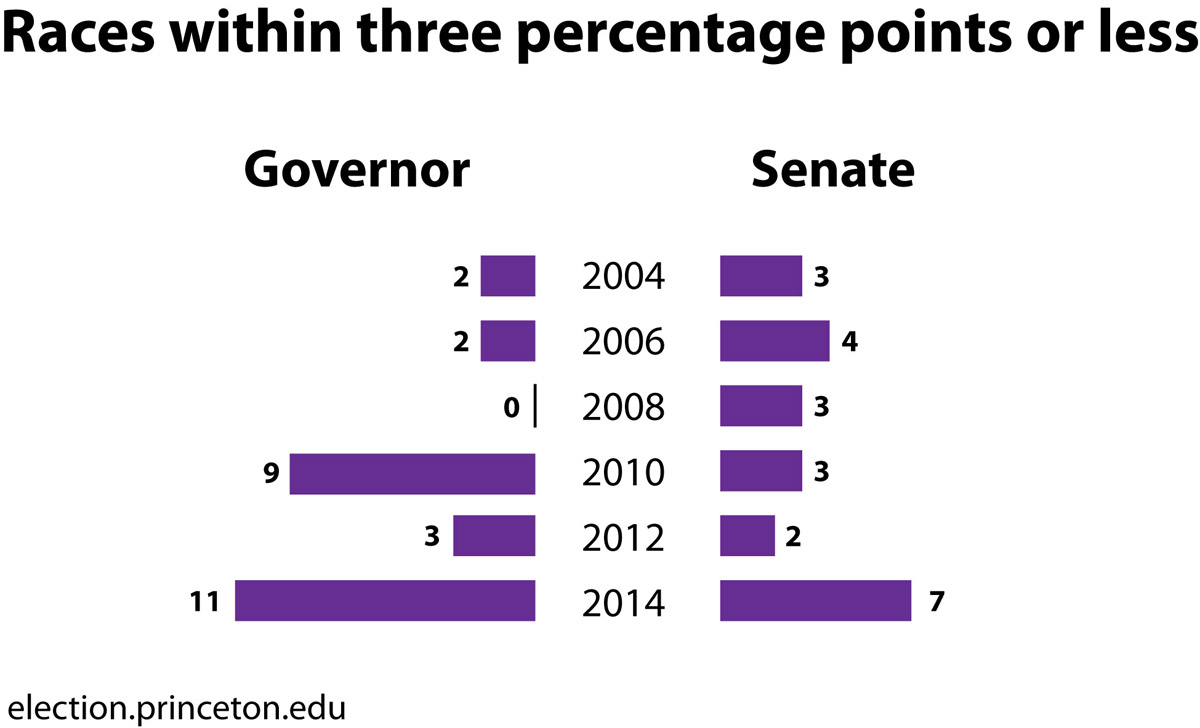
Sam Wang compares this election to past ones:

Journalists and pundits have lavished considerable attention on the question of who will control the Senate in 2015. But a broader phenomenon has escaped notice: the sheer number of close state-level races, both in the Senate and in statehouses. At risk are many incumbents who were elected in previous wave years: in 2010 for Republican governors and in 2008 for Democratic senators.

Silver remarks upon the relative stability of his forecast:

Republicans’ odds have never been higher than 66 percent — a figure they reached late last week — or lower than 53 percent. The informal model updates we published going as far back as March also had Republicans as 55 or 60 percent favorites.

To an extent, this stability reflects the noise-reducing features of the FiveThirtyEight model. Our program examines the polls for signs of statistical bias, and weighs them more heavily when they have larger sample sizes, better methodologies and better track records — which can reduce the impact of outliers. The FiveThirtyEight model is also fairly conservative in estimating the uncertainty associated with each race and the disposition of the Senate overall. At times in the past, the polls in most swing states have been biased in the same direction (either toward Democrats or Republicans).

But this degree of stability is unusual. In pretty much every election we’ve covered, the polls have more clearly broken toward one or another party by this point.

Nate Cohn anticipates that “the results of the governors’ races may ultimately play a big role in how analysts interpret the results Nov. 4, including whether this will be viewed as a ‘wave election.'”:

On balance, Democrats seem set to pick up two or three states, mainly because the Republicans enter the elections with twice as many Republican-held seats. But it is easy to imagine the Republicans holding their advantage — there are 29 Republican governors and 21 Democratic ones — or the Democrats picking up a half-dozen seats.

The Debt Collector’s Dilemma

For his book Bad Paper, Jake Halpern investigated the world of American debt collectors. In a review, Thomas Geoghegan considers what makes people pay up:

In [debt collector and ex-con Brandon] Wilson’s case—and I admit I came to like Wilson—it’s because he knows how to “marry the debtor.” He doesn’t threaten; he doesn’t talk about bringing a suit, much less raise the specter of incarceration. It’s true that’s all illegal under the Fair Debt Collection Practices Act. But the real point here is that such measures don’t get results. No, as Wilson notes, a good collector is even and caring. The good collector will say things like “It’s the right thing to do” and “You’ll feel better about yourself.”

Here’s what collectors know: People want to pay. It’s what Porfiry knows about Raskolnikov: He wants to confess. The good collector helps the debtors get out of their mental jails.

After explaining, Wilson’s collectors dare the author to make a call; for me, and perhaps for Halpern, it’s the most unsettling part of the book.

This is not a writer who calls attention to himself unduly, so the encounter that prompts him to enter into the narrative stream of Bad Paper is significant. Halpern does try to marry the debtor. He tries to show empathy. He listens to the woman Wilson assigns him. She is not a deadbeat. She has been ill. She is bipolar, didn’t he know? But Halpern lets her go. He writes that he lacks a real collector’s rapport with people, together with Wilson’s “innate sense of when to segue from courtship back to the unpleasant matter of collecting.” But the real problem, he admits, is that he doesn’t have the drive. If he were desperate enough, if he had to do this for a living, if the alternative were to push dope out on the streets . . . well, he might be much readier to squeeze her. As he later quotes one collector, who happens to be African American, debt in America is the “white man’s dope.”

So a dealer can have only a certain amount of empathy. Or, as one collection manager tells the author: “You have to empathize with debtors but not have sympathy, because if you have sympathy you don’t get paid.”