Data-Driven Dating

OkCupid co-founder Christian Rudder advocates it in his new book Dataclysm:

[On OkCupid] the copy-and-paste [message-sending] strategy underperforms from-scratch-messaging by about 25 percent, but in terms of effort-in to results-out it always wins: measuring by replies received per unit effort, it’s many times more efficient to just send everyone roughly the same thing than to compose a new message each time. I’ve told people about guys copying and pasting, and the response is usually some version of “That’s so lame.” When I tell them that boilerplate is 75 percent as effective as something original, they’re skeptical — surely almost everyone sees through the formula. […] [L]et me tell you something. Nearly every single thing on my desk, on my person, probably in my entire home, was made in a factory alongside who knows how many copies. I just fought a crowd to pick up my lunch, which was a sandwich chosen from a wall of sandwiches. Templates work. […] Innovation is using a few keyboard shortcuts to save […] some time.

In a review of the book, Evan Selinger protests Rudder’s logic:

This passage is disturbing in several respects.

First, Rudder treats the process of communication in purely instrumental terms: it’s a numbers game and to win you’ve got to maximize your response-to-effort ratio. Now, it could be argued that during the early stages of dating, minimal effort is appropriate. After all, people are busy, and they can take a more conscientious and personalized approach to socialization after things go to the next level and it becomes clear what a particular individual is worth. But Rudder doesn’t convey a sense that as relationships deepen so do our responsibilities. Instead, he posits an unnerving equivalence between people and commodities. That’s the second problem: Rudder’s comparison of people to factory goods. Sure, most of us take advantage of mass production and treat artisanal wares as … well … treats. But viewing people, or even delicious sandwiches, as widgets is dehumanizing to anyone, not just Marxists! …

[Another] problem is that Rudder associates innovation with efficiency. This is Silicon Valley dogma: friction is bad because it slows people down and generates opportunity costs that prevent us from doing the things we really care about; minimizing friction is good because it closes the gap between intending to do something and actually doing it. Such a cavalier attitude toward efficiency-enhancing technology creates the impression that at any moment we can slow down and behave more thoughtfully and deliberately. But why assume this is the case when technology companies are providing us with ever-increasing opportunities to do things hyper-efficiently and creating an infrastructure that’s conducive to cut-and-paste culture?

But in an interview last month, Rudder marveled at the way data can pinpoint personal information:

What statistics and other crazy facts about human nature did you discover while researching this book?

Honestly, some of the craziest stuff were things where these guys in the UK looked at Facebook likes and — it’s insane, that from just your likes, forgetting your social network or pictures — that you can tell, with incredible degrees of certainty, shit about you, down to your race, to 95 percent. Which makes sense, if you’re really into Tyler Perry or whatever you can probably make a guess about your ethnicity. But you know, sexuality — it was at 85 percent, and kind of like all the way down to “were your parents divorced,” which is 50 percent.

Which is kind of intense, because it’s not a demographic fact about you, it’s just something that happened in your life history, especially because likes have only been around for five years. That’s not very much time. I’m 39, so I was starting to realize I knew kids whose parents had been divorced around maybe ’85 or whatever, and they were into Ozzy Osbourne, Judas Priest. I remember this one kid, I went to his house and he wanted to stay up all night and watch the Ozzy Osbourne concert on HBO… The kids I knew who were from stable, more normal households back then were into REM or whatever. You can see it in life, but it’s cool that they were able to actually pull it away from a “this one guy one time” into a thing that’s more legit.
Live-Streamed From Your Work, It’s Not Saturday Night

Surveying four decades of criticism chronicling how SNL has lost its edge, Ian Crouch posits that the Internet has sounded the true knell for the show:

The final death of “S.N.L.” … may coincide with the death of live television itself.  “S.N.L.” has faced challenges from other shows in the past, but, now, everything that is funny anywhere, at any time, is a challenge. On television, Comedy Central’s “Key & Peele” and “Inside Amy Schumer” can make the sketches on “S.N.L.” look slapdash and tame; the topical sharpness of John Oliver’s “Last Week Tonight” often makes Weekend Update seem meek and scattered; and surreal shows like “Drunk History” and “Nathan for You” produce moments of left-field oddity that rarely make it past “S.N.L.” ’s dress rehearsals.

And that’s just what’s on television, never mind the surfeit of great series and amateur comedy creations on the Web. Many of these are carefully shot and meticulously edited, giving them a polish that surpasses what can be managed on a weekly, live stage show. And, like with “S.N.L.,” we can watch them whenever we want. And so, as fewer people arrange their lives to be on the couch on Saturday nights, the limitations of the live form begin to seem less thrilling, and more like a liability.

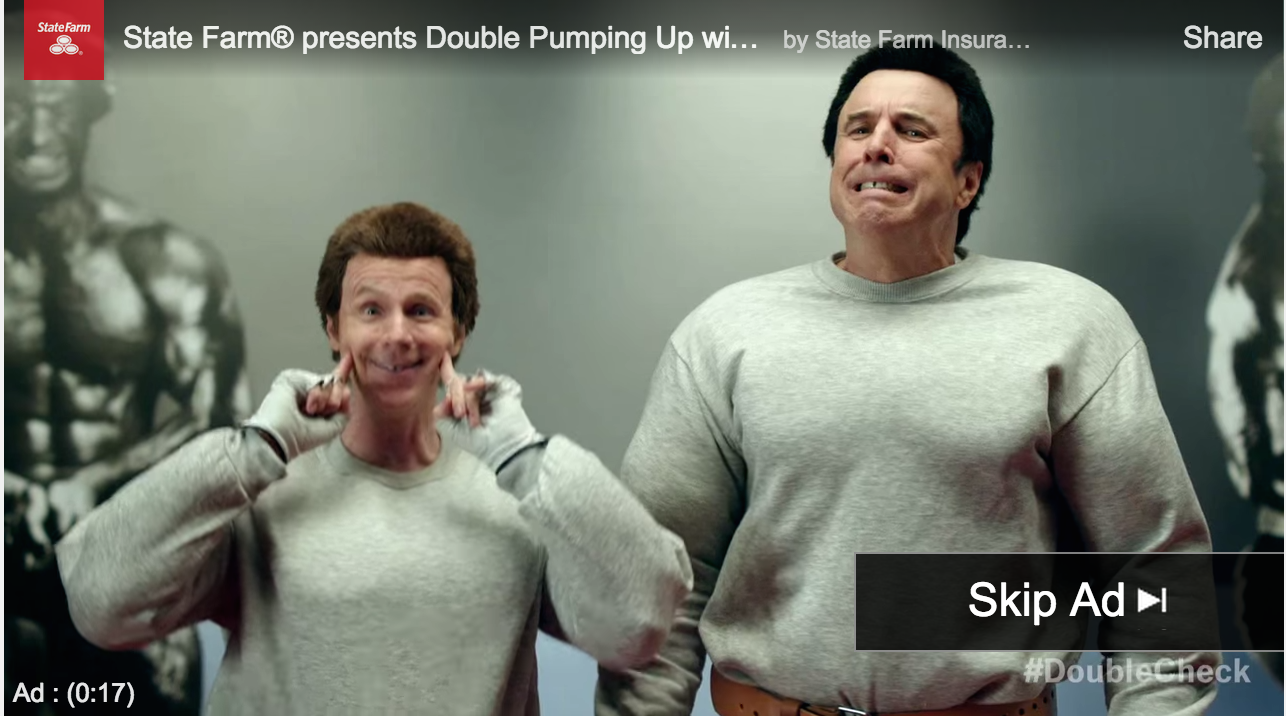
Coincidentally, the YouTube ad attached to the above video from Key and Peele featured an old SNL duo:

Screen Shot 2014-10-25 at 10.30.42 AM

Introducing The Reality Novel

We used to work through social problems with novels, writes Tim Parks, but what if we’ve now entered the era of “reality fiction”?

Readers have become so canny about the way fiction works, so much has been written about it, that any intense work about sexuality, say, or race relations, will be understood willy-nilly as the writer’s reconstituting his or her personal involvement with the matter. Not that people are so crass as to imagine you are writing straight autobiography. But they have studied enough literature to figure out the processes that are at work. In fact, reflecting on the disguising effects of a story, on the way a certain set of preoccupations has been shifted from reality to fiction, has become, partly thanks to literary criticism and popular psychology, one of the main pleasures of reading certain authors. What kind of person exactly is Philip Roth, Martin Amis, Margaret Atwood, and how do the differences between their latest and previous books suggest that their personal concerns have changed? In short, the protection of fiction isn’t really there anymore, even for those who seek it.

Parks goes on to consider the thoughts of David Lodge, who wrote recently in Lives in Writing that “as he gets older he finds himself more interested in ‘fact-based writing’ than in fiction and goes on to offer an account of the lives of eleven writers, most of them novelists”:

Lodge explains his new interest in fact rather than fiction in his typically low-key manner, as merely “a common tendency in readers as they age, but it also seems to be a trend in contemporary literary culture in general.” Very casually, without any further elucidation, that is, Lodge has suggested that both as individuals and as a culture we can expect to grow out of fiction. It was a phase. All the same, the facts that Lodge turns out to be interested in, when we turn to his recent novels or to Lives in Writing, are the lives of people who wrote fiction—Kingsley Amis, Graham Greene, Muriel Spark, Anthony Trollope—and what interests him is how these people transformed their personal concerns into novels. …

So has fiction now outlived one of its sustaining purposes? That is the question Lodge, Dyer, Coetzee, Knausgaard, and many other writers are posing (one thinks in particular of David Shields’s madly provocative Reality Hunger). It could be we are moving towards a period where, as the writer “gets older”—as Lodge has it, carefully avoiding the positive connotation of “matures” or the negative of “ages”—he or she finds it increasingly irrelevant to embark on another long work of fiction that elaborately reformulates conflicts and concerns that the reader anyway assumes are autobiographical. Far more interesting and exciting to confront the whole conundrum of living and telling head on, in the very different world we find ourselves in now, where more or less anything can be told without shame. Whether this makes for better books or simply different books is a question writers and readers will decide for themselves.

A Natural Subject

dish_horst

Antonia Wilson praises Patterns From Nature, a new collection of “largely unseen, kaleidoscopic and abstract works” by the 20th-century photographer Horst P. Horst:

The book draws from the original 1946 publication of the same name, along with presenting a larger selection of unpublished images from the photographer’s archive. The series is distinctly set apart from the high glamour that his is predominantly known for, as a revered figure of the fashion industry, who worked for Vogue and House & Garden for sixty years, documenting couture, celebrities and interiors. …

The original book presented a series of straight, close-up, black-and-white shots of botanical specimens, including plants, shells, and minerals, naturally lit and often experimental in composition … “For the most part, the pictures found here [are] of common objects daily passing before our eyes. Nothing has been added to enhance them. They are photographed without artificial arrangements and special effects, in their own setting and in their paper light. Direct or diffused sunlight coming from above caresses their surface and in some instances dew or rain brings relief into their fine texture,” Horst writes.

Meanwhile, Ben Pentreath revisits a different side of Horst’s work, reviewing his 1965 volume, Vogue’s Book of Houses, Gardens, People:

Horst’s subjects are at ease with him and he with them. Through his lens, we see the rich, powerful or artistic – “the beautiful people” as [Vogue editor Diana] Vreeland called them – relaxing in their own spaces, smiling, apparently unaware at all of the immortality that Horst’s all-seeing camera was to bestow upon them, and equally appear unaware of their often staggering wealth and privilege. …

Many of Horst’s photographs are shot through softly focused foreground flowers, or candlesticks, silver or glass, as if to impart a mood of artlessness. We just happen to be here, looking in at this world, Horst seems to say: enjoy it while it lasts. Perhaps it is this sense of fragility that makes Houses, Gardens, People so poignant and enduring. There is the quality of the hastily taken image that belies the extent to which Horst composed his interior photographs, often rearranging furniture and entire rooms. Do we find here something of the mood of the voyeur of our own age, artist Alison Jackson, who goes to extraordinary lengths, with the help of celebrity lookalikes, to create views that look utterly casual? Maybe – but while Jackson’s subjects are fake, Horst’s are real.

(Image usage courtesy Merrell Publishers of London & New York)

Octo-Blog Of The Day

dish_fairbankspus

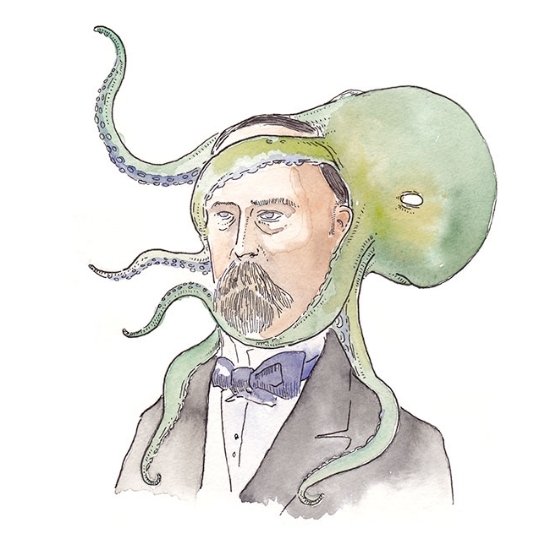
Jonathan Crow’s Veeptopus is everything you could want from a portrait series of US Vice Presidents being mauled by cephalopods. (Above is Charles W. Fairbanks, second-in-command to Teddy Roosevelt.) Katherine Harmon Courage, octo-blogger extraordinaire, recently interviewed Crow about the project:

KHC: Why the veeptopus? By that I mean, why vice presidents—not presidents, baseball commissioners, or Swedish royal family members? And why with octopuses—not giant moths, sloths, or cuttlefish?  

JC: The Vice Presidency is sort of an absurd job. It bestows all the pomp and import of the United States Government—the most powerful political body in the world—but the job itself, as defined by the Constitution, is vague and poorly defined. All it requires is for the veep occasionally preside over the Senate and check on the president’s health. Basically, the VP spends his term struggling to define himself while waiting for death. How existential can you get?

I added the octopuses because I thought they were funny. I could say it’s a metaphor for the morally corrosive nature of power or Capitalism or something like that. But the real answer is, I just think they’re funny. And they also drape so much better than wombats.

KHC: I love that each octopus seems to approach the role of headpiece with a very different attitude. How did you decide what the positioning would be? Was it partially dictated by the veep’s legacy? 

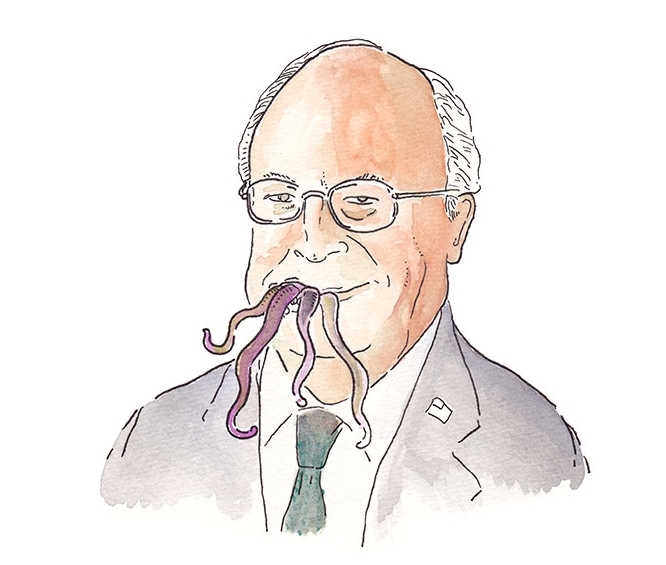
JC: Sometimes the position of the octopus was a comment on the veep — see Hubert Humphrey and Dick Cheney — but more often than not, its position was determined by practical considerations. I didn’t want to cover distinctive features—Nixon’s jowls, Nelson Rockefeller’s glasses, Charles Fairbanks’s beard. So I figured out other places on the face and head to put them. On the flip side, tentacles can be really helpful for troublesome facial features. Al Gore has a really odd face that doesn’t really seem like it ought to hang together. He has a hawk-like nose, strangely full lips and really sparse eyebrows. I think I drew him six or seven times before I got him right and even then I made a point of covering much of his face with a well-placed tentacle.

Browse through Crow’s collection of drawings here, and purchase prints of his work here. We’ll leave you with a Cheney-pus:

dish_Cheneypus2

Looking Back At Berryman

On the centenary of John Berryman’s birth, Daniel Swift reflects on his poetic legacy:

Berryman has not been canonized, quite; he has not continued to receive the respect, even awe, accorded to his great contemporaries Robert Lowell and Elizabeth Bishop. This may be because he appears a little less serious than them. He is certainly funnier than they are, constantly mirthful about the process of critical celebration and literary canonization. “[L]iterature bores me, especially great literature,” complains “Dream Song 14.” “Henry bores me, with his plights & gripes / as bad as achilles,” it continues, and the joke is only half that Henry [the “sad man” character in his collection The Dream Songs] is no Achilles. It is also in the mismatch of classical literature and teenage ennui, balanced by the voice.

Swift goes on to argue that Berryman’s eventual suicide shouldn’t overshadow his work:

There is a strong temptation to read Berryman’s life as tragic, to see in it a parable of art and suffering. His biographers and critics find it hard to resist this precisely because Berryman himself leads them to it. In 1955, he wrote a fragmentary memoir of his school days, and he called it “It Hurts to Learn Anything”; throughout his life he repeatedly expressed his belief in a kind of equation of suffering and creativity. In 1965, when asked by a newspaper interviewer about the elements of good poetry, he replied, “Imagination, love, intellect—and pain.
Yes, you’ve got to know pain.”

(Video: Berryman reads Dream Song 29)

It’s A Hard Smock Life

BFAMFAPhD_ArtistsReportBack2014-8-1

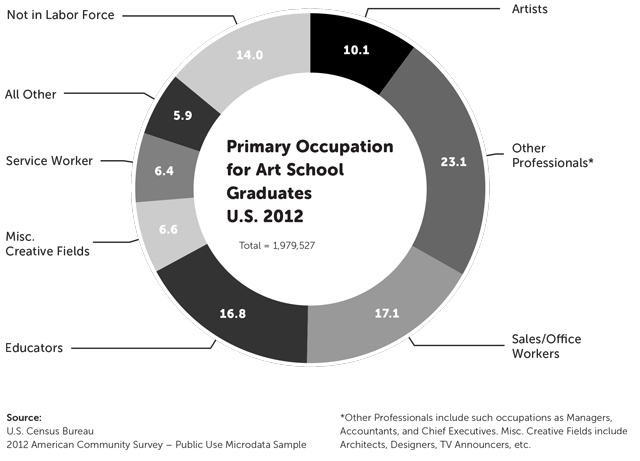
A new analysis of Census Bureau data indicates that art students have a mere 1-in-10 chance of becoming working artists. And that’s not all:

Most surprising was the lack of overlap between working artists and arts graduates. In the United States, 40 percent of working artists do not have a bachelors degree in any field. Only 16 percent of working artists have arts related bachelors degrees. Though arts graduates may acquire additional opportunities and skills from attending art school, arts graduates are likely to graduate with significant student loan debt, which makes working as an artist difficult, if not impossible. … Although there are 1.2 million working artists over the age of 25 in this country, there are only 200,000 working artists with arts-related bachelors degrees. The majority of working artists have median earnings of $30,621, but the small percentage of working artists with bachelors degrees in the arts  have median earnings of $36,105.

But Alexis Clements is skeptical:

Most reports about artists that I’ve seen (and I’ve seen a fair number) that are based on quantitative data are pretty fuzzy when it comes to the thing that many artists would love to know: How much money do artists make from their creative work?

Why is the data so imprecise? Because almost everything about the ways that artists work seems to defy typical practices for collecting labor and earnings statistics. By and large, it appears that labor statistics, like the ones collected in the American Community Survey, generally assume that most workers have a single or primary job that provides the largest share of their earnings and that job is comprised of a bounded set of tasks or modes of earning money — for example, if you say you are an auto mechanic, the assumption is that you earn most of your money fixing cars. But as many artists know, when you say you’re an artist, how you earn your money can and often does come from a wide array of sources — it could be sales or commissions, it could be royalty payments, fees for presenting work, or teaching in various forms, which many artists lump into their occupation as an artist. … All of this makes it really tough to understand what income really means for an artist when you’re trying to isolate their artistic earnings.

(Image from Artists Report Back: A National Study on the Lives of Arts Graduates and Working Artists)

Why Women Belong On Mars

dish_marspic

Last year, Kate Greene and five teammates simulated living conditions on Mars for a NASA-funded project (the experiment actually took place on a volcano in Hawaii). What she noticed while collecting and managing data:

Week in and week out, the three female crew members expended less than half the calories of the three male crew members. Less than half! We were all exercising roughly the same amount—at least 45 minutes a day for five consecutive days a week—but our metabolic furnaces were calibrated in radically different ways. During one week, the most metabolically active male burned an average of 3,450 calories per day, while the least metabolically active female expended 1,475 calories per day. It was rare for a woman on crew to burn 2,000 calories in a day and common for male crew members to exceed 3,000.

Female astronauts, Greene suggests, may simply be more cost-effective than male ones:

The more food a person needs to maintain her weight on a long space journey, the more food should launch with her. The more food launched, the heavier the payload. The heavier the payload, the more fuel required to blast it into orbit and beyond. The more fuel required, the heavier the rocket becomes, which it in turn requires more fuel to launch.

Rachel Nuwer adds:

Greene is not alone in this thinking. Alan Drysdale, a systems analyst in advanced life support and a former contractor with NASA, supports the idea of selecting for astronauts with smaller body sizes, including women. According to some figures Drysdale crunched, the smallest women in the NASA program require half the resources of the largest men, Greene reports. “There’s no reason to choose larger people for a flight crew when it’s brain power you want,” he told Greene.

(Computer-generated image of Mars at the boundary between darkness and daylight via NASA/JPL-Caltech)

The Psychology Of Heroes

Katy Waldman cites new research on the subject. One finding? Heroes tend not to over-think it:

In a study out last week in the journal PLOS ONE, Yale researchers recruited more than 300 volunteers to read statements by 51 contemporary “heroes.” These men and women had all received the Carnegie Hero Medal for “civilians who risk their lives to save strangers”; the experimenters wanted to know whether they had acted without thinking or after exerting “conscious self-control” in order “to override negative emotions like fear.”

The volunteers—and a computer algorithm, for safesies—analyzed the medal winners’ statements for evidence of careful thought, or of unpremeditated action. Overwhelmingly, they found that day-savers rescue first and reflect second. As Christine Marty, a 21-year-old student who wrested a trapped senior citizen from her car during a flash flood, said, “I’m thankful I was able to act and not think about it.” Study author David Rand noted that people playing economic games are similarly less likely to share resources when they ruminate about their moves, but more generous when they don’t take time to consider strategy.

Waldman goes on to note previous studies that shed light on the thoughts of altruistic risk-takers:

In 2005, researchers ran personality tests on 80 Gentiles who risked their lives to shelter Jewish refugees during the Holocaust, as well as 73 bystanders. Two interesting commonalities arose among the “heroes”: First, they were more likely to embrace, or at least tolerate, danger. Second, they were more likely to say they interacted frequently with friends and family. These findings expanded on a classic 1970 study of 37 Holocaust rescuers, in which researchers determined that the helping Gentiles were animated in part by “a spirit of adventurousness.” (Related but more prosaic: Studies suggest that “sensation-seeking” is positively correlated with the willingness to give blood.) In 1984, scientists John P. Wilson and Richard Petruska determined that “high-esteem” college students—those who believed they were worthy and competent—more often rushed to aid an experimenter during a simulated explosion, while “high-safety” students, driven by a need for security and the desire to avoid anxiety, were less likely to lend a hand. In the realm of smaller, but still substantial, risk, 74 percent of kidney donors interviewed for a 1977 study said they put great faith and trust in people, compared with only 43 percent of non-donors.

Why Do Americans Go Out Sick? Ctd

A reader shakes his head:

The post this morning in which Julia Ioffe blames American individualism for the tendency of Americans to go to work or school sick is missing the fundamental cause. According to a report by the Center for Economic Policy and Research, the United States is the only advanced economy that doesn’t guarantee paid vacation time and is one of only a few rich countries that doesn’t require employers to offer at least some paid holidays. A full quarter of the US workforce receives no paid vacation or holiday time. It shouldn’t be surprising to find that when faced with the prospect of not getting paid or giving up scarce vacation days, American workers choose to show up sick.

Another notes that even businesses with sick-leave policies discourage workers from calling in with the flu:

Many companies pay employees not to use sick time, encourage them to ration it for when things get “really bad,” or actively prohibit its use. For example, they have policies that don’t allow employees to use sick time during their “probationary period” of six months to a year. This makes it seem normal to go about business as usual even when you feel like something the cat dragged in off a pile of hazmat suits.

Another adds, “Even if you get sick leave and using it doesn’t cut your vacation, you’d better not use more than half of it in any given year unless you’re actually in the hospital”:

Because if you do, management will assume that either a) you’re calling in sick when you are not in order to get a paid day off, or b) you’re a slacker who is unwilling to put out a little extra effort in order to get the job done. Either of which is grounds for termination, or at the minimum a bad performance review, which will get you to the head of the queue next time layoffs come around. The job is, obviously, more important than something trivial such as the health of the staff.

Note also that, if your job allows telecommuting, you will be expected to be working from home, even if you stay home because you are sick.

Another illustrates how sick children can be a major factor:

I’ve lived in rural South Texas for 35 years, and my two children attended a public elementary school in a very small town. In order to encourage economically disadvantaged children with limited English skills to get all the way through high school, our area rewards children at the elementary level for “100 percent attendance.” This isn’t strictly a rural phenomenon; I believe our nearest metropolitan area, a city of several hundred thousand people, has a similar practice.

As a result, the number of children who would show up at my kids’ school with fevers and running noses was appalling. Their parents would drop them off with a cheery and proud assurance that this was at their child’s insistence: “They want to win that attendance award!” So civic responsibility was removed from the list of things learned at school early on. Lately, I believe, a regular school nurse has started removing children who are running a fever from class.

And consider the problem of families with working parents. What does one do with a sick child who should be at home in bed when no one is home to care for them and paid child care is out of the question? Indeed, many Americans, with or without children, go out sick because they have no other alternative if they want to pay their bills. These are not the people Julia Ioffe is describing – people who are, indeed, insufferably self-centered and who do more damage showing up for work sick than they realize.

Protestant work ethic? Nah. Just being a self-centered asshole? Could be. Just trying to get by? More likely.