One commonly proposed solution to the organ shortage derives from behavioral economic “nudge” principles. Rather than requiring Americans to complete paperwork in order to opt-in to donation at death, the country could shift to the European model of presuming that donation at death was acceptable. But Tom Mone, chief executive of OneLegacy, the nation’s largest organ and tissue recovery organization, points out that “The recovery rate for deceased donors in the United States is actually better than that of European nations with presumed consent laws. The United States rigorously follows individual donor registrations whereas presumed consent countries actually defer to family objections.”
In any event, because less than 1% of deceased individuals are medically eligible to donate organs, and 75% of this group in the United States in fact does so, there simply isn’t enough “there there” to remedy the shortage with improved recovery from deceased donors.
He interviews Sally Satel, who advocates for compensating living donors:
No one is talking about a traditional free market or private contract system. No organ “sales.” And no large lump sum of cash to donors. Those of us who want to test the power of incentives to increase the number of people receiving kidney transplants – and it is a rich network of transplant surgeons, nephrologists, legal scholars, economists, and bioethicists – envision a system where every needy patient, not just the financially well-off, can benefit.
Here is one model: a governmental entity, or a designated charity, would offer in-kind rewards, like a contribution to the donor’s retirement fund, an income tax credit or a tuition voucher, or a gift to a charity designated by the donor. Because a third party provides the reward, all patients, not just the financially secure, will benefit.
Eric Posner supports the charitable donation option:
Suppose that Martha needs a kidney for her daughter but Frank’s son does not need a kidney. Martha proposes to Frank that if Frank donates his kidney to her daughter, Martha (or, actually, Martha’s insurer, which, remember, wants to avoid the high cost of dialysis) will make a $100,000 contribution to Frank’s favorite charity—say, Doctors Without Borders, which could use the money to combat Ebola in Liberia. Frank, of course, might say no; but there are likely other people who might be willing to take Martha up on the deal.
I am nerdy, but not a nerd. Let me explain. I am nerdy because I have a Joker bobble heads on my desk, I have Final Fantasy VI on my phone and a Stay-Puft Marshmallow Man keychain. But I’m also an attorney, a theater major, a lover of F. Scott Fitzgerald and a Dish Subscriber. I am nerdy because I am fluent in Batman and love video games. But I am not a nerd, because if you are not interested in those things, I am capable (nay, enjoy) discussing other things. Current events, dramas, poetry, even baseball. In short, I am more than the things I love. nerdy things does not make one a nerd. A nerd is a person who can only view life through the things they are obsessed over. It doesn’t matter how they got there, what matters is their inability to see their own tunnel-vision. Therefore, yes, there are sports nerds, political junkie nerds, historical accuracy nerds. They’re everywhere, and they want what they want on their own terms. Alas. Here’s a guy who said it better – Robert Ebert on Revenge of the Nerds II:
These aren’t nerds. They’re a bunch of interesting guys, and that’s the problem with “Revenge of the Nerds II.” The movie doesn’t have the nerve to be about real nerds. It hedges its bets. A nerd is not a nerd because he understands computers and wears a plastic pen protector in his shirt pocket. A nerd is a nerd because he brings a special lack of elegance to life. An absence of style. An inability to notice the feelings of other people. A nerd is a nerd from the inside out, which is something the nerds who made this movie will never understand.
Another reader:
Holy shit. As problematic as the actual content of what this reader wrote is, I find it absolutely spot on as an explanation for why I drifted away from all those stereotypical subcultural things that nerds are into: comic books, video games, sci-fi/fantasy, etc. Loved them as a shy and awkward kid. Learned how to deal with others, be sociable, talk to girls, and get laid when I was about 16. And it wasn’t like I didn’t still enjoy those things. No, it was that it seemed everyone else who enjoyed them was, as your reader writes, in some various stage of arrested development, and pretty insufferable to be around (e.g. “because we’re smarter than the idiots who wouldn’t let us in”). This was two decades ago: I kind of wish the mainstreaming of the things I like had happened back then, because then I could have continued to enjoy them without having to deal with the basement dwellers.
Several, less churlish readers sound off:
Hi Chris, Andrew, and team! I’ve been reading the Dish on and off for more than 10 years, and this is the first topic I’ve ever felt inspired to write in about. Forgive me if this is long, but I feel that a lot of people have been led astray by Gamergate.
First, thank you for posting Jesse Singal’s Reddit letter. It clarified a lot of things for me. Another truly excellent article that clarifies the fog that is GamerGate is by Katherine Cross. Second, I have a response to your reader who wrote:
I went home and played videogames because I couldn’t play sports and didn’t have the competitive instinct, but eventually the jocks followed me home, demanding sports games and fighting games and soon the market shifted to cater to them, leaving me to find another thing. Then it was comics, and then the dopes followed me home again and demanded lowest common denominator action nonsense with the names of the things I liked slapped onto them. This is the plight of the nerds; we have to listen to media morons talk about how mainstream being a nerd is as what we love, what we devote our lives to, is co-opted by the very people who we sought escape from through our eclectic obsessions.
I’ve liked “nerdy things” since I was a kid who collected comics, played D&D, read fantasy and sci-fi, had encyclopedic knowledge of the Star Trek and Star Wars universes. I don’t know if that makes me a nerd. I know I definitely had my moments of feeling socially outcast when I was a kid who liked to make manga drawings in class. Regardless, I disagree with your reader’s chronology of the special worlds that belonged to nerds only. Some of these things have never been nerd only. I’m definitely not a hardcore gamer. But even what little I know of games shows your previous letter-writer is wrong about jocks forcing the industry to cater to them by producing “sports and fighting games”. Wikipedia clearly shows that video games have been featured sports in some form or other since the very beginning. (Um, what is Pong?? or Atari Olympics (1977)?) American football was all the rage on NES starting in 1989 with Tecmo Bowl. Street Fighter II is one of the most popular games of all time (fighting or otherwise). It came out in 1991. Did the jock takeover happen then? No. The majority of nerds I knew loved Street Fighter. And the ones who didn’t were partisans of other fighting games like Mortal Kombat. Now let’s talk comics. I’ve been buying comics for decades. I can tell you from both personal experience and some reading about the history of the industry, comics have always been a mass medium. For a long time, it was decidedly not a niche for nerds only. From the 1930s to the 1960s, they were read by boys and girls, nerds, jocks, and everyone in-between. That’s just in the US. Obviously, comics are still popular across all demographics today in Japan. Sure, comics became less of a universal medium in the US as other forms of popular entertainment became important (esp. TV and rock music in the 1950s and 60s), but it’s wrong to think that somehow the jocks decided to only invade comics sometime in the ’80s or ’90s or 2000s. It was theadult and teenage male nerds in the 1980s who celebrated the rise of the grim, dark, revisionist comics of the 80s (exemplified by The Dark Knight Returnsand Watchmenand almosteverything by Frank Miller in this period). Jocks didn’t do this. Nerds did. And we loved it (except when we are arguing about it ;) ). And we kept collecting – before, during, and after the comics bubble burst in the early ’90s. This desire to keep the world of comics, games, or other nerd-dom free of politics shows no sense of history and a lack of self-awareness.
Another points to more history:
Here is a very interesting factoid that should enliven the debate: while in the late ’60s role-playing games and D&D were the province of males, StarTrek fandom was essentially a female endeavor. All the early fanzines, the fan fiction, the early conventions and the devotion to the universe were driven by female fans. It is well known in the world of fandom that ladies are those who make their own gear and costumes. Very few guys do (except Adam Savage, of course). Guys buy stuff. That is also why most of the advertising is directed at boys – it is well known that “girls don’t buy the fuckin’ toys” and therefore nerd programming for women is of little use to the entertainment industry. A recent StarTrek fan survey done by an anthropologist showed that 57% of fans are female. On the role of female fans, I recommend reading Prof. Henry Jenkins’ Textual Poachers. If you set aside the usual comp-lit/de Certeau/post-structuralist blah blah, it’s a fascinating book that destroys the myth of the nerd as a young man (with Spock ears). Early fandom was female and queer.
Speaking of the gays, another reader:
Like nerd culture, gay culture has recently seen a great deal of upheaval, going from an ostracized and marginalized fringe to a wide acceptance from the mainstream that happened in a relatively short period of time. I’ve long felt these two groups shared some similarities in their shunting from normal society, and now they are in similar positions in their cultural evolution. There are some parallels beyond the sudden co-opting by the masses. Take the comic-book/gaming shop as an analog for a gay bar. Pre-internet, the back rooms of comic shops were the first place that many nerds first found their like-minded compatriots after a lifetime of ridicule and ostracism from the mainstream. Also, the importance of these places are being diminished by both the Internet becoming the de facto hangout for these groups, their acceptance in less specialized areas of society, and less persecution in general, which made the need for strength-in-numbers support less of an issue. The “self-identified” nerd you posted rings just the same as the “gay kids today have no idea how hard it was” types. I also self-identify as a nerd, and have done so for 30-plus years, so I know all about the dark days. However, I choose to embrace this influx of interest rather than try to maintain an air of purity that is as artificial as calling someone a “fake” geek. Genuinity of someone’s “Geek Cred” is an arbitrary and pointless exercise that will differ radically from person to person based on whatever they consider to be a “real nerd” and is a fallacy both old and well known to many as “No True Scotsman”. Young, old; man, woman; newbie, vet. Everyone brings something to the nerd table. Those who are constantly trying to keep the gates closed are having trouble adapting. They aren’t trying to contribute or preserve the culture, they are trying to devolve it. The environment just isn’t the same, and it is not going to go back. Thank God.
Follow the whole discussion on Gamergate and nerdom more generally here.
After a two-hour meeting between Hong Kong officials and protest leaders made no real progress toward resolving the standoff, the demonstrations continued yesterday, including some 200 protesters marching to the home of the territory’s Chief Executive Leung Chun-ying. Many are reportedly outraged over comments Leung made to the foreign press on Monday insisting that open elections were unacceptable because they could give the poor too much of a voice:
In an interview with a small group of journalists from American and European news media organizations, [Leung’s] first with foreign media since the city erupted in demonstrations, he acknowledged that many of the protesters are angry over the lack of social mobility and affordable housing in the city. But he argued that containing populist pressures was an important reason for resisting the protesters’ demands for fully open elections. Instead, he backed Beijing’s position that all candidates to succeed him as chief executive, the top post in the city, must be screened by a “broadly representative” nominating committee appointed by Beijing. That screening, he said, would insulate candidates from popular pressure to create a welfare state, and would allow the city government to follow more business-friendly policies to address economic inequality instead.
Beinart ties this in with the debate over voter ID laws and early voting in the US, arguing that “Leung’s views about the proper relationship between democracy and economic policy represent a more extreme version of the views supported by many in today’s GOP”:
In 2010, Tea Party Nation President Judson Phillips observed that “The Founding Fathers … put certain restrictions on who gets the right to vote … one of those was you had to be a property owner. And that makes a lot of sense, because if you’re a property owner you actually have a vested stake in the community.”
In 2011, Iowa Representative Steve King made a similar observation, noting approvingly, “There was a time in American history when you had to be a male property owner in order to vote. The reason for that was, because [the Founding Fathers] wanted the people who voted—that set the public policy, that decided on the taxes and the spending—to have some skin in the game. Now we have data out there that shows that 47 percent of American households don’t pay taxes … But many of them are voting. And when they vote, they vote for more government benefits.”
In 2012, Florida House candidate Ted Yoho remarked, “I’ve had some radical ideas about voting and it’s probably not a good time to tell them, but you used to have to be a property owner to vote.” Yoho went on to win the election.
Philips, King, and Yoho are outliers. Most prominent Republicans would never propose that poor people be denied the franchise. But they support policies that do just that.
Concluding a series of conversations with philosophers of religion – many of which we’ve featuredonthe Dish – Gary Gutting conducts a self-interview, posing and answering the question:
G.G.: How can you be an agnostic and still claim to be a Catholic?
g.g.: Because, despite my agnosticism, I still think it’s worth pursuing the question of whether God exists, and for me the Catholic intellectual and cultural tradition has great value in that pursuit.
G.G.: Still, I don’t see how you can find a place in a church that claims to be the custodian of a divine revelation, when you don’t believe in that revelation.
g.g.: The fundamental revelation is the moral ideal expressed in the biblical account of Christ’s life.
Whether or not that account is historically accurate, the New Testament Christ remains an exemplar of an impressive ideal. Engagement with the practices (ethical and liturgical) inspired by that ideal is the only requirement for being a Catholic. Beyond that, historical narratives and theological doctrines can at least function as useful means of understanding, even for those who aren’t prepared to say that they are true in any literal sense. Some believers may have experiences (or even arguments) that have convinced them that these doctrines are true. But religions — even Catholicism — should have room for those who don’t see it that way.
G.G.: So it seems that you agree with most of your interviewees — believer and nonbelievers — that practice is more important than doctrine.
g.g.: Yes, and I agree with Kitcher that the greatest obstacle facing atheism is its lack of the strong communal practices that characterize religions. People need to believe something that provides a satisfying a way of living their lives, and most people need to find this in a community. So far atheism has produced nothing like the extensive and deep-rooted communities of belief that religion has.
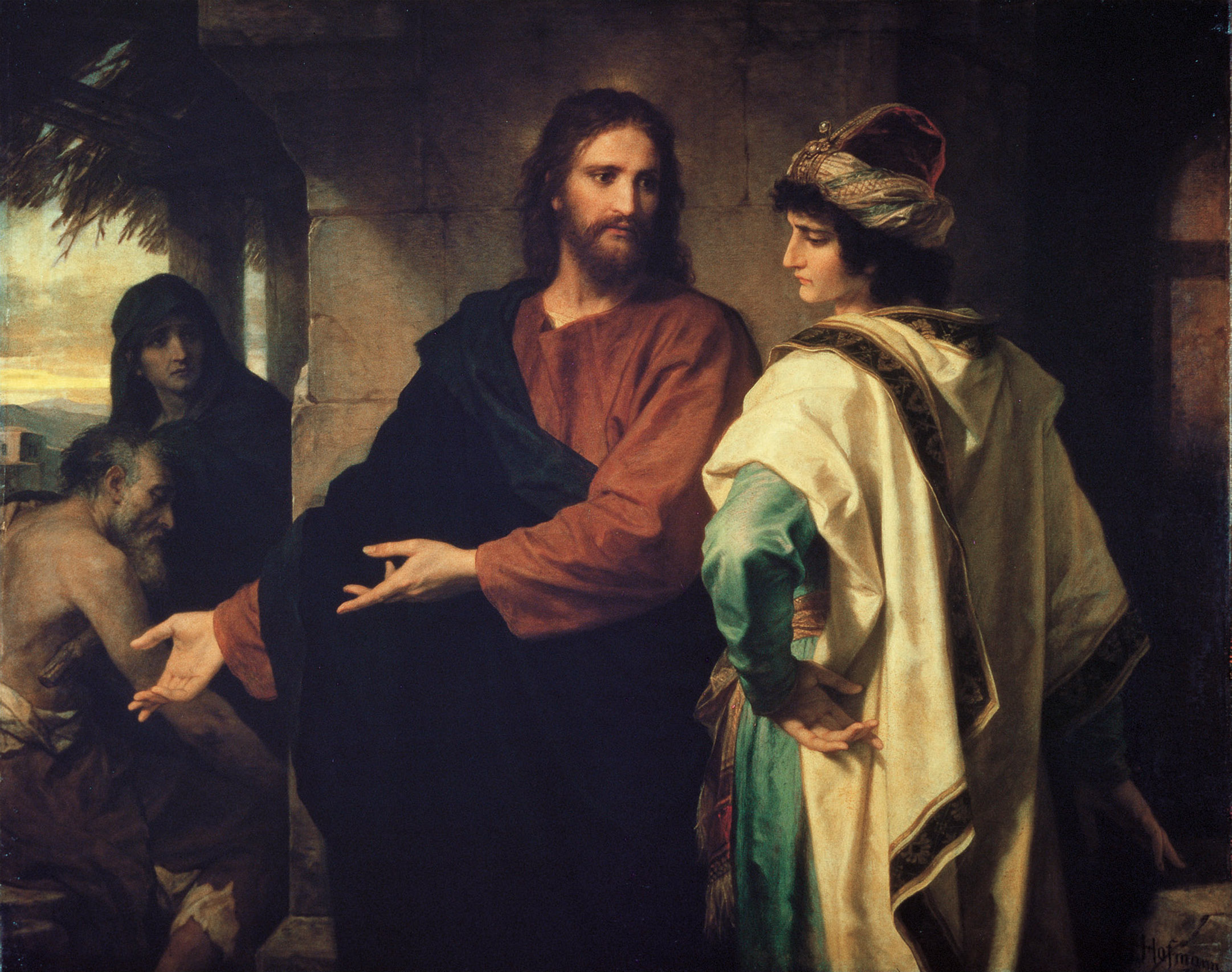
(Image: Christ and the Rich Young Ruler by Heinrich Hofmann, 1889, via Wikimedia Commons)
British MP Rory Stewart reviews Anand Gopal’s No Good Men Among the Living: America, the Taliban, and the War Through Afghan Eyes, which “demonstrates that the failures of the intervention were worse than even the most cynical believed”. In particular, Stewart praises the insight Gopal brings to just how ethically compromised our alliances with Afghan warlords really were:
His long interviews with warlords, his sympathetic accounts of their youth and sufferings, make their crimes only more convincing and more shocking.
Thus he interviews Jan Muhammed at length, tracing his rise from school janitor to major resistance commander in the fight against the Soviet Union. He describes his being imprisoned, the tortures he suffered, and his being marched out to face a Taliban firing squad. He describes how Jan Muhammed saved President Karzai from an ambush in the 1990s and then became his friend and adviser. All this, however, is the introduction to Jan Muhammed ordering death squads to shoot unarmed grandfathers in front of their families, to electrocute and maim, and to steal people’s last possessions, in pursuit of an ever more psychopathic crusade to eliminate anyone associated with the Taliban or indeed with a rival tribe. No one reading Gopal would be tempted to joke about these men again, or present them simply as “traditional power-brokers” and “necessary evils.”
Peter Tomsen compares Gopal’s work to two other recent books on Afghanistan by Carter Malkasian and Carlotta Gall, which focus more on how Pakistan—”the true enemy”, in Gall’s words—was playing a double game all along:
Unlike Malkasian and Gall, Gopal does not depict Pakistan as the primary spoiler in Afghanistan. And he rejects the conventional wisdom that the Afghan war went astray only because Washington took its eye off the ball by shifting its attention to Iraq. He puts forward a different hypothesis: “Following the Taliban’s collapse, al-Qaeda had fled the country. . . . By April 2002, the group could no longer be found in Kandahar — or anywhere else in Afghanistan. The Taliban, meanwhile, had ceased to exist. . . . The terrorists had all decamped or abandoned the cause, yet U.S. special forces were on Afghan soil with a clear political mandate: defeat terrorism.” This, Gopal claims, presented Washington with a puzzle: “How do you fight a war without an adversary?” The answer, he writes, was supplied by Afghan warlords who saw an opportunity to consolidate their power with the unwitting assistance of the Americans — and to get rich in the process.
But Tomsen finds Gopal’s conclusion only halfway convincing:
There is merit to Gopal’s thesis that the U.S. partnership with unpopular warlords helped open the way for the Taliban’s return. But Gopal errs in concluding that the Taliban had “ceased to exist” in Afghanistan after the group’s leaders fled back to their former Pakistani sanctuaries following the U.S.-led invasion. Thousands of Taliban foot soldiers, along with scores of midlevel leaders and commanders, had merely gravitated back to the protection of clans and tribes in Afghan villages and mountains, ready to fight another day. And although Washington’s embrace of warlords helped the Taliban win public support after regrouping, the militants would not have been able to return to Afghanistan in force without Pakistan’s assistance.
Pew finds that men and women experience different sorts of online harassment:
Jake Swearingen sees how “men, on the whole, report higher rates of less severe types of harassment (with the exception of physical threats), while women are more likely to be the focus of the two most frightening forms of it: sexual harassment and stalking.” Elise Hu connects the Pew survey to Gamergate:
The Pew research supports the notion that women are less welcome in the world of online gaming. Survey respondents, who were both men and women, were asked about a series of online platforms — social networks and online commenting forums, for example — and whether they thought those platforms were more welcoming to women, equally welcome to both sexes or more welcoming toward men. The findings show that while most online environments are viewed as equally welcoming, gaming is not. “The starkest results were for online gaming,” the researchers write, where 44 percent of respondents said the platform was more welcoming to men.
But Amanda Hess acknowledges the limits of Pew’s survey:
Pew asked respondents to elaborate on their experiences with harassment, and the resulting collection of anonymous accounts speaks to the difficulty of arriving at a shared definition of what “harassment” even is.
One respondent said that they were “told that someone should rape me which was horrific since it’s one of the things I fear most”; another “was called a racist on a blog for criticizing administration lies.” One said that a “man I went to high school with was sending me inappropriate photos and comments of a sexual nature”; another experienced “Chiding … for their likes and dislikes in things such as sports, cars, athletes, colleges football teams, things of that nature.” One was “told that if I stopped communicating with this man he would find me and rape me”; another reported that “any feminist who doesn’t already know me has been quick to characterize me as a privileged, misogynistic rape apologist.”
Is being called a rape apologist the same as being threated with rape? No, but it’s all harassment here. Whatever it is, it affects women and men differently; the study found that 38 percent of harassed women said their most recent experience with harassment was “extremely or very upsetting,” compared with 17 percent of harassed men. …
This is not to say that we know that women have it worse on the Internet. It’s to say that, so far, we just don’t know. What the Pew study does show is that the Internet is producing a lot of garbage, and men and women are served different flavors. Understanding exactly how that works will require better definitions and more dedicated study.
Timothy B. Lee recently interviewed legal scholar Danielle Citron, who suggests that things have gotten better:
TBL: You’ve been writing about this issue [of online harassment] since 2009. How do you see public attitudes shifting on this issue since you started?
DC: It’s been amazing, I have to say. I’m still not totally sold on the idea that we all agree this stuff is bad. But social attitudes have really shifted in the last two years. I gave a presentation at Yale in early 2008 about the problem of cybermobs and online harassment, and at the time the pushback to do anything about this was so profound. It was like “look, don’t touch the internet, you’re going to break it. Regulating it is going to cause more problems than good.” In the last couple of years, this phenomenon of revenge porn has brought alive the harm — maybe just because people can envision people they care about experiencing it.
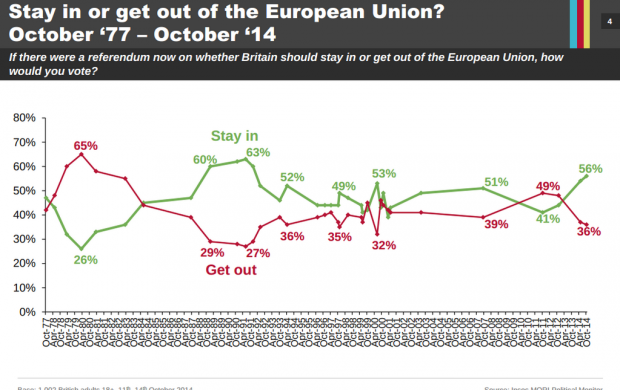
Ipsos Mori shows that support for the EU at its highest level since 1991. YouGov’s EU referendum tracker also gives the status quo a narrow lead by 40 per cent to 39 per cent this month. How can this be when Ukip is running rampant? The truth is that for all the cocky Ukip rhetoric about a people’s army, the party appeals to nothing like a majority.
Alex Massie suspects that “that UKIP, paradoxically, tarnish and hamper their own cause”:
UKIP may help kill the thing they love the most. Without realising it, they may actually limit support for leaving the EU. UKIP may put a ceiling on euro-scepticism not a floor. And the more attention and publicity UKIP enjoy the lower that ceiling may become.
UKIP has been gaining support because it presents itself as an anti-establishment political movement, because it taps into dissatisfaction with the country’s immigration policies, and because it has used populist rhetoric to appeal to working-class voters. It also serves generally as a vehicle for protesting the political class as a whole. Many others have observed with some amusement that this makes UKIP very much like nationalist protest parties all across Europe. It doesn’t follow from this that its new supporters find its main goal of leaving the EU appealing.
Well, she couldn’t help herself, could she? Maybe Charles Cooke will ask Bristol Palin why she is spilling so much ink on the topic. But today she brings us her deliciously hathetic view of the past couple of months, including her account of the brawl she was in. She might have given just her side of the story. But, of course, she also had to go there didn’t she, with the usual Palinite victimology and press-bashing. So let’s fisk it a little, shall we?
First, the media said Trig was not really my mom’s kid.
Untrue. No mainstream outlet touched the question of her mother’s bizarre account of her last pregnancy, let alone stated that Trig was not her son. And the few of us who merely asked for a simple verification of the alleged improbable facts – including me and the Anchorage Daily News – were vilified by the rest of the press, treated as pariahs, and told to jump off a cliff by the Palins. There must be a mountain of medical records that could easily have verified Palin’s own bizarre “I was only pregnant a month” account of her last pregnancy – including a wild plane ride from Texas to Alaska, with one stop-over, while in labor with a child with Down Syndrome – but none was forthcoming. I begged her to make a fool out of me for merely asking. Instead, she released a reclusive doctor’s letter about her medical history just hours before the polls opened.
I don’t know the truth about this and never claimed I did. But the only reason why any doubt exists at all is because of Palin’s refusal to dispel it (even after the campaign to a news source offering to debunk the conspiracy tales). That’s not on me; it’s on her. And still is.
After a month and a half of hearing rumors about myself and family, I’ve finally decided to comment about the situation. Instead of listening to all the people who weren’t there — people who claim they heard this from their cousin/brother/sister-in-law/step-daughter/long lost little brother – let me tell you what actually happened.
“People who weren’t there?” “Rumors”? We’re talking about a public police report detailing the views of the people, on both sides, in the middle of the melee. Then Bristol gives an account of the incident in which she simply dismisses the eye-witness accounts of all the non-Palins there that she confronted the owner of the house and repeatedly punched him in the face until he finally stopped her. The incident has now become a very disturbing and unprovoked – “scary and awful” – assault on a vulnerable woman whose only crime was acting in self-defense. Which raises the obvious question: if this is true, why on earth did she not press charges? If it’s that serious, she surely should have. Which is why CNN anchors should not be intimidated by the rightwing noise machine.
Then this:
I have mostly stayed out of the public eye for the past few years.
Oookaaay: two appearances on Dancing With The Stars in 2010 and 2012, one of the highest-rated shows in network TV; appearing on the ABC show, My Secret Life As A Teenager, in 2010; appearing on Sarah Palin’s Alaska reality TV show; her own reality-show, Life’s A Tripp, in 2012; and a memoir, Not Afraid of Life: My Journey So Far, in 2011. Apart from that, she was a fucking recluse.
I’ll ignore her assertion that she is just another middle-class mother – because it’s such self-serving bullshit one doesn’t know where to start. And give me a break on reporting about Palin’s children. Bristol Palin is an adult and a public figure, making charges about the media. Of course we have the right to push back. And if you still harbor any faint sympathy for her, at this point, she should dispel that with the following classy questions:
John Adams and Alice Goodman’s 1991 opera explores the murder of Leon Klinghoffer, a wheelchair-bound American Jew who was killed during the 1985 hijacking of the cruise ship Achille Lauro by members of the Palestine Liberation Front. The Metropolitan Opera’ new staging of the play opened on Monday night, but long before the curtain was drawn, the drama had already begun, as the Anti-Defamation League and other Jewish organizations (and some guy named Rudy Giuliani) protested the Met’s decision to stage a show that they claim has anti-Semitic overtones and tries to justify an act of terrorism:
Angry protesters gathered across from the Met on the opening night of the opera season last month; a pair of public talks with members of the “Klinghoffer” creative team were quietly called off; and Peter Gelb, the Met’s general manager, said that he had received threats related to the production. He recently sent an email to the opera’s cast expressing regret that they had been subject to “Internet harassment” and defending the work from its critics, according to a copy obtained by The New York Times. Many Jewish leaders, including liberals and conservatives, are finding themselves drawn into the debate. The Met’s attempts to calm things by canceling a planned transmission of the opera to movie theaters around the world this fall accomplished little — and may have fueled more criticism. Now “Klinghoffer” threatens to become the Met’s most controversial company premiere since 1907, when Strauss’s “Salome” was deemed outrageous and banned for decades.
Alex Ross, vitally, reveals the hateful illiberalism of the opera’s prime critic:
The most aggressive rhetoric came from Jeffrey Wiesenfeld, a money manager who has also worked as a political operative. A few years ago, Wiesenfeld won notoriety for seeking, unsuccessfully, to deny the playwright Tony Kushner an honorary degree, on account of Kushner’s criticisms of Israel. Wiesenfeld led the “Klinghoffer” rally, and he had much to say. “This is not art,” he thundered. “This is crap. This is detritus. This is garbage.” He declared, as he did at an anti-“Klinghoffer” event last month, that the set should be burned. He made a cryptic joke to the effect that, if something were to happen to Gelb that night, the board of the Met would be the first suspects.
Burning the set?
Paul Berman, in his review of the opera, gets why it’s so controversial but doesn’t quite agree with the protesters:
I can see why, in gazing on what they have wrought, Adams and his librettist must feel that, all in all, they have been badly misunderstood by their detractors, and that, in fact, they have presented a subtle and nuanced picture, not romantic, not apologetic, but intent on showing why, at times, decent people do sometimes sink into degraded hatreds and gratuitous violence.
And yet, in regard to seeking out everyone’s humanity, The Death of Klinghoffer seems to me to run aground on a philosophical shoal. Everything in the opera hangs on the validity of the “root cause” explanation—on the assumption that Palestinian terrorism and violence result from the dispossession of 1948, which means that reasonable or “human” traits attach to even the ugliest aspects. But something in that assumption ought to be questioned. Many millions of people and entire ethnic and religious groups were displaced and exiled in the course of the turmoil that accompanied the end of World War II, and not all of those millions responded by forming terrorist movements, and this reality may suggest that something else, apart from suffering and dispossession, is required for terrorist crazies to emerge.
But Frank Rich rolls his eyes at the scandal, noting that the opera’s loudest critics haven’t even seen it:
Klinghoffer has zero anti-Semitism. It does have what Justin Davidson of New York has accurately described as a “clumsy libretto” — dramaturgically diffuse, often lyrically banal — though it is far more lucid in this gripping, beautifully sung Tom Morris production than it was in Peter Sellars’s original at BAM. Not for a second does the opera present the terrorists as anything other than cold-blooded killers — in Adams’s score and the staging as well as in words — and not for a second does your heart fail to go out to their victims, led by Leon Klinghoffer. The performance ends with a wrenching solo by the widowed Marilyn Klinghoffer — “They should have killed me / I wanted to die” — and, as Alex Ross of The New Yorkertweeted Monday night, “In the end, the protest failed completely. Marilyn Klinghoffer had the final word, and John Adams received a huge ovation.”
Moustafa Bayoumi argues that the opera is problematic, but not for the reasons the ADL asserts:
Palestinian history in Klinghoffer is staged as Muslim only – and only as fundamentalist Muslim, which is wrong and dangerous. The group that carried out the Achille Lauro operation, the Palestinian Liberation Front, was a Marxist-Leninist faction, an offshoot (twice removed) of the Marxist-Leninist Popular Front for the Liberation of Palestine, which was led by the Christian Palestinian George Habash. But if you watched Klinghoffer, you’d have no idea Marxist Palestinians even existed, or that Christian Palestinians were at the forefront of much of the Palestinian national movement. … Klinghoffer wants to collapse the complexities of the conflict between Israel and the Palestinians into a timeless religious battle between Muslims and Jews.
[Y]ou could make the case that if The Death of Klinghoffer caricatures anyone, it’s Palestinians, not Jews. The ‘Chorus of Exiled Palestinians’ that opens the opera features a group in Afghan-style clothes, evoking the vanished paradise of pre-1948 Palestine and the Nakba that robbed them of their land and future. Dressed in black and virtually indistinguishable, they’re designated mourners of Palestine, an undifferentiated mass united in suffering and thirsty for revenge. The women are all covered in full abayas, which is unusual among Palestinian women today, and was even more unusual in 1985.


 The Dish
