The Trouble With Religion, Ctd

A reader writes:

As a professor of religion, I cannot resist responding to Reza Aslan‘s latest effort to put foolishness in the mouth of “every scholar of religion.” According to him, the “principle fallacy” of “New Atheists” and many other “critics of religion” is that “they believe that people derive their values, their morals, from their religion. That, as every scholar of religion in the world will tell you, is false.” It takes only one scholar of religion to refute that claim, and I am happy to be that scholar.

The first problem with Aslan’s view is that it treats “morals” and “religion” as if they exist in two separate boxes. The second problem is that it assumes that “morals” can impact “religion” but “religion” cannot impact “morals.”

It is of course the case, as Aslan argues, that people “bring their values to their religion.” That fact helps to explain why they can read the same texts (the Bible, the Quran) and find in them such divergent plans of action. But it is not the case (as Aslan also argues) that “people don’t derive their values from their religion.”

Aslan is quite good at telling interviewers on CNN or FOX that they are oversimplifying things. But here his own oversimplifying is epic.

Religion, culture, values, and morality all grow up together, intertwined, and there is no simple way to disentangle them, either in an individual life or in the history of a civilization. The reason we try to disentangle them is to defend one while throwing the other under the bus. Like the New Atheists, we want to indict “religion” for clitoridectomies or suicide bombings or homophobia, so we pretend that “religion” is separate and at fault. Or, like Aslan, we want to protect “religion” from Hitchens’ claim that it “poisons everything,” so we pretend that it is “culture” or “morality” that does the dirty work.

Unfortunately, it’s a lot more complicated than that. Is religion really as inert as Aslan implies? Religious beliefs, institutions, practices, and leaders shape us, both culturally and morally. A nun tells you to take care of the “least of these,” and you listen. A pastor tells you to “hate fags,” and you do. Yes, we hear these sermons in bodies and minds shaped by moral norms and cultural forms, but those are shaped in turn by religion, which is shaped itself by morality and culture. And round and round it goes, as just about every scholar of religion in the world will tell you.

Another notes a “striking juxtaposition” of two Dish posts:

In “The Trouble With Religion“, Reza Aslan tells us, “People don’t derive their values from their religion – they bring their values to their religion.” But in “Hasidic No More” (the immediately preceding post – was that deliberate?), we are told about the Satmar Hasidim, ultra-orthodox Jews who live lives that are strictly regimented: isolated from the secular world, segregated by sex, told what to wear and how not to cut their hair, commanded to say a particular prayer after their morning shits.

Another piles on:

Aslan is generally a pretty thoughtful guy, but this is just silly. First off, he talks as if all adherents of a religion come to it voluntarily as adults, already possessing set ideas about how life works. Children who are raised in a religion most definitely do not. Depending on their parents’ devoutness and how immersive the religion is, they derive their values from that religion.

He also elides the existence of religious authority. While adult adherents do come to a religion with their own values, no religion simply accepts and adopts those values. Religions have doctrines. Insofar as they are text-based, they have canonical lists of religious texts. They have authoritative interpretations of those texts.

Of course, there’s tremendous variation in how strict religions, sects, denominations, etc., are. Some tolerate a good deal more heterodoxy than others. And some build authority from the bottom up, rather than deriving it from the top. But none are completely without authority. To one degree or another, all religious communities are disciplined communities.

Aslan has more of a point in Western societies where ethnic identity has largely been divorced from religion and states no longer dictate religion, so a person can shop for the religion they want, and change at will. That’s very much the American experience nowadays, but it’s hardly universal.

Lastly, he ignores the fact that often what adult converts want – what they come to a religion for – is transformation. Their whole purpose is to lose their values and adopt the religion’s.

The GOP’s Likely Gains

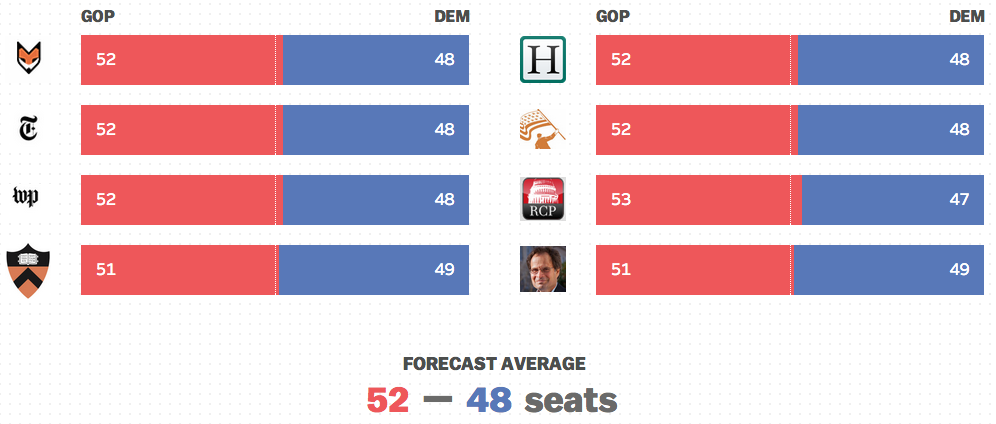
Most of the midterm models expect Republicans to pick up 52 seats:

Senate Forecasts

Chris Cillizza notes that the Republicans’ chances of taking the Senate have improved. But Jonathan Bernstein focuses instead on the diminishing likelihood of a Republican blowout:

Granted, pickups in Iowa and Colorado would be a nice way to put Republicans over the top. But at least so far, they haven’t managed to add potential targets such as Minnesota, Michigan or Virginia to the list of closely contested states, and they remain unlikely to win New Hampshire or North Carolina. The result is that prediction models are converging at 52 Republican seats, not 54 or more.

I’m not playing that down. No matter what the opportunities, I doubt there has been a single point during this election cycle when Republican strategists would not have been satisfied with winning seven seats to reach 52. And just as Democratic hopes to hold a majority are still realistic, so are Republican dreams of an even larger landslide. Still, what’s happening is consistent with Republicans taking advantage of expected opportunities.


Greg Sargent maintains that “Democrats do still have paths to retaining control. But they are increasingly narrow”:

Put it this way: Republicans are favored to take the Senate. If they do, it wouldn’t be at all surprising. On the other hand, if Democrats somehow hold on, that outcome wouldn’t be all that shocking, either. But a lot has to go right for Democrats for that to happen.

Charlie Cook is keeping tabs on the Kansas and Georgia races:

The prospects remain very tough for Democrats to hold onto their majority in the Senate, but there is a new scenario emerging—albeit still unlikely—that is turning the majority math a bit on its head.

As I have said previously, Republicans need a net gain of six seats to take the majority. The question has generally been whether Republicans just need to knock off six Democratic seats to get to 51, or if they will need to gross seven seats in order to net six. Now there appears to be a real question as to whether Republicans may need to gross eight seats in order to net six, covering for the potential loss of not just Sen. Pat Roberts in Kansas but an open seat in Georgia as well.

The Grave Risks Of A Travel Ban, Ctd

With Marco Rubio preparing a bill to ban nationals of Liberia, Guinea and Sierra Leone from entering the US, and with vulnerable Dem candidates hopping on the Ebolanoia bandwagon, our political class appears to be warming more and more to an Ebola travel ban. (Ron Paul, at least, has called out such proposals as bad, politically motivated policy). So the point bears repeating that a travel ban is not as commonsensical as its supporters make it out to be. Julia Belluz and Steven Hoffman look back at past epidemics in which travel bans proved unhelpful, including the AIDS crisis:

After HIV/AIDS was discovered in 1984, governments around the world imposed entry, stay and residence restrictions on people with the disease. As one 2008 study notes: “Sixty-six of the 186 countries in the world for which data are available currently have some form of restriction in place.” In the US, the ban — instituted by President Ronald Reagan in 1987 — was only lifted when Obama came into office. But HIV/AIDS managed to spread anyway, reaching pandemic proportions by the 1990s. This 1989 review of HIV/AIDS travel restrictions found they were “ineffective, impractical, costly, harmful, and may be discriminatory.” Prevention of HIV worked better than travel restriction, the authors concluded.

And swine flu:

After the arrival of H1N1 swine flu in 2009, some countries imposed travel restrictions on flights going to and coming from Mexico, resulting in a 40 percent decrease in overall travel volume. A study looking at this event found it “only led to an average delay in the arrival of the infection in other countries (i.e. the first imported case) of less than three days.” So again, reduced travel delayed (by three days!) but didn’t stop disease spread. The authors wrote: “No containment was achieved by such restrictions and the virus was able to reach pandemic proportions in a short time.”

Another common argument against travel bans is that they would seriously harm relief efforts. Jonathan Cohn elaborates on this:

Experts, along with non-profits like Doctors Without Borders, say that they’d have a much harder time getting volunteers into the countries if those volunteers knew they could not easily return. Even with an explicit exception for aid workers, they say, the extra burden and uncertainty of having to get special clearance would dampen enthusiasm. Meanwhile, a U.S. travel ban would almost certainly cause other highly developed countries to follow, dramatically reducing the demand for flights and other transportation options to West Africa. Agencies already struggling to get supplies into the area would struggle even more.

Lots of people wonder, couldn’t the U.S. government just arrange other transportationmaybe a modern-day version of the 1948 Berlin airlift? I’ve put that question to a number of officials and experts and the answer I keep hearing is “no.” In the real world, they say, making these arrangements would be difficult and solutions would be inadequate. It’s not as if assistance is this highly organized campaign, with all the necessary aid workers and their supplies lined up at Dover Air Force base, just waiting for C-17s to take them across the Atlantic. The flow of people and wares into West Africa is a constantly changing, unpredictable blob that’s heavily dependent on freely available commercial transportation. Replacing that would take resources and time, the latter of which the region really doesn’t have.

Pregnant With Depression, Ctd

David Bornstein argues that postpartum depression has been misunderstood:

Postpartum depressions are often assumed to be associated with hormonal changes in women. In fact, only a small fraction of them are hormonally based, said Cindy-Lee Dennis, a professor at the University of Toronto and a senior scientist at Women’s College Research Institute, who holds a Canada Research Chair in Perinatal Community Health. The misconception is itself a major obstacle, she adds. Postpartum depression is often not an isolated form of depression; nor is it typical. “We now consider depression to be a chronic condition,” Dennis says. “It reoccurs in approximately 30 to 50 percent of individuals. And a significant proportion of postpartum depression starts during the pregnancy but is not detected or treated to remission. We need to identify symptoms as early as possible, ideally long before birth.”

Regarding treatments, the following passage from Bornstein brings in a recent thread on telemedicine:

The third model grows out of Cindy-Lee Dennis’s research in Canada, and is important because it illustrates the potential of treating women through interventions over the phone. It thus reduces one of the biggest barriers low-income or rural women face in accessing treatment: transportation to and from treatment and scheduling appointments.

In one clinical trial, 700 women in the first two weeks after giving birth, who had been identified as being at a high risk of postpartum depression, were given telephone-based peer support from other mothers — volunteers from the community who had previously experienced and recovered from self-reported postpartum depression (and received four hours of training).

“We created a support network for the mothers early in the postpartum period,” Dennis explains. “It cut the risk of depression by 50 percent.” On average, each mother received just eight contacts — calls or messages, and the calls averaged 14 minutes. Over 80 percent of the mothers said they would recommend this support to a friend.

Previous Dish on depression and pregnancy here and here.

Creepy Ad Watch

The above ad for BLAH Airlines – Virgin America’s parody of airline travel – is just a glimpse into the nearly 6-hour commercial tracing a flight from Newark to San Francisco. Jessica Plautz calls the full film “more than boring – it’s nearly Dalí-style surrealism”:

It starts out boring, as you would expect on any flight with nothing but the safety manual to entertain you. Shots go back and forth between the back of the seat and our protagonist, a gaping dummy with a bowl cut. A fasten-your-seatbelts announcement 12 minutes in is so familiar it’s uncanny. At 3 hours and 19 minutes, a dummy appears outside the window, Nightmare at 20,000 Feet style. And then it gets even more Twilight Zone. There are weird small talk conversations throughout that must have been a treat to write and produce.

Full video after the jump:

The Limits Of Meritocracy

Screen Shot 2014-10-20 at 12.30.56 PM

Matt O’Brien discusses a new paper showing how even “poor kids who do everything right don’t do much better than rich kids who do everything wrong”:

You can see that in the above chart, based on a new paper from Richard Reeves and Isabel Sawhill, presented at the Federal Reserve Bank of Boston’s annual conference, which is underway. Specifically, rich high school dropouts remain in the top about as much as poor college grads stay stuck in the bottom — 14 versus 16 percent, respectively. Not only that, but these low-income strivers are just as likely to end up in the bottom as these wealthy ne’er-do-wells. Some meritocracy.

What’s going on?

Well, it’s all about glass floors and glass ceilings. Rich kids who can go work for the family business — and, in Canada at least, 70 percent of the sons of the top 1 percent do just that — or inherit the family estate don’t need a high school diploma to get ahead. It’s an extreme example of what economists call “opportunity hoarding.” That includes everything from legacy college admissions to unpaid internships that let affluent parents rig the game a little more in their children’s favor.

Noting the abundance of other studies that point to this same class disparity, Freddie stresses that the notion of America as a pure meritocracy has been thoroughly debunked, even if many people still believe in it:

The question of how much control the average individual has over his or her own economic outcomes is not a theoretical or ideological question. What to do about the odds, that’s philosophical and political. But the power of chance and received advantage — those things can be measured, and have to be. And what we are finding, more and more, is that the outcomes of individuals are buffeted constantly by the forces of economic inequality. Education has been proffered as a tool to counteract these forces, but that claim, too, cannot withstand scrutiny. Redistributive efforts are required to address these differences in opportunity. In the meantime, it falls on us to chip away, bit by bit, on the lie of American meritocracy.

Marriage Makes All Relationships More Stable

Ronald Bailey digs through recent research:

In a September study in the Journal of Marriage and Family, [Stanford sociologist Michael Rosenfeld] uses time series data from the How Couples Meet and Stay Together survey (HCMST) to probe the longevity and breakup rates of America’s marriages. The HCMST, which began in 2009, is a nationally representative survey of 3,009 couples, of which 471 are same-sex. Rosenfeld’s paper reports the breakup rate of the couples surveyed annually through 2012.

What he discovered:

Not too surprisingly, there are big differences in relationship stability between married and unmarried heterosexual couples. The annual breakup rate among married different-sex couples was 1.5 percent. The relationships of unmarried different-sex couples dissolved at annual rate of 21.7 percent.

Married same-sex couples broke up at a rate of 2.6 percent per year, while 12.8 percent of unmarried same-sex couples went their separate ways annually. Interestingly, Rosenfeld notes that “lesbian couples have a significantly higher rate of break-up compared to heterosexual couples, while gay male couples have a break-up rate that is not distinguishable from the break-up rate of heterosexual couples.” It is also noteworthy that unmarried same-sex couples broke up at about half the rate of unmarried different-sex couples. It is likely that part of the reason for this disparity is that unmarried same-sex couples had already been together almost twice as long their different-sex counterparts at beginning of the survey.

Rosenfeld also found that “marriage is not just associated with stability but causes it.”

The State Of The Race In Texas

One of our midterm correspondents from the in-tray directs our attention to a “very important underreported story” in the Lone Star State:

It’s not getting the attention it deserves here because of the sad state of both the news media and the Texas Democratic Party.  You are probably aware that Texas is voting on all of its statewide offices in next month’s general election because of the Greg Abbott-Wendy Davis match-up for governor.  That is the only statewide election that has received any significant press coverage.  This is likely due to Rick Perry’s retirement and Abbott and Davis becoming national celebrities in the last couple of years because of Abbott’s lawsuits against the Obama administration and Davis’s filibuster of HB-2 (the abortion law).  Sadly, the other campaigns are receiving almost no press coverage, which will probably result in another Republican sweep of all statewide offices.  This disinterest is probably what helped the Republican Party nominate three people for statewide offices who have no business being on the ballot.

The most egregious of these candidates is Ken Paxton, the Republican nominee for attorney general.

Paxton admitted to violating state securities laws back in the spring and paid a fine to the state securities board.  Shortly thereafter, the Travis County District Attorney’s office brought a criminal complaint against him but will not proceed with the case until after the election.  Paxton has admitted to breaking the law yet will probably become the the most powerful legal officer in the state because of disinterested voters and straight-GOP-ticket voters.  (The Democratic nominee is named Sam Houston.  How can someone named Sam Houston lose an election in Texas?!)

The Republicans have nominated for comptroller (aka the person in charge of the state’s finances) Glen Hegar.  He is a long-time state representative who is also a farmer with a history degree.  He has no professional accounting or finance experience at all but will probably win anyway.

Finally, there is the lieutenant governor’s race.  This should actually be the most important and most covered race in the state because of how powerful the lieutenant governor is in Texas.  It has received slightly more coverage than the other non-governor statewide elections, but not much.  The Republican candidate is Dan Patrick (no, not the guy from ESPN).  He was a radio personality and Houston’s equivalent of Rush Limbaugh for many years (though more conservative) before he became a state senator, representing Houston’s northwest suburbs (by far the most politically and culturally conservative part of the Houston area, a city that is generally pretty moderate).  Patrick’s views are extreme even by today’s Republican Party standards – supporting laws that would ban all abortions without exception and advocating mass deportations of illegal immigrants, among other things.  Patrick was able to win the nomination because the Republican primary is always dominated by the most extreme voters and because David Dewhurst, the sitting lieutenant governor, looked ineffectual after Wendy Davis’s successful filibuster.  Patrick and some of the other Republican candidates for statewide office are not really campaigning because they are so confident they will win.

It feels like the Texas Republican Party is trolling us simply because it can.  There is no effective check on its power right now.  I hope the 2014 election is a wake-up call to the Texas Democratic Party and local media outlets throughout the state.  They cannot allow these utterly unqualified people to continue to hold these important public offices.

Today is the first day of early voting in Texas, so these stories are on my mind.  This seemed like an issue that would be dear to the Dish’s heart – the decline of the news media and the continued rightward lurch of the Republican Party – so I hope you don’t mind my rant.  Thanks for listening.

Black Holes Under A Microscope

Ron Cowen relays the news that scientists “have come closer than ever before to creating a laboratory-scale imitation of a black hole.” Why it’s important:

The black hole analogue, reported in Nature Physics, was created by trapping sound waves using an ultra-cold fluid. Such objects could one day help resolve the so-called black hole ‘information paradox’ – the question of whether information that falls into a black hole disappears forever.

The physicist Stephen Hawking stunned cosmologists 40 years ago when he announced that black holes are not totally black, calculating that a tiny amount of radiation would be able to escape the pull of a black hole. This raised the tantalizing question of whether information might escape too, encoded within the radiation.

Hawking radiation relies on a basic tenet of quantum theory – large fluctuations in energy can occur for brief moments of time. That means the vacuum of space is not empty but seethes with particles and their antimatter equivalents. Particle-antiparticle pairs continually pop into existence only to then annihilate each other. But something special occurs when pairs of particles emerge near the event horizon – the boundary between a black hole, whose gravity is so strong that it warps space-time, and the rest of the Universe. The particle-antiparticle pair separates, and the member of the pair closest to the event horizon falls into the black hole while the other one escapes.

Hawking radiation, the result of attempts to combine quantum theory with general relativity, comprises these escaping particles, but physicists have yet to detect it being emitted from an astrophysical black hole. Another way to test Hawking’s theory would be to simulate an event horizon in the laboratory.

Vengeance Of The Nerds, Ctd

A few readers provide key counterpoints to the controversy:

Your latest post presents only one side of a very complex, many-sided argument and unfortunately perpetuates the narrative that #GamerGate is mostly a reactionary, misogynistic movement. Please understand that the vast majority of GamerGate is not misogynist. The vast majority of GamerGate does not think death threats are trivial. GamerGate is a movement that has embraced women, gays, trans-gender people of all political stripes and nationalities, worldwide.

GamerGate is many things, but it is largely a reaction against the huge amount of abuse that gamers have suffered over the years, culminating in a coordinated campaign by a dozen or so articles that appeared on numerous gaming news sites nearly simultaneously on August 28-29, proclaiming that gamers were dead, spear-headed by a piece on Gamasutra by Leigh Alexander, who called gamers:

These obtuse shitslingers, these wailing hyper-consumers, these childish internet-arguers – they are not my audience. They don’t have to be yours. There is no ‘side’ to be on, there is no ‘debate’ to be had.

Now is that any way to speak to a large number of your target audience? Most of the other articles weren’t quite as strident, but the mass coordinated nature of this campaign was not lost on many gamers. Understandably, being called “shitslingers” and “childish internet-arguer” upset many people. Hence GamerGate really took off.

It’s a horrible thing that Zoe Quinn, Anita Sarkeesian and Brianna Wu have received death threats. However, there is very little evidence that at least the threats against Sarkeesian and Wu have had anything to do with GamerGate. And yet, instead fingers were immediately pointed to GamerGate, in an appalling example of guilt-by-association. It is grossly unfair that a movement comprised of thousands of people worldwide is being tarred for the actions of the very few destructive people who just want to watch the world burn. That’s like blaming all Muslims for ISIS!

GamerGaters have been quite vigilant, often being the first and most vocal in calling out harassment as soon as they discover it online. This is a totally open movement. Anyone can do anything and claim that they did it on behalf of GamerGate. Even then, it’s abundantly clear to anyone who has actually talked to GamerGaters, that nearly all of us condemn harassment and welcome women into our movement. In order to counter this misrepresentation, the hashtag #NotYourShield was created in order to demonstrate just how diverse and inclusive the movement is.

Despite all this, GamerGate are being constantly insulted by others as “misogynerds,” “pissbabies,” “worse than ISIS” and god knows what else. Supporters of GamerGate have been given death threats, doxxed, lost their jobs and God knows what else. Yet none of that has gotten any exposure in the mainstream media.

The abuse received by people for the mere mention that they support GamerGate has been so bad that it has caused more than a few people who initially positioned themselves as anti-GG to realize that GamerGaters are on the whole good people who condemn harassment and just want to be able to enjoy video games without being constantly told by self-appointed social activists that their hobby is awful, degenerate, and they should be shamed. It’s part of a larger movement that has been touched upon by you in the past. Just listen to the voices of women here and here who received far more harassment from those opposed to GamerGate than from GamerGate itself.

There’s much much more that I can get into. But I’m just a nobody. GamerGate has been covered more fairly by conscientious, articulate people like these, both supporting and neutral to GG:

https://twitter.com/oliverbcampbell
https://twitter.com/erikkain
https://twitter.com/Totalbiscuit
https://twitter.com/Boogie2988
https://twitter.com/georgieonthego
https://twitter.com/mundanematt

There are many more. Please contact them and listen to their voices. Fairness is important.

Another reader details another major part of the story:

I was surprised to see that your take on #Gamergate ignored its central issue, chiefly because it’s one of your own pet issues – corruption in the media. And by “corruption,” I mean the press acting as a form of PR and not as a source for news. Gamers are upset because it seems, and has seemed for a while now, that the press is no longer interested in talking to them. Leigh Alexander’s piece declaring gamers to be “dead” (alongside a slew of other insults) was just the purest expression of that trend.

But make no mistake: these accusations of misogyny are deflections meant to shift focus (successfully, so far) from their own wrongdoing.

Take, for instance, Jeff Gerstmann, who was fired from GameSpot in 2007 after rating a game as “fair.” The game publisher, Eidos Interactive, pressured the GameSpot to fire Gerstmann, and GameSpot complied. Take also the review of Aliens: Colonial Marines, produced by Gearbox Software, which the press lavished with praise after being shown a “demo” that, in truth, represented nothing contained in the actual game. Or take the latest scandal, wherein WB Games offered review copies of Shadow of Mordor under the condition that the resultant review praise and advertise the product.

The gaming press is too busy begging for the developers’ scraps to care whether or not their readership gets taken for a ride. And in a $93 billion industry, that ride can be quite expensive.

Which leads us to #Gamergate, a scandal that sprang to life after evidence emerged that Zoe Quinn, an indie developer, had leveraged her inappropriate relationship with the press to boost her profile, including shutting down a rival feminist charity (one #Gamergate would later help get back on its feet). Rather than report on these relationships (as they had Brad Wardell and Max Temkin), the press went silent. This, naturally, prompted further digging, which revealed the gaming industry’s very own Journolist, wherein certain members of this press pushed predefined narratives.

Outraged at having been lied to, silenced and manipulated, gamers revolted. #Gamergate. This revolt won’t end by calling gamers misogynists. They’re not. No, this will only end when the press debrides itself of the notion that it reports to anyone other than its consumers. It’s time they stopped lecturing gamers, and started helping them find a fun game on which to spend their hard-earned money.

Another zooms out:

I think the actual point is completely missed by everyone there. It would not have been missed if people didn’t stereotype and objectify nerds as much as they accuse them of stereotyping and objectifying women.

The point is, nerds never wanted to “win”. The ascendancy of their subculture is a horrifying development for most of them. They grew up being marginalized by the in-crowd. They found interests and a common ground with the rest of the persecuted non-alpha class and they were relieved to never again have to be bullied around and to find a social subculture in which they could express themselves freely and, shockingly, even become admired by their peers. Like, really admired. Socially admired, not just admired by their parents and upstanding grown-ups in their community after receiving another scholarship or citizenship award.

And now here come the alphas to take this from them, as well as their eighth grade lunch money. They aren’t undermining themselves; they are sabotaging the movement. I see so many people throwing their hands up and wondering why these guys are behaving so beastly, and if you take five minutes and realize how they got where they are, then you could see where they’re going.

The nerds want the women to go away, because when the women go away, so will the alpha males. High school never ends, not really. Alpha males hate everything new or different, but they learn to feign interest in things that women are drawn to. And so now you have these massive audiences for comic book movies and video games, because women started liking these subjects and the alphas are following along. The producers of this content know that to keep those big audiences spending, they need to lower the sophistication to a level that the casual, obtuse consumer will like. The women will still prefer the alphas to the nerds, no matter what the nerds do, and the nerds know this. They don’t have the tools for the game the way that the alphas do.

Now here is the perfect storm. Everything they like is overrun by women who don’t really want to engage with them and want to see the subculture change to be more appealing to them (and this is where things like feminist critiques of video games drive them even more bonkers). The women are followed by alpha males, who the nerds revile and who will try to seize control everywhere they can, like alphas do. The quiet living room of the nerd has become the scene of a giant house party hosted by the cast of Jersey Shore. Oh, and that’s about to be the level of sophistication coming across in comic books and movies now that there’s billions of dollars to be made by appealing to the lowest common denominator.

Now I don’t sympathize with anyone who engages in death threats or who expresses anti-feminist ideals, or who essentially falls under the sway of their worst fears rather than their highest hopes. But I also gotta say, just because you’re paranoid, doesn’t mean they’re not after you.

So I’m not saying you need to sympathize with these people or ally with them or approve of the obscene ends that some of them go to. But you will never, ever, understand nerd behavior if you think that they are exultant at the new attention on their subculture, and that all this misogyny and anti-social behavior is just exactly what your objectifying, stereotypical model of them says that it is. They are not struggling to express themselves and grappling with zero-IQ social intelligence. They aren’t fumbling their way through their moment in the spotlight because they don’t know how to behave. I know that’s what everyone has been raised to believe about them, and it sure looks like it’s what they’re doing. But the fact is, all this acting out and hostility isn’t awkwardness and it isn’t a dominance play. It’s a simple message to the newcomers: get. the. fuck. out.

Another touches on something we were suggesting with the choice of tweet-image above:

Wow. That third reader doesn’t so much zoom out as much as he spaces out. Apparently there are no female nerds, and the only defining characteristic of nerd-dom is being a social outcast. Really? I thought it was liking scifi and being socially inept was an unfortunate side effect of spending so much time reading as a kid (maybe that was just me?).

And the whole idea that the “sophistication” of some monolithic nerd culture is going to suffer is ridiculous. You know what is happening? They are making more geeky, nerdy things – from movies to comic books to novels. Sure, some will be less sophisticated. Some will be more. Some will not appeal to your tastes and so what, go read or watch something that does, there’s a ton of it. I personally find the idea of Depression Quest ridiculous; it seems more like a psych class than a game to me, but if enough people want to play it to make that kind of genre popular, it’s not like it’s hurting me.

I’m a female gamer, though I admit I haven’t been following the GamerGate nonsense closely. Mostly because yes, there is as much misogyny in gaming as in the rest of life, and yes, video-game review sites have been useless for a long time now. It would be nice if neither of these things were true, but you know what? I play video games to relax, and stressing about that shit isn’t relaxing at all. If sexism in a game bothers me, I stop playing it. If I’m looking for a new game to play, I’ll look at one or two blog reviews and then download it and try it (if the game doesn’t have a trial version, there are plenty of others that do, so, move on to the next one).

The whole death threats thing is ridiculous and people need to realize that’s not ok, but I feel like summing this all up as a message to “get the fuck out” is unhelpful. Not just from a putting the genie back in the bottle perspective, but the vast majority of nerds aren’t issuing death threats. Only a handful of whack-jobs are.

Another gets the last word:

Oh Jesus Christ, can we just let this thing peter out as it should? Honestly, I already have four kids and I have to listen enough of he said/she said young love acquired, denied, lost and how it is the end of and most important thing in the world teen angst babble around the family dinner table. Do I also have to suffer through this at my favorite blog as well?

Sure, there are game developers out there who have an agenda against woman because they weren’t with the cool crowd in high school and carry that resentment into their apparently adult adolescent years. And yes, there are woman out there who detest game developers who seemingly objectify and reduce woman to sexual byproducts. Please, can we just let them go sling it out in their own high-school sophomoric fashion by posting nasty comments to each other on their blogs and the rest of us just move on and focus on more important things? Thank you.