Apprenticeships: Lost In Translation?

Reacting to news that “the Obama administration is about to announce $100 million worth of apprenticeship grants – and wants to spend another $6 billion over the next four years,” Tamar Jacoby considers whether German-style apprenticeships would work in the US:

The first thing you notice about German apprenticeships: The employer and the employee still respect practical work. German firms don’t view dual training as something for struggling students or at-risk youth. “This has nothing to do with corporate social responsibility,” an HR manager at Deutsche Bank told the group I was with, organized by an offshoot of the Goethe Institute. “I do this because I need talent.” So too at Bosch. …

The second thing you notice:

Both employers and employees want more from an apprenticeship than short-term training. Our group heard the same thing in plant after plant: We’re teaching more than skills. “In the future, there will be robots to turn the screws,” one educator told us. “We don’t need workers for that. What we need are people who can solve problems”—skilled, thoughtful, self-reliant employees who understand the company’s goals and methods and can improvise when things go wrong or when they see an opportunity to make something work better.

But there’s a catch:

Why is it likely to be hard for Americans to transplant the German model? It starts with cost. Each German company has a different way of calculating the bill, but the figures range from $25,000 per apprentice to more than $80,000. It’s likely to be more expensive still in the U.S., where firms will have to build programs from scratch, pay school tuition (in Germany, the state pays), and in many cases funnel money into local high schools and community colleges to transform them into effective training partners.

Update from a reader:

Actually, I think we are evolving something akin to German apprenticeships in the US, at least for some fields. We just don’t call them that. Mostly, we call them “interns.” But the function can be very similar:

  • take someone who doesn’t know much about the work that your organization does but is interested in learning.
  • bring them on board (probably for very little money) and start teaching them what you do.
  • get them to the point where they can be a productive member of the team.

Granted, there are organizations that use “interns” as simply no-cost low-skill temporary labor. But there are also some (I work for one) that are using the position to create people who can do things that we have difficulty hiring skilled staff to do. Done right, it’s a win for the individual – she learns skills that she didn’t have before, and which are in demand in the job market. And it is a win for the company as well – we get someone who has skills we need and have difficulty finding, and who knows how our corporate culture works as well. With a little luck, we get to keep them for several years after they become fully trained.

Would we be delighted to have the state pay for the training, on the German model? Of course. But it is still worth our while to do it at our own expense.

The Sharing Economy In The Big City

Airbnb

Airbnb is having some troubles in New York:

While it’s technically illegal for New York City residents to rent their entire place for fewer than 30 days at a time — room-shares and extended sublets are allowed — the city and attorney general’s office have insisted they’re not interested in small-time Airbnb-ers, but those using the share economy to become mini hospitality moguls. Their first targets: brothers Hamid Kermanshah and Abdolmajid Kermanshah, who own and operate a four-story building on Fifth Avenue and a ten-story building on West 31st Street.

Alison Griswold has more:

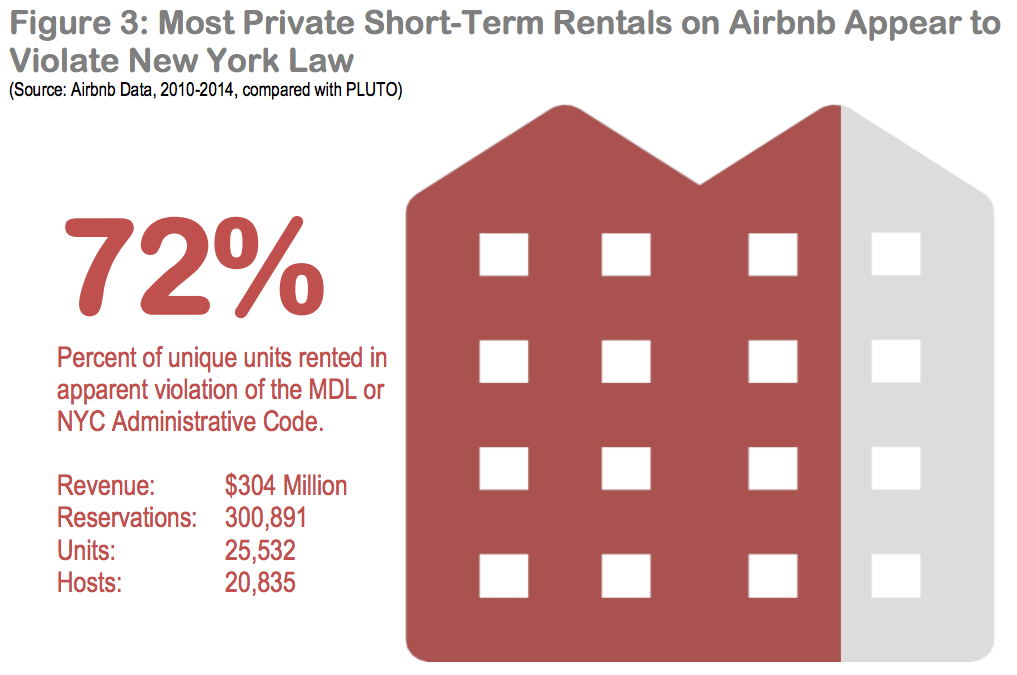
Airbnb, according to the AG’s [Attorney General’s] analysis of 497,322 transactions for stays between January 2010 and June 2014, is largely illegal, hugely profitable, and quickly consuming lower Manhattan. Rather than helping the average New Yorker make ends meet, much of Airbnb in New York City is making money for a small number of commercial hosts running large, multimillion-dollar operations.

J.J.C. weighs the pros and cons of the service:

For business travellers there are obvious benefits. Booking may be less convenient than for hotels and prices are not always lower, but travellers benefit from more choice and, usually, space. For more seasoned road warriors, Airbnb’s varied portfolio makes a refreshing change from the depressing homogeneity of hotel interiors.

But even as Airbnb claims victory in its home city the honeymoon period may be coming to an end. … Part of the problem is the gold rush Airbnb has prompted. What began as a platform for homeowners with spare rooms to make a bit of pocket money on the side, is becoming overrun with property entrepreneurs looking for lucrative short term gains. The market is also getting more crowded with competition coming from upstarts such as Roomoramaand HomeAway. Meanwhile success breeds exploitation. From trashed properties and wild parties to a multitude of scams, there are plenty of Airbnb horror stories circulating to put off prospective tenants (and landlords).

Megan McArdle considers the implications:

I love the sharing economy — what’s not to love about taking underutilized assets and making them more productive? But Airbnb has an almost uniquely difficult task in converting rooms to a permanent revenue stream. Most people are more sensitive about what happens with their homes than they are about what happens with their cars, bikes, or designer handbags. That may be particularly true in the dense, expensive areas where Airbnb is most in demand — though to be sure, I’ve also heard people in single-family home neighborhoods complaining about the potential for rowdy house parties.

Whenever a new market opens, there’s a sort of wild west period when gaps in the law allow people to make a bunch of money. Over time, however, legislators and regulators wake up, and start laying down the law. Entrenched competitors are protected, numerous interest groups are given concessions, fees are tacked on. The end result is greater certainty, but lower profits and innovation.

During his interview with Marc Andreessen, Kevin Roose brings up the politics of the sharing economy:

[Q] Politicians like Rand Paul are seizing on young people’s embrace of companies like Uber and Lyft and Airbnb that are disrupting heavily regulated industries and saying, “You know, if you’re frustrated about Uber, let me tell you about these other regulations that are terrible.” Are these companies breeding a new generation of libertarians?

[A] I guess I would say the following: If you have been in an Uber car and gotten pulled over and had the car seized out from under the driver when you were like in the middle of a trip that you were otherwise having a good time on, you might be a little bit radicalized. You might all of a sudden think, Wait a minute, what just happened, and why did it happen? And then you might discover what the taxi companies did over the last 50 years to wire up city governments and all the corruption that’s taken place. And you might say, “Wait a minute.” There’s this myth that government regulation is well intentioned and benign, and implemented properly. That’s the myth. And then when people actually run into this in the real world, they’re, “Oh, fuck, I didn’t realize.”

Previous Dish on Airbnb here and here.

Centers For Damage Control

Screen Shot 2014-10-20 at 2.20.04 PM

After its fumbling of the Ebola outbreak, the public has rightly soured on the CDC:

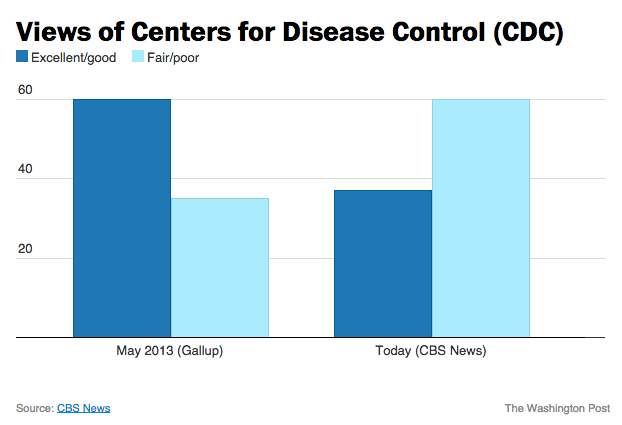
A new CBS News poll shows just 37 percent of American rate the CDC as either excellent or good, while 60 percent rate it as fair or poor — a virtual mirror image of 17 months ago. The worst part: The agency now ranks below the Secret Service, which has dealt with a series of scandals in recent weeks and years. But the CDC is still slightly more popular than the IRS.

Morrissey isn’t surprised:

Back when I worked for a defense contractor in its technical publications department, one worker had a sign in her cubicle which accurately diagnoses the phenomenon in play here: “One aws**t cancels out a thousand attaboys.” It isn’t what the CDC did for the past ten years, but what they’re doing when the spotlight is on them that counts. In fact, the CDC’s performance over the past few weeks will have people questioning just how well they’ve done their job all along, and perhaps they should.

On the other hand, it’s possible that the public perception might be a little too harsh. One amazing aspect of this poll is that the CDC is only seven points up on the VA (30%) and only six over the IRS (31%). Both of those agencies have been embroiled in scandals that involve outright corruption, not just incompetence, and yet they’re almost within the margin of error with the CDC, which to this point is only considered to be well-meaning but failing.

Harold Pollack defends the agency:

Despite the CDC’s budget problems and its recent stumbles, it is a more effective, better-led organization than it was during the Bush years, when five out of six former agency directors publicly criticized the CDC’s managerial hijinks, low morale and lapses from scientific integrity. At that time, the CDC ranked 189th out of 222 federal agencies in workforce morale. It now ranks 49th out of 300 federal agencies on such measures. That’s a striking improvement.

“When the public health enterprise loses political standing,” he adds, “it may not be listened to when it most needs to be heard”:

Almost 40 years ago, the CDC suffered public humiliation when it was perceived as having bungled a massive vaccination campaign for a Swine Flu epidemic that didn’t materialize. Only a few years later, CDC officials tried to sound warnings about a mysterious new pathogen. They were shoved aside, often by government and medical officials who specifically cited the Swine Flu debacle. One unfortunate 1983 Red Cross memo, opposing aggressive measures to protect America’s blood supply, expressed the general mood: “CDC is likely to continue to play up AIDS,” because “CDC increasingly needs a major epidemic to justify its existence.”

SCOTUS Split On Voter ID

In a ruling issued at the unusual hour of 5 am on Saturday morning, the Court allowed Texas’s voter ID law to remain in place for the upcoming elections, citing concerns about disrupting the voting process. But not all of the justices were on board:

A majority of justices rejected an emergency request from the Department of Justice and civil-rights groups to keep the state from enacting a law that requires citizens to produce prescribed forms of photo identification before they could cast a ballot, while three justices—Ruth Bader Ginsberg, Sonia Sotomayor and Elena Kagan—dissented. “The greatest threat to public confidence in elections in this case is the prospect of enforcing a purposefully discriminatory law, one that likely imposes an unconstitutional poll tax and risks denying the right to vote to hundreds of thousands of eligible voters,” wrote Ginsburg.

The order was delayed, apparently, because Ginsburg insisted on issuing a dissenting opinion. Rick Hasen digs into her six-page dissent, which he sees as laying the groundwork for a future battle:

Importantly, Ginsburg concluded that the effect of the law in its entirety would be to diminish voter confidence in the system. “The greatest threat to public confidence in elections in this case is the prospect of enforcing a purposefully discriminatory law, one that likely imposes an unconstitutional poll tax and risks denying the right to vote to hundreds of thousands of eligible voters,” she wrote.

The Texas case will likely make it back to the Supreme Court, perhaps next year, after the 5th Circuit takes a full look at the case. While the Supreme Court’s vote on the stay order in the Texas case does not tell us for sure how things will go when the court gets to the constitutional merits of the challenge, the five conservative justices on the Supreme Court are likely to let Texas put its ID law in place because of their general view of the scope of the Constitution and the Voting Rights Act. No doubt Justice Ginsburg knows this.

How Judis understands the motivation behind the law:

[Gov. Rick] Perry claimed that the law would “uphold the integrity of our state’s electoral process and insure our state has passed the proper protections against voter fraud.” The law, which requires a photo ID, was intended to prevent voter impersonation, but as [judge Nelva Gonzales] Ramos pointed out, Texas had uncovered exactly two cases of voter impersonation from 2001 to 2011. Its real purpose was to forestall a demographic time bomb that could threaten Texas’ Republican majority. From 2000 to 2010, 78 percent of Texas’s population increase consisted of African-Americans and Hispanics, who could be expected to support Democrats rather than Republicans. If those population trends were to continue, and if the new Hispanic voters (who made up the bulk of the population increase) were to flock to the polls, Republicans could be doomed.

Scott Lemieux admits that there is “a quasi-defensible reason for the court’s latest move”:

The Supreme Court is usually reluctant to issue opinions that would change election rules when a vote is imminent. For example, the court recently acted to prevent Wisconsin from using its new voter ID law in the upcoming midterms, coming to the opposite result from the Texas case. That is the principle at work here, and on a superficial level it makes sense.

But as Ginsburg — joined by Justices Elena Kagan and Sonia Sotomayor — points out, the general reluctance to change election rules at the last minute is not absolute. In Wisconsin, using the new law would have created chaos. For example, absentee ballots would not have indicated that identification was necessary for a vote to count, so many Wisconsin voters would have unknowingly sent in illegal ballots.

In the Texas case, conversely, there is little reason to believe that restoring the rules that prevailed before the legislature’s Senate Bill 14 would have been disruptive.

Ultimately, the court may end up backing Ginsburg’s contention that the law is unconstitutional, but Ian Millhiser complains that letting it stand even for one election is dangerous, and looks to history for the reason why:

For much of the Jim Crow Era, the South was a one party region. General elections were largely formalities, and the Democratic Party’s candidate was all but guaranteed victory. So, in 1923, Texas tried to prevent African Americans from voting by enacting a law providing that “in no event shall a negro be eligible to participate in a Democratic party primary election held in the State of Texas.” When this law was struck down by the Supreme Court, Texas enacted a new law allowing the state Democratic party to establish rules that only permitted “white democrats” to vote in the primary. When that law was struck down, the state party passed a resolution, pursuant to no law whatsoever, providing that only “white citizens” may vote in a Democratic primary. This action by the state Democrats was ultimately upheld by the Supreme Court, although the justices reversed course nine years later.

The lesson is that, if you allow a voter suppression law to go into effect for just one election, then the supporters of that law are likely to come up with a new way to suppress the vote if the first law is ultimately struck down. And even if the second voter suppression law is ultimately struck down, this cycle can continue forever so long as each law is allowed to be in effect for just one election.

A Smashed Pumpkin Festival

Caroline Bankoff recaps one of the stranger stories from this weekend:

Keene, New Hampshire’s annual Pumpkin Festival – which features a community-wide effort to “set a world record of the largest number of carved and lighted jack-o-lanterns in one place,” according to CBS Boston – saw at least 14 arrests and dozens of injuries this weekend as hordes of Keene State College students and their guests took to the small town’s streets for no apparent reason other than to cause trouble. The Boston Globe reports that hundreds of people were seen “throwing bottles, uprooting street signs, and setting things on fire,” as well as overturning cars and dumpsters. Cops outfitted in SWAT gear responded with “tear gas, tasers, and pepper spray.” The Keene Police Department claims that one group of rioters “threatened to beat up an elderly man” while others threatened the lives of the cops, who had to call for backup from nearby towns.

Will Bunch raises his eyebrows:

[I]f you have a few minutes, read the news accounts of what happened in New Hampshire – the youths who set fires and threw rocks or pumpkins were described as “rowdy” or “boisterous” or participants in “unrest.” Do you remember such genteel language to describe the protesters in [Ferguson] Missouri? Me neither. …

[A]t this point there have been so many “white riots” in the last couple of years – Huntington Beach, Santa Barbara, Penn State (more than once), and just this week, Morgantown, and now, most epic-ally of all-time, the great Pumpkin Festival riots of Keene, N.H. It’s gotten to the point where all of the obvious jokes, about how the white community needs to have a serious conversation about getting our own house in order, or asking where are the (white) fathers, have been made again and again and again.

Ferguson is also on Yesha Callahan’s mind:

While black people are protesting the senseless deaths of unarmed black men, white thugs are ravaging the streets because of pumpkins and football.

Freddie slams some of the snarkier coverage of the riots:

First: police violence and aggression is wrong no matter who it targets. Crazy!

Second: police violence and aggression against people we assume have social capital is a signal that those who we know don’t have social capital will get it far worse. If these cops feel that they have this much license to go wild against that white, largely-affluent crew, what do you think they’ll do when they pull over some working class black guy in a run-down car? Treating this as a barrel of laughs throws away a profound opportunity to include these types of people in a very necessary social movement against police violence, which poor people of color desperately need.

But, as Jamilah Lemieux argues, the riots “don’t even lend themselves to the conversation about overpolicing because the riot police showed up as they were actually rioting.” She adds:

For all the hashtags and the jokes, we won’t see a media assault on the youth who ruined the festival for acting in ways that were not merely inappropriate, illegal and potentially deadly, but bizarre and wrought with the stench of unchecked privilege. These causeless rebels won’t be derided as thugs, nor will people wonder why they don’t just ‘go get a job,’ (something that I heard no less than three times while attending protests in St. Louis, and have seen over and over again from Twitter trolls responding to the Missouri unrest.) Unlike the young people who have mobilized in Ferguson for an actual cause, there will likely be few serious ramifications for those who participated in making Keene, New Hampshire the laughingstock of the country, while putting themselves and others at serious risk for injury or death at a pumpkin festival.

Update from a reader:

Has anyone noted yet that John Oliver, in his recent piece on the over-militarization of local police forces vis-a-vis Ferguson, mentioned with incredulity that that Keene, NH had named their annual Pumpkin Festival as a possible target for terrorism to justify their need for military gear? About 7:30 in …

http://youtu.be/KUdHIatS36A

A Breakthrough With Boko Haram?

On Friday, news of a ceasefire between the Nigerian government and Boko Haram raised hopes that the 219 kidnapped schoolgirls from Chibok might finally be released, but with the truce already in doubt, nobody is daring to celebrate too soon:

Two senior government sources said on Saturday that they hoped the release would be completed by Tuesday. On Friday, Air Chief Marshal Alex Badeh announced a deal with Boko Haram for a ceasefire that would enable the release of the girls, who have been held since April.

But within hours, Boko Haram had already broken the ceasefire, killing at least nine people in two attacks – one on the village of Abadam on Friday night, and another attack on the village of Dzur on Saturday morning. “I can confirm that FG (the federal government) is working hard to meet its own part of the agreement so that the release of the abductees can be effected either on Monday or latest Tuesday next week,” one source told Reuters by telephone.

Atta Barkindo questions whether the ceasefire is genuine:

The first inklings of this particular ceasefire agreement were heard on October 16 when Danladi Ahmadu, who claimed to be the “secretary-general” of Boko Haram, told the Voice of America (VOA) that an agreement had been reached between his group and the Nigerian government with the involvement of officials from Chad and Cameroon. …

But there are some credibility problems with this ceasefire agreement. First there is huge scepticism about the identity of Danladi Ahmadu. In his VOA interview, Ahmadu even referred to Boko Haram as Boko Haram and not its real name, Jama’atu Ahlul Sunnah Lidda’awati wal Jihad. Additionally, it is difficult to ascertain if Ahmadu is representing a particular faction of Boko Haram or the group’s mainstream leadership. Ahmad Salkida, a Nigerian journalist with proven records of contact with the leadership of Boko Haram, dented the credibility of the ceasefire and appeared to suggest that Nigeria may have been hoodwinked by the broker.

And even if the deal is for real, Simon Kolawole points out that some people won’t be very happy about it:

In some circles … a ceasefire represents the ultimate surrender of the Nigerian state to terrorism, a huge dent on national ego and a sign of how weak the Nigerian government has become. To the military hierarchy, this may be viewed as a humiliation, for how can we be discussing with terrorists who deserve nothing but death after all the horror they have inflicted on soldiers and civilians? I also heard several comments that President Goodluck Jonathan agreed to the peace deal because he is desperate to be returned to office next year. We all have our opinions, of course.

Jonathan’s re-election bid is just one part of the “multilayered drama” in which, to Richard Joseph’s eyes, the kidnapped girls are merely pawns:

For a start, it has been unclear how Boko Haram is financed — and how much assistance it might be receiving from disaffected members of the northern Nigerian elite, as well as those holding government positions at the federal and state levels. “Underground” campaigns involving the use of armed thugs have been a staple feature of Nigerian party politics for decades, and international human rights groups have noted a “dirty war” conducted by soldiers and government-financed militias. These abuses, combined with the dysfunction of the armed forces, complicate external assistance.

The problem for Nigeria is that although the jihadists will eventually almost certainly be crushed, as were the secessionists in Nigeria’s civil war, the clock is ticking on a greater threat to the Nigerian nation, namely popular protests in northern Nigeria following February’s presidential poll, which President Goodluck Jonathan is certain to contest.

Trusting In The Polls

John Sides recommends it:

[T]here is the question of whether polling misses might mean that the Democrats end up with a slim Senate majority after all.

There are reasons to be skeptical that this will happen.  It’s not just that we can’t easily predict whether the polls will over- or under-estimate one party’s vote share, as discussed by Nate Silver and by Mark Blumenthal & Co.  And it’s not just, as Josh Katz and Sean Trende have found, that Senate polls already tend to be pretty accurate at this point in time — especially when candidates have a 3- to 4-point lead, as do Republican candidates in Alaska, Arkansas, Georgia, Kentucky and Louisiana.

The other key point is this: Late movement in Senate polls tends to be in the direction of the underlying fundamentals.

Sean Trende agrees:

The biggest problem with these sort of data — very little variance, small number of observations — is that they invite introduction of our own biases. I don’t mean bias in the crudest sense of the term, although I don’t think it is accidental that the people discussing poll skew in 2012 tended to be conservatives, and vice-versa this year. … If you only have a dozen or so data points and go looking for a pattern, sooner or later you will find something that explains those data points well. The problem is that we don’t have a great basis for sorting out the good theory from the bad, at least until the theory has survived a few trial runs.

To see the potential problem here, when I look at close races only in midterms, the pattern that jumps out at me is that pollsters understate the “victorious” party. 1994 and 2002 were good Republican years, and there was a pro-Democratic bias. 1998 and 2006 were good Democratic years, and there was a pro-Republican bias. This might suggest that there will be a pro-Democratic skew this year.

Kobani: ISIS’s Stalingrad?

Syrian Kurds Battle IS To Retain Control Of Kobani

Last night, American military transport planes delivered weapons, ammunition, and medical supplies to the Kurdish fighters still holding the northern Syrian border town of Kobani against a lengthy siege by ISIS militants:

The supplies were not provided by the U.S., but instead came from other Kurdish forces outside of Kobani, the official told FP. U.S. aircraft merely facilitated the airdrops. American warplanes have been bombing Islamic State targets in and around the city for weeks, but the airdrops escalate that effort and mean that the U.S. is now facilitating direct assistance to the Kurdish fighters defending the city.

The defenders of Kobani welcomed the aid but warned that it would not be enough to decide the battle. Much still depends on how much help Turkey will allow across its border. Obama reportedly gave Erdogan advance notice of the drop on Saturday night, but Juan Cole interprets it as defiant of the Turks’ wishes. Since then, Ankara has been sending its usual mixed signals:

In comments published by Turkish media on Monday, [Turkish President Recep Tayyip] Erdogan equated the main Syrian Kurdish group, the PYD, with the PKK. “It is also a terrorist organization.

It will be very wrong for America with whom we are allied and who we are together with in NATO to expect us to say ‘yes’ (to supporting the PYD) after openly announcing such support for a terrorist organization,” Erdogan said. Also on Monday, Turkish Foreign Minister Mevlut Cavusoglu said that Turkey was facilitating the passage of Iraqi Kurdish peshmerga fighters to Kobani to aid Syrian Kurds defending the town against Islamic State militants. Cavusoglu, speaking at a news conference, did not provide details on the transfer of the fighters.

Looking at the big picture, Henri Barkey considers the battle of Kobani a seminal moment in the national history of the Kurds:

Kobani will have two different effects on the region. First and foremost, it will be an important marker in the construction and consolidation of Kurdish nationhood. The exploits of Kobani’s defenders are quickly joining the lore of Kurdish fighting prowess. After all, the Iraqi Kurdish forces, not to mention the Iraqi army, folded in the face of a determined IS onslaught only a couple of months ago. The longer the city resists, the greater will be the reputational impact (although it is already assuming mythic proportions).

There is another, rather unique aspect of the resistance that is adding to its mythic character: the role of women in the fight. The juxtaposition of an Islamic State, which enslaves women or covers them from head to toe, with the Syrian Kurds’ Democratic Union Party (PYD), which has large numbers of women fighting and dying alongside men, is particularly striking. Social and other media outlets have brimmed with stories of the heroism and sacrifice of these women. The fighting in Kobani, and especially the emergence of women fighters, has now entered the Kurdish lore and imagination.

Paul Iddon also grasps the battle’s symbolic significance. He hopes it will prove to be the Islamic State’s Stalingrad:

The reason I stress the symbolic importance of this is because as was the case during the Battle of Stalingrad the name was of great significance to the invading Third Reich whose ruler saw destroying that city and killing all of those who resisted to be of great symbolic and psychological importance given the fact it was named after the dictator of the country they were attempting to conquer. Kobani for similar reasons has become a symbol of Kurdish defiance to IS and is the reason that group is pouring more resources into in order to try and break that towns spirit and the Syrian Kurds ability to resist and repel its advances. And like Stalingrad the locals there have shown they will fight building-to-building to the death before they let IS overrun their town.

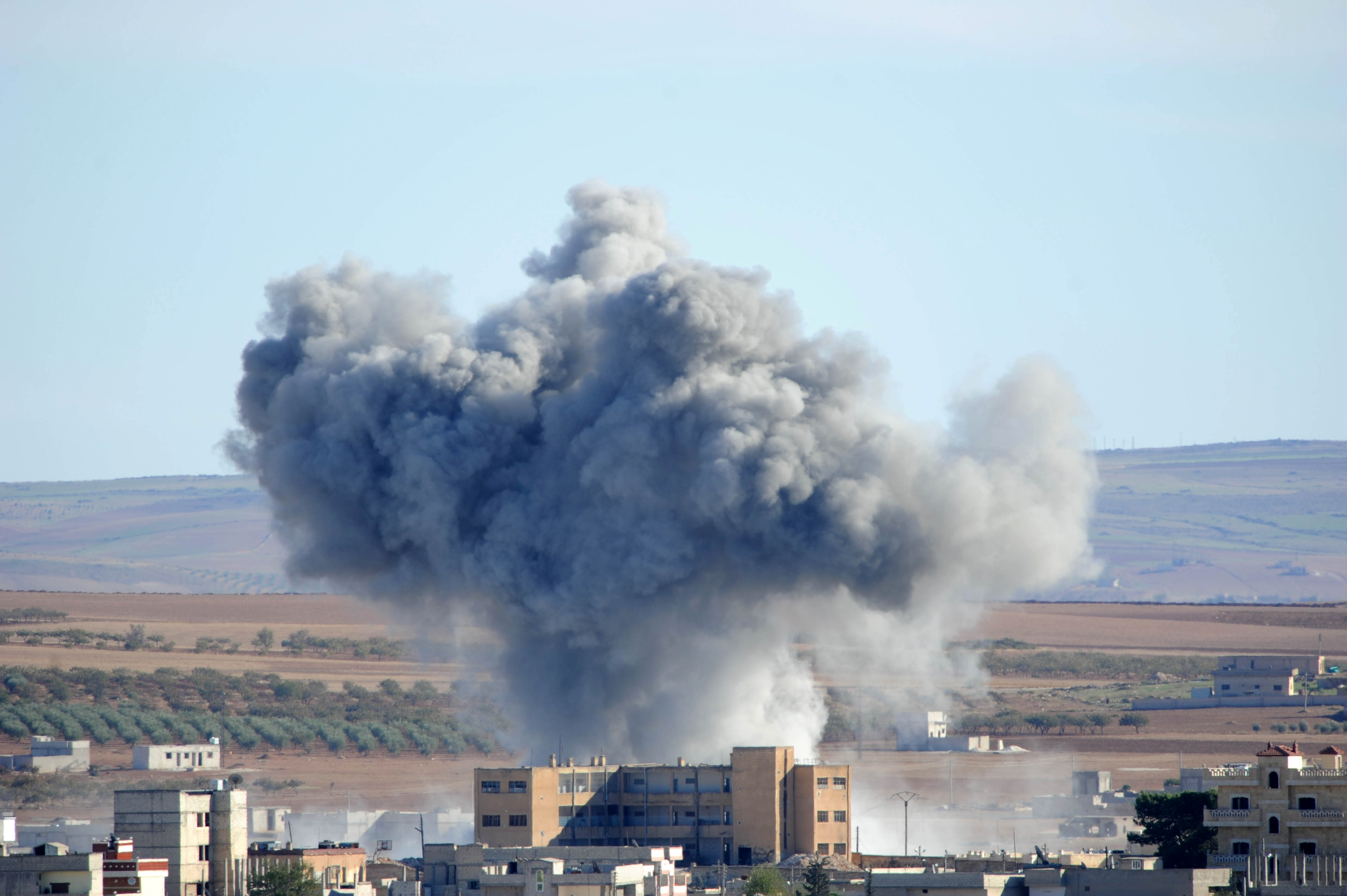
(Photo: Heavy smoke from an airstrike by the U.S.-led coalition planes rises in Kobani, Syria, October 20, 2014 as seen from a hilltop on the outskirts of Suruc, at the Turkey-Syria border, in Sanliurfa province, Turkey. By Gokhan Sahin/Getty Images)

Fifty Shades Of Racism?

Reviewing James Booth’s Philip Larkin: Life, Art, and Love, Alexander Adams praises the biographer for pushing back against Larkin’s more vociferous critics, especially those who dwell on his private sexism and racism. About the latter charge:

Any biographer has to take into account the criticism Larkin has faced for racist comments made in private letters. Those who are quick to apply the label ‘racist’ are usually unwilling (and NPG x12937; Philip Larkin by Fay Godwinunable) to distinguish causes and types of racism.

Racism is a spectrum of views, ranging from the pseudoscientific conviction that certain groups are genetically superior/inferior to a dislike of certain cultural manifestations. The causes of racist sentiment can be anything from displaced dissatisfaction, cultural prejudice, political partisanship, religious conditioning and nationalist sentiment in time of war right up to paranoid delusion. Dyspeptic misanthropes often express disgust in racist form when their frustration is of a general unfocused kind.

There is no suggestion that Larkin ever uttered a racial insult to a person’s face or engaged in any discriminatory behaviour (indeed, Booth presents examples of where Larkin supported the careers of non-white authors). Booth points out that Larkin only voiced racist opinions to receptive individuals (Amis, Monica, etc) in private and often undercutting epithets with irony or self-mockery.

While true, this does not make Larkin’s racist expressions false.

It would be surprising if a culturally conservative white Englishman with mild nationalist sentiments did not resent some of the cultural changes of Britain from the 1950s onwards, just as it is equally unsurprising that he felt somewhat ashamed of his prejudices and unwilling to hurt anyone directly. Booth has no need to excuse Larkin’s prejudices, just as we should have no reason to require excuses. HP Lovecraft’s racist view on life is an essential part of his writing; Larkin’s racist comments about West Indian cricketers and Indian doctors are peripheral and irrelevant to understanding his poetry.

There is also a very English Amis-Larkin cultural sub-text here: the ironic private use of racist and sexist language as a kind of mock meta-protest at the forces of progress. Jonathan Raban, in a review for The New Republic, discussed this question – without flinching from the actual words – this way:

In 1978 [Larkin] wrote to Robert Conquest: “We don’t go to Test matches now, too many fucking niggers about.”

The letters to male friends like Conquest and Kingsley Amis are salted with terms like “wop”, “coon” and “wog”, just as they are salted with nursery ruderies like “bum”, “piss” and “shit”; and in context the childishness of the words counts for a good deal more than their tiresome spray-gun racism. Larkin’s alternative conservative manifesto (“Prison for strikers, Bring back the cat, Kick out the niggers—How about that?”) and his ditty addressed to *H.M.* the Queen (“After Healey’s trading figures, After Wilson’s squalid crew, And the rising tide of niggers—What a treat to look at you”) have all the political heft of a pre-schooler showing off his hoard of dirty words to épater the aunties and get in with the big kids. No word was dirtier than “nigger”, and Larkin used it extensively to his boys-room cronies, for the usual boys-room reasons.

You see this increasingly on the American right: essentially trolling liberals by semi-humorously advancing outrageously racist or sexist  ideas and images as some kind of cultural identity. Merely a glance at much conservative media sees this Breitbartian tendency in full bloom. See: Drudge and depictions of African-Americans. See: Rush passim. But the difference, of course, is that the latter is fully public; while Larkin’s foul racist language was absolutely and extremely private.

Does that distinction matter? For the poetry, it seem pretty clear to me that it doesn’t. For the human being? Of course it does. To my mind, this kind of statement is dispositive:

I find the “state of the nation” quite terrifying. In 10 years’ time we shall all be cowering under our beds as hordes of blacks steal anything they can lay their hands on.

That quote comes via a review by John G Rodwan Jr of a book exonerating Larkin. And yet, as Rodwan notes, the same person who wrote that in private could also write the following in public:

The American Negro is trying to take a step forward that can be compared only to the ending of slavery in the nineteenth century. And despite the dogs, the hosepipes and the burnings, advances have already been made towards giving the Negro his civil rights that would have been inconceivable when Louis Armstrong was a young man. These advances will doubtless continue. They will end only when the Negro is as well-housed, educated and medically cared for as the white man.

It’s also true that few racists would have devoted their critical lives to reviewing jazz, as Larkin did. It was his one true passion apart from poetry, and it is an indelibly African-American art form. Rodwan deals with that question really insightfully.

I would simply add that human beings are extremely complex. No one is immune to the primate, private aversion to “the other”, whatever it is. No one is immune from resistance to cultural change. What we are responsible for is whether we allow those impulses to control our thoughts and actions, in private and public. My rather conventional view is that we should all strive as hard as we can to obliterate those impulses in both the private and public spheres. But in actuality, given human nature, they will tend to manifest themselves in all sorts of ways that can be misread or misunderstood if the only two categories are racist or non-racist. And what I worry about – especially with the almost constant stream of easy online pieces and posts decrying the racism or homophobia or sexism of one person or another – is that we simplify things that, in most human lives, resist simplification. By defending the dignity of some, we can reduce the complex humanity of others.

It is possible for a human being to be racist and non-racist in the same day, and indeed exhibit a mountain of contradictions across a lifetime. It is possible for someone to be publicly homophobic but privately tolerant and embracing, just as it is possible for someone to publicly be a model of human virtue while harboring private impulses and acts that are truly foul at times.

What I’m saying is that Larkin was clearly both things – in many mutations and manifestations through his life. What I’m also saying is that we are all both those things to some degree or other. And the spectrum of these varying thoughts, feelings and acts is broad and wide. We are not either/or. We are both/and. We are human.

Update from a reader:

It sounds as if Larkin was fine with AMERICAN culture being multi-racial, with AMERICAN Negroes getting their civil rights, with AMERICAN jazz reflecting the indelible print of African-American tonality and rhythm … but the idea that ENGLAND was going to experience the same diversity and cultural change was very scary to him.

(Photo of Larkin by Fay Godwin, via Wiki)
Getting Ebola Under Control

Yesterday and today brought a few bits of good news:

According to the BBC, the Spanish nurse who was the first person to contract Ebola outside of West Africa has tested negative for the virus (a second test is required before she’ll be officially free of the disease). And the United States has reached an important milestone: the 21-day monitoring period for the 48 people who had contact with Thomas Eric Duncan, the Liberian man who died of Ebola in Dallas, ended on Sunday and Monday. Aside from the two nurses who cared for him, there have been no new infections.

Things are also looking up in Africa, where two countries have been declared Ebola-free:

On Friday, the World Health Organization announced that Senegal had completely contained the spread of the disease, and now on Monday Nigeria has joined them.

The ruling was made after determining that it has been six weeks without any new cases of the disease. The last reported case was on September 5. Seven Nigerians died of the disease since July, but the country is being praised for swift and decisive efforts to contain the outbreak. In particular, Nigerian officials quickly traced all those who came in contact with the first person to be diagnosed with the disease this summer.

Of course, none of this means the epidemic is over. The CDC is updating its safety guidelines for health workers in order to reduce the risk that other nurses will contract the virus if and when more Ebola patients arrive in American hospitals. And while the news from Senegal and Nigeria is worth celebrating, other West African countries remain in dire straits, with Liberian President Ellen Johnson Sirleaf warning that the disease has brought her country to a standstill:

“Across West Africa, a generation of young people risk being lost to an economic catastrophe as harvests are missed, markets are shut and borders are closed,” the Nobel Peace Prize laureate said in a “Letter to the World” broadcast on Sunday by the BBC. “The virus has been able to spread so rapidly because of the insufficient strength of the emergency, medical and military services that remain under-resourced.”

In neighboring Sierra Leone, emergency food rations were distributed for a third day on Sunday to give a nutritional lifeline to 260,000 residents of an Ebola-stricken community on the outskirts of the capital, Freetown. The Waterloo area in Freetown has 350 houses under quarantine with people suspected of having the Ebola virus and infections in the district are rising, according to the UN World Food Program.

Meanwhile, one new study suggests that the 21-day monitoring period may not always be long enough:

According to Charles Haas of Drexel University, who authored the study, the exact scientific origins of the World Health Organization’s recommended quarantine period for Ebola are murky. The recommendation could be traced to data from the 1976 Ebola outbreak in Zaire and the 2000 outbreak in Uganda, both of which reported incubation periods of 2-21 days, but nobody can be certain.

A more concrete approach is needed to determine an appropriate quarantine period, Haas wrote, so he analyzed data from the 1995 outbreak in the Congo and the current one in West Africa. After examining the newly expanded data set, Haas discovered that the probability of excedence for Ebola incubation was .1 to 12 percent. “In other words,” he wrote, “from 0.1 to 12 percent of the time, an individual case will have a greater incubation time than 21 days.”