Codifying Consent, Ctd

I haven’t weighed into the debate over California’s sexual consent law or the new regulations in many colleges, including my alma mater, Harvard, that defines any sex without vocalized continuous consent as sexual assault or rape. One reason is my lack of any real experience of male-female sex where the power dynamics can often be very different from gay sex. But what does concern me a great deal is the lack of any due process for the accused in these unfortunate and often deeply contentious circumstances. Mercifully, some of the faculty at Harvard – specifically the law school – have now risen up against what look to me like kangaroo courts, designed to instill fear into one gender alone. In an open letter, published in the Boston Globe, the law profs write:

Harvard has adopted procedures for deciding cases of alleged sexual misconduct which lack the most basic elements of fairness and due process, are overwhelmingly stacked against the accused, and are in no way required by Title IX law or regulation. Here our concerns include but are not limited to the following:

■ The absence of any adequate opportunity to discover the facts charged and to confront witnesses and present a defense at an adversary hearing.

■ The lodging of the functions of investigation, prosecution, fact-finding, and appellate review in one office, and the fact that that office is itself a Title IX compliance office rather than an entity that could be considered structurally impartial.

■ The failure to ensure adequate representation for the accused, particularly for students unable to afford representation.

Ezra Klein – in a remarkable column that we featured yesterday – actually defends the lack of due process as a positive aspect of the new regulations, because their inherent bias against accused men will create a climate of fear that is necessary to curtail male sexual violence and assault:

To work, “Yes Means Yes” needs to create a world where men are afraid … Critics worry that colleges will fill with cases in which campus boards convict young men (and, occasionally, young women) of sexual assault for genuinely ambiguous situations. Sadly, that’s necessary for the law’s success. It’s those cases — particularly the ones that feel genuinely unclear and maybe even unfair, the ones that become lore in frats and cautionary tales that fathers e-mail to their sons — that will convince men that they better Be Pretty Damn Sure.

Jon Chait and Charles Cooke both note the profound illiberalism here – and it’s enabled by the pomo gender ideologues who now control most discussion of sex and sexual identity in the academy. But what’s also impossible to ignore is how the social left is now trying to micro-manage what goes on in the bedroom with almost as much assiduity as the social right – and to do so in order to target one gender alone.

When all men are regarded as potential rapists, and when you have bought into the argument that the patriarchy is so entrenched that only radically illiberal procedures to punish, stigmatize and shame them will suffice, you have embraced a new Puritanism almost as troubling as the old. Play out this scenario: If a judicial process were set up that assumed that all women reporting sexual assault and rape were liars until somehow proven truthful, there would be an outcry. But if an identical judicial process is established that assumes all men accused of sexual assault and rape are guilty until proven otherwise – with no due process allowed – that is, apparently, a progressive move.

And it may well be a progressive move; but it sure isn’t a liberal or fair one. This does not mean that I don’t take the issue of sexual assault and rape seriously. In fact, it’s precisely because I do take it seriously that I’d support laws and regulations that allow real justice to be done, in which the accused have some basic right to defend themselves. The rest is a function of a leftist academic culture in which men are somehow inherently a problem; and almost anything is justified to make sure their “privilege is checked” and their gender stigmatized. At some point, the sexism inherent in this needs to be confronted as well.
A Virtual Physical

James Hamblin makes the case for telemedicine:

If some basic needs were addressed remotely, doctors could focus on more dire cases during their busy office hours. Patients could ask simple questions without needing to take an afternoon off work for an office visit. As of last year, only 12 percent of Americans had ever texted or e-mailed with a doctor, according to a survey conducted for The Atlantic. But about a third of people under 30 were open to having their primary communication with their doctors be online. …

Under the current model, doctors don’t see patients on an ongoing basis. As a result, a patient is inevitably getting advice from a doctor who, because she hasn’t seen what he looks like when he’s not sick, can’t tell whether he really “looks sick”—a gut valuation that remains crucial to effective primary care.

Yet, with the American Association of Medical Colleges projecting a national shortage of more than 90,000 doctors by 2020—especially in rural areas—there simply may not be enough doctors to provide this kind of ongoing care. Telemedicine could play a crucial role in addressing basic needs, particularly in settings where long-term relationships don’t come into play, like emergency rooms. Already, to take one example, a company called Avera Health makes physicians in cities available via video to hospitals in small towns, where they are remotely helping to staff emergency rooms overnight. (They work in concert with people who are on-site. So, for instance, a nurse might perform hands-on work at the direction of an onscreen doctor until a local doctor can arrive.)

Previous Dish on telemedicine, as applied to abortion, here. Update from a reader:

Haven’t we had telemedicine for like a decade now?

Heh. Another reader:

Personal anecdote: the Fortune 100 company I work for rolled out a telemedicine option (“free for 2014!”), so I tried it for a persistent cough I’ve had this week. The doctor told me that in most states you’re required by law to have a webcam, so the doctor can see you and look down your throat, I guess. After hearing my symptoms, she wrote a prescription to my local pharmacy for a strong cough suppressant. Pretty handy, huh?

I decided to get a second opinion. After being told to wear a mask in the office, the Nurse Practitioner did a nose swab (just as much fun as it sounds), diagnosed me with Influenza B, and signed me up for Tamiflu

I have an 18-month-old daughter. I’m sure telemedicine will have it’s place, but I’m gonna stick with the clinic for now.

Does Voter ID Inherently Discriminate?

Screen Shot 2014-10-15 at 12.48.54 PM

Dara Lind highlights a new study illustrating the subtle ways in which race influences white Americans’ opinions of voter ID laws:

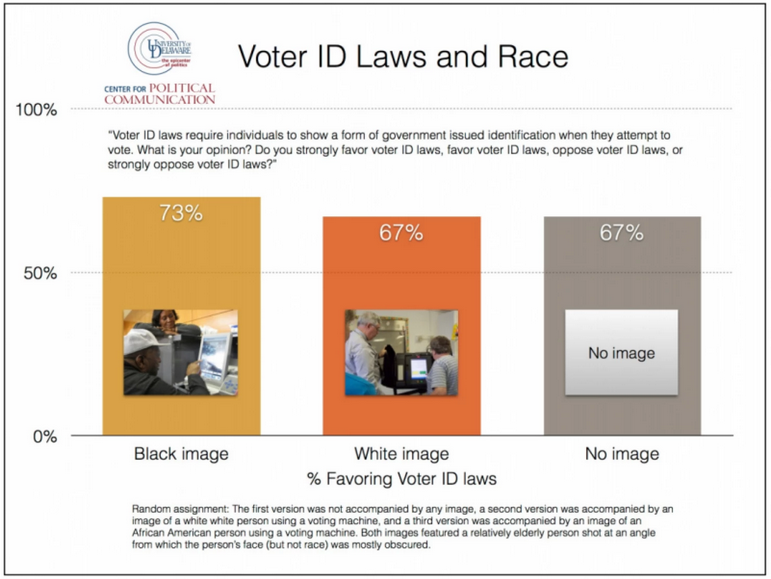
The study, which was conducted by two University of Delaware professors and a Pennsylvania high school student, was fairly straightforward. It asked people whether they supported or opposed laws that required people to show a form of government-issued ID at the polls.  Some respondents were shown a picture alongside the question, of either a white voter or a black voter, and others weren’t shown a picture at all. The researchers found that black and Hispanic respondents were about equally likely to support or oppose the laws regardless of who was featured in the picture. And white respondents were as likely to support the law when they saw a picture of a white voter as they were when they saw no picture at all. But when the picture alongside the question showed a black voter, more whites supported voter ID .…

The study isn’t too surprising. Similar research has shown that whites are more likely to support harsh criminal justice policies, like stop-and-frisk, when they see images of or hear statistics about black prisoners. And voter ID is like stop-and-frisk in one important respect: it’s a race-neutral policy in theory, but in practice it ends up disproportionately harming people of color.

Bouie puts the study in context of a growing body of evidence that voter ID laws have discriminatory effects, even though that may not be their intent:

Likewise, a 2013 study from researchers Keith G. Bentele and Erin E. O’Brien found a tight relationship between race, Republicans, and voter ID. If a state elected a Republican governor, increased its share of Republican legislators, or became more competitive while under a Republican, it was more likely to pass voter ID and other restrictions on the franchise. Moreover, states with “unencumbered Republican majorities” and large black populations were especially likely to pass identification laws.

For Bentele and O’Brien, this comes down to partisanship. “These findings demonstrate that the emergence and passage of restrictive voter access legislation is unambiguously a highly partisan affair, influenced by the intensity of electoral competition,” they write. Even with the context of the other studies, I think this is right. Voter ID boosters don’t hold anti-minority animus as much as they want to maximize political advantage.

Chris Ingraham hopes the tide is turning against these laws:

The legal justification for voter ID laws stems from a 2008 Supreme Court ruling that the laws are generally applicable and nondiscriminatory, meaning that they’re not meant to reduce turnout among a particular group. But studies this year have demonstrated strong evidence for discriminatory intent behind the laws. The University of Delaware study adds to this body of evidence. It also seems that the judiciary is starting to agree: Courts have blocked the enactment of voter ID requirements in Wisconsin and Texas this year, citing these disproportionate impacts.

Even more notably, Judge Richard Posner, the Ronald Reagan appointee whose 2008 ruling in favor of voter ID was upheld by the Supreme Court, has had a change of heart. In a blistering opinion released last week, he concludes that the case for voter ID laws is at odds with the evidence.

Michael Hiltzik digs into Posner’s opinion and explains why it’s such a BFD:

Posner’s dissent in the Wisconsin voter ID case is especially telling, because he wrote the so-called Crawford decision in 2007 upholding Indiana’s voter ID law, in which he was upheld by the Supreme Court. But he has since recanted. In a 2013 book, he accepted the view that such laws are properly regarded as “a means of voter suppression rather than fraud prevention.” That’s the view that informs his latest opinion.

“There is only one motivation for imposing burdens on voting that are ostensibly designed to discourage voter-impersonation fraud,” he writes, “and that is to discourage voting by persons likely to vote against the party responsible for imposing the burdens.” More specifically, he observes, photo ID laws are “highly correlated with a state’s having a Republican governor and Republican control of the legislature and appear to be aimed at limiting voting by minorities, particularly blacks.” In Wisconsin, according to evidence presented at trial, the voter ID law would disenfranchise 300,000 residents, or 9% of registered voters.

On the other hand, Noah Feldman argues that Posner’s heart hasn’t changed – the evidence has:

A close reading of Posner’s opinion indicates that the judge hasn’t so much reversed his earlier view as he has taken seriously data that were unavailable in 2007. The numbers, as Posner now interprets them, do strongly suggest that the purpose of voter ID laws is to make it more difficult for poor people, especially blacks and Latinos, to cast votes. According to Posner, he wasn’t wrong in 2007. It’s just that then, there was no basis to assume that Indiana was trying to exclude minority voters. Now, there’s evidence in favor of that view.

HBO Cuts The Cord

Linda Holmes summarizes the news:

Beginning in 2015, HBO will offer a streaming service to cord-cutters and other nonsubscribers on an a la carte basis. It should be noted that the announcement HBO released to the media does not explicitly say the service will be HBO GO (or that it won’t), only that it will be “a stand-alone, over-the-top, HBO service.” And, of course, it doesn’t say how much the service will cost. It doesn’t even say it will carry every HBO show, let alone what archival material will be available — HBO GO has a lot. Those who are currently jumping up and down and declaring their independence from their cable provider may or may not be as happy when more details emerge.

The move, though, would seem to be a big one, given that requiring a cable subscription is standard on many services besides HBO that provide streaming access to cable programming (without requiring episode-by-episode purchase through services like iTunes or Amazon).

Derek Thompson imagines the target audience:

It seems that the audience most likely to pick up an HBO “Go-It-Alone” product today are mostly the young, lower-income Internet-savvy viewers who weren’t cable customers, anyway. That suggests that HBO Go-It-Alone will restrain cable’s growth by preventing new sign-ups, rather than hurt cable by creating more cord-cutters.

Brian Merchant declares that HBO has “killed cable”:

I’m not worried that the death of cable TV will deprive of us of future Mad Men. We’ve already seen that the likes of Netflix and Amazon are more than willing to pay for thoughtful, elaborate productions; Transparent is the best show I’ve seen this fall, and everyone seems to love House of Cards and Orange is the New Black. The shows themselves are still better than ever, hence the success of Walking Dead—which, by the way, counted plenty of internet users among its record-breaking viewership—and there’s indisputably a market for them. Now, plenty of niche shows may fall by the wayside without the help of subsidies from the big packages—but ultimately, I think that means less crappy TV and more time-wasting on the internet.

I’m planning on returning to internet-only TV. More and more people are following suit—the number of households without satellite or cable TV has grown 44 percent over the last four years. That oft-uttered phrase “Oh, I don’t have a TV” is no longer an affected hipsterism but a practical choice.

McArdle asks, “how much will this actually benefit cord cutters in the end? ”

At first blush, the answer is “a lot” — they can get HBO without paying for ESPN! Over the long term, however, as this becomes a bigger revenue source, I’d expect to see the cable networks stop selling their content to other streaming services, crack down on login sharing, and otherwise make sure that if you personally are not paying the cable company, then you personally will pay HBO, not your old roommate who forgot to change his password. I’d also expect to see them offer significant bonuses for longer-term contracts to discourage viewers from signing up, binging for a month or two, then moving onto some other network like harvesting crews moving north.

Zachary M. Seward checks in on the HBO-Netflix rivalry:

HBO now says it can easily pick up additional revenue in the US from people who don’t pay for TV but would subscribe to a standalone HBO package. It’s not yet clear how that will affect the rivalry with Netflix. They can certainly coexist, but more heated competition could put pressure on their prices. Netflix blamed its slower-than-expected subscriber growth on its price increased to $9 a month; HBO’s internet-only service is likely to cost significantly more than that.

James Poniewozik sees HBO’s big news as “a potentially exciting development for TV viewers tired of watching their cable packages swell into bloated, gold-laden barges of tied-together offerings topping $200 a month”:

If big player HBO sees that it can offer a cable-free package and survive, that may lead the way for companies in other pricey TV sectors–live sports, for instance–which you’ve had to agree to buy a giant cable package to get.

Along those lines, CBS announced its own stand-alone web subscription today:

The new “CBS All Access” service, costing $5.99 a month, is the first time that a traditional broadcaster will make a near-continuous live feed of its local stations available over the web. … In a notable carve-out, National Football League games will not be available on the service. CBS executives said they now are in discussions with the N.F.L. and that other live sports already are available for streaming. A similar service from Showtime, the premium cable network owned by CBS, is likely in the “not too distant future,” [CBS CEO Leslie] Moonves said.


Ebolanomics

Screen Shot 2014-10-15 at 12.23.13 PM

Kim Yi Dionne and Laura Seay discuss how Ebola panic – coupled with ignorance of geography – is doing economic damage to African countries thousands of miles away from the outbreak:

Estimates of the economic damage to be caused by Ebola are as high as $33 billion. Whatever the ultimate cost, everyone agrees that Guinea, Sierra Leone, and Liberia’s economies will be deeply and negatively impacted. Much of that damage is likely unavoidable because people in heavily affected countries engage in “aversion behavior” — or taking actions driven by fear alone (e.g., employees not going to work for fear of being exposed to Ebola).

But this Ebola outbreak is wreaking havoc on African economies beyond the three most heavily affected by Ebola, and that damage is completely avoidable.

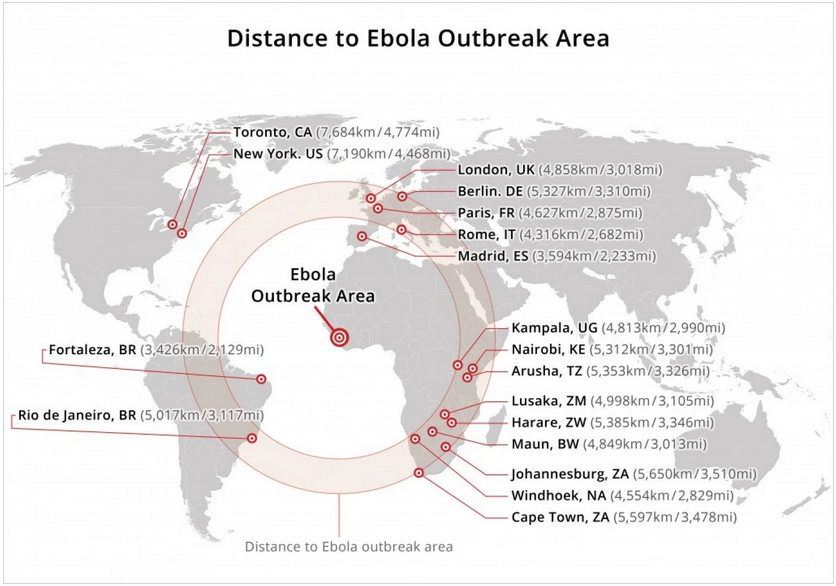
The East and Southern African safari industry provides a good example. Bookings for safaris there — including for the famed Great Migration in Kenya and Tanzania — have plummeted due to the Ebola outbreak. In a survey of 500 safari tour operators, SafariBookings.com found a majority of respondents had a decrease in bookings and an increase in cancellations. These actions are based in fear, not reality. We are faced with risk every day, and would be better suited to understand our relative risks if we appreciated where in the world some places are.

Ylan Q. Mui zooms in on Liberia, where the epidemic threatens to turn back the clock on the economic progress the country has made in recent years:

With critical public works projects in limbo and businesses struggling, the virus is threatening Liberia’s chance to escape generations of poverty and join Africa’s rising prosperity. “Liberia was moving,” said Estrada Bernard, chairman of the International Bank in Liberia and the Liberian president’s brother-in-law. “The whole thing hinges upon how well we can get this virus under control.” The best-case scenario compiled by the World Bank predicts Liberia’s economic growth will still plunge by more than half this year. Rubber, one of the nation’s biggest exports, is expected to fall 20 percent this year. Gold and diamond mining have also dropped off. Beer production plunged 30 percent during the first quarter.

And that’s not to mention the human toll of the virus in a country that currently has 2.3 million fewer boxes of sterile examination gloves than it needs. Worse still, Abby Haglage reports, thousands of children have been orphaned in the epidemic:

Of the more than 8,000 people infected with Ebola in West Africa, an estimated 20 percent of them are under the age of 18. Without solid health or proper nutrition, the chances of recovery in this demographic are even lower than for the epidemic at large. “Three out of four of children infected with Ebola in West Africa are dying—that’s a 75 percent mortality rate,” says [Save The Children president and CEO Carolyn] Miles. “These kids are already malnourished, they’re not in the best of health. They’re just not able to survive this.”

Those that do survive, or are lucky enough to have escaped infection, meet a shadowy future. According to data from UNICEF, upwards of 3,700 children have lost one or both parents to Ebola in Sierra Leone, Guinea, and Liberia thus far. Miles, who met with four different groups of orphans in Liberia on her visit, suspects the number is much higher. “I think there are thousands we don’t even know about,” she says.

What Spooked The Markets?

Danny Vinik recounts yesterday’s worrying economic news:

Wednesday was an ugly day for the global economy. British and German stocks each fell around 3 percent. Greek stocks fell 6 percent. (That’s huge.) In the U.S., a trifecta of economic indicatorsretail sales, the producer’s price index, and a manufacturing reportwere all disappointing. That sparked an early morning selloff here with investors fleeing into safe-assets like U.S. Treasuries. The interest rate on the 10-year-bond hit a low of 1.86 percent, a drop of more than 16 percent. (Again, that’s really big.) Equity markets closed down around 1 percent and U.S. Treasuries rebounded, closing the day around 3 percent.

This volatility has been a feature of the market during the past few weeks and is a signal that something is not right with the global economy.

The sell-off has continued today. Yglesias is concerned:

On Tuesday, the Eurozone reported that industrial production in Europe had fallen 1.9 percent over the past year. Even the German economy is struggling, leading to fears that the Eurozone will fall into a third post-crisis recession. Since the Eurozone never addressed the underlying problems that led to its last crisis, a new European downturn could plunge the world into another round of big financial scares.

The difference is that this time around the Chinese economy is also slowingas is Russia’sas is Brazil’s. It’s basically bad news everywhere.

Annie Lowrey asks if the problem is Ebola:

At least right now, Ebola poses little direct risk to the global economy. It is the fear of Ebola — a fear that the virus might reduce travel, hurt industry, slash trade, or just foment uncertainty — that seems to be rattling the markets.

It’s been engineered by the monetary scientists at the Fed, who’ve pumped $4 trillion into the economy since 2009 in an attempt to strengthen an economy that is fundamentally not as strong as it looks. Despite the Fed’s best efforts (and I agree that they needed to do something, especially in the beginning), the real economy simply hasn’t caught up to the markets. Unemployment has ticked down, but wages still haven’t ticked up. It’s no accident that weak retail sales in the U.S. were one of the economic indicators that triggered the sell-off. As I’ve said many times before, you can’t have a sustainable recovery, one markets can really believe in, until you have the majority of the population with more money in their pockets.

The reality is that this hasn’t happened in the last few years, and for many people, decades (the average male worker today makes less in real terms than he did in the early 1970s).

Matt O’Brian’s bottom line:

[T]he global economy still hasn’t recovered from the financial crisis. And this time, policymakers don’t look as ready to ride to the rescue. The Federal Reserve is about to finish winding down its bond-buying program and is beginning to talk about when to raise rates. The European Central Bank is debating whether it should do too little too late or too late too little about Europe’s lost decade. And China’s central bank is reluctant to open its monetary spigots any further for fear of fueling an even bigger bubble. This means that the world’s central banks are all either pulling back or not pushing ahead despite weak growth. And that’s why inflation is disappearing everywhere.

Leonhardt’s explanation is simpler:

There are many reasons stocks are falling, from the worries about the condition of the global economy to the unknowable forces that often cause market fluctuations. But beyond those immediate factors, there is also the simple fact that stocks are expensive.

When stocks are expensive — relative to their earnings — they have less margin for error. Small pieces of bad news have the potential to make investors more anxious, because current prices are based on a relatively optimistic view of the world. Such optimism can crumble quickly.

The Texting-While-Driving Epidemic That Isn’t, Ctd

unnamed (7)

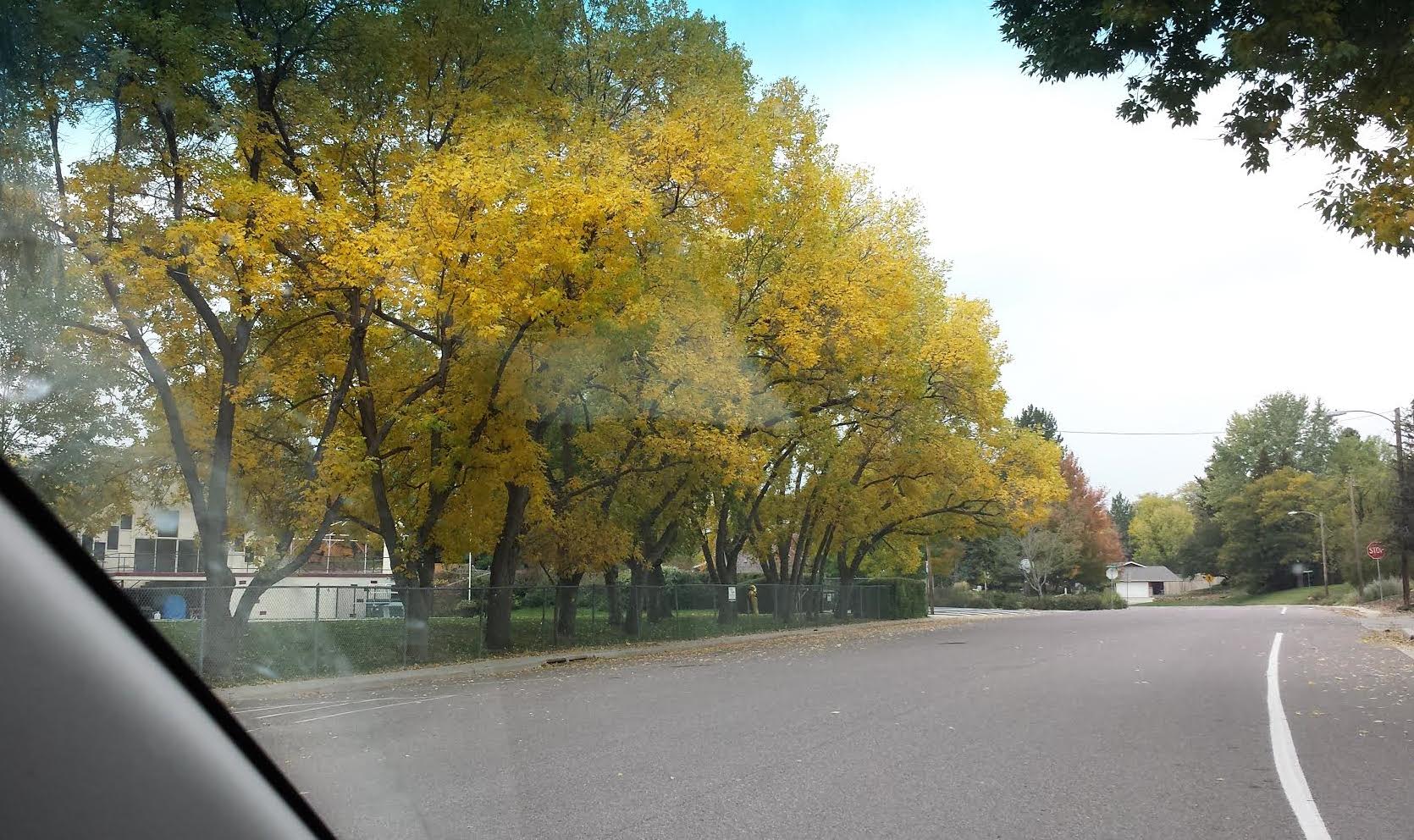
Centennial, Colorado, 12 pm

David Watkins absorbs Philip Cohen’s recent findings debunking a killer-text epidemic:

Driving, of course, is what’s deadly here, and texting-while-driving, like anything that takes your focus away from such a dangerous, high-stakes activity, is obviously a terrible idea, the effort to focus on this one distracting activity misdiagnoses the fundamental problem …. [I]f we’re serious about continuing to push the fatality figures down, the most important thing we can do is make the kind of transit investments and change the regulatory environment to encourage the construction and development of neighborhoods and cities that facilitate low-car lifestyles. (To mount a hobby-horse of mine, down with parking requirements!) The good news is the kids want it, if we’ll let them have it.

On that note, Emily Badger looks into why young people are driving less:

It’s true that the recession has probably dampened car use, not just for millennials but for everyone. But there are also some relevant, long-term socioeconomic shifts underway that will likely continue to affect car use even after the economy fully recovers. As student loan debts rise, alongside the cost of housing in many big cities, budgets for car payments will be squeezed. This is particularly true in cities like Washington, D.C., where the high cost of housing is partly subsidized by the low cost of transportation for young professionals who rely on transit and bikes instead of cars.

Americans are also forming their own households, getting married and having children later – all trends that predate the recession and that postpone life stages associated with the peak driving years. … And one more economic argument: Americans just reaching driving age today “have no living memory of consistently cheap gasoline,” the PIRG and Frontier Group authors write. And they’re not likely to see it again in the near future, regardless of what the economy does.

A reader chimes in:

There has been something bothering me about Philip Cohen’s piece since and just put my finger on it (I’m sure Dish readers well versed in statistics have already seen this and pointed to it.) Cohen’s work comparing driving deaths and cell phone subscriptions doesn’t link anything, so it is not a surprise he ends up with a scattershot chart. It is funny that the work is about statistical truth while his chart his full of assumption. The chart assumes that owning a cell phone equals texting while driving.

But. This discounts all the people who have cell phones that don’t drive, can’t drive or don’t text while driving. My 93-year-old grandmother owns a cellphone – doesn’t drive. My 72-year-old father has a cell phone and wouldn’t know how to turn it on while driving, much less text while driving. My 9-year-old niece has a child safety cellphone – so she can’t text nor drive. And I never text while driving.

So while we own a cellphone (and thus are on the chart) we can’t die while texting. So you can’t know from us if texting equals fatalities. Our existence only proves we have not yet died while owning a cellphone.

I’m sure if we any kind of ownership study of widely used goods there would be the same scattergun chart. But I bet if we did “fedora hat” purchases by state suddenly death rates in certain retirement states suddenly cluster. Will owning a fedora cause fatal car crashes? No, but being an older man – the demographic likely to buy a fedora – would be the problem.

What needs to be examined is what people are actually doing when they have a fatal crash (drinking, drugs, eating, conversing, texting, watching a movie, on wifi, etc) and who knows where (or if) you can pull those statistics. Owning something is different from using something which is different from causing something.

The Politics Of Inequality In China

Pew’s Katie Simmons reports that 42 percent of Chinese citizens think inequality is a “very big issue.” 46 percent of Americans said the same — and inequality is one of the most important issues in American politics. As the below chart shows, a plurality of Pew’s Chinese respondents blame their government’s policies for the wealth gap:

chinese survey pew quote inequality

This is a real problem for China. The past view years have seen a spate of low-level social unrest — protests, riots, strikes, and the like. While in part this surely has to do with the rise of social media and other outlets for organizing, as well as the sense of civic participation that often comes with urbanization and a growing middle class, these protests are arguably tied to the growth in inequality as well. In 1993, there were about 8,700 “disturbances” — the official name for protests, riots, and the like — in China. By 2010, the figure was 180,000. Nargiza Salidjanova, an analyst at the US-China Economic and Security Review Commission, links this to growing inequality. So while Chinese citizens broadly think the transition to capitalism has been worth it, there’s real anger about the rising inequality that’s accompanied by it. It’s a major problem for the Chinese Communist Party going forward — and it’s one among many.

Meanwhile, Darrell West wonders what kind of influence China’s growing moneyed class will wield on the government:

China is becoming a land of billionaires. With 152 billionaires, China is minting ultra-wealthy individuals at a brisk pace. Currently, the country ranks second in the world in number of billionaires, according to the Forbes compilation of billionaires. This is below the 492 in the United States, but ahead of Russia (with 111), Germany (85), Brazil (65), and India (56). But the broader question is what impact [Alibaba founder Jack] Ma and other billionaires will have on Chinese society and government.

West notes that Ma, like other Chinese billionaires, has “been careful not to position himself as an oppositional political figure”:

For example, he has set up a charitable trust with an estimated $3 billion in assets and announced plans to address China’s environment and health care problems. The wealthy billionaire is concerned about environmental pollution and has told reporters that “somebody has to do something. Our job is to wake people up.” But in announcing his charitable venture, he reassured government authorities about his long-term intentions. “I’m not political,” he told the Wall Street Journal. “We don’t want to confront [government officials]; we want to sit down and work with them.” …

In thinking about his options, Ma should be cognizant of the case of Chinese billionaire Wang Gongquan. That businessman attracted unfavorable government attention when he spoke out about his desire for greater citizen involvement in his country’s decision-making. He was arrested on charges of “assembling a crowd to disrupt order in a public place”, and his case is pending in the legal system. The line between billionaire policy advocacy and political involvement can be very treacherous in nondemocratic systems.

The Plight Of The Yazidis Still Isn’t Over

George Packer checks in with his Yazidi contact “Karim” in northern Iraq, who reports that his community remains on the brink of a humanitarian disaster two months after a much-heralded rescue effort:

Yesterday, I spoke on the phone with Karim. He’s still at the top of Mt. Sinjar, living in a military camp with around a hundred fighters, the majority of them Kurdish, the rest Yazidis. They sleep in United Nations tents and eat canned food brought in by humanitarian airdrops. There is no real way out except by airlift—in the past ten or twelve days, according to Karim, ISIS has pushed Yazidi fighters out of villages north and west of Mt. Sinjar, and they now surround the mountain. Karim told me that there are still about a thousand civilians around the mountain, also living in tents. The humanitarian airdrops are not enough, food is running low, and the past few nights have been cold with the approach of winter. The Yazidi resistance fighters want an international ground force to liberate Sinjar—something that they are unlikely to get.

A few hours before we spoke, Karim said, five Yazidi girls arrived at the mountaintop camp. The youngest was nine, the oldest twenty. They had walked several dozen miles from their town to the south of the mountain. They carried nothing with them and were barefoot. The girls said that they had been held prisoner for weeks by ISIS fighters, and were badly beaten, according to Karim. Other Yazidi girls and women have been distributed in slave markets to ISIS fighters, and when I asked Karim if the girls had also been raped, he told me, “I couldn’t bear to ask that question, to be honest.”

Ralf Hoppe interviews a Yazidi woman who was kidnapped by ISIS but managed to escape after nine days in captivity:

Their captors beat them, sometimes several times in a single day, for no apparent reason. There was a man with a beard who used an electric cable, while two others preferred wooden switches. Sometimes they were also punched and kicked, and they were repeatedly sexually abused.

Nadia doesn’t give a literal account of these rapes. It is virtually impossible for her to talk about them, and it contravenes the conventions of her culture. She merely says: “We were taken individually to another room, to one of the men.” Then she lowers her head, in silence, awash with shame. “What else could we do?” she says after a while, now speaking very quietly. She says the men were merciless. Some women threw themselves at their tormentors’ feet, kissed their knees and hands, and — eyes filled with tears — pleaded for mercy. It was no use. The men remained unmoved. It only entertained them.

The jihadists are claiming a theological justification for enslaving the Yazidis in their English-language propaganda newsletter Dabiq:

The Islamic State newsletter, released online at the weekend, also contains an article by John Cantlie, a British journalist being held hostage, in which he says he fears he will soon be killed like his four fellow hostages, James Foley, Steven Sotloff, David Haines and Alan Henning. But most of it is devoted to theological justifications for Islamic State behaviour, citing early clerics and the practices of the Prophet Mohammed and his Companions during the early years of Islamic expansion.

“The enslaved Yazidi families are now sold by the Islamic State soldiers as the mushrikin were sold by the Companions before them,” the article, entitled “The Revival of Slavery before the Hour”, says. It says that “well-known” rules are observed, including not separating mothers from their children – something which may account for the number of teenage girls being used in this way, according to their families. It says that 20 per cent of women are being taken in this way, in accordance with rules demanding a fifth of property captured in war to be handed over as tax.

Where Is The Studs Terkel Of Fiction?

Nikil Saval, author of Cubed: A Secret History of the Workplacewonders why so few contemporary novelists deal with the substance of work:

[I]f there is a politics of the white-collar novel in the United States, it is this: office fiction is deliberately and narrowly construed as being about manners, sociability, gossip, the micro-struggles for rank and status – in other words, “office politics” – rather than about the work that is done in offices. There are major exceptions to this rule:

the genre of the police procedural and the legal or medical thriller often make naturalistic drama out of the details of professional methods. So, too, do recent novels about finance. But well into the current era of the office novel – with books like Ed Park’s Personal Days (2008) and Joshua Ferris’s Then We Came to the End (2007) – novelists place a premium on satirizing how shockingly little employees manage to get done in a day. At the center of their novels is the sheer emptiness of work—the fact not only that little gets done, but that one only remembers little about the little that does get done. …

The late David Foster Wallace blazed a lonely and unfinished path with The Pale King, with its sublime portrait of the tedious labor of IRS employees. Wallace seemed to want to redeem a publicly maligned bureaucracy, in much the way that the sheer bulk of his heavily worn research testified to the unexampled heroism of the writer, who could make literature out of boring materials. If a new politics and a new novel of work still remains to be found, it might be found here: in the still submerged mass of what we do and how we feel about it.