The Relatio: The Old Guard Strikes Back

VATICAN-POPE-AUDIENCE

There’s been quite a bit of pushback, as I predicted, to the revolutionary pastoral content of Pope Francis’ Synod on the Family. But what some are missing, I think, is that the word “pastoral” is critical here. It does not mean “doctrinal”. There is no indication that the Synod intends even to relax strictures against re-married Catholics from receiving Communion, let alone its formal doctrines about the impermissibility of any sexual intimacy or committed relationships for gay people for our entire lives. Instead, it seems to me, the Synod’s mid-term Relatio is arguing that insisting on these exclusions, and using harsh language to describe them – “living in sin”, “intrinsically disordered” etc – does nothing to bring people into a greater communion with the church and its teachings. In fact, the emphasis on such categories of the damned risks creating a smaller, more rigidly orthodox church, devoted to sustaining and revering certain doctrines, in ways that make evangelization effectively impossible. So, yes, this Synod is a response to the collapse of the church in the West – intellectually, morally and institutionally – under John Paul II and Benedict XVI.

The church right now is losing so many in their 20s and 30s, never to return, not because they have rejected the core teachings of Jesus, but because these stern strictures – coming from a hierarchy of celibates, child-abusers and their enablers – appall them in their rigidity, cruelty and indifference to the complex lives we fallible humans lead. A church that throws out a devoted couple of 43 years because they got a civil marriage license is a perfect emblem of that problem. So too are the abrupt firings of teachers in Catholic schools for the sin of pregnancy! When I asked recently if the Church has a future in America, this is what I was thinking of. And Pope Francis sees this so clearly. Rocco Palmo reminded us yesterday of previous words from Francis that help make sense of what is now happening:

I see clearly that the thing the church needs most today is the ability to heal wounds and to warm the hearts of the faithful; it needs nearness, proximity. I see the church as a field hospital after battle. It is useless to ask a seriously injured person if he has high cholesterol and about the level of his blood sugars! You have to heal his wounds. Then we can talk about everything else. Heal the wounds, heal the wounds…. And you have to start from the ground up.

“The church sometimes has locked itself up in small things, in small-minded rules. The most important thing is the first proclamation: Jesus Christ has saved you. And the ministers of the church must be ministers of mercy above all. The confessor, for example, is always in danger of being either too much of a rigorist or too lax. Neither is merciful, because neither of them really takes responsibility for the person. The rigorist washes his hands so that he leaves it to the commandment. The loose minister washes his hands by simply saying, ‘This is not a sin’ or something like that. In pastoral ministry we must accompany people, and we must heal their wounds.

“How are we treating the people of God? I dream of a church that is a mother and shepherdess. The church’s ministers must be merciful, take responsibility for the people and accompany them like the good Samaritan, who washes, cleans and raises up his neighbour. This is pure Gospel. God is greater than sin.

Notice that he seeks a balance between the “rigorist” of pure doctrinal judgment and the “lax” priest who abandons the teaching of the church. The point here is that the church has veered far too far in the direction of the rigorist after veering too far in the lax direction – and now needs mercy and listening and humility to re-engage those wounded or excluded or repelled by the recent past. And the way too many churches have treated gay people or divorced people or young cohabiting couples in the last three decades has been more like the Pharisees than Jesus.

But, of course, one also senses in Francis something that was very hard to discern in his predecessors and that places him more in the tradition of Cardinal Newman. It’s clear he believes that doctrine can develop, with new understandings of human nature. Here’s another passage from Francis on that very theme:

Human self-understanding changes with time and so also human consciousness deepens. Let us think of when slavery was accepted or the death penalty was allowed without any problem. So we grow in the understanding of the truth.

Exegetes and theologians help the church to mature in her own judgment. Even the other sciences and their development help the church in its growth in understanding. There are ecclesiastical rules and precepts that were once effective, but now they have lost value or meaning. The view of the church’s teaching as a monolith to defend without nuance or different understandings is wrong.

After all, in every age of history, humans try to understand and express themselves better. So human beings in time change the way they perceive themselves. It’s one thing for a man who expresses himself by carving the ‘Winged Victory of Samothrace,’ yet another for Caravaggio, Chagall and yet another still for Dalí. Even the forms for expressing truth can be multiform, and this is indeed necessary for the transmission of the Gospel in its timeless meaning.

[My italics.] I believe, for example, that we have grown in our understanding of what homosexuality is and who homosexual persons are. And yet the church – after accepting that the orientation is a given and blameless in 1975 – subsequently attempted to rein that understanding back, most notably in then-Cardinal Ratzinger’s brutal letter of 1986 and subsequent references to gay people as somehow inherently threats to the church. I just don’t think it’s possible, after reading and studying Francis’ own faith-journey and intellectual development, that he sees gay people that way. And so, while he will not change doctrine, he can still change the way gay people are treated pastorally, and declare that our gifts should be valued, our presence welcomed. That is the impact of the current shift.

At the same time, once you change the pastoral dimension, and see gay people as human, and our relationships as in many ways valuable and loving, I find it hard to believe the doctrine can remain unaltered in perpetuity. I think of how the church shifted its understanding of other faiths in the Second Council, or how it shed its still-resilient anti-Semitism in the same era. I don’t think this is Machiavellian, as Damon has it. And I don’t believe it is about “liberalization.”

I think it’s about truth – and how we humans can grow in our understanding of it through history. I think Francis is simply ahead of most of us, and patient with history and aware of how slowly and incrementally a church can change. He knows he will not live for ever. But the seeds he has sown – some on barren ground and some on fertile earth – will sprout and grow and transform us in the end. This, at least, is my faith: we grow in the understanding of the truth.

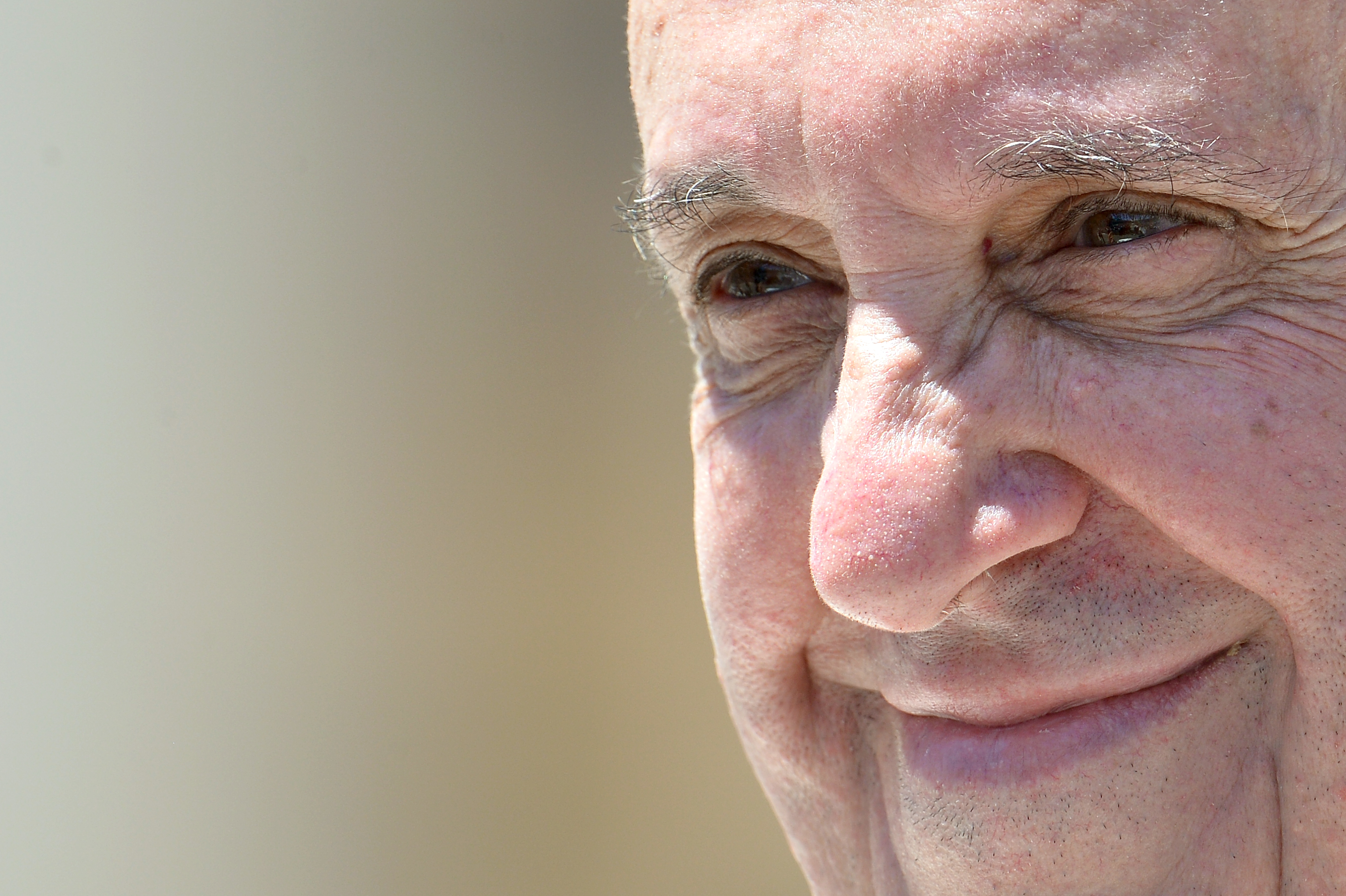
(Photo: Pope Francis smiles after his weekly general audience in St Peter’s square at the Vatican on June 12, 2013. By ALberto Pizzoli/AFP/Getty Images)

Patient Three

A second health worker who had cared for Ebola patient Thomas Eric Duncan has contracted the virus:

The second worker was immediately isolated and tests conducted after they reported coming down with a fever on Tuesday. Test results came back overnight confirming the diagnosis, and interviews immediately began to identify anyone the person may have come in contact with, so they could also be monitored for symptoms. More than 100 people are currently being watched after having come in contact with Duncan before he entered the hospital. …

As news of the new infection broke, more information has been revealed about the care that Duncan received when first trying to gain treatment, and not all of it is good. National Nurses United, a California-based union, has made a number of claims about poor preparation and infection control on behalf of the nursing staff at Texas Health Presbyterian Hospital. Among the charges are claims that Duncan was left in an open room with other patients “for hours,” employees were given substandard protective gear, and hazardous waste piled up to the ceiling.

By the CDC’s account, the hospital was ill prepared to handle an Ebola patient and improvised safety protocols on the fly:

“They kept adding more protective equipment as the patient [Duncan] deteriorated. They had masks first, then face shields, then the positive-pressure respirator. They added a second pair of gloves,” said Pierre Rollin, a CDC epidemiologist. … He said the hospital originally had no full-body biohazard suits equipped with respirators but now has about a dozen. Protocols evolved at the hospital while Duncan was being treated, he said: “Collecting samples, with needles, then you have to have two people, one to watch. I think when the patient arrived they didn’t have someone to watch.”

The CDC itself was also slower to act than it should have been:

CDC Director Thomas Frieden expressed regret Tuesday that his agency had not done more to help the hospital control the infection. He said that, from now on, “Ebola response teams” will travel within hours to any hospital in the United States with a confirmed Ebola case. Already, one of those teams is in Texas and has put in place a site-manager system, requiring that someone monitor the use of personal protective equipment. “I wish we had put a team like this on the ground the day the first patient was diagnosed,” he said. “That might have prevented this infection.”

Boer Deng details how complex these hospital safety protocols can be:

It is hard to track just what goes wrong if a misstep occurs, says Maureen O’Leary, secretary of the American Biological Safety Association. A case of Ebola reported in Spain last week involved a nurse trainee who admitted that she broke protocol by touching her face with a gloved hand after handling patient waste. Removing protective items that were used during care is complicated by the specificity of the process by which it must be done: “Using a gloved hand, grasp the palm area of the other gloved hand and peel off first glove; Hold removed glove in gloved hand; Slide fingers of ungloved hand under remaining glove at wrist and peel off second glove over first glove,” the CDC’s glove-removal instructions read.

The meticulousness is necessary to distinguish between the contaminated parts of a gown or facemask and the parts that are safe to touch. Contamination often can’t be seen, so even the smallest deviation might create a problem, says Ken Anderson of the American Hospital Association. For this reason, “the sequence of removal is key” to prevent clean surfaces from touching dirty ones. The CDC recommends two possible protocols. Both end with washing hands thoroughly (for the duration of two rounds of “Happy Birthday to You,” according to Anderson).

Amesh Adalja proposes a way to ensure that any future Ebola patients are treated at facilities that are prepared to handle them:

[W]e should seriously consider designating certain medical centers as our primary response centers for any further cases that are treated in the US. Such is the model employed for many diseases including trauma, burns and strokes. In fact, such a regionalization model organically arose during the H1N1 influenza pandemic, when smaller hospitals worked in a hub-and-spoke model to transfer their sickest patients to major medical centers—a phenomenon I studied. Such tiering of levels of care is being implemented now in the UK, which has treated one airlifted Ebola case successfully.

Yes, This Is A Pastoral Revolution: Your Thoughts

Readers react to the big news of the week:

Perhaps to see where Francis is going, you should also consider the homily he gave Monday morning prior to the release of the Relatio:

This picture taken 21 March 2007 shows a“The scholars of the law also forgot that the people of God are a people on a journey, and when you journey, you always find new things, things you never knew before,” he said. But the journey, like the law, is not an end in itself; they are a path, “a pedagogy,” toward “the ultimate manifestation of the Lord. Life is a journey toward the fullness of Jesus Christ, when he will come again.” The law teaches the way to Christ, and “if the law does not lead to Jesus Christ,” he said, “and if it doesn’t get us closer to Jesus Christ, it is dead.”

Read the whole thing, it’s beautiful and very telling of where Papa Bergoglio is trying to take the church. It also is perhaps one of the best critiques of the modern understanding of natural law. Natural law does not evolve (so yes, the conservatives are right in one respect), but we’re on a journey and God reveals more of himself and his law to us on this journey.

I’m with you, Andrew; I cried tears of joy when I saw the Relatio, and burst to tears again upon reflecting upon the homily preached only hours before. But it’s going to be an uphill battle, and already the knives are drawn from certain prelates, especially the outspoken probably soon-to-be-former Prefect of the Apostolic Signatura – Raymond Leo Cardinal Burke.

A small dissent:

I think you’re too harsh when it comes to JP2 and Benedict.  JP2 came at a time when there was utter confusion.  He had to clarify teaching.  Benedict is an intellectual, a theologian.  Francis is at heart a pastor.  Can’t we appreciate different leadership attributes and characteristics?

Another dissent of sorts:

I wish I could be as excited about Pope Francis as you are, but as a woman who has been serving as organist in a very large Catholic parish for 1 1/2 years, I am actually losing enthusiasm and feeling left out.

I know that the LGBT community deserves this attention.  The issue is hot; it is smart to talk about it now.  I also believe it is heartfelt on Pope Francis’s part – after all, he has spent most of his life amongst men, many of whom are gay, so his direct experience has given him much to ponder and work out in his own mind.  (Ditto the bishops)

I understand that all revolutions can’t happen at once, e.g. it seems to be common thought that priests will be allowed to marry before the revolution of women being allowed to serve in diaconate or priesthood.  OK great, and I totally think priests should be allowed to marry; but here again, it is men before women.

Having had no prior experience with the Catholic church and being very excited to have started my tenure at the time of the new pope, I am sorry to say that I’ve come to see that women are indeed second-class citizens in the Catholic church.  They are there to serve the men.  OK, we are all here to serve humanity, but since the Church is a male hierarchy, that means the women serve the men.  I see it all over the place and am sick of the dynamic.

Having said my sour-grapes piece, I do honor that this is an exciting time for you as a gay Catholic, and I am truly happy for you in that.

Another draws attention to what Benedict’s right-hand man is up to:

The Synod is entering its second week, and as a cradle Catholic, I’ve been watching it as closely as possible.  I was born and brought up after Vatican II, and I understand only too well the reasons why Pope Francis called this Synod and what he hopes to achieve from it.

To be frank, I was touched by the Pirolas’ testimony about the gay son of their friends.  My late sister had a childhood friend who is gay and who is so well-loved he is like a brother to me.  You can imagine how upset I was by Cardinal Burke’s statements, and I don’t wonder why he was roundly criticized. I wonder, though, have you heard about Arch. Ganswein’s interview with Chi? He’s saying that same things Cardinal Burke says about homosexuals being “intrinsically disordered”, and he even said that nothing much would change after the Synod. How different from Pope Francis’ very merciful declaration “Who am I to judge?”

I try to follow Church-related news as best I can, and it really distresses me that for a long time now, Archbishop Ganswein says so many things that contradict Pope Francis’s direction for the Church. Now, there’s this interview with Chi, and right smack in the middle of the Synod.

Another reflects:

My brother died last month. He lived in Sullivan County, New York, and attended a parish run by Franciscans. At his funeral, the pastor made some remarks that turned around my whole concept of the Church, which I’ve stayed away from except for family weddings and funerals for decades.

Father acknowledged and was very harsh about the message of the Church in recent times. He talked about how we were all looked on as sinners first, last, and only. He was very plain that he found this approach wrong, damaging, and in need of reversal. He then went on to speak about my brother (who was a devoted parishioner) in a way that highlighted John’s humanity, devotion, and grace. I was filled with happiness that John had had this man as his priest, as my brother had a touch life and relied heavily on his faith.

I’m sad to report that a day after the funeral the priest suffered a stroke. He was already frail; deacons performed most of the Mass while Father sat to the side. I haven’t had a report on his condition lately, but I hope that he is recovering.

I regret that in my rejection of Catholicism as I learned it (and as a gay man, as I experienced its rejection of me), I didn’t understand the fullness of a spiritual life possible in some corners of the Church, a fullness that my brother lived.

My lesson from this is to not think I know what is in a person’s heart or mind, or what comprises their faith, until I’ve taken the time to speak with them and hear them. I never spoke to my brother about these things; I just assumed what his mindset was from the fact of his strong faith. My loss, now, but hopefully not in the future.

(Photo by Getty)

How Long Will Midterm Voters Skew Right?

Ronald Brownstein discovers that “the racial and generational difference in participation between presidential-year and midterm elections is long-standing; it’s the more recent divergence in preferences that has resulted in the GOP’s midterm advantage”:

[T]he turnout gap has already contributed to the whiplash nature of modern politics, with voters careening back and forth between the two parties. This instability has encouraged both sides to treat every legislative choice primarily as an opportunity to score points for the next election. Oscillation, in other words, has encouraged polarization.

But the best news for the Democrats is that, whatever happens this year, eventually demographic change will overwhelm the turnout gap.

While Millennials and minorities still participate at lower rates in midterms than in presidential elections, their presence is inexorably growing on both fronts: the minority share of the vote in off-year elections jumped from 14 percent in 1994 to 23 percent in 2010, and this year will likely come in somewhere between that figure and the 28 percent from 2012. If Republicans can’t attract more votes from the growing numbers of minorities, Millennials, and white-collar white women who have powered the Democrats’ success in recent presidential elections, demographics will ultimately threaten the GOP’s hold on the House, too. “Obviously the Democratic presidential coalition continues to expand,” notes Ruy Teixeira, a leading liberal analyst of voting patterns. “Eventually you reach the point where even turnout differentials aren’t enough to derail it.” That’s an encouraging long-term prospect for Democrats—but it may be cold comfort if lagging turnout among their best voters contributes to another brutal midterm this year.

The Trouble With Islam, Ctd

Below are a bunch of remaining emails from the huge wave we received last week on the subject of Islam:

As a frequent reader, I take issue with your recent post: “And the lack of such a [civil] space is a key tenet of the religion itself.” That is completely incorrect. I’m sure many Muslims feel that way, but you cannot categorically claim that’s a tenet of the religion. Go read Tariq Ramadan‘s extensive discourse on the topic, or Hamza Yusuf in America. Come visit my mosque in downtown Manhattan at NYU. I’m hard pressed to find Muslims that fit your stereotype that Islam is so dogmatic. Islam is based on Fiqh, or Reasoning and Logic.

Above is a video of British imans speaking out against violent sectarianism. Another reader, born and raised in Pakistan, points to more resources:

Here is a Friday sermon by Yasir Qadhi on ISIS and what they mean for Islam (it’s 36 minutes long, but maybe you’ll listen to it).  And here is a small article from the Al Madinah Institute that takes Muslim scholars in Muslim countries to task for their silence in the face of oppression.

I get that Western-style liberal democratic cultures don’t exist in many parts of the Islamic world. However, a world of 1.5B people spread across a hundred countries cannot be binary – either like us or not.  In each country, liberalism exists along a spectrum; it is a work in progress, and it is also a product of history, politics, economics, extra-Islamic social mores, and not just Islam itself. And this is true even in liberal democratic societies.  Israel has all the markers associated with a liberal society and yet some really deranged illiberal attitudes are embraced by a large segment of that society. Is Judaism to blame for that?

Correlation is often never causation, and you make that mistake here, Andrew.  Just because ISIS and Al-Qaeda are Muslims doesn’t mean they have anything to do with Islam.

Another also invokes “correlation isn’t causation”:

There are too many examples of extremist Islam in today’s world to ignore the issue. However, people who take this issue seriously should consider what alternative hypotheses might explain the correlation, and what evidence might contradict the hypothesis that present Islam causes violence. Two major points here:

1. Majority-Muslim countries and other countries with Islamic governments are concentrated in Northern Africa, the Middle East, and Central Asia. Is it possible that awful politics and dysfunctional economies in these regions explains the chaos and poverty that can often lead to violent religious movements?

2. Outside these regions, Islam does not look so bad after all. Indonesia is home to 200 million Muslims, or just over 12% of the global Muslim population. India and Pakistan are tied for 2nd place with 177-178 million Muslims each (Pew 2010 via Wikipedia). Which one has the overwhelming majority of the Islamist violence?

Don’t look at India, which has a oddly robust democratic tradition (warts and all) and a growing economy. I will admit that India’s Muslims are probably kept in check by the Hindu majority to the extent that Indian Muslims need a check, but I still don’t see how 2 out of the 3 largest Muslim populations can be ignored in your assessment of global Islam. Neither are India’s Muslims undermining the safety or security of their government or fellow citizens. Indeed, most of them could serve as models for Muslims in Europe and Britain.

I am cherry-picking of course, but so are you when you speak about the current state of Islam. You lend too much credence to ISIS/ISIL and its prominence in the news cycle when you make broad conclusions about Islam.

Of course, cherry-picking aside, there is a strange correlation between Islam and extremist governance. Is there a connection between the 98% Muslim population in the Aceh region of Indonesia (which is only 87% Muslim overall), its violent rebellion against Jakarta, and its current implementation of sharia law? Why are American Muslims more integrated in the national culture when compared with British and European Muslims? These and other questions would be great topics for your blog.

I realize that you were egged on to make some statement of your views, and that this blog format is not conducive to an analysis of Islam‘s total state at the global level. I also don’t feel that you should censor your blog to be sure and avoid offending people or their sensibilities. Nonetheless, you and a lot of other commentators are relying heavily on an observed correlation between Islam and extremism, without considering how many destabilizing factors have affected impoverished regions that perchance are home to Muslim-majority populations.

Sure, other non-Muslim majority regions like Central America might be poorly governed and undercapitalized, but no external power fucks with Honduras or Guatemala as has been done with Iraq, Syria, Afghanistan, and Saudi Arabia, which have each in turn been the most prominent jihad exporters over the last 25 years. Some of the meddlers include other Muslim countries like our ally and jihad exporter Saudi Arabia and also our arch-enemy Iran, but other top meddlers include Russia and the United States. Oops!

Setting social policy aside (as many countries have retrograde social policies unrelated to Islam), only a small handful of Muslim countries actually pose a risk to global peace and security. We would do better to focus more on that short list of terrorism exporters first before expanding the scope of discussion up to an entire religion with 1.6 billion believers. It could make them feel better, but it’s also a much more efficient way to identify the root causes of terrorism.

Another turns to the Koran:

The ongoing discussion brought to mind an article that Nicholas Kristof wrote for the NYT back in 2004 titled Martyrs, Virgins and Grapes. He talks about the origins of terms in the Koran and explains how they may be re-interpreted.

The Koran is beautifully written, but often obscure. One reason is that the Arabic language was born as a written language with the Koran, and there’s growing evidence that many of the words were Syriac or Aramaic. For example, the Koran says martyrs going to heaven will get “hur,” and the word was taken by early commentators to mean “virgins,” hence those 72 consorts. But in Aramaic, hur meant “white” and was commonly used to mean “white grapes.” Some martyrs arriving in paradise may regard a bunch of grapes as a letdown.

Another points to some interesting scholarship:

While I have seen a number of readers cite the influence of colonialism on the development of Islamic radicalism, most seem to be focusing more on colonialism’s sociopolitical aspect rather than its effect on the faith itself.  While at McGill University I had the pleasure of studying under Wael Hallaq (now of Columbia’s much vaunted Middle East Institute), who put forth the argument that the “sharia” law that Islamist movements are supposedly based upon is to some degree a Western creation.

Hallaq’s case rests upon the institution of ijtihad, or “independent reasoning”, a central part of historical Islamic jurisprudence.  Traditionally, ijtihad was used to interpret laws based on the Quran and the hadiths to fit within the society the laws governed (this last point is key).  Essentially, legal doctrine was not strongly codified but instead malleable as society grew and matured through the ages, to be interpreted and adjusted with changing times.  Point being, a far cry from the imagining of sharia law that has it rising out of the desert and marching on unaltered for 1,400 years.

While there is debate as to whether the “doors of ijtihad” were closed prior to European intervention, Hallaq argues that they remained cracked open, at the very least, and that it was only Westerners, with their insistence on codifying laws, that froze existing laws in place.  Who did these Westerners ask for guidance when codifying those existing laws?  Elites who were already in power, who had every reason to solidify existing power structures.  Essentially, the argument goes that without so much Western interference in the Middle East, there would be significantly more room to maneuver within Islamic law, but due to codification by Western powers we’re now stuck with these laws as written ones, concrete ones rather than something that might be more malleable.

This is obviously quite controversial both inside and outside Islam, and perhaps an overly rosy view of ijtihad. but it is interesting food for thought in determining what exactly Islam is, and in reassessing our own views and biases towards the faith.  For what it’s worth, Hallaq has no dog in this fight, being an atheist born into a Christian family, which perhaps puts him in a unique position to analyze the issue both from within, given his Arabic linguistic and cultural background, and without, given his faith.

One more knowledgeable reader:

Joshua Mitchell’s idea that the people of the Middle East are unable to cope with the freedoms offered by modern democracy, and therefore seek refuge in a re-enchanted world which they attempt to establish through religious fundamentalism is historically wrong on almost every count.

For one, Islamic fundamentalism is not in any meaningful way a turn back to an enchanted world. The world of Islamism is thoroughly disenchanted: there is a strict and rational (although by no means scientific) cosmology, and rigid external control and social order – there is no place for mystery in this world.

Second, the kind of social order Islamism is imagining, the type of totalitarianism ISIS is seeking, is thoroughly modern. The sectarianism on which it is built is not the continuation of primordial divides in Islamic history, but the mirroring of modern identity politics onto the sphere of religious communities where the national divides which came to be the framework of Western democracy did not exist. We should keep in mind that nationalism is the countermovement of democracy, that the universal equality proposed by global democracy de facto is reigned in by the division into “imagined communities”, providing the ideological coherence that the democratic enterprise needs. In Europe those came into being as nations, and we should not overlook the quasi-religious character nationalism can take. In the Arab Middle East the sense of national difference is minimal, so it was much easier to harness sectarian difference to create the same “imagined communities”. In fact, the notion of the religious frequently prevents us from seeing that the divides we are dealing with are thoroughly political, and that they mean very little at the level of theology.

Finally, I cringe when I read the term “ready for democracy”. I have met plenty of people from Middle Eastern countries who seek nothing more than the opportunity to live in a truly democratic society. Have we forgotten that the Arab Spring, that the Syrian uprising began as a revolt against dictatorship, demanding freedom and democracy? Have we forgotten the liberal spirit of Turkey’s Gezi Park protests? Who and what is missing in the Middle East?

Part of the answer is the paradox formulated by German constitutional judge Wolfgang Böckenförde in the 1970s: “The liberal secular state depends on conditions which it cannot guarantee by itself.” More specifically, the establishment and the defense of democratic order depends on a buy-in by its constituents that the state cannot create or enforce. Therefore, the fostering of a democracy is easy to prevent, and its continuation always precarious.

Finally, let us keep in mind that there are also plenty of people in the West, who are not “ready for democracy”, but would not hesitate a second to dismantle it if they saw an advantage in it. The various little steps the GOP is taking to undermine and manipulate democratic processes, in my view, point to exactly this lack of commitment to democracy in the sense of Tocqueville.

Pharma Chameleon

2653991611_6528d99317_b

Tessa Fiorini Cohen examines how the colors of medicine influence us:

Imagine burning your skin and treating the pain with a cream. Is your imaginary cream white? Now picture it red. Would you trust the cream to work as well? If you had a moment of pause there, you’re not alone. Multiple trials – some with placebos, others with active drugs – have shown that patients’ color-effect associations can impact a drug’s efficacy by measuring physical signs like heart rate and blood pressure. Pharmaceutical companies are well aware of these associations and carry out extensive related research when developing new products or rebranding old ones.

Blue pills, contrary to what Breaking Bad may have you believe, act best as sedatives.

Red and orange are stimulants. Cheery yellows make the most effective antidepressants, while green reduces anxiety and white soothes pain. Brighter colors and embossed brand names further strengthen these effects – a bright yellow pill with the name on its surface, for example, may have a stronger effect than a dull yellow pill without it.

When researchers take culture into account, things get a bit more complicated. For instance, the sedative power of blue doesn’t work on Italian men. The scientists who discovered this anomaly think it’s due to ‘gli Azzuri’ (the Blues), Italy’s national soccer team – because they associate the color blue with the drama of a match, it actually gets their adrenaline pumping. And yellow’s connotations change in Africa, where it’s associated with better antimalarial drugs, as eye whites can turn yellowish when a person is suffering from the disease. (Interestingly, this is the opposite of the norm. Just like with the burned-skin example, drugs usually work better when their color matches the intended outcome, not the symptoms of the condition they’re treating). Such cultural variances are one reason why a drug may appear totally different in separate countries.

(Photo by Flickr user neur0nz)

MoDo-Proofing Edibles, Ctd

The free market is responding to customers like Maureen Dowd who can’t handle their dosage:

New on the shelves in Colorado’s recreational pot shops is the “Rookie Cookie,” a marijuana-infused confection that contains 10 milligrams of marijuana’s psychoactive ingredient. That’s a low enough dose that most adults wouldn’t be too impaired to drive a car.

Then there’s a new marijuana-infused soda that’s 15 times weaker than the company’s best-known soda. The Dixie One watermelon cream soda contains 5 milligrams of THC — half of what the state considers a serving size — and is billed as “great for those who are new to THC or don’t like to share.”

But Sullum warns that it “would be a mistake to mandate a one-size-fits-all approach”:

Currently the maximum amount of THC per package for recreational products is 100 milligrams, or 10 standard servings. Gov. John Hickenlooper has suggested each package should contain just “one dose.” But one dose for whom? Ten milligrams may be plenty for an occasional user, but it is way too low for many regular users. As [Michael Elliott of the Marijuana Industry Group] puts it, “A lot of consumers are saying, ‘I don’t want to get diabetes trying to get everything that I want. I don’t want to have to eat 10 candy bars to get the 10 doses of marijuana that I want.” Such a mandate would impose extra packaging expenses on manufacturers (and ultimately on consumers) while decreasing customer satisfaction. It makes more sense to offer a variety of potencies to suit the needs of different consumers.


A Premature Peace Prize?

Although much of the recent criticism of Malala Yousafzai’s Nobel win has been lazy and predictably contrarian, Tabish Khair makes a convincing case that the committee should have waited to honor the young advocate:

What kind of burden rests on her 17-year-old shoulders now, I wondered? Is it fair to put that sort of burden on such a young person? Is it fair to award the prize for what might be achieved, rather than what has been achieved – because, unlike [Global March Against Child Labor founder Kailash] Satyarthi, Malala has not had the time to organize anything of substance, despite her brave personal example and her visibility as a symbol. To date, Satyarthi and his organization are credited with rescuing and educating about 100,000 such child laborers in India. She has not had the time to rescue 100,000 children from the darkness of Taliban and its ilk.

Now she might never get that chance. The adulation of well-meaning but largely ignorant people has put her beyond the pale. One original reason why she became such a fresh and enabling symbol – unlike the thousands of men or women who share her opinions in Delhi or Karachi or New York – was that she was “in the field.” Real change – in Pakistan or elsewhere – will be brought by people in the field, as Malala was when she was shot, as the anti-polio workers and hundreds of educators continue to be. …

Now, I realize, Malala has been taken over by the superior circles. I won’t call it the West. I call it the superior circles – people with lots of good opinions, and the inability to operate in the field.

Update from a reader:

Tabish Khair seems to be nitpicking. A girl who had been shot by the Taliban and lived to become an activist might have been an internet sensation for a few days, a la #saveourgirls. The Nobel selection process has brought lasting attention to her cause. Those “people with good opinions and the inability to operate in the field” are called rich people and their support can buy many supplies and operatives. Whether that support is due to the merits of the cause or the cachet of a Nobel is irrelevant.

Putting Our Kids In A Panopticon

Maria Guido laments the lack of privacy among children today:

I never really thought about the concept of toddlers and privacy, but if I stop and examine how I feel about it, is it ridiculous to say that I believe they should be afforded some? I think all parents love to peek in on their sleeping children or sneak up and look in unnoticed when their child is lost in play. I certainly understand why parents would be drawn to making a habit of it by ogling a video monitor nightly. But there are things I remember about my childhood – and a lot of my best memories were solitary ones. …

Recently, New York City Mayor Bill DeBlasio vowed to end the cell phone ban in schools to a collective sigh of relief from parents everywhere.

He admitted that his own son violates the ban and called it a “safety issue” for parents to be able to keep track of their kids. Raising children in the city is potentially worrisome, but is having a direct line to your child at all times really a safety issue? When I was growing up and a parent had to reach a child in an emergency, they called the school. Perhaps we have more emergencies now, or are we just so used to being on top of our children that we truly believe they can’t make it to school and back without being able to reach us, immediately?

In our attempts to protect our children, we may be crippling them instead. Learning how to move through the world without a direct line to your parents is an important skill for older children. We’re demanding our kids be reachable at all times for their own good. Or is it for our own good?

The above video illustrates how some parents can’t let go even after their kids go to college.

Is Amazon A Monopoly? Ctd

Readers continue the thread on the mega-company:

As a measure of how Amazon is getting its fingers into an ever-widening area of retail, consider this: My Audi TT had a headlight go bad, which required replacing the entire headlight module.  Cost from a dealer? $1200. Cost from Amazon? $600.  (Directly from Amazon, not from a reseller.)

Car parts for a 12-year old, low volume model?  Wow.

A business professor writes:

Two key points about Amazon’s market position are being consistently missed, even in the business press:

1. While Amazon shows accounting net losses, they have generated net positive cash flows for the last three years running from $574 million up to $2.8 billion. Accounting income is largely a fiction these days, aimed as much at minimizing taxes as anything. The ability to generate a positive cash flow through creative means (including “innovative” financing) is what drives most really big businesses. A key part of this strategy is keeping accounting profit so low that competitors cannot fly this close to the ground without crashing.

2. Amazon, like Walmart who mastered the art before them, is a “penny scraper.” Sam Walton realized that if you scraped a few extra pennies per transaction out of suppliers, customers and employee pay, profit becomes irrelevant. Multiplied by millions of transactions daily, these pennies add up to billions of dollars over a single year if you are big enough.

Another focuses on books:

It’s hard to like Amazon.  Their size is genuinely troubling, and they treat many of their employees quite badly.  I’d rather work in a Walmart than an Amazon warehouse.  And it’s easy to love old school publishers, who champion great books, and so much of what’s best in our culture.

But the traditional publishers are doing a terrible job with ebooks.  There are publishers of tech books who do a great job with ebooks, who manage to distribute books without Amazon (even to Kindle owners), and who have found good ways to minimize piracy.  The traditional publishers can’t even copy those existing and proven business models.

The best example of a small publisher that gets ebooks right is probably the Pragmatic Press.  If I buy an ebook book from them, I can download epub, mobi, and pdf versions.  The files I download have my name all over them, which discourages me from pirating them.

They’re good at delivery. I have my Prag press account synced to my Dropbox, so the files appear there automatically.  When corrections are made (which happens often with geek books), updated versions appear automatically.  They also offer automatic delivery to Kindles via email, although I don’t use that.  I just copy the files to my device manually.

It’s really nice to have both PDFs and mobi files of tech books because sometimes the formatting is important it tech books.  This would be a huge advantage for other types of books too – poetry, for example, which has never worked well for me on Kindles.

When the Prag Press sells me a book, they get to keep all of the money.  And they have a relationship with me that they control, which lets them market to me directly.  They send me notifications of new books and discount codes.  This stuff works; I buy books in response to their emails several times a year.

I just bought an ebook as a text for a free online programming class, and I was really unhappy that I had to buy it through the Kindle system (the publisher is more traditional), not because I have a political axe to grind, but because it’s a worse experience.

Everyone who loves books wants literary publishers to succeed.  But they want to respond to ebooks by using some other company (Amazon) as if it were just another bookstore to sell their stuff.  It’s just not a viable approach.  They’ve outsourced their response to massive tech trends to Amazon, and they’re surprised that Amazon has set things up on favorable terms for Amazon.

And another counters many of the previous readers:

I’m glad there’s pushback against the notion that Amazon is a monopoly, but it needs to be mentioned that the fallback view, that Amazon is a monopsony, is also demonstrably false. What is the definition of a monopsony? As your readers say, its “a market form in which there is only one buyer for goods”. A monopsony means that sellers are forced to agree to the terms of the buyer, because there is no one else to sell to.

But the current dispute with Hachette proves that Amazon is not a monopsony, since Hachette is refusing to agree to Amazon‘s terms, and is instead insisting that Amazon agree to its terms. If Hachette had been forced to quickly give in to Amazon, that would serve to prove that Amazon is effectively a monopsony. That they aren’t even entertaining the notion of doing so, but willing to suffer whatever consequences come their way, demonstrates that Amazon can’t force its suppliers to accede to its demands.

And this isn’t the first time. In 2010, Amazon got in similar disputes with the Big 5 publishers, who were demanding agency pricing on ebooks, and guess who was forced to give in to the other sides’ demands? Right again, it was Amazon who folded. Later the Justice Department sued and the courts agreed that those publishers, along with Apple, had engaged in an illegal collusion conspiracy to force Amazon to accept their demands. Again, more evidence that Amazon is not a monopsony, but strong evidence that the major publishers constitute a cartel-monopoly that can force even giant retailers like Amazon to accept their terms.

Following that lawsuit, the major publishers have been required to renegotiate their contracts with Amazon. They are allowed to demand agency pricing, but not to do so as collusion. And that’s exactly what Hachette is doing. They are from all accounts demanding agency pricing on ebooks, and not giving an inch, even when Amazonmakes things more difficult for buyers to order or ship Hachette books. Hachette is the smallest of the major publishers, but it seems reasonable to infer that they would not be taking this hard line unless they felt confident that they would be backed up by the others when it is their turn to negotiate new agreements with Amazon. If that is how it turns out, Amazon will likely be forced to concede to the big publisher’s demands. Which simply isn’t how a monopsony is supposed to work.

If one examines the publishing industry honestly, massive consolidation of publishers into a few major corporations has created an effective monopoly cartel that has successfully forced all the players in the market to accept its demands and pricing. And when it comes to authors, they have also created uniformly non-competitive standard author contracts that only the biggest selling writers are able to get around, which pay the same royalties and have the same highly restrictive provisions. That has made them an author’s monopsony, meaning that most authors have no choice but to sell their works on those same terms.

Only Amazon has created a means to break that cartel-monopsony, by allowing authors to self-publish through their Kindle Direct Publishing program (which has since been copied by Apple, Barnes and Noble, Smashwords, Kobo, and others). And that makes the major publishers and best-selling authors mumble vague threats about the end of literature and the demise of publishing. As if letting authors bypass the monopsony cartel on publishing that has been enjoyed by the major publishers for decades now is somehow a bad thing for writers.

It’s not that Amazon is some angel here, but their disruptive digital technologies have been proven to be a boon to authors and are helping to break up the monopolies and monopsonies of the publishing industry.

Update from another:

I can’t add much to the monopoly thread regarding Amazon, but you have to wonder if the actually sellers being lorded over by Amazon are very happy about not getting a fair shake online when it comes to being found when someone does a search for the products you sell and being absolutely squashed by Amazon’s ability to own the search results.

The Audi TT headlight is a good example. The actual seller/supplier not only sells that headlight for half the price and squat for profit, but then more than likely pays Amazon a percentage for that privilege. Amazon effectively controls their ability to make money. I’m sure there are some who would have no business, but when the profit margins are shit, and Amazon is potentially making more off the sale than they do, where’s the motivation? Where’s the fairness? You’re part of a mega-chain gang, just working to get through the day, but probably not getting ahead.

I used to buy bee pollen from a company in Arizona for $17 a pound. Search results came up with Amazon’s price as $10 per pound. This is a niche market, where that $7 of profit would make a huge difference. I used to buy directly from the supplier to be the nice guy. If you think about the labor and time invested in collecting and packaging bee pollen, not including the efforts of the bees of course, it makes you wonder how this outfit survives.

Amazon is probably great for the consumer, but they’ve effectively killed consumer loyalty when it comes to actually being loyal to a business and their business model. Buying their product from Amazon shows loyalty to the product, maybe. But wholly at the expense of the supplier.

I’m not sure Amazon has a monopoly, but certain they’ve created an unfair advantage. How can you compete with their pricing and stay in business. Amazon is the 1% and their vendors are victims while the business profit margin gap is widening.

One more:

Your reader wrote, “I’d rather work in a Walmart than an Amazon warehouse.” I don’t know if this person has experience working in either, but I tend to think “not,” because there is no comparison.

I just finished 6 weeks of working in an Amazon Warehouse in Tennessee near Nashville. The starting pay is $11.00, plus 50 cents an hour for working the night shift (6:30pm to 5:00am, four ten-hour shifts per week). About four weeks in, there was a big meeting where they announced our pay was going up 25 cents per hour based on a survey of similar businesses in the region.

This would NOT happen at Walmart. Walmart starts at minimum wage (the federal $7.25 here in Tennessee) and good luck actually working full time (they send you home before 40 hours to avoid paying full-time benefits).

I’m not going to lie and say that working in the warehouse was easy, or that the $11.75 per hour I was getting was great and working nights was awful. I quit as soon as I could. And yes, they monitor your production to the minute and require you to hit a certain rate (it depends on your job; mine, in the “Sort” department was one of the “better” jobs in the warehouse). But I met a lot of people who have worked there since it opened and liked it very much.

Most of the horror stories you hear are from seasonal temps who work there during the busiest, craziest time of the year, don’t get proper training and never have a chance to figure out what was going on. It may suck for them, but I was able to earn a basically living wage (supplementing my wife’s income) and sustain us until I found something better. I didn’t have to deal with shitty customers, the managers treated me fairly. I would have stayed there had I not gotten a significantly better-paid job that allows me to sleep normal hours.

(Full disclose: the Dish gets about 3 percent of its annual revenue from Amazon’s affiliate program, detailed here.)