Steve Friess introduces us to Judge Jeffrey Sutton “the inscrutable swing vote on the Federal Sixth Circuit Court of Appeals’ three-judge panel, which is due to rule any day now on six gay-marriage cases that span Michigan, Tennessee, Ohio, and Kentucky”:
In the complicated legal morass created by the Supreme Court’s refusal to hear appeals in several gay-marriage cases, the legal consensus is that SCOTUS decided it could keep ducking because every appellate court thus far has ruled the same way — that is, for marriage equality.
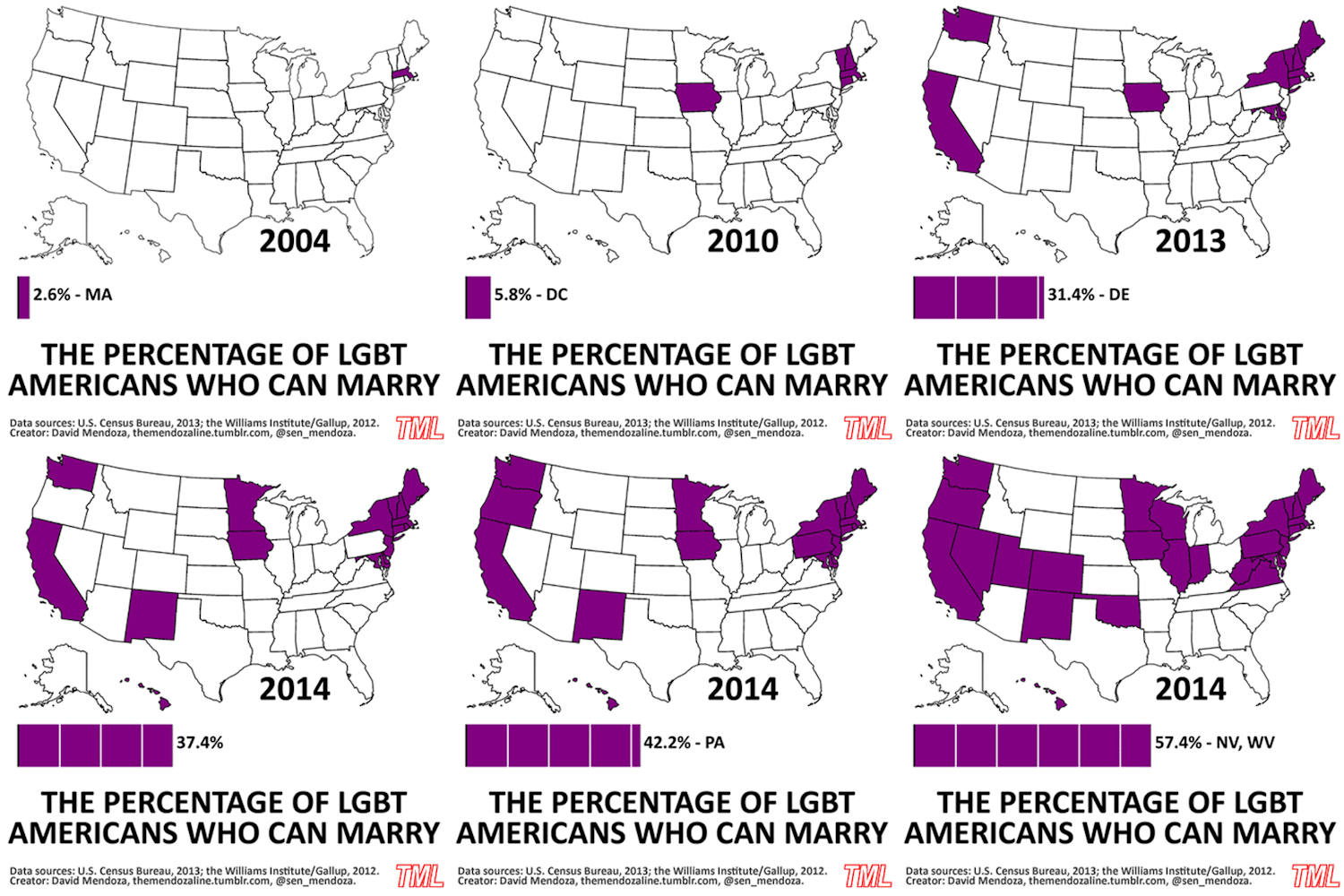
Sutton, flanked at oral arguments in August by one judge who was almost comically pro-marriage equality and another who seemed solidly on the other side, finds himself in a fascinatingly powerful position. If he concurs with the eight circuits that have already found a fundamental right to same-sex marriage, his vote will expand marriage equality to four more states. If he and the Sixth Circuit come down in support of the right of states to ban gay marriage, the Supreme Court, faced with conflicting rulings among the circuits, will almost certainly step in to take the case. If that happens, there is good reason to think that marriage equality will become the law of the land.
Which is all to say Sutton could be doing gay marriage a big favor whichever way he votes.
Dale Carpenter explains what happens if Sutton rules in favor of marriage equality:
If the Sixth Circuit does this, gay marriage would be legal in Kentucky and Tennessee, and the states of Ohio and Michigan would have to recognize same-sex marriages from out of state. One or more of the states might simply acquiesce to the decisions, as other states have done when further appeal became fruitless. If the states petitioned the Court, it would likely deny their petitions since there would still be no circuit split. It also seems likely that stays on the lower-court decisions would be immediately or very quickly lifted since the stays had functioned only to preserve a status quo that the Supreme Court has now let pass. …
The onus would then fall on the Fifth, Eighth, or Eleventh Circuits to reject same-sex marriage claims. Any of them would have to be considered more likely to uphold SSM bans than the circuits that have decided the matter thus far. But given that oral argument has not been scheduled in the Fifth Circuit, that briefs have not yet been filed in the Eleventh Circuit, and that there is not even a case before the Eighth Circuit, a decision from one of them would probably put the matter off for at least another Term.
But Damon Root points out that Sutton could “uphold the gay marriage bans as an act of judicial deference, the legal philosophy which says that the courts should give lawmakers the benefit of the doubt and therefore rarely strike down democratically enacted statutes”:
After all, the last time Sutton found himself at the center of a roiling national debate over the wisdom of a controversial piece of legislation, he voted to sustain the law in part on those very grounds.
What case was that? It was Sutton’s 2011 opinion in Thomas More Law Center v. Obama, in which the 6th Circuit upheld the constitutionality of the Patient Protection and Affordable Care Act, aka Obamacare. According to Sutton, the great legal battle over President Obama‘s health care law is “just as stirring, no less essential to the appropriate role of the National Government and no less capable of political resolution” than the debate over the constitutionality of the Second Bank of the United States at issue in McCulloch v. Maryland (1819). And in that foundational case, Sutton observed, “the Supreme Court erred on the side of allowing the political branches to resolve the conflict.” Similarly, he declared, the fate of Obamacare should be decided by “the peoples’ political representatives, rather than their judges.”


 The Dish
