What Counts As A Cult?

Ross Douthat wrote a recent column noticing how “the cult phenomenon feels increasingly antique, like lava lamps and bell bottoms.” Drawing on the thinking of religious historian Philip Jenkins and entrepreneur Peter Thiel, Douthat argues that the decline of cults “might actually be a worrying sign for Western culture, an indicator not only of religious stagnation but of declining creativity writ large”:

The implications of Jenkins’s argument are specific to religion. Cults can be dangerous, even murderous, but they can also be mistreated and misjudged (as Koresh’s followers were, with fatal consequences); moreover, spiritual experiments led by the charismatic and the zealous are essential to religious creativity and fruitful change. From the Franciscans to the Jesuits, groups that looked cultlike to their critics have repeatedly revitalized the Catholic Church, and a similar story can be told about the role of charismatic visionaries in the American experience. (The enduring influence of one of the 19th century’s most despised and feared religious movements, for instance, is the reason the state of Utah now leads the United States on many social indicators.)

cult_mac_big_0Thiel’s argument is broader: Not only religious vitality but the entirety of human innovation, he argues, depends on the belief that there are major secrets left to be uncovered, insights that existing institutions have failed to unlock (or perhaps forgotten), better ways of living that a small group might successfully embrace.

Suderman argues that Douthat probably “understates the ways in which semi-cult-like behavior has come to infuse daily life and mainstream culture”:

Yes, there are probably fewer cults in the aliens-and-messiahs sense, but there are more subcultures, in a wider variety, than ever before, more regimented lifestyle trends and minority beliefs about how to improve personal productivity or fitness, about how to become a better person and live a purer, more interesting, more connected and compelling life. Some of these subcultures remain distinctly fringe (dumpster-diving freegans, gently quirky bronies, furry fans, Juggalos [seen in the above video), while others are embraced, to varying degrees, by the mainstream:

At its height, Occupy Wall Street was as much an alternative lifestyle and belief community as a political movement. What is Crossfit if not a ritualized system that offers its highly dedicated, tightly-knit cells of followers a better and more meaningful existence?

None of these are cults in the specific sense that Douthat describes, with gated compounds and secret songs, but they are all experiments in behavior, taste, and belief intended to help adherents find meaning and connection in their lives.

In response, Douthat wonders if these subcultures really can take the place of religion:

I’m only slightly exaggerating when I say that this raises the most important question facing Western culture and society right now. Suderman is right, I think, that these “individualized and custom-tailored” forms of association are where creative/questing/artistic/religious impulses are increasingly being channeled, thanks to the internet and various broader economic and social forces; what’s more uncertain, to my mind, is whether they really encourage the kind of intense, enveloping commitment that I tend to think that deep creativity (among other goods) requires.

To the extent that like-minded people finding one another in ways that weren’t previously possible are creating cultural experiments that are as immersive, if not more so, than anything in the human past, then Suderman’s case for optimism makes a lot of sense. But to the extent that these experiments are more, well, dilettantish than past cultural groupings, more like hobbies than real commitments, more of a temporary identity that can be shaken off the moment it no longer completely pleases, they seem more likely to skim the shallows of creativity (to borrow an image from one of online culture’s more persuasive critics) than plumbing the true depths, more likely to cycle through pastiches and remixes (often fun and entertaining ones!) without stirring up something fully-realized and new.

(Image from the cover of Leander Kahney’s book Cult of Mac)

Polls Are Far From Perfect

Sabato contends that “the truly remarkable thing is that polling is as accurate as it is.” But he fully admits their predictive limits:

First, we can probably expect up to a baker’s dozen of Senate contests to remain highly competitive right up to Election Day. Second, polling averages are likely to mislead us about the eventual winner in one or two cases. And finally, if there should be multiple Senate contests where the pre-election polling average has the candidates separated by three percentage points or less, the polling leader in about a third of these cases may well lose.

Therefore, if we’re headed for an election that produces a Senate divided by only a seat or two, don’t expect polls to precisely predict the outcome. Even well-conducted, large-sample surveys are blunt instruments with a margin of error.

Enten keeps an eye on the Kentucky and Georgia Senate races:

FiveThirtyEight’s forecast still gives McConnell a little better than a 77 percent chance of winning. Most people aren’t looking at Kentucky as a place where the Senate will be decided. Nor are many people looking at Georgia, where Republican David Perdue is a 71 percent favorite to beat Democrat Michelle Nunn.

But consider the chances of a Republican victory in races more often placed in the middle of the 2014 board. FiveThirtyEight has the Republican candidates in Alaska, Arkansas and Louisiana holding between a 72 percent and 75 percent chance of winning — the same range as Georgia and Kentucky.

Georgia and Kentucky remaining on the table for Democrats significantly hurts Republicans’ overall chances of winning a Senate majority.

Bernstein examines the big picture:

[C]urrent polling averages are within four percentage points for Senate races in Alaska, Arkansas, Colorado, Georgia, Iowa, Kansas, Kentucky, New Hampshire and North Carolina. Some of those contests (such as Colorado, which is a dead heat) could go either way — even if the polling is correct. But if something is systematically wrong, then 4-point contests such as New Hampshire (where the Democrat leads) or Kentucky (where the Republican leads) could turn out very differently, even if the polls don’t change before Election Day. I wouldn’t bet on Republican Scott Brown in New Hampshire or Democrat Alison Lundergan Grimes in Kentucky based on the polling to date, but I also wouldn’t be surprised if the trailing candidate ended up winning in any of these closely contested races.

Bottom line? The polls are still likely to be correct. And the uncertainty makes relying on polling averages even more important. But I don’t expect to know which party will have a Senate majority — however large — until the votes are counted (or even later).

A Well-Timed Mishap

The was a mysterious explosion near Tehran on Sunday, allegedly at the Parchin military facility. Some observers are wondering whether it was an accident or an act of sabotage:

According to the BBC, one Iranian opposition site described the event as a massive explosion that lit up the sky and shattered windows over nine miles away. The semi-official Islamic Republic News Agency dubbed the episode a “fire [that] broke out in an explosives producing factory in eastern Tehran,” neglecting to include the name Parchin and adding that two people had died. Neither source mentioned or even speculated upon the cause of the incident.

It’s widely believed that the United States and Israel have engaged in a heavy regimen of sabotage against the suspected Iranian nuclear program including, but not limited to, crippling computer viruses, the assassination of nuclear scientists, and a series of mysterious explosions that have killed high-level targets and damaged facilities. This development comes just hours before Iran and the International Atomic Energy Agency (IAEA) were reportedly set to meet in Tehran. The Parchin complex, which has long been a site that the U.S. and Israel say might be part of an illicit Iranian nuclear program, has not been inspected by the IAEA since 2005. If the episode in Iran is some kind of sub-rosa attack, the timing couldn’t be better.

Jim White speculates:

Another possibility that I haven’t seen mentioned is the potential of a semi-intentional accident that would destroy the building that is at the heart of the negotiations.

It is only a matter of days before satellite imagery of the blast site become public, so we will know fairly soon whether the particular building with the blast chamber in question was destroyed. If the site is completely destroyed, that would be a convenient way for Iran to prove, without saying it, that no further work of this type will take place.

Allahpundit finds this story suspicious:

If Parchin really is a test site for atomic weapon technology, go figure that a test might occasionally go bad. Which raises the question of just what sort of explosion this was. If it broke windows miles away and emitted a bright glare, that could mean either a really large conventional blast (e.g., if the fire reached the base’s weapons depot) or a small atomic blast — and of course western governments who detected it would have an interest in hushing it up too, lest they’re forced to admit that they failed to stop Iran from getting the bomb. But if there really was a huge explosion, how come social media wasn’t instantly inundated with “whoa!” tweets from Iranians living in and around east Tehran and Parchin? Seems hard to believe Iran’s Internet censorship could be so thorough that no trace of a reaction like that was detected online by western media. Which means maybe there was no such reaction, and thus no explosion.

To Frum, the fact that the IAEA hasn’t inspected Parchin in nearly a decade “reminds us how limited and defeated U.S. inspection rights have been in Iran, through this year of negotiation”:

Here’s the key point: The rulers of Iran clearly want sanctions relief. They have got a considerable measure already, and will likely soon obtain more from the Obama administration. The rulers of Iran are not, however, looking “to come in from the cold.” They are not looking to rebuild a more normal relationship with the United States. They are looking for the maximum economic benefit consistent with not abandoning their pursuit of a nuclear weapon. Any inspection rights the U.S. may ultimately obtain will be inspection rights within the context of persistent and profound Iranian rejection of the goals of an inspection regime.

When Journalism Fuses With Advertising

I’m a broken record, but here’s a new development in the surrender of journalism to public relations and pap: “Collectively.” It appears as a new news site that seeks to emphasize the positive in the world:

Today’s media is obsessed with fear-mongering tactics, and a pervasive pessimism that would have us all believing that “everything is f*cked, and it’s all our fault,” which has had the undesirable effect of making people feel alienated and ineffectual, unable to figure out what they can do to alter the current path we’re on. Collectively will break through that negativity and cynicism to help people learn how they can help. Take meaningful action. Choose to make a difference.

A sort of Upworthy with added Zoloft and a touch of Xanax – perfect for “sharing” on Facebook as an expression of your own personal virtue. And, of course, you keep waiting for the catch, the poll-tested euphemism that will tell you what this site is really about – because you can see no advertisements at all, and there are no subscribers … and … ah, yes … bend over, here it comes:

Collectively symbolizes a new synergy between industries, institutions, and people that moves beyond blame and fault to focus on positive change.

“A new synergy between industries, institutions, and people?” Has your bullshit detector gone off yet?

The founding partners – Unilever, The Coca-Cola Company, Marks and Spencer, BT Group and Carlsberg – wanted to help build a non-profit platform open to the voices and opinions of as many different organizations and individuals as possible. We’re ridiculously excited by the list of highly energized participants who are already on board, and this is just the beginning. VICE Media’s creative services division, VIRTUE, was selected by the founding group to create and curate Collectively with complete editorial independence.

So this is a site directly funded by major corporations to tout their own alleged virtues – and, as Gawker’s Hamilton Nolan notes, it’s a site “run with ‘complete editorial independence’—by an ad agency.” Which is to say Vice‘s. Nolan reports on all the corporations involved:

Vice, Diageo, Dow, Facebook, General Mills, Google, Havas, Johnson & Johnson, McDonald’s, Microsoft, Nestle, Nike, Omnicom, PepsiCo, Philips, SAB Miller, Twitter, and WPP, among others.

I’ve been warning for a while that when established journalistic outlets whore themselves out to corporate propaganda through “sponsored content”, they are playing a mug’s game. The only reason these companies are paying these media outlets to disguise their ads as editorial copy is because they can still trade on those outlets’ residual reputation. But as native advertising cumulatively undermines that reputation, magazines and newspapers will lose their luster. Instead, corporations will simply fund and create their own pseudo-journalism directly, and cut out the middleman altogether.

This isn’t some future specter; it’s already here.

Sacking Plastic Bags, Ctd

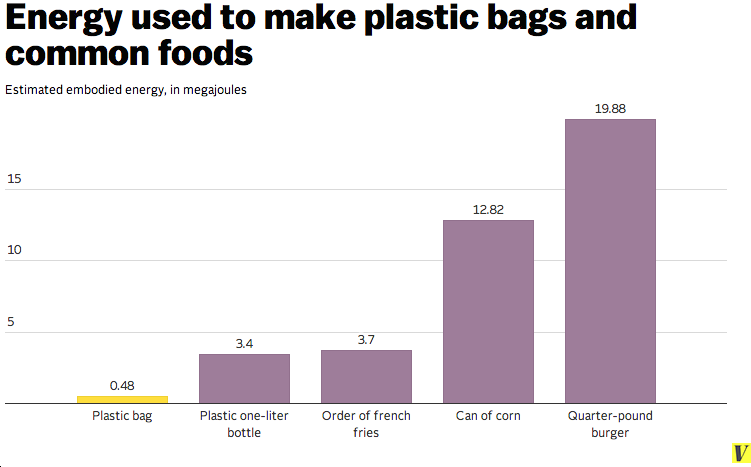
Screen_Shot_2014-10-03_at_5.35.14_PM.0

Joseph Stromberg thinks the importance of reducing plastic-bag use has been overstated:

In 500 to 1000 years, the primary concern for pretty much every ecosystem on earth will be global warming. The facts on this are pretty clear. If we don’t significantly cut back on greenhouse gas emissions very soon, the world will get hotter, sea levels will rise, and the oceans will turn more acidic, among other problems. If we let truly drastic levels of warming occur — and at this point, there’s no sign we’re doing anything to stop it — scientists warn that profound disruptions to both modern human society and the natural world are very likely.

What does all this have to do with plastic bags? When it comes to greenhouse gases, they’re once again dramatically less important than the products we buy and put inside them.

Vauhini Vara has a more favorable take on the issue:

I live in San Francisco, where a local plastic-bag ban and paper-bag charge went into effect in 2012.


At the time, I was working for the Wall Street Journal. While working on an article about the city ordinance, I called a grocery store in my neighborhood, Canyon Market, to see how its owners felt about the law. Janet Tarlov, who owns the store with her husband, didn’t like the idea of giving shoppers fewer options, and worried that the inconvenience would persuade some of them to drive to nearby cities without bans or fees. “On balance, I think it’s a bad idea,” she told me at the time.

On Thursday, I called Tarlov again to see how things had played out. She laughed, a bit abashedly: “I’ve changed my mind,” she said. Even though paper bags tend to cost more than plastic bags, Tarlov thinks that the amount she has spent over all on bags since the ban has grown by less than her revenue has. Tarlov’s store pays about twenty-five cents for each paper bag it uses, and the ten-cent charge covers only part of that. But, in the past, the store had to cover the entire cost of the paper bags. (Bigger grocery chains can pay much less for paper bags, as little as a couple cents apiece; the California law requires that if stores end up with proceeds from the paper-bag fees, after covering the cost of the bags, they have to spend the money on activities related to the law, like educating customers about bringing their own reusable bags.) Plus, the ten-cent paper-bag charge has had more of an impact than Tarlov expected; more people are bringing their own reusable bags. “Our consumption of bags has gone way down,” she said. “That’s good for the environment, and people adjusted to it very quickly.”

Nobel Intentions

Joshua Keating thinks a certain peace prize needs a year off:

This year the [Nobel] prize committee could best serve its mission by giving the prize to the person who most deserves it: nobody. Such a move would highlight that this has been a particularly violent year around the world. More importantly, it would serve as an Dr. Francis Crick's Nobel Prize Medal on Heritage Auctions acknowledgment that the most notable eruptions of violence have been so grimly predictable, the result of years of individual and collective failures by governments and international institutions. … [I]t’s hard to find anyone deserving of a Peace Prize in 2014. The original purpose of the Nobel Peace Prize was to reward the person who “shall have done the most or the best work for fraternity between nations, the abolition or reduction of standing armies and for the holding and promotion of peace congresses.” And on that score, there was not much to report this year. The committee should follow the example of the Mo Ibrahim Prize for Achievement in African Leadership, the world’s most generous prize given to individuals, with an outlay of $5 million over 10 years plus $200,000 per annum after that. The prize has simply not been granted in three of the six years it has existed because no suitable candidates were found.

Noah Smith argues that the entire Nobel system is seriously flawed:

In addition to giving too much credit to too few people, the Nobels have the disadvantage of not being given postmortem. This means that great scientists from ages past, who were probably prevented from receiving the prize only because of sexism or racism, will remain Nobel-less forever. Examples include nuclear physicist Lise Meitner, mathematician Emmy Noether (whose work was hugely important to theoretical physics), and nuclear physicist Chien-Shiung Wu. Speaking of discrimination, another problem with the Nobels is that they are awarded almost exclusively by Swedish and Norwegian people. Just look at the committee that selects the physics prize. In the era when Europe ruled the world, the neutral countries of Scandinavia might have seemed like the ultimate honest brokers, but in today’s globalized world there is no good justification for such provinciality.

But Emily Badger notes one of the awards that went to a project with noble applications:

The Nobel Prize for physiology or medicine was given Monday morning to three scientists who’ve uncovered the “inner GPS” in our brains that helps us find our way through the world around us, identifying where we are, where we’ve been and how to get back there again. … The answers have some direct implications for how we understand diseases like Alzheimer’s that rob people of their spatial memory. But they also have some fascinating implications for perfectly healthy people, too, and for the way we design spaces — from individual buildings to neighborhoods and whole transportation networks — that we move through daily. While the first story is clearly the province of scientists and doctors, the second is very much of interest to urban planners, architects and cartographers.

And as Rachel Feltman points out, the physics Nobel went “to researchers whose findings you probably rely on just about every day (or, if you’re like me, just about every minute). The blue light-emitting diodes they helped create are taking over lightbulbs as we know them, but already see universal use in smartphone flashlights and displays.” Update from a reader:

Perhaps this year would be a good year for the Nobel Committee to not just refuse to award a new prize but to rescind the Nobel Peace Prize awarded to Barak Obama in 2009. I understand that there are several online petitions circulating urging the Nobel Committee to do just that.

Chicken Not So Little

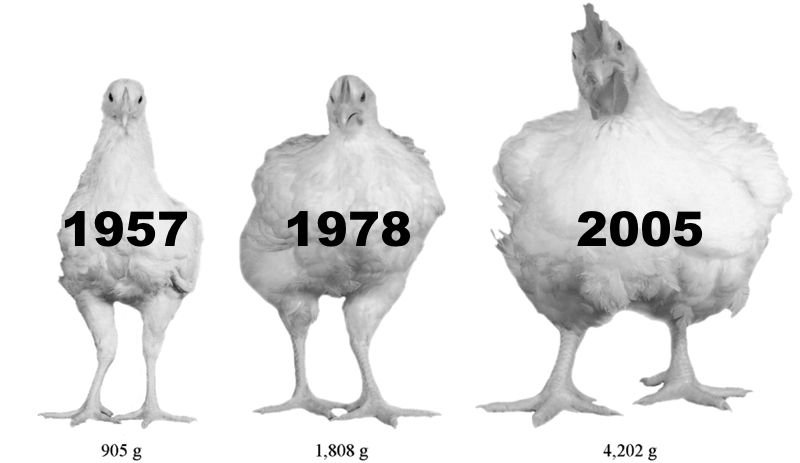
dish_chicken

The delicious creatures have grown a lot in 50 years:

The one on the left is a breed from 1957. The middle one is a 1978 breed. And the one on the right is a commercial 2005 breed called the Ross 308 broiler. They’re all the same age. … The image above comes from a study done by researchers at the University of Alberta, Canada, who raised three breeds of chickens from different eras in the exact same way and measured how much they ate and how they grew. This allowed them to see the genetic differences between the breeds without influences from other factors like food or antibiotic use.

They remind me of how football players have grown in the same period. Meanwhile, Christopher Leonard examines the modern poultry industry from a different angle, focusing on “the tournament,” a “secretive system that companies like Tyson use to pay chicken farmers, which … pits farmers and communities against one another to earn a living”:

[C]ompanies like Tyson keep a tally of the farmers who deliver chickens to slaughter. Based on how well they fattened the birds on a given ration of feed, the farmers are ranked against each other. At the end of a given week, Tyson will mail out tournament results to all the farmers whose birds were processed. Farmers will learn how they ranked, how many players were in the tournament, and how much weight their birds gained on their feed rations. Those at the top receive premium payment, while those at the bottom are financially penalized. …

Critically, the tournament is a zero-sum game: the financial windfall of the winners is taken from the pay of the losers. This means the tournament systematically pits farmers against each other. The difference in pay between the winners and the losers can be the difference between making a profit on six weeks of work and taking a loss.

Poultry companies say the tournament incentivizes farmers to work hard, which might make sense if they had any control over their operations. But the success of a given flock of chickens rests on the quality of feed the birds eat, and the healthiness of the chicks when they’re delivered. A farmer can be a genius, can put in ten-hour days, seven days a week, but he will not raise a good batch if his feed is bad or he gets sickly chicks. His impact is on the margins: if he completely neglects his birds, they won’t gain as much weight. If he’s in the chicken houses constantly, they’ll gain a little more. Farmers pray for good birds and feed, and the tournament is laid bare as a lottery.

How To “Contain” A Problem Like Jihadism?

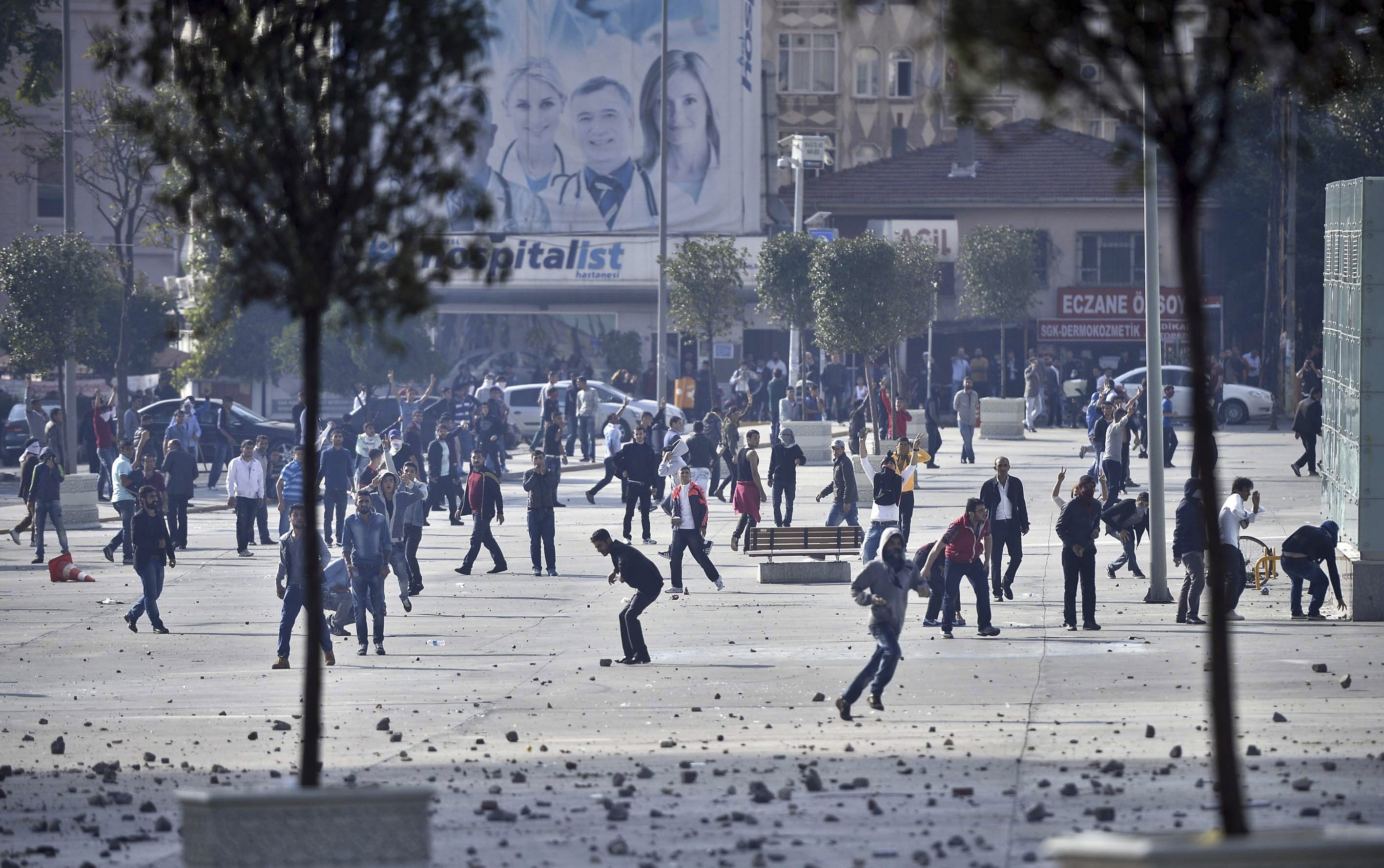
Unauthorized demonstrations against the advance of ISIL in Turkey

A reader quotes me:

Except, of course, it was Kennan’s careful and conservative case for containment that ultimately won the Cold War without the near-Armageddon that the predecessors of today’s chronic interventionists (Kennedy especially) nearly brought us to.

As someone who advocated a continuation of the containment policy towards Saddam Hussein rather than an invasion as you did, I think it needs reminding that “containment” during the Cold War did not mean isolationism, or doing nothing, but instead involved a very complex series of actions and alliances, including using force as an option. Keenan’s containment policy, as actually put into action, was a very active form of engagement with the entire world. It’s during that time that our entire “military-industrial complex” rose to prominence and influence.

So invoking Kennan and Cold War containment makes the opposite case in terms of our foreign policy in the Middle East, or against ISIL or Syria or whomever. Containment is a way of actively engaging these military threats, while being under no illusion that full-scale invasions and occupations are the solution.

I see Obama’s strategy in relation to ISIS and the Iraq to be one, essentially, of the same kind of active containment that our country used during the Cold War. Engagement, not isolationism, is the key. And that includes some use of force, and the arming ofiraq2 various groups, realistically understanding that we are not going to “win” by these means, but that we can at least prevent anyone else from winning either, and by drawing out the conflict over decades, we can ensure that the natural superiority in the underlying cultural and economic conflicts will resolve themselves in our favor.

It’s clear that preventing ISIS or any other radical Islamist group from taking power over a country such as Iraq is in America’s interests. That doesn’t mean that we should re-invade the country, but it does mean that we should remain militarily engaged to make sure it doesn’t happen, without of course going overboard on the idealism and machismo.

It’s of course debatable as to which containment strategies will work best in any given set of circumstances, but I don’t think one of the options is just walking away from the Middle East and assuming all will work out best without our involvement. That’s the first kind of isolationism Keenan described and criticized. The second kind, isn’t even one that Keenan himself advocated, given his endorsement of large US military bases in Europe and around the world, and military engagements in local clashes as Cold War proxies. So don’t go hiding behind Keenan as some sort of shield for advocating that the US should just disengage from these sorts of wars and conflicts.

My reader makes some excellent points, so let me explain why I still do not agree. There is a core difference between the threat we face today and the threat we confronted during the Cold War. The threat today is asymmetrical, whereas the face-off between the US and the USSR was eerily symmetrical. This means that the use of force against our current enemy is much more easily turned back against us – and the zero-sum assumptions of the Cold War can easily splinter into a myriad complications and unintended consequences when confronting global Jihad.

We did not have to worry in the battle against communism that we would somehow create many more spontaneous support for communism by resisting it; and we were confronting a huge multi-nation state, with a unitary command structure and global allies and puppets.

With Jihadism, we are beset by countless more complexities. The entities we are fighting change, melt away, re-group, and are capable of coming back from the near-dead in any anarchic place on earth they can find (and there are many). We are dealing with a world of disorder, not of frozen order. We are not confronting an advanced nation-state seeking to control large swathes of territory by conventional means. We’re dealing with asymmetrical terrorism which cannot be deterred the way the Soviets were, and which can even gain strength by our opposition. This requires a much nimbler, subtler touch – one few statesmen or women can muster for long.

The Jihadists are not suppressing large previously democratic populations with totalitarianism like the Soviets either; they are exploiting deep conflicts within the Muslim world – the Sunni-Shi’a divide pre-eminent among them – which refuels them in a way the bankrupt doctrines of Soviet Communism couldn’t, and in a culture where Western democracy is deeply alien. They are able to exploit all the resentments of those who see the West as a looming tower of decadence and wickedness – a huge f0rce in our modern world.

And they harness (even as they pervert) the immense power of fundamentalist religion, which, unlike communism, has roots deep in many cultures, and is resurgent in part because of the perceived threat of modernity (something that is not going to go away soon). The kind of raw military power that could deter the Soviets – as in the nuclear stand-off – simply does not work against the kinds of insurgencies we have been tackling.

We know this. The Sunni insurgency in Iraq – which I fear may be a permanent feature of that region unless the Sunnis retake control of what’s left of the central government – was bribed and charmed into quiescence for a brief period – while we had tens of thousands of troops in country. Once we left – and even if we had stayed with a residual force – we had no leverage to keep it at bay, as the deeper contradictions of the imperial construct of Iraq unfold. Our allies, unlike in the Cold War, also have many different agendas. Take Turkey, a NATO stalwart against the Soviets. Today, Turkey is beset with a much more complex set of problems – a Rubik’s Cube of how to control Kurdish separatism and depose Assad while resisting ISIS. And we expect an alliance as in the olden days? In the Cold War, moreover, we had no major NATO allies actually funding communist ideology and secretly arming the Soviet Union – while many of our so-called allies in the Middle East, like Saudi Arabia, are both the cause and purported solution to our dilemma.

In my opinion, we have learned these past few years that a conventional attempt to defeat Jihadism – by invasion and occupation – will fail, unless we construct a permanent imperial presence, which we neither want nor can afford. We have learned that drones and air-power can help at times – but also over time hurt, by incurring civilian casualties which emboldens our enemies, or splintering insurgencies into ever-more extreme and fringe groups; we have learned that funneling arms to our supposed allies can easily backfire – as ISIS’ plentiful supply of purloined US hardware attests to; and we have learned – and are fast re-learning – that when local governments lack legitimacy – like Baghdad’s or Kabul’s – the use of air-power against an insurgency is even less effective. In those circumstances, I believe we simply have to accept that, whatever our motives and power, there are some problems we cannot solve. And my concern with the president’s ISIS policy is that he has led Americans to believe that we can “ultimately destroy” something that we simply cannot.

Until Iraq’s Sunnis really believe Baghdad can represent them, there will be no progress against ISIS. The one sliver of hope I see is the current desperation of some Sunni tribes in the face of ISIS’ brutality. There’s a report in the NYT today on those lines. Money quote:

After enduring weeks of abuse by insurgents of the group called Islamic State, members of the Aza tribe struck a secret deal last month with local police and military officials: The authorities would supply weapons to two tribal regiments totaling about 1,150 fighters, and in return the tribe would help government security forces fight Islamic State.

Several days later, the tribal regiments, in collaboration with Iraqi government troops and Shiite militia fighters, liberated 13 villages in Diyala Province from Islamic State, which is also known as ISIS, officials said. “ISIS has humiliated the top sheikhs of Diyala and has done horrible and unforgivable crimes against people here,” said Abu Othman al-Azawi, an Aza sheikh and a member of the provincial council. “They tried to vandalize the tribal system and break its ties.”

But even this is a very tricky business:

The geometry of tribes and tribal loyalties in Iraq is byzantine. Allegiances — even within tribes — can vary from province to province, district to district, village to village. Iraqi officials have also been concerned that arming Sunni tribes could enable the formation of paramilitary organizations that could turn quickly against the Shiite-led government.

But note one essential thing about this potentially good sign. It happened not because we made it happen; it emerged out of a convergence of interest among the relevant parties. That’s the only way this will find some kind of resolution – and our neo-imperial meddling can actually impede it as easily as help it. Less is sometime more; more is sometimes less. But at some point, amid these dizzying complexities in regions the locals know far far better than we do, we have to ask ourselves if this kind of challenge is simply too hard for us to overcome, and whether less intervention can do more to undermine our enemies than more. We may well be better off keeping our heads down, bolstering our defenses (which is why I am not a huge critic of the NSA), and occasionally pivoting to exploit an opening on the ground.

I cannot prove this, no more than the interventionists can prove that more meddling will help. But I cannot look at the past decade and draw the conclusion that more intervention is the real solution to our woes. In fact, I think it is close to madness to believe so.

(Photo: Protesters take streets across Turkey to hold unauthorized demonstrations against the advance of Islamic State of Iraq and the Levant (ISIL) militants toward central Kobani, in Istanbul, Turkey on October 7, 2014.  By Sebnem Coskun/Anadolu Agency/Getty Images.)

The View From Your Window Contest: Winner #225

VFYW-C-225

A wistful reader gets us started:

Priest Lake, Idaho. No good reason, except the photo reminds me of this place I love. It’s really heaven on earth. I wish I could be there now.

Another spins the globe:

Looking towards The Remarkables from Halfway Bay, New Zealand?

Another is thinking Canada:

I’m unfortunately short of time to do a thorough search. But I am living in the Okanagan area of British Columbia right now, and it sure looks like the territory around here, especially the dry bare hills. This is all assuming the U.S. flag is a red herring.

It isn’t. Another reader thinks he’s got it:

Finally something I know at a glance. It is the iconic mountain to all New Englanders, Mt. Washington. You can tell by the building at the summit. But where? Not north or south, and east is not likely since the view is blocked by Wildcat Mountain, so West we go and it seems to be at Forest Lake Rd. Where exactly? I don’t care, because it’s a beautiful day in the state of Maine and I’m going outside to enjoy that air.

Another gets us back where we belong, the American West:

I was pretty proud of myself for being correct that last week’s tree house view was in Costa Rica. This week, I may have to content myself with being correct that this lake house view is in the United States. OK, lake in the mountains. Probably not National Forest land, based on what look to be sparse settlements around the lake. The mountains are a little bit perplexing … they are shaped like Appalachians, but are relatively bare, like ranges further west. The vegetation looks more Western, too (though I am certainly no expert on this.) I can’t help but think that the key to this is the (apparent) structure on the mountain in the distance. An observatory, maybe? My best guess is the Meyer-Womble Observatory, near the peak of Mt. Evans in Colorado, but I cannot seem to find a big enough lake nearby to make sense of the view.

As Det. Bunk would say, this is a stone fucking whodunit.

Wendell Pierce, the actor who plays Detective Bunk in The Wire, was also in the movie Sleepers, which means he’s only one degree from this October-themed guess:

Any child of the ’70s and ’80s knows that spot. Camp Crystal Lake in Sussex County, New Jersey, home of the Friday the 13th films and a young Kevin Bacon’s demise.

A less murderous entry:

OK – this was a fun one. The trees looked northwestern. There was a snowy mountain, with a bump on the top that looked like a ski lift. Some scanning of Google maps revealed Schweitzer in Montana being near Lake Prend Oreile. This photo shows the top of Schweitzer and a comparable mountain range. Trying to triangulate the VFYW photo from there, it appeared Bottle Bay was the best location. And Bottle Bay Resort appears in a search for lodging:
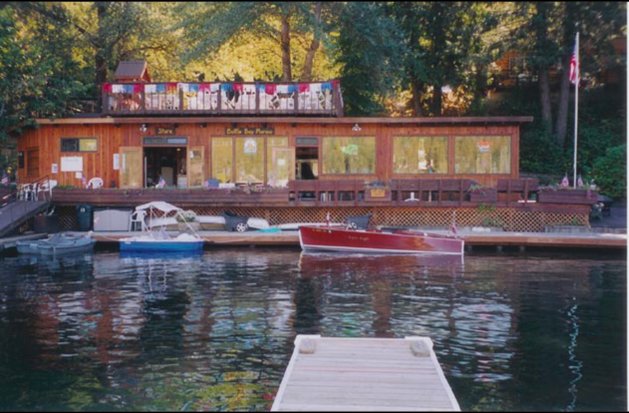
image001

My official guess: Cabin #6 at the Bottle Bay Resort, in Sagle, ID.

Another really struggled:

I know this isn’t right, but I had to throw something out into the VFYW Contest universe after nearly five hours of futile searching.

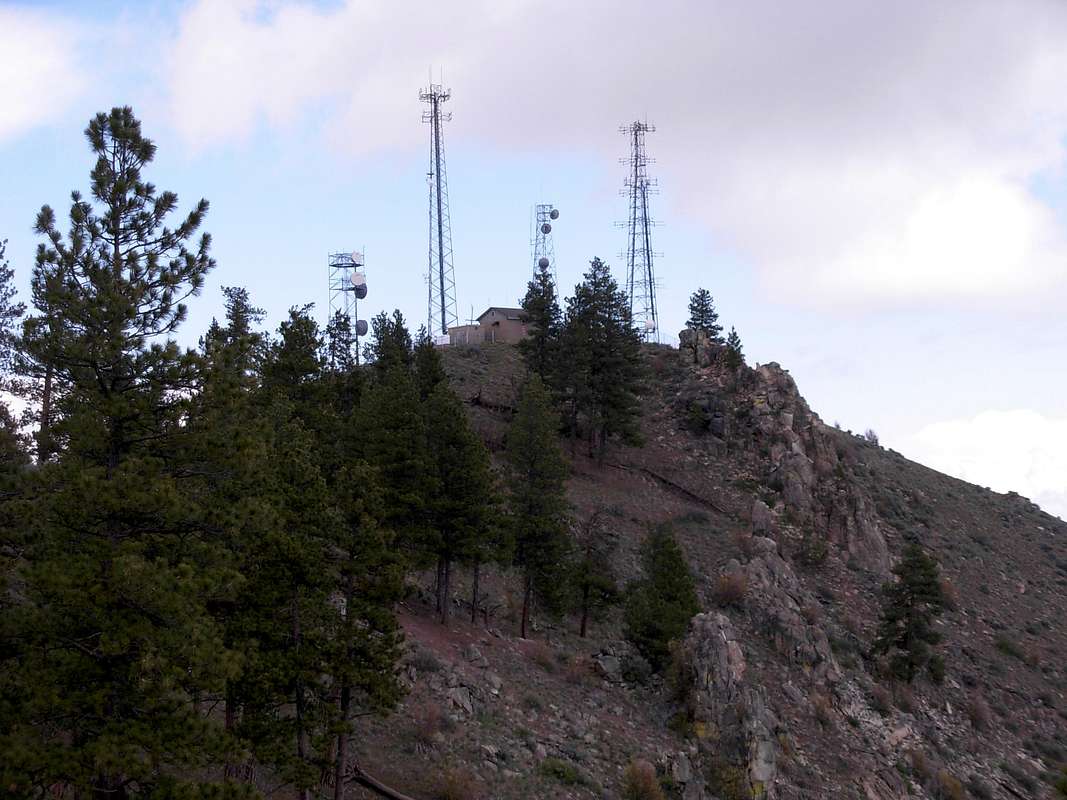
First of all, there is the American flag. Then I focused on whatever the hell that white thing is at the top of the distant mountain. Oh Dish Team, please tell me what that thing is.  I looked at observatories, old hotels, power plants, radio towers, mansions – I couldn’t figure it out. There seems to be a stone arch bridge in the background (maybe). I googled those for a while to no avail. The only other clue was the pine tree to the left. Did I google types of pinecones to figure out what kind of tree it was? Absolutely.  Is it a Sugar Pine? I think so. They mainly grow in California, Nevada and Oregon. The biggest body of water near those is Lake Tahoe. So I picked a city on that lake, and that was as close as I got.

I am eagerly awaiting the answer to this one. I’m hoping for lots of labels so I can learn what everything I couldn’t find actually is!

Our fave entry this week:

I thought “what if it’s not a lake, but a wide river?” So I traveled down the Columbia to the ocean. Lots of scenes that look similar, but nothing matched. Snake River. Klamath. Illinois. Nothing. Nothing. NOTHING!

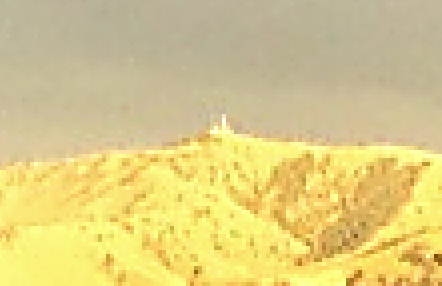
Then there’s this object on the top of the mountain range in the distance:

E75A8FF9-EB49-4C38-896C-5251D9D0AC79

What the fuck is that? Is it a building? A natural rock formation? A remote Mormon temple? None of the photos I looked at (and I looked at thousands) had anything like that. It sits there like a big middle finger, taunting me.

Lol. Another reader doubts the master:

I think even Chini won’t be able to pin this one done.

Not without some consternation:

You do this long enough and you start to break the views down into sub-groups. This week’s shot, for example, belongs to the “seemingly hopeless lake view” category, prior members of which include VFYWs #166, #114 and #125. These views tend to have few clues and no clear place to start searching. But once you get over the initial panic (for me this always involves running to Wyoming and looking desperately at Yellowstone Lake from every angle), the water views turn out to be surprisingly easy:

chini

Another names that lake:

I’m just going to guess Lake Chelan, WA, because we got married on a dock on the lake and it was beautiful.

The town is Manson, Washington. Even when we try to stump even our most veteran players, we come away even more impressed with the caliber of play this contest inspires. A former winner takes us to school:

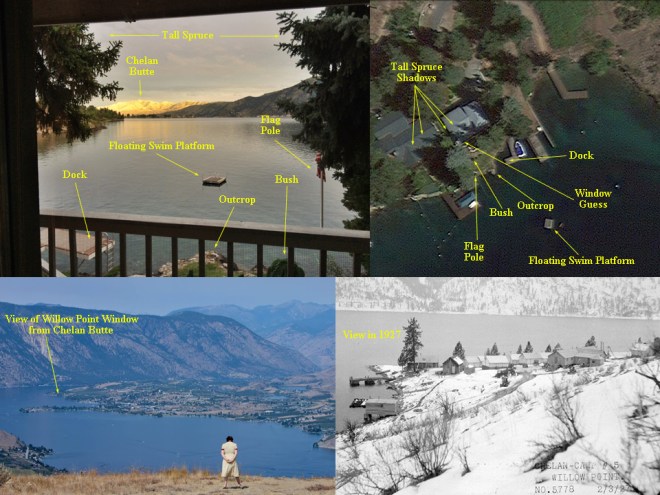
The search began by identifying the large trees by the cones visible in the contest photograph. Not much help, as the naturalized and cultivated Norway spruce is widely disturbed in many, mostly Northern states. I then looked for a large body of water with significant fluctuations in water level, which is apparent on the shoreline in the photograph and in the elevated docks with ladders. I assumed it was a lake created by a dam or one that fluctuated naturally. By chance, I began in Washington State in the area east of the Cascades but west of the drier parts of eastern Washington. Lake Chelan was a prominent candidate and fortunately a Google Earth photograph had a view with landmarks similar to that of the contest.
vfyw_collage_10-4-2014

The rest was narrowing down the approximate location based on visible landmarks and searching for accommodations that might provide helpful images. The latter proved useless (at least for me). I eventually relied on Google Earth to identify the most plausible house along the most likely stretch of the lake’s northern shore.

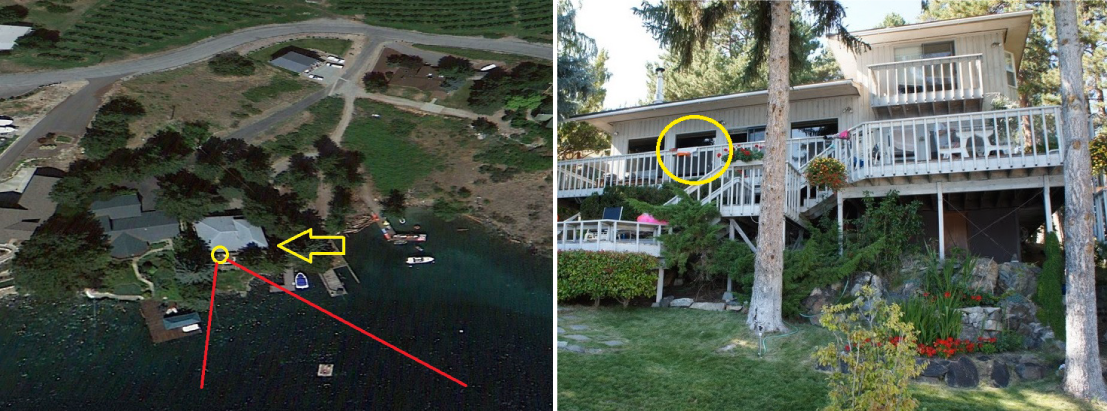
A big clue is that large stretches of the northern shoreline have been hardened or walled while that in front of the house and visible in the contest photograph had not. Finally I found a combination of features that resembled those in the contest photograph. These are illustrated in the attached (tall trees close to house, flag pole, bush in yard sloping to lake, prominent outcrop on shoreline, floating swim platform that is gray with white trim, and dock in the same location although apparently replaced recently). My window guess simply points to that part of the house which seems most probable. This is the only position that allows a view between the large trees while also capturing the flag pole, a portion of the dock, the neighboring shoreline, and distant landmarks. I assume the window is on the second floor.

The photograph is lovely.

Another former winner submits an equally impressive entry, and he was, aside from Chini, the only contestant to nail the exact address:
Window with labels

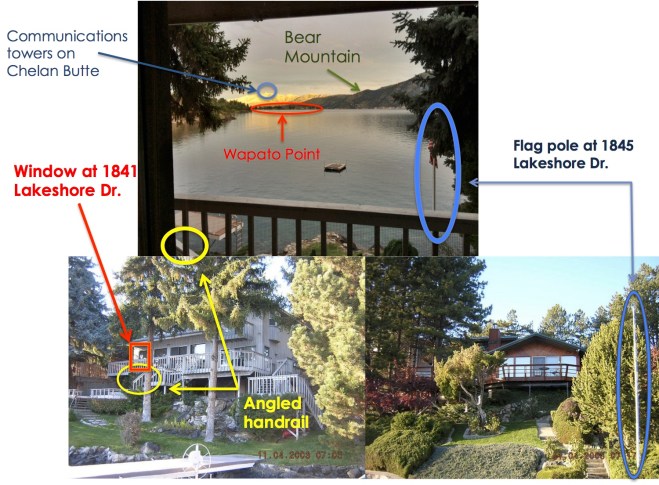
Back in Washington State this week.  Instead of the shores of Puget Sound, we are on Willow Point looking out over Lake Chelan towards the Chelan Mountains.  Specifically, we are admiring the view out of the back of 1841 Lakeshore Drive in Manson, WA 98831.  Various online maps lacked an address for the home, but the county assessor’s office came through with a number.  The window is the large window, furthest to the west on the main floor just above the porch.  The attached picture identifies the window.

This week’s contest took time to solve.  Obviously, the American flag ruled out Canada, New Zealand or South America.  The combination of the lake, pine trees, and arid hillsides across the water focused the search on the boundary where the temperate forests of the west coast abruptly transition to the arid steppes of eastern California, Oregon and Washington.  The Cascade and Sierra Nevada ranges cause the stark differences in rainfall between west and east.  Unfortunately, I started in at the southern end of the line in the Sierra Nevada and worked my way north.  And Lake Chelan is almost at the end of the line.

As for why I ended up on Lake Chelan, the combination of the numerous private docks and the communications towers on the mountain in the distance excluded many lakes and reservoirs along the way. Only Lake Chelan, it seemed, fit the bill.

The array of communications equipment on the far hill sits atop Chelan Butte.  Also on the mountain live a herd of bighorn sheep.  In 2004, the state’s Department of Fish and Wildlife released thirty-five bighorns to repopulate the area.  Today, the state permits hunters to kill a handful of them each year (examples here and here).

Our resident neuroscientist calls this week’s view a “fairly tough one”:

fig3

The American Flag significantly constrains the search area, and the semi-arid landscape looks like various parts of the American West. The blue spruce on the photo’s right further indicates this. California can probably be excluded because draught conditions there make for much lower water levels that this lake. Similarly, the terrain is not quite as dramatic as the rockies, thereby excluding CO, it’s not as verdant as pacific NW locales like Coeur D’Alene area, and it’s not arid enough to be around Roosevelt lake near Yellowstone. Instead, the area looks a lot like the rain shadow of the Cascades, and indeed lake Chelan in WA turned up a hit based on landmarks in the photo.

Here is the heatmap of this week’s guesses:

This embed is invalid

And readers have been around there, of course:

I have two sets of fond memories of this area.  My wife was waiting tables 40 miles uplake at Stehekin Lodge in North Cascades Park back in 1986 – till she crossed the owner’s son and got fired two weeks before the season’s end.  I bailed on my job and joined her for some spectacular backpacking – even bad things sometimes work out right.  Chelan is nice, but Stehekin and the North Cascades behind it are on a whole other level.  As close to an Alaska-type remoteness as you’ll find in the Lower 48.

I also helped on a dam licensing project for Lake Chelan in the 2000s – trying to figure out how much water to release into Chelan Gorge for fish, whitewater boating, and aesthetics.  It’s a tricky situation trying to keep the lake levels good for lake tourism, hydropower, flood control, and river values.  The lake is natural, but has been raised about 20 feet.  They drop it every spring so they can handle the runoff from the mountains and then try to keep it stable for the summer so all those people on the lake can use their boat docks.  The “bathtub ring” in the photo is what gave the View away to me – I’ve spent a lot of time looking at rivers and reservoirs around the west, and knew we had to be on one of the few that are not incredibly low from the drought (most of those in California and the southwest), and had some pretty small lake level limits to work with.  The spruce in the near view and the arid cascades basalt on the far side were the final tipoffs that we were in central WA.

Here’s a video of the whitewater boaters taking on Chelan Gorge just downstream from the lake.  This is the flow releases provided for whitewater boating two weekends a year.  Might make an interesting add-on mental health break:

Of the handful of players that guessed the right building this week, our winner had the most previous entries:

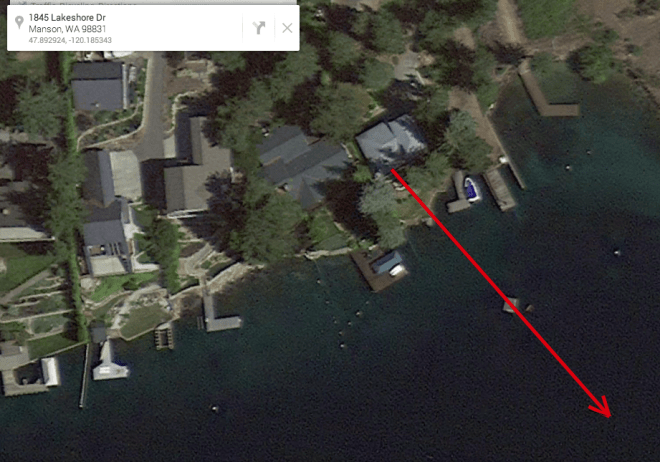
This is the SSW window of the guest house/annex at 1845 Lakeshore Dr Manson, Washington, looking southeast toward sunlit Chelan Butte, late afternoon. No doubt mine is one of literally thousands of correct answers.  Savvy contestants will note the flag. OK, somewhere in the USA. I recognized Washington State right off the bat. The light vegetation on the sunlit highest peak suggests this view is somewhere along the north side of the south end of Ebola virus shaped Lake Chelan. That is Chelan Butte catching the last sun of the day and most of Lake Chelan is in shade at this time of day.

A close look at the photo shows what Google Maps IDs as Wapato Point jutting into the lake in between the window and Chelan Butte. So a bit of triangulation with Chelan Butte and the secondary peak to its west points us to the small bay at Lakeshore Dr and Willow Point Rd in Manson. The sunbathing platform is visible on Google, and its design and orientation match the photo. So this is the guest house/smaller unit at 1845 Lakeshore Dr. Which window? The one at the SSW corner, it’s the only window with a clear view to the platform given the large trees, and with the ladder of the “L” shaped dock visible in the lower left of the shot:
Screen Shot 2014-10-04 at 11.15.37 PM

Missed it by one window, but still close enough for a win – congrats! This week’s view was actually submitted by last week’s winner, who also sends this entry-like explanation:

Winning last week and now my submission this week?  #blessed.

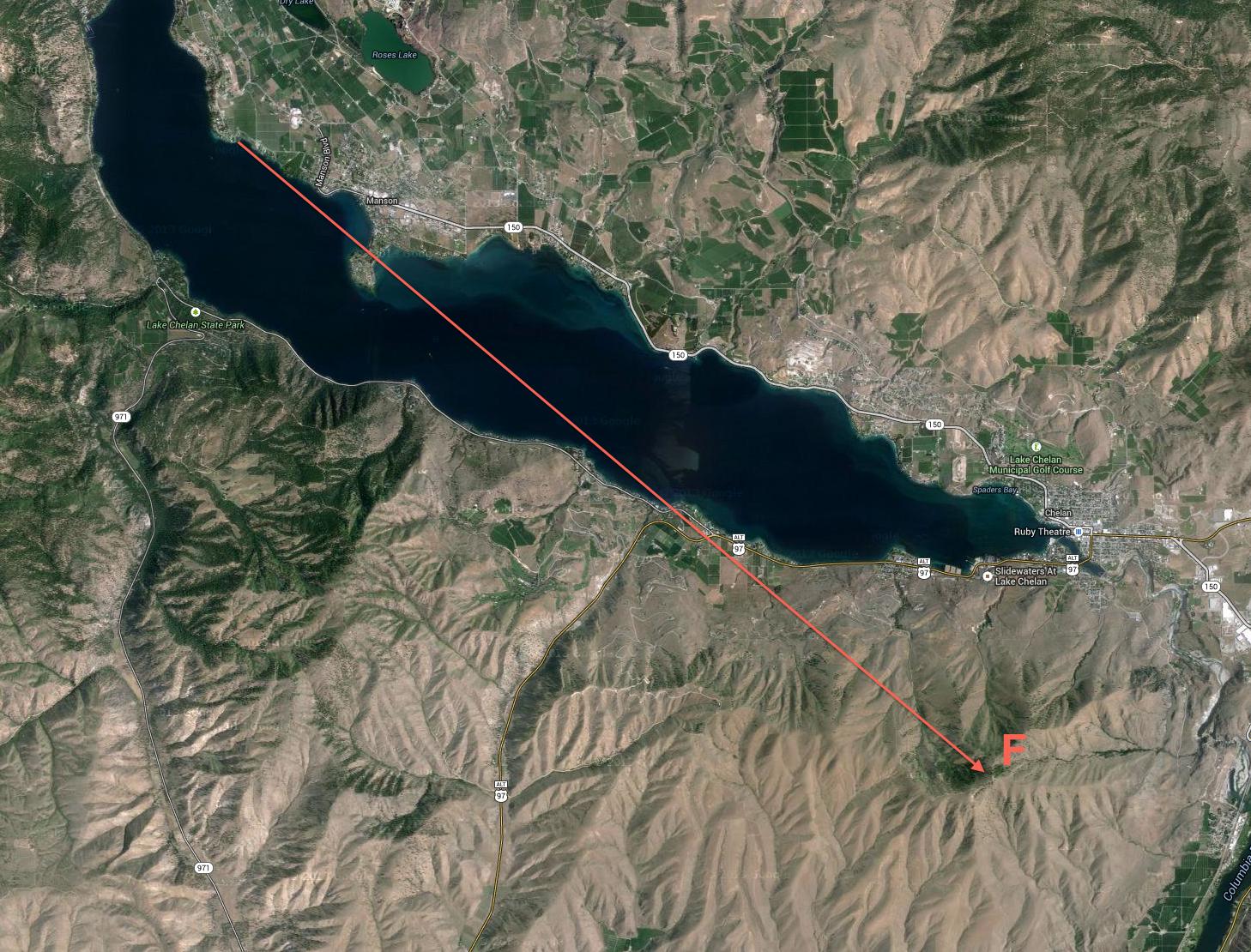
It’s hard to look at this photo objectively because it’s a view that is so baked into my psyche.  The view is looking southwest toward the foot of Lake Chelan (Shuh-LAN), the City of Chelan and Chelan Butte looming above it. In the middle distance, barely discernible, is Wapato Point, a peninsula-type feature that juts out into the lake.  The white cut just above the lake on the right side is the state highway that runs along the South Shore of the lake.  I’ll leave it to Chini to figure out the compass vectors. [Obliged: Southeast along a heading of 134.64 degrees.]

labeled VFYW

I’m conflicted about bragging too much about Lake Chelan because I don’t want to spoil what is, without a doubt, the jewel of Washington State.  The stats themselves are pretty impressive:  It’s the 3rd deepest lake in the country (after Crater and Tahoe) at almost 1,500 feet deep, a fact made more impressive in that it is a 1/2 mile across at its deepest point with 8,000 foot mountains that rising straight up from the shore. It’s 55 miles long. The head of the lake is in the North Cascades National Park and the location of a small town, Stehekin, that is only accessible by float plane, boat or foot.  The City of Chelan, at the arid south end of the lake, sees a good amount of tourist activity (especially from Washingtonians from the wet side of the mountains looking for a respite from the rain and gloom).  Lots of wine grapes and fruit are grown in the area.  If you’ve ever eaten an apple, it was likely grown here.

The lake level is controlled by a dam near the City of Chelan.  In the fall and winter months, the water goes down about 15 feet, leaving docks and boats high and dry. The glacial run-off from the surrounding peaks fill it back up for the summer.  That’s why the ladder on the dock is out of the water. The black looking rocks on the left side of the picture show the high-water mark.  The apparatus on the floating dock is simply to keep ducks and geese from resting there and shitting.  They are prodigious shitters.

Chelan Butte is also a world-class paragliding venue.  The photo below gives you an idea of the topography, although there is about a 800 foot differential between the Columbia River and the Lake Chelan valley. The star marks where the view photo was taken:

Task3Crossing2

Another interesting fact:  In November 1945, along the white cut on the other side of the lake, a school bus plunged into the lake during a snowstorm, killing 16 (15 kids and the driver, who had just returned from the war). Here’s a newsreel about the tragedy. There’s a roadside memorial that most people obliviously drive past on their way to taste local wine.

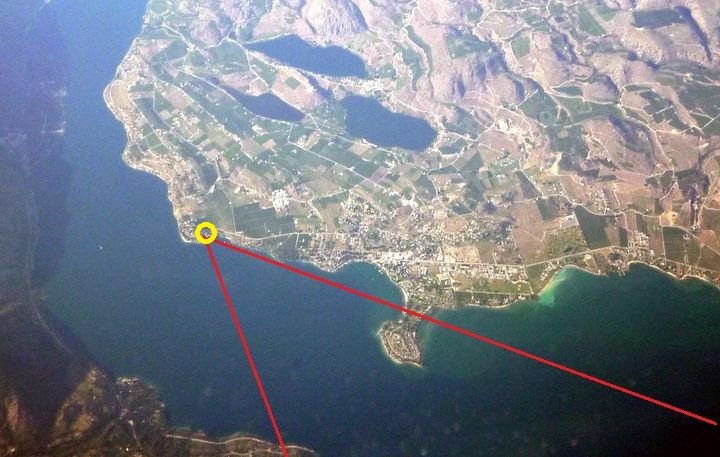
This aerial view gives a good perspective of Wapato Point:

aerial chelan

The green orchards are either apples, cherries, peaches or grapes. Unfortunately, many of the orchards are being ripped out to put in housing developments. The village of Manson, home of the world famous Buddy’s Tavern, is tucked into the armpit of Wapato Point. The view is taken from the living room window. The street address is 1841 Lakeshore Drive, Manson Wa, although I’ll note that the Google address machine is not very good in rural locations.  Any street address in the 1840s is acceptable.

sidebyside-chelan

Thanks again!

Thanks to you, and all our players. Come back Saturday at noon for next week’s contest.

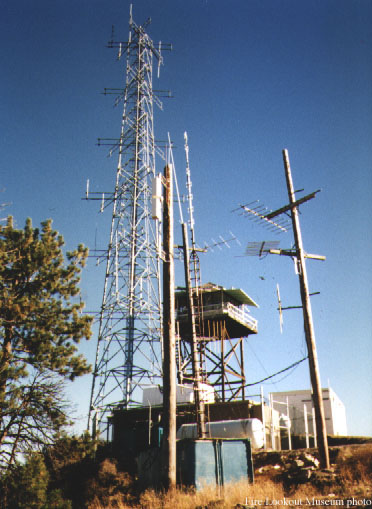
Update from the reader behind our favorite entry, who is clearly relieved to have now identified the mountain-top middle finger:

There you are, you little fucker:
EB1CAFAA-5DB8-418F-BF07-1EC80F926D11

There’s actually a bit of history behind the Chelan Butte Fire Lookout. Built in 1938 by the Civilan Conservation Corps, it was manned until 1984 and provides a 360-degree view of the area, which includes Lake Chelan, the town of Chelan, the Wenatchee National Forest and the Columbia River. I did look at Lake Chelan, among several thousand other lakes, but never found a view that looked similar enough, and there just aren’t a lot of pictures of this structure from a distance.

Ah well … there’s always next week.

See you Saturday!

(Archive: Text|Gallery)

Hardly Anyone Cares About The Midterms

Cillizza faces facts:

Just 15 percent of Americans said they were following the 2014 midterm elections “very closely” in the past week, according to polling released Monday by the Pew Research Center. That’s less than half the number that said they were tracking the Ebola virus (36 percent) story or the reports on the U.S. airstrikes against the Islamic State in Syria and Iraq (31 percent). It’s also less than the 21 percent of people paying close attention to the problems at the Secret Service. …

Most people do not care about midterm elections. Like, at all. I can’t emphasize this strongly enough.  The election is in one month from tomorrow and it remains a back-of-the-mind story for most people. Midterms are largely battles between the two party bases, the most energetic partisans who follow this stuff as closely as, well, me.

But Ponnuru urges us to pay attention:

[S]ome races have an importance for our political future that goes beyond the question of who runs the Senate.

The Senate race in Arkansas, for example, is not only one of the most competitive contests in the country. It’s also a race that will tell us whether Democrats are beginning to have the kind of turnout success in midterm elections that they’ve had in presidential ones. Black turnout in Arkansas has been low — which means that if Democrats’ efforts to get out the vote are going to succeed, we ought to see the evidence there.

The Kansas governor’s race will tell us whether it’s possible to go too far with an agenda of tax cuts even in a reliably Republican state. If Republican Governor Sam Brownback — whose aggressive tax cuts have led to deepening revenue shortfalls and a debt downgrade — loses, others in his party will conclude that the answer is yes. They will take that lesson especially seriously if Brownback brings down Republican Senator Pat Roberts with him.