President Butters?

Senators Attend Briefing On Release Of Sgt. Bowe Bergdahl

He’s apparently considering a run. The man who has been running around like a chicken with his head cut off fretting that we’re all gonna die in our sleep as ISIS takes over the US … well, he is the perfect candidate to describe the current GOP, isn’t he? Except, of course, he’s single. And been wrong about almost every single foreign policy question in the last decade. Larison piles on:

Graham is kidding himself if he thinks he could be the nominee, so I’m not sure what the point of this would be. The likely 2016 field will already be filled with reliably hawkish candidates. Graham distinguishes himself from that field in that he has never encountered a foreign intervention that he didn’t like and by being wildly out of step with most Republicans on immigration. Those will make him an easy target and useful foil for all of the others, who will be able to point at the second “amigo” and say something like, “I want to keep America secure, but I don’t want to bomb every a new country every five minutes as Sen. Graham does.”

A Graham bid is the closest one can get to re-running a McCain campaign, and Republicans are even less interested in doing that than they are in giving Romney another chance. Worse for the party, he is the embodiment of everything that is wrong with the party, especially when it comes to the issues of foreign policy and immigration. He is the walking reminder of why most Americans shouldn’t trust Republicans to conduct foreign policy and why most conservatives don’t trust their party leaders.

Scott Shackford adds:

So Graham could run as the next McCain, but without the charisma, or an alternative to Rubio, but without the youthful appeal or energy (or charisma). But who can resist the charms of a presidential candidate who believes that ISIS is coming to kill us all, each and every one of us? Who can better instill the belief in American Exceptionalism than the guy who keeps screaming about monsters under the bed?

Allahpundit suggests a slogan of “He’s not the RINO America wants. He’s the RINO America needs.”:

The obvious play for centrist hawks who are worried about Paul and Cruz is to unify behind a candidate early and try to push that guy to victory in Iowa and New Hampshire, all but locking up the nomination. Rubio’s their best bet (unless, I guess, Jeb runs), yet here Graham is not only tearing him down for caring what the party’s base thinks but threatening to actually siphon off votes from Rubio by running himself. It’d be like Sarah Palin deciding to jump in and cannibalize some of Ted Cruz’s tea-party support because, even though she agrees with him on basically everything, he’s a little too green for a big campaign. Why risk blocking your faction’s best chance at that nomination?

(Photo: U.S. Sen. Lindsey Graham (R-SC) talks to reporters. By Alex Wong/Getty Images)

The Crime Of Ebola Transmission

Allahpundit considers Liberia’s plans to prosecute Thomas Eric Duncan:

Should Duncan be prosecuted? Ace worries that if you throw jail time into the mix, Liberians who fear they might have Ebola will panic and become more determined to conceal their symptoms, putting the people around them at risk. I can understand that as a matter of Liberian domestic policy; you want people to feel as comfortable as possible in reporting their symptoms so that you can treat them (and isolate them) ASAP. But you also don’t want them getting on planes, and the prospect of jail time if they decide to fly when they fear they might be infected would deter that. No? What am I missing here?

Oh, by the way, Duncan did tell the staff at the hospital in Dallas that he’d just come from Liberia when he first showed up sick to the ER last week. They sent him home with antibiotics.

Scott Neuman points out that Duncan may have actually been less than forthcoming:

Officials at Texas Health Presbyterian Hospital now say Duncan wasn’t honest with them either. When asked if he had been around anyone who had been ill, Duncan told them he had not.

Adam Chandler puts the prosecution in context:

As West African countries battle the largest Ebola outbreak on record, the notion of pursing criminal charges against a man who claims he wasn’t exposed to the virus may come off as wasteful, if not extreme. Given that thousands of people continue to move between the borders of West African countries, Liberia’s intention to prosecute Duncan for traveling to the United States with Ebola—unwittingly or not—also rings a little hypocritical.

But as Jens David Ohlin of Cornell University Law School contends, the prosecution of Duncan may have less to do with what he did (or did not) do and more with the precedent his case could set.

“Liberia is probably anxious about maintaining travel connections to the United States and other countries,” Ohlin told me. “And countries have probably felt comfortable keeping air connections with Liberia so long as protocols for screening passengers are in place.” He added that were Liberia to ignore this potential breach of its screening process, it would ultimately convey that “these protocols are worthless.”

The Walrus Is The New Polar Bear

A lack of arctic ice has forced Alaskan walruses onto land:

Katie Valentine reports on the phenomenon:

Tony Fischbach is a wildlife biologist with the U.S. Geological Survey who’s a member of the Walrus Research Program in Anchorage, Alaska. He told ThinkProgress that when summer sea ice is at normal levels, only a small number of walrus will come to shore in Alaska — numbers typically in the tens or sometimes low hundreds of animals. This mass convergence of walrus — most of whom are females and calves — is a new phenomenon, he said.

Gwynn Guilford adds further context:

As it happens, the chunk of sea ice that caps the Arctic was, this year, the sixth-smallest on record.

“The walruses are telling us what the polar bears have told us and what many indigenous people have told us in the high Arctic,” Margaret Williams, managing director of the World Wildlife Fund’s Arctic program,told the AP, “and that is that the Arctic environment is changing extremely rapidly and it is time for the rest of the world to take notice and also to take action to address the root causes of climate change.”

Linda Qiu explains how living on land could hurt the walrus population:

For one, calves are particularly at risk of disease and from stampedes. Upon a disturbance, whether that’s a polar bear or a boat in the distance, walruses tend to rush to the water.

“The calves get trampled,” [Lori] Polasek [a marine biologist at the Alaska SeaLife Center] said.

In 2009, about a tenth of the walruses that hauled out died. This year, at least 36 walrus carcasses have been spotted, according to NOAA. That track record does not bode well for the species.

A Weak Recovery For Wages

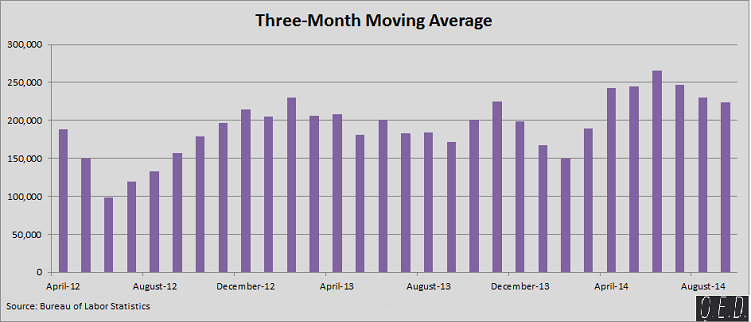
three month moving average

Bill McBride analyzes today’s jobs report:

This was a solid report with 248,000 jobs added and combined upward revisions to July and August of 69,000. As always we shouldn’t read too much into one month of data, but at the current pace (through September), the economy will add 2.72 million jobs this year (2.64 million private sector jobs). Right now 2014 is on pace to be the best year for both total and private sector job growth since 1999.

Vinik recommends looking at the three month moving average (above), which shows that “the economy certainly has strengthened over the past six months and is in better shape.” But he also spotlights the “one glaring sign that there is still slack in the labor market: wages are stagnant”:

In September, wages grew 0.0 percent, below expectations of 0.2 percent. Over the past year, wages have grown just 2.0 percent, barely keeping up with inflation. Wages will rise when employers have to compete for scarce labori.e. when the economy is at or near full employment. That clearly isn’t the case right now, meaning the 5.9 percent unemployment rate doesn’t represent the current state of the labor market. If the Fed were to raise interest rates, it would choke off the recovery and prevent any wage growth.

Annie Lowrey finds that “Jobs Day has become less and less of a tentpole event in the economic data calendar”:

In part, that is because the story of the recovery has become static: It just keeps chugging along at the same decent-enough pace. It is also because the unemployment rate — the headline number in the jobs report — has started telling us less and less about the state of the economy.

She adds that a “broader set of indicators generally gives a dimmer view of the economy — and that remains true this month, good headline number aside”:

So applaud this jobs report. It’s a legitimately good one. But do not let it change your view of the economy too much. Growth might be accelerating, but the underlying story of the recovery is not changing. For tens of millions of families, that unemployment rate is nothing but a number.

Jared Bernstein focuses on the participation rate:

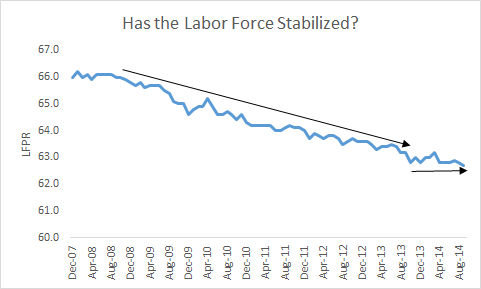
The labor force participation rate (LFPR)—the share of the 16 and up population either working or looking for work—is a key variable to watch these days. It ticked down slight last month, as noted, but as shown in the chart, has generally stabilized over the past year. This has two important implications.

labor force stable

Source: BLS

First, it suggests a strengthening job market as part of the decline in the LFPR over the recession and weak recovery was due to discouraged job seekers giving up hope. Second, as noted above, it means that recent declines in the jobless rate are due to more people getting jobs versus giving up the search.

Ben Leubsdorf plucks out other key numbers from today’s report. One that shouldn’t be overlooked:

The number of workers who have been unemployed for more than six months has declined over the last year by 1.2 million. But 3 million strong in September, they still made up 31.9% of all unemployed Americans.

And Kilgore asks, “will it matter politically?”

It’s unlikely. As Dave Weigel points out, at this point in 2006, just prior to a Democratic midterm landslide, the unemployment rate was under 5% and net job growth was steady if not spectacular.

Truth Be Told

Virginia Hughes looks at the methods for detecting lies:

[T]here’s a huge problem with the polygraph: it’s all-too-frequently wrong. Truth-tellers may show a strong physiological response to being questioned if they’re nervous or fearful, which they often are — particularly if the target of a hostile interrogation. … Because of these considerable flaws, polygraph evidence is almost never allowed in court. But it’s still used routinely by federal law enforcement agencies, not only for screening accused criminals but potential new employees.

It turns out there’s a much more accurate way to root out deception: a 55-year-old method called the ‘concealed information test’. The CIT doesn’t try to compare biological responses to truth versus lies. Instead, it shows whether a person simply recognizes information that only the culprit (or the police) could know.

She considers why the CIT, employed frequently in Japan, hasn’t caught on in the US:

One reason, according to [John] Meixner, is that the CIT only works if it’s given at the very beginning of an interrogation. Otherwise, through the process of questioning, the suspect may gain knowledge about the crime that he or she didn’t have before. Investigators are “not especially keen on that.”

The CIT is also a bit less versatile than the traditional polygraph, because investigators have to know some hard facts about the crime before testing the suspect. In a real-world terrorism plot, for example, investigators wouldn’t necessarily know what city or month or weapon to ask about.

But the biggest reason we don’t use the CIT, according to Meixner and Rosenfeld, is probably cultural. As they wrote in a review paper last year: “The members of the practicing polygraph community simply do not like giving up [that] which they are used to.”

Our Pharmacist Glut

Katie Zavadski covers it:

The pharmacy boom began in 2000. That year, a report from the Department of Health and Human Services suggested that 98 percent of Americans lived in an area adversely affected by a pharmacist shortage. Almost 6,000 pharmacist jobs stood empty, and the shortage was only predicted to grow worse. The following year, a group now known as the Pharmacy Workforce Center predicted a shortfall of 157,000 pharmacists nationally within two decades as demand and responsibilities increased while the number of pharmacists stood still. As Baby Boomers aged, the thought went, pharmacists would be able to fill some roles traditionally held by doctors, and would be able to counsel them on how to take the medications prescribed to them.

Quickly, the free market kicked in.

Over the last 20-odd years, the number of pharmacy schools in the United States has almost doubled. There were just 72 such schools in 1987; today, there are more than 130.

At first, graduates found work easily. No matter where in the country a young pharmacist wanted to settle, the number of jobs available far exceeded the number of people qualified to fill them. Slowly, the numbers began to even out, and 2009 marked a turning point: The number of jobs available was roughly on par with the number of pharmacists searching for work. The days of signing bonuses and vast job choices were over.

How this compares to the quickly deflating law school bubble:

What makes the situation in pharmacy slightly more sinister than a comparable crisis in law is that students commit to many of these six-year programs straight out of high school. (About half of graduating pharmacists each year are aged 25 or under.) Not only do they have little understanding of what such a debt load may mean for them, but they also tend to rely more heavily on the suggestions of parents and friends. And, even if they made the decision to pursue pharmacy through their own research, the rapid growth in the number of pharmacists means many are gambling on a job market six years into the future. Further, while a law degree can be useful in a wide range of professions, including business and consulting, pharmacy degrees have relatively narrow purposes: PharmDs are equipped to oversee the dispensation of medication and counsel patients on how to take it and its effects.

The Dissident We Didn’t Understand

800px-Aleksandr_Solzhenitsyn_1974b

Reviewing Daniel J. Mahoney’s The Other Solzhenitsyn: Telling the Truth about a Misunderstood Writer and Thinker, Lee Congdon appreciates the effort to push back against the famed Soviet dissident’s most vehement Western detractors – but isn’t quite convinced when Mahoney “insists that Solzhenitsyn was a proponent of democracy”:

[Solzhenitsyn] was skeptical of democracy at the higher reaches of power. One need not, he recognized, hold a degree in political science in order to arrive at informed judgments about local matters, but only those qualified by education and experience were competent to guide policy, domestic and foreign, at the national level. It is true, as Mahoney points out, that Solzhenitsyn was more or less resigned to some form of democratic order in post-communist Russia, but like Tocqueville he was far from welcoming it. In Rebuilding Russia, written a year before the collapse of the Soviet Union, Solzhenitsyn observed that “Tocqueville viewed the concepts of democracy and liberty as polar opposites. He was an ardent proponent of liberty but not at all of democracy.”

One of the reasons for Mahoney’s insistence upon his subject’s commitment to democracy is his fear that the Russian might be classed as an authoritarian. In his Letter to the Soviet Leaders, Solzhenitsyn had, after all, written that “it is not authoritarianism itself that is intolerable, but the ideological lies that are daily foisted upon us.” Mahoney insists, however, that “Solzhenitsyn nowhere endorsed authoritarianism as choice-worthy in itself.”

Praising Mahoney’s book, Carl Scott advises those unfamiliar with Solzhenitsyn’s work where to start:

Had I to start over again, I’m not sure the order I’d go in, but certainly the GULAG Archipelago first, in the abridged edition, perhaps some of the key essays and speeches next, available in the Solzhenitysn Reader, edited by Ericson and Mahoney, and then onto either In the First Circle, or the first two first “knots” of the super-novel The Red Wheel, namely, the just reissued–in the superior/complete Willetts translations–August 1914 and November 1916.  The third of these is one of my very favorite novels, despite the criticism it gets for providing too much history and political commentary alongside its main sections.  For In the First Circle and August 1914, make sure you get the newer versions.  And somewhere in there, you need to delve into a number of the short stories and poems.

For more, you can listen to an absorbing podcast Mahoney did about the book here.

(Image: Solzhenitsyn in Cologne, West Germany, in 1974, via Wikimedia Commons)

France And Jews, Then And Now

James McAuley interviews Anne Sinclair, who recalls a challenge when renewing her French identity card in 2010:

The bureaucrat that day… demanded that she prove her citizenship in the following way: “Are your four grandparents French?” he asked. In New York this week, Sinclair told me that this was precisely the moment she decided to write My Grandfather’s Gallery: A Family Memoir of Art and War. “As you know,” she said, “this question is particularly … tricky.”

Sinclair’s grandfather was none other than Paul Rosenberg, the legendary Parisian art dealer who was among the first to showcase masterpieces by Braque, Léger, Matisse, and Picasso in the 1920s and 1930s. In June 1940, during the German invasion, Rosenberg and his familyJews who dealt in what the Nazis had dubbed entartete Kunst, “degenerate art”fled for New York, and were subsequently “denationalized” by the Vichy government. Their beloved Galerie Rosenberg at 21, rue la Boétie would be sequestered by the Nazis and transformed into the Institut d’Étude des Questions Juives, a virulently anti-Semitic propaganda organization. The gallery’s wallswhich had once bravely displayed a seminal transition in twentieth-century artwere then made to bear witness to the organization of “Le Juif et La France,” the infamous 1941 Palais Berlitz exhibition that encouraged viewers to “identify the Jew and protect themselves against his actions.”

Sinclair also gives her thoughts on the current status of French Jewry:

[M]ore French Jews are making aliyah to Israel in 2014 than ever before. The reasons for their departure, of course, are complex, and not easily explained by the desire to escape an anti-Semitic environment. But the fact remains that more than 2,000 Jews have left France, compared with only 580 from the same period last year. “There’s been a lot of fuss everywhere about that,” says Sinclair, “and it’s not always accurate. … I’m concerned, of course, by the anti-Semitic revival. There is one. Not only in France, in Europe, everywhere.”

“And,” she adds, “there’s a new anti-Semitism, which is not one of the ’30s or the ’40s, which is more related to the conflict in the Middle East. In some suburbs in France you have people coming even in the third generation from the Maghreb, who are living in very bad conditions, and they feel they are rejected, well, by the whole community. … This sense of being rejected is a social despair, which can mutate into anti-Semitism when they want to protest for something.”

“But don’t believe that the French Jews are fleeingit’s absolutely untrue,” she said, emphasizing the complicated nature of the statistics often used in the reports. French Jews may be leaving France in greater numbers than before, but so have many other French citizens, seeking friendlier business climates and lower tax rates overseas.

Against Mindless Automation

In an excerpt from his new book, The Glass Cage: Automation and Us, Nicholas Carr tackles the increasing automation of our society:
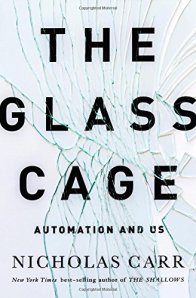
Glass CageMachines are cold and mindless, and in their obedience to scripted routines we see an image of society’s darker possibilities. If machines bring something human to the alien cosmos, they also bring some­thing alien to the human world. The mathematician and philoso­pher Bertrand Russell put it succinctly in a 1924 essay: “Machines are worshipped because they are beautiful and valued because they confer power; they are hated because they are hideous and loathed because they impose slavery.”

The tension reflected in Russell’s description of automated machines—they’d either destroy us or redeem us, liber­ate us or enslave us—has a long history. The same tension has run through popular reactions to factory machinery since the start of the Industrial Revolution more than two centuries ago. While many of our forebears celebrated the arrival of mechanized production, seeing it as a symbol of progress and a guarantor of prosperity, others wor­ried that machines would steal their jobs and even their souls. Ever since, the story of technology has been one of rapid, often disorient­ing change. Thanks to the ingenuity of our inventors and entrepre­neurs, hardly a decade has passed without the arrival of new, more elaborate, and more capable machinery. Yet our ambivalence toward these fabulous creations, creations of our own hands and minds, has remained a constant. It’s almost as if in looking at a machine we see, if only dimly, something about ourselves that we don’t quite trust.

In another excerpt, Carr fears that automation is damaging the labor market:

The science-fiction writer Arthur C. Clarke once asked, “Can the synthesis of man and machine ever be stable, or will the purely organic component become such a hindrance that it has to be discarded?”

In the business world at least, no stability in the division of work between human and computer seems in the offing. The prevailing methods of computerized communication and coordination pretty much ensure that the role of people will go on shrinking. We’ve designed a system that discards us. If unemployment worsens in the years ahead, it may be more a result of our new, subterranean infrastructure of automation than of any particular installation of robots in factories or software applications in offices. The robots and applications are the visible flora of automation’s deep, extensive, and invasive root system.

Nick Romeo lays out some of the book’s primary arguments:

We are increasingly encaged, [Carr] argues, but the invisibility of our high-tech snares gives us the illusion of freedom. As evidence, he cites the case of Inuit hunters in northern Canada. Older generations could track caribou through the tundra with astonishing precision by noticing subtle changes in winds, snowdrift patterns, stars, and animal behavior. Once younger hunters began using snowmobiles and GPS units, their navigational prowess declined. They began trusting the GPS devices so completely that they ignored blatant dangers, speeding over cliffs or onto thin ice. And when a GPS unit broke or its batteries froze, young hunters who had not developed and practiced the wayfinding skills of their elders were uniquely vulnerable.

Carr includes other case studies: He describes doctors who become so reliant on decision-assistance software that they overlook subtle signals from patients or dismiss improbable but accurate diagnoses. He interviews architects whose drawing skills decay as they transition to digital platforms. And he recounts frightening instances when commercial airline pilots fail to perform simple corrections in emergencies because they are so used to trusting the autopilot system. Carr is quick to acknowledge that these technologies often do enhance and assist human skills. But he makes a compelling case that our relationship with them is not as positive as we might think.

But, after reading the book, Josh Dzieza remains unafraid of such technologies:

Carr takes a broad approach to automation, so any technological abbreviation of a task would qualify. Google’s auto-completing searches automates inquiry, Carr says, while legal software automates research, discovery, and even the drafting of contracts. CAD automates architectural sketching. Thanks to an explosion in computing power, more and more things are getting automated, and Carr worries that it’s all combining to degrade our skills and insulate us from the world. “When automation distances us from our work,” Carr writes, “when it gets between us and the world, it erases the artistry from our lives.”

I think Carr is probably right about much of this, but I have a hard time mustering his concern. I too am nostalgic for the romance of early flight, when pilots were intuitively attuned to their surroundings through the shuddering of their plane’s throttles and levers; but as Carr himself notes, a great many of those early pilots died in crashes, and personally I’m glad my captain isn’t flying by unaided gut feeling. Pilots might be less manually skilled now, but flying is far safer. For my part, I’m probably less engaged with my surroundings because of Google Maps, but it also allows me to explore more new places without getting lost. Every tool, automated or not, opens new possibilities and closes others, fosters new skills and lets others lapse. Most of the problems Carr points to either seem like good trade-offs or fixable shortcomings. He even suggests some possible design solutions, including taking cues from game makers and designing tools that are always slightly challenging to use.

A Gun Restraining Order

Jacob Sullum disapproves of a new California law, according to which a cop or family member “can seek a ‘gun violence restraining order’ that prohibits an individual from possessing firearms and authorizes police to seize any he currently owns”:

If the applicant is a cop, he must have “reasonable cause” to believe “the subject of the petition poses an immediate and present danger of causing personal injury” to himself or someone else. If the applicant is a relative or roommate, he must show there is a “substantial likelihood” that “the subject of the petition poses a significant danger, in the near future, of personal injury” to himself or someone else. Either standard suffices to take away someone’s right to arms for three weeks, after which he has an opportunity for a hearing where the petitioner has to show by “clear and convincing evidence” that he “poses a significant danger of personal injury” to himself or others. If the judge decides that test has been met, he issues a one-year restraining order than can be renewed annually.

Bloomberg View’s editors, meanwhile, welcome the reform:

The law enables people to temporarily prevent mentally disturbed family members from possessing or purchasing guns. A so-called gun-violence restraining order, akin to the one used to obtain restraining orders in domestic violence cases, will allow police to search for and seize firearms.

The impetus for the law, which also allows law-enforcement officials to ask for a restraining order, was the shooting in May in which a mentally disturbed man killed six and wounded a dozen near the University of California at Santa Barbara. Although the killer’s parents had expressed grave concerns about his mental state, nothing prevented him from purchasing guns.

But Sullum doubts the law would have prevented that shooting:

[A]s far as I know no one in his family was aware that he owned guns. In a case with different facts, of course, it is conceivable that one of these new restraining orders might stop a would-be mass murderer. But it’s more likely this law will become a tool of meddling and harassment that mostly affects people with no homicidal intent.

Patrick Kulp compares the law to others across the country:

Under current California law, officers are only allowed to confiscate weapons if their owner has been convicted of a violent crime, deemed mentally unstable or is subject to a restraining order for domestic violence. Connecticut, Indiana and Texas all have laws in place that allow police to seize firearms with a judge’s order, but California is the first state to extend this right to immediate family members.