Turkey’s Stake In The ISIS War

TURKEY-SYRIA-KURDS

As expected, Turkey’s parliament today authorized the government to take military action against jihadists in both Syria and Iraq, but Ankara has yet to say what, if anything, that action will be. With ISIS on its border, though, we might find out soon:

Kurdish fighters backed by US-led air strikes were locked in fierce fighting Wednesday to prevent the besieged border town of Ain al-Arab from falling to the Islamic State group fighters. “There are real fears that the IS may be able to advance into the town… very soon,” the Syrian Observatory for Human Rights warned, with the jihadists within three kilometres (two miles) of the strategic town.

Or an attack on the tomb of Suleiman Shah, a Turkish enclave in northern Syria, might be what finally draws Ankara into the war:

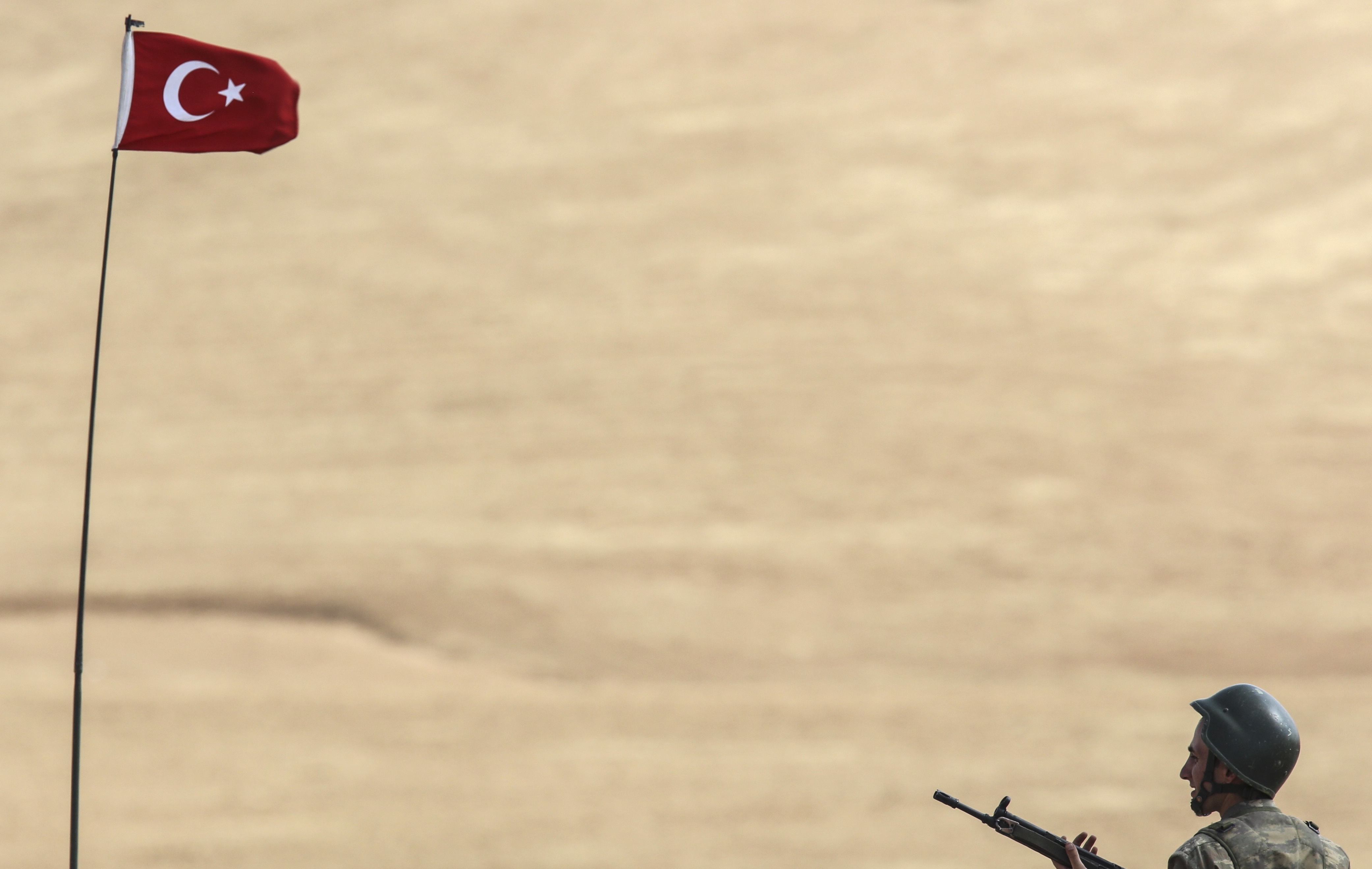
Deputy Prime Minister Bulent Arinc said Tuesday that the militants were advancing on the white stone mausoleum, guarded by several dozen Turkish soldiers and perched on a manicured lawn under a Turkish flag on the banks of the Euphrates. The tomb was made Turkish under a treaty signed with France in 1921, when France ruled Syria. Ankara regards it as sovereign territory and has made clear that it will defend the mausoleum if it is attacked.

Jamie Dettmer relays the suspicions of diplomats in Ankara that “Turkey will limit its military role—doing a bare minimum as a NATO member to avoid embarrassing the Western alliance but not enough to undermine the anti-Western narrative that thrills Erdogan’s Islamist supporters and other religious conservatives in the country”:

“As much as Turkey enjoys the protection of NATO’s Patriot missiles against the Syrian regime, Ankara is perhaps not willing to appear an active member of a war operation against what was initially a Sunni insurgency movement in Syria,” according to Marc Pierini, a former ambassador of the European Union in Ankara. “Turkey under the Justice and Development Party (AKP) has never wanted to appear to be aligning itself with Western policies.”

Erdogan’s domestic critics say he has to some degree helped the rise of ISIS, as well as other Islamic militants. At the very least Turkey has turned a blind eye to them as they emerged in the Syrian civil war and increasingly formed the vanguard in the fight to topple Syrian President Bashar Assad. Some critics argue that Turkey’s intelligence agencies have gone farther and actively channeled arms supplies to the jihadists.

Koplow also explores how the spillover effects of the conflict in Syria stand to influence Turkey’s domestic politics. For one thing, the government’s non-response is alienating the country’s Kurdish population, threatening to undo what had been a fairly successful rapprochement:

Many Kurds blame Ankara for allowing ISIS to fester and even for empowering the group through its previous see-no-evil-hear-no-evil border policy. The more half-hearted the Turkish government has been about getting rid of ISIS, the harder it is to successfully conclude the Kurdish peace process. In southeastern Turkey, funerals for Kurdish fighters who have been killed fighting ISIS across the border are a regular occurrence, and they contribute to growing discord between a naturally restive population and the Turkish government. The ongoing battle between ISIS and Kurdish fighters for the town of Kobane on the Syria-Turkey border — and Turkey’s apparent reluctance to get involved for fear of empowering Kurdish militants in Turkey — is inflaming passions and contributing to antigovernment rhetoric in ways that will reverberate well beyond this particular fight. …

An economy burdened by refugees, renewed unrest among Turkish Kurds, resurgent nationalism, and policy run by unaccountable intelligence services makes for an unstable brew. ISIS has presented the United States and the entire Middle East with a new set of problems, but its immediate legacy may be an end to what has been a remarkable period of Turkish domestic stability.

(Photo: A Turkish soldier stands on a hill in Suruc, Turkey on October 2, 2014, facing the Islamic State (IS) fighters’ new position, 10km west of the Syrian city of Ain al-Arab (Kobani). By Bulent Kilic/AFP/Getty Images)

Ripples From Kowloon Bay?

As Beijing worries over the Hong Kong protests emboldening democrats and separatists in the hotspots of China’s periphery, Isaac Stone Fish interviews a leading Uighur independence activist about how she views the past week’s events:

According to Rebiya Kadeer, the exiled leader of the movement for Uighur rights, the ideals of the Hong Kong movement are already influencing the northwestern Chinese region of Xinjiang. “Because of the brutality and wrongfulness of the Chinese government, the Uighur people have concluded that their only option is independence,” she said in a Sept. 30 interview with Foreign Policy. The protests in Hong Kong “are very inspiring” to Xinjiang, she said. Uighurs, a Turkic-speaking Muslim group who make up roughly 43 percent of the population in Xinjiang, think that “if Hong Kong wins, it will benefit Uighurs as well, and then the Uighurs can strengthen their own movement.” …

“I saw what happened in Hong Kong and Taiwan,” she said, referring to protests in Taipei this spring, and “I wished” that Xinjiang could also have Western journalists reporting there. “Our people can’t do what the Hong Kong people are doing because they’re getting killed by the Chinese government,” and there are no outsiders to observe it.

Alexa Olesen looks to Macau, the former Portuguese colony and current gambling mecca just up the coast from Hong Kong with a somewhat similar governing arrangement. For now, at least, a battle for democracy doesn’t seem to be in the cards there:

[O]ver the past year or so, Macau has seen the emergence of an aggressive labor movement fond of protests and strikes and the stirrings of a political opposition with democratic ambitions. It remains to be seen how Hong Kong’s experience — massive protests over many days that police have tried to beat back with pepper spray and tear gas — will color those developments. What’s clear is that Macau is watching intently. …

Is Macau ripe for a Hong Kong-style Umbrella Revolution? Alex Choi, an assistant professor in public administration at the University of Macao, told FP that while the territory’s labor movement gathered steam, he doesn’t expect them to shift their focus from better wages to universal suffrage any time soon. Choi said it would be “a big jump” to go from labor issues to “a fight for democracy and against Beijing.” So far, he said, the labor movement hasn’t appeared eager to take that leap.

Taiwan, of course, is not part of China, but Beijing would like it to be, and so Taipei is also keeping a watchful eye on the Hong Kong standoff. Taiwanese activist Lin Fei-Fan explains why:

The main goal of the “one country, two systems” policy by which China governs Hong Kong is to provide a template for Taiwan, but the developments of recent years clearly show China placing increasingly tight restrictions on Hong Kong’s self-governance. It’s not just that China has reneged on its promise that Hong Kong’s system would remain “unchanged for 50 years.” A more serious problem is that conflicts within Hong Kong society have proliferated. The wealth disparity there cannot be solved via existing structures, and the huge influx of mainland tourists, as well as mainlanders who become Hong Kong residents, have also created even more social problems. Taiwan faces similar concerns. We have seen that Taiwan and the Chinese government have signed a number of trade agreements exposing Taiwan to industrial outsourcing, falling salaries, increases in the disparity between rich and poor, national security risks, and other crises.

A New Eugenics?

 troubled by the sky-high abortion rate for Down syndrome pregnancies:

If the numbers on abortion and Down syndrome are even remotely accurate, the birth of a Down baby is something already against the norm. As medical costs are more and more socialized, it is hard to see how the stigma attached to “choosing” to carry a Down syndrome child to term will not increase. Why choose to burden the health system this way? Instead of neighbors straightforwardly admiring parents for the burden they bear with a disabled child, society is made up of taxpayers who will roll their eyes at the irresponsible breeder, who is costing them a mint in “unnecessary” medical treatment and learning specialists at school. Why condemn a child to a “life like that,” they will wonder.

He contends that “the ingredients still exist for a more explicit return to eugenics in our culture and politics: inequality, fear, detestation of the other”:

But if it comes back, it is unlikely to come in the explicitly racialist terms of the biodiversity-obsessed right. Liberal societies have the antibodies against that. Instead, it will come to us in terms of “quality of life,” and “health and safety.” We will be urged that every child deserves the best society can grant, and stigmatize those for whom “the world is a difficult place.” And thereby we legitimize the destruction of those who would merely “live” in society rather than thrive in it.

Whom Exactly Are We Bombing In Syria? Ctd

SYRIA-CONFLICT

David Kenner has more on our Syrian allies, who for some reason aren’t all that grateful for the bombs we’re dropping on their country:

Foreign Policy interviewed six FSA commanders from [Deir Ezzor] who are currently exiled by the Islamic State and hiding out in southeastern Turkey. All of them were arrested at some point by the jihadist group; some were tortured. They all agree that the U.S. airstrikes in their home country are a bad idea. FSA fighters and commanders complained to Foreign Policy that they have received no increase in support since the international effort to combat the Islamic State began, despite promises from the Obama administration that the United States would begin supplying arms to the rebels. The FSA fighters also disparaged the airstrikes, saying they would mainly kill civilians and give the Assad regime a chance to gain ground.

Anti-Assad Syrian civilians have echoed this opposition. While Islamists have seized on the attacks to brand U.S. President Barack Obama as an “enemy of God,” even the traditionally secular protesters in the town of Kafr Anbel held a poster blasting the coalition for killing civilians.

Zack Beauchamp calls these civilian deaths “not an inevitable feature of any sort American involvement in Iraq and Syria” but rather “a direct product of the maximalist goals the Obama administration has set for its war on ISIS”:

By choosing only to provide limited help to Iraq in critical situations, the United States had enormous control over targeting. It could focus only on ISIS targets where airpower was likely to be effective, such as disrupting supply convoys between Iraq, that also were unlikely to kill a lot of civilians.

But now, the United States has committed itself to helping both Iraqi and Syrian rebel soldiers take back all of ISIS-held territory. That’s a more ambitious strategy that takes on a lot more risk, including toward civilians. If and when Iraqi military and Syrian rebel forces move on ISIS positions in heavily populated areas, they will expect and may very well depend on American close air support. The US will be forced to rely on sketchy Syrian intelligence and strike dangerously close to civilian population centers. It’s this simple: the more aggressive the American objectives are in the war against ISIS, the more likely American forces are to kill civilians.

Erika Solomon and Geoff Dyer back up previous reports that our targeting of the Nusra Front is alienating our friends and encouraging the al-Qaeda franchise to seek out Western targets:

[M]oderate rebels on the ground fear Washington’s decision to widen its attacks could not only weaken them, but create a larger pool of fighters who believe the west – and its partners on the ground – are their enemy as much as Mr Assad. Nusra fighters insist they had no interest in foreign attacks before the coalition strikes. But since then the group appears to have shifted its position: Jabhat al-Nusra’s leader, known as Abu Mohammed al-Golani, recently put out a statement warning western civilians to demand an end to strikes to avoid becoming victims of attacks in their own countries. Nusra fighters have been a critical partner to other rebels fighting to end four decades of Assad family rule. Their targeting by the US outraged some opposition forces.

And Joshua Hersh observes that most of the pro-democracy activists who launched the 2011 revolution are no longer there, having been killed, silenced, or driven into exile either by the regime or by ISIS:

Not all revolutionary civil activity has ceased inside Syria. In the town of Kafranbel, in Idlib province, a clever and merry band of activists continue to create humorous banners that comment on recent events, and seek to bring attention to their ongoing plight. (Recent banners have quoted Robin Williams, honored the murdered journalist James Foley, and mocked the world’s obsession with the World Cup.) And in Aleppo, there are revolutionary councils and civilian activists networks, not to mention a noble brigade of volunteer rescuers who risk their lives daily to pull survivors from the rubble of regime airstrikes. But for so many other would-be do-gooders, the rebel-held countryside, not to mention the major cities still under government control, has long proven unwelcome terrain. Going home remains a distant illusion.

“The sense of despair and the sense of loss is so powerful,” one longtime Syrian activist and humanitarian worker told me by Skype last week from his asylum in London. “For the people still inside, even if they are activists, they are under so much pressure—the pressure of the war, the militarization, the abuse.” He added, “At this point, if you want to be an activist, it’s basically to call for the fighting to stop, the bloodshed to stop.”

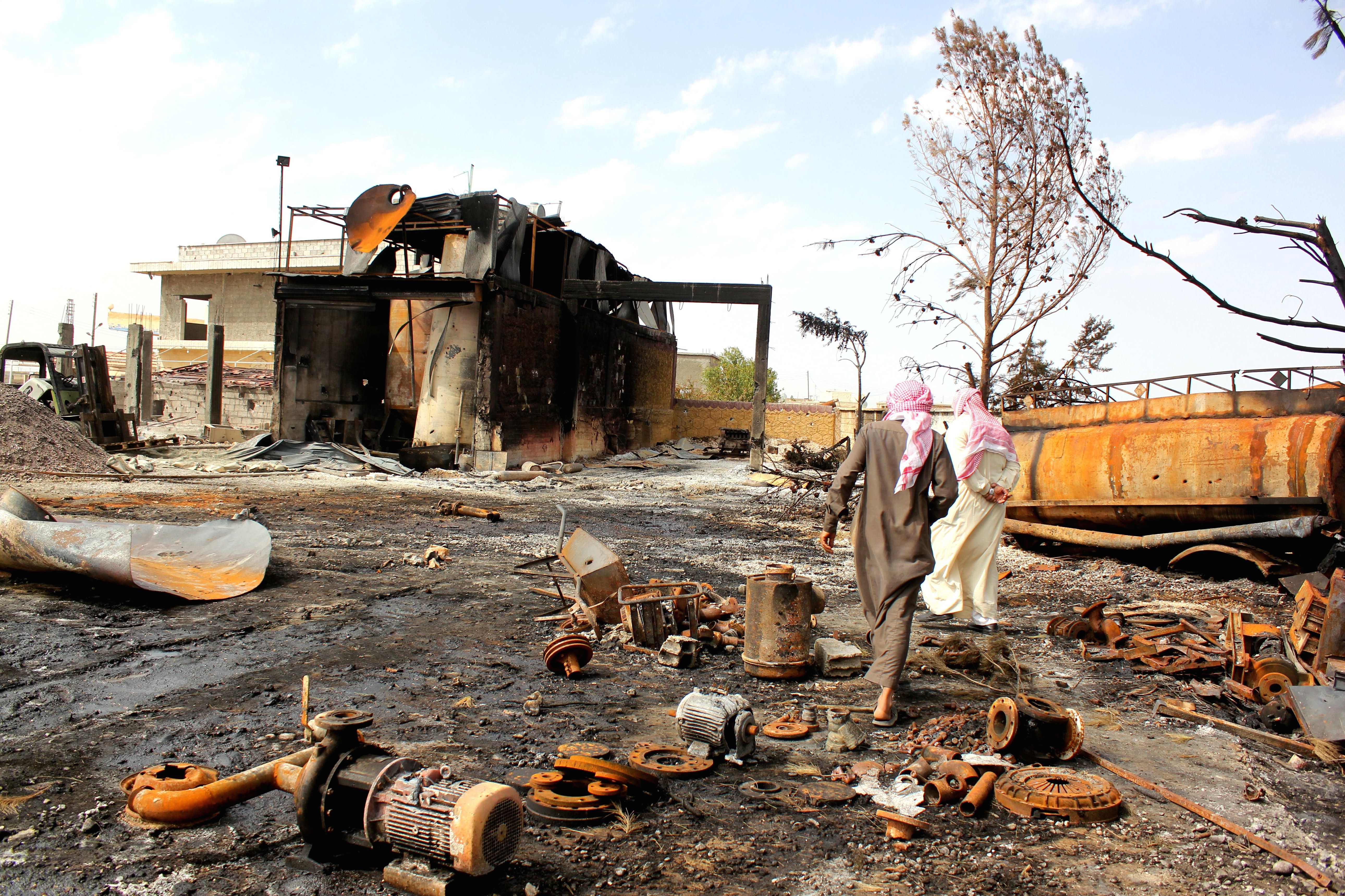
(Photo: On October 2, 2014, men walk through the rubble of an oil refinery that was reportedly targeted by the US-led coalition on September 28, in the northern Syrian town of Tal Abyad near the border with Turkey. By AFP/Getty Images)

Should Washington “Speak Out” On Hong Kong?

Pace the WaPo editorial board, Larison doesn’t want the US to involve itself in the standoff, which he calls “exactly the sort of tense, potentially explosive situation in another country that the administration shouldn’t be talking about publicly”:

It would be appropriate for the administration to convey its concerns to Beijing through diplomatic channels, and perhaps they have already been doing this, but there is absolutely no need for public declarations or “explicit support” for the protesters. How could that benefit the protesters? The Post doesn’t even pretend that it would. As ever, the desire to have our government “speak out” in support of foreign protesters trumps all other considerations. It’s not as if Beijing will react well to be warned by Washington about how it conducts its own affairs. We know very well that the Chinese government reacts angrily to any hint of foreign interference in their internal politics. Indeed, there are few governments in the world less likely to respond well to statements from U.S. officials about its internal affairs than the Chinese government.

Before meeting with John Kerry yesterday, China’s Foreign Minister Wang Yi warned Washington to back off and respect Chinese sovereignty. There is also a conspiracy theory, encouraged in the pro-Beijing press, that the protest movement is an American plot. David Wertime situates this theory within the context of negative reactions to the demonstrations on the mainland:

A vocal but not negligible minority genuinely believes that foreign forces are behind recent events. A widely circulating article, originally penned in June and republished Oct. 1 on 163.com, a major news portal, ably summarizes the attitude of some Chinese conservatives toward Hong Kong. The accusation-packed piece, called “Who really is the black hand behind Hong Kong independence?” begins, “Recently, gangdu – Chinese for Hong Kong separatists, who do not appear to actually be a driving force behind the current protests — “have been happily making trouble, and behind it is an America hoping to push [the movement] to its height.” It goes on to name a great many bogeymen: Paul Wolfowitz, the National Endowment for Democracy, George Soros, and the CIA. The article accuses the West of making “cultural products” in a “war of ideals” that it then foists on unsuspecting overseas populations. The goal, the article declares, is to then “stimulate Taiwanese independence, Xinjiang independence, and Tibetan independence” to cause “multiple troubles for China, making China unable to pay attention to its great power struggle with the United States.”

Noting that Russian state television is also on board with this theory, Bershidsky compares it to similar mutterings about the massive protests in Moscow in 2012 and the Euromaidan revolution in Kiev:

The problem with the U.S. conspiracy theory is that it’s impossible to buy if, like me, you experienced the Moscow and Kiev demonstrations first hand. The leaders were weak and non-essential. The protests would have gone on without them. If not through the leaders, how could any puppeteer exert influence? People took to the streets because they felt cheated, and in every case the deception was real. In Moscow, Putin’s party blatantly stole a parliamentary election. In Kiev, the president reneged on his promise to sign a trade pact that would have put Ukraine on a path toward European integration. In Hong Kong, a plan to vet candidates for the city’s chief executive nullified Beijing’s promise of universal suffrage.

The U.S. neither perpetrated the deceptions nor opened people’s eyes to them. People aren’t as dumb as authoritarian leaders think. The creation of symbols, organization against common ills and the desire to keep protest camps clean are instinctive and universal. They require no more conspiracy or outside influence than a swarm of bees does to organize a new hive.

Burn After Investing

Start Ups

Timothy B. Lee keeps an eye on the burn rate of startups:

This chart shows that young [software] startups are burning through cash at about the same rate they did four years ago: around $200,000 per month. But older startups today are burning through cash a lot faster than startups the same age were four years ago. The average startup in its fourth round of venture financing is now burning through $1.6 million per month, about three times the burn rate seen at startups in the same position in 2010. Pitchbook, the company that compiled the data, says that “the burn rate has increased for Series B and later rounds to the highest levels since the height of the tech bubble.”

Do these high burn rates mean that we’re on the verge of another 2000-style crisis?

It’s hard to say. It’s certainly possible that the high burn rates simply reflect a return to the irrational exuberance of the late 1990s. But it’s also possible that companies are spending more money because the markets these new companies are pursuing will be bigger and more lucrative than the ones companies were pursuing 15 years ago.

Relatedly, Ben Casselman flags data showing that entrepreneurship is still in the doldrums:

Last week, the Census Bureau released new data on so-called business dynamics (startups, failures, hirings and firings) for 2012. Entrepreneurship did rise in 2012, but barely. Americans started 410,000 businesses in 2012, up just 2 percent from a year earlier and still more than 20 percent below prerecession levels. The startup rate — the number of new businesses as a share of all businesses — was essentially flat at 8 percent.

Leung Stalls

As the midnight deadline set by demonstrators for him to resign approached, Hong Kong’s Chief Executive Leung Chun-ying refused to step down but pledged to hold talks between Chief Secretary Carrie Lam and the protestors:

Leung praised the Hong Kong police and the SAR government for their restraint. He said that the protests would continue to be tolerated as long as protestors do no attempt to occupy important government buildings, such as the police headquarters and the chief executive’s office. Leung said that he did not want a confrontation between police and protestors, and urged protestors not to advance on the police cordons. When asked about reports that the Hong Kong police are armed with rubber bullets, Leung emphasized that the police will continue to exercise restraint. Still, he also urged to protestors to end their occupation of the city center.

Though Leung offered the protestors a dialogue with Carrie Lam, there still seems to be little to no room for compromise. Leung insisted repeatedly that the dialogue and the ultimate solution must follow Hong Kong’s Basic Law and work within the framework of the National People’s Congress Standing Committee (NPCSC) decision on Hong Kong’s elections. Following these two guidelines is the only way to have universal suffrage in 2017, Leung told reporters. The protestors have already indicated they are not willing to accept the NPSC decision, which would  see all candidates for chief executive be nominated  by a Beijing-friendly committee.

Occupy Central still insists that Leung must step aside in order to break the impasse. Melinda Liu argues that a negotiated outcome is still possible, if only President Xi Jinping will allow it:

In fact, there is some room to maneuver for both sides. Although Hong Kong residents are unlikely to get the precise sort of direct vote protesters are demanding, the composition of the election committee that vets nominees, the number of nominees and the use of secret balloting could be open to negotiation. There’s also a possibility that Leung may be cashiered eventually, though if that happens before 2017 his successor will be chosen the same way he was.

The question is whether Xi can afford to project an image of weakness by permitting such negotiations and considering even minor compromises. The demonstrations that are paralyzing Hong Kong’s Central district today have as many dissimilarities with Tiananmen Square in 1989 as they have parallels. And the world has changed dramatically, as has China. But in the end the outcome may ride on the same question that so frightened the Communist Party mandarins back then: whether the leader in charge of the world’s largest authoritarian nation can stomach an uprising of democracy for very long.

Srdja Popovic and Tori Porell praise the protest movement’s organization, orderliness, and focus:

Although it may seem obvious that a protest movement must win popular support to combat oppression, it is no easy feat, and something we have seen movements in dozens of countries fail to accomplish. The staunch adherence to nonviolence Occupy Central has demonstrated takes preparation, training, and discipline—a combination that’s very rare for many movements. Most of the time, organizers aren’t prepared to handle the crowds that surge into the streets, and with no way to maintain calm and cohesion, too many movements have been derailed by a few thrown rocks or smashed storefronts. Governments seize on the smallest acts of disorder or violence as excuses to crack down. However, Occupy Central’s organizers seem to have come prepared. By issuing the manual and attempting to train their activists, they have maintained a united front and warded off the pitfalls that plague too many social movements.

But Richard C. Bush fears that this won’t last:

The unity and leadership of the opposition camp is a matter for concern. The New York Times had a good article this morning on the amorphous, loosely led character of the movement (“Hong Kong Protests Are Leaderless but Orderly”). Those who are seeking more democracy than Beijing is willing to grant are quite “democratic” within their ranks. The pro-democracy camp has suffered serious fragmentation over the last two decades, to its own detriment. This is a cause for serious concern. The beginning of the current crisis began when one faction of the pro-democracy camp decided on Friday evening to independently undertake action that was more radical than other factions preferred.

Chris Beam spots some hostility toward mainland Chinese around the edges of the movement, which could hurt its image:

Occupy Central organizers have done their best to distance themselves from the anti-mainland movement and keep the focus on election reform and universal suffrage. … But pro-democracy ideas and anti-mainland sentiment can be difficult to tease apart in Hong Kong. Many protesters want autonomy for Hong Kong in order to boost policies that will mitigate the influence of mainland Chinese on the island. For example, they support liming the number of properties that mainlanders can buy in Hong Kong and tightening visa regulations. (Ironically, the much-denounced chief executive C.Y. Leung has promoted some of these policies.) Of course, defensive policy positions easily blur with personal feelings toward mainland Chinese.

On the other hand, James Palmer argues that “Hong Kong is in many ways more Chinese these days than mainland China”, and that “might be what scares the authorities so much”:

The shrines and altars that dot Hong Kong speak to the richness of Chinese custom, annihilated between 1949 and 1976 in the mainland. … Hong Kong preserves hobby clubs, literary societies, family associations, clan ties and ancestral temples that once made up the fabric of Chinese society. In mainland cities, the once-vast variety of regional cultures and traditions has been wracked twice over; first by Maoist persecution and then by waves of migration and materialism. Most of all, the Hong Kong protests themselves are part of a great Chinese tradition, not only of peasant revolt and popular uprising, but of the student demonstrations that made China’s 20th century, from the protests of 4 May 1919 onwards. The Chinese public have never been the complacent sheep or communal masses of some westerners’ imagination, but an active, powerful force.

Overall, Jeffrey Wasserstrom is pessimistic about China’s political future:

Alas, what we have seen is Beijing leaping from a lack of self-confidence straight to a projection of arrogance. It is more insistent than ever on joining the global order only on its own terms. The party used to legitimate its rule by promising a China more equal than the country had ever been, run by an organization less corrupt than its predecessors. Now, flagrant inequalities and bountiful instances of corruption are exposed regularly.

So what rationale is left? Well, only a strong state can protect the nation’s interest in a chaotic world, the party line goes. And the current sorry state of the wider geopolitical world makes harping on this theme easier than it should be for Beijing. A cloak of counterterrorism hides state-waged terrors chillingly resonant of Cultural Revolution. The Hong Kong protesters are voices of freedom. When we look back on the demonstrations in 10 years, will we hear the song of China’s trajectory? Or will it be an elegiac tune that only makes us wistful for what China could have been?

Follow all of our Hong Kong coverage here.

The Most Reliable Birth Control We’re Not Using, Ctd

Rebecca Leber flags some new medical advice for teens: “The American Academy of Pediatrics has just revised its official position on birth control: The academy’s new guidance advises members to recommend intrauterine devices (IUDs) and progestin implants as the most effective birth control methods available”:

The announcement, which appears in the flagship journal Pediatrics, is important for its own sake because it’s likely to change patterns of medical practiceand reduce the incidence of pregnancy. It’s also important for what it says about the ongoing controversy over who should pay for contraception. …

IUD usage in the U.S. is still fairly rare in the United States, especially among teens (just 3 percent of teens rely on IUDs). But that is finally changing, rising from just 2 percent to 8.5 percent between 2002-2009. One likely reason that may continue to change is, under the Affordable Care Act, all insurance policies must cover birth control fully, without extra out-of-pocket costs. Implanting an IUD is expensiveit can run several hundred dollars, without insuranceso the coverage makes a difference.

Some conservatives might bristle at the idea of pediatricians counseling teens about sex. But the new guidelines make clear that “Adolescents should be encouraged to delay sexual onset until they are ready.” The problem, the article explains, is that “existing data suggest that, over time, perfect adherence to abstinence is low (i.e., many adolescents planning on abstinence do not remain abstinent).”

Julia Lurie explains why this is such a big change:

It’s no secret that a lot of teens have sex; according to the report, nearly half of US high school students report having had sexual intercourse. Each year, 750,000 teenagers become pregnant, with over 80 percent of the pregnancies unplanned. But the recommended AAP guidelines are a huge step away from the current practices of the 3.2 million teenage women using contraceptives; in fact, it seems that the frequencies with which teens use contraceptives are inversely related to their efficacy.

Lurie notes that “male condoms are by far the most frequent choice of contraception, with over half of teenage women reporting condom use the last time they had sex. According to the Centers for Disease Control, condoms have an 18 percent failure rate.” IUDs, on the other hand, “can prevent pregnancy for up to 10 years with a failure rate of less than 1 percent.” Meanwhile, James Hamblin homes in on the economic impact:

The United States has more teenage pregnancies than any other wealthy country, and the cost of that is around $11 billion every year─in the form of public assistance, care for infants more likely to suffer health problems, and income lost as a result of lower educational attainment and reduced earnings among children born to teenage mothers. So it’s especially interesting that only about 4.5 percent of women 15 to 19-years-old currently use LARC [IUDs].

Previous Dish on the devices herehere, here, and, more recently, here.

The Fear News Network

This embed is invalid


Hotel rooms can occasionally make you watch Fox. It happens. And I know I should be better than this, but it’s still, yes, shocking in its relentless, cynical propaganda. I was watching a foul, smug gabfest headed by Greg Gutfeld late last night and they introduced a segment on the first Ebola case in the US. Immediately, they cut to a graphic of a gloomy looking Obama with the words “Only in Obama’s America.” Seriously. He’s now responsible for Ebola, it seems. And, of course, the subtle insinuation that Ebola is a black disease and Obama is therefore somehow part of this dark menace coming to our shores was the subliminal message.

Then last Friday night, alone in my DC apartment – Aaron and the hounds are still in Provincetown – I also watched the Megyn Kelly show. You should never watch Fox alone. It was, of course, about the horrifying incident in Oklahoma that day where an obviously unstable and deranged worker had been fired and gone on a rampage, yelling Islamic slogans, and actually beheading one of his victims. It was obviously a deeply disturbing incident and certainly deserved coverage. But the coverage was designed not to lay out the facts, but to foment the most widespread fear imaginable. They played the full 911 tape – to accentuate the horror. They spoke of his possible ties to international terror groups. They had photos of him at a local mosque. They implied – in full McCarthy mode – that the authorities were covering up this Muslim in our midst out of political correctness or, in Obama’s America, government support for Islamist terror. Kelly intoned that this was “the first beheading on American soil,” implying that this was the beginning of a campaign to behead Americans all over the country. It was way into the segment before one of the guests, when asked why on earth the authorities weren’t describing this as an act of Islamist terror in the heartland, muttered that, well, in fact, the dude had just been fired at the place he worked, after a heated argument, and maybe that had something to do with it. Kelly immediately pounced and dismissed any such motive – and the segment moved directly from the local police who had called this workplace violence to an assertion that the Obama administration was behind this p.c. move.

The incident happened that day. I understand that breaking news may not have all the facts available to make full sense of it. But to assert he was arguably part of an international Jihadist group, already planning more attacks, to describe what prompted this horrifying act as solely terrorism, to watch Kelly’s widened incredulous, scandalized eyes asking over and over again why the police were still calling this as a preliminary measure an act of workplace violence … well, it was pure fear-mongering.

It turns out now that more facts are in that he’s obviously a deeply disturbed individual, singled out people he had a grievance about, had shown up at a local mosque and asked to have pictures taken (even though he was not a member of it and its members had no idea who he was), and had gotten into his sick head that he was an Islamic warrior, from reading on the Internet and watching the recent ISIS beheadings. He had just “converted” to Islam and was full of racist and misogynist poison. It would not be the first time an unstable individual had grappled with his demons by adopting some new religion and then went on a rampage to avenge those he had a grievance against. His weapon? A kitchen knife he had gone back to his apartment to get after being dismissed.

My point is not that this was not a horrifying act, and he faces the death penalty for it. My point is simply that the way this was covered reveals ever more starkly that we are in a new era now of the kind of paranoia and terror that sees a terrorist conspiracy behind any and every act of violence, that seeks to equate the acts of this disturbed and violent man as somehow indicative of the many Muslims in that community who were as appalled as anyone by this murder, and that is fast becoming national hysteria that shows no sign of abating.

America, my adopted home, is a place of wonder, of energy, of enterprise, of compassion, of risk and diversity. But it is now and always has been a place where deep-seated fear and paranoia have always simmered below the surface – where McCarthyism once stalked the land, where recent hysteria justified the American president authorizing appalling torture of hundreds of people (with complete impunity), where civil liberties were shredded in a period when more people were killed by lightning than by terrorism, where refugee children as young as eight or nine are treated as terrible dangers to the republic, where undocumented immigrants are left in permanent limbo and where legal immigrants are treated as threats first and assets second, and where our leaders, whom one might expect to calm the public, instead fan the flames of panic for short-term political gain.

The great achievement of those maniacs in Iraq and Syria is to have ignited this strain in American life, exploited the PTSD of 9/11, and brilliantly baited this country into another unwinnable, bankrupting war which will only deepen the polarization that leads to more terror – a war in which what’s left of democratic accountability and constitutional norms are once again under threat. I see no one in our elites, including the president, doing anything to calm this down. And I see a Republican landslide coming in the Congress this fall, with all the consequences of more war and more hysteria ahead.

Welcome to America, no longer the land of the free or the brave, but the land of the paranoid and terrified. I haven’t felt this glum since the Bush-Cheney years. Because, it appears, they never really ended.

The War On Ebola

Clint Hinote finds it “striking… how similar this struggle [against Ebola] is to counterinsurgency operations”:

Counterinsurgencies are long-term struggles. Systemic problems usually drive the creation of the insurgency in the first place, and until these underlying issues are addressed, the insurgency will simmer, sometimes mutating and reappearing later. The best counterinsurgency efforts address the root causes of the insurgency over time.

This fight against Ebola must also be a long-term effort, especially among the health care institutions within the affected countries. These have been decimated, and they must be rebuilt with the expertise and capacity to provide an acceptable level of care for the population. If this does not happen, the disease will return. There is a real fear among health experts that the disease will become endemic, existing in perpetuity among humans, mutating and spreading within the vulnerable population. If this tragic development is to be prevented, a long-term commitment to building health care infrastructure and institutions will be needed.

Rachel Kleinfeld argues that “ISIS and Ebola have the same root cause: failed governance”:

Liberia and Sierra Leone have been heralded in the West as success stories, countries that rebounded from devastating civil wars to rebuild their states. Liberia, particularly, has been showered with World Bank and other donor money thanks to its widely trusted president, Ellen Johnson Sirleaf. But under her, and in Sierra Leone, lies a broadly rotten apparatus of cronyism and patronage that has resulted in favoritism in public services and general government incapacity. Locals in remote villages see this, even if Western donors at Davos and the Clinton Global Initiative do not. And therein lies the formers’ distrust for their governments, which can now be measured in the spread of disease.

The West similarly thought it could buy and counsel a functional Iraqi military. Billions of U.S. dollars and years of our military troops’ lives were poured into twinning, training, providing equipment and mentoring Iraqi troops. But no amount of equipment and tactical training could build a military with the esprit de corps to fight when the country’s leadership marginalizes and betrays an entire portion of the population. The individuals could be well-trained, but the institution itself was rotten.

However, Adam Taylor suggests that the Texas Ebola case might help African patients:

Americans already seem well aware that helping other nations with their health problems can help Americans — a 2013 Kaiser Family Foundation poll found that 68 percent of respondents felt that spending money on improving health care in developing countries would help protect Americans from infectious diseases such as SARS, bird flu and swine flu.

However, it was only two weeks ago that the United States announced it would be sending 3,000 troops to West Africa to help fight Ebola. It was a big move, expected to cost $750 million in the next four months, but it came only after criticism from African leaders at what they saw was a delay in the mobilization of the United States’ considerable resources. Remember, for countries such as Liberia, Sierra Leone and Guinea, this Ebola outbreak has been a problem since December, and they have struggled to contain it on their own.