Critical Thinking On The Job

Tara Mohr flags startling new research on the criticism men and women receive in the workplace:

Across 248 reviews from 28 companies, managers, whether male or female, gave female employees more negative feedback than they gave male employees. Second, 76 percent of the negative feedback given to women included some kind of personality criticism, such as comments that the woman was “abrasive,” “judgmental” or “strident.” Only 2 percent of men’s critical reviews included negative personality comments.

She offers some practical advice:

In my coaching practice and training courses for women, I often encounter women who don’t voice their ideas or pursue their most important work because of dependence on praise or fears of criticism. …

I’ve found that the fundamental shift for women happens when we internalize the fact that all substantive work brings both praise and criticism. Many women carry the unconscious belief that good work will be met mostly — if not exclusively — with praise. Yet in our careers, the terrain is very different: Distinctive work, innovative thinking and controversial decisions garner supporters and critics, especially for women. We need to retrain our minds to expect and accept this.

There are a number of effective ways to do this. A woman can identify another woman whose response to criticism she admires. In challenging situations, she can imagine how the admired woman might respond, and thereby see some new possible responses for herself. It can be helpful to read the most negative and positive reviews of favorite female authors, to remind ourselves of the divergent reactions that powerful work inspires.

For more on Mohr’s work, check out her new book Playing Big: Find Your Voice, Your Mission, Your Message.

“Psychological Suspense That No Child Is Equipped To Manage”

A reader shares a harrowing series of stories and insights on corporal punishment, which at times borders on torture:

This email is too long, Andrew. But I don’t know another way to do it. Those last sentences in your post on “The Racial Divide On Spanking Kids” are packed with the stuff I’ve been struggling with all week. I’m sending this because I took so much time to write it. I’ve been close to tears often this week, and I suppose it’s a way of defending that tenderness.

“Discipline”: It was a belt or a switch in my house, except for the handful of times I was slapped. I hail from a poor, white, fundamentalist family in Texas. Sometimes we managed to get a hold of the bottom rung instead – lower-middle class, or is it upper-lower class? – but it wasn’t ever a very firm grip. I think that matters, our economic and social status – how it operated on my parents, their sense of self, their sense of control and agency, their standing, that fuzzy line between “poor” and “trash,” the dependable hierarchy at home of respect and obedience. But I can’t unpack all of that, and I don’t know what it would mean for anyone else if I did.

Whenever I got caught swearing – or if someone told my mother I’d been swearing – I had my mouth washed out with soap. In practice, even this is a stupid and violent thing to do. Really, the logistics of the sink and the soap and the faucet, the mouth and the hands, the gagging and spitting and crying – it’s jammed with aggression. I was six the first time.

Mind you, I never once swore at my parents. Not once. I swore at other kids or my siblings, and as I was the youngest by a decade – this was all mimicry. In truth, I was a freakishly good kid, but only because I wanted, more than anything, to keep out of the way and get through the day unnoticed. As all the evidence shows, this stuff doesn’t work: I’m a committed swearer to this day – but, well, there’s a time and a place. You learn that sort of thing over time, not over a sink.

Before I was tall enough to choose my own switch, my mother would get it herself. And the period of time that marked her absence, waiting for her to return with one, was filled with terror. It is a kind of psychological suspense that no child is equipped to manage. I certainly wasn’t. I remember that waiting period much more vividly than I remember the pain of being struck, repeatedly. (Does anyone “spank” a kid once a session? Isn’t it always part of a series?) I can hear myself crying and screaming, I can see myself touching the welts later, the stippled blood, but it has none of the embodied force of that terrible, terrible waiting.

When I was finally made to get my own switch, it was a kind of relief. Maybe because I felt I had some control? Alone and outside, it was nice to get lost in the concentration required to choose the right switch, the one that might hurt the least. (I’m choking up now, typing this. All week it’s been like that, following the national reactions.)

Anybody who thinks that hitting a kid with a switch is remotely related to “spanking” or “swatting” or “discipline” is full of shit. It’s a violent, strange, lacerating affair. Where the length of the switch lands can’t be controlled; anyone who’s used one – or been hit with one – knows this. Adults don’t get to shrug and claim they didn’t mean to lash a child’s scrotum or face or breasts. A child will automatically jerk and twist and try to shield herself when someone is striking her with a switch. (Whipping posts were useful because they prevented this very dance. One could aim better, land the strike with precision. Become a marksman.)

A child is also typically being grabbed and yanked with the parent’s free hand. It’s chaotic. Shit is going to go wrong. You don’t know where the next blow is going to land. That’s what makes it so terrifying for a kid. And a switch is like a whip – it is a whip: each lash has stages; it curls and snakes and bites. The sound of it, both a rip and whistle – awful.

As a kid, I was not only hit with a switch; I was “paddled” with a board (in school), hit with the belt, and slapped. But nothing had the psychological impact of the switch. Every blow was new and surprising and fresh. A switch is unpredictable. That is its nature. That is its power. Any offending adult who claims not to know that is a liar.

My father never hit me. I don’t know why. He beat the shit out of my brother and sisters. My mother didn’t intervene.  And then one day he stopped. Cold turkey. Later, perhaps motivated by guilt (her other children were his stepchildren), my mother would scream at him to punish me, but he wouldn’t. I can still see him shaking as she screamed, pushing the belt into his hands. I don’t know how I knew it – I was too young – but I did know: he was trying to control himself. He was shaking from the effort required to resist. And I remember perfectly those minutes of fear and confusion: Why does he look afraid? Why does she want him to hurt me? Is he going to? Why does she hate me?

Almost ritualistically, it ended with her grabbing the belt, crying and yelling both, and “spanking” me with all she had. My father always, always, left the room. I feel certain they would tell you, or anyone taking a survey, that they spanked us and disciplined us. Yes. That is was their responsibility, and their right.

I graduated high school in Texas in 1986. Students were still “paddled” in the principal’s office then. It was a long board with three holes drilled into it. It had a handle. We would bend over, knees straight, and put both hands on a chair. For the girls, a secretary was called in to observe. I worked half days my senior year and so was ineligible for detention. After three tardy slips and without the option of detention, I was paddled. I can faithfully report that it didn’t help me get to class on time. I was already a tired kid, overwhelmed and depressed, living in a chaotic house. I couldn’t always get it together or keep it together between work and school and home. Corporal punishment didn’t change that.

I will say that the boys in my high school got hit a lot harder. A lot. I remember leaving class with a bathroom pass once and seeing a boy I didn’t like – he frequently taunted me in front of other students about my small breasts – alone in the hallway, returning to class after a “paddling.” His walk was slow and stiff. He was in real and visible pain. He looked humiliated, and like he’d been crying. And I remember feeling confused because I had the urge to comfort him – him of all people.

Mostly I’ve been wrestling a lot with how all these terms have been conflated in the media and between people lately: “spanking” and “discipline” and “punishment” and, let’s be straight about it, flogging. The bravado and the gallows humor: classic (mal)adaptive coping strategies for all manner of survivors and people living or working in violent, fearful, unpredictable environments – soldiers, the hazed, the bullied, the ostracized or marginalized, ER nurses, cops. I sense it sometimes, how tough I can feel – or toughened. I took it. I made it through. Man, can I take things. There’s something haughty in the feeling. Triumphant. A badge-of-honor quality to it. But I know it’s an overcompensation. I know it’s a coded admission of my vulnerability and my anxiety about feeling helpless, of how my early dependence and vulnerability was exploited.

Maybe it’s transference, but I swear I could see the very same brew on Hannity’s face during this piece. He repeatedly invokes his father and the ways he was punished by his father. He sounds almost like a battered spouse (or, say, an abused child), claiming he deserved what he got, making excuses for his father. There’s even a pleading tone in his voice – do not take away this guy’s career, don’t put him in jail. But who is Hannity really talking about? Who should be spared and protected? Because for almost the entire clip he’s been talking about his father, and himself as his father’s child.

There’s something poignant and terrible about that merry reenactment with his belt. Slapping it against the desk. Even the certified guests seem to be dazed by the simultaneous demonstration and disavowal. But wait, now he’s snapping the belt. And snapping a belt like that at a child is nothing but a calculated form of emotional torture. I remember it well. I remember it physically, everything in my little body starting to rev and jack-knife. Snap. Snap. Snap. It’s nothing to do with discipline; it’s everything to do with domination, control, intimidation. (There’s this, too: Some people just like this shit. Same way some people like making and seeing their dog cower.) Either way, it’s pretty much condoned in our culture.

If you’re the sort of person who needs to idolize your parents your whole adult life; if you can’t navigate the necessary distance from which to admit their inevitable mistakes and weaknesses; if you can’t simultaneously love them and admit your own honest anger or pain, the dark ways you’ve been formed, too; if you need a rationalization for how you also “discipline” your children – well, then, I guess you talk a lot about how fine you are, or how you deserved it, or how harmless and necessary it is and the rights we have to it – all this “spanking” and “discipline” – maybe you brag about it a little, and you take off your belt on live TV and snap it for all the world to see, because, hey, everybody’s all right. The kids are all right. Right?


Go To Congress, Mr. President, Ctd

An expert from the in-tray weighs in:

I am a political scientist, and my research focuses on executive power and the American warfare state. I’m writing in response to the ongoing discussion about the Obama administration’s tenuous legal rationale to wage war against ISIL without requesting permission from Congress. Most legal scholars that you cite agree that a congressional authorization is constitutionally required in order to carry out extended air strikes. You pushed this normative case even further, balking that “Obama…has blown a hole so wide in any constitutional measures to restrain the war machine that he has now placed future presidential war-making far beyond any constraints.”

However, there are very logical (if troubling) reasons why presidents continually assume the prerogative to carry out their national security agendas unilaterally, and why Congress’ power to declare war has become nearly obsolete.

Although the US Constitution explicitly gives Congress the power to declare war, this prerogative is only meaningful if Congress also exercises strict budgetary authority over the military. For most of the nation’s history, Congress’ tight control over the defense budget required that presidents not only obtain formal legislative authorization for military operations, but also that they secure funding, weapons and armies from Congress in order carry out large-scale military endeavors. However, the formal power to declare war is rendered almost entirely symbolic in era in which legislators overwhelmingly support large military budgets, procure sophisticated military technologies and refuse to limit funding for imprudent, reckless or unpopular wars.

Since President Truman referred to the Korean War as a “police action” (using a semantic sleight of hand to explain the absence of a congressional declaration of war), Congresses have furnished presidents with the armies, weapons systems and funding to wage war regardless of the legality of their actions. Presidents have assumed the prerogative to project American military power and exercise force abroad as they see fit, and they have received so little pushback from Congress, the courts or the American people that it often appears as though this outcome was the result of deliberate planning. Obama is no different in this regard than most of his predecessors who also found that inheriting an executive monopoly over vast arsenals of military equipment was too irresistible to bother with constitutional formalities. In fact, most Americans hardly notice that intensifying air strikes in Iraq and Syria even raise constitutional questions.

By maintaining large military budgets at all times and refusing to limit the war funding available to presidents, Congress has essentially relinquished any meaningful authority over the decision about how, when and whether to go to war. Congress’ blank check mentality with regard to war funding also promotes military solutions to complex foreign policy problems, and empowers presidents to carry out their national security agendas independently.

The cost of bombing ISIS is already closing in on $1 billion. And Eisenhower wept.

Obama Is Now Covering Up Alleged Torture

Readers may understandably be concerned by my continued dissent on the new war counter-terrorism operation in Iraq and Syria – which has no chance to roll back a Sunni insurgency that will endure as long as Iraq is still kept as a unitary “state”, huge chances that blowback will bring terror to the US again, and has only token Sunni support in a region where the Shi’a-Sunni war may well continue for years or decades. But I have long argued that we should look at Obama’s long game in assessing results. And with two years to go, the long game can begin to be assessed.

The results in foreign policy? A new open-ended years’ long war in Iraq and an indefinite continuation of thousands of troops in Afghanistan. These were not wars, it turns out. They were operations in which the United States became permanently responsible as a neo-imperial power for two more failed states. More to the point, as ISIS has managed to become the new al Qaeda, Americans have returned to their 2002 mindset, with a new Congress looking as if it will be dominated by Republicans, who are all-too-eager for ever more wars against ever more non-threats to the United States. The last two years of Bush were more hopeful for some kind of unwinding of this war machine. But now a liberal Democrat has given them bipartisan legitimacy – and fueled the fires for a Cheneyite comeback.

Gitmo, of course, remains open. More to the point, even as war criminals have been given total immunity, the Senate Intelligence Committee report remains bottled up, as the CIA is allowed to doctor, redact and openly challenge it, while the president sits back and lets Denis McDonough protect the war criminals we once had some aspiration to at least expose. James Clapper has been revealed as a liar to the Congress and suffers no consequences; he admits he failed to anticipate ISIS’s breakout, and the president retains full confidence in him. John Brennan runs an agency which actually spied on its Congressional over-seers, lies about it in public – and retains the president’s full confidence. And now we discover that a real current issue of mistreatment of detainees in Gitmo is being covered up:

The Obama administration has asked a federal judge to hold a highly anticipated court hearing on its painful force-feedings of Guantánamo Bay detainees almost entirely in secret, prompting suspicions of a cover-up.

Justice Department attorneys argued to district judge Gladys Kessler that allowing the hearings to be open to the public would jeopardize national security through the disclosure of classified information. Should Kessler agree, the first major legal battle over forced feeding in a federal court would be less transparent than the military commissions at Guantánamo Bay.

That’s precisely what we supported Obama for, isn’t it? That allegations of abuse of detainees in Guantanamo Bay be kept completely secret – and that no one will ever be held accountable for it. The actual videotapes of the force-feeding – critical evidence to allow anyone to judge whether these methods are indeed a form of torture – are barred from any public viewing.

The videos exist – just as they did of the brutal water-boarding of terror suspects conducted by a lawless CIA that then destroyed the tapes – again with total impunity. The lawyer for the detainee alleging inhuman treatment has the following to say:

“It’s obvious what is really going on here: the government wants to seal the force-feeding trial for the same reason it is desperate to suppress the tapes of my client being hauled from his cell by the riot squad and force-fed. The truth is just too embarrassing … The Defense Department says force-feeding isn’t torture? Bring it on, I say. Release my client’s force-feeding tapes, and let’s let the American people decide for themselves. DOD [the Defense Department] know full well that if Americans saw the real evidence they would side with the Navy nurse who refused to force-feed my client, and condemn this daily violation of medical ethics.”

But this president won’t allow it. The administration has even ordered a media ban on any reports of hunger-strikes – understandably conducted by prisoners with no recourse ever for a fair trial, release, or anything but a lifetime in legal and political limbo. If this were happening under Bush, it might be prompting an outcry:

The government’s desire for secrecy in the hearings is consistent with the military’s attempts to break the hunger strikes through a media blackout. Guantánamo officials no longer release formerly public information about how many of the 149 detainees are on hunger strike, going so far as to ban the term from its lexicon in favor of “long-term non-religious fasting.”

“Long-term non-religious fasting.” Orwell would be proud. Obama should be ashamed.

Ebola Makes It To America, Ctd

Sara Stern-Nezer and Aliza Monroe-Wise insist that “even if you were on that September 19th flight from Liberia to Dallas and shook the hand of America’s ‘patient zero,’ your risk of transmission remains relatively small.” Julia Belluz looks at how fast Ebola spreads:

A mathematical epidemiologist who studies Ebola wrote in the Washington Post, “The good news is that Ebola has a lower reproductive rate than measles in the pre-vaccination days or the Spanish flu.” He found that each Ebola case produces between 1.3 and 1.8 secondary cases. That means an Ebola victim usually only infects about one other person. Compare that with measles, which creates 17 secondary cases.

If you do the math, that means a single case in the US could lead to one or two others, but since we have robust public health measures here, it probably won’t go further than that.

Jonathan Cohn doesn’t see how we could have prevented the Dallas case:

According to the CDC, the infected traveler to the U.S. had no symptoms when he arrived in the U.S. on Saturday, September 20. A temperature test at a U.S. airport wouldn’t have picked up anythingand that would have been true for at least another four days, because it wasn’t until Wednesday the 24th that he started to feel sick and run a fever.

Public health experts I consulted quickly on Tuesday thought that was entirely predictable, given that Ebola has a long asymptomatic period of up to 21 days. Short of putting all travelers from affected areas into quarantine for three weeks, they said, airport screening isn’t likely to do much. “The idea is misguided,” said Howard Markel, a professor of medicine and communicable diseases at the University of Michigan and author of When Germs Travel. “It would not have worked in the case of an asymptomatic person. Airport screeners look for obvious signs, such as high fever and other visible or measurable signs of illness.”

Rebecca Leber analyzes the CDC’s “textbook response to public health news that has the potential to incite mass panic”:

“Great uncertainty without guidance and support increases unhelpful behavior in a crisis,”  Dr. Barbara Reynolds, now director of public affairs at the CDC, wrote in a 2011 blog post. She notes that panic itself is a rare behavior. “From a psychological point of view, panic is best used to explain a behavior that is irrational or counter to a person’s survival.”

But Jesse Walker thinks it’s the press, rather than the public, that is most prone to panic:

Everyday citizens tend to keep their heads in situations like this. As I wrote half a decade ago, when the purported panic on the horizon involved swine flu, “It’s easy to find examples of public anxiety, with every hypochondriac in the country fretting that the cold his kid always catches this time of year was actually the killer flu. But panic? Where’s the evidence of that?” Going through a series of stories that were supposed to show flu hysteria, I was underwhelmed. … In Dallas right now, the chances that people will start stampeding in the streets is far, far smaller than the chances that scare-mongering coverage will make it harder to get good information.

Our complete Ebola coverage is here.

What Do Prisoners Value Most?

Sarah Shourd argues that a certain “progressive” jail in New Hampshire has major drawbacks:

There are many things about Cheshire County Jail that you’d be hard-pressed to find in any other carceral space in the country. The warden, Rick Van Wickler, prides himself on the building’s environmental design—complete with a geo-thermic heating and cooling system—and overall low-carbon footprint. The correctional officers insist that there’s “very little conflict” between the 150 prisoners currently being held at this 240-bed facility. They also claim that they’ve had relatively few issues with contraband and zero escapes in the 4 years of the jail’s existence, thanks in part to high-tech surveillance and the 118 cameras spread throughout the site. Boasting accessible health and psychiatric services, over 100 community volunteers and the strict enforcement of U.N. standards on the use of solitary confinement, which limit isolating a prisoner to 15 days, Cheshire County Jail has attracted national attention as a rare model of progressive incarceration.

The prisoners at Cheshire offer a different perspective. …

“Yeah, there’s a lot less violence here,” says Arthur Labshere, “but I’d take two years at a federal facility over one here. I spent 10 years at the Fed—at least there I could go outside.”

“I’m here for a reason,” he added. “I’m gonna do my time, but I can’t just sit on a block like this all the time. What’s the point? I’m going crazy.”

In most jails and prisons, exercise takes place outside, in a yard. But at Cheshire, prisoners rarely, if ever, leave their pod. That means no fresh air and no sunlight. Cheshire is supposed to be a “short-term” facility, with 60 percent of its prisoners awaiting trial. Yet, with the courts backed up it often takes years—in at least one instance four years—for these detainees to see the inside of a courtroom, let alone freedom. “I’m strictly about family,” another prisoner, Bessette Robert, adds to the conversation, “but since I don’t have any money I can’t visit with my family much, I can’t even afford to call them on the phone.”

The only visitation available to prisoners at Cheshire is through a video screen, a privilege for which they are charged $1 per minute (with some exceptions for holidays).

New York Shitty, Ctd

A reader sends an ominous view from his East Village window yesterday morning:

unnamed (4)

Another New Yorker pounces on my recent snark over the subway:

Really, your pique about New York merely makes you look like an idiot. It’s like a bad breakup that you can’t get over. Well, try.

You would also have a stronger case if you didn’t live in a city where the Metro stations look like the set of a science fiction film about the dystopian future. Every time I’m there, I half expect someone to come running into the Dupont Circle station screaming, “Soylent Green is people!”

Several more dissenters have the floor:

I can’t believe I am writing once again to rail against your railing against NYC, but here I am. Yes, the subway is different from the London Underground. I found the tube-medium-zonedUnderground dizzyingly different when I first encountered it. But yes, it is cheap, and all the millions of people who ride it to school or work really appreciate it! One price takes you to wherever you want to go, no matter how far you have to go, unlike the Underground, which had me standing in front of the map longer than I wished, wondering which zone I will be in if I went here or there. But I just assumed it is just one of many different ways in which seeing the world teaches us to adapt and adjust. If I whined every time a city didn’t live up to my dream image of it, I would never leave my house!

You hate NYC, so you left. Good for you! But can you please remember that it is still home to many, many people and we don’t appreciate someone bashing it again and again, even after he has left, and even if we may actually agree with some of your opinions about it? Please give it a rest!

If I am so inclined, I can find faults with and rail against every city I have lived in or visited, but I accept that every city is what it is! Yes, NYC is a chaotic city; yes, it has all the faults of a giant sprawling city, and yes!, some people have bad experiences there, but tell me in which city all these things are not true!

And no, even in your own dramatic heart of hearts, you know that Lagos is not more civilized than NYC. Sorry for the rant, but your last jab at it actually made me think one more post like it will make me give up my subscription, despite the cool Dish t-shirts I’ve been sporting.

Another isn’t as threatening:

I’ve been a constant reader since, I don’t know, 2001. And I’m a subscriber, too. Maybe due to re-up right about now.  And I will.

I admire and appreciate so much about The Dish – up to and including your self-confessed hysteria sometimes. I mean – go for it. Leave the hand-wringing for the rest of us. Still, you threw me one that rankles tonight.

I’m sorry you hated New York City. That sucks. Lots of people hate it. I lived there from 1997 to 2003, and I was aware every day that there were so, so many people having a hard time of it. People getting just crushed. Or less dramatic than that, people getting worn down by the endless indignities. People in all corners of the economic tangle getting pummeled by this city. My partner at the time was one of them, even though it was she who insisted we move there. I didn’t want to. I didn’t give a shit about New York.

Until I got there. I fucking loved that city. And I had lived in so many places – in the U.S., Europe, Asia, Latin America. But somehow it felt like it was New York that blew my horizons open. Go figure.

I live in San Francisco now, and it’s a lovely town. But the rest of my life I’ll be hoping I get to move back to New York some day.  And every time I visit, I feel it instantly. Put me in the bustle of mid-town, the crush of a  subway, the off-kilter alleys below Houston, the tiny tangle of shelves at your neighborhood bodega – why do I love this shit? I don’t know. I have some ideas. But I don’t think you’d be interested in them.

I can say this. Even most of the people I know who have had a hard time in New York, who even hated New York, at least know what they still love about the place. You, on the other hand, left in a hurry and keep throwing shit over your shoulder at people who are dumb enough to imagine they like living there. A “cult”? Jesus, Andrew. Why the schoolyard insults? For a man of your age, experience, stature and maturity, it’s amazing how sometimes, you still just need to grow the fuck up.

Another circles back to the subway-underground showdown:

As a regular user of the subway in NYC and an occasional user in London, I can’t let yesterday’s shot at NYC signage and route complexity go unchallenged.  There are lots of things to hate about the NYC subway sytem, but I don’t think this is one of them.

In brief, both systems have to come up with a visual means to communicate that many of their lines fan out into branches at their distal ends.  If you board a train in the city center, you can ignore all this if your destination is in the center.  But if you’re headed for the distal fringes, you need to know which branch this train is going to follow.

New York does that by giving each branch a name (a number or letter) and grouping the related branches that share a common trunk by color. Within each color family, the routes may also be distinguished by whether they are all-stops locals or skip-stop expresses.

London names the whole group of lines the same, but you need to know London pretty well to know which train to board, since the only clue you will get is a sign on the train with a destination that the visitor has probably never heard of.  Do I really need to get on a train marked “Barking” to get to a spot only a few stations to the east?  Personally, I find the NYC system easier to remember. This system hardly applies in the rest of the US, since our transit systems are so underdeveloped that most rail lines elsewhere have few branches or none at all.

As for signage in London, could someone please explain to me why the Circle Line isn’t actually a circle, and why the direction of travel isn’t simply indicated as clockwise or counter clockwise?

Update from a reader, who might have our Email of the Day:

I’m so envious over all y’all fighting over subway systems … I wish we (Houston – 4th largest city in the US) had a mass transit system to bitch about.

But another reader demonstrates that I’m not alone:

I lived in NYC for two years before moving to London for the past three, and I have strong views on this subject. First, let me dismiss the comparative advantages of map designs outright. If you are visiting either city, and you don’t understand something, ask for help or spend an extra minute using your brain. Within a handful of journeys on either subway you probably know enough to navigate the system without a major blunder. If you don’t, it’s really your own fault. It’s a fucking subway map, not your tax return.

Second, living in London has opened my eyes to what an impact the subway system can have on your entire day-to-day experience. While some lines are better than others, the veins of the London Underground are an absolute marvel, humming along like a well-oiled machine. The average wait time is a few minutes at most. Even late in the evenings the reduction in service is marginal, adding one or two minutes on average. I am able to pick up the phone, agree to meet someone, and estimate with incredibly accuracy the time I will arrive.

The NYC subway? Not a chance. I had to take the 4/5/6 to and from work each day from lower Manhattan to Midtown, and I can’t even count the number of times I worked myself into an homicidal state pacing on the platform. During rush hour the range of wait times was anywhere from one to twenty minutes, and I am not joking. This incredibly important line under Lex was constantly behind schedule, or more likely, just under serviced. During the endless “waits” between stations, we’d be given cookie cutter updates that you knew were bullshit. I think this patronizing approach towards its ridership is the ultimate difference between the attitudes of the MTA and the Tfl.

New York City is a tough city, without a doubt, but it doesn’t help itself. The subway is a mess, and you don’t ever get the feeling anyone is trying to make it better. Can you imagine a New York City with the Underground beneath it? I’d move back tomorrow. I much prefer London in terms of the level of stress it requires from me. The apologists for the New York subway are either ignorant or not being objective.

Whom Exactly Are We Bombing In Syria?

Last week, a US air strike meant to hit a base held by the al-Qaeda affiliated Nusra Front almost hit a Free Syrian Army facility instead:

Since U.S. airstrikes against ISIS in Syria began on Sept. 22, there has been no coordination between the U.S. military and its alleged partners on the ground, according to FSA leaders, civilian opposition leaders, and intelligence sources who have been briefed on the U.S. and allied military operation. It’s this lack of communication that led to an airstrike that hit only 200 meters from an FSA facility in the suburbs of Idlib. One source briefed on the incident said multiple FSA fighters were killed in the attack.

“Unfortunately, there is zero coordination with the Free Syrian Army. Because there is no coordination, we are seeing civilian casualties. Because there is no coordination, they are hitting empty buildings for ISIS,” Hussam Al Marie, the spokesman for the FSA in northern Syria, told The Daily Beast.

Shocking that things can go awry like this during a war “effort”. Allahpundit rightly sees downsides to targeting both ISIS and other jihadist groups at the same time:

What’s at risk of happening here, as ISIS and the Nusra Front congeal, is our allies in the Free Syrian Army suddenly getting it on all sides. Assad has every reason to keep killing the “moderates”; the west has always eyed them as a potential governing regime in Syria once Assad is gone, so by eliminating them Assad makes himself the only anti-ISIS game in town. And now both ISIS and the Nusra Front have a strong reason to target the FSA.

Notwithstanding this week’s mishap, Nusra will suspect that the “moderates” are either already [feeding] intelligence to the Pentagon about their locations or will be soon. The smarter strategic play here, surreal though it may seem, might have been to leave Al Qaeda alone at first and concentrate on ISIS, so as to better isolate the latter group.

But then, maybe that was impossible. Once ISIS is gone, who’s likely to replace them in control of Sunni areas? Right — Al Qaeda. We’re holding the weakest hand on the field with the FSA. To clear a path for them to rule, we’ll have to eliminate … everyone, basically.

And the quicksand will get deeper and deeper. As if that’s not enough, Fred Hof insists that the US treat Assad as our enemy as well:

The salient fact governing today’s situation in Syria is that there would be no Islamic State were it not for the criminally sectarian manner in which the Assad regime chose to respond to peaceful political protest. This would be true even if the Assad regime had had nothing to do with sustaining Al Qaeda in Iraq during the years of American occupation. This would be true even if regime-IS collaboration on the ground in western Syria were merely happenstance: an accident produced by the existence of a common enemy.

Aaron David Miller illustrates why all of this is nuts:

So, here’s my latest worry. Looking at our Syria policy, it has begun to dawn on me that we really face a two-part conundrum that we will have difficulty unpacking. First, there’s the obvious: hitting the Islamic State (IS) strengthens Syria’s President Bashar al-Assad. Second: If we choose to hit him, we’ll buck up IS, al-Nusra, and the rest of the swell groups who are in the Syrian opposition, not to mention alienating our new friends, Iraq’s prime minister, and of course, Iran, and a few of our old acquaintances like Putin.

That two-part conundrum only reinforces my real concern: the new and potentially slippery slope that is at the heart of our approach. And it’s not boots on the ground. Instead, it’s the reality that we’re being pulled inexorably like a moth to a flame not just toward a military conflict with Assad, but toward bearing the responsibility for fixing — or worse for creating — the new Syria. Indeed, under the realist’s rubric of striking IS to keep America safe, we may well end up in the very place U.S. President Barack Obama has willfully tried to avoid: nation-building.

And the beat goes on, and on, and on …

What Non-Nuclear Powers Want From America

It’s simple really, says Elaine Scarry:

Last spring I went, as did many other people, to the UN when they had a conference in preparation for next spring’s Nonproliferation Treaty review. Country after country said, “We want a guarantee that the United States will never target us with a nuclear weapon.” I mean, that may seem ho-hum to us. But imagine now if you’re a citizen of this other country and you don’t feel an absolute guarantee that the United States won’t do this?

In the 2010 Nuclear Posture Review, President Obama wanted to present an improvement—and it was an improvement. But do you know what its improvement was?

It said, “We will not use nuclear weapons against any country that is a signer of the Nonproliferation Treaty and themselves do not have nuclear weapons, but we also reserve the right to change our mind.” Okay? Now, you think, “We won’t use them against countries that don’t have them? Wasn’t that always something we had a rule about?” Well, apparently not. This was seen as a big breakthrough. That’s as close as we have to a step forward. So I do think, you know, I think next spring, country after country is going to say, “The nuclear states still haven’t made enough progress. They have not honored Article 6 which requires them to abolish their nuclear arms.”

Jeffrey Lewis addresses another nuclear issue – the US government’s denial that Israel has nukes:

One obvious downside to our absurd policy of refusing to acknowledge Israel’s bomb is that it ends up being enforced in an arbitrary and capricious manner. When Bob Gates, during his 2006 confirmation hearing to be secretary of Defense, referred to Iran being surrounded by nuclear-armed neighbors including “the Israelis to the West,” nothing happened — even though he had served as director of central intelligence and maintained his clearances. I’ve certainly heard plenty of current and former officials, in private conversation, state the obvious. It’s hard not to mention. Hell, even Ehud Olmert, when he was Israeli prime minister, slipped up once. As a result, the classification is little more than a handy excuse to prosecute someone we don’t like for some other reason — such as writing annoying articles about disarmament while working for a nuclear weapons lab or something.

There is one simple solution to this problem. Change WPN-136 Foreign Nuclear Capabilities to declassify the “fact” that the United States intelligence community has believed that Israel has possessed nuclear weapons since the 1970s. That’s it. We don’t have to declassify the details of the stockpile. And we don’t have to hold a press conference. (WPN-136 is classified anyway, so there will be no roll-out.) But U.S. officials should be free to acknowledge the obvious without fear of losing their clearances and their jobs. That’s all.

Our Carbon Footprint Is Crushing Wildlife

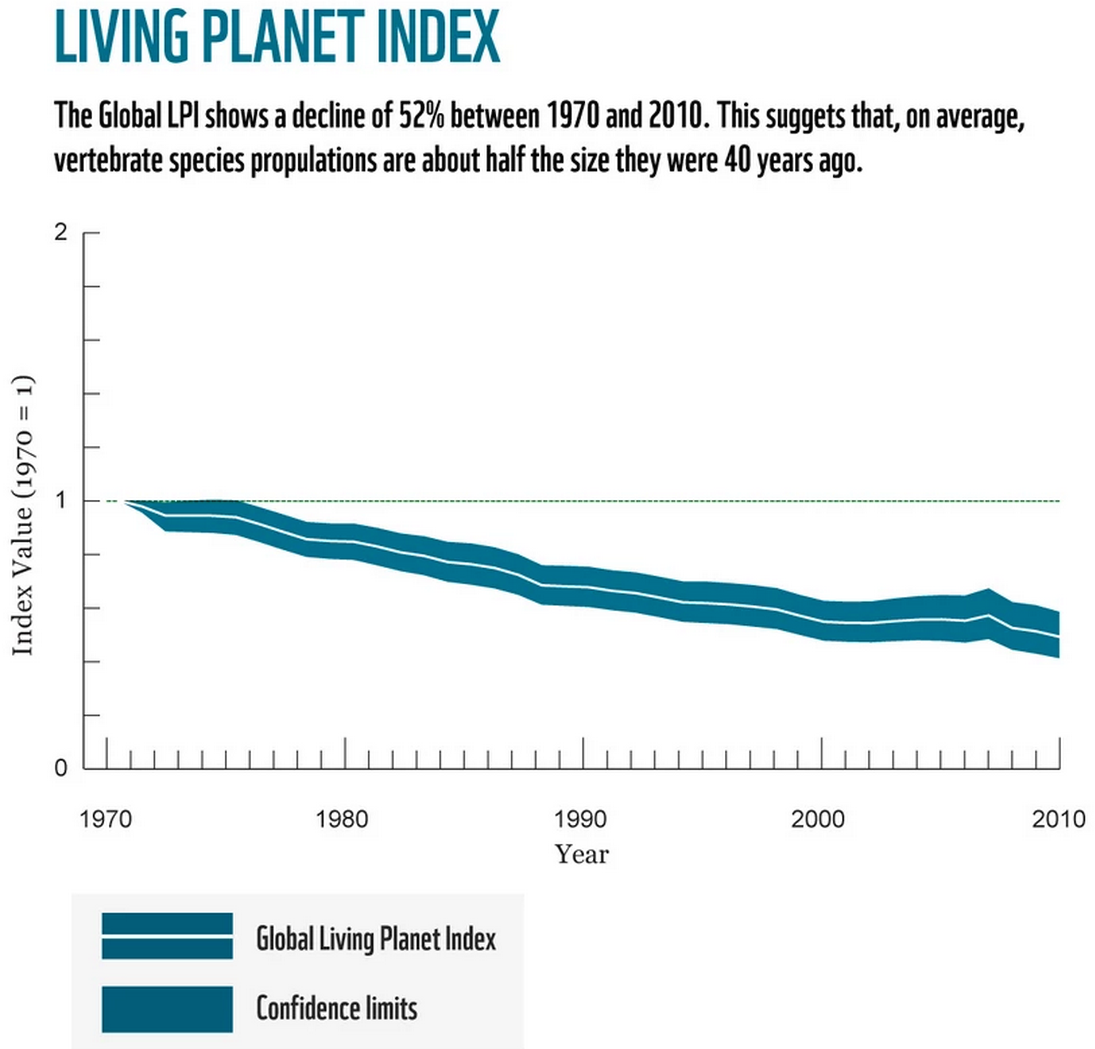
Living Planet Index

Christopher Ingraham flags a highly disturbing study:

The new Living Planet Index report from the World Wildlife Fund opens with a jaw-dropping statistic: we’ve killed roughly half of the world’s non-human vertebrate animal population since 1970. … The declines are almost exclusively caused by humans’ ever-increasing footprint on planet earth. “Humanity currently needs the regenerative capacity of 1.5 Earths to provide the ecological goods and services we use each year,” according to the report. The only reason we’re able to run above max capacity – for now – is that we’re stripping away resources faster than we can replenish them.

The report attributes this insane drop almost entirely to human activity, including overfishing, unsustainable agriculture, a dramatic loss in natural habitats, and—of course—climate change. The most severe decline was experienced by freshwater species, whose populations fell a shocking 76 percent—nearly twice the rate experienced by marine and terrestrial species (both of which dropped by 39 percent).

Brad Plumer compares this report to an earlier one:

In its previous 2012 report, the WWF estimated that vertebrate populations had declined just 28 percent since 1970. Now they estimate that there’s been a 52 percent decline. Why the change? In that previous report, the WWF’s scientists said, they had been over-representing trends in North America and Europe, which have actually had fairly stable wildlife populations in recent decades. Re-weighting their sample to account for steeper declines in the species-rich tropics — particularly in Latin America and Southeast Asia — makes for a bleaker picture.