An Actual War On Women, Ctd

The victims of ISIS are often raped, as we’ve detailed. But take issue with much of the reporting on these rapes:

Press reports and punditry about sexual violence in Iraq and Syria continually employ the phrases “weapon of war” and “tool of terror.” Without a doubt, some wartime rape is a weapon of war: Some commanders use rape or the threat of rape strategically to punish enemy communities, induce compliance, or demoralize opponents. But the “weapon of war” narrative is disastrously incomplete.

Research suggests that rape has multiple causes, and is more closely associated with fighting forces’ internal practices (like forced recruitment, training practices, or the strength of the military hierarchy) than with strategic imperatives, ethnic hatred, or other “conventional wisdom” causes. In short, to assume that wartime rape is always “rape as a weapon of war” is to ignore the majority of cases.

Moreover, to the extent that wartime rape is a weapon of war, policymakers who invoke the “weapon of war” narrative may actually strengthen belligerents’ strategic positions. Commentary about the Islamic State’s sexual “brutality” ­– exemplified in a recent policy recommendation aimed at “shaming” the organization – risks reinforcing the Islamic State’s intimidating reputation (which is already well-known on the ground and in the refugee camps). Reputations and rumors matter in conflict; recent research in Lebanon has suggested that fear of rape has become an important reason for refugees to leave Syria. Playing into combatants’ rhetorical strategies could result in increased refugee flows, contribute to efforts to diminish women’s involvement in public life, or even increase the incidence of wartime rape.

A 19th Century Frenchman Explains the 21st Century Middle East, Ctd

A reader writes:

Regarding the uses of Tocqueville to explain why the Middle East isn’t ready for democracy:

If we really want to know what Tocqueville thought about Islam and the Middle East, just skip the flattering portrait he gives us in Alexis_de_Tocqueville“Democracy in America” and read his enormous body of work on France’s 1830 colonization of Algeria — a colonization that didn’t come to an end until 1962. Surprise: Tocqueville the liberal was an early and vocal supporter of the invasion, conquest, and subjugation of Algeria. In fact, he was such a fan that he made two trips there himself to determine whether he and his brother ought to buy land and become settlers. He also read the Qur’an, considered taking Arabic lessons, and positioned himself in the Chamber of Deputies as an expert on the “Algeria Question”. The man was committed.

So what can Tocqueville tell us about how modern Middle Eastern politics got so messed up? Stop me when this starts sounding familiar.

He sets out with the best of intentions, to civilize the barbarous Arabs and introduce solid French virtues like liberty and fraternity. But that doesn’t last long. When the native population turns out to not appreciate France’s virtuous conquest, a full-scale counter-insurgency is launched. And when other politicians begin to question the French army’s tactics, Tocqueville pulls a full Cheney: “I have often heard men in France whom I respect, but with whom I do not agree, find it wrong that we burn harvests, that we empty silos, and finally that we seize unarmed men, women, and children. These, in my view, are unfortunate necessities, but ones to which any people that wants to wage war on the Arabs is obligated to submit.” (1846)

Likewise, some of his colleagues began to complain that French liberals were being hypocritical, demanding equality at home but promoting despotism abroad. In words that might as well have been spoken by Netanyahu, Tocqueville reminds us:

“There is neither utility in allowing, nor a duty to allow, our Muslim subjects exaggerated ideas of their own importance, nor to persuade them that we are obligated to treat them under all circumstances precisely as though they were our fellow citizens and our equals. They know that we have a dominant position in Africa; they expect us to keep it. To abandon it today would be to astonish and confuse them, and to fill them with erroneous or dangerous notions.” (1847)

And contra Mitchell’s argument about the roots of “Islamic fundamentalism”, Tocqueville never once believed that the problem in the Middle East was too much tribal or religious linkages. Rather, his claim was the exact opposite, that the roots of Algerian violence can be found in the destruction of native institutions, habits, and social connections — and, moreover, that this is entirely Europe’s fault. French rule, he writes, has made “Muslim society much more miserable, more disordered, more ignorant, and more barbarous than it had been before knowing us.” (1847) Such was his faith in the importance of empire for France, however, that even admitting this failure could not undermine his ultimate support for the Algerian conquest.

I could go on. Others have at length. My point is just that if we really want to get into the business of shaping our Middle Eastern policy according to the theories of a man dead more than a hundred and fifty years, we should be serious about looking at what he actually said and wrote on the topic. And when we do, we may find that we bear far more direct responsibility than Mitchell or you, Andrew, seem to allow.

How You Can Die From Ebola Without Getting It

weekly_ebola_cases_SL.0

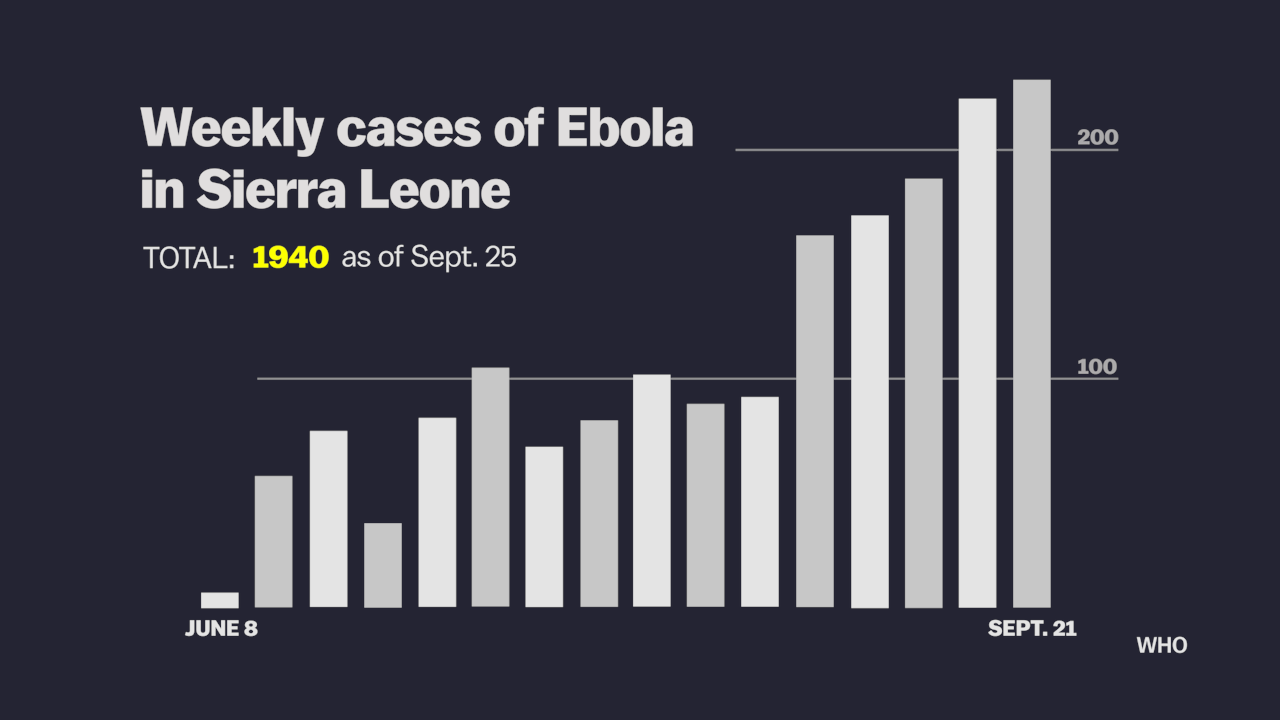
Julia Belluz explains that Sierra Leone is “imposing mandatory lockdowns on its citizens.” She provides the above chart showing the extent of the devastation:

The districts where Ebola is believed to be moving fast — Port Loko, Bombali, Moyamba — are now isolated. People won’t be able to leave their homes or go to school or work. During these periods, government and public-health officials will go door to door, educating people about Ebola and trying to identify patients who should be brought to containment facilities. Officials in Sierra Leone are worried that many Ebola victims are either going underground or simply unable to access care. And the death toll continues to surge — with nearly 600 estimated Ebola deaths in Sierra Leone this year.

Adam Taylor sees “numerous signs that pregnant women in Liberia, Sierra Leone and Guinea could be dying due to Ebola without ever getting the disease”:

Maternity hospitals are fearful of taking women in due to the risk of catching Ebola from a sick patient. That fear is understandable. Hundreds of health-care workers have been infected with Ebola recently, and many were infected by the patients they treat.

Bruce Aylward, assistant director-general for polio and emergencies at the World Health Organization, said that at first, most health workers who died were people working in “poorly run Ebola treatment centers.” However, as the disease spread, it began to affect the broader health community. “Now, if you look at [health-care workers infected with Ebola], they’re somebody who is delivering a baby in a clinic that had nothing to do with Ebola,” Aylward explained. The shift has affected both local and foreign doctors: Rick Sacra, one of the American doctors who contracted Ebola, was treating pregnant women in Liberia when he became infected (he has since made a full recovery).

Worse still, the fear of Ebola infection at medical facilities cuts both ways. Many pregnant women who need treatment are too scared to head to a health center, fearing a visit to a medical facility will actually increase their chance of catching Ebola. In countries where maternal mortality rates are so high than almost one out of every hundred women die, such a lack of treatment can have a deadly impact.

We featured one of those women here.

Putin vs The Internet

Well, this is unnerving:

Russian President Vladimir Putin and members of the Russian security council are reportedly considering a plan that would give the Kremlin the ability to cut off the Russian Internet from the rest of the world’s connection in the event of a national emergency. The plan, which officials say is necessary to protect Russian cybersecurity, has raised fears about tighter Kremlin censorship, though questions remain as to whether a national “kill switch” is even possible.

Reports first surfaced Friday in the Russian business newspaper Vedomosti, with sources saying, “Russian Internet service providers will be required to install equipment that would make it possible to shut off Russia’s access to the global Internet, in the event of an emergency.” The broadly defined “emergency” reportedly includes “military actions” or “serious protest actions,” possibly of the kind that came in the wake of Putin’s return to the presidency in 2012. The security council will also discuss a plan that gives Russia control of the country code top level domains (ccTLDs), the websites ending in “.Ru,” “.рф,” and to a lesser extent “.Su.”

Ilya Khrennikov and Henry Meyer contextualize the move:

Russia last month banned anonymous access to the Internet in public spaces and expanded the regulation of media to the blogosphere, requiring those with at least 3,000 daily readers to register their real names and contact information. In February the authorities had passed a law allowing them to close webpages without a court decision if material is deemed “extremist.”

Russian opposition leader Alexey Navalny, who used to criticize Putin and reveal corruption among his inner circle, was the first victim of that law when his blog on LiveJournal.com was shut in March. Recent legislation requires Internet companies to store Russian users’ information on servers in the country, similar to Chinese regulations.

Emily Parker adds:

According to Freedom House, from January 2012 to February 2013, the number of websites flagged for containing extremist material and blocked by the Ministry of Justice increased by around 60 percent. In 2012, Russia enacted a law allowing for the blocking of certain websites without judicial oversight. The law supposedly protects children and controls other harmful content but has been widely viewed as an attempt to clamp down on free speech. According to one study, in the year that followed, more than 83,000 websites were put on an Internet blacklist, and the vast majority was blocked “without a valid reason.”

In other Putin punditry, Benjamin Bidder worries that Putin’s successor will be even worse:

The fear is that someone could seize control of the Kremlin who thinks and acts more radically than Putin. The president created the preconditions of such a possibility with his own failed policies. If the Kremlin insiders want to find a successor, they will have to recruit him from the immediate circle of the current president. But Putin has reinforced hard-liners and pushed out the liberals.

The revolution scenario is no less disheartening. Power could be seized by forces from the extreme right and left. The boundaries between both are vague in Russia, as the name of such groups as the “National Bolsheviks” suggests.

Motyl disagrees:

In the final analysis, Bidder’s assessment amounts to an unwitting justification of dictatorial rule, repeating the self-serving claim that all dictators make: après moi, le déluge. In fact, world experience and both Russian and Soviet history suggest that Russia is likely to experience a better future if and when Putin finally goes. Getting rid of him, as quickly as possible, is a bet worth making—both by Russia and the West.

Hitting ISIS In The Pocketbook

Mark Thompson remarks that strikes on ISIS’s oil refineries amount to America “going to war against oil, not for it”:

The fact that the U.S. and its allies attacked a financial hub of the Islamic State in Iraq and Greater Syria (ISIS) on Tuesday–the first day of strikes in Syria—and spent Wednesday and Thursday bombing its oil-production facilities, highlights ISIS’s predicament. Unlike a smaller terrorist organization—al-Qaeda, for example—ISIS now occupies, and purports to govern, a wide swath of desert straddling the Syrian-Iraqi border. It needs the estimated $2 million a day it’s grossing by smuggling oil because many, if not most, of its 30,000 fighters are in it for the cash, not the ideology. But the refineries represent only a small slice of ISIS’s oil revenues. It makes most of its money from crude oil, and the U.S. has refrained so far from attacking oil fields in the region. If the money eventually dries up, Pentagon officials believe, many ISIS fighters will head back home. The terrorists control about 60% of Syria’s total oil production, according to a Syrian opposition estimate.

But Jamie Dettmer calls cutting off ISIS’s oil wealth “a monumental task”:

Hitting a dozen rudimentary refineries isn’t going to undercut the group, according to analysts. They say the oil refined by ISIS inside Syria is for the militants’ own immediate transport needs and not for sale to dealers in Turkey, Jordan, and Iran. Revenue is generated from the sale of crude oil, according to Luay al-Khatteeb, an energy expert at the Brookings Doha Center.

To deprive ISIS of its oil revenue would require the U.S. and its allies to bomb nearly a dozen oilfields and hundreds of wells the group has seized in both Syria and Iraq—an operation that would require a huge commitment from the coalition’s air forces and if conducted would cause an environmental hazard. And the government in Baghdad has tied the Pentagon’s hands when it comes to oilfields seized by ISIS in Iraq; it has asked the U.S. not to bomb them, hoping to recapture them intact.

Even more than bombing, a key component in stopping ISIS from profiting from oil will be blocking militants from getting their oil to market by locking up the border with Turkey and Jordan and pressing Kurds to stop dealers in semi-autonomous Kurdistan from trading. The Turks have shown little enthusiasm for halting the trafficking in the past, although in recent weeks they have interdicted some tankers carrying illicit oil.

Who Stands To Profit From Another War?

Good Sam Club 500

Dan Froomkin eyes defense contractors:

Now, with U.S. forces literally blowing through tens of millions of dollars of munitions a day, the industry is not just counting on vast spending to replenish inventory, but hoping for a new era of reliance on supremely expensive military hardware.

“To the extent we can shift away from relying on troops and rely more heavily on equipment — that could present an opportunity,” Jack Ablin, chief investment officer at BMO Private Bank, whose $66 billion portfolio includes Northrop Grumman Corp. and Boeing Co. shares, told Bloomberg.

Defense contractor stocks have far exceeded the performance of the broader market. A Bloomberg index of four of the largest Pentagon contractors rose 19 percent this year, compared to 2.2 percent for the S&P 500.

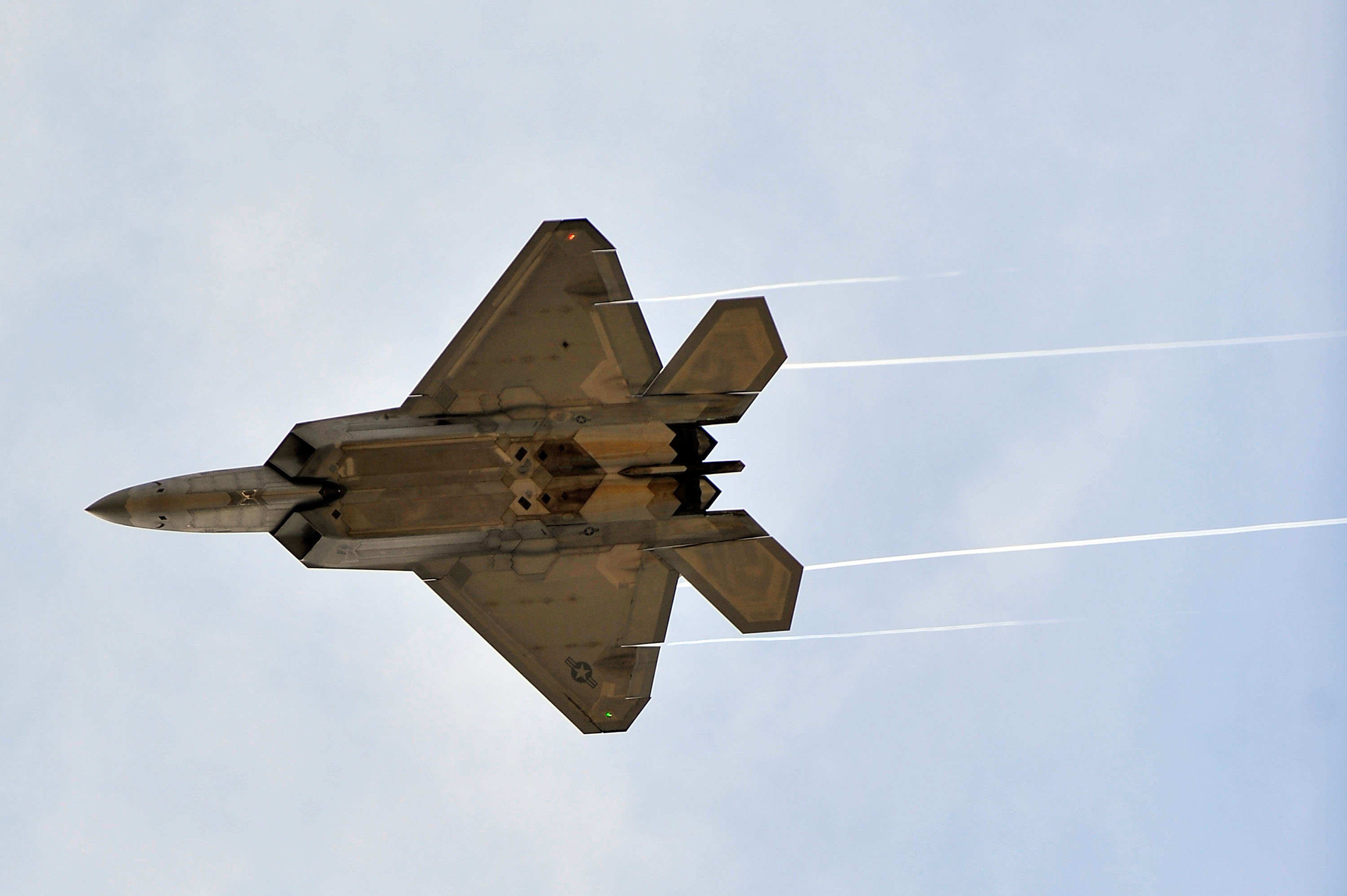
The pricey F-22 made its combat debut this week:

[T]he F-22 is extremely expensive to operate and difficult to maintain. In 2013 the Raptor cost the Air Force about $68,000 per hour to operate once maintenance and other factors are added in, according to documents provided by the Center for Defense Information.

Daniel Altman wonders “whether the arms industry put its thumb on the scale”:

Even a short involvement in Syria will be exceedingly profitable; the first round of air strikes this week reportedly cost $79 million, more than India’s mission to Mars. To “train and equip appropriately vetted elements of the Syrian opposition,” as the amendment voted on by the House states, could cost much more, perhaps as much as $500 million.

So the arms industry had a lot on the line in Roll Call Vote 507. In the end, it passed easily. But those who voted for the amendment may have been much more beholden to the industry than those who did not. On average, the “Yea” voters had received more than $36,000 in contributions from the defense sector during the last campaign cycle, according to the Center for Responsive Politics. The “Nay” voters had taken only about $22,000.

Relatedly, Tom Z. Collina questions the utility of our vast nuclear arsenal:

As the New York Times reported on Sept. 22, the United States plans to spend about $355 billion on nuclear weapons over the next 10 years, and up to $1 trillion over 30 years. As they say in Washington, that’s real money. Yet these weapons play essentially no role in responding to today’s highest-priority threats. U.S. nuclear weapons did not keep Russia from taking Crimea. They did not stop the Islamic State from rampaging through Iraq and Syria. And Ebola? Yeah, right.

A quarter-century after the Cold War, spending this much money on nuclear weapons is simply not justified. But even if it was, the harsh reality is that the country does not have the cash to pay the tab.

(Photo: An F-22 Raptor. By Jason Smith/Getty Images)

The Era Of Threatiness

Rosa Brooks parodies Obama’s speech to the UN:

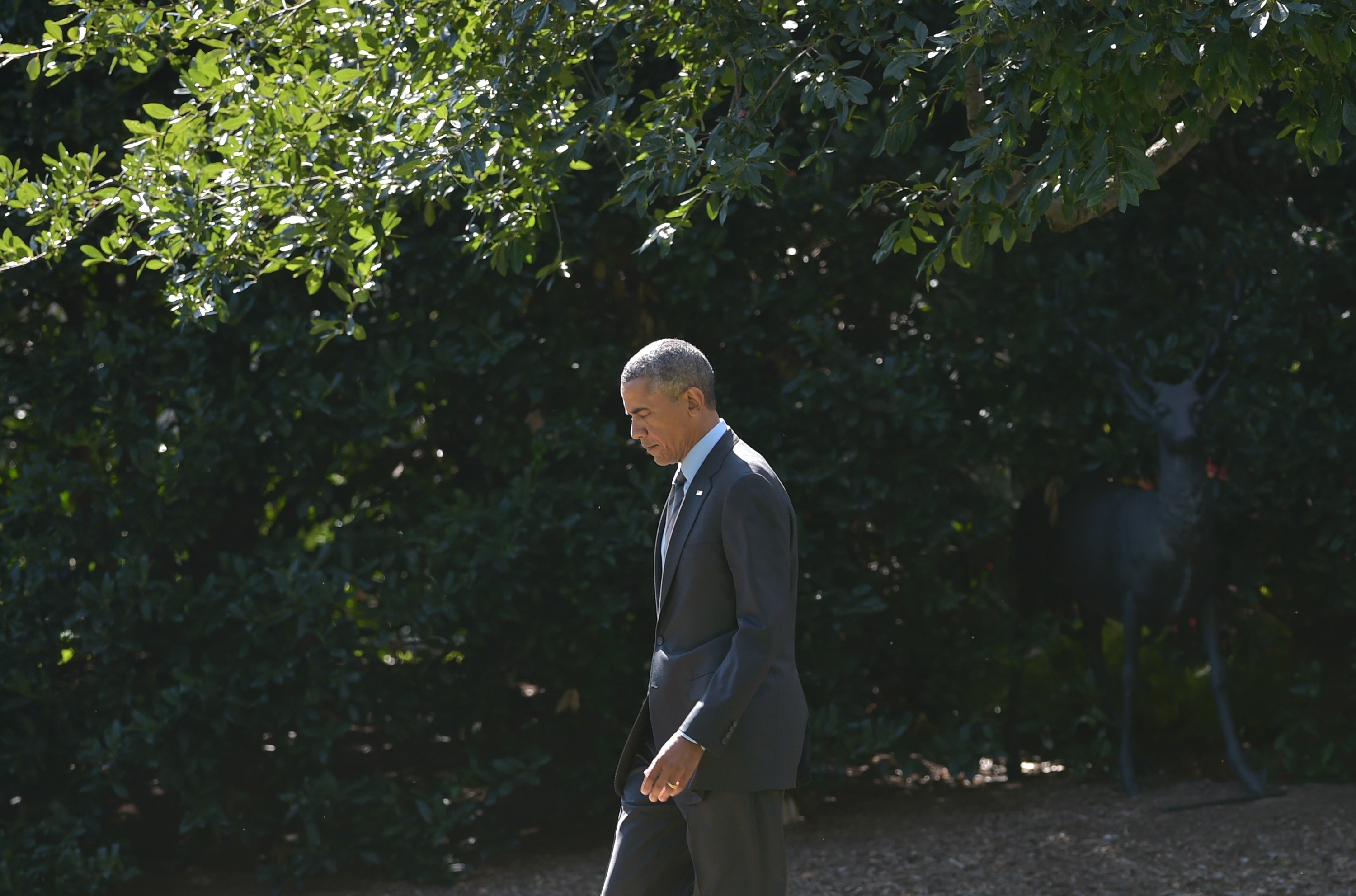
PRESIDENT OBAMA: My fellow Americans, the Middle East today is frighteningly full of threatiness.

What, you ask, is threatiness? As my good friend Mr. Stephen Colbert will surely understand, threatiness is to threat as truthiness is to truth. By this, I mean that sometimes we cannot articulate why something is a threat, or offer evidence, but we still think it just feels, you know, threaty. We know it in our gut. And let me be clear: when there is enough threatiness floating around, America must take action.

Nicely done. It’s amazing that no one has yet identified any threat to the US to justify a return to war in Iraq, let alone Syria. Fisher finds Brooks’ coinage useful:

There are two ways to interpret the threatiness of the Obama administration’s case for Syria strikes. The sympathetic interpretation is that there is in fact a good case for intervening against ISIS to curb the danger it poses, but that this danger is difficult to sell politically, because it is too indirect, abstract, and/or complex for a prime time speech. For example, the administration may believe that ISIS is destabilizing an already unstable region in a way that, if left unchecked, really would lead to non-exaggerated threats to the US, not unlike what happened when the Taliban took over Afghanistan. And so, for the sake of political expedience, Obama is using the more palatable language of threatiness, even though that language is at least partly bullshit. That’s the sympathetic interpretation.

The unsympathetic interpretation is that the Obama administration felt pressured into strikes that it now has to justify, or it has no strategy and is trying to cover that up, or it earnestly believes its overstated language.

Take your pick. But none of the interpretations really add up, at least in my mind.

Why Are We Suddenly At War Again?

US-POLITICS-CLINTON

Maybe it’s worth tackling one more time. Dougherty, channeling my own thoughts, thinks it’s basically on an emotion-driven whim:

Barack Obama’s exit from Iraq was as popular as his re-entry. America is against war in Iraq and then for it with the same non-committal “Um, okay.” The nation was founded by a people who made vows, who would “pledge to each other our Lives, our Fortunes, and our sacred Honor.” Now its wars are are on and off like a proposed take-out order: “Chinese or pizza? I mean, whatever you want.”

The pundits who say that President Obama has failed to demonstrate leadership have never considered whether the public is capable of following him, or even their own train of thought. The American public is not even capable of not following him in any recognizable way. We might have been dropping bombs in Syria against Assad to the benefit of ISIS a year ago had it not been for the hearty “No” vote in the British Parliament that denied Obama the fig leaf of multilateralism. A democratic people should be bewildered that their president was urging them to join one side of a civil war a year ago, and now joins them to another. But the American people are as responsive to this stimulus as a cattle herd is to the conclusion of a Dostoyevsky novel.

My own view is that any circumspection about this – indeed any sign of a working collective memory at all – can be suddenly driven from the American mind by the obvious fact of seriously foul actors doing horrifying things to Westerners. 200,000 Syrians died in a brutal civil war and there was no groundswell for intervention. And yet a handful of beheadings of white dudes in the desert (even by another Westerner!) provokes an immediate, Jacksonian rush to war.

But I don’t want to be reductionist here, and I’ve absorbed many good points from your emails. Other factors are clearly at work. Americans do not want to be the policeman of the world, but they like and are reassured by America’s untrammeled military might. And in the last couple of years, as the US has retrenched (only slightly) from its post-9/11 posture of offensive defense, there was a sense that other powers were filling the vacuum – especially Russia. This has spooked Americans, and they are conflicted about it. The resumed disintegration of Iraq – begun in 2003 – provoked further anxiety. Was this not becoming a classic Jihadist enclave from which terrorists could launch attacks on the US?

On the right, there was also a desire to pummel the president for anything and everything. So when he is not being a lawless tyrant, he is a total wuss and loser in foreign policy. And so the re-emergence of the decade-old Sunni insurgency in Iraq was too-perfect a bludgeon for them to resist. They got to trash Obama for “weakness”, cast the Iraq war as some kind of “victory” that Obama managed to turn into “defeat”, and generally use bad news from Mesopotamia as another brick to throw at the man’s head. Total American amnesia about the horrors and futility of the Iraq war helped matters – even as Obama refused to force the GOP to confront head-on the question of ground troops yet again in Iraq.

Then there is the utterly understandable revulsion at the moral abyss that ISIS represents. Fighting against evil has always stirred American hearts – even if we have come to learn that fighting it with brute force can sometimes make it stronger. And the cumulative effect of so many depressing developments – from Crimea to Donetsk to Erbil and Mosul – led to an impression of American drift and disengagement. So a call to action against evil was the natural response to the summer of our discontent.

And one also senses that the administration began to believe this summer that ISIS could actually take down the Baghdad government. They haven’t said this much in public, because it would be damaging. But John Kerry recently gaffed to Christiane Amanpour that “Baghdad could well have fallen.” Others have bruited that the situation in Iraq had approached a potential tipping point in the summer, as the uselessness of the Iraqi army in Sunni neighborhoods became clearer. For Obama, watching Baghdad fall – or be convulsed by serious sectarian urban warfare – was intolerable. So he has done what he often does: fashioned a reasonable, needle-threading strategy to prevent the worst from happening, forestall as much mission creep as possible, and attempt to rally the regional actors into action.

He has not done something obviously stupid. And I may simply be under-estimating the pressures on a president facing mid-terms when such a huge public consensus emerges that Something Must Be Done.

He has tried to do it in coalition with the Sunni Arab dictatorships – and is, in his usual way, trying to thread the needle with the other actors in the region, especially Iran. There is a good chance it might do some good in the very short term, although there is a stronger chance that it will generate ever-more unintended consequences in the long term, something the president openly conceded would be left to his successor.

My concerns are based on the notion that ISIS cannot be defeated in this manner; that the root cause is the irreparable disintegration of Iraq and the Sunni-Shiite struggle; that interposing the US in the middle of a Muslim civil war is likely to increase Jihadist terrorism against the West, without being able to remedy the situation; and that the way in which the US has had to corral the Arab dictatorships into defending themselves does nothing but perpetuate the dysfunctional relationship between the US and the Middle East – in which we are held responsible for everything and despised as a result.

But I’ve said my piece. Maybe I should end by saying that, of course, I hope I’m wrong and that Obama manages to pull off an extraordinary military and diplomatic coup over the next two years. I hope his newfound moxie against evil-doers ends up in a different place than his predecessor’s. I hope this doesn’t upend the negotiations with Iran. I hope it helps his party retain control of the Senate in November. And I hope his precedent doesn’t further empower the war machine, the CIA shadow government and the imperial presidency that drives so much of this. All I can promise readers is that I will be open to all those hopeful possibilities, even as I fear a much darker time ahead.

(Photo: Mandel Ngan/AFP/Getty.)

War Support With An Expiration Date

Cassidy makes an obvious but essential point:

At the start of the wars in Korea, Vietnam, and Iraq, fewer than one in four respondents to the Gallup survey believed it was a mistake to send in U.S. military forces. Thereafter, though, this number steadily increased. By the time the wars had been going on for two or three years, more than fifty per cent of respondents said that the decision to wage them had been an error. The one exception was Afghanistan, where, after three years of war, the percentage of people describing the decision to dispatch U.S. forces as a mistake was still pretty small. Since then, though, this figure has grown: by 2012, it was close to fifty per cent.

Larison wonders how Americans will support the war:

In most cases, the near-instant bipartisan consensus that congeals around an interventionist policy and the attendant media demands to “do something” tend to drown out countervailing arguments during the first few months of the campaign. This boosts public support for military action in the short term, but like any bait-and-switch trick it also causes people to sour on the intervention more quickly than they might have done otherwise. More Americans gradually become aware that the threat to the U.S. was overstated (or simply made up) all along, and they start to realize that the war they were originally told about at the beginning is not the one that the U.S. is actually fighting. Because presidents often set unrealistic goals for these interventions, there is usually even greater disillusionment because the war comes to be seen as “not working.” That is a trap that presidents set for themselves. They are the ones promising results that aren’t possible, and those results certainly aren’t possible at the very low cost that the public is willing to accept.

Chart Of The Day

Income Distribution

Drum flags the above one – and it is truly staggering:

The precise numbers (from Piketty and Saez) can always be argued with, but the basic trend is hard to deny. After the end of each recession, the well-off have pocketed an ever greater share of the income growth from the subsequent expansion. Unsurprisingly, there’s an especially big bump after 1975, but this is basically a secular trend that’s been showing a steady rise toward nosebleed territory for more than half a century. Welcome to the 21st century.

Jordan Weissmann chimes in:

Through mid-century, when times were good economically, most of the benefits trickled down to the bottom 90 percent of households. Then came the Reagan era and actual trickle-down economics. Suddenly, the benefits started sticking with the rich. Since 2001, the top 10 percent have enjoyed virtually all of the gains.

This isn’t a totally new story. But it is a vivid and visceral illustration of what we’ve basically known to be true for a while (the graph is updated from this paper).

Ryan Cooper adds:

Most staggering of all, during our current economic expansion, the bottom 90 percent is suffering declining incomes. Not only is the rising tide not lifting everyone equally, it’s actually submerging nine out of ten people.

So it seems that the theory behind trickle-down economics has been empirically refuted: its impact has been overwhelmingly trickle-up. It is also quite clear by now that huge tax cuts do not remotely pay for themselves – and the recent experience in Kansas only adds a final coda to this. And yet the GOP shows absolutely no sign of absorbing these facts, or having anything to say about the dangerous political instability of huge social and economic inequality and crippling debt that are their consequence.

This is why I have such a hard time with contemporary American conservatism. It is still incapable of moving on from Reagan, even as the world has changed beyond recognition.