The State Of The Secret Service

Peter Grier looks ahead to next week’s Oversight hearing on the Secret Service, scheduled soon after an intruder dashed across the White House lawn and made it into the building:

Among the questions sure to arise: Why wasn’t the White House front door locked? Why didn’t the uniformed Secret Service agents on the grounds unleash their trained defense dogs, or fire at Mr. Gonzalez before he reached the White House threshold? Had the Secret Service heard about Gonzalez beforehand? After all, he’d been arrested in rural Virginia on July 19 for erratic driving. In his vehicle, law-enforcement officials found three rifles and two handguns, ammunition, and a map of Washington with a circle around the White House grounds.

Ambinder says the Secret Service’s problems run much deeper than unlocked doors and text-happy agents:

After the Sept. 11, 2001, attacks, the Secret Service found itself overburdened, under-resourced and undermanned. Agents who might not have passed muster in previous eras – including several involved in the recent alcohol-fueled scandals overseas – not only survived, they became supervisors. Ignoring, for the most part, the Secret Service, the government focused instead on building the Transportation Security Agency and the Federal Air Marshal Service, added thousands of agents and officers to the Border Patrol and to the Immigrations and Customs and Enforcement service, and dumped it all inside the new Department of Homeland Security.

And last year’s budget cuts have had consequences:

The current White House Security Plan, which is supervised by the Presidential Protective Division and executed by the Uniformed Division, is based in large part on a classified 2010 study of the complex. Its results were shared with congressional overseers, and appropriators programmed more money for specific functions: counter-surveillance, technical counter-measures (such as infrared cameras) and better barricades. But most of the money to fund those enhancements and to staff the White House security apparatus at an appropriate level did not survive the automatic budget cuts of 2013. The Uniformed Division is now short at least 100 sworn officers. Officers work overtime. Perhaps that much overtime stretches them thin and dulls response time.

Meanwhile, Ronald Kessler contends that “while agents are brave and dedicated, Secret Service management perpetuates a culture that condones laxness and cutting corners”:

Under pressure from White House political staffs or presidential campaign staffs, Secret Service management tells agents to let people into events without magnetometer or metal detector screening. Assassins concealing grenades or other weapons could theoretically enter an event and easily assassinate the president or a presidential candidate. When it comes to firearms requalification and physical fitness, the Secret Service either doesn’t allow agents time to fulfill the requirements or asks agents to fill out their own test scores. All this has led to poor morale and a high turnover rate. Tired agents and officers are forced to work long overtime hours, contributing to the sort of inattention that took place when Gonzalez scaled the White House fence.

Jeffrey Robinson traces the cultural shift back to the George W. Bush’s first term, “as leadership changed and institutional memory of the Reagan assassination attempt faded”:

The first sign of this came in 2003, when Bush became the first president in history to land on an aircraft carrier in a fixed-wing plane. The president’s entry by Navy jet provided a flashy visual opening to his “Mission Accomplished” speech. But it was a very dangerous maneuver and an unnecessary stunt made simply for the sake of becoming the lead story on the evening news. A person close to the agency told me that the Secret Service originally objected to the plan, but eventually relented, given an agent would be in the plane with Bush – even though, if something had gone wrong, the agent couldn’t have done anything.

Under Reagan, the Secret Service never would have permitted it. Former agents told me they would have fought the idea tooth and nail. They would have thrown their Commission book on the table, refused to take responsibility and resigned.

But Matt Farwell suggests that the Secret Service deserves credit for its restrained treatment of a man who by all accounts struggles with mental illness:

Of all law-enforcement agencies in the United States, members of the Secret Service are among the most experienced at dealing with mentally ill individuals – because they have to as a routine part of the job. Mentally ill individuals come up to the gates demanding to speak to the president on a near daily basis. …

Agent training in Beltsville, Maryland, features classes in psychology and role playing various scenarios agents might encounter in the course of their duties. These lessons are derived from an exhaustive longitudinal study of assassins and near-assassins completed in 1998. The study focused on the thoughts and behavior of suspects before their attacks and near misses. It found that more than one-third of those assassins and near assassins appeared to hold delusional ideas (the atmosphere collapsing, covert spy satellites beaming signals directly into the brain, or a nonexistent relationship), three-fifths had been evaluated or treated for mental illness, and two-fifths had been hospitalized for psychiatric reasons.

Romney 2016: Greater Than Zero

Will Mitt take another run at the White House? According to Byron York’s reporting, the answer is absolutely yes – uh, maybe! “Definitely more than zero.” Larison somehow managed to type while banging his head on his desk:

If it was Romney’s “turn” in 2012, he has had it and squandered it, and there won’t be many interested in giving him another one. Indeed, almost every faction of conservatives would be unhappy with another Romney campaign.

For reformist conservatives, Romney’s last campaign was the embodiment of the party’s complete failure to adapt to the present. Romney’s agenda was the antithesis of almost everything libertarians and small-government conservatives support. Republicans that are concerned primarily with winning elections can’t be pleased by the idea of a Romney return, since he represented everything most non-Republicans loathe about the party between his corporate business background, his condescending attitude towards working-class and poor Americans, and his outdated economic agenda. He topped that off with a foreign policy worldview that was by turns ignorant and frightening. His supporters have desperately been trying to rehabilitate Romney’s foreign policy over the last two years without success, but nothing would be worse for the GOP’s foreign policy than to accept the false notion that “Romney was right” about anything in 2012.

Finally, it doesn’t make any sense for Romney to do this. He is a terrible politician and he isn’t well-suited for what presidential campaigning requires. There must be things that he would rather spend him time and energy on than mounting a third failed bid, and he has no good reason to undergo the scrutiny and mockery that he would inevitably face if he ran again.

Suderman piles on:

[T]he case for Romney in 2016 is rather like the case for Romney in 2012: Romney, who was in the GOP primary fray in 2008 as well, would still like to be president, there are some party bigwigs who see him as their best shot, and some campaign professionals would like to cash in on yet another sure-to-be-pricey run. That’s not an argument for why Romney should run. It’s an argument for why he shouldn’t.

A reluctant Drum takes the bait:

[A]s long as we’re supposedly taking this seriously, let’s put on our analytical hats and ask: could Romney beat Hillary Clinton if they both ran? On the plus side, Hillary’s not as good a campaigner as Barack Obama and 2016 is likely to be a Republican-friendly year after eight years of Democratic rule. On the minus side, Romney has already run twice, and the American public isn’t usually very kind to second chances in political life, let alone third chances. Plus—and this is the real killer—Romney still has all the problems he had in 2012. In the public eye, he remains the 47 percent guy who seems more like the Romneytron 3000 than a real human being.

Still, snark aside, if you put all this together I guess it means Romney really would have a shot at winning if he ran. We still live in a 50-50 nation, after all, and for the foreseeable future I suspect that pretty much every presidential election is going to be fairly close. And Romney certainly has a decent chance of winning the Republican nomination, since he’d be competing against pretty much the same clown show as last time.

Beutler argues that Republicans could do worse than Romney:

Conservatives can be forgiven for being sick of Romney and wanting fresh blood. But they should hope (perhaps quietly hope) that someone like Romney throws his hat in fairly soon. Otherwise they’ll be stuck with a candidate who carries all the baggage of the congressional party, and a down-ballot catastrophe. A Romney-ite would have a hard time beating Hillary Clinton, but a much better chance than any of the conservatives who have all but declared their candidacies already.

Looking to history, Kilgore wishes Mitt luck:

Three losing major-party nominees have managed to win a second nomination the next cycle: William Jennings Bryan (1896-1900), Thomas Dewey (1944-48) and Adlai Stevenson (1952-56). Bryan and Stevenson were beloved figures among their party’s activists. And so we come to the obvious analog to Mitt, Tom Dewey. Like Romney, he ran unsuccessfully for the presidential nomination the first time out (in 1940), and lost to an incumbent president second time out. His 1948 campaign was a struggle, as he lost a couple of primaries to Harold Stassen (don’t laugh—Stassen was a real force that year) and only overcame Stassen and Robert Taft on the third ballot at the convention. Dewey did, however, have something going for him in 1948 that Mitt could not match: he won landslide re-election as governor of New York in 1946.

The rest, of course, is well-known history, as Dewey managed to lose what was considered a huge lead over Harry Truman, whose Democratic Party had fractured to the right (via Strom Thurmond’s Dixiecrat campaign) and the left (with Henry Wallace running on the Progressive ticket).

Dissents Of The Day III

US Secretary of State Colin Powell holds

The fisking from readers over my Bush-Obama comparison continues:

“But we are going to war despite the fact that ISIS is no more a direct threat to the United States than Saddam was – arguably much less, in fact.”

Really? And exactly how did Saddam threaten the U.S.? I’ll give you the reported attempt to kill George H.W. Bush in 1993, though that was never proven true. But there was no serious threat after that. Saddam did not conduct any public executions of U.S. citizens, and he did not threaten terrorist attacks against the U.S. There was no threat beyond the hysteria promoted by you and the neocons.

If you dismiss ISIS as a threat, you are surely hiding your head in the sand. That does not necessarily mean our incursion is the proper course, but your decision to equate Obama with Bush is more than a little depressing.

Another quote of mine:

“And it’s much smaller than George W Bush’s coalition in 2003.”  

Size matters?  You might want to revisit that Coalition of the Willing list; not a single Arab or Middle Eastern country signed on.  Most of the countries enlisted contributed nothing (if you discount that infantry division from Micronesia).  And most of the rest made a token contribution.  GW Bush‘s coalition was pure PR.  And how many American chits got pushed across the felt to obtain that “coalition”?

Whatever contributions the Gulf States, the Saudis, and Jordanians make, they made their commitment public, and that’s not nothing in this region.  Truth is, Saudi, Egyptian, Syrian, and Jordanian forces did very little in Gulf War I.  But the public alliance was deemed necessary for legitimacy in the region.

And another:

“I can’t imagine [Obama supporters] downplaying the folly of this if a Republican president were in charge.”

Umm … seriously?

Do you not recall that Congressional Democrats did in fact acquiesce like little lambs when Bush was president, and they also did the same when any Republican launched military action in the past, be it Papa Bush and Panama, Reagan in Lebanon, Grenada, etc?

Another, from our Facebook page:

“This comes perilously close to proving that our democracy doesn’t really have much of a say.”

Not really, does it? I mean, sure, Obama was America’s choice (twice!). But the elected Congressfolk were their constituencies’ choices, too. And in both cases, most people share some of their president’s priorities, but not all, and share some of their congressfolks’ priorities, but not all. This is simply the result of a mixed government, which democracy, flawed as our version may be, has brought us. The democracy does have a say, and it seems to be saying that we elect these people for the promises *we* want them to keep, not the ones *they* want to keep.

Another:

“This is an illegal war …”

I’m not in favor of the bombing in Syria, but not for legal reasons.  The Authorization for Use of Military Force (S.J.Res.23) specifically states:

the President is authorized to use all necessary and appropriate force against those nations, organizations, or persons he determines planned, authorized, committed, or aided the terrorist attacks that occurred on September 11, 2001, or harbored such organizations or persons, in order to prevent any future acts of international terrorism against the United States by such nations, organizations or persons.

Note the specific words “he determines”.  These words delegate to the president all of the power to decide to whom the resolution applies.  No one else needs to agree with his determination, because under the law passed by Congress, the determination is his alone to make.  President Obama has decided it applies to the organizations the US is currently bombing.  Therefore, the action is authorized by Congress, and no further authorization is required.

If Congress wants to rescind or amend the AUMF it has the power to do so, but until then, Congress delegated authority to President Obama, and he is The Decider.

Another piles on further:

“This is an illegal war, chosen by an unaccountable executive branch, based on pure panic about a non-existent threat to the United States, with no achievable end-point.”

I must disagree on almost all counts.

First, Congress has willingly abdicated its war-making responsibilities in this instance, largely for political reasons. For Republicans in Congress, the calculation is particularly crass. By refusing to accept the responsibility of taking the reins on this action, they are free from any responsibility for outcomes – except, of course, for their certain continuing ability to criticize Obama no matter what he does. If he takes no action, he is aiding and abetting our enemies; if he acts strongly, then he was too slow and too timid to act in the first instance.

So, please, spare us the “illegal war” hyperbole – it would be illegal only insofar as Congress wanted to exert its authority, but to the contrary, Congress has willingly waived it.

Second, there has been no rush to war here, no fear-mongering, and most notably, no lying about the cause and purpose of this action – in other words, the antithesis of the snake-oil sales-pitch of the Bush Administration.  You call that a small matter.  I think most rational people would find Obama being honest, forthright, and direct to be a sea-change from the fabrications and evasions of the previous administration.

As for the claim that the threat is “non-existent,” well, I suppose that depends on whether one is willing to abandon any and all responsibility for the mess caused by the Bush invasion of Iraq and walk away entirely.  The problem, of course, is that walking away and doing nothing has consequences – for the Kurds, for Iraqi moderates, and for Iraq’s new government.  Do we turn our back and close our eyes to the slaughter?  Do we abandon the Kurds yet again?  There are no easy solutions, nor any certain outcomes. But doing nothing is neither helpful nor moral.

To paraphrase Colin Powell, we broke it, we bought it.  Obama didn’t choose this mess. He is merely struggling to try to clean up a nearly intractable mess.  So, yeah, targeted air strikes are the worst option … except for everything else.

The rest of the reader dissents here and here.

(Photo: US Secretary of State Colin Powell holds up a vial that he said was the size that could be used to hold anthrax as he addresses the United Nations Security Council on February 5, 2003. Powell urged the UN Security Council to say “enough” to what he said was Iraq’s 12 years of defiance of international attempts to destroy its chemical and biological weapons. By Timothy A. Clary/AFP/Getty Images)

To Have And To Put On Hold

The proportion of unmarried Americans has reached an all-time high, according to a new Pew report. Clare Cain Miller looks at a major reason why:

Though marriage was once a steppingstone to economic stability, young adults now see Screen Shot 2014-09-24 at 4.53.25 PMfinancial stability as a prerequisite for marriage. More than a quarter of those who say they want to marry someday say they haven’t yet because they are not financially prepared, according to Pew.
“If you go back a generation or two, couples would literally take the plunge together and build up their finances and nest eggs together,” said Kim Parker, director of social trends research at Pew. “Now it seems to be this attitude among young adults to build up households before they get married.” In other words, marriage has gone from being a way that people pulled their lives together to something they agree to once they have already done that independently.

Kat Stoeffel remarks, “It’s not that we forgot to get married. We’re just being nominally picky”:

According to Pew, 78 percent of unmarried women “place a great deal of importance on finding someone who has a steady job” — a population in decline. The number of employed men ages 25 to 34 per 100 women of the same age “dropped from 139 in 1960 to 91 in 2012,” says Pew, even though there are more 25- to 34-year-old men than women. So, no, you are not imagining it: There is a quantifiable shortage of eligible men. [As Pew puts it,] “If all never-married young women in 2012 wanted to find a young employed man who had also never been married, 9% of them would fail, simply because there are not enough men in the target group.”

Jordan Weissmann adds, “A dearth of eligible bachelors isn’t the only reason marriage has been on the wane”:

Young people are getting married later in part because they spend more time in school. … Oh, and then there’s birth control, changing social mores about sex out of marriage, etc. But economics are an obvious and unavoidable dimension of the issue. That’s why it’s far-fetched to think we can revive the institution of marriage in a meaningful way without addressing the underlying forces that have left young men in such shabby financial shape.

Update from a reader:

The way Pew presents this data only shows half the story. Specifically, it only shows the 2nd half of the 20th century. If you look at a wider range of data, a different story appears. It’s not covering the exact same data, but this table shows the wider story. The year 1960 was a low-point for the percentage of population that’s unmarried. Before and after, the % of the population that was never married was much higher. At the turn of the last century, it was much higher than today. In many ways, the 1950s and ’60s are proving to be the aberration, not the rule. (See also: Political partisanship – can’t find a reference at the moment, sorry- and income inequality.)

Dissents Of The Day II

But first, a reader “couldn’t resist making a few alterations to ‘Bill O’Reilly’s Dumb Plan to Defeat ISIS’”:

oreilly

But many readers think I’m the one being dumb by comparing Obama to Bush:

Andrew, you really let your emotions dictate your judgement.  I mean REALLY. Let’s start by clearing something up, this isn’t a war.  It is a military operation.  There is a difference. You wrote: “It is true we are not sending in 140,000 troops into another country. We are sending almost none…” Ok cool, so can you stop calling it a “war” please?  You’re sensationalizing this in the same manner Fox News does.

To my more important point, the first time I heard the name ISIS was on The Dish earlier this summer.  Those early stories you posted were about ISIS killing thousands of people and burying them in mass graves.  You remember that right?  If so, then what the fuck is the problem?  Dude, they’re killing shitloads of people and they’re not going to stop.  Ok?  Can you please stop acting like some Ron Paul college kid?

It’s not a war; it’s just a kinetic military operation that just dropped a huge amount of bombs on another sovereign country! It’s not dead; it’s just pining for the fjords! Dude, of course it’s a fucking war. Sometimes I wonder if Americans would regard it as a mere “military operation” and not a “war” if another country started carpet-bombing Atlanta. You think? Another reader:

That headline – Is Obama Pulling A Bush? – is a tremendous insult to your readers. Obama isn’t embarking upon regime change; he’s hoping to tamp down a rogue organization through airstrikes. That’s a compelling difference. We’re not completely destabilizing an existing government and forming a new one from scratch; we’re providing cover while an effete government refreshes itself politically.

If that were all the differences, it would be enough to find the equating of these wars insulting. But also, the White House isn’t using The New York Times, the Secretary of State and the United Nations to employ a bait-and-switch this time. There’s no setting up of an all-powerful bogey man to discredit rebuttals. This time, the ISIS situation is pretty clear to anyone who can tune into 60 Minutes or Newshour.

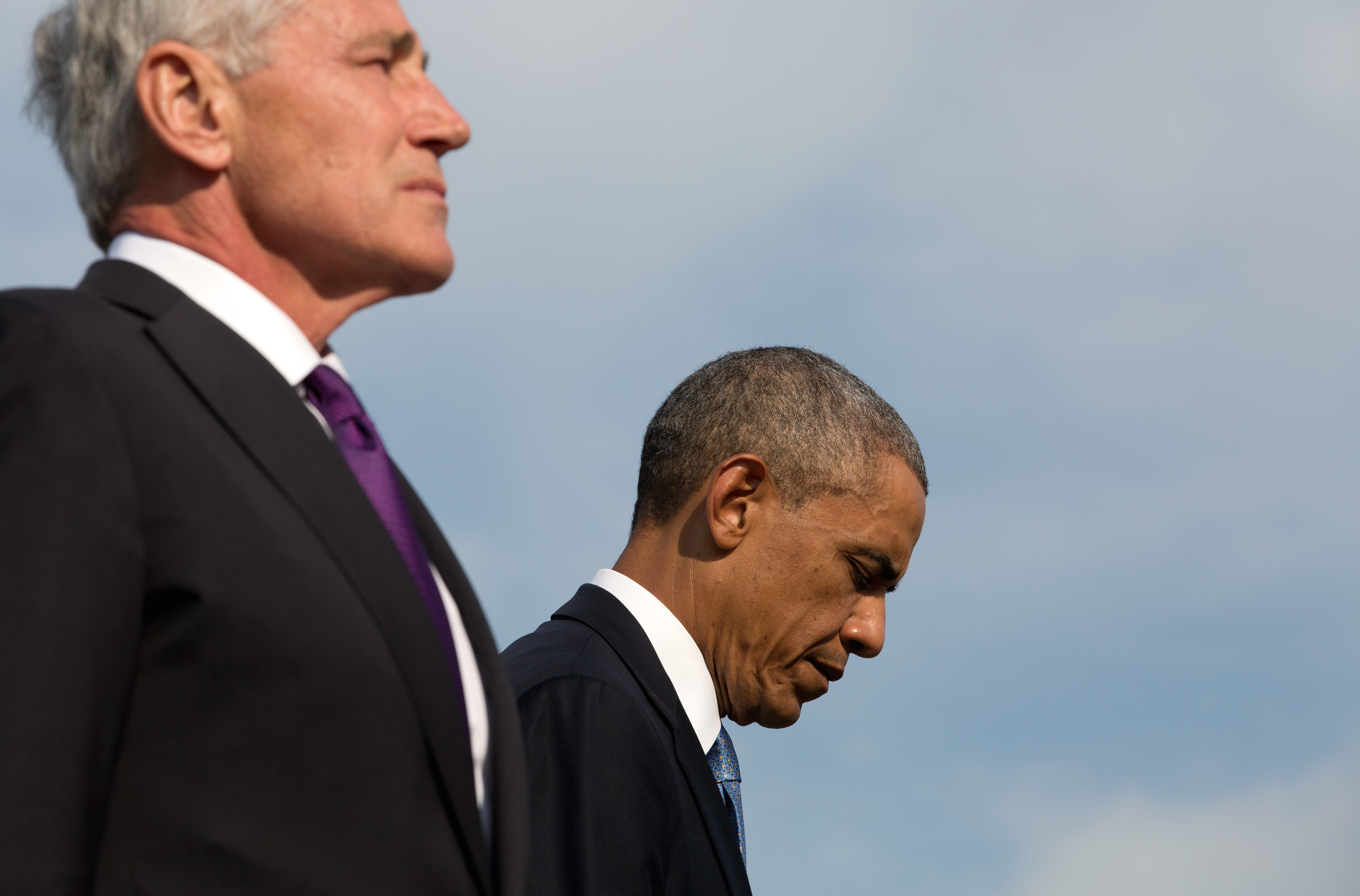
Let me take those points one by one. Obama did explicitly callfor “regime change” in Syria, the country we are now President Obama Marks Anniversary Of September 11th Attacks At The Pentagonbombing, and is now training and arming some Syrian rebels who are the dictator’s foes. As for the notion that we are “providing cover while an effete government refreshes itself politically” – really? The core problem in Iraq is that we replaced a Sunni minority’s despotic rule with a Shiite government backed by militias after a period of extraordinary sectarian blood-letting between the two. Despite a new prime minister, there are very few signs that the government in Baghdad has achieved anything like a “refreshing”.

It still does not command the trust of the Sunnis, cannot fill its interior and defense ministries because of sectarian division, and its army, after huge sums spent on it by the US, turned and fled when it came to operating in Sunni areas. This is the core issue – and we have not resolved it, and we have gone to war without settling that core question. I don’t know how many times the US is going to support a counter-insurgency campaign by a government without broad legitimacy and still hope for success. But at this point, one might have a smidgen of hope that we have learned something from the past. But it appears we haven’t.

Another reader:

I wonder how you can veer between Obama’s Nobel comments you posted the other day and your desire to criticize this campaign against ISIS as a panicked fool’s errand. There is evil in the world. ISIS planned a genocide of an ethnic minority in Iraq, kills en masse (villages, police cadets), rapes and enslaves young women, beheads innocent journalists, an aid worker and now a hiker – but this is none of our business. When does it become our business? What about that Nobel speech and evil that cannot be negotiated with and tramples our most cherished values? What country is still the most admired in the world because of those values? And if we don’t act on them, what does it say about us?

Ah, but that is sentiment and we’re dealing in hard realities here. This is not our fight. They are not an imminent threat, you say. How far do you let these people go and grow before it qualifies as your “imminent threat”? I’d like to see the punditry offer constructive solutions instead of constantly criticizing.

You’ve never underestimated Obama. Why begin now?

The Syrian war killed 200,000 people and we stayed out – for good reasons. Why was my reader not demanding a new war in Syria before now? The only answer is the rise of ISIS, and its grotesque media strategy. And my deeper point is simply this: even if we should do something to counter this kind of evil, what if there’s nothing we can actually do that doesn’t make the situation worse in the medium and long-term? What if we are indeed helpless to do anything other than direct Jihadist terrorism more squarely at the US and the West? Another points out:

Look at what Obama’s already accomplished.

Avoiding the slaughter of thousands of innocent Christians who were stranded with almost certain death at their doorstep, but for our air strikes. Of course if he was 100% determined to wipe ISIS out, then he’d have to send in troops, but my thinking is that by kicking things off in this manner, he’ll massage the other countries in the area to actually provide the ground troops. He realizes the US doesn’t support sending troops in – yet – so is doing what he can with air strikes.  Maybe with a few more American beheadings they just might support them. And I would too.

I still hope the other countries figure out a way, since they’re more directly involved, but if they don’t? You’d be fine with just sitting back and watching ISIS keep up their derangement?

In a word, yes. I do not believe ISIS can sustain itself for very long. No such group has managed to do such a thing before without its own insanity and brutality creating a backlash. We have just swallowed their hype – and elevated them in the eyes of the Arab and Muslim world. You have to remember: however disgusting ISIS is, the Arab-Muslim world will always regard the US as worse. Always. Another sees a long game:

How exactly do you ask someone to fix a problem that cannot be fixed?  You buy time.  And that is precisely what Obama is doing. He is slowing the Islamic State, stopping their forward movement, and spending his time behind the scenes working with all the nations in that area to get them to deal with it.  Because that is the only solution that works.

It is messy.  It is not clear.  It is not guaranteed in any way to be successful.  But it is responsible, and what a clear thinking leader does when there isn’t a better option. Isolationism is no better than neoconservatism or being an interventionist; they are all extremes and wrong.  Reality requires, in my view, the ability to modulate between the two poles when assessing and dealing with current circumstances.  A “doctrine”, as Bush had, is the scariest and worst possible method of dealing with this as it implies that there is a universal strategy that will fix the situation … like when you heard that we would be greeted as liberators – because the doctrine says so.

That’s by far the most potent criticism I’ve yet read. I can only say that I hope my reader is right. Another puts me on the couch:

Your rhetoric on this “reckless” war and implicit and explicit suggestions that what’s happening now is no better or different than 2002-03 all over again have mostly been off-base at best and an embarrassment at worst, and if I was an armchair psychologist, I’d say it’s some weird attempt at atonement for your (admitted) idiocy with respect to the invasion of Iraq. Oops, too late.  I said it.

In any event, stop, breathe, and try to take a more balanced look at what’s going on.

Another adds:

I read the e-book collection you put together – “I Was Wrong” – and it was hysterical between 2001-2003. Don’t fall into that rabbit hole again.

Earlier dissents here. And more to come.

(Photo by Getty)

War Without End

That’s what Jack Shafer fears Obama has launched:

A war with a conclusion that its participants can’t see or can’t imagine is a war without end. None of the dig-in parties in Syria and Iraq look like pushovers, but neither do any of them look like sure bets. Without American intervention, the current war will likely rage on. With regard to American intervention, not even the Pentagon dares to predict an end.

For Americans, at least so far, this war is rumbling on like background noise. The usual markers of military victory—body-counts tabulated, territories seized and banked, no-fly zones established, governments-in-waiting imposed, and elections supervised—don’t apply to the Syria war. The borders, combatants, allegiances, and military objectives in the Syrian war are too fluid to conform to our usual expectations. Nor do the usual markers of peace seem to exist. There are no peace talks taking shape, no shuttle diplomacy, no evidence of a dominant power about to exert its might to create a lasting peace by flattening everybody.

One way of looking at this is to ask: what should we call this war? Is it, as the Obama administration ludicrously argues, merely an extension of the war against al Qaeda, begin in 2001? Is it a new war on Syria – a sovereign state we have now bombed with no UN authorization? Is it a continuation of the 2003 Iraq War? Or was the 2003 war effectively a continuation of the Gulf War in 1991? I cannot decide. When you have so many over-lapping wars, most without any understanding of “victory”, and when the CIA launches covert wars all over the world all the time anyway, and when a conservative Republican president and his liberal Democratic successor both agree on the necessity of an endless war that creates the terrorism that justifies more war, it’s bewildering. One is reduced to quoting the Onion:

Declaring that the terrorist organization’s actions can no longer be ignored, President Obama vowed Wednesday that the United States would use precision airstrikes for as long as needed to ensure that ISIS is divided into dozens of extremist splinter groups. “ISIS poses a significant threat to U.S. interests both overseas and at home, and that is why we are committed to a limited military engagement that will fracture the terrorist network’s leadership and consequently create a myriad of smaller cells, each with its own violent, radical agenda,” said Obama during a primetime address to the nation.

Gitmo remains open; we are still at war in Afghanistan; we are still at war in Iraq; and all this is true despite a president elected explicitly and clearly to end the failed wars he inherited. This comes perilously close to proving that our democracy doesn’t really have much of a say in whether this perpetual war should continue or not. The public just wants “something to be done” in response to videos of beheadings, and seems to have little interest in carefully processing the pros and cons or unintended consequences – even after the catastrophe of the Iraq War under Bush! And here’s what happened when the Senate “debated” the authorization for military force against ISIS … and it’s not from the Onion:

The Senate debate did not fill up the allotted time, so at one point a senator devoted time to praising the Baltimore Orioles for their successful baseball season.

Those who argue that the US is in terminal decline, its democracy attenuated, its leaders interchangeable in a perpetual war based on no threats to the United States, have some more evidence on their side from the last couple of months. We are told, in response, that we live in a new world, in which these amorphous threats really do require a forever war to pre-empt and forestall them. But we can never know exactly what those threats really are – because it’s all classified.

I feel, I have to confess, helpless in the face of this – and my job requires me to understand these issues as well as anyone. What of other Americans, going on with their lives, struggling to make ends meet much of the time, barely able to digest what’s left of the news? It’s a recipe for passivity and acceptance, as the CIA and the Pentagon and their myriad lobbyists and fear-mongers do what they want – with no accountability even for war crimes, let alone policy mistakes.

I listened to the president yesterday – unrecognizable from the past. His embrace of the forever war paradigm is a real moment in American history. It is the moment when we must come to the realization that there really is no going back now. This is for ever.

The Long, Twilight Struggle For Independent Journalism, Ctd

The comments that got Bill Simmons suspended:


My take is here. VanDerWerff considers the places of ESPN and the NFL in the controversy:

While it seems unlikely Goodell asked ESPN to suspend one of its employees for calling him a liar, the situation speaks to how much power the NFL has in the modern media environment. With football increasingly seeming like the only consistent ratings draw in a splintered TV landscape — and the NFL attracting more and more suitors every time rights to games become available — the league can essentially ask for whatever concessions it likes in broadcast coverage.

Vinik assesses Simmons’ claim:

Is [Goodell] a liar? That’s still unclear, but there is strong evidence that might be the case. Goodell has adamantly denied that the NFL knew the contents of the tape before TMZ released it on September 8. But last week, Don Van Natta and Keith Van Valkenburg reported for ESPN that “Rice told Goodell that he hit her and knocked her out, according to four sources.” It’s of course possible that those four sources are either lying or have the story wrong. But Simmons was just saying what the evidence seems to indicate. Is that really in violation of ESPN’s standards? In fact, on Tuesday, ESPN’s ombudsman praised Simmons for his comments, including it in part of the “strong coverage and commentary” from the network.

Richard Deitsch tries to understand ESPN’s rationale:

Someone familiar with ESPN’s management’s thinking said the combination of the nature of the personal attack on Goodell and the challenge to his bosses were the key elements in the decision and the length of the suspension. It should be noted that Simmons has been very critical of Goodell in the past and was not reprimanded. So have others at the network, including NFL analyst Tedy Bruschi and Keith Olbermann.

There is also something else likely at play here. ESPN management is looking to become more decisive with suspensions when its employees go off the rails.

But Linda Holmes suspects the suspension has done more harm than good for ESPN and Goodell:

In all honesty, had he not been suspended, these comments from Simmons, who has all kinds of opinions about all kinds of things, might have passed largely unnoticed. It’s entirely possible that by suspending him for three weeks, ESPN guaranteed that the comments would reach many, many more people than they ordinarily would have.

Margaret Hartmann has more:

ESPN has a $15.2 billion deal with the NFL to air Monday Night Football through 2021, and it’s believed that the network cut its ties to the Frontline documentary League of Denial last year due to pressure from the NFL. A few people agree that there should be consequences for publicly taunting your employer, but … the Twitter reaction has been overwhelmingly negative. If ESPN cares about the backlash they can always follow the NFL’s example and reconsider Simmons’ punishment. On the other hand, $15.2 billion is a lot of money.

A couple weeks ago, Stefan Fatsis spelled out how the NFL manipulates the media:

The league’s financial muscle allows it to create its own quasi-journalistic outlets and to exert soft power over the media partners that pay it billions of dollars annually to televise its games. Last week, New England Patriots owner Robert Kraft went on a CBS morning news show to promote the network’s new Thursday night football broadcasts. After a few questions about Ray Rice, in which Kraft criticized Rice and defended Goodell, the hosts moved on. “We’re so proud to be partnered with CBS,” Kraft declared as a countdown clock to Thursday’s game flashed onscreen. The chyron labeled him “Master Kraftsman.”

On CBS’s pregame show that night, anchor James Brown delivered what Slate’s Allison Benedikt called “a powerful speech about male responsibility, not just for domestic violence, but also for our collective devaluation of women.” It absolutely was. But it also was devoid of criticism of Goodell or the NFL. That wasn’t surprising. John Ourand of Sports Business Journal reported that CBS Sports chairman Sean McManus said he instructed on-air talent to refrain from criticizing “individuals involved in the story, whether it be team ownership, whether it be NFL management.” According to Ourand, McManus said the talent was encouraged to “express opinions about the situation, to express opinions about domestic abuse, to express opinions on how the NFL has handled this.”

The Clintons Remain The Clintons

And they still hate the press. Wemple’s jaw drops:

For the latest on how Clinton Inc. views the Fourth Estate, go no further than Amy Chozick’s update on how the media is moving around at the ongoing Clinton Global Initiative conference in New York. The highlights:

  • Reporters must be escorted to the restrooms. Chozick reports that her minder “waited outside the stall in the ladies’ room at the Sheraton Hotel, where the conference is held each year.”
  • “Hordes of journalists,” notes Chozick, have ended up “cloistered” in a Sheraton basement.
  • Barricades separate journalists from the lobby, where “actual guests enter.”
  • Escorts are required “wherever we go, lest one of us with our yellow press badges wind up somewhere where attendants with an esteemed blue badge are milling around.”

This bush-league totalitarianism appears somewhat recent: Though there were “always” tight security measures, Chozick writes, “reporters could roam relatively freely until last year, when interest in and scrutiny of the Bill, Hillary & Chelsea Clinton Foundation spiked amid speculation that Mrs. Clinton would run for president in 2016.”

Cillizza shares his own experience:

Regardless of who was to blame, by the end of the [2008] campaign, reporters — including me — and the Clinton operation were at each others’ throats daily and often more than daily. In the wake of that campaign — particularly as it became clear that Clinton was, in fact, interested in running again — some of those in Clintonworld promised a different approach to the press in 2016. No, Clinton would never be John McCain in the back of the straight Talk Express in 2000 but neither would she or her campaign repeat the mistakes of their dealings with the press in 2008. They understood, they insisted, that while Clinton was very well defined to most voters, there was an entire generation of younger people — who, not for nothing, were a pillar of Obama’s electoral success — who knew little about the former Secretary of State other than her famous name and would use the media coverage of her to form their opinions.

The early returns on those pledges don’t look promising.

Drum somewhat sympathizes with the Clintons:

Nobody should take this as a defense of the Clintons. High-profile politicians have always been gotten klieg-light treatment, and they have to be able to handle it. At the same time, there ought to be at least a few mainstream reporters who also recognize some of the pathologies on their own side—those specific to the Clintons as well as those that affect presidential candidates of all stripes. How about an honest appraisal—complete with biting anecdotes—of how the political press has evolved over the past few decades and how storyline reporting has poisoned practically everything they do?

I take Kevin’s point. The 1990s got way out of hand (and I played my part). But what you have to grasp is how the Clintons’ own fathomless paranoia actually enables this cycle, and perpetuates it. The kind of reporter-control the CGI imposes – even in the bathroom – is exactly the kind of thing that would make any journalist want to find out what the Clintons want to hide. In other words, I think the problem isn’t simply the press or the Clintons. It’s the toxic combination of the two that seems to bring out the worst in both.

Dissents Of The Day I

A reader quotes from the Lincoln quote I quoted:

This our Convention understood to be the most oppressive of all Kingly oppressions; and they resolved to so frame the Constitution that no one man should hold the power of bringing this oppression upon us. But your view destroys the whole matter, and places our President where kings have always stood.

Except that now we have a volunteer army and the draft doesn’t exist. So the “Kingly oppression” only falls on those who choose to put themselves at the mercy of a dysfunctional executive branch.  Bring back the draft and I suspect we will suddenly find this argument rather ubiquitous.

Another notes:

The quote you printed was not from Lincoln when he was Commander-In-Chief; it was a letter to William Herndon regarding the Mexican war … when Lincoln was a congressman. Lincoln actually felt a little different later when he was president. This evolution happens to eventual presidents, as you know.

(As an aside, Herndon, Lincoln’s closest confidant, was my great, great, great uncle, and was always known as “Uncle Billy” in my family.)

Another remarks on that evolution:

Certainly this Congressman Lincoln should be more rightly compared to a Senator Obama – a much more liberal man who denounced the Cuban embargo and then goes on as president to renew it for the sixth time in a row; or a man who can denounce the very concept of the Iraq war and then as President go on to bomb Libya, Iraq, and Syria. So maybe Obama has a little more Lincoln in him than at first glance.

More readers reassert the parallels between Obama and Lincoln:

You know, of course, that Lincoln‘s Congress never declared war on the Confederates in order to weasel around international law. For the Union to declare war would have meant recognition of the Confederate States of America as a sovereign nation. In the fight against ISIL, who are we to declare war against?

Also, in an earlier post, you stated that Bush “procured a clear declaration of war from the Congress” – that didn’t happen! Also, back to the Lincoln quote, there is no invasion of Syria!

Your sky-is-falling reaction to these airstrikes (quagmire! mission creep! Bush-like!) is really disappointing.

Another gets into more detail over Lincoln’s war:

You cited Lincoln for his statement of constitutional restraint.  Have you read his history?  Lincoln stands as one of our great presidents (I put only Washington above him) because of his capacity to wrestle with moral and civic complexity and almost always come out right.  But keep in mind what he unilaterally determined as necessary in order to deal with the tick-tock of an existential crisis, from the suspension of habeas corpus (find me something more constitutionally fundamental than that) to the imposition of martial law in unaligned border states (the state of Missouri was still under martial law when Lincoln died.)

On balance, though, we are deeply grateful to Lincoln for doing what had to be done.  He was willing to personally commit the sins necessary for the nation’s salvation.

In the present crisis, we have the president confronted with a rapidly growing force of genocidal malevolence with genuinely global implications – and this time around it’s indeed a crisis that is open and actual.  We also have a Congress that may well have buried itself to a new depth of partisan triviality.  In the meanwhile, in lieu of any other nation or entity that is capable, we are the world’s last resort against the horrors that the worst angels of our nature are capable of.

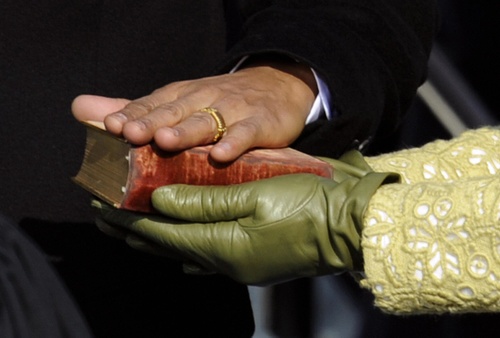
(Photo: Barack Obama’s hand lies on a Bible owned by President Abraham Lincoln as he is sworn in as the 44th US president on January 20, 2009. By Timothy A. Clary/AFP/Getty Images)

Holder Out

tumblr_m8cvlmGWtZ1rahfz9o1_500

https://twitter.com/jetpack/status/515166901866336256