Freddie responds to Vanessa Grigoriadis’s piece on campus rape:
I think that it’s a mistake to create different standards of consent for college students. The potential unforeseen consequences scare me, and besides, a central aspect of the fight against sexual assault is to insist that rape is rape. I think it sends a retrograde message to suggest that there is a different standard that is applied only to college students. I would argue that a clear takeaway from the New York piece is that the establishment of this entire separate legal system for campus sexual assaults, while undertaken with good intentions, has added a layer of complexity and lack of accountability that has backfired badly. …
I feel strongly that explicit consent laws actually undercut the absolute ownership by the individual over her or his own sexual practice.
One of the most important parts of the feminist project is insisting that women own their own bodies. This has application to abortion, where the pro-life movement seeks to take physical control of women’s bodies away from them. And it has application to rape. The insistence of those who work against rape is that only the individual has the right to define appropriate and wanted sexual practice. With the informed consent of all adult parties, no sexual practice is illegitimate. Without that consent, no sexual practice is permissible. This is a humane, moral standard that has the benefit of simplicity in application and clarity in responsibility.
But it stems first and foremost from the recognition of individual ownership. To define the exact methods through which individuals can request and give consent takes away that control and turns it over to the state, or even more ludicrously, to a dean or some academic grievance board. We should be expanding the individual’s control over their own sexual practice, not lessening it. And we should maintain the simplest standard that there is: that if a person rejects a sexual advance, or is in such an incapacitated state that they cannot rejected that advance, or is under the power of the other party to the extent that they feel compelled to consent, sexual contact cannot morally or legally take place.
It’s true that the President’s approval on terrorism has plummeted and the GOP now holds a huge advantage on foreign policy. Republican strategists have been pretty explicit in explaining that they see this as a way to exploit a general public sense that things have gone off the rails, and polls do show high wrong-track numbers and rising worry about terrorism. If things go wrong, which is certainly possible, this could well redound to the benefit of Republican candidates.
But for now, it’s hard to imagine that arguments such as Brown’s above are going to cut it. After all, if GOP candidates are really going to paint the U.S. response to ISIS as insufficiently realistic about the nature of the threat, then that should theoretically open them up to thequestion of whether they support sending in ground troops. You’d think that if the criticism continues now that operations are underway, it would be harder for them to duck that basic follow-up.
Waldman agrees that ISIS fear-mongering is unlikely to work:
Despite the surface similarity between political attacks like those and the ones we saw when George W. Bush was president, there’s a crucial difference. Back then, there was a Republican president taking actions against America’s enemies, while Democrats supposedly didn’t want to protect the country (even if, in reality, elected Democrats gave ample support to the wars in Afghanistan and Iraq and other elements of the “War on Terror”).
Today, however, it’s a Democratic president who is taking action against terrorists. Even if you believe that action is inadequate, it still creates a fundamentally different impression with the public when they see Tomahawks launching and jets taking off from aircraft carriers on Barack Obama’s orders.
Which may explain why Josh Green found that few GOP ads thus far have mentioned ISIS:
Now that the U.S. has begun bombing Syria, those ads may start to materialize. Then again, maybe they won’t. Republicans leaders such as House Speaker John Boehner (R-Ohio) have endorsed Obama’s latest campaign. “ISIL is a direct threat to the safety and security of the United States and our allies,” Boehner said of the group formerly known as Islamic State in Iraq and the Levant, according to a statement. “I support the airstrikes launched by the president, understanding that this is just one step in what must be a larger effort to destroy and defeat this terrorist organization. I wish our men and women in uniform Godspeed as they carry out this fight.”
I’ve been enjoying the thread. And then earlier tonight during happy hour, a friend said: “My Mom has a heart on for Pope Francis.” I didn’t even bring attention to it, I just immediately thought, “I need to write the Dish!”
Another:
Someone said “Jew him down” around me when I was 15 and working in an antique store one summer. But I heard “chew him down.”
I figured it meant when you talk someone into giving you a lower price one something, when you haggle, your jaw is moving up and down. You’re chewing down the price. Chewing them down. Chew him down.
I didn’t have tons of cause to use the expression once I was no longer working in an antique store, but I did use it from time to time, as I like to go to junk sales and flea markets. I think I was nearly 25 when I used it in front of the right person – someone who gasped, looked me in the eye, and said, “I can’t believe you would say something like that.” I was completely mortified when she told me what I actually heard in that antique store when I was 15.
Another:
I once mentioned to my wife that there was a new tapas bar in town and that we should go there, to which she responded, “Why would you want us to go to a topless bar!”
Another:
I can’t believe it took me so long to remember my biggest eggcorn. I’ve been saying since I was a kid that, in cold weather, “It’s a bit nipply outside.”
And another:
Okay, I haven’t seen this one show up on The Dish yet. I work in a group that designs and operates cutting-edge satellite instruments. One of my co-workers is an engineer known for being the best worrier in our building that something might go wrong with the latest instrument. My favorite phrase he always uses whenever he wants to point out a possible problem with a design or plan we’ve come up with is to start by saying: “But the flaw in the ointment is … “
Another:
I’m a family law trial attorney and often hear clients complain about being “lamblasted” by their spouses, etc. in relation to their often caustic situations. I’ve always loved that, and I never correct them!
Another:
I’ve been greatly enjoying your threads on eggcorns, mostly because I feel like I’ve committed half of them myself. Here’s another: When I was a kid, growing up in DC in the ’80s, my parents were friends with a couple named Mary and Barry. They were always saying things like “we’re going out with Mary an’ Barry tonight,” etc. I spent a good portion of my childhood thinking my parents were great friends with the mayor!
Another:
As a physician, my all-time favorite eggcorn is “sick-as-hell anemia”.
One more:
Years ago my then three year old son was having a tantrum about something I have long since forgotten. Trying to make peace, I suggested he come join me for a nice bowl of chicken soup. “NO!,” he screamed. “OK, suit yourself,” says I. “No, YOU shoot YOUR-self!!,” came the outraged reply. Holy Moly. He has since grown into a kind and gentle young man.
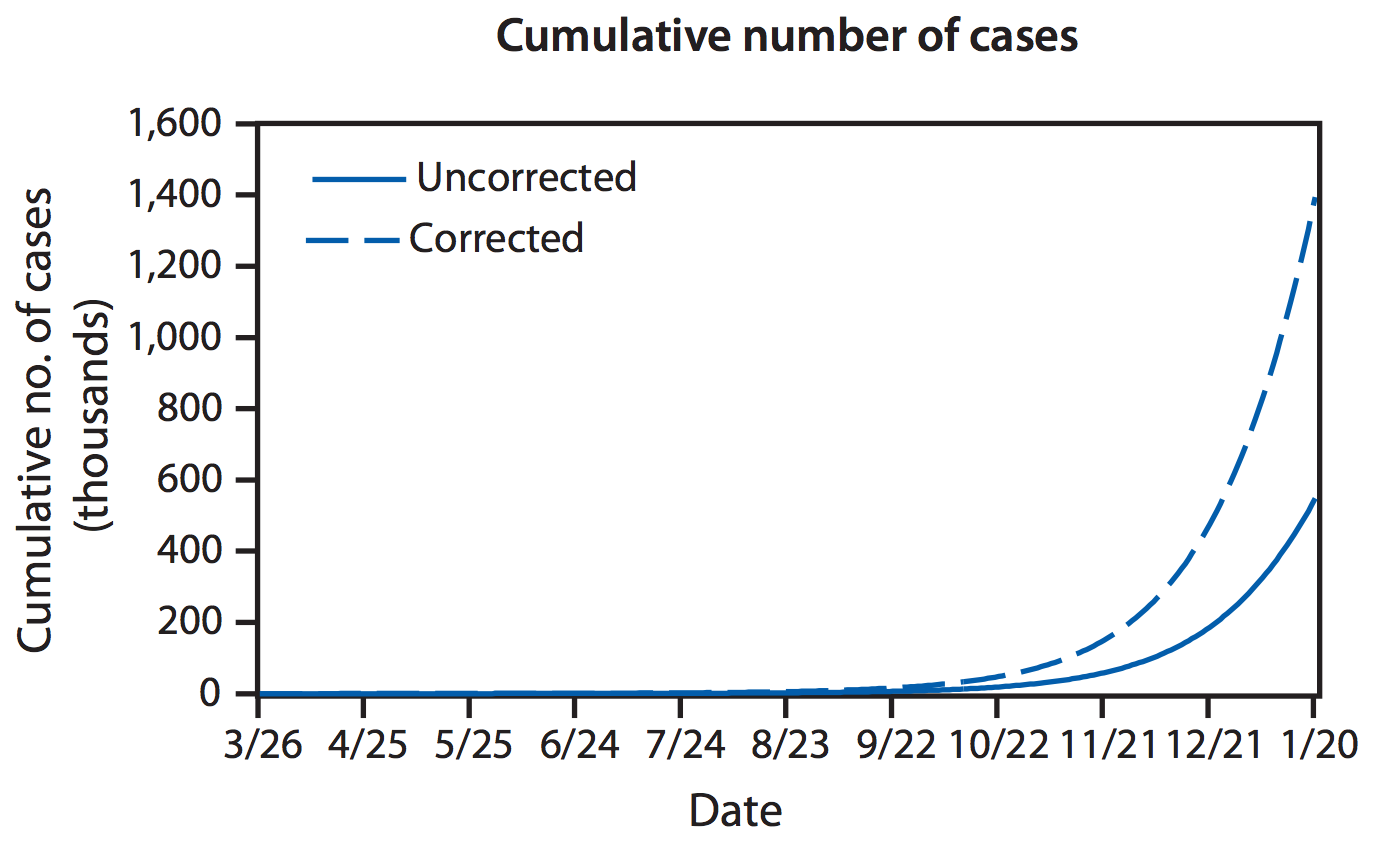
Lena Sun flags a new CDC report suggesting that 1.4 million West Africans could catch the virus by January:
The report released Tuesday is a tool the agency has developed to help with efforts to slow transmission of the epidemic and estimate the potential number of future cases. Researchers say the total number of cases is vastly underreported by a factor of 2.5 in Sierra Leone and Liberia, two of the three hardest-hit countries. Using this correction factor, researchers estimate that approximately 21,000 total cases will have occurred in Liberia and Sierra Leone by Sept. 30. Reported cases in those two countries are doubling approximately every 20 days, researchers said. “Extrapolating trends to January 20, 2015, without additional interventions or changes in community behavior,” such as much-improved safe burial practices, the researchers estimate that the number of Ebola cases in Liberia and Sierra Leone could be between approximately 550,000 to 1.4 million.
Meanwhile, Siobhán O’Grady points out a distressing pattern in aid distribution:
[A] United Nations Office for the Coordination of Humanitarian Affairs report released Monday sheds light on a different kind of neocolonialism taking form in the region’s Ebola crisis: Rather than coordinating an effort to combat the massive outbreak, the United States, the United Kingdom, and France are instead sending disproportionate amounts of aid to the territories they once controlled. This lack of coordination among the three largest donors to the fight against Ebola ignores the reality of borders between Liberia, Sierra Leone, and Guinea, where political lines are more a trace of colonialism than an accurate representation of modern-day relationships between the border communities of the three developing nations.
Zoe Chace compares the international community’s response to the Ebola outbreak to its actions following the 2010 earthquake in Haiti:
The response to the 2010 earthquake in Haiti was massive: Billions of dollars in donations poured in. “It had everything,” says Joel Charny, who works with InterAction, a group that coordinates disaster relief. “It had this element of being an act of God in one of the poorest countries on the planet that’s very close to the United States. … And the global public just mobilized tremendously.” People haven’t responded to the Ebola outbreak in the same way; it just hasn’t led to that kind of philanthropic response. From the point of view of philanthropy, the Ebola outbreak is the opposite of the Haiti earthquake. It’s far from the U.S. It’s hard to understand. The outbreak emerged over a period of months — not in one dramatic moment — and it wasn’t initially clear how bad it was. Donors like being part of a recovery story. In Haiti, buildings and lives were destroyed. The pitch was, let’s help them rebuild. In the case of Ebola, it’s been harder to make a pitch.
Not surprisingly, Tara Smith notes that the NGOs at the forefront are struggling:
Doctors Without Borders (also known by its French name,Médecins Sans Frontières, or MSF) has led the international battle against Ebola, and where its workers have had success in the past, they have been completely overwhelmed now for months. MSF International President Joanne Liu has made multiple appeals to the United Nations, begging for additional assistance, noting on Sept. 16:
As of today, MSF has sent more than 420 tonnes of supplies to the affected countries. We have 2,000 staff on the ground. We manage more than 530 beds in five different Ebola care centres. Yet we are overwhelmed. We are honestly at a loss as to how a single, private NGO is providing the bulk of isolation units and beds.
The plea has fallen on sympathetic ears, but the response has been slow and insufficient. The United States has answered the call to some extent, promising 3,000 military personnel and up to $750 million in aid. Even this massive amount is less than what the World Health Organization has called for: a minimum of $1 billion, and even that will only keep infections contained to the “tens of thousands.”
While I think this is important question, I also find the suicide rates not at all surprising. In fact, it is about as surprising to me as the data about soldiers taking their own lives in record numbers (that is to say, not surprising in the least).
During the middle of my residency in surgery, which was before work hour restrictions, I would go months at time without seeing the sun. I would typically work 80-100 hours a week, take in-house call every second or third night, and deal with all manner of death, dying, stress, and trauma. I was single and had little time to date, much less start a family. Showing fatigue, stating you needed a break, or any other sign that you were suffering resulted in you being labeled weak or whiny.
I could look forward to 2-3 more years of the same before my residency was complete. After that, I could look forward to an average salary which seemed to be shrinking by the year unless I tacked on 1-2 more years of fellowship training. Furthermore, I could read in the paper everyday that physicians were losing respect and were perceived as a major source of our country’s health care woes.
I went to work everyday and suffered through nurses with clipboards asking why patient X and Y hadn’t been discharged yet, administrators telling us we had to use instrument A instead of instrument B because A was cheaper (even though B was better or safer), operating rooms that were understaffed (“your case will have to wait until 7 pm to get done because it’s after 2 pm and we’ll have to start paying nurses overtime if we start your case now.”), and patient’s family members who weren’t there at all for the first 10 days of a patient’s hospitalization but are now demanding to see the doctor at 8 pm at night.
So after one snowy February day, after treating a mother whose baby had been decapitated in a car accident and all other manner of horrors, as I was driving home I thought, “wouldn’t it be nice to drive up into the Cascades (my residency was in the Pacific Northwest), get out of my car, walk into the woods for about 30 minutes, find a nice tree, and sit down in the snow and drink a bottle of whiskey until I became numb and fell asleep? I would never wake up.”
The good news is, I didn’t. And I’m one of those older doctors now who has no interest in or thoughts of suicide. I make a good salary, and while I still work hard and treat all manner of horrible things that happen to people, I usually make them better. I have a lovely wife and two beautiful children.
But when I read this question, I think that, like our soldiers (I was one of those too, by the way), most people have no earthly idea about what many physicians experience in training and in practice every day, and how much stress, sleep deprivation, administrative nonsense, medico-legal threats, and continual erosion of autonomy we deal with. It adds up. Throw in a sudden lawsuit, marriage break-up, or other major stress and you have the potential for a physician imploding.
We have definitely tried to make things better for doctors in training, and that needed to happen. We haven’t made things better for new physicians out of training; if anything, things have gotten worse with all the upheaval in the health care system. We are constantly asked to deliver more with less. Patients are more demanding, not less. We have a incredibly skewed perspective on end of life care, a topic which has been previously covered at length in this blog. The future is uncertain for private practitioners. There are multiple factors in play, and what leads a troubled physician to take his own life is different for each one.
For many more stories on suicide, read our long discussion thread here. Update from a reader:
Your man Aaron Carroll, a doctor himself, has done a lot of pushback on the “it’s horrible being a doctor, we’re all going to quit” meme – here, here, here, and here.
One of Carroll’s readers had a great line:
Most people have to choose between doing God’s work and being in the 1%. Only doctors get to do both.
David Leonhardt figures that, “while the 2014 election is certainly is not the most important of our lifetimes, it is important in some stealth ways”:
Even if no major legislation is likely in the next two years, the people elected this November will be in the Senate for another four. The 2014 elections could well mean the difference between a Democratic Senate and a Republican Senate in 2017. (The map is more favorable to Democrats two years from now than this year.)
Imagine a Washington in 2017 in which President Marco Rubio and a Republican House want to cut top tax rates sharply — but Senator Bruce Braley, an Iowa Democrat who squeaked out a win in 2014, is part of a 51-member Democratic Senate caucus that stands in the way. Or imagine that President Hillary Clinton wants to push an immigration overhaul — but can’t get any momentum behind a bill in either a Republican-led Senate or House.
Nate Cohn maintains that “there’s plenty of time for Republicans to take the lead as undecided voters make up their minds”:
In most states, the Democratic candidates are still stuck in the mid 40s or even low 40s. Most undecided voters probably disapprove of President Obama’s performance. In the red states, a vast majority of the undecided voters probably voted for Mitt Romney. If the national generic ballot numbers are right, those voters probably prefer that Republicans control Congress as well.
This would be the easiest explanation. The Republicans could take a lead in states like Iowa, Colorado or even North Carolina as undecided voters make up their minds. It would give the G.O.P. an advantage commensurate with their edge in the generic ballot, especially in the red states.
The political environment is so bad, the playing field is so tilted in favor of Republicans, and the midterm election electorate has started to favor Republicans so much so that there are simply many more routes for Republicans to get to 51 seats than there are for Democrats to keep 50. Winning every purple state and picking off a state in enemy red territory obviously can happen, but it usually doesn’t with the other dynamics we see in play.
In a series of poll released last week in places like Arkansas, Kentucky and even North Carolina, President Obama’s job approval rating never crested 40 percent. In the first two states, he was in the very low 30s. Ask any Democratic consultant what their side’s biggest problem is heading into November and they will tell you Obama. Ask any Republican consultant what their side’s biggest advantage is heading into November and they will tell you Obama. Bipartisanship! The reality is that for people like Pryor, Landrieu and Alaska’s Mark Begich, overperforming the president of their party by 15 or more points is a very tough thing to do. That’s true — to a lesser extent, but still true — for people like Jeanne Shaheen in New Hampshire, Bruce Braley in Iowa and Mark Udall in Colorado. The tough thing for Democrats is that it’s getting dangerously close to being too late for a change in Obama’s approval numbers to have a real impact on the political dynamic in their state.
Update from “one politically independent, liberal-to-libertarian man’s point of view from North Carolina” – a great description of a typical Dish reader:
I haven’t been polled, but if I were, I guess I would be counted as an “undecided” voter. Put bluntly, I find the race between Thom Tillis and (the incumbent) Kay Hagan as repulsive as it is boring. Tillis is running against President Obama, and Hagan is running against the NC legislature (of which Tillis is the outgoing speaker of the House). An outsider could be forgiven for not realizing that they are both running for a seat in the US Senate.
There was a time when I would find the arguments of my (mostly liberal) friends about the implications of who controls the Senate a compelling reason to hold my nose and vote for Hagan (again), but I just can’t bring myself to do it this time around. As much as I abhor nearly everything Tillis stands for, I have yet to hear Ms. Hagan articulate a single positive accomplishment that I should care about in the job she’s had for nearly six years.
There was also a time when I could have happily registered a protest vote for a candidate like Libertarian Sean Haugh, who clearly doesn’t want the job (the persistent problem with Libertarian candidates is that they aren’t actually interested in doing the jobs they seek) because at least his YouTube videos are entertaining. His electoral prospects (or rather, the lack thereof) don’t bother me, but campaigning as performance art (however much I share his sentiments and genuinely enjoy his delivery) is not something that I think merits encouragement.
But … if I vote for anyone at all, it will be for Haugh, if only because he’s the only candidate that voting for won’t leave me wanting to take a shower. More likely, I will write in “none of the above” and devote my attention to more local races, where my vote might matter (marginally) more.
If this is where someone as politically engaged as I am (I’ve voted in just about every election since I turned 18 in 1995, including ones for things like school board and sales tax referendums) finds himself, you know the system is fundamentally broken.
We must congratulate you on lulling us in to a false sense of security. This is quite possibly the hardest “view” you’ve ever posted. Our best guess is my dad’s: Williams County, North Dakota. We base this on the mountains, and the look of the buildings, which seem to resemble an industrial mining or fracking operation.
Next time, perhaps something between “nondescript mountain range with weird building” and “stadium with identifiable flag”? Thank you as always for a fun contest!
Another anticipated a hard one after a few weeks of easy contests:
Well, we knew this was coming, didn’t we? We have what appear to be prefabricated buildings of recent vintage, on a rocky, barren, and otherwise undeveloped landscape, with snowy mountains off in the distance. Somewhere in the Arctic, during the summer. A woman and child walk in the foreground – Inuit, perhaps? So let’s say Alaska, somewhere along the North Slope, and for sake of specificity call it Barrow, even thought I cannot pin down these buildings on maps of the town.
Another gets fictional:
Taken from the office of Gustavo Fring at the Los Pollos Hermanos Compound, just outside of Albuquerque, New Mexico.
Another heads much farther south:
After spending a disconcertingly long time on Google Maps in Satellite View, I’m going to go with Potosí, Bolivia. It actually might be any other city in the Bolivian Altiplano, but I’m tired of satellite view and Potosí looks about the right amount of brown. Plus, it’s an important mining city, and the edge of that pit looks like a mine.
But for all I know, that’s a tar-sands operation in Alberta and I’ve just spent two hours in the wrong hemisphere. This might be the most challenging contest you all have done! I opened the photo today and said, “Ugh.”
Wrong hemisphere. Another gets the wrong planet:
Mars? There was a story on This American Life / Love + Radio last week about a Mars station to host 4 humans is 2023. This may be the terrestrial training ground. Looking in the arid, iron rich soils of greater Mongolia I worked my way to some disputed lands between China, Kyrgyzstan, Tajikistan. Is this an homage to Chini or a nose-thumbing after two easy weeks? I’m not sure what Aksai Chin is, but it showed up on my Google map, and one can only assume the people who live there would be the Chini. There don’t appear to be any roofs in the area, but just by name association alone, I hope this is close, and I hope Doug found it.
To the right country:
To me the picture said Northern Canada, or possibly Alaska. But I’m guessing it wouldn’t be the US three weeks in a row. So after some half-hearted googling, I guess somewhere in Yukon, Northwest Territories, Canada. A vague guess, because it was a gorgeous weekend and I went apple picking on Saturday and then simply had to make pies and crisp on Sunday. I’d send you one, but Internet.
Another reader nails the province and town:
I got lucky on this one. I zoomed in to see the people walking down the dirt road, and thought they looked Inuit. I then thought of Nuuk, Greenland, which is at least pretty small and unique. When it wasn’t Nuuk, I looked at the Chevy van in the photo thought “oh, maybe it’s Alaska” – in which case, game over, because Alaska is huge and has dozens of tiny little settlements. But then I remembered Nunavut, Canada’s newest territory. I hopped on over to Iqaluit, and lo and behold, there was the crazy modular spaceship form of the high school. (By the way, kudos for making sure the flag was illegible.)
Another wasn’t impressed with our promise to make this week more difficult:
I haven’t submitted to the contest in some time. But I was excited when you said this week would be harder than than recent contests, so I thought I’d go for the challenge. Some challenge. The landscape was unmistakably Arctic. Nunavut was my first guess. I was in Iqualit, Nunavut before my coffee was cool enough to drink.
Reality TV helped out this reader:
Got it in a flash thanks to the wonderful BBC program “A Cabbie Abroad”. In it, London cab driver Mason McQueen visits remote places – Mumbai, Bangkok, Fiji and Iqaluit, to ply his trade:
Whilst the set up is about learning to be able to drive there, the really interesting part is how he gets to appreciate the plight of the locals. In the case of Iqaluit it was the dispossession of the land of the indigenous people and the poverty, health and alcohol problems in the community. He approaches it with an open mind and a real honesty and humanity.
A funny footnote though. In the program he has to master the house numbering system of Iqaluit, where there is one set of house numbers for the whole town, and by the end he has it mastered.
I actually contacted Mason on Twitter about the contest … and his guess was Colorado!
One reader has a fantastic visual walkthrough to nail the right apartment building:
Not a single legible sign. No automobile license plates. No distinctively styled lampposts or street signs. Now we’re talking!
First, I identified the key landmarks in the window’s view:
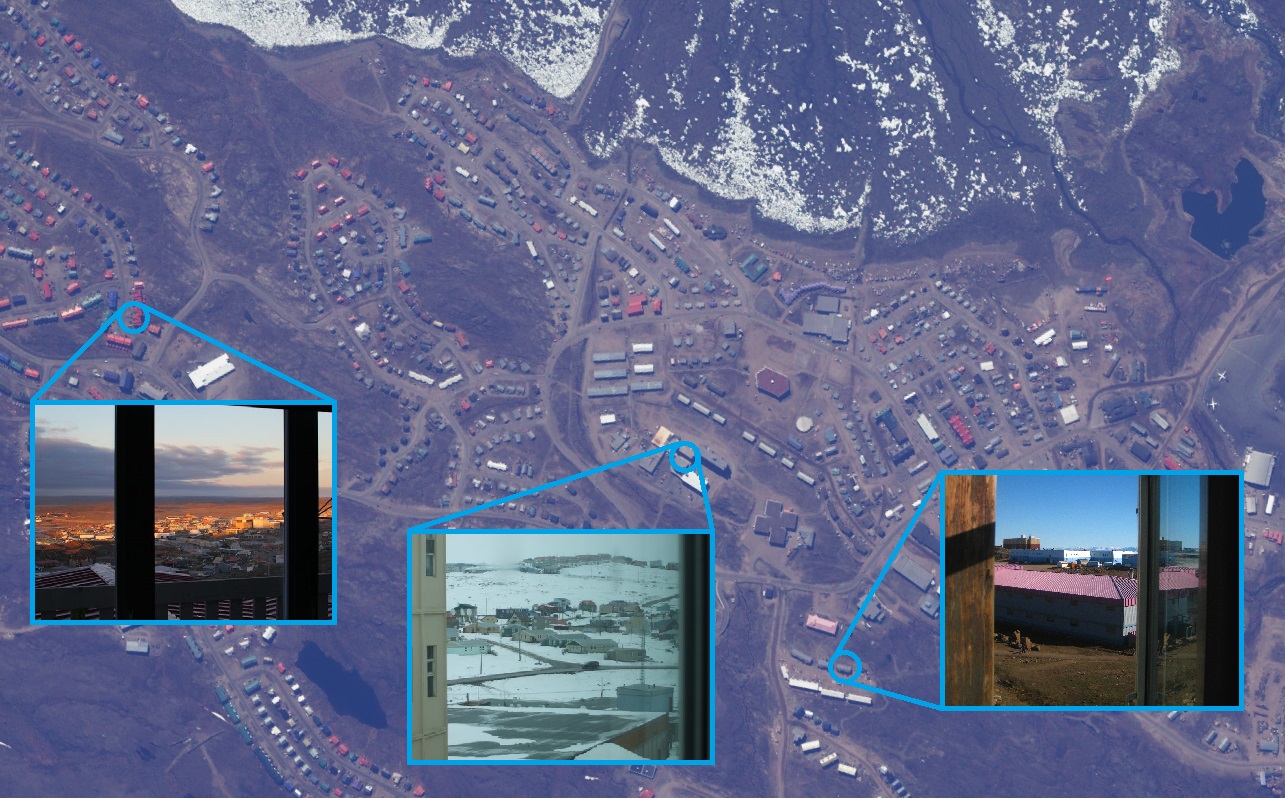
Then I located those landmarks in the aerial image of Iqaluit:
Here’s an alternative view of the apartment tower, seen from the east (rather than from the north):
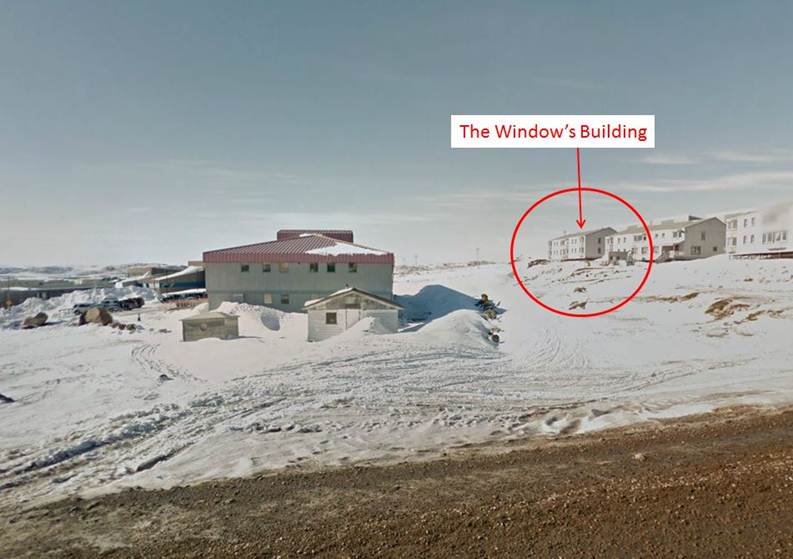
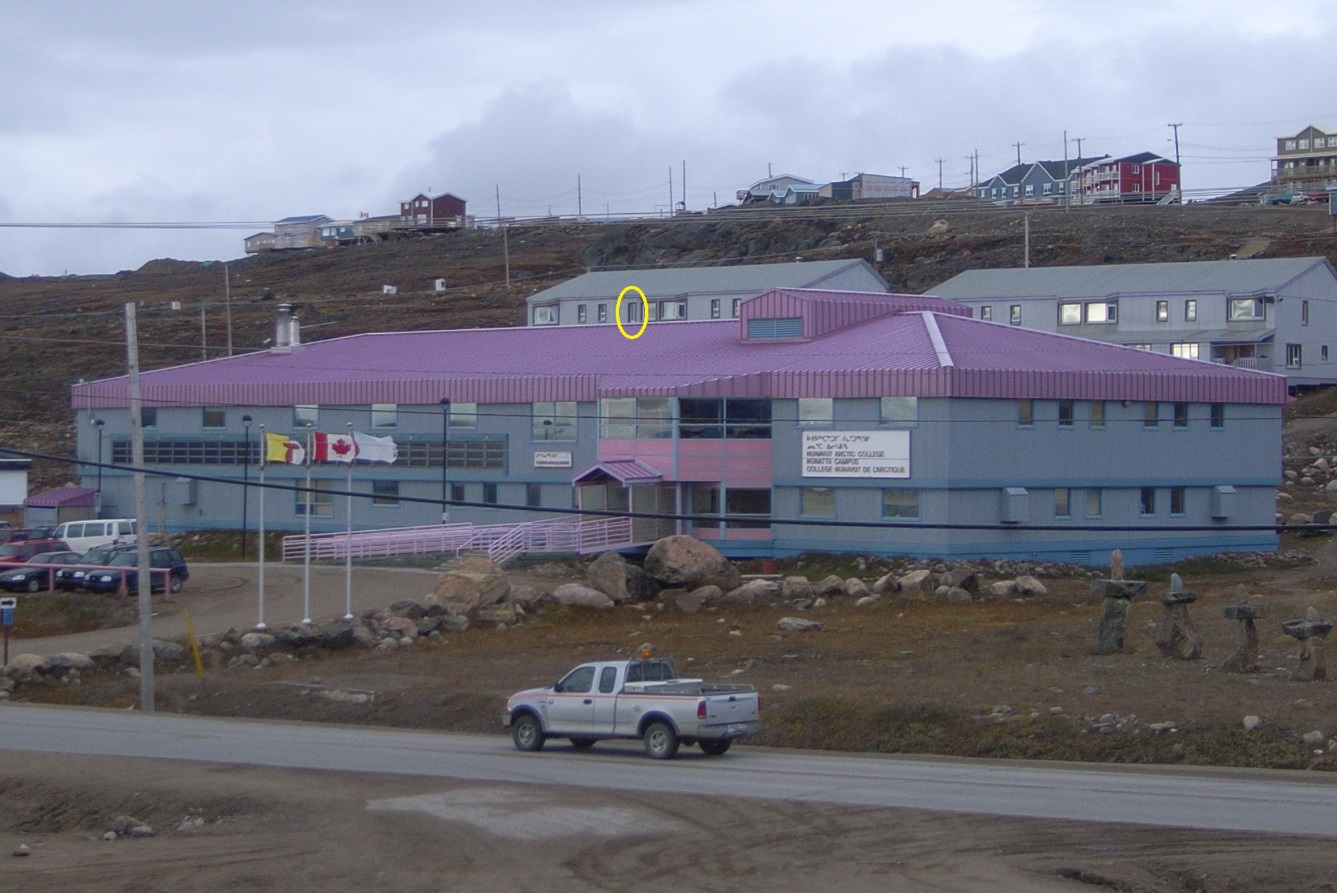
Given the line of sight, our window must be in the westernmost of 3 buildings on Qulliq Court, overlooking the Arctic College head office. (The qulliq, sometimes translated as kudlik, is a type of oil lamp used by the original Inuit inhabitants of Baffin Island.) Thanks to Street View, this building can be identified as 508 Qulliq Court.
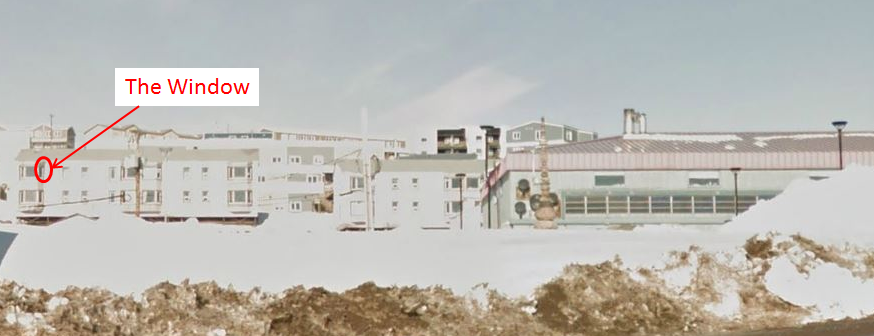
But which window? Given how much of the Arctic College’s roof that is visible in the VFYW, I believe that the photographer was on the second floor rather than the ground floor (even though the ground floor is itself higher than the roof). We also know that the photographer’s window opens. I surmise that it is one of the flanks of the building’s bay windows. Finally, given the angles from the landmarks to the window, I believe that the picture was taken from the westernmost bay of 508 Qulliq Court:
Based on what I’ve read today, I believe that 508 Qulliq Court and its neighbors are housing belonging to Nunavut Arctic College. If I’ve identified the correct bay window, the VFYW picture was taken from Unit No. 27.
Another notes:
I’m actually rather impressed that there’s Google Street View for this city, given that it’s accessible only by plane and is the smallest and most remote of the Canadian provincial/territorial capitals. And this was the first time that Street View wasn’t actually a lot of help since the snow banks are so high that it’s hard to get a good view in any direction.
The Street View story is pretty cool, as this reader discovered:
Having been to Alaska for work a few times, my gut reaction was somewhere in the North American Arctic. The signs are:
A lack of any foliage suggesting it gets very snowy and cold.
Large metal buildings which are fast to construct during summer, cheap to transport their raw materials, and big enough for the community to spend all winter inside
Lots of chimneys on roofs, curved over to prevent snow falling in.
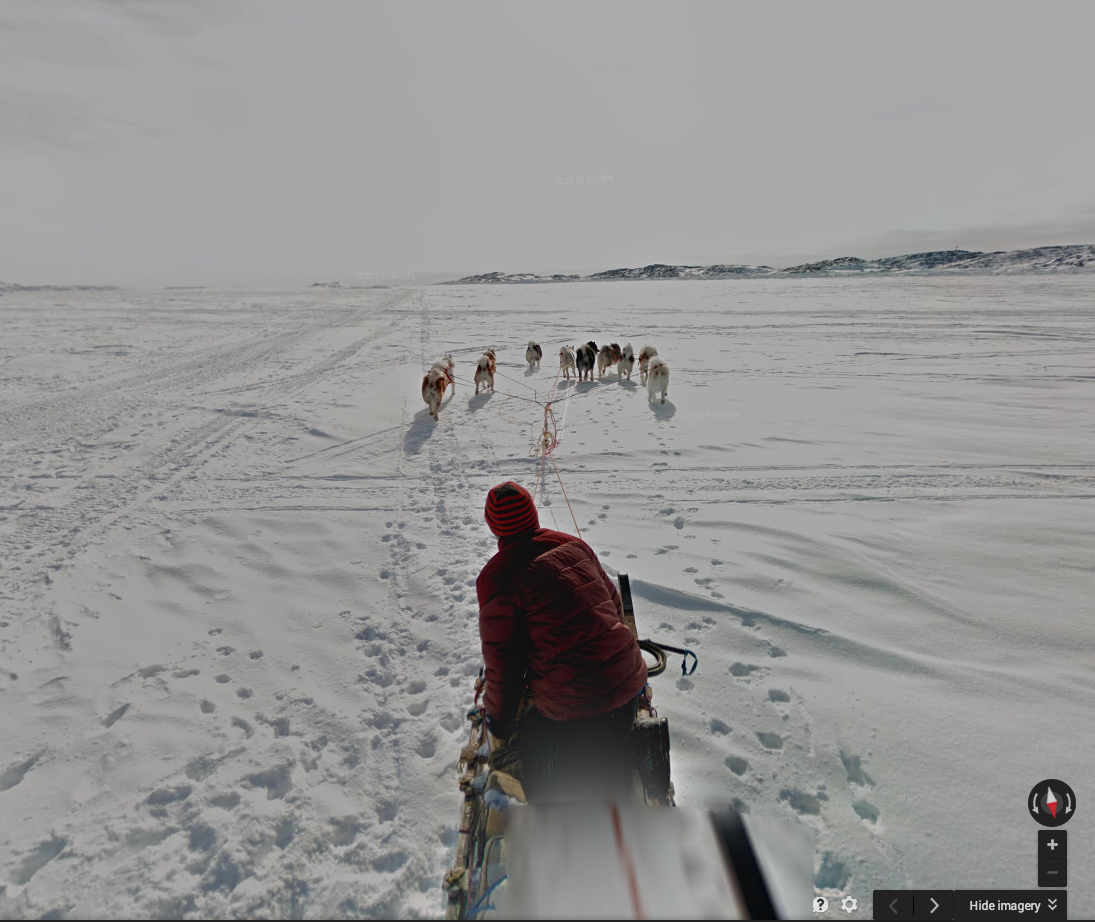
That didn’t give me much to go on but searching for “Arctic Towns in Canada” I got lucky and came across a video by Christopher Kalluk – who took Google Street View images by walking around town carrying something like R2D2 on his back:
From that video I quickly found the three buildings shown, and the apartment complex.
Finding that was great fun.. even better was finding this Google Street View image of Christopher on a sled being pulled by dogs. Amazing!
Don’t forget the donuts:
To show just how thoroughly the Canadians have conquered the Arctic, consider this local establishment (notice the slogan written in Inuktitut syllabics):
As always, a reader informs us about the town:
Founded in 1942 as an American air base, accessible mainly by air (by boat in the summer, and dogsled and snowmobile in the winter), Iqaluit grew in the 1950s due to a NORAD radar station project. In 1958, there was a proposed plan to build the city under a giant concrete dome. Seriously! It was to be artificially lit, heated to -6°C (21°F) in the winter, and powered by nuclear energy. Thankfully the dome did not come to pass (Iqaluit is apparently a great place to see the Northern Lights), although it would have made for an excellent reality show today.
Notable Iqaluit current events include the opening of the first beer and wine store in 38 years (an attempt to quell the alcoholism made worse by prohibition), the extinguishing of a 4 month long town dump fire, and the ouster by the city council of the chief administrative officer. These incidents are supposedly unrelated.
Another reader connects the view to last week’s big story:
Iqaluit is an interesting choice just a week after Scotland’s vote for independence. Nunavut is in its 15th year of territorial quasi-self rule. The split from the Northwest Territories was a major victory for Native sovereignty and self-government, even though it is still governed by Canada. That fight continues in Canada and around the world. Here in the US, we have Native Hawaiians toying with taking the illegal overthrow of its monarchy to the UN, Akwesasne Mohawk insists it is sovereign territory straddling the US-Canada border (they issue their own passports), and the Navajo Nation is stretching its legs with the idea of becoming a “state” for Medicaid and Medicare purposes.
A previous winner provides a soundtrack:
This VFYW contest has a tenuous connection to the Dish’s new and sporadic cover song contest. The White Stripes played Iqaluit (pop. 6,699) on there final tour in 2007. The tour was a long trek across Canada. Their movie about the adventure Under Great White Northern Lights contained footage of the Iqaluit stop and the accompanying album’s cover is a doctored picture of Jack and Meg walking near the shore in Iqaluit (about here; the old location for a Hudson Bay Company post). The set list for their show at Iqaluit’s Arctic Winter Games Arena included their covers of Dolly Parton’s Jolene, Blind Willie Johnson’s John the Revelator, and Son House’s Death Letter, among others. Although not a cover, I prefer Gillian Welch’s retort Time (the Revelator).
Another regular reader offers a dissent:
Could you please stop quoting from Chini’s responses every week? It’s like the guy in class who always raises his hand. Nobody wants to hear from him every time.
Perhaps, but plenty of other readers look forward to his little blockquote column every week, as do we:
Bare dirt, tiny windows, thin grass; yep, we’re hell and gone from the equator. At first blush that might seem to make this one crazy hard but it’s actually helpful; there simply aren’t that many people living at these latitudes. Not to mention the dead giveaway at center left; once you saw it, this one became an insta-find (for myself and presumably quite a few others). Chini kuviasungitok!
This week’s view comes from Iqaluit, the capital of Canada’s Nunavut province. The picture was taken from a second floor window in residence building #508 on the campus of Nunavut Arctic College and looks almost due south along a heading of 170.21 degrees.
Here’s the location of two Iqaluit views that the Dish featured back in 2008/2010 alongside this week’s shot:
And here’s this week’s winner, who also gives us a colorful architecture tour:
I’m not a world traveller, so each week I hope for a familiar view of Canada or the US. This time I identified the scene immediately: Iqaluit, capital of the territory of Nunavut, Canada. I was there a year and a half ago; you actually published my view from my sister-in-law’s window in the suburb of Apex.
The giveaway is the two-tone blue Inuksuk High School, with its distinctive porthole windows and fibreglass panels, pictured here, behind an arch of bowhead whale bones:
Behind it is the brown and tan Frobisher Inn. Anyone who has visited the city (population 7250) will recognize these landmarks. The architecture of Iqaluit can be quite striking, such as Nakasuk Elementary School, which could pass as a lunar research station:
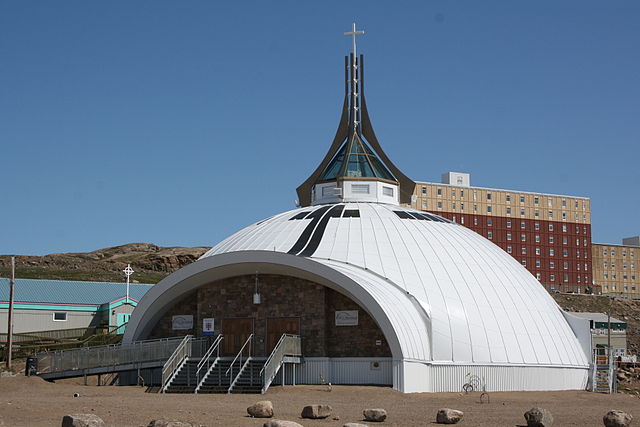
And the igloo-shaped St. Jude’s Anglican Cathedral:
It’s also very colourful, which helps break up the white of winter. Bold colours are popular for residential buildings:
And the bright yellow of the Iqaluit Airport is easily spotted from a distance:
I’m pretty confident the photo was taken from an apartment in the building I’ve indicated on the map below, based on the angle of the window opening to the hotel and high school, and the angle of the roof hip of the Nunavut Arctic College in the foreground.
I’m less certain about the exact window, but I believe it’s the left window of the second bay window unit from the left, on the southwest side of the building, on the second story. I chose this one because the perspective of the view appears to correspond roughly to the middle of the building, and since I assume the hinge of this swinging window would be on the wall side of the frame, not the side protruding from the building:
We confirmed the above image with the reader who submitted this week’s view:
That’s absolutely the window! Facing out the right. I opened the right side of the bay window to get the shot. The Dish sleuths do it again.
The view is from an apartment (Apartment Q-26, QI Complex) that was made available to short term researchers associated with the Arctic College, part of which is seen in the foreground with the pink roof. The distinctive blue building with the portholes is the Inuksuk High School. The taller brown building beyond is a hotel with cafe and theatre, the tallest building in Nunavut and part of the Astro Hill complex.
Thanks to all for the many great entries this week. Many of them come to you in this collage:
Mitchell had me until the final paragraph of your excerpt: “In the meantime, in the interludes of peace, diplomatic and cultural outreach and, above all, higher education initiatives intended to help the younger generation understand and thrive in the disenchanted world it will inherit offer perhaps the most constructive ways to engage the region.”
Empirical study of Islamist extremism, looking both at political and ideological commitment and at participation in violence, have shown that higher education correlates with higher, not lower, commitment to the dream of “returning to an enchanted world for which an imagined Islam provides a ready guide.” (See Krueger and Maleckova’s “Education, Poverty, and Terrorism: Is There a Causal Connection?” for an entry into the modern literature.)
Worse for Mitchell’s conclusion is that the correlation between education and Islamist radicalism is more pronounced among those who have earned advanced degrees in technical subjects rather than religious studies – and also more pronounced among those who have studied in the West.
This shouldn’t be a surprise to any reader of Tocqueville – his world was one that had only recently emerged from a generations-long spasm of violent religious extremism in which the best-educated and most entrepreneurial few fueled the violent radicalization of the many in the name of ever purer faith. The shadows of Reformation extremism and violence cast themselves across Tocqueville’s view of America, overtly in several chapters. When Weber wrote of the “Puritan work ethic” eighty years after Tocqueville, he was describing a continuity of habits of thought and conduct from the time when educated, industrious, entrepreneurial Protestants plunged Europe into maniacal religious terror.
Education, at least in the near term of a few generations, is not the answer. Or anyway, education for men will not solve the pathologies of the Middle East – better education and entrepreneurial spirit among Middle Eastern men may in the long run be necessary and virtuous, but in the short run, more educated and industrious men likely means more extremism, illiberality, and violence, not less.
It’s an American heresy to believe that education may not be the answer to everything. But it can be true. I think Mitchell’s core point is that violent Jihadism is a response to the bewildering terror that modernity evokes for many in the Arab and Muslim worlds. It is thereby reactionary in content but truly modern in form and style. We see this in a much milder fashion with American Christianists. Modernity for many Christianists is really a function of sin and decadence; and the more modern the world the more reactionary and pure must the religion be. And so we have seen a remarkable surge in fundamentalism in an era when the Founding Fathers assumed we’d all be deists at most.
Some liberals forget this. Liberals forget it because many find religious faith ludicrous and cannot quite internalize the fact that fundamentalism often has the strongest appeal to some of the most intelligent people around. Some conservatives don’t get this because they always assume that religion is a force for tradition and continuity, while in actuality it can become radically disruptive and, in its fanaticism, very modern indeed. Modernity emits the fumes that fundamentalists huff.
What does this mean about the Middle East?
To me, it means that this violent and radical psychosis we call Jihadism is not going to go away any time soon – and the attempt to stop it from the outside is almost certainly likely to energize and inspire even more anti-Western, anti-modern fundamentalism. My view is that we have to hang tight, keep calm and carry on. In so far as we can divert these powerful passions away from us, we should. The hope is that, just as Europe had to fight itself until it had become a bloody human abbattoir in the sixteenth and seventeenth centuries before turning away from theocratic madness, so too may the Arab and Muslim world in the century ahead. This is a stage that the Arab world has to go through. It will not be pretty, and it might not end well. But we cannot do much to control that. We merely have to limit the damage – to us and to humanity.
And in that respect, I remain of the view that the most under-rated achievement of this president in his second term was his deft maneuvering to get Syria’s WMD arsenal out of the country and destroyed. It’s the WMD issue that could truly make the long Muslim civil war an apocalyptic one. Obama achieved in Syria without a shot what Bush failed to achieve in Iraq with a grinding, lost war. Maybe one day, that will be better understood, and the wisdom of a minimalist approach to anti-terrorism better appreciated and understood.
Maria Abi-Habib explains how the Yemeni capital came to the brink of a coup this weekend during the worst fighting since the 2011 overthrow of former president Ali Abdullah Saleh:
The militants known as Houthis have been protesting outside government ministries in the capital Sana’a since August, complaining about rising fuel prices and demanding the government quicken the pace of political overhauls. By Sunday evening, they had taken over the central bank and the defense, interior and finance ministries, adding to advances last week that included the airport.
Shortly after Sunday’s takeover, the Houthis, President Abed Rabbo Mansour al Hadi and most of the country’s major parties signed a United Nations-mediated cease-fire that included an agreement to form a new government. Mr. Hadi will choose the next prime minister but must consult with the parties that signed the agreement, details of which were scarce. The Houthis are likely to have an edge in those negotiations after their recent display of force.
Khalil Harb suggests that the Houthi movement acted “strangely” by inking a deal “while having all the makings for a successful coup d’état in their grasp.” Meanwhile, Peter Salisbury notes that many Sana’a are skeptical that the deal will hold:
“Considering the massive military victories the Houthis have gained in recent days, it’s quite hard to imagine they’d give up Amran and al-Jawf in the absence of massive concessions,” says Adam Baron, a London-based Yemen analyst who lived in the capital for three years. “Concessions that the government is unlikely to be willing, or able, to give,” Baron said.
Others argue that the Houthis clearly have their sight on Maj. Gen. Mohsen, a presidential military adviser who led successive campaigns against the Houthis in Sa’dah between 2004 and 2010.”I just don’t see the Houthis coming this close to him [Mohsen] and giving up,” says a Yemeni politician who spoke on condition of anonymity. “He devastated Sa’dah for years, and they think had [the Houthis’ founder] Hussein al-Houthi killed [in 2004]. It’s hard to believe they’ll take political gains over revenge and power.”
Ibrahim Sharqieh explains how it got to this point:
After Saleh was overthrown in 2011, the new transitional government acknowledged the past mistreatment of the Houthis, and officially apologized for the six wars Mr. Saleh waged against them between 2004 and 2010. But it did not address all of the historical grievances of the Houthis, who pressed on with their insurgency. Many Yemenis believe that the Houthis are acting as agents of Iran, which backs them. To legitimize their rebellion, the Houthis had to come up with popular proposals to address rising energy prices and incompetence in the government. It was the poor performance of Yemen’s transitional government that allowed them to succeed. President Hadi, and his government – including Prime Minister Mohammed Salem Basindwa, who just stepped down – failed miserably to deliver basic services, spur economic development and, most important, create jobs. Unemployment was one of the main drivers of the revolt against Mr. Saleh.
Gregory D. Johnsen notes that the Houthis have “moved far beyond their narrow sectarian origins” over the past two years:
They have broadened their appeal beyond their traditional power base of Zaydi Muslims – a branch of Shiite Islam that is relatively close to Sunni Islam – and in the process become Yemen’s primary opposition group. They are also, as the latest agreement makes clear, the closest thing Yemen has to a kingmaker. The Houthis may not have enough power to impose their will upon the rest of the country, but they now have enough supporters and weapons to act as an effective veto on Yemen’s central government. This is a remarkable turnaround for a group that once believed itself to be on the verge of political and religious extinction in Yemen.
Adam Baron agrees that the conflict shouldn’t be viewed through the prism of sectarianism, “even if the Houthis are largely followers of Zaidism, a northern Yemeni brand of Shia Islam, and their adversaries are overwhelmingly Sunni Islamists”:
The Houthis’ biggest achievement has been to transcend their roots in the mountains of the devoutly Zaidi far north to position themselves as a national movement. Notably, the Houthis’ ties with Iran notwithstanding, the Gulf Co-operation Council (GCC) has issued a statement welcoming the peace agreement. The Houthis themselves acknowledge that they have received political and media support from Iran, while their adversaries claim that they receive Iranian arms and funding, something that has long raised the suspicions of Yemen’s Gulf neighbors.
Meanwhile, Zack Beauchamp reminds us that the situation in Sana’a isn’t the only conflict roiling Yemen:
As if the Houthi movement wasn’t enough, southern Yemen plays host to an entirely separate Sunni Islamist rebellion. Al-Qaeda in the Arabian Peninsula (AQAP) is the driving force here, along with Ansar al-Sharia, a group that’s either simply an extension of AQAP or affiliated with it. The weakness of the Yemeni government and broad national insecurity, as discussed above, has allowed AQAP to fester here. While Yemeni government offensives and a US bombing campaign have pushed AQAP out the most populated areas in southern Yemen, the group still has a hold a lot of territory in the rural areas of the region. The US National Counterterrorism Center sees AQAP as the terrorist group “most likely to attempt transnational attacks against the United States.”
The two rebellions are not directly linked, but the Yemeni government’s inability to fight informs its failures against the other, and the weaker that the government gets, the easier it will be for both groups to grow unchecked.
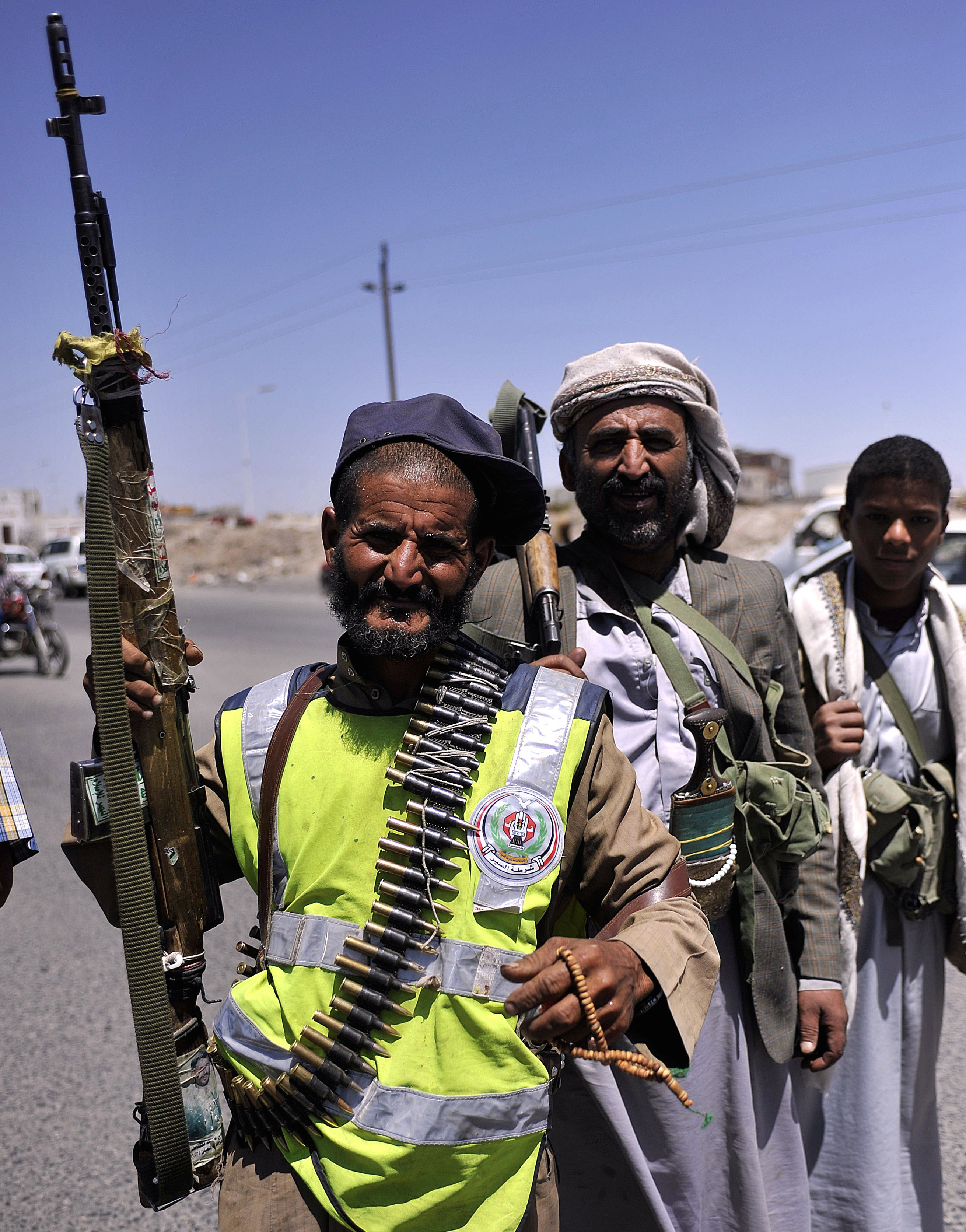
(Photo: Houthi rebels take position around Yemeni Government TV during the clashes between Houthi rebels and government forces in al-Caraf north of Sanaa, Yemen on September 21, 2014. By Mohammed Hamoud/Anadolu Agency/Getty Images)
Omar el-Jaffal explains how Iraq’s militias feed off the country’s political dysfunction:
[The militias] cannot sustain themselves except through manufacturing sectarian fear mongering and cannot attract new fighters except through the new wars that they wage. The egregious economic situation, coupled with the rise of unemployment rate among youth, plays a significant role in the increase of those who enlist in the militias and in the expansion of their scope of activity both in Shi‘i and Sunni areas. This is particularly due to the fact that these militias receive international, regional, and local funding. …
Taking into account the high population growth in Iraq (estimated at 3.1 percent), Iraq will remain a fertile ground for militias in the near future if al-Abbadi government follows in the footsteps of previous governments. This in turn, will lead skilled Iraqis, especially the youth, to leave the country making Iraq a state officially ruled by militias. Currently, none of the dominant Iraqi parties are making an effort to build a state that respects the constitution and takes security into its own hands. All parties prefer to deploy militias, rather than official troops, to maintain security in conflict zones because militias extend the influence of parties in the society. Parties expand the scope of activity for militias because the latter constitute a guarantee for them to remain in power and a tool to intimidate those willing to oppose them, not to mention the fact that allegations of corruption are mounting up against political parties.









 The Dish
