The Michael Moore Of The Right?

In an interview conducted as he awaits sentencing for violating campaign-finance law, Dinesh D’Souza reveals the inspiration behind the “documentaries” he’s produced, such as 2016: Obama’s America (trailer above) and America: Imagine the World Without Her:

I went back and watched Roger and Me, which I think is [Michael Moore’s] best film. It’s got an interesting premise: General Motors closes down a big auto plant that his dad happened to work at, and he’s going to go find the CEO of General Motors and demand to know why. Now, it fails intellectually, because there is an obvious reason why General Motors might want to close that plant—i.e., it’s not making money. And one possible reason it’s not making money is General Motors has been paying people like his dad way too much and can make cars much cheaper in North Carolina or other countries. You can’t proceed without confronting that argument. But Michael Moore’s presumption is that the CEO of General Motors, Roger Smith, is just a mean guy who wants to deprive working people of their livelihood. So intellectually, it’s ridiculous.

But visually, cinematically, narratively, it works. This clownish Michael Moore showing up everywhere, the cops in dogged pursuit. All of that works. What Michael Moore understands is that a movie traffics in the language of emotion. The intellect is subordinate to that.

On the Obama question, D’Souza is actually copying Moore’s intellectually ridiculous oeuvre.

He starts, as Moore does, with a crude reductionist idea of a public figure – Obama as seeking revenge on a colonial America – undergirded by nothing but D’Souza’s own pop-psychologizing of Obama’s relationship with his own father. Everything else needed to explain the actions of a center-left president (who has waged more wars in more places than most American presidents) is moot. For D’Souza, a crude narrative of racial revenge is all that’s really necessary to understand the Obama presidency – and he then simply adds layer upon layer to this caricature, which feeds paranoia and conspiracy theories and glib ideology as powerfully as Moore once did.

D’Souza once believed in making serious arguments for a more conservative view of the world. It’s telling about his own evolution – and the degeneration of public discourse in America – that he has largely given that up in favor of really lucrative propaganda designed to monetize the polarized red state masses. He’s another example of the power of the right-wing media-industrial complex. Its ability to reward its propagandists with fantastic monetary awards without any need to engage critics has transformed conservatism in this country – for the gridlocked, ideological worse.

Feeding Off Our Humanity

In Liberia medical care for is restricted due to  recent outbreak of the Ebola virus.

The latest on Ebola is even more alarming than you thought:

[N]ew research suggests that the speed at which it’s spreading is totally out of proportion to past outbreaks. Thomas House, a mathematician at the UK’s University of Warwick, used historical data from outbreaks reported by the World Health Organization24 in totalto create a mathematical model for the spread of the virus. By analyzing information on the timing of the outbreaks, the number of cases, and the number of people who died, he was able to develop a model that describes the pattern of all outbreaksexcept for one. The current outbreak is off the charts.

And House can’t explain why:

“It could be a mutation,” he said. “It could be that the way that society is structured has changed as West Africa’s developed: People are in contact with more other people. It could be that control efforts or the behavioral response are just different. My model isn’t detailed enough to say exactly which one.” It is detailed enough to raise the panic level, though.

And the UN is scrambling:

Acting on the initiative of the Obama administration, the 15-nation U.N. Security Council unanimously adopted a resolution [last] week declaring the Ebola virus a threat to international peace and security, and urging the U.N.’s member states to rally financial, political, and medical support to contain the plague. The resolution was co-sponsored by 131 countries, the largest official show of international support for a Security Council resolution in history, according to the United States.

“This is likely the greatest peacetime challenge that the United Nations and its agencies have ever faced,” Margaret Chan, the director-general of the World Health Organization, warned the council this week. “None of us experienced in containing outbreaks has ever seen, in our lifetimes, an emergency on this scale, with the degree of suffering, and with this magnitude of cascading consequences.”

Benjamin Hale shudders:

The most striking thing about the virus is the way in which it propagates. True, through bodily fluids, but to suggest as much is to ignore the conditions under which bodily contact occurs. Instead, the mechanism Ebola exploits is far more insidious. This virus preys on care and love, piggybacking on the deepest, most distinctively human virtues. Affected parties are almost all medical professionals and family members, snared by Ebola while in the business of caring for their fellow humans. More strikingly, 75 percent of Ebola victims are women, people who do much of the care work throughout Africa and the rest of the world. In short, Ebola parasitizes our humanity.

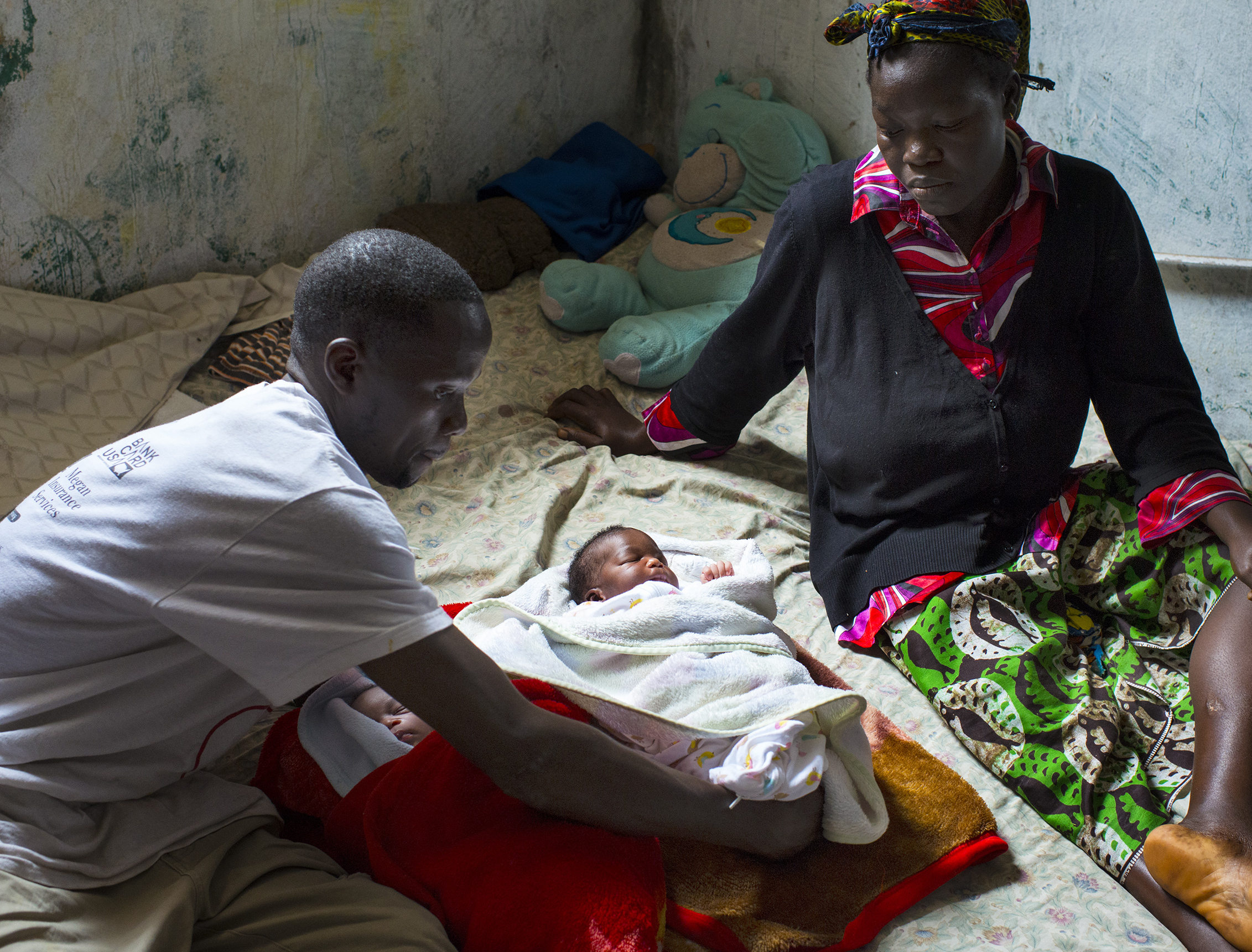
(Photo: Victor Fayiah, 40, and his wife Comfort Fayiah, 32, are seated on a mattress on the floor of a room with their twin girls, Faith and Mercy, discussing their ordeal in Monrovia, Liberia on September 19, 2014. Comfort went into labor and delivered the girls on the ground in the yard of her church assisted by a local medic and a church mother because she could not get medical care; most hospitals and clinics were closed for non-Ebola treatment. The closed facilities are an attempt to protect medical staff and other patients from Ebola. By Michel du Cille/The Washington Post via Getty Images)

Does The GOP Really Give A Shit About The Debt?

enator Lindsey Graham (R-SC)

It’s been a remarkable aspect of the foreign policy “debate” over the last month that I haven’t heard a single leading Republican express misgivings about a new Iraq war’s impact on fiscal policy. And yet, for a few years now, we have been subjected to endless drama about the mounting debt when it comes to anything the government wants to do. Cost was one (ludicrous) reason to oppose Obamacare; it’s behind cutting off 3 million long-term unemployed from any benefits; it has led to proposals to turn Medicare into a premium support system and for cutting social security. Some of this fiscal vigilance I find useful – if it weren’t so transparently  a way to dodge GOP responsibility for the debt and to blame Obama for all of it and if it weren’t raised as a matter of urgency when the world economy was deeply depressed (the one time when fiscal lenience is warranted). But it is hard to resist the conclusion, after the last few weeks, that it’s all a self-serving charade.

I mean: where are the fiscal conservatives now? The ISIS campaign is utterly amorphous and open-ended at this point – exactly the kind of potentially crippling government program Republicans usually want to slash. It could last more than three years (and that’s what they’re saying at then outset); the cost is estimated by some to be around $15 billion a year, but no one really knows. The last phase of the same war cost, when all was said and done, something close to $1.5 trillion – and our current travails prove that this was one government program that clearly failed to achieve its core original objectives, and vastly exceeded its original projected costs.

If this were a massive $1.5 trillion infrastructure project for the homeland, we’d be having hearing after hearing on how ineffective and crony-ridden it is; there would be government reports on its cost-benefit balance; there would be calls to end it tout court. But a massive government program that can be seen as a form of welfare dependency for the actual countries – Turkey, Iran, Jordan, Kurdistan – facing the crisis gets almost no scrutiny at all. And what scrutiny it gets is entirely due to partisanship and the desire to portray this president as effectively useless.

Now take a look at the international disgrace that is the resilient torture and detention camp at Gitmo. It has been kept in operation – despite the huge damage it does in our campaign to restrain Jihadism – by the same people who have been hyper-ventilating about a British loser decapitating innocents in the deserts of Mesopotamia. Its cost? They don’t care. But ask yourself: if this were a domestic program, would there really be any debate? Some context:

At a cost of $2.8 million per prisoner per year, Guantánamo is the most expensive prison in the world. (The costliest prison in the U.S., the Colorado Supermax, at $78,000 per prisoner per year.) And the costs will continue to rise as facilities that were built to be temporary, like the Camp America Dining Facility, deteriorate. In addition to the dining facility repairs, the 2015 defense budget also calls for $11.8 million to upgrade a medical clinic that was never built to serve an aging population of prisoners. Congress earmarked another $69 million to renovate Camp 7, the top-secret facility that holds the 15-high value detainees who were tortured in CIA black sites prior to their transfer to Guantánamo. In March, The Miami Herald reported that the ground below the facility had shifted, causing the floors and walls of the building to crack.

Obama took office and proposed saving the US much of that $15 billion, by transferring the tortured detainees to super-max prisons in the mainland. The GOP blocked it – and continue to. Their only arguments are an appeal to irrational panic and fear of terrorists – which, come to think of it, is their only real response to the latest Sunni insurgency in Iraq as well. Some of us held out hope that the sheer fiscal drain of a perpetual, lose-lose war against a constantly replenishing Jihadism empowered by our intervention might temper some of this unreason. But we’ve just seen how a couple of videos can snap the GOP – and most of the country – into a fiscally reckless “do something whatever it costs” mindset, in which the debt is the last thing on any Republican’s mind.

They are frauds and hysterics. Anyone who cares about our fiscal future and believes the GOP is the part of our polity most able to address it is deluding herself. The past and the present definitively say otherwise.

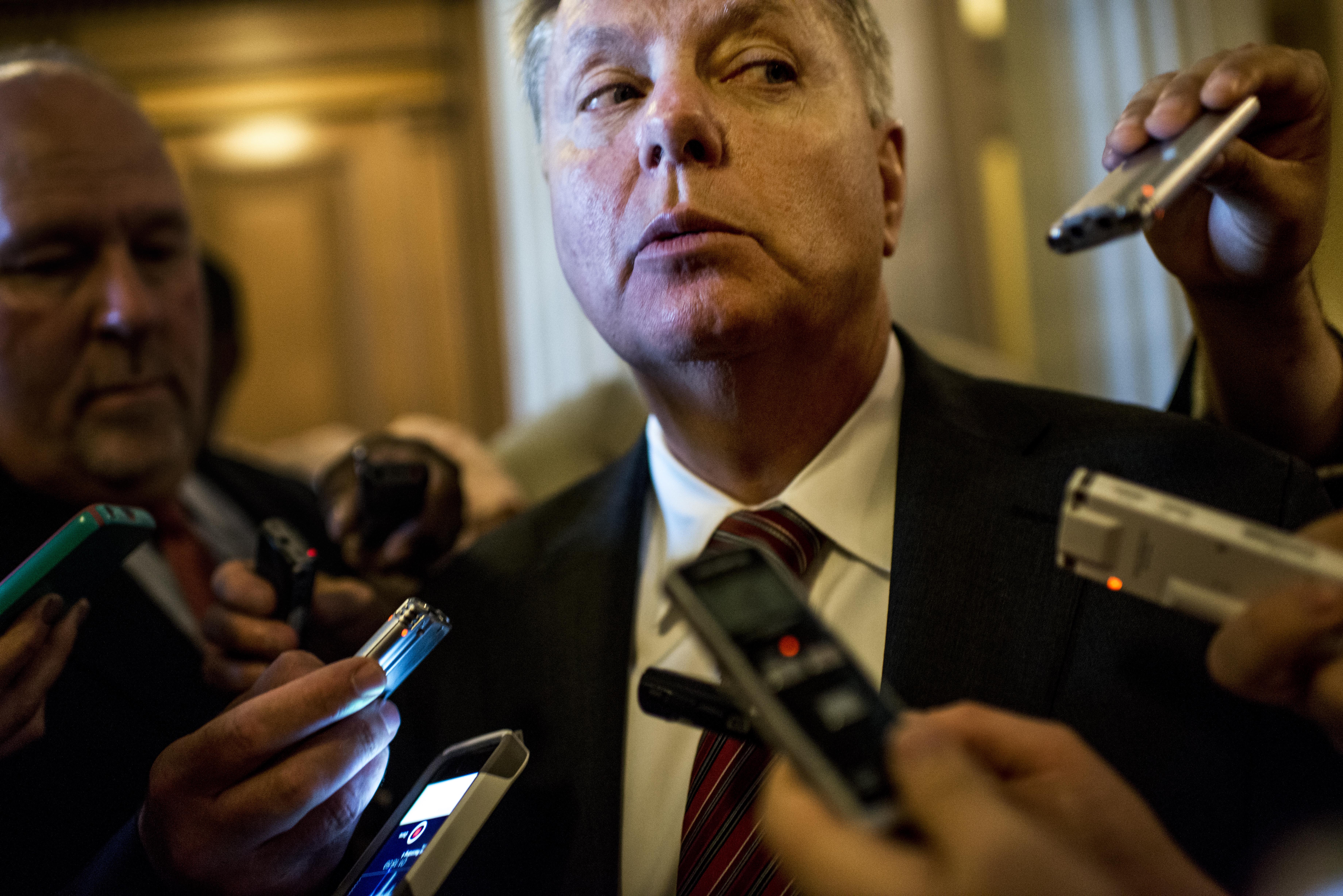
(Photo:  Senator Lindsey Graham (R-SC) coming off the Senate floor after votes is asked by reporters about the situation in Iraq and the capture of a suspect in the 2012 Benghazi attack, on Capitol Hill in Washington, DC Tuesday June 17, 2014. By Melina Mara/The Washington Post via Getty Images.)

A Hundred Thousand Displaced

TURKEY-SYRIA-KURDS-REFUGEES

The Guardian explains how this state of affairs came to be:

The border region of Kobani, home to half a million people, has held out for months against an onslaught by Islamists seeking to consolidate their hold over swaths of northern Syria. But in recent days, Isis extremists have seized a series of settlements close to the town of Kobani itself, sending as many as 100,000 mostly Kurdish refugees streaming across the border into Turkey. “I don’t think in the last three and a half years we have seen 100,000 cross in two days,” the representative for the UN refugee agency (UNHCR) in Turkey, Carol Batchelor, told Reuters. “So this is a bit of a measure of how this situation is unfolding, and the very deep fear people have about the circumstances inside Syria and, for that matter, Iraq.”

A Kurdish commander on the ground said Isis had advanced to within 9 miles (15km) of Kobani. A Kurdish politician from Turkey who visited Kobani on Saturday said locals told him Isis fighters were beheading people as they went from village to village. “Rather than a war this is a genocide operation … They are going into the villages and cutting the heads of one or two people and showing them to the villagers,” Ibrahim Binici, a deputy for Turkey’s pro-Kurdish People’s Democratic party (HDP), told Reuters.

Juan Cole marvels, “I lived to see the day when thousands of Kurds take refuge in Turkey”:

For anyone who knows the history of the Turkish government’s dirty war against Kurdish separatists in the 1970s and 1980s, it is a startling reversal to see Syrian Kurds flooding for refuge into Turkey. The influx was not smooth and Turkish security did at points try to stem it. But actually Turkey has something like a million Syrian refugees already.

The Kurds have since halted ISIS’s advance, it seems. Meanwhile, Aki Peritz doubts the US has the political will to defeat ISIS:

[I]t remains unclear whether America has the popular stamina to take on this group for what clearly will be a years-long struggle. The latest polling from the New York Times and CBS News show clear majorities approving airstrikes against ISIL fighters in both Iraq and Syria, but only 48 percent of Americans are in favor of training and providing military equipment to rebels in Syria—the fighters who would actually have to hold the ground presumably vacated by ISIL. Congress may have given President Obama the green light to arm the rebels, but it’s not clear the American people are behind him.

As the United States expands its air campaign and put more “advisers” on the ground in and around Iraq, will Americans continue to support this effort – and probable casualties? After all, without sustained public support, any extended military campaign is doomed to fail. And people are anxious about the lengthy time horizon: Some 83 percent of Americans are either “very concerned” or “somewhat concerned” with a long and costly involvement in Iraq and Syria.

Josh Rogin and Eli Lake examine the administration’s “mission to build an ISIS-killing army in Syria”:

Many lawmakers don’t see how training 5,000 Syrian rebels a year, assuming trustworthy, vetted brigades can be found, can defeat an ISIS army that the CIA estimates may already have 31,000 fighters and growing. “The goal is not to achieve numerical parity with ISIL, but to ensure that moderate Syrian forces are superior fighters trained by units,” Hagel said.

Even some lawmakers who support the plan don’t believe the administration’s claims that the Syrian rebels will only fight ISIS after being trained by the U.S., rather than focusing on their real enemy, the regime of Syrian President Bashar al-Assad. After all, that’s what the FSA is saying openly it plans to do.

Larison rolls his eyes:

No one seriously thinks that arming and training a few thousand rebels will make much of a difference or do much good, but it is the relatively risk-free option (for Americans) that provides a temporary sop to insatiable hawks while also providing cover for fence-sitters that want to be considered “serious” on foreign policy without having to take big political risks by backing more aggressive measures. Finally, many members of Congress endorsed this policy just so that they could get it off the agenda before the elections, so majority support in Congress for arming Syrian rebels may be shown to be illusory much sooner than we might have guessed.

(Photo: Syrian Kurds wait near Syria’s border at the southeastern town of Suruc in Sanliurfa province, on September 20, 2014. Tens of thousands of Syrian Kurds flooded into Turkey on Saturday, fleeing an onslaught by the jihadist Islamic State group that prompted an appeal for international intervention. By Bulent Kilic/AFP/Getty Images)

Can The Church Survive In America?

This embed is invalid


I used to believe – and a part of me still does – that the question of homosexuality was not that big an issue for Catholicism. Gays are only a tiny minority of the population at large; the power and beauty of the church’s core understanding of heterosexuality sustains most people’s interest and commitment; and the central teachings of Jesus – of forgiveness of sins, redemption, charity, mercy – are so much more important than issues relating to human sexuality and romantic love.

When I was asked – with mind-numbing regularity – how I could remain happily gay and a Catholic, I answered honestly that, for those very reasons, I could live with institutional dissonance, as any thinking member of a hierarchical church has to, from time to time. But I think now that I misread a couple of things – and that the whole question may be a much bigger deal than I once believed and hoped. Here’s a story that underlines the problem:

A Catholic church in Montana has told two gay men that they can no longer receive communion simply because of their gay marriage and, in order to do so again, they must file for divorce. The two men, Paul Huff, 66, and Tom Wojtowick, 73, have been together for over 30 years and were married in Seattle in 2013. They’ve attended Saint Leo The Great Catholic Church in the town of Lewistown since 2003 and have also been members of the church’s choir. The’ve also now been denied participation in that church group.

Maybe years ago, removing two faithful choir members because they’re gay would have passed some kind of muster. First off, the couple wouldn’t have been out of the closet and so the entire don’t-ask-don’t-tell paradigm would have allowed the pastor to ignore the fact that two gay men were in the choir – or to keep their expulsion on the down-low; second, they would probably have been too ashamed to protest, and their peers too embarrassed to support them. But those two conditions are now no longer close to being met:

Huff and Wojtowick have received support from many of the church’s congregation. Forty members have reportedly either voiced their disapproval of the church’s offensive decision or have quit attending mass there altogether. One parishioner has suggested the title of a song sung at the church be changed from “All are Welcome” to “Some are Welcome.” How apt.

The controversy has now led to the bishop intervening and holding a meeting with 300 parishioners to air views. The bishop claims there is polarization in the congregation over this and is now mulling the decision to bar the couple from the sacraments and from participation in their church – unless they get a civil divorce and sign a statement supporting civil marriage as exclusively heterosexual. Yes, the church is now in favor of divorce as a condition for being a Catholic! If that sounds perverse, you’re not wrong.

Here’s the problem: maintaining doctrinal orthodoxy requires penalizing two men, aged 66 and 73, who have been committed to each other for thirty years and are pillars of the local community. Here’s a brief profile of who these two men are:

Huff and Wojtowick have both historically been active in their community and in their church. Huff is a two-time past-president of the local Kiwanis Club, chairman of the Fergus County Fair Board, board member of the Lewistown Art Center and formerly served as an organist and cantor in the St. Leo’s church choir.

Wojtowick recently retired as executive director of the Central Montana Council on Aging, and has served as either a board member or chairman of the Lewistown Public Library, Lewistown Art Center, and as an adviser to the Central Montana Medical Center Home Health and Hospice Program. Wojtowick is a four times elected representative of the Fergus County Community Council.

It’s kinda hard to portray these two as some kind of subversive force. More to the point, the core reason behind the church’s position is the natural law teaching barring all non-procreative sex. I don’t know how much non-procreative sex the two men are now having, but it’s not entirely crazy to assume it’s no more than any heterosexual couple past menopause and in retirement. So the sodomy question has to be pretty moot.

And the action against the men came not because they are gay but because they decided to celebrate their love and friendship with a civil marriage license. So they’re not really being targeted for sex; they are being targeted for their commitment and responsibility and honesty. And the only reason they have been excluded on those grounds is because they are gay.

If the church upholds this kind of decision, it is endorsing cruelty, discrimination and exclusion. Pope Francis’ view is that this is exactly the kind of thing that requires the church to exercise mercy not rigidity. But allowing a married gay couple to sing in the choir as an act of “mercy” would merely further expose the fragility of the church’s thirteenth century views of human sexuality. It would put the lie to the otherness of gay people; to the notion that it is essential or even possible for a tiny minority to live entirely without intimacy or love or commitment. It also reveals that gay men have long been a part of the church – and tolerated, as long as they lied about their lives and gave others plausible deniability with respect to their sexual orientation. It is an endorsement of dishonesty.

None of this is compatible with the core moral teachings of the church – about fairness, truth, compassion, forgiveness, mercy and inclusion. And this is clear to large numbers of Catholics – especially the younger generation who will rightly view this kind of decision as barbaric and inhuman. There is only so much inhumanity that a church can be seen to represent before its own members lose faith in it. I recall the feelings of my own niece and nephew who lost a huge amount of respect for the church when they heard a homily denouncing the civil marriage of their own uncle. I notice the outcry among Catholic high school students when a teacher was fired for the very same reason. When a church responds to an act of love and commitment not by celebration but by ostracism, it is not just attacking a couple’s human dignity; it is also attacking itself.

What was once a blemish can become a defining wound. It has split one small parish. It may slowly wreck the whole church.

Update from a reader:

Question: Why would the church need these two men to get a “divorce”… for a “marriage” that isn’t even recognized by the Roman Catholic Church?

Possible Answer: Did a member of the Roman Catholic clergy just recognize and affirm the existence of a gay marriage?

Dish followups to this post here and here.
Saving The Planet On The Cheap

Last week, Krugman contended that it can be done:

I’ve just been reading two new reports on the economics of fighting climate change: a big study by a blue-ribbon international group, the New Climate Economy Project, and a working paper from the International Monetary Fund. Both claim that strong measures to limit carbon emissions would have hardly any negative effect on economic growth, and might actually lead to faster growth. This may sound too good to be true, but it isn’t. These are serious, careful analyses.

He noted the “dramatic progress in renewable energy technology, with the costs of solar power, in particular, plunging, down by half just since 2010.” But Michael Levi points out that the “optimistic cost estimates have little to do with cheap solar.” Those estimates are possible only when you figure in the impacts of nuclear power, carbon capture technology, abundant bioenergy, and increased efficiency:

Krugman does an important service by rebutting those on both the right and the left who claim that serious climate action requires turning our economic system upside down. (It’s a good guess that this Wednesday column from Mark Bittman, which basically called for the end of capitalism in order to deal with climate change, provoked Krugman to write his latest.) But the sorts of policies you pursue if you think that serious climate action is mostly about wind and solar are fundamentally different from those you pursue if you believe otherwise. A central upshot is that if the modeling exercises that Krugman touts are correct, and countries pursue policies based on a belief in wind and solar, the actual costs of cutting emissions will be far higher than what Krugman claims. At the same time, if the modeling exercises Krugman highlights are wrong, he hasn’t given us particularly strong reason to believe that steep emissions cuts would be cheap.

McArdle also throws cold water in Krugman’s direction. She hesitates to draw too many conclusions from the New Climate Economy study he cites:

The details are a bit fuzzy so far (the report promises more in a forthcoming technical appendix). But most of the benefit seems to come from reducing respiratory diseases in the developing world and ending fossil-fuel subsidies, which are, no matter what you may have heard on the Internet, also concentrated in the developing world, not the U.S. tax code. …

This is not to say that the report is wrong. But many of the people who read it seem to have come away saying, “OK, great, it’s free, why can’t we do it?” Even if this is a free lunch over the long term, it is not a free lunch right now to the people who would need to make major changes in their lives. No matter how long you point to the equations, they will resist.

The Nonprofit Football League

Philip Klein calls the NFL’s tax-exempt status “bad policy that exemplifies the problems with the nation’s disastrous tax code”:

The NFL’s nonprofit status was enshrined into law in a 1966 act meant to protect the league from antitrust issues surrounding its merger with the rival AFL (which was considered a lesser league until my Jets pulled off the greatest upset in football history in the 1969 Super Bowl). The same law added, “professional football leagues” to the part of the tax code listing entities granted nonprofit status.

Though the league distributes lucrative television and licensing revenue among the 32 teams, which do pay taxes on their earnings, the teams also send dues to the NFL league office. The office does not pay taxes on those dues, and the fees could be deducted from the teams’ taxes.

The NFL reported total revenue of $326 million for the 2012 tax year, according to its most recent publicly available filing with the Internal Revenue Service. During that year alone, the NFL paid $44.2 million in compensation to commissioner Roger Goodell. Goodell earned $105 million over the course of the five-year period from 2008 through 2012, according to a CNN report – more than any player.

Well, it might fall under the religious exemption, no? At this point, it requires blind faith to believe in its future. But Jordan Weissmann notes that revoking the NFL’s tax-exempt status “wouldn’t drastically change its finances”:

Only the league office, which considers itself a trade association for its clubs – just like the U.S. Chamber of Commerce or the National Dairy Council—is a nonprofit; the teams themselves are purely for-profit. As a result, pro football’s copious TV revenues are taxed once they’re passed down to the franchises. A separate, for-profit company called NFL Ventures, co-owned by the teams, handles the league’s merchandising and sponsorship earnings. Finally, the league office often operates at a loss—in 2011 it finished more than $77 million in the red, while in 2012 it only had $9 million left at year’s end. Without profits, of course, there’s nothing for the government to tax. …

Congress itself doesn’t think the NFL’s tax bill would be that big. [Tom] Coburn has suggested that taxing the NFL and NHL alone would raise about $91 million per year. But the Congressional Joint Committee on Taxation – probably a bit more credible in this instance – believes ending tax exemptions for all sports leagues would bring in just under $11 million per year. Booker hopes his bill would raise about $100 million over a decade, which would go to support domestic abuse programs. That’s a mere trickle compared with the geyser of cash the NFL generates each year.

However, he adds:

If money isn’t really the issue, what is? It’s about principles. Letting the NFL operate tax-free makes a mockery of the entire concept behind nonprofits, which is that we should give a special break to organizations that do the useful, unprofitable work normal corporations won’t.

Update from a reader with expertise on the subject:

As an accounting professor specializing in nonprofits, I wanted to reiterate the view that the NFL is not really avoiding any taxes with its status (true, it has a lot of revenues, but it shows even more expenses, so the profits are really held by the for-profit teams). I would also like to add that one big benefit of the NFL’s nonprofit status is that it requires the NFL to make its financial statements and executive pay public (without the required form 990, we never would have known that Goodell got a $40 million bonus in 2013). Here is a bit more on the misconceptions about the NFL’s nonprofit status.

In short, does the NFL deserve its nonprofit status? Probably not. Does stripping the status accomplish anything? Again, probably not.

By the way, thanks for your team’s consistently great work.

“It’s On Us”

Katie Zavadski flags a new White House campaign to raise awareness about sexual violence on college campuses:

Officials are hoping the new ads will be screened on youth-oriented television networks and shown at sporting events. In order to appeal to the collegiate demographic, the White House recruited celebrities like Questlove, Jon Hamm, Rose Byrne, and Cleveland Cavaliers center Kevin Love to film spots.

Elizabeth Nolan Brown, who has addressed campus rape in the past, has some doubts:

Reading [Jeffrey] Zients’ post, I was reminded of author and professor Joel Best speaking on the hallmarks of how media hype (and the attendent bogus statistics) get promulgated: First there is a high-profile tragic event, then the need to define the event as part of an identifiable Problem (“the heroin epidemic”), and then a desire to quantify the problem so as to place it in a larger context. I put “campus rape crisis” in quotes not to diminish the seriousness of sexual assault but because I think the phrase is a prime example of the phenomenon Best describes. Rape is a problem wherever it happens, which is sometimes on campus and more frequently not. The “campus rape crisis” is a thing perpetuated by people interested in profiting from the fear in various ways.

When you make up a problem—and again, let’s be clear that I’m not saying rape, the underreporting of rape, or the way campuses handle rape is a made-up problem, but rather the idea that college campuses are some sort of rape epicenter—it is much easier to get credit for solving that problem. The White House doesn’t actually have to impact rape rates or rape prosecution rates or anything tangible, because that’s not how it has defined the problem. Its central concern is raising awareness about rape on college campus, a goal both amorphous and measurable in Facebook likes.

Meanwhile, the movement against college sexual assault continues on the campuses themselves. Columbia student Emma Sulkowicz’s mattress project is back in the news. Vanessa Grigoriadis contextualizes Sulkowicz within broader cultural trends:

A few years ago, an Ivy League student going public about her rape, telling the world her real name—let alone trying to attract attention by lugging around a mattress—would have been a rare bird. In America, after all, we still assume rape survivors want, and need, their identities protected by the press. But shattering silence, in 2014, means not just coming out with an atrocity tale about your assault but offering what Danielle Dirks, a sociologist at Occidental, calls “an atrocity tale about how poorly you were treated by the people you pay $62,500 a year to protect you.” By owning those accusations, and pointing a finger not only at assailants but also the American university, the ivory tower of privilege, these survivors have built the most effective, organized anti-rape movement since the late ’70s. Rape activists now don’t talk much about women’s self-care and protection like they did in the ’90s with Take Back the Night marches, self-defense classes, and cans of Mace. Today, the militant cry is aimed at the university: Kick the bastards out.

The World’s Biggest Climate March

Over 300,000 turned out in NYC yesterday:

Bill McKibben isn’t holding his breath for an international climate deal:

The collapse of the Copenhagen climate conference in 2009 was a signal event in diplomatic history, calling into question the ability of our societies to act cooperatively in the face of clear scientific warnings. There is no prospect of anything much happening next week at the climate summit, either. As Mark Bittman memorably put it in the New York Times: “The summit is a little like a professional wrestling match: There appears to be action but it’s fake, and the winner is predetermined. The loser will be anyone who expects serious government movement dictating industry reductions in emissions.”

Which is why McKibben helped organize Sunday’s climate march. His reasons for marching:

As individuals, there’s not much we can do. We can change our light bulbs—and we should—but doing so won’t change global warming. It’s a structural, systemic problem that needs to be addressed structurally and systemically. The most important rule for an individual in this fight is to figure out how not to remain an individual, how to join a movement big enough to change the politics. There’s no guarantee that we’re going to win, because it’s a timed test. In this case, if we don’t win pretty soon, it’s going to be a moot point.

Amy Davidson asks, “Whom did the march change?” She figures this is possibly “a more enduring question than what it changed, which, on an immediate policy level, might not be so much”:

Though the march was big, the coverage was fairly muted. Maybe it will still be effective; perhaps the numbers will persuade some politicians that more people care than they thought. But its less predictable legacy might be helping some people who were in the crowd, or who saw pictures of it, realize that they care more than they thought. Some might even become leaders, or—stranger things have happened—politicians. Marches like this may not be the planet’s last hope, but they may be a last chance to persuade a generation that the profession of politics is not entirely disconnected from the planet’s great problem.

Ronald Bailey takes issue with the marchers’ opposition to biotech, fracking, and nuclear. And with their hostility to capitalism:

[T]here is one placard with which I wholeheartedly agreed, “Enough, For All, Forever.” Sadly, many of the marchers oppose the only system that has ever enabled hundreds of millions of people to rise above humanity’s natural state of abject poverty.

Byron York also puts a negative spin on the march:

[T]he People’s Climate March was one long, loud, loosely organized demand that vast sums of money be taken from the wealthy and given to the clients of the coalitions and alliances and networks and task forces that make up today’s environmental justice movement. They’ve had enough of debating climate models. They want to start taking — now.

Juan Cole admires the marchers. But:

I just do have to point out that holding large rallies doesn’t always result in political change. It is by organizing at the district level, walking neighborhoods, and putting pressure on those running for Congress that we would get real legislative change. Some activists are such purists that they sniff at giving political contributions. Likewise, disinvestment from oil and gas companies is a great symbolic gesture but it doesn’t stop global warming.

He argues that “a single-issue Climate PAC, if well-funded, would make far more difference than standing in the street.” Sally Cohn is more upbeat:

The big greens “have to shift the way they do business, from being large top-down institutions to being accountable to democratic bases and practicing democratic decision-making,” said Ananda Lee Tan, representing the Climate Justice Alliance as a lead organizer behind the march. There are also still political rifts; the grassroots groups oppose big green support for corporate-backed cap-and-trade, and the big green groups refused to officially support the Flood Wall Street action the day after the march that will connect climate change with structural inequalities in capitalism.

These rifts may not be resolved any time soon. But for the first time in recent memory, grassroots organizations have been equal partners at the table with national groups, working in coordination, cross-racially, to organize a massive event. Whatever the outcome of the march, this process — and the relationships built as a result — will hopefully transform and strengthen the movement for the future.

Scotland Stays, Ctd

Clive Crook contends that last week’s vote “settles nothing”:

Here’s the problem. If the nationalists had won, they’d have started a risky, costly transition, but the final destination would have been clear. The unionists’ victory avoids that short-term pain but prolongs the constitutional uncertainty indefinitely. Cameron might wish things were “settled,” but they aren’t. The demand for independence isn’t going away. When you consider the apocalyptic predictions of the No campaign, the Yes campaign’s transparent dishonesty (on taxes and spending) and incoherence (on the currency), the threats of Scottish businesses to move south, and the rock-solid consensus outside Scotland that leaving the union would be a tragic error, 45 percent support for independence suggests a certain resilience.

Larison agrees that the conflict is not yet over:

As we have already seen, instead of settling anything the referendum has produced new promises of devolution for Scotland and increased demands in England for significant changes to the current system. The former probably can’t or won’t be honored, since they were made on the fly without the consent of the rest of the U.K., and that will eventually mean another referendum. In that case, unionists won’t be able to make credible offers of greater devolution, and that would make it more difficult to avert independence later on.

But Keating begs to differ:

I suspect British politics will return to normal fairly quickly. Some have also predicted that the independence movement isn’t quite done yet, and that there’s potential for a Quebec-style “neverendum” in which independence becomes a perennial debate. But with the aftermath of the euro crisis and an unpopular Conservative government in power in London, this was probably the best opportunity available for Alex Salmond’s Scottish National Party. The independence advocates took their best shot, missed, and probably won’t get another one as good for a while.

Meanwhile, John Cassidy notes that “As Salmond and the ‘Scottish question’ recede from the headlines, the ‘English question’ could well replace them.” Crook explains:

Recall that the Scots, despite having their own parliament in Edinburgh, currently enjoy the bizarre privilege of sending Scottish members of parliament to Westminster to vote on English-only matters (not to mention a fiscal bonus called the Barnett formula, which underwrites higher public spending in Scotland). Because Scotland leans to the left, this arrangement has been vital in maintaining the strength of the Labour Party in the south. You’ll be shocked to learn that it was a Labour government (led by Tony Blair, born and educated in Scotland, and Gordon Brown, a Scot representing a Scottish constituency) that enacted it.

A new round of devolution, with Tories in charge in London, opens this Pandora’s box. To meet the demands of English conservatives, Cameron has said that the rest of the U.K. must now get devolution, too –English votes on English policies. The prospect is a constitutional restructuring almost as radical as the one implied by full independence for Scotland.

The question is already splitting the parties:

On Friday morning, the No victory in Scotland’s independence referendum just hours old, David Cameron stood before 10 Downing Street and set a trap for the opposition. The new powers pledged to Edinburgh during the campaign would be transferred on the promised, fast timetable, he confirmed. On the same timetable, he added (in a barb reportedly devised over curry with George Osborne the night before), William Hague would work on plans for English-only votes on English matters. …

So far Labour has brushed aside the proposal. It is self-interested, cynical and drawn up on the back of a fag packet, party figures avow, rightly pointing out that there had been no agreement to link new Scottish devolution to solving the English question. In an interview with Andrew Marr this morning Ed Miliband countered that it would be hard to separate parts of legislation only affecting England from those affecting the rest of Britain, and that EVEL would create two classes of MPs. He wants a constitutional convention, a longer, more exhaustive and more bottom-up process than the constitutional supermarket-sweep proposed by Mr Cameron, one also encompassing devolution to city and regional authorities within England.

These points are all entirely valid. But they risk making Labour look as self-interested as the Conservatives. And the question is not likely to go away. According to the British Social Attitudes and Future of England surveys, the proportion of voters “strongly” supporting EVEL rose from 18 percent in 2000 to 55 percent in 2012. The imminent transfer of new powers (particularly tax-raising ones) to Holyrood will only accentuate that trend.

Zooming out, political scientist Graeme Robertson suggests that “the key lesson from the Scottish referendum is something that scholars have long known but that citizens and politicians often seem to miss – allegiance to states is highly malleable and can be quickly changed by events, even in an old country like Scotland.”