West Africa’s 9/11?

The West African country of Liberia is crippled by a recent outbreak of the Ebola virus.

Compiling coverage of the Ebola epidemic from around the region, Margaret Hartmann points to a reflection by Liberian journalist Makanfi Kamara on how the outbreak, whose death toll is approaching that of September 11, 2001, is impacting her society in a similarly extreme way:

The Ebola virus has not only caused tragedy and changed the lives of people affected, but it has also drastically affected our life style. Liberians are so used to greeting each other by touch – a hand shake here, an embrace there, even a kiss. Where we used to share cups, bowls and spoons; beds, clothes and shoes; we now think thrice about potential threats of infection from our closest friends and relatives. Instead, we wash hands religiously at every door post, keep a distance beyond arm’s length and sometimes bow to greet each other like the Chinese. Some women have even put their male partners “on dryer” – a moratorium on sexual activity until the Ebola Season is over. And many men have admitted that, fearing for their own lives, they have decided to “abide by the rules of the game” – fidelity.

There are also direct and indirect psychological effects:

where members of households and families are infected with Ebola, the dichotomy of care vs. neglect persists, because of the fear of infection being transmitted. Where armed government forces go shooting at unarmed people contesting an imposed quarantine; or where family revenue streams get dried up because of epidemic-preventive regulations imposed by government or private employers; it gets really disturbing and forces people to find new ways to adapt to the situation. Then, there is the sight of dead bodies lying all over, in the streets; and the depression of thinking you could be next and the stigma it leaves you with.

Alex Park remarks on the chaos:

On Monday, Liberia’s legislature announced that the House of Representatives had canceled an “extraordinary sitting” to discuss the outbreak because its own chamber had been tainted by “a probable case of Ebola” and was being sprayed down with chlorine. The statement didn’t specify the source of the infection, but it noted that one of the chamber’s doormen had recently died after a “short illness.”

Liberia is ill-equipped to fight off the Ebola outbreak. Its entire national budget for 2013-2014 was $553 million, with only $11 million allotted for health care—about what Kanye West and Kim Kardashian are estimated to have spent on their Bel Air mansion in 2012. Despite its meager resources, last month Liberia’s legislature allocated $20 million to battle virus. But the nation had already burned through a quarter of that money by the first week of September.

James Gibney wants China to pitch in, considering its deep economic investment in Africa:

With much fanfare, China has said it will increase the number of its medical personnel in Sierra Leone to 174 and raise its total amount of assistance to roughly $37 million. I know, I know: Relative to the U.S., China remains a poor country, and its growing willingness to extend humanitarian assistance outside its borders is a good thing. But consider this: China has close to 20,000 citizens working and living in Guinea, Liberia and Sierra Leone. Setting aside U.S. money flowing into Liberia’s lucrative shipping registry, China’s investment in those three countries dwarfs that of the U.S. (In fact, China’s trading relationship with Africa overall is twice that of the U.S.) It recently signed deals for iron ore mining in the region that collectively run into the billions of dollars.

Laurie Garrett fears that the US military mobilization announced yesterday won’t be enough to curb the epidemic:

Nothing short of heroic, record-breaking mobilization is necessary at this late stage in the epidemic. Without it, I am prepared to predict that by Christmas, there could be up to 250,000 people cumulatively infected in West Africa. At least 30 nations around the world, I dare predict, will have had an isolated case gain entry inside their borders, and some will be struggling as Nigeria now is, tracking down all possibly exposed individuals and hoping to stave off secondary spread. World supplies of PPEs (personal protective equipment, or “space suits”), latex gloves, goggles, booties — all the elements of protection — will be tapped out, demand exceeding manufacturing capacity, and an ugly competition over basic equipment will be underway.

The great African economic miracle will be reversing, not just in the hard-hit countries but regionally, as the entire continent gets painted with the Ebola fear brush. Mortality due to all causes will soar in the region, as doctors, nurses, and other health care workers either succumb to Ebola, become full-time Ebola workers, or flee their jobs entirely.

But a reader objects to the doomsaying of Michael Osterholm, whose op-ed last week stoked fears of the virus mutating and becoming airborne:

Ebola is a horrible disease, but fear mongering over such an unlikely scenario hinders our ability to fight it properly.  We’ve already seen people raising concerns over flying patients back to the US for treatment when this is actually quite a safe scenario if proper precautions are taken.  The difficulty in Africa is they lack the healthcare infrastructure to take those kinds of precautions at a high enough level to prevent the disease from spreading.

It’s also worth keeping in mind that the forces of evolution not only push Ebola towards spreading more effectively but also towards being less lethal.  Dead patients don’t spread viruses very well.  So while random mutations could, in theory, make it airborne, what’s even more likely is random mutations would make Ebola non-lethal. What makes the virus scary is also what makes it evolutionarily unsound, and in the long run, that’s a good thing for all of us.

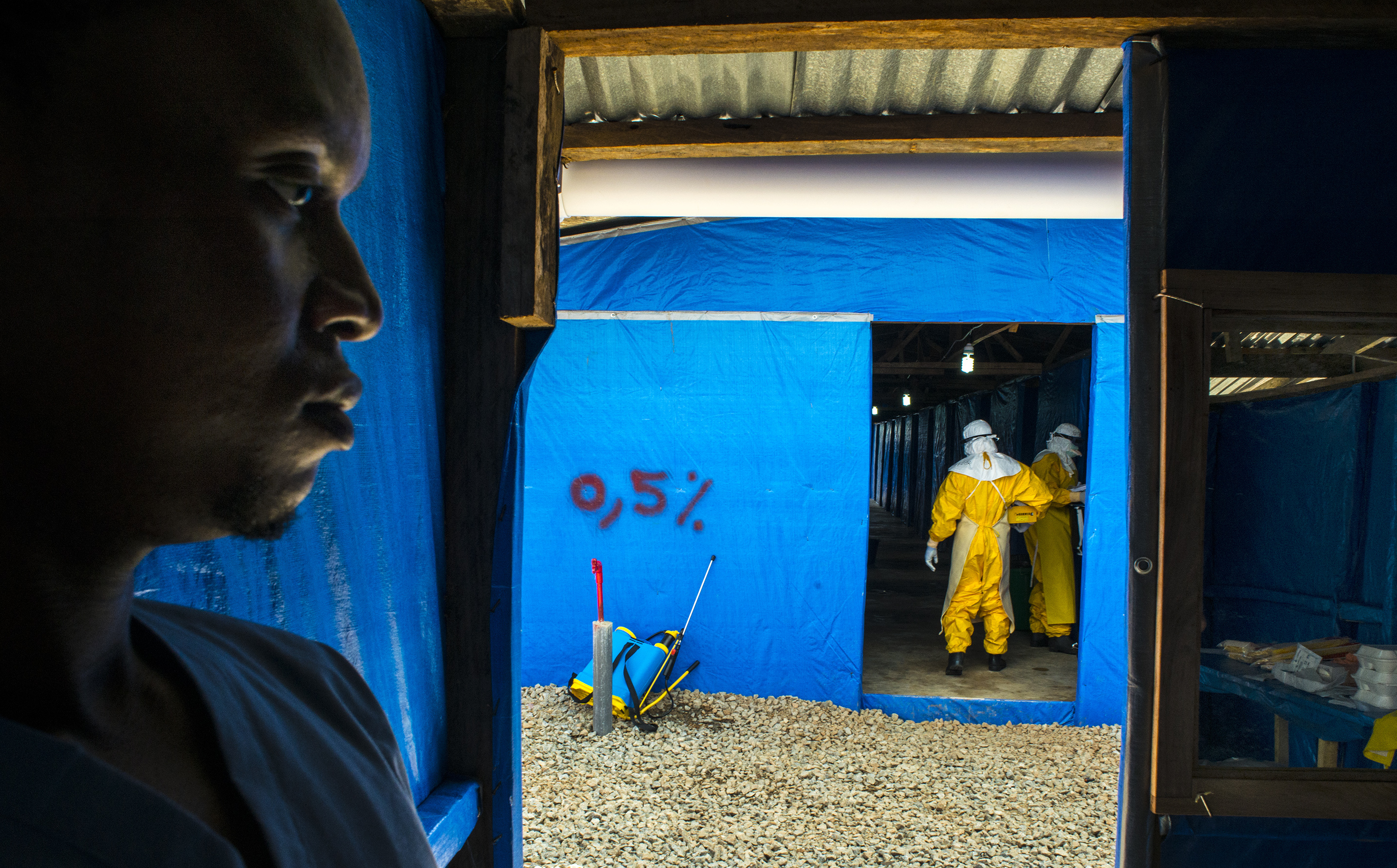
(Photo: James Momoh stands by as colleagues enter the suspected Ebola case ward Bong County Ebola Treatment Unit, on Tuesday September 16, 2014. The newly opened 50 bed unit is managed by International Medical Corp, and was built by Save the Children. By Michel du Cille/The Washington Post via Getty Images)

A Vote Against Inequality?

Katie Engelhart views the Scottish vote as a manifestation “of the increasingly hot debate about rising global inequality and what we should do about it”:

Scotland’s pro-independence movement differs from similar movements in places like Catalonia, Kurdistan, and eastern Ukraine in that it does not revolve around hard identifiers like language, religion, and ethnicity (or Russian military backing). What divides Scotland and England is a vocal lilt and a legacy of 14th-century clan warfare—seemingly surmountable obstacles to keeping a country together. As a result, Scottish nationalists have taken to claiming that London is to blame for all of Scotland’s economic ills. They contend that, with independence, Scotland can strike a different kind of compromise with its citizens. They argue that a vote for independence is a vote against inequality.

Reporting from Scotland, Noah Caldwell heard over and over again “the belief that Scots are fairer, more caring and more egalitarian than the rest of the United Kingdom”:

Initially a bemusing, inconsequential assertion, after enough repetition I realized it was a fundamental motivator for Yes voters, and therefore key to understanding independence. Since Scottish nationalism isn’t an outright ethnic, religious or linguistic movement, it relies heavily on socio-cultural definitions of “Scottishness”—namely, a shared egalitarianism. It’s the bedrock of the country’s liberal politics. It’s why First Minister Alex Salmond believes Scotland will be the next Denmark or Norway. Its roots, however, are hard to pin down, and even harder for Scots to explain to a panting American journalist on a beat-up retro road bike. It is, essentially, a living, breathing myth.

Gordon Brown connects to push for Scottish independence to globalization:

Globalization comes down, in practical terms, to the shift from the national sourcing of goods and services to their global sourcing, and from a reliance on national flows of capital to global flows, and it is matched by our ability to communicate easily and instantaneously beyond old borders and around the world.

And secessionist groups may be on the rise not in spite of these global forces — but because of them. In the years of the Industrial Revolution, people turned to political nationalism to cushion their regions against the uneven, inequitable patterns of growth. Now, people who see themselves as victims of change are turning back to — and organizing their politics around — old loyalties and traditional identities. They seek to insulate themselves against what appears like an unstoppable juggernaut of economic disruption and social dislocation. But because change seem to threatens to sweep aside long-established customs, values and ways of life, political nationalism becomes a credible vehicle for their response.


Scotland’s Day Of Reckoning

The Guardian is live-blogging the Scottish vote. From their afternoon summary:

A final poll has put the no vote on 53% and yes on 47%, in line with other recent predictions. The poll, by Ipsos Mori for the London Evening Standard, also found that 90% of Scots said they intended to vote today, with 57% saying they based their votes on hope more than fear.

Ben Page, the chief executive of Ipsos Mori, unpacks that poll:

[T]here is the idea of “silent Nos” – that there is a spiral of silence making some intimidated “No” voters less likely to agree to take part in surveys at all, or to say they are undecided or refusing to say how they will vote and biasing the sample. The challenge for us is spotting them in the polling data and how to treat them. If “shy Nos” really don’t want to take part in even internet surveys, or completely private phone calls, then even with samples that are demographically matched to Scotland’s population, we will be understating the size of a No vote. We will see.

The Guardian is also keeping tabs on the voting process:

Polling stations have been busy all morning, with some reports of queues, but there have been no complaints of intimidation of voters, and the threatened potential “carnage” has not been in evidence. Unconfirmed reports suggest that there has so far been one arrest at a polling station.

Murdoch dismisses reports of violence:

Carl Bialik explains when to expect results:

For the election junkies who want to watch results as they come in, I’ve put together a guide to how early Friday morning could unfold: when the 32 local councils can be expected to report their constituents’ vote counts, what percentage of the electorate each area represents, and which way voters from each area can be expected to lean. The registered voter numbers are solid and were provided Wednesday by Dougie McGregor, who works in the office of the referendum team’s chief counting officer. (He said those numbers might change slightly when final counts are available.) The times and the electoral lean, though, are rough enough to warrant a number of caveats

His guide:

Scotland Vote Guide

Husband Beaters, Ctd

Another reader shares his story:

I am a large, physically capable male who worked as a bouncer in bars through most of university. My ex-wife was emotionally and physically abusive. She would hit/attack me without warning, sometimes when I was asleep, sometimes during sex (out of the blue), rarely in front of witnesses, even though the kids saw her do it a couple of times.

When my ex-wife would hit me, I would challenge her later (after a cool-down). I would ask her why she did it, and why she felt it was ok to hit me, but not ok for a man to hit a woman. Her response was a few apologies, many deflections and dismissals, and often “My mom did a lot worse to my dad.”

FYI: for very personal reasons, I am a violence-against-women activist and have been since my late teens. I do not strike or abuse women. I am a firm feminist. My ex-wife would use that to her advantage, knowing I wouldn’t respond other than verbally and to try to protect myself without striking back. I didn’t even grab her wrists – except once, when she attacked me while I was sleeping and I was disoriented on awakening.

My ex-wife was abused/beaten by her mother and sexually abused by a family member. I tried very hard to be understanding and accommodating of her life trauma. Some of the writers on this thread, and in articles on other sites, have minimised the kind of injury a woman can effect on a large male. Some writers even call them “little taps” and “harmless taps”.

I still have PTSD flashbacks from my ex-wife hitting me, with her fists or other objects, or a pillow or fists during sex, because she had a sudden flashback to the sexual abuse she suffered as a child and she lost self-control (and chose to lose it).

My two now-adult children are still edgy around the subject. They were witnesses to their mother hitting their father – however “little” the blows were. The blows she landed caused no permanent physical injury, but they were in no way harmless. While I understand the context of my experience and my ex-wife’s issues, the lasting pain of those “little taps” is pretty profound (that and the emotional abuse that accompanied it). I have difficulty getting people to believe the deep emotional injury those “harmless taps” caused, and I have been mocked for my ongoing anguish.

Under male stereotypes, I should be just brushing off the fact that the person I ostensibly loved most (my spouse) perpetrated physical violence against me on a regular basis.

Another sends the above video:

Long-time reader, sometime emailer here (you’ve actually published a couple of my emails a few years back, about Bioshock/Ayn Rand and about loyalty to a sports team). Full disclosure: I’m male, I have never been the victim of domestic abuse, so this is not something I’ve ever experienced (thank goodness). I’ve been following your “Abuse In The Public Eye” thread for some time, and I am not at all surprised that there are stories of women domestically abusing their husbands/boyfriends.  When I was a teen and a college student, I assumed that if there was a case of domestic violence it would be a man striking a woman.  That is, until I saw a stand up routine by Christopher Titus.

This is a man, in his 40s, who’s had a very rough life (psychotic mother who committed suicide, alcoholic father) and the way he deals with it is basically making a comic routine out of all the awful things he’s had to deal with. His awful experiences include an ex-girlfriend who would physically abuse him.  Now, much of the information is from a comedy routine, so it’s played for laughs, but as Titus puts it, his girlfriend would routinely lose her temper (because she was bipolar) and “crack me in the face”.  But he doesn’t leave.  He stayed for months, even moving in with her after she beats him up watching a Christmas special.

The Great “Unraveling”?

[Re-posted from earlier today.]

I’m a huge admirer of Roger Cohen’s writing – and can appreciate many of the thoughts percolating in his latest column on what he sees as a disintegration of the world order. He manages to cite Scottish independence, the rise of ISIS, and the devolved powers to Eastern Ukraine – and even Ebola! – as part of a trend toward dissolution and anarchy.

But when I look at all the developments he is citing, I don’t really see anything that new. Take Iraq – please. What we are witnessing is the second major Sunni revolt since they were summarily deposed from power by the United States in 2003. How is this new? The Sunnis have long since believed in their bones that Iraq is theirs by right to govern. They despise the Shiites now running the show. The entire construct Syria_and_Iraq_2014-onward_War_mapof Iraq in the first place was designed on the premise of permanent Sunni rule over the majority. That rule necessarily had to be despotic – as all attempts to permanently deny rights to a majority in the country must be.

So we removed the despot – as we did in Libya – and we have an ongoing power-struggle that is a continuation of the same power struggle Iraq has been hosting since time immemorial. I mean look at that map on the right, from Wiki on the current division of power and land in Iraq. Does it look familiar? It looks like every map of Iraq’s sectarian divide since time immemorial. And we think we will change that by air-strikes?

My fear is that the catastrophic error of 2003 will never lead to a stable state, because the Sunnis will never tolerate or trust majority Shiite rule. Yes, we bribed them enough to switch sides temporarily in the “surge”. But they knew we’d leave; and they knew what they had to do when we did. The only conceivable way to avoid such a scenario would be to stay in Iraq indefinitely – but that too is untenable, for both the Iraqis and for us.

The Beltway nonetheless decided – against all the evidence – that the surge had worked, that sectarian passions had subsided, and that a multi-sectarian government would be able to overcome the profound rifts in Iraqi society that have always been embedded in its DNA. We were sold a bill of goods – by Petraeus and McCain and the other benign imperialists. They have spun a narrative that Iraq was “solved” in 2009 – and that the absence of US troops led to subsequent failure. But they flatter themselves. We never had any real reason to believe these sectarian divides had been overcome – and after a decade of brutal and traumatizing mutual slaughter, why on earth would they be?

Iraq was unraveled in 2003; in my view, it has thereby become the battle-ground for the simmering, wider Sunni-Shiite civil conflict that has also been a long-running strain in the region. Our own solipsistic focus on ISIS as another al Qaeda against us – again the narrative of the utterly unreconstructed neocon right and the pious interventionist left – misses this simple fact. We cannot see the forest for our own narcissistic tree.

When you look at Russia and Ukraine from the same historical perspective, the unraveling meme also seems unpersuasive. Russia is a proud and ornery and mysterious country. It has gone from global super-power to regional neo-fascist state in a matter of decades. Its sphere of influence has retreated from the edge of Berlin to the boundaries of Ukraine, which it simply controlled for an extremely long time.

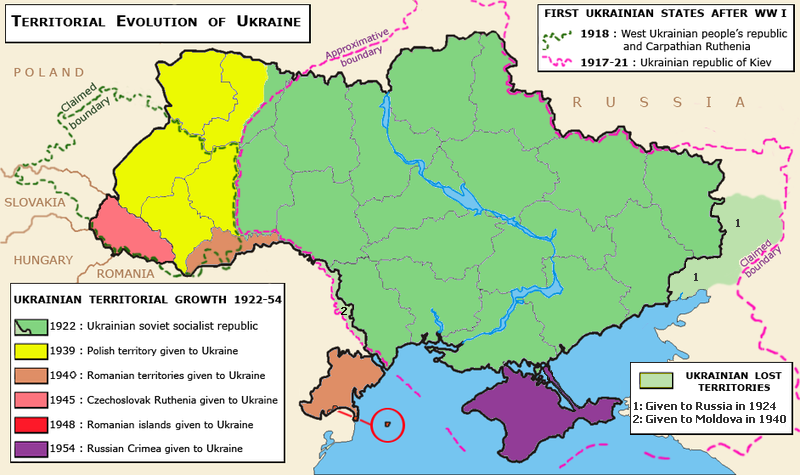
Ukraine has never existed as an independent country for very long; as you can see from another Wiki map on the left, it is itself a cobbled together mix of land lost to Russia, gained from Poland and Czechoslovakia and Romania. It was “given” the Crimea by the Soviets only in 1954. And throughout, Russia has obviously been its big brother, with a deep belief in its right to dick around with its near-abroad (a similar historic belief to the Sunnis faith in their own right to rule).

Ukraine-growthAnd what is sometimes lost in all this is that the last pro-Russian leader of the country was democratically elected and then deposed by a revolution from the European-centered populations of the West of the country. Russia did not start this; it reacted to a sudden, revolutionary loss of a pliant neighbor. Anyone with any inkling of Russian history would know what would happen next. I’m not defending Putin’s military and pseudo-military aggression. I am saying that the resolution reached this week – with significant autonomy for the Eastern, Russian-speaking provinces together with a new trade pact with the EU is a perfectly logical way to resolve this. And if Scotland demands outright independence, who could deny the East Ukrainians for wanting more autonomy?

Then Scotland. I don’t know what will happen – and, yes, the term “unraveling” is the most apposite in this case. But what the campaign has shown is that the unraveling has already taken place, that the desire for self-government and the disdain for the Westminster elites have combined to make the current arrangement anachronistic. But that kind of change – conducted democratically and peacefully – is not the same thing as an undoing. It is an adjustment to an emergent, new reality. And it increases democracy in the UK, rather than diminishing it.

What I’m saying is that America is in great danger of over-reacting to all these things, and blundering into new errors because of a generalized anxiety about declining relative US power, and PTSD from 9/11 in which every Jihadist in a hummer with a knife and a social media presence is imminently going to come over here and slit our collective throats. So my “hysteria” about this new, unknowable, fast-escalating rush to war is actually the opposite. It’s really a call to calm down, to breathe deeply, to stop reacting to the news cycle like neurotic lab-rats and to remember history – ours and theirs.  And to carry on.

I thought Obama was the man to sell this message. But he has been overwhelmed by the collective freak-out. Maybe he’ll regain his composure, keep this war limited and contain these loons for others, with much more at stake, to fight. Or maybe American amnesia will take hold again – and the Jacksonian impulse will once again trump every rational attempt at a foreign policy that isn’t always doomed to repeat the errors of the past. From the way things are going, it’s America’s own history of Jacksonian violence against outsiders that will prevail. We believe we are immune from history – that it can be erased, that what matters is just the latest news cycle and the political spin that can be applied to it. But history will have – and is having – the last word.

“Scotland’s Impending Disaster”

BRITAIN-SCOTLAND-INDEPENDENCE-VOTE

That’s how one reader puts it:

I am an American and I love Scotland and Scottish culture. My father is from Scotland, my grandfather served as an officer in a famous Scottish regiment, The Black Watch, and he was given an award for bravery posthumously by the King of England in WWII. I am involved with Scottish charities in the US and have been a Trustee representing one of the largest Scottish charities here in the U.S.

Sometimes when dealing with the home country, I’ve heard my fellow Scottish-Americans mutter, “The smart ones left”. I can’t help but feel this may be true, as the “Yes” vote seems an increasing possibility.

Who rules who? The last three prime ministers are Scottish or of Scottish descent. The Scots have historically been a force at the Bank of England. Scotland is subsidized by the rest of the U.K. and, unlike the English, they have their own separate parliament. In fact, it makes (barely) more sense that England would tell Scotland to leave at this point, rather than the other way around.

This isn’t the thirteenth century or even the seventeenth century. There’s 300 years of cooperation and prosperity with the English. Where was Scotland before the Union in 1707? It was broke! That’s why they agreed to join. The U.K. assumed their debt and gave Scotland access to their markets to trade. I hope they like independence, because they’re coming out the same way they went in.

Oh and by the way, the only people the Scots like to fight with more than the English are with each other. You can see it now with the violence and intimidation (mostly by the SNP it seems) as the vote gets closer. And if there’s a “Yes” vote in Scotland tomorrow, get ready for a Shetland Independence vote as well. Huge economic incentive for these folks with a big slice of what’s left of the North Sea oil. We reap what we sow …

Another is also worried:

While we wait for the Scots to decide what they want to do, it might be worthwhile to consider the ramifications beyond Britain.

I have seen a couple of people speculating about the implications for various places in Europe: Catalonia, Northern Italy, etc.  And no doubt there will be an impact there.  But what nobody seems to be talking about (at least in my limited browsing) is the impact beyond Europe. The Middle East and Africa are full of countries that are completely artificial constructs, with no relation to the reality of the nations (or tribe, or ethnic groups, or what-have-you) on the ground.  If Scotland can become a separate country, why not Kurdistan?  Why not Somaliland?  Etc., etc., etc.

How will Britain, or any other country that recognizes Scotland as a separate country, justify not doing the same for others?  How will they justify the last half century norm of treating virtually all national boundaries (Bangladesh and South Sudan being the only exceptions I can think of) as set in stone?  Will China decline to recognize Scottish independence, lest it be used as justification for considering independence for Tibet or Xinjiang?

If it happens, there is a huge can of worms being opened up, not just for Britain but for the entire world.

Another reader:

I like many in Northern Ireland, England, and Wales are waking up to the possibility that a part of our identity may, in many important and resonant ways, cease to exist by this time tomorrow.

The British aspect of national identity in Northern Ireland is, as can be expected, complex. Between the hardline orange unionists and the revisionism of Sinn Fein that sees British influence as nothing but negative, there are many in the province who hold a kind of conflicted affection for being British.
It comes less from a conflict of national identities than a kind of hierarchy.

I would view myself, first and foremost, as Northern Irish, possessed of a mongrel mix of Celtic traits that borrows from Irish and Scottish influence. Because of this, I have no issues with being described as Irish. But both Irish-ness and British-ness seem inaccurate designations that prompt a “yes, but” rather than a “no, actually”.

If Scotland secedes, our closest cultural link with the rest of the UK will disappear. In the short term, this will lead to a crisis in political Unionism that, frankly, will be an entertaining watch. Over the long-term, a referendum on a united Ireland will be inevitable. The Scottish debate, while notably mature by Northern Irish standards, has so far failed to present a positive case for Britishness beyond the financial implications for the Scots. I would fear that a national conversation in Northern Ireland would be dominated by the extremes of both sides, leaving the rest of us, with complex identities that can love Radio 4, value the NHS, and still despise the England rugby team with a jihad-like passion, out in the cold.

Follow all of our Scotland coverage here.

(Photo: A pro-independence supporter blows a “Yes” balloon during a rally in Glasgow’s George Square on September 17, 2014, ahead of the referendum on Scotland’s independence. Campaigners for and against Scottish independence scrambled for votes on Wednesday on the eve of a knife-edge referendum that will either see Scotland break away from the United Kingdom or gain sweeping new powers with greater autonomy. By Leon Neal/AFP/Getty Images)

Passions Running High In Scotland

https://twitter.com/BradenDavy/status/512280185690140672

So what else is new? But Brenda Kutchinsky, a Scottish No voter, argues that the independence referendum has unleashed a “collective madness”:

I am as passionately Scottish as anyone who is planning to vote Yes, but I am being made to feel as if I don’t deserve to belong in my own country. … One of the region’s wealthiest businessmen, Charles Ritchie, has dared to speak out against both independence and the alleged bullying behavior of the Yes campaign. In the past two months, his company has reportedly received two hoax bombs in the post and one live bullet in a box of matches. I have heard that the police are now investigating this terrible matter. Two weeks ago, I summoned up my courage and put a No Thanks poster in my window, against the advice of friends who said it would open me up to abuse and possibly even a brick through my windowHow ridiculous that I should be worried about the consequences of expressing my opinion to people among whom I have lived happily for 15 years, but this is the climate of fear in which I am currently residing.

But Leonid Bershidsky emphasizes that in a global context, “both the secession and anti-secession campaigns have been courteous, nonviolent and affable”:

“Within the set of civil wars, secessionist wars are not only the most common, but are additionally among the longest and bloodiest types of warfare,” Bridget Coggins, now at the University of California at Santa Barbara, wrote in her 2006 doctoral thesis, based on a database of the secession attempts from 1931 to 2002. Of these 275 attempts, 195 were characterized by violence on at least one of the sides.

Although that suggests rather a lot of peaceful disengagements, many derive from Britain’s relatively nonviolent dismantling of its empire after World War II — a policy orchestrated, at least partly, by Prime Minister Harold Macmillan, who was of Scottish descent. Ask Chechens, East Timoreans, Sudanese, Kosovars, Eritreans – or the leaders of the countries from which they fought to split – about playing by the rules; the word “massacre” figures prominently in the histories of these independence bids. … Comparing Scotland with Chechnya or Crimea may seem far-fetched, but Northern Ireland during the so-called Troubles was a hot spot on a similar scale, and its own secession referendum in 1973 was boycotted by the Catholic population. Passions in Scotland, by contrast, run no higher than they would during a local soccer match.

Bershidsky sees the relatively calm campaigns as evidence of the status quo’s soundness, asking “What would a division solve that negotiations within the current scheme of things can’t?” Tom Rogan argues that it’s in the Scots’ economic interest to vote No:

Consider a few statistics. Scottish exports account for only 6.3 percent of the U.K. total, whereas England accounts for 74.1 percent. While Scotland has a slightly higher total employment figure than England does, it has a bloated public sector (22.1 percent of total employment vs. 17.4 percent in England). The Scottish work force is also less productive than its English counterpart. Most disconcerting: Measured per 10,000 adults in the U.K., Scotland has fewer businesses than Northern Ireland and Wales, and a staggering 21 percent fewer than England. The business community has been clear about its view of the referendum. Even the Royal Bank of Scotland has threatened to leave Scotland if independence occurs. In short, the Scottish independence movement has subjugated itself to voodoo economics.

But the prospect of independence sends Suzanne Moore into paroxysms of enthusiasm:

Surely if this “political reformation”, as John Harris described it, happened anywhere else, we would be calling it a velvet revolution and marveling at democracy in action. It may well be fierce, shouty and messy, but these are undeniably voices from below and we should listen. The SNP, once conservative and narrow-mindedly nationalist, has turned itself into something that can harness progressive forces. … All this fretting about neighbors becoming foreigners is a denial about who we already are. Rather than post-national identities, post-sovereignty is the aim. Open borders, mobility and federalism could have been offered through devo max – but they weren’t, so now we have the entire establishment yelling “no, no, no.” So I say yes. Take a leap towards self-rule. One can be on the side of change or against it. The thing is, change is here now, whatever happens. Finally, thankfully, yes.

More Dish on tomorrow’s vote here.

The Senate Is A Coin Flip, Ctd

Senate Control

Aaron Blake ran simulations with the WaPo’s election model. The result:

The battle for control of the Senate is a pure toss-up. Not just like a this-is-very-close toss-up, but like a 50-50-odds toss-up. Our team ran 10,000 simulations using our most recent ratings of the 36 seats up for grabs on Nov. 4. It showed Republicans with a 50.03 percent chance of winning the Senate and Democrats with a 49.97 percent chance of holding the Senate. Again: pure toss-up.

Ben Highton asks, “What explains this over-performance by Democrats, or under-performance by Republicans?”

One possibility is that the “midterm penalty” — the loss in vote share suffered by the president’s party in the midterm — is shaping up to be smaller than in the past. That penalty is estimated by comparing midterm and presidential election years from 1980-2012.  For 2014, we have applied the average penalty, taking into account uncertainty due to variation in past midterm penalties along with the uncertainty that arises simply because 2014 is a new election year.  But it is plausible that the size of the midterm penalty in 2014 may end up being smaller than in the past.  This could be the consequence of voter discontent with the Republican Party, as Nate Cohn has noted.

Another possibility is that there are idiosyncratic features of individual races that the background fundamentals cannot easily capture, and which favor Democrats in certain races. For example, maybe some candidates in the key races are just better or worse in ways that we cannot easily measure — but that the polls are capturing.

Harry Enten presumes that the Democrats’ advertising advantage has played a role:

Democratic Senate candidates and the outside groups supporting them have enjoyed advertising edges in almost all the competitive Senate contests over the past few weeks. Three of their larger advertising leads have been in Colorado, Michigan and North Carolina — the three states where we’ve seen the biggest movements toward Democratic candidates in the FiveThirtyEight forecasts. New Hampshire, one of the few competitive states to move toward the GOP over the last week, is also one of the few states where Republicans have had an advertising advantage. …

The question is whether Republicans and their affiliated groups can catch up. If they can, then we may see a reversion to the mean, and the Republicans’ more robust position might be restored. If Democrats maintain their lead on the air — and if that edge is what’s driving the Democratic run over the past few days — then they might able to overcome a bad national environment.

Andrew Prokop provides more details on the Democrats’ advertising edge:

Some of this advantage is because more Democratic incumbents are at risk, and incumbents usually have an easier time raising money than challengers. But Democrats are getting substantial support from Super PACs and dark money groups as well — the Washington Post’s Matea Gold describes how close allies of Senate Majority Leader Harry Reid are coordinating a major outside spending effort. The top disclosed donors to these pro-Democratic groups include wealthy financiers Tom Steyer and James Simons, as well as media mogul Fred Eychaner and former New York City Mayor Michael Bloomberg, and several unions, according to BOpenSecrets.

Recent Dish on the Senate races here.

Busted With An Eggcorn, Ctd

A flood of emails came in following my bleg for examples of eggcorns. The most commonly cited one:

An eggcorn I am guilty of is “for all intents and purposes”.  I guess I thought it was an extreme statement, therefore I was guilty of stating the phrase as for all INTENSIVE purposes.

Another:

A former employer always said “let’s nip this in the butt” instead of bud, and I always had to stifle a laugh picturing what it would accomplish.

Another:

My favorite example dates back to the early ’90s, when an abstract for a presentation at a computer conference talked about the need to “integrate desperate mail systems”. Why yes, I’ve seen quite a few of those.

That’s actually a malapropism, which many readers are confusing for an eggcorn. Wikipedia helps with the distinction:

The unintentionally incorrect use of similar-sounding words or phrases in speaking is a malapropism. If there is a connection in meaning, it can be called an eggcorn.

But we can’t pass up this malapropism:

My all-time favorite, culled from the annals of Freshman Literature classes everywhere, is Honoré de Ballsac.

Back to the eggcorns:

As a person who sends and receives thousands of so-called professional emails, I can’t tell you how many times I’ve seen a point described as “mute” instead of “moot”.

Another:

For some reason my marketing colleagues are all about “flushing out” concepts these days, rather than fleshing them out. Granted, most of them would be better off flushed …

Another:

People routinely say “breech the subject” when (I’m 98% sure) they mean broach.

And another:

Not too embarrassing, but I long thought that in the Pledge of Allegiance, we were describing the attributes of the Almighty when we said, “one nation, under God, invisible, with liberty and justice for all.”

On that note:

One of my younger brothers when we were little thought the opening verse of the patriotic hymn America the Beautiful went like this: “O, Beautiful for spaceship guys … ”

Another reader:

When I was a kid, my father had an employee in his business who was somewhat developmentally challenged. He used tons of eggcorns, but my favorite was that he called varicose veins “very close veins” – a pretty good description.

One more for now:

Stevie Nicks’ song “Edge of Seventeen” is an eggcorn. Someone told Stevie they had been doing whatever it was they were doing since the age of seventeen. Stevie heard “edge of seventeen” and decided to use that as the title of one of her hit songs.

Many more to come …

Haters Be Calling This War A “War” Ctd

Looking at how the Obama administration has hemmed and hawed over whether this campaign against ISIS counts as a “war”, Dave Uberti ponders the meaning of the word today:

In the past, nations typically fought wars against other nations or enjoyed peace, providing a dichotomy that was easy for politicians to communicate, the media to relay, and the public to understand. Wars ended and, perhaps as importantly, the concept of victory or defeat was unambiguous. But that era is long over, said Martin J. Medhurst, a Baylor University professor of rhetoric and communication. “War, in the American experience, has not been a simple question since the end of World War II,” he said. “The whole nature of what is a war, how to conduct warfare, and how to know whether you win or lose has become very murky in the past half century.”

The administration’s capitulation on the word choice is notable, Medhurst added, as it represents a starting point for the evolution of political discourse surrounding the war. “Once you invoke the term ‘war’ — whether it’s literally, as was the case with Vietnam, or not, as was the case with the War on Poverty — once you invoke that metaphor, you’ve put all of those marbles in the game,” he said. “There’s almost no going back.”

Tanisha Fazal brings up some other reasons why the nomenclature matters:

A major reason states do not declare war upon non-state actors is because doing so would accord these actors the very legitimacy, rights and status that states are fighting to keep them from gaining. We observe this most easily in civil wars, where rebel groups might declare war upon states, but states tend not to reciprocate, instead labeling rebels as criminals or terrorists.

There are other reasons not to expect a US declaration of war against ISIS. As I have shown, all states have pretty much stopped declaring war. The US is no exception – Congress has not declared war since World War II. This decline is not due to a decline in war – there have been plenty of wars and armed conflicts since the Second World War, and the US participated in many of them. Rather, once states issue a formal declaration of war they unequivocally oblige themselves to comply with international humanitarian law. And as the standards of complying with international humanitarian law have risen over time, states appear to be increasingly reluctant to step over the bright line of issuing a formal declaration of war.

But Friedersdorf, responding to Ambinder’s contention that this really isn’t a war, insists that it is, and that Obama must get permission from Congress to wage it:

Yes, the War on Terrorism is different from other conflicts in various ways. But why does the number of troops needed as compared to Iraq matter? Why does the cost, which is only “negligible” in terms of the rest of a gargantuan military budget, matter? Why must Obama be graded on a curve set by George W. Bush and Dick Cheney?

If American war planes are firing missiles at a foreign nation or militia, that is war. Everyone understands as much with respect to foreign countries. Imagine an Iranian drone carried out a single targeted missile strike on an Israeli settlement. Would that be an act of war? Or not so much, because it’s merely part of “a balance of measures—political, military, legal, and otherwise,” to degrade Zionism? What if Russia stationed, in a foreign country, just a tiny fraction of the troops that Bush mobilized for the occupations of Iraq and Afghanistan?

And Ilya Somin takes on what he considers “the strongest of the newer arguments for Obama’s decision”, i.e. that there’s no need to declare war because ISIS itself has already initiated it:

The self-defense theory has several virtues. It does not rely on a strained interpretation of the 2001 Authorization for the Use of Military Force, or the 2002 Iraq AUMF. And unlike John Yoo’s theory of executive war powers, it does not give the president blanket authority to initiate new wars on his own.

But the idea nonetheless has some real flaws. ISIS’ atrocities in beheading two American journalists and holding a few other Americans hostage are horrendous. But it’s hard to argue they are an attack against the US on a large enough scale to count as a war. Serial murderers such as Ted Bundy and the Unabomber probably killed as many or more Americans than ISIS did before Obama ordered air strikes against it (like ISIS, the Unabomber even did it for political reasons). The same is true of quite a few pre-9/11 foreign terrorists. Yet few claim that their actions amount to initiating a war against the United States.