Is The Anti-ISIS Coalition Coalescing? Ctd

20140920_gdc901

Ali Murat Yel defends Turkey’s reluctance to join the war coalition against ISIS:

Public opinion in Turkey holds that a Muslim cannot be a terrorist and any terrorist cannot be a Muslim. In other words, terrorism and Islam cannot be reconciled. This public conviction is certainly the real attitude of the President Recep Tayyip Erdogan who has formed the Alliance of Civilizations with Spain against the expectation in some quarters of a “clash of civilizations” and has been trying to restore peace with different ethnic groups in Turkey. The President himself and the majority of Turkish people believe that terrorism could be defeated intellectually not through waging war on them.

Turkish foreign policy has been formed on the principle of “zero problems with neighbors” because we believe that stability in the region would only bring more peace and wealth. … Instead of an external military operation the local politicians and people should come together and find their own solution according to their own realities and circumstances. Outsiders cannot understand all the local realities like the ethnic origins, sectarian divisions, or the political or ideological power structures of these peoples. Turkey, finally, does not want to be in the position of going to war in another, neighboring Muslim country.

Sanity! But we, thousands of miles away, know better. Amos Harel takes a look at the background role Israel is playing:

Despite the growing concern, it should not come as a surprise that the Netanyahu government has not yet taken any immediate steps against IS. The government has only announced that the organization would be considered illegal in Israel and the Palestinian territories, and decided to focus intelligence-gathering on the group’s activities in Syria and Lebanon. But while IS might not present an imminent threat at home, Netanyahu has been extremely eager to aid the Arab world in the battle against the group. Last week, the prime minister confirmed media reports that Israel was supplying intelligence to the new anti-IS international coalition. Jerusalem no doubt has useful information to contribute: For decades, it focused on acquiring first-rate intelligence about events in Syria, which it considered its toughest enemy.

Michael Crowley turns to Saudi Arabia, the linchpin of the coalition, and what King Abdullah al-Saud brings to the table:

While Saudi money has long helped nurture a fundamentalist Sunni doctrine that inspires groups from al Qaeda to Boko Haram, Islamic radicalism has come to threaten the king as well. … ISIS seems to have raised the king’s anxiety another notch, however. He has banned Saudis from traveling to join the fight in Syria, lest they return to threaten his regime. Last month Saudi authorities arrested dozens of suspects linked to ISIS — including members of an alleged cell plotting attacks within the country. But Abdullah wields a potent weapon in his defense: his influence over Saudi Arabia’s religious leaders. The king has a symbiotic relationship with his kingdom’s hardline clerics, whose words hold sway far across the Muslim world.

But Simon Henderson suspects that the Saudis will prefer to play both sides:

Despite the diplomacy of recent days, which suggests an emerging coalition that includes Saudi Arabia and will take on the fighters of the Islamic State in Iraq and perhaps Syria, the House of Saud will likely continue to try to balance the threat of the head-chopping jihadists, while also trying to deliver a strategic setback to Iran by overthrowing the regime in Damascus. From a Saudi point of view, the move of IS forces into Iraq contributed to the removal of Nouri al-Maliki in Baghdad, whom they regarded as a stooge of Tehran. Despite official support by Riyadh for the new Baghdad government, many Saudis who despise Shiites probably regard IS as doing God’s work.

Which is why this really is whack-a-mole. The administration, meanwhile, is engaging in linguistic contortions to explain how we’re not “coordinating” with Iran or Syria even if we’re talking to them and perhaps sharing intelligence:

“Coordinating means we talk directly to [the] Syrian Air Force and coordinate our attacks against ISIS with their operations against ISIS,” Christopher Harmer, an analyst with the Institute for the Study of War, told Foreign Policy, using one of the Islamic State’s acronyms. “That’s not happening, won’t happen.” But “deconflicting,” Harmer explained, means that the United States will monitor where the Syrian aircraft are flying and stay out of their way, thus avoiding any potential skirmishes. “That way we don’t accidentally intrude on their operations, or they on ours,” he said.

Harmer said the United States and Iran followed this protocol during the 2003 invasion of Iraq. “The U.S. did not coordinate with Iran, but Iran definitely deconflicted their normal military operations to avoid any unwanted interaction with the U.S., particularly in the Persian Gulf,” he said. In that case, Harmer said, the Iranian Navy held back patrol boats that had often harassed U.S. Navy ships in the Strait of Hormuz. “They backed way down off of their normal operations in order to deconflict with the U.S. operations,” Harmer said.

But Jacob Siegel rightly worries that Iran could become our shadow enemy in Syria:

As Iran showed in the last war in Iraq, when it armed and backed insurgent groups fighting U.S. forces, having a common enemy, as Saddam Hussein once was, won’t prevent Tehran from trying to counter American influence in the Middle East. For Iran, the question is what comes after ISIS. In Iraq there is already a Shia-led government in Baghdad broadly aligned with Tehran. But in Syria, where Shia are a minority, a post-ISIS future threatens to freeze Iran out.

To defeat ISIS, the U.S. is relying heavily on Sunni coalition partners to give its aims local legitimacy and ensure that constructing the post-ISIS political order won’t fall solely to America. Fearing the loss of its power, Iran could try to destabilize U.S.-led efforts in Syria, causing a protracted conflict that would weaken the allied participants. Alternately, if Tehran resigns itself to Assad’s ouster, it may seek other means to maintain its influence in Syria. One option would be controlling the political transfer of power from Assad, to ensure that the new government installed in Damascus remains receptive to Iranian interests. Then there’s the real long shot: that Iran reaches a détente with its Sunni rivals and accepts a power-sharing arrangement rather than a client state in Syria.

(Chart of Middle Eastern relationships via The Economist)
The Bill Factor

Ben Jacobs calls Bill Clinton’s speech “the most memorable moment” of the pro-Hillary event in Iowa:

Bill Clinton lit into Senate Minority Leader Mitch McConnell, who is facing a tough reelection bid in Kentucky. Clinton trotted out a new attack line, slamming McConnell for saying the worst day of his political career was when President George W. Bush signed the McCain-Feingold campaign finance legislation. “I was profoundly sad,” Clinton said of McConnell’s remarks. “When I look back on my life in politics, after all those decades and fights and all those campaigns, if the worst thing that ever happened to me was an attempt to limit black bag contributions?” Why not 9/11, the farm crisis, the loss of manufacturing jobs in the ’80s, or the loss of coal mining jobs in Kentucky? Clinton suggested.

He’s such a talented politician – and Hillary such an awkward one – that their joint appearances may well be a mixed blessing in their coming juggernaut back to power. Ira Stoll suspects that “Bill Clinton will surely find a way, once the midterm elections and the Democratic primary is over, to tone down the partisan leftism and reach out to more centrist and independent voters”:

As he confided to the Steak Fry audience, a secret of political message making is that “Without being dishonest, you want to appeal to as many people as you can.” After eight years of Obama, that may be a refreshing change. Or it may be that voters in 2016 feel the way they did back in 2008 — they’ve had enough of the Clintons and are ready for someone new.

But Chait questions Bubba’s political genius:

The idea that Bill Clinton possesses unique political talent has been disseminated both by Clinton and his enemies for years. It appeals to both of them, for different reasons. Conservatives are happy to attribute his success to Clinton’s mystical black magic, rather than to any shortcomings of their own agenda. And Clinton himself has every incentive to attribute the credit for his victories to his own unique skills, which just so happen to be available to his party once again if it returns the Clinton family to the top of the ticket. …

Clinton does give a good speech, and he does retain more pull than Barack Obama or most Democrats with marginal Democratic constituencies. He also follows politics closely. Beyond that, is there any actual reason to believe the story of Clinton as political impresario is anything more than a mutually convenient myth?

Chait takes a few well-deserved whacks at the press’s supine adoration of the guy, but I think he sells Clinton short. Clinton made the Democratic party electable again in 1992, and he won re-election handily. He gave the best speech at the 2012 Democratic Convention, in favor of Obama. He’s mesmerizing in person – so much so I recommend never getting near him. And I can’t help feeling that he still tends to over-shadow his wife in joint public appearances. He is a former president, after all, and the dynamics of a former president’s wife running for the presidency is a new thing in American politics (even though it has been common in some developing countries). Cassidy likewise views Bill as both a potential asset and liability:

Bill’s presence should help his wife at least somewhat. According to Jordan Ragusa, a data analyst at the Rule 22 blog, “when Bill’s approval rating increases by 1 unit, Hillary’s approval increases by just under 1/2 in the same direction.” I’m not sure how this finding can be reconciled with the recent sharp decline in Hillary’s numbers. But given the halo that now surrounds the late nineteen-nineties, a period of peace and prosperity, it only makes sense for Hillary’s campaign to remind voters of Bill. One of his adages from 1992 might go over better now than it did back then: when you elect a Clinton, you get “two for the price of one.”

The danger for Hillary’s campaign is that her husband’s presence becomes an unwelcome diversion—a story that some parts of the media are already running with.

And the beat goes on …

Scotland’s Independence Day Approaches, Ctd

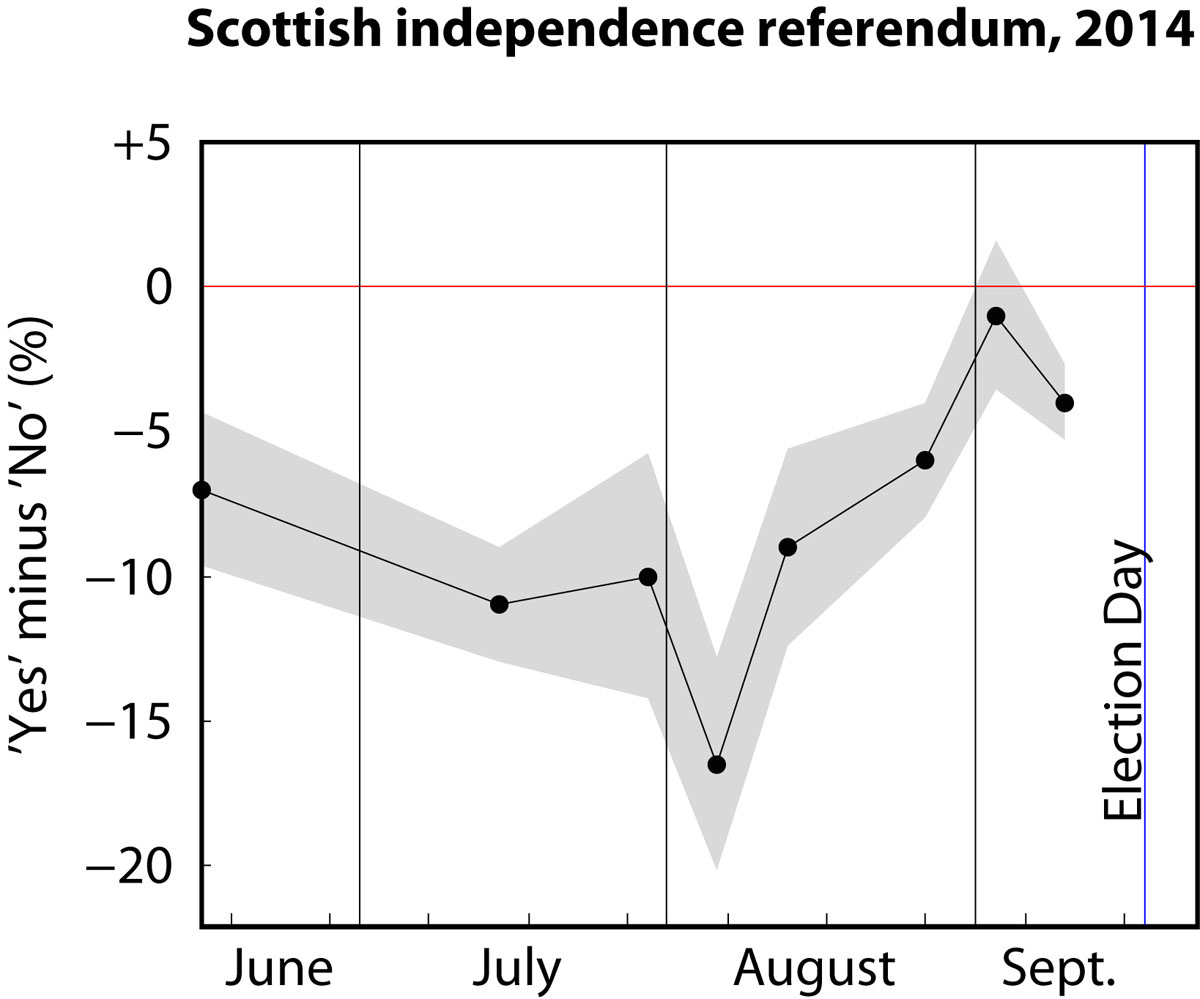
C:UserssswangAppDataLocalTemptp11643681_efa7_4172_a659_cfb

Sam Wang examines the Scottish polls:

Thursday’s election will be extremely close, thanks to the elusive quality of political momentum. Shown above are the results of opinion surveys conducted in Scotland on this question. Each data point shows the median of 2 to 6 surveys, and the gray zone indicates the 1-sigma confidence band. The word “momentum” gets thrown around loosely in politics. To get back to its meaning in physics, one definition might be a change in opinion that looks like it will continue in the same direction. In that sense, “yes” has had the momentum.

Mark Gilbert expects that the way the referendum is phrased will impact the vote:

“There’s lots of experimental research showing that a strong positivity bias exists,” Andrew Colman, a psychology professor at the University of Leicester, said in response to e-mailed questions. “The ‘Better Together’ campaign, or perhaps the U.K. government, made a mistake allowing the ballot question to be as it is. It is obviously easier to campaign for ‘Yes, we can’ than ‘No, we can’t.’ If the U.K. government wanted to keep Scotland in the union, then the question should have been ‘Do you want Scotland to remain part of the United Kingdom?'”

I’m finding all of this riveting. We’re talking about secession, after all, an option David Cameron insisted upon as a binary matter three overly-confident years ago. And yet a supra-nation has to have a binding identity to keep its constituent parts together. Britain was a vehicle for empire; that was its core purpose; and that purpose is no more. The deep cultural shifts in England that I detected even fifteen years ago have only gained momentum. And meaning matters – more, perhaps, than things like a stable currency or even economic growth. For a very long time, the English have alternately over-compensated for Scottish resentment – think of how many Scots have been prime ministers of Britain over the years – and yet also treated the place as a distant province.

I’m against secession, but I understand where the Scots are coming from. People want to be in charge their own destiny, be in control of their own future. If they no longer truly identify as British rather than as Scottish, then their future is effectively being determined by someone else – and it doesn’t help matters that Cameron is almost a text-book example of the kind of Englishman the Scots have always detested. This deep sense of identity matters in politics. Nations are mysterious things, wrapped up in human psychology. And what I’m seeing from this distance is an element of excitement for the future in Scotland that I haven’t seen before. I think that when such underlying shifts have already occurred, it is not unreasonable to adjust the political arrangements to accommodate them. Just read your Burke. And who doesn’t get a little thrill at the thought of Elizabeth, Queen of Scots?

Much more opinion and analysis below. Frum claims that Scottish independence is against America’s interests:

First, a ‘Yes’ vote would immediately deliver a shattering blow to the political and economic stability of a crucial American ally and global financial power. The day after a ‘Yes’ vote, the British political system would be plunged into a protracted, self-involved constitutional crisis. Britain’s ability to act effectively would be gravely impaired on every issue: ISIS, Ukraine, the weak economic recovery in the European Union.

Second, a ‘Yes’ vote would lead to a longer-term decline in Britain’s contribution to global security. The Scottish separatists have a 30-year history of hostility toward NATO. They abruptly reversed their position on the military alliance in 2012 to reassure wavering middle-of-the-road voters. But the sincerity of this referendum-eve conversion is doubtful. Even if it was authentic, the SNP’s continuing insistence on a nuclear weapons-free policy would lock U.S. and U.K. forces out of Scotland’s naval bases. The SNP’s instincts are often anti-American and pro-anybody-on-the-other-side of any quarrel with the United States, from Vladimir Putin to Hamas.

Larison pushes back on Frum:

[T]he “potential disaster” isn’t anything of the kind. The rest of the U.K., NATO, and the EU will continue to function just as well (or just as poorly) as ever. The U.K. was already being held back from a very activist foreign policy by its fiscal priorities and the public’s aversion to involvement in new foreign wars, so the separation of Scotland would have less of an effect than at almost any time in the last thirty years. Whatever problems NATO and the EU may have, including Scotland in these organizations won’t be a serious problem for either of them. NATO is already filled with small countries that don’t pull their weight. One more or less won’t make any difference. Both organizations may make it difficult for Scotland to join for individual members’ own reasons, but in that case Scotland wouldn’t be contributing to their dysfunction for years to come.

Noah Millman mulls Scottish nationalism:

In a multi-cultural age, nationalism makes sense as a response to collective oppression, which Scotland does not suffer from, and/or some sense of profound and unbridgeable difference, which Scotland does not really manifest. Nationalism as an ideal in itself, as a way for a people to establish itself as a force in the world, romantically actualizing their ethno-historical essence, frog-marching their people into modernity and/or purifying themselves of foreign influences – all elements of nationalism when it mattered for Germany, or Italy, or China, or Japan, or Egypt, or Israel – is more than slightly alarming to contemporary cosmopolitans. But on that score Scottish nationalism doesn’t look much like nationalism at all. And, okay, maybe it’s just more practical for New Zealand not to be governed from the other side of the world. But is Scotland really “necessary” or “inevitable” in that sense? Not really. So why vote yes? Isn’t it setting the requirements for divorce rather low?

Bloomberg View’s editors encourage Scotland to stay:

[W]hat problem, exactly, is independence supposed to fix? In a sense, Scotland’s First Minister Alex Salmond and his supporters have already won the battles that count. Scotland already sets its own course in education, offering free university tuition compared with the 9,000 pounds a year payable in England, and in health care withfree medical prescriptions (which the English help to pay for). Moreover, the U.K. government is clambering to devolve more tax and spending powers, both in response to the independence movement and as part of a wider acknowledgment that more decentralization is desirable.

With the momentum toward devolution likely to accelerate, Scotland is in a position to gain control of its fiscal affairs without abandoning a relationship that has worked well for more than three centuries. Its politicians could tailor economic and social policies to suit local needs without the potentially disastrous distractions of balancing the books, managing its heightened dependence on oil, and seeking membership of an EU that is wary of setting a precedent for Spain’s Catalonia and other discontented regions.

Matthew Dal Santo has related concerns about independence:

It’s not fear that’s clouding the referendum debate; it’s amnesia about the scale of the union’s achievements and the inter-dependence of the British peoples. After 1707, Scots and English (and Welsh) invented Britishness together. It’s entirely within their creative capacity to reshape its content for the 21st century.

Larison calls out a double-standard:

Western policymakers and pundits are normally too enamored of the benefits of partition, secession, and the creation of new states when it applies to states that they don’t like or that they view as intractable problems. Iraq isn’t stable? Maybe we should split it up into sectarian and ethnic enclaves, regardless of what the people living there might want. Sudan suffers from a protracted civil war? Let’s create a new, automatically failed state as part of the “solution.” Ukraine is politically divided and dysfunctional? Maybe we should cut it in half! Over the last few months, advocating for an independent Kurdistan has suddenly become popular again, as if that weren’t potentially very dangerous and explosive for the entire region. But when there is a popular movement to establish a new state peacefully and it affects a Western country that they know well, it suddenly seems mystifying and bizarre. “Why would anyone want to do that?” they ask. Self-determination and national independence are supposed to be what nations somewhere else want. People living in modern Western democracies are supposed to have outgrown that sort of thing.

And Emile Simpson is upset that the rest of Britain doesn’t get a vote:

[T]o have no voice feels culturally unjust. Not just for many of those among the 830,000 people born in Scotland who now live elsewhere in the United Kingdom (and thus can’t vote), but for many British citizens who feel that Scotland is inseparably intertwined with their broader cultural identity. Both my grandfather’s name (Simpson) and my grandmother’s maiden name (McDougall) are Scottish. My family can trace some of our Scottish ancestors back to the 19th century, and I take pride in that.

Scottish nationalists will say, “That doesn’t make you Scottish.” That is true in my case — I don’t identify as Scottish; I identify primarily as British — but it is also banal. What I resent in that argument is being forced out of claiming as my primary civic identity an open-facing and inclusive “British” identity, which incorporates and celebrates the diversity of sub-national character and origins within the United Kingdom. There are countless families whose roots and cultural heritage span far beneath the border; cutting the family tree’s roots in two will cause many of them huge cultural pain in a visceral, human sense.

Previous Dish on Scotland here.

Dissents Of The Day I

A reader succinctly sums up a common sentiment in the in-tray:

Give the president some time and see how this works out.  I can’t believe that after six years of meep meep, you keep freaking out like this.

Another adds, “Is it too much of a cliché to say Keep Calm and Know Hope?” Another:

Really disappointed in your attacks on Obama. So far, his actions against IS(IS) have been President Obama Delivers Statement On Situation In Iraqquite successful. Most of the Yazidis are off the mountain and receiving food and medicine rather than a horrible death, the same for the Shia community of Amerli.  IS’s march towards the Kurdish capital of Irbil, a rare success story in the region, has been stopped. IS have lost control of the Mosul Dam, which controls the region’s water and electricity supply and if destroyed would unleash a tsunami over a huge area. Maliki’s been replaced in Iraq. All this without generating any real outrage against America.

Some of the rhetoric about destroying IS may be way unrealistic, but I think his actions have been careful and effective. I think Obama will stall and partially reverse what was an alarmingly rapid expansion of this frightening group, and at an acceptable price ensure the Middle East becomes a little less awful in a situation when doing nothing would see it become a lot more awful. Doesn’t that deserve our support?

Another reader:

As for “war,” calm down. We’re going for containment.  ISIL is not ten feet tall, they’ve lost repeatedly when faced by peshmerga or Iraqi forces backed by US air power.  If Mr. Obama really meant to obliterate ISIL, we’d be talking Marines, not air power supporting the locals. So this is containment to be followed we hope by ISIL making a hash of things in their territory and eventually being nibbled to death by Baghdad and the Kurds and Assad and even the Free Syrian Army.  Al-Baghdadi’s only possible winning move is against Mecca and Medina, and if we block that effectively, he’ll wither over time.  If ISIL attacks the US or Europe we have their home address and we have lots of bombs.  None of this is good, but neither is it time to panic.

Mr. Obama played a bad hand about as well as it could be played.

Another switches metaphors:

As always, I think we underestimate Obama when it comes to playing foreign policy chess.  Remember how it looked like Syria was an utter disaster for him a year ago?

But he achieved his objective, near complete destruction of Assad’s chemical weapons.  I think his long game in the current situation is this: continue a punishing air campaign against ISIL while ramping up intelligence to thwart more videos of Americans being murdered and prodding reluctant allies to step up.  In two months (the extent of his authority, according to the War Powers Act and after the elections), he’ll go to Congress for further authorization.  Then the hot potato is in their laps.  They can’t punt it then – the whole country will be watching.   If the allies have started to roll ISIL back, the chorus for further escalation might be defeated.  If they haven’t, it still might – a lot of Republicans AND Democrats resent our having to clean up other country’s messes alone.

But much more importantly, the decision won’t be made by an imperial president.  It will be made by the recently elected representatives of the people – and that, I think, is Obama’s real objective.

Another references our most recent Email of the Day:

“My gut reaction was that this wasn’t the guy I voted for – what happened to that guy?” What is it about Americans that they constantly delude themselves that the Candidate is ever going to bear any relation to the Office-holder? When junior Senator Barack Obama was running for President in 2008, he had no access to classified information, comparatively little information about the world beyond the borders, and absolutely no information whatsoever about the nature of the threat or of other national security interests in the REAL WORLD. Which is why, incidentally, Mitt Romney quit talking about Benghazi after he was officially the Republican nominee – because if you were reading the papers, you read that the day AFTER the Republican convention ended he got his first, albeit limited, classified intelligence briefing.  

The President of the United States is not, cannot be, and should not be expected to be, the “same guy” as the candidate for the office of President of the United States.  Get over it already. 

Another questions the idea that the president should have a set strategy on ISIS:

Isn’t it possible that the reason Obama did not give a long-range detailed plan for how to deal with ISIL is that he has learned that war in the Middle East is very fluid and constantly changing?  If so, then he is the smartest one in the room, because he is not predicting anything.  He is taking an action (which will have a military effect on ISIL) while basically saying, “Let’s see what’s going on in six months before we choose our next step.”  Maybe the Iraqi government will be more solid; maybe the Kurdish troops will be better trained; maybe our relationship with Iran will be stronger because of a mutual enemy … who knows what will be.  Obama is taking his usual centrist approach and saying let’s see what’s happening later before we decide our next step.

Or as another puts it:

Obama’s proposed path occupies a more flexible, middle ground between the extremes of the neocon’s “shock and awe,” total-war argument and your new “do nothing,” burn-and-rebuild position.

Another round of dissents coming soon.

(Photo by Chip Somodevilla/Getty Images)

Is The Ebola Epidemic Just Getting Started?

Nishiura_fig1

Maryn McKenna flags a paper that attempts to calculate the outbreak’s reproductive number (i.e., the number of cases likely to be caused by one infected person) and comes to a startling conclusion:

The Eurosurveillance paper, by two researchers from the University of Tokyo and Arizona State University, attempts to derive what the reproductive rate has been in Guinea, Liberia and Sierra Leone. … They come up with an R of at least 1, and in some cases 2; that is, at certain points, sick persons have caused disease in two others. You can see how that could quickly get out of hand, and in fact, that is what the researchers predict. Here is their stop-you-in-your-tracks assessment:

In a worst-case hypothetical scenario, should the outbreak continue with recent trends, the case burden could gain an additional 77,181 to 277,124 cases by the end of 2014.

That is a jaw-dropping number.

In an NYT op-ed last Thursday, Michael Osterholm sounded an even more dire warning:

The current Ebola virus’s hyper-evolution is unprecedented; there has been more human-to-human transmission in the past four months than most likely occurred in the last 500 to 1,000 years. Each new infection represents trillions of throws of the genetic dice. If certain mutations occurred, it would mean that just breathing would put one at risk of contracting Ebola. Infections could spread quickly to every part of the globe, as the H1N1 influenza virus did in 2009, after its birth in Mexico. Why are public officials afraid to discuss this? They don’t want to be accused of screaming “Fire!” in a crowded theater — as I’m sure some will accuse me of doing. But the risk is real, and until we consider it, the world will not be prepared to do what is necessary to end the epidemic.

What is necessary, in his view, is a Security Council resolution that would “give the United Nations total responsibility for controlling the outbreak”. The Pentagon has asked Congress for “up to $500 million” to help fight the outbreak, but there’s a catch:

The Defense Department plans to also use at least a portion of those funds to respond to the growing refugee crisis in Iraq. When the Pentagon wants to shift that much money between its accounts, it’s required to send what’s called a reprogramming request to Congress. The Defense Department has offered no details about the breakdown, which means it’s theoretically possible the United States could spend $1 on Ebola and $499,999,999 on Iraq.

“The situations in both Iraq and West Africa are dynamic, and the funds we are seeking to reprogram will help enable [the Defense Department] to be responsive to needs on the ground in both areas as they arise,” a defense official told Foreign Policy. “Therefore, the total amount that may be used in either West Africa or Iraq under this reprogramming request may not be determined at this time.” Without more information, one is left guessing about the scale to which the Pentagon plans to respond to either problem.

The Economist reviews how the spiraling crisis has spurred the development of new drugs to treat the virus:

The arrival of new medicines will encourage health-care workers who have given up their posts to return to attend the sick. It would also help address the fear and panic that is proving so disastrous in the infected countries. But there are other difficulties. One is highlighted in a forthcoming working paper for the National Bureau of Economic Research, which finds that some Indian drugmakers are taking advantage of the lack of regulatory oversight to send their lowest-quality antibiotics to Africa.

The biggest problem remains containment, especially in the months before new medicines arrive. Virologists, such as Dr Ball at Nottingham, worry that increasing human-to-human transmission is giving Ebola the opportunity to become more transmissible. Each time the virus replicates, new mutations appear. It has accumulated and hung on to some mutations, like “cherries on a one-armed bandit”, he says. Nobody knows what would happen if Ebola hit the jackpot with a strain that is even better-adapted to humans. But the outcome could be grim, for Africa and the rest of the world.

The Offense Industry On The Offense

In a really terrific post during my vacation, Freddie DeBoer nailed something to the cross:

It seems to me now that the public face of social liberalism has ceased to seem positive, joyful, human, and freeing. I now mostly associate that public face with danger, with an endless list of things that you can’t do or say or think, and with the constant threat of being called an existentially bad person if you say the wrong thing, or if someone decides to misrepresent what you said as saying the wrong thing. There are so many ways to step on a landmine now, so many terms that have become forbidden, so many attitudes that will get you cast out if you even appear to hold them.

Freddie’s concern was with online hazing of the politically incorrect. Writers are not just condemned any more for being wrong or dumb or rigid. They are condemned as sexist, racist, homophobic, anti-Semitic, blah blah blah – almost as a reflex in trying to discredit their work. That’s particularly true when it comes to fascinating issues like race or gender or sexual orientation, where liberalism today seems to insist that there are absolutely no aggregate differences between genders, races, ethnicities, or sexual orientations, except those created by oppression and discrimination and bigotry. Anyone even daring to bring up these topics is subjected to intense pressure, profound disapproval and ostracism. This illiberal liberalism is not new, of course. But it’s still depressingly common.

Sam Harris is one of its latest victims. There sure is plenty to disagree with Sam about – and we have had several such arguments and debates. But the idea that he is a sexist – and now forced to defend himself at length from the charge after a book-signing discussion – is really pathetic. His account of the episode is well worth-reading for the insight it gives into the Puritanical wing of the left. Michelle Boornstein decided to play the sexist card after a contentious interview, and then tweet it out thus:

Here’s what she was referring to (in her words):

I also asked Harris at the event why the vast majority of atheists—and many of those who buy his books—are male, a topic which has prompted some to raise questions of sexism in the atheist community. Harris’ answer was both silly and then provocative. It can only be attributed to my “overwhelming lack of sex appeal,” he said to huge laughter.

“I think it may have to do with my person[al] slant as an author, being very critical of bad ideas. This can sound very angry to people… People just don’t like to have their ideas criticized. There’s something about that critical posture that is to some degree intrinsically male and more attractive to guys than to women,” he said. “The atheist variable just has this—it doesn’t obviously have this nurturing, coherence-building extra estrogen vibe that you would want by default if you wanted to attract as many women as men.”

This is impermissibly sexist because it assumes that there are some essential biological and psychological differences between men and women, and for a certain kind of leftist, this is an intolerable heresy. If that truth cannot be suppressed or rebutted in a free society, its adherents must be stigmatized as bigots. It’s a lazy form of non-argument – and may have been payback from Boorstein after Harris and she differed quite strongly on the power of fundamentalism in American culture.

But Boorstein’s premise – that because many more men than women seem to buy and read his books, there must be some sexism at work – is preposterous.

Anyone can buy a book on Amazon. There are no gender barriers whatever. The free flow of ideas will often lead to different audiences for different authors. That some books by white Americans are read disproportionately by whites doesn’t mean they’re racist. And, yes, style of writing – especially the combative, testosteroned debates that occur online or typify the slash-and-burn atheist conversation – can lead to a disproportionately male-skewed audience for that kind of thing. But all that is a function of free choice in a free market of ideas – not some kind of institutional sexism – let alone personal sexism. Why we cannot revel in these differences and embrace them as part of what makes being human so fascinating and variable is beyond me. But clearly it threatens people. Reality can.

Then Sam was subjected to a public dressing down by a person in the book-signing line:

She: What you said about women in the atheist community was totally denigrating to women and irresponsible. Women can think just as critically as men. And men can be just as nurturing as women.

Me: Of course they can! But if you think there are no differences, in the aggregate, between people who have Y chromosomes and people who don’t; if you think testosterone has no psychological effects on human minds in general; if you think we can’t say anything about the differences between two bell curves that describe whole populations of men and women, whether these differences come from biology or from culture, we’re not going to get very far in this conversation.

But the conversation is not the point. Even an individual writer’s personality and style is not the point. The point is the enforcement of an ideology by the weapon of stigma and social ostracism. Some favorite lines from the p.c. war:

You should just know that what you said was incredibly sexist and very damaging, and you should apologize … You’re just totally unaware of how sexist you are.

It’s that last line that really gives the game away. It means essentially that a writer cannot win. Or rather: that a writer somehow has to represent all of humanity or risk being regarded and demonized as hostile to whole sections of it. This should be called out for what it is: a full-scale assault on the integrity and freedom of writers in the name of social liberalism. Writers need to stand up to this cant – and not capitulate to it.

For more on the subject of women and atheism, check out the Dish discussion thread, “Where Are All The Female Atheists?” One of those readers brought to our attention the work of the brilliant female atheist Jennifer Michael Hecht, whom we subsequently invited to join our Ask Anything feature to discuss the subject of suicide, explored in her book Stay: A History of Suicide and the Philosophies Against It.

Husband Beaters, Ctd

A reader sharpens the discussion over female domestic violence, which the Dish broached back in June:

I think both readers you recently quoted regarding Janay Rice hitting Ray Rice have valid points. What bothers me is that it seems to be treated as a zero sum game when we talk about reciprocity in domestic violence. Do women have it worse than men? Of course! Does that mean that violence against men shouldn’t be mentioned? I don’t think so. If anything, I think it would help the conversation if men understood how universal it is. Not talking about it seems like it only encourages men to accept abuse until they snap back. That by no means justifies when they snap, but it does contribute to it. And just making that point clear definitely doesn’t mean men have it anywhere near as bad as women in domestic violence.

This should not be a contest of who is more oppressed. Everyone suffers from toxic or outdated expectations about gender. The more open and nuanced the conversation, the better.

Two male readers share their stories of abuse:

Never thought I’d be writing to someone about this, but your discussion is prompting me to write. I suffered a severe beating at the hands of a former girlfriend – broken nose, splinters (from a 2×4) in and around the eyes.

The incident, for lack of a better word, went on much longer than it should have simply because for me to defend myself would have involved my committing violence against a woman – such an ultimate “no no” that it’s practically etched on most (stressing “most”) men’s DNA.  I have sisters.  If I had touched my sisters in ANY WAY, my dad would’ve killed me.

I finally realized that if I didn’t do something, the woman in question might literally not stop, and I was somewhat disoriented as a result of the nose-breaking shot to the face with the 2×4, with which I was still getting hit.  I finally took her down to the floor as gently as I could and – I can hardly believe I’m writing this – put a hand around her neck, just enough to let her know it was there – and said “Stop.”   This served to make her snap out of the rage she was in.  It was like a light switched off, and then it was over.

I woke up the next morning and didn’t even recognize myself.  I have a driver’s license photo taken seven weeks after the event in which a black-and-blue shadow can still be seen along one side of my face.  It took two years for a splinter lodged near my temple to finally dislodge itself, and I have some scarring around one eye.  This was almost 30 years ago.

For a long time I thought I must have brought this on myself.  I mean, isn’t this kind of thing unheard of?  All I can say is that I found out years later that she got physical with her next boyfriend, and I’d be lying if I didn’t tell you that a great burden was lifted from me upon hearing that news.

I’m not saying in any way that Ray Rice was justified in hitting his fiancee/wife.  But sometimes – stress “sometimes” – these things are more complicated than they appear.

Another quotes a reader from another post:

Men are far, far more likely to injure, abuse and murder their partner than women are; it’s not a remotely equal situation, and treating it as such undermines the very real danger millions of American women are facing every single day.

What an absurd argument for the second writer to make regarding the need to crack down on female abusers.  This is not a zero sum game. Abuse is abuse, and the message can be universal without detracting from the fact that women are the more likely victims.

And quite frankly, speaking from experience, when you are on the receiving end, even as a man, it is your own personal hell and statistics go right out the window.  My partner liked to attack me while I was sleeping.  I would wake up in total confusion and then immediately try to restrain her.  I outweighed her by 80 pounds, but to hold a physically fit person by her wrists in the hope she will calm down when she is amped on adrenaline is an exhausting test of stamina.  Trust me: the person’s legs are free to kick out and a determined person can reach a neck with her teeth.

Even in a progressive city like Seattle, she counted on the expectation that she could shame and endanger me by calling out loudly for help as I held her back.  When the neighbors knocked on the door, you can bet your life I opened it as fast as I could, brought them inside and explained exactly what was going on (she often had been drinking and was still “ornery”). I consider it a modern miracle the police never came.

But that is the problem. Neighbors and society, in general, still shrug off the acts of female abusers.  It can’t be that bad, or “legitimate,” if the bad guy is a “bad gal” who is cute as a button and a hundred ten pounds in her stocking feet.  It even worked on me. The aftermath would be tears and apologies that left me feeling sorry for her and guilty about not doing a “better job” to avoid bruising her wrists in the act of holding her down.

Have We Outgrown Growing Up? Ctd

In response to A.O. Scott’s essay on the death of adulthood in popular culture, Freddie sighs, “To believe that different types of cultural products should exist, and that some of these should create artistic pleasures based on work, ambiguity, or difficulty, is to be immediately and permanently labeled a snob”:

If you like any kind of artwork that does not leave its pleasures totally and utterly accessible at all times and to all people with no expectation that consuming art should involve effort, you will be lectured to by the aggrieved. You will get yelled at by the AV Club and Vulture and Slate, by Steve Hyden and Andy Greenwald and the rest of the crew at Bill Simmons’s Geographical Center of the American Middlebrow, in the New York Times and the New Yorker and every other sundry magazine, blog, site, app, Tumblr, Twittr, Tindr, Grindr, newsletter, listerv, forum, message board, image board, room & board, surfboard and broadsheet that humanity produces. …

The only part of adulthood that really matters is the part where when you finally grow up, if you ever really do, it’s because you recognize that there’s other people in the world and that they matter and their needs matter and you need to set aside your self-obsession for long enough to recognize that other people’s needs are often more pressing or important than yours and to act accordingly. Every frame of Guardians of the Galaxy exists to tell you that you are the only human being in the universe.

Alexandra Petri, who is much less perturbed by the shift, attributes it to the rise of the Internet, “where the primary mode of communication is the confessional”:

We know better, now, than to think anyone has anything under control. Too many people have admitted — in GIFs or paragraphs or videos — what a frantic scramble things really are (even and especially for those people, like celebrities, whose job is to appear to be have things effortlessly together). So much for the facade. The celebrities everyone clutches most fervently to their bosoms now are not the ones you aspire to be, but the ones you feel like you already are, the ones who wear their mess on the outside. We don’t want to look up to people. We want something different: to look out from their eyes. Online, currency is identification and sympathy. Competence is admirable, but it isn’t inherently relatable. If anything, the tendency is to play up the bumbling. If you can convincingly pretend to be a polished, collected socialite who is not, in essence, a frantic 12-year-old on stilts who doesn’t know whom to call about the plumbing — what can we possibly have in common with you?

Tom Hawking nods:

It’s not so much that culture is abandoning adulthood; it’s more that culture is deconstructing it. It’s fascinating to watch old American TV shows and think about how much they reinforced the idea of traditional patriarchy, where women deferred to men and children to adults. (I mean, Christ, we’re talking about a TV industry that literally produced a show called Father Knows Best.)  …

Clearly, there’s a mental and emotional difference between childhood and adulthood, and clearly experience does lend some surety and confidence — I’m not A.O. Scott’s age, but at 36 I certainly feel I have something of a firmer grasp on my life than I did at 26, or 16. I suppose I’m technically a grown-up. But you never really lose that feeling of being alone and wondering what the hell you’re supposed to be doing — indeed, I’d argue that’s at the core of human experience. You just learn to mask it better. And I’m sure that hasn’t changed in millennia. If anything, the difference between adulthood as it’s presented in contemporary culture and how it’s been depicted in the past is that today’s writers depict this idea with gusto. The difference between, say, Don Draper and the patriarchs of the past is not that Don doesn’t know what to do, but that he is depicted as confused and increasingly impotent. It’s not that such characters haven’t existed before — but their bewilderment has usually manifested as the result of some sort of crisis, not as an inherent aspect of their character.

Meanwhile, Andrew O’Hehir points a finger at the economy:

[S]ometimes economic forces really do shape the cultural zone. Real wages have fallen since Don Draper’s heyday, especially for American men and double-especially for the middle-class and working-class white men who were once the bulwarks of the mid-century model of adulthood. We now live in a culture (using the word in its anthropological sense) of diminished expectations and permanent underemployment, where many or most young people will never be as affluent as their parents. Lifetime job security is an antediluvian delusion, and in many metropolitan areas home ownership is out of reach for all but the rich. It’s just as useless to object to those changes as it is to complain about grownups reading Harry Potter books, but certainly those things were the essential underpinnings of classic adulthood, and without them it’s no surprise to see the old order fading away.

Lastly, a reader writes:

Your post brought to mind what C.S. Lewis said about growing up and childishness in his 1952 essay “Three Ways of Writing for Children”:

Critics who treat ‘adult’ as a term of approval, instead of as a merely descriptive term, cannot be adult themselves. To be concerned about being grown up, to admire the grown up because it is grown up, to blush at the suspicion of being childish; these things are the marks of childhood and adolescence. And in childhood and adolescence they are, in moderation, healthy symptoms. Young things ought to want to grow. But to carry on into middle life or even into early manhood this concern about being adult is a mark of really arrested development. When I was 10, I read fairy tales in secret and would have been ashamed if I had been found doing so. Now that I am 50 I read them openly. When I became a man I put away childish things, including the fear of childishness and the desire to be very grown up.

The Senate Is A Coin Flip

The NYT’s Senate forecast is trending towards Democrats:

NYT Senate

Nate Silver’s calculations have also become more Democrat-friendly:

When we officially launched our forecast model two weeks ago, it had Republicans with a 64 percent chance of taking over the Senate after this fall’s elections. Now Republican chances are about 55 percent instead.

Why the change? He sees money as a big factor:

Consider the states with the largest polling movement: In North Carolina, Hagan had $8.7 million in cash on hand as of June 30 as compared with just $1.5 million for her Republican opponent, Thom Tillis. In Colorado, Udall had $5.7 million as compared with $3.4 million for Republican Cory Gardner. These totals do not account for outside spending. But in stark contrast to 2010, liberal and Democratic “super PACs” have spent slightly more money so far than conservative and Republican ones, according to the the Center for Responsive Politics.

Nate Cohn agrees that the Democrats’ chances have improved:

Over all, the Republicans are still the slightest favorites to retake the chamber. For Democrats to retain their majority, they will have to win at least two states that voted against President Obama in 2008 and 2012. It is possible that this will prove untenable over the final few months of the race, and that Republicans will gradually gain as undecided voters who disapprove of the president’s performance and voted for Mitt Romney make up their minds. But the Democrats now have a lead in enough races to get to 49 seats — and have a few options to reach 50.

Sam Wang, who has always given Democrats a good chance of keeping the Senate, pats himself on the back:

[A]s the election approaches, other sites are decreasing the bias that they add by using fundamentals. This will inevitably make them approach the [Princeton Election Consortium (PEC)] snapshot, day by day. If everything converges on the PEC Election Day prediction, I would score that as an argument in favor of using polls only – or at least letting readers see the difference added by the use of fundamentals.

Getting Intimate With The Roosevelts

Ken Burns’s multipart documentary, The Roosevelts: An Intimate History, premiered last night. Damon Root reviews it:

[W]hile the film is clearly pro-Roosevelt in its leanings, it does make room for certain contrarian views. Among The Roosevelts‘ stable of talking heads, for example, is none other than conservative writer George Will, who pops up from time to time to remind viewers that the family’s impact was not always a benevolent one. “Building on the work of the first Roosevelt, the second Roosevelt gave us the idea, the shimmering, glittering idea of the heroic presidency. And with it the hope that complex problems would yield to charisma. This,” Will declares during one episode, “sets the country up for perpetual disappointment.”

But The Roosevelts is by no means a flawless film. For one thing, it sometimes fails to present an accurate picture of the family’s political opponents. Indeed, the film leaves the distinct impression that only reactionaries and fringe loonies ever dissented from the New Deal.

Harvey J. Kaye lodges other criticisms:

[Filmmaker Ken Burns and historian Geoffrey C. Ward] ignore the ways in which working people and the labor movement shaped their “heroes’” thinking and propelled their action. They note TR’s presidential intervention in the 1902 coal strike, but fail to speak of labor’s role in the Socialist and Progressive parties’ prewar battles against Gilded Age capital (labor unionist and Socialist leader and presidential candidate Eugene Debs is never named).

They emphasize Eleanor’s involvement with the League of Women Voters in the ’20s and her relationship with independent reform-minded women of the day, but barely mention her work with the Women’s Trade Union League. As a consequence, they ignore how her encounters and friendships with East European Jewish women labor organizers of Manhattan’s Lower East Side not only led her to shed the anti-Semitism and racism of her youth (attitudes that are never discussed), but also enabled her to educate FDR to the needs of working families and the politics of industrial and social democracy by bringing those women to Hyde Park to spend time with him.

James Wolcott anticipates later installments:

Compelling as the Teddy Roosevelt saga is, it is for me the set-up, the prolonged prologue, to the true heart of this series, the improbable life and transformative reign of Franklin Delano Roosevelt. I will write about the FDR and Eleanor installments as they approach airdate–though I will advise for now that the episode four, “The Storm,” devoted to his crippling attack of polio and his founding of Warm Springs, is the one you should circle most urgently on your calendar–but let me make a prejudice plain: for me, FDR is the greatest man of the twentieth century. Our twin savior, along with Lincoln. You may respectfully or disrespectfully disagree with that. That’s fine. You’re wrong.

And I feel even more convinced, having spent time reading Nigel Hamilton’s The Mantle of Command: FDR at War, 1941-1942 and David Kaiser’s No End Save Victory: How FDR Led the Nation into War, both of which I recommend as fireside reading, even if you lack a fireplace and have to make do with the theatrical illusion of a fan blowing some red strips of paper.

Jeremy Berlin interviews Burns:

[Q.] You call this film “an intimate history,” and it does seem more personal than your previous works. It also gets at a number of still-relevant issues—some of which you alluded to earlier—in an implicit way. Was it hard to reconcile the tone with the topic, or the scale with the scope?

[A.] Not at all. This is the first time we’ve done a long-form, major-length series about individuals, not about things like baseball or jazz or the Civil War. It’s sort of like a Russian novel—taking one family and understanding their interrelationships.

But this isn’t psychobabble or tabloid history. Nor does it neglect the outer events—the Gilded Age, the World War I era, the Roaring Twenties, the Depression, World War II, and the Cold War.

They’re all there. But you see them from a less familiar, more interesting perspective than you’re used to.

John Dickerson also speaks with Burns:

Burns is in a great hurry to get people to slow down. He would like them to watch 14-hour documentaries, of course, but also to understand the complexity and tensions at the heart of history. It makes for more meaningful lives, he believes, and a better understanding of events, including the ones unfolding before us in the present.

“We are in a media culture where we are buried in information but we know nothing,” said Burns. “Because of that superficiality, we expect heroes to be perfect, but they’re not. They are a strange combination of strengths and weaknesses.” He points to two of his main characters as examples. “Franklin and Theodore couldn’t get out of the Iowa caucuses [today]. Franklin is too infirm. CNN and Fox would be vying for the worst images of him unlocking the braces, the sweat pouring off his brow, the obvious pain and that kind of pity that it would engender would be political poison. And Theodore is just too hot for the new medium of television. There would be 10 ‘Howard Dean’ moments a day.”

Alyssa Rosenberg agrees that the Roosevelts likely wouldn’t survive modern-day politics:

It is one thing to decry a newly invasive media culture, or the fact that we still demand female politicians meet standards of attractiveness that have nothing to do with the functioning their jobs. But “The Roosevelts” ought to encourage us to think more broadly about what we deny ourselves when we narrow the path that can lead people to public office at any level.

Her bottom line:

In refusing to let politicians be human, we have denied ourselves the opportunity to be seen and to be treated the same way.