A Growing Industry In Colorado

CO Marijuana Sales

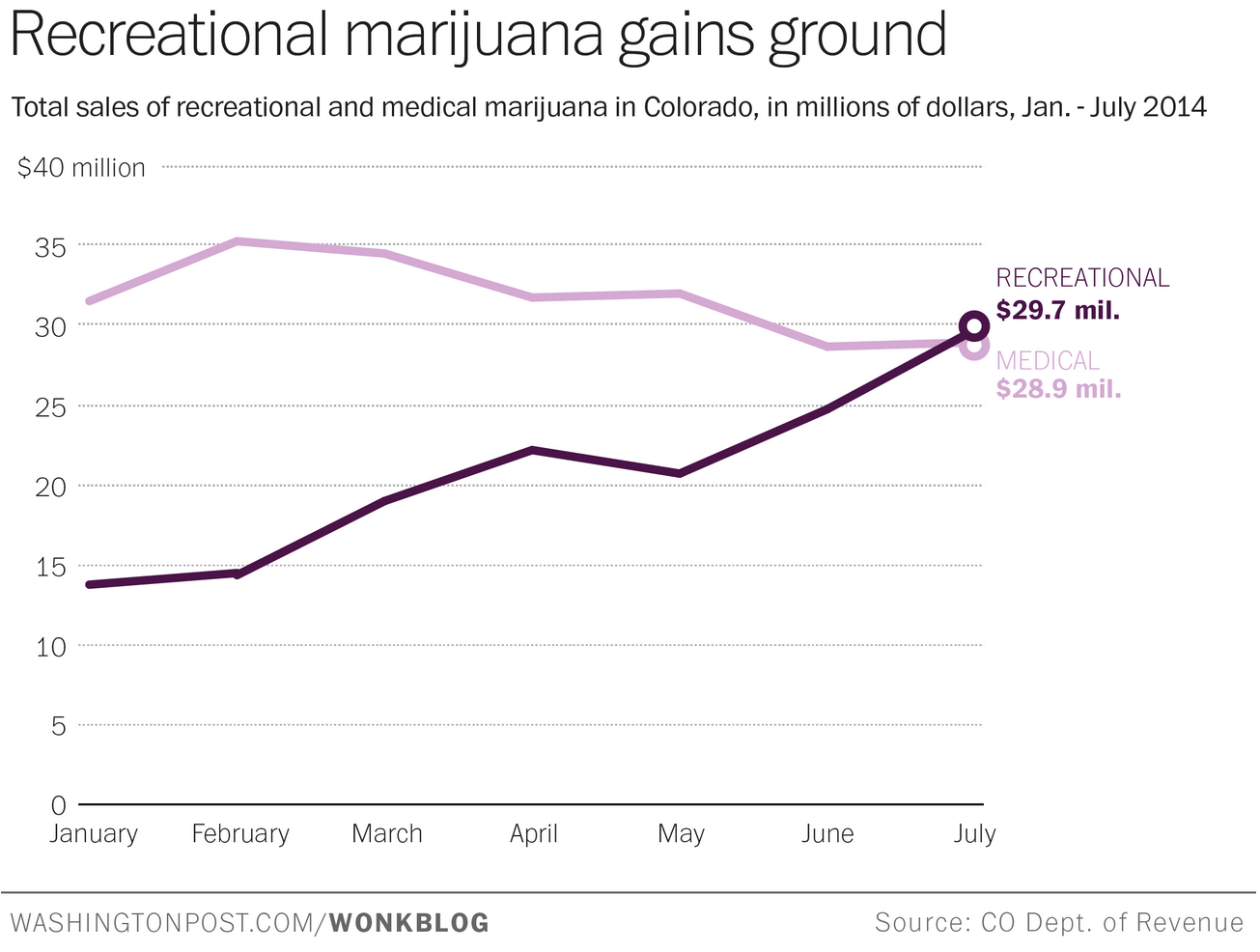
Colorado’s recreational marijuana sales have now surpassed medical marijuana sales:

Many legalization proponents welcomed the latest sales figures. But they don’t necessarily mean the imminent demise of Colorado’s black market. “I don’t think the increase in sales necessarily reflects a decrease in the black market, although it may,” Brookings’ [John] Hudak said in an interview. The sales increase could be due to “increases in marijuana tourism – an industry growing pretty rapidly in the state.”

A cultural shift is also likely under way, as more residents dip their feet in the recreational market. “It might reflect a relaxation of state residents where people are coming around and saying ‘Ok, this is real, this is legit and I’m not going to get arrested for it.’”

Katy Steinmetz keeps an eye on marijuana tax revenue:

During the month of July, the state received $838,711 from a 2.9% tax on medical marijuana, meaning that patients spent an estimated $28.9 million at dispensaries. The state meanwhile raked in $2.97 million from a 10% sales tax on retail marijuana, putting those sales at about $29.7 million, according to calculations by theCannabist.

Though that amounts to a less than $1 million gap between retail and medical sales, this is a small victory for champions of legalization who have argued that the experiment will be profitable for the state, as revenues have lagged behind some expectations.

Early this week, Jon Walker passed along a poll finding that Coloradans have no regrets – 55 percent support the legalization law:

Although a sizable minority still doesn’t like the new law there is little active opposition to it. Only 8 percent of adults say they are trying to have the law overturned. On the other hand, roughly half of the people who favor the new law say they are actively supporting it. Both the raw numbers and the intensity of support are with the pro-legalization side.

If voters and politicians in other states are “waiting to see” how legalization goes in Colorado the general consensus seems to be that it has gone pretty well. Most Coloradans are happy with legalization and would do it all over again.

The Quality Of Britishness, Ctd

A reader quotes a previous one:

“Separation of Scotland has more than political implications. For many of us who do not have any vote in the matter, it carries profound implications about our identity, and what our nationality means.” Yeah, I feel this pain. I’m as Scottish as it gets, and I don’t have a vote in the matter either. I was born in Scotland, hold (only) a UK passport, have lived in England and the US, and now live in Canada. If independence happens, my life is turned upside down. The practical and emotional effects would be unimaginable. Every little page of immigration paperwork, my right to travel freely, my relationship to “home” – whatever that is – all in limbo. If I’m reading the propaganda – sorry, the White Paper – correctly, we will be forcibly repatriated to a new state while living abroad! God help us all.

Expat Scots will suffer as much disruption from this independence experiment as anyone, maybe more. But we do not get a vote. That makes me furious. I mean, 16 and 17 year olds living in Scotland have been franchised especially for this occasion, but I don’t get to play? Am I supposed to hope that they have my best interests at heart?

So I have to sit here, watch, and stew, while the future of my home, my nation and my identity is decided for me. Forgive me, but fuck the whole thing.

Another view:

I’m puzzled by your readers who worry about being unable to feel British if the Scots vote to secede. If, say, France were to leave the EU, does that mean I could no longer feel European?

Of course not. Europe is more than its political institutions. The concept of Britishness is not defined by the scope of the Westminster parliament.

I hope the Scots vote for independence, because I think they will create a kinder, fairer and happier society than the UK has become. Perhaps one day they’ll invite those of us in north-east England to join them: my roots are English not Scottish, but culturally, politically and geographically I feel closer to Scotland than I do to London.

Another draws a distinction:

To get a bit technical about it, Scotland cannot separate from Britain – at least not without employing a tremendous amount of earth-moving equipment. “Britain” is a geographic term, not a political one. It is, of course, short for “Great Britain,” the name of an island called such because it is the largest of the many British Isles.  Scotland can leave the UK, but it is stuck in Britain forever. The Scottish will always be British. If sharing an island with the English and the Welsh is part of the Scottish identity, then separating from the UK will not take that part away.

Another reader:

The letter you posted from the descendant of the Jacobite veteran of Culloden at first surprised me. How can an American, whose family has been in the USA since before the USA existed, be thrilled that “we” might be out from the English thumb?  You and your ancestors have been free of the English thumb for more than 250 years!

This is an example of how ancient political issues in Europe find a long echo in America. My own family is immigrant Irish, and like so many others, my ancestors came to America to escape the civil unrest in Ireland during the late 1800s and early 1900s.  They were devoutly Catholic, adamantly anti-British, and staunchly Republican.

I visited Ireland for the first time in the weeks after the Omagh bombing, and I was surprised to find that the locals I met were quite cool to me, and rather keen to have me on my way.  After awhile I realized that this was because they did not particularly trust Irish-Americans like me.  My – and so many others like me – views on Northern Ireland came to me almost unchanged from Grandpa’s views in 1916.  I think that is why there was such support for Irish republicanism (i.e. terrorism) from the succeeding generations of Irish Americans.  The locals were in no mood for another American’s nostalgia for Grandpa’s stories and how Grandma sang Republican songs as a lullaby.

In short, it caused me to realize that Ireland didn’t stop when Grandpa stepped on the boat at Westport. Obviously this phenomenon is not confined to the Irish-American experience, and can last far longer than the few generations of my family’s experience.

Another shifts focus:

As a Canadian, I’m fascinated by the parallels between England/Scotland and Canada/Quebec. Consider the following rewrite of your original post:

It’s a prickly country, bristling often at [Canada], its exports to [Ottawa] often having more than a bit of a chip on their shoulders. … It’s politically well to the left of [the rest of Canada], and is a big net beneficiary of [Canada’s] Treasury. After a while, if you’re [an anglophone Canadian], and right-of-center, and taxed to the hilt, endlessly subsidizing the [Quebecois] in return for their thinly veiled disdain, you get a bit irritated. Deep, deep down in my [Canadian] soul, there’s a “fuck ‘em” urging to come out.

This, I think, accurately captures some of the feeling in anglophone Canada around the time of the last referendum on sovereignty in 1995. The interesting thing to note is the way Quebecois separatist sentiment has ebbed and flowed over the years. When times are good, the separatists seem to lose sight of the real economic difficulties that an independent Quebec would face: concerns related to a separate currency or monetary union, how to divide up things like the national debt, what’s going to happen to growth and investment after the split, etc. – in short, many of the same issues facing Scotland. When times are not so good, the citizens of Quebec seem to recognize the benefits that they receive from remaining part of Canada and talk of separation largely disappears. This suggests to me that support for Scottish independence may move in the same way – greater support in good times and less when times are tough.

There is an important difference, however, between Canada and Britain: the division of powers between the provinces and the federal government in Canada is much more clearly defined than in Britain. The responsibilities of the federal government and the province of Quebec, while they have been tweaked over the years, are largely fixed by the constitution and other legislation; the situation in Britain seems much less well defined and, as a result, it seems like the politicians and citizens of Britain are more likely to misunderstand or misrepresent the relationship.

What I mean by this is that Scots who feel that Scotland should be independent have more latitude to feel that they’re getting a raw deal, since the deal they have is not really all that well defined. Similarly, the English who want to say “fuck ’em” to the Scots have more latitude to feel that the Scots are getting more than their fair share, again because the terms of the deal are not well defined.

One solution to this would be for Britain to hold a “constitutional conference” with the goal of spelling out, exactly, what exactly is the status of Scotland, England, Wales, and Northern Ireland – are they states in the American sense? Are they provinces in the Canadian sense? Are they something else? Removal of the uncertainty around this relationship might go some way toward resolving Scottish complaints about the union.

Another also looks at the Quebec parallel:

The aftermath of Quebec’s “no” vote was ugly – the reason the referendum lost was because the non-francophone minorities voted nearly unanimously against succession (many Native Americans – or First Nations as is the term up there – swore they would never be part of an independent Quebec given the ugly history with the Catholic church/Provincial government). After the defeat the leader of the successionists basically said they lost because of “money and foreigners” (many read money as “Jews” and foreigners was easy enough to understand). There was also more uncertainty surrounding that vote – nobody knew how Canada would have reacted to a “yes” vote. After the defeat, the Canadian Supreme Court issued a ruling that set out future ground rules for succession, but at the time of the 1994 vote there was no agreement re: potential currencies, etc. so the economic uncertainty was even greater.

And yet, it was 49-51%

My view from afar: If Scotland can’t even stay a part of the U.K., the Middle East is doomed to unravel into goodness knows how many tribal mini-states.

Update from a reader:

I just got a little taste of your life! A reader responded to my comment by saying:

How can an American, whose family has been in the USA since before the USA existed, be thrilled that “we” might be out from the English thumb? You and your ancestors have been free of the English thumb for more than 250 years!

I didn’t mean our family in America is under the English thumb. I meant we would be thrilled the Scots in Scotland were finally free of the English!

How you do this day in and day out, with people parsing every word you write, is beyond me.

The Trauma We Endured

455263680

Marking today’s anniversary, Damon Linker recalls the months after 9/11:

Those were deranging times. I was so fearful in those days that I actually expressed regret to a friend that the fourth plane had failed to destroy the White House. The thing I feared most in those initial weeks after the attacks, you see, was that we would hesitate in striking back against our enemies. I wanted assurance of our national resolve, and I thought that nothing short of a vision of the White House in ruins would guarantee it.

I’m not proud that I had such thoughts and fears. But I wasn’t the only one. Some members of the Bush administration obviously had them, too.

He pleads with the country to break out of this mindset:

The United States is about to embark on yet another war in the Middle East in a desperate, clumsy effort to clean up the mess created in large part by the one started as a wildly excessive response to a single morning of murder in lower Manhattan. Although I never supported the Iraq War, I understand how smart, well-meaning people were able to convince themselves it was an absolutely necessary response to a dire threat. I spent several months 13 years ago stuck in that state of mind.

But then I got over my trauma and came to my senses. I’m still waiting for more of my fellow citizens to do the same.

Ellen S. Bakalian reflects on life without her husband, who was killed on 9/11:

A few months ago, I found myself in my attic at 11 p.m., tearing through boxes marked with Jeff’s initials, looking for a button-down shirt and tie for my 15-year-old daughter, Maggie.

Her lacrosse team had decided to wear men’s shirts and ties to school the next day to get pumped for a game. It sounds like fun, unless your father is dead and you don’t have a man’s shirt and tie in your house. I had not planned to open boxes that had been closed for almost 13 years on that particular night, but that’s what I was doing. I knew I saved at least one monogrammed shirt, but where was it? I could hear Maggie in her room crying tears for her father, who was killed in the World Trade Center when she was not yet 3 years old.

It’s a small-seeming thing, but these are the moments that loom large in my house. It’s those moments of sudden realization that Jeff should be here—and they always give me pause.

After his death, I saved some of Jeff’s clothes because I did not know what the girls would want. Maggie was so little, and Charlotte wasn’t even a year old. One day, I figured, they would either laugh at me for saving his favorite T-shirts, or they would be happy to have them. Turns out I was right to save what I did; they wear their father’s Miami Hurricanes and Rochester football shirts to school on spirit days. This summer, they found all his sweatshirts, and now they fight over them.

John Avlon, who worked as Giuliani’s speechwriter, remembers NYC after the attacks:

One unseasonably warm night in early December I went walking down from my office toward ground zero. I walked without a coat, wanting to take a break and refocus my mind. We had written nearly four hundred eulogies for the mayor and his surrogates to deliver over the past three months, as many as forty-five in a single weekend, with the mayor attending up to nine wakes and memorials in the course of each of his marathon 18-hour days. The relentless pace required us to impose a certain degree of emotional distance to get the job done. But now the feelings of heartache increased as the workload diminished.

Rescue workers had been laboring at ground zero every hour since the disaster. At night the site was lit by spotlights, like a movie set. Fires had burned there for eighty days, rekindling when a lower level of the underground fire was exposed to the oxygen in the air. Now tourists and well-wishers on pilgrimage sought out the site, standing at great distances, taking pictures of the hulking wreckage and skeletal spires looming over the fences. There were flowers left against every gate and poetry scribbled out of paper taped to the lampposts. The missing-person posters that had appeared around the city in the days after the attacks had given way to heart-wrenching good-byes, handwritten cards with photographs promising them that we would never forget. Family members still gathered at the platform set up on the edge of the site and gazed at their loved ones’ last resting place with haunted eyes.

The largest mass grave in America existed uneasily as both hallowed ground and deconstruction site. The scope of the destruction, the size of the wound cut into the heart of our city, remained humbling and retrained its ability to inspire calm outrage, cold purposefulness.

Josh Robin spoke with Giuliani:

[T]he former mayor concedes that even as he steeled us in those days of throat-burning dust, he, too, was barely holding it together. Maybe we shouldn’t be surprised. Mark Twain famously said courage is resistance to fear, mastery of fear—not absence of fear. In retrospect, Giuliani’s doubt oozed during his first news conference—four hours or so after the North Tower collapsed. A reporter asked him how many were dead.

“The number of casualties will be more than any of us can bear, ultimately,” he said then.

Molly Knight Raskin tells the story of Danny Lewin, 9/11’s first victim:

[B]efore any of the horror unfolded that day, a little-known act of heroism is likely to have taken place on Flight 11 when Lewin—an Israeli-American who served in one of the most elite counterterrorism units of the Israel Defense Force (IDF)—rose from his seat and engaged in a struggle with one of the terrorists to try to thwart the hijacking. During the struggle Lewin was killed, making him the very first victim of the 9/11 attacks.

Until now, Lewin’s story has remained untold—mainly out of respect for friends and family who closely guarded their memories of the brilliant commando turned computer scientist. In addition, the official reports of what happened on Flight 11 were, for some time, conflicting and confusing. A memo mistakenly released by the Federal Aviation Administration stated that terrorist Satam al-Suqami shot and killed Lewin with a single bullet around 9:20 a.m. (obviously inaccurate, as the plane crashed at 8:46 a.m.). But almost as soon as the memo was leaked, FAA officials claimed it was written in error and that Lewin had been stabbed, not shot.

The 9/11 Commission concurred in its final report, issued four years later, offering a more detailed summary: Based on dozens of interviews with those who spoke with two of the plane’s flight attendants during the hijacking, the commission determined that al-Suqami most likely killed Lewin by slashing his throat from behind as he attempted, single-handedly, to try to stop the hijacking. The time of his death was reported to be somewhere between 8:15 and 8:20 a.m.

Dreher shares his memories of that day:

We were New Yorkers on 9/11. Because I was a newspaper reporter, and because the last words I said to my wife before running across the Brooklyn Bridge to the burning towers was, “I’m going to get as close as I can,” and because she could not reach me by mobile phone after the first tower collapsed, so she thought I was dead, and because like every other New Yorker we lived through that horrible autumn of smoke and stench and funerals, and missing posters on every public surface, and PTSD, and anger, constant anger, and fear, and conversations about whether or not it would be worth living if a dirty bomb went off in Manhattan — because of all these things, it is a blessing that 9/11 feels like just another day now. I never thought it would.

My next thought is guilt. Am I forgetting them? I am forgetting them. For a long time, years after that day, I believed that I was obliged to maintain the traumatic bond with that day, as a matter of honor. Never forget. But you can’t live like that. You can exist like that, but you can’t live like that.

There is the old woman I know, long divorced, who cannot let go of her bad marriage. She has built an entire identity around the memory of her abusive ex-husband, and her own victimization. It has ruined her. As far as I can tell, the man was horrible to her. But this was 30, 40 years ago. She’s as angry as if it were yesterday, and if you naively pity her and try to ease her pain, she will turn on you as uncaring and disloyal. Her bad marriage, with all its hate and pain, is the event that gives her life meaning. I didn’t know her before the divorce, but I imagine that she was a beautiful, caring woman. Now, the memory of her suffering has disfigured her.

(Photo: A woman bows her head in prayer during 13th anniversary ceremonies commemorating the September 11th attacks at the Wall of Names at the Flight 93 National Monument in Shanksville, Pennsylvania. By Jeff Swensen/Getty Images)
Accounting For The Caliphate

Howard J. Shatz has been studying the finances of ISIS and its precursors since 2006. He offers perhaps the most comprehensive view we’ve seen so far of how the group spends its money:

ISIL historically has paid its members (yes, it maintains payroll sheets) based on a flat monthly rate per person and then additional fixed amounts for each wife, child and dependent unmarried adult woman in the household. In Anbar, Iraq, the rate was $491 per year in 2005 and 2006, and then about $245 per year per dependent; the rate was similar in Mosul in 2007 and 2008. These payments to family are meant to continue if the ISIL member is captured or killed—a primitive form of life insurance. If enough members are captured and killed, however, these costs start to mount.

ISIL also pays rent for its members in some cases—payments that might be bonuses to high-performing members, although we cannot be sure—and medical expenses for some members and their families. In the past, the group has sometimes hired lawyers to help get captured members out of jail. And it runs safe-houses and has to buy equipment. Guidelines published by a predecessor of the group say that expense reimbursements should be filled out in triplicate and explain where each copy goes within the organization. We don’t know for sure whether ISIL today is making money or even breaking even, but at least in Anbar from 2005 to 2006, the money was being spent as fast as it came in.

His takeaway:

Even if ISIL is making $3 million per day—at the higher end of the various estimates out there—then it makes slightly more than $1 billion per year. Just to be conservative, in case ISIL is doing more business than we’re aware of, let’s double that to $2 billion per year. Although exact totals are difficult to find, in 2013, before ISIL’s advance, the Iraqi government spent far more than $2 billion per year running the governorates ISIL now controls, including salaries to civil servants, other costs of service provision and investment spending. That means ISIL likely isn’t keeping up the same level of service that the Iraqi government once did. True, ISIL need not maintain that level—it hardly rules with the consent of the governed. But it’s not only a problem that those under its rule can rebel, as happened in 2007 and 2008; with the exception of oil, the group’s continued revenue-raising also depends on there being enough money to skim and extort from the economy, and this requires some minimum level of services and economic activity.

Thailand’s New Dictator Settles In

Duncan McCargo checks in on Bangkok, where General Prayuth Chan-ocha, the leader of the May coup, has installed himself as prime minister. McCargo writes that the new regime is already starting to wear on people:

The coup has been largely a Prayuth affair: Besides the song he wrote in early June, in which he exhorts his fellow citizens to “have faith” in the military, the general has his own Friday night television show, on which he lectures his fellow Thais on topics ranging from education to how to raise their kids. (The show, broadcast on every Thai TV station, is called “Returning Happiness to the People.”) His fellow senior officers, including Supreme Commander Thanasak Patimaprakorn, who is nominally Prayuth’s superior, find themselves at the beck and call of the army chief. His office even vets their schedules before they can confirm appointments, two people familiar with the matter told me.

According to a former Thaksin minister, “the boss,” as he called him, had told everyone to lie low and to wait for the military to begin alienating people. That may have already begun. Despite the soft lyrics of his song, Prayuth is not setting out to win friends. After an initial flurry of overt resistance in the first couple of weeks from anti-coup groups — mainly “red shirts” loyal to Thaksin, who now lives in self-imposed exile in Dubai — the opposition has largely gone underground, as a result of the junta’s harsh crackdown on dissent.

Predicting that Prayuth’s creeping authoritarianism will only get worse, Josh Kurlantzick considers how the US should respond to the prospect of an entrenched military regime in Thailand:

Washington and Brussels continue to operate as if this coup were similar to previous Thai coups, just a bump in relations that will soon be overcome. Many American officials have quietly pressed for resuming Cobra Gold joint exercises with Thailand next year, for example, arguing that Thailand is a critical partner on everything from counterterrorism cooperation to narcotics interdiction to dealing with troublesome neighbors like Myanmar and Cambodia.

But this assumption, of a quick return to robust ties, is based on flawed thinking. Thailand will continue to remain highly unstable under prolonged junta rule, since the military cannot maintain power indefinitely. The large numbers of Thais who have repeatedly voted for pro-Thaksin parties will not be silenced forever.  Instead of simply preparing to return to normal, the United States should be making plans to move operations in Thailand to other partners in the region and, overall, to become much less dependent on the kingdom, while reminding contacts in the Thai government and military that, if the kingdom returns to real democracy, the robust U.S.-Thai partnership of the past would resume in earnest.

Charlie Campbell spotlights the general’s many eccentricities, including his beliefs in feng shui and black magic:

He has told residents of Bangkok to each pick up to 20 water hyacinths from the Chao Phraya River to help unclog the iconic waterway. Farmers, he says, should only grow rice once a year to keep the grain’s price up. The poor need to alleviate their woes by “working harder” and the indebted must return to solvency by “stopping shopping.” If such dictates faintly echo the on-the-spot guidance dispensed by North Korea’s tyrannical Kim clan, then Prayuth’s growing superstitiousness is reminiscent of Burma’s former military rulers, who governed with the advice of numerologists, mystics and astrologers. In a high-profile speech last week, Prayuth said, “Today, I have a sore throat, a pain in the neck. Someone said there are people putting curses on me.” His solution was to have so much protective holy water poured over him that he “shivered all over.”

Email Of The Day

A reader writes:

I write this from the perspective of one who didn’t participate in politics before Barack Obama, but I voted for him twice.  I’m part of that “Obama coalition” that political writers like to talk about – a “creative class” member, family man, early 40s, white, with deep skepticism toward American politics and outright disdain for the two major political parties.

Watching the president last night made me think two things.  First, my gut reaction was that this wasn’t the guy I voted for – what happened to that guy?  Second, it made me think more deeply about why I had supported him in the first place.  Sure, the idea of a black president was interesting to me, but that really had very little to do with my vote.  I also didn’t vote for Obama out of fear of Sarah Palin’s lunacy or John McCain’s warmongering (though both were certainly compelling reasons).  No, he was different. We didn’t vote for Obama because we hated or feared the other side, and that is actually something that makes him different from most of the milquetoast candidates the two parties typically put forward (and are already planning to put forward in 2016).

I think the disappointment in Obama stems in part from the fact that most of us who voted for him did so affirmatively.

We actually voted for Obama, not against McCain or Palin or Romney or Ryan.  We voted for the guy he ran as – a profoundly intelligent, intellectually independent, thoughtful man who insisted on treating the public like adults and who, on issue after issue, self-consciously refused to be responsive to whatever the Beltway shouting about. In short, he decided he wanted to be president on his own terms.

Obama knew he couldn’t control events, obviously, but he certainly could control himself – and his composed, sober, longer view of the churn of day-to-day issues conferred an inherent dignity upon himself.  The political class and some in the media didn’t always “get it”, still breathlessly chasing after the latest big story, trying to “win the hour”, etc.  But Obama’s poised refusal to go along (remember how he used to deride what he called “cable chatter”?  I sure do…) was a major dog whistle for people like me. I saw the president acting the way I wanted him to act. That was the guy I elected.  The guy who wouldn’t play along with all the bullshit, who would insist that we actually deal with both policy and politics based on facts, reasoning, and long-term strategy.

This can seem mundane, but for people like me who have watched Obama closely over the years, that’s what we liked and what we voted for.  I work in a corporate job with mostly conventional Fox-news Republican types, and time and again over the years, every argument they make bounces off me like Teflon.  It was always so easy to see how they had to mischaracterize Obama in order to effectively criticize him.

Not anymore.

Last night’s speech looked transparently political. OK, so Obama goofed and said we didn’t have a strategy, a rhetorical blunder that handed the Republicans a short-term tactical advantage in the midterm elections … so, after enough Democrats bitched about it, he goes on TV to announce a strategy.  The actual content was secondary to the fact of the speech itself.  That’s just not the guy I voted for.  It also lacked any actual strategic thinking – what are we going to do, who’s going to help us do it, how long, costs, risks and mitigants.  It was a political errand dressed as a speech, which frankly was one of the things I despised most about George W Bush.

It is sad to see Obama fall this far.  Furthermore, beyond even the inadequate content of the speech or the stench of midterm politics behind it, didn’t anyone bother to think of how the speech elevates ISIS around the world?  I admit they’re extremely violent and completely incapable of being deterred.  But they’re what – 30,000 guys?  A primetime presidential address gives them stature, legitimacy … which can only help them strengthen their hold on those they already have, and recruit even more.  How does that serve a real strategy to defeat them?

This is not the guy I voted for.  I remembered thinking this during the first debate with Romney, and now I’m thinking it again.  Is he checked out?  What happened?  Last night was a failure not only for Obama himself, but his political and policy teams.  Every president is surrounded by people for whom part of their responsibility is to not let the president look ridiculous.  Where are THOSE people?

The president looks like a solitary, adrift figure to me, a guy who may have already written off these next couple of years.

The Problem With Partners

Obama Meets With Iraqi Prime Minister Nouri al-Maliki At White House

In contrast to the right’s caricature of Obama as a president too feckless to stand up to our enemies, Benjamin Wallace-Wells posits that his real quandary is “whom the United States might trust — the problem of friends”:

The futile hunt for friends characterized the long Obama withdrawals from Afghanistan and Iraq. In Syria, the long, pained, ultimately failed search for a tolerable proxy in the opposition precluded any American involvement, a hesitation that now looks like the biggest foreign-policy error of Obama’s presidency. During the Gaza conflict, Obama was far cooler towards Israel than his predecessors have been. If you want to hang back from the front lines, to hover overhead and urge your friends to the front lines, then the question of exactly who those friends are becomes crucial. ISIS, in its radicalism and its cartoonish barbarism, solved the enemy problem for Obama. It hasn’t completely solved the matter of the friends. Obama spoke confidently about the new, “inclusive” government that Iraqis had formed “in recent days.” Given the long history of sectarian animosity and slaughter in Iraq, it seems worth wondering whether this new coalition of a few days duration will hold under the pressures of a war.

Afzal Ashraf calls the decision to rely on regional partners “the most immature and risky part of the US strategy”:

Middle Eastern countries have spent billions on their defence capability but have shown a remarkable reluctance to deploy it beyond quelling mostly unarmed civilian rebellions. A history of petty squabbling and so little experience of political cooperation or joint military operations further reduces their potential impact. If the anti-Iranian attitude of the Saudis and other Gulf states is not checked before any troops from those countries arrive in Iraq then there is a danger of sparks flying if they come into contact with the Iranian military “advisers”, who appear to be advising very close to the frontline. Increasing efforts to remove President Assad from power in Syria is probably the greatest strategic flaw. Identification and maintenance of a single clear aim is a maxim of strategic success. If defeating Isis is the main aim of this strategy then why complicate an already difficult task by simultaneously engineering regime change in Syria?

Bobby Ghosh makes the easily overlooked point that Arab leaders who join this war will have to sell their publics on it as well:

The template for the coalition against IS should be the international effort in 1991, marshaled by another US secretary of state, James A. Baker III, to drive Saddam Hussein’s forces from Kuwait. The presence of many Arab nations was not only vital for the military strategy, it also prevented Saddam from portraying the conflict as a battle between Islam and the West. Kerry will no doubt invoke the Baker coalition in his conversations with Arab officials in Riyadh.

But as effective as the 1991 military campaign was, many Arab people felt no sense of ownership over the victory. Their leaders had not sought their approval, and had failed to explain why it was necessary to join non-Arab armies to eject Saddam from Kuwait. This explains why Saddam remained popular among Arabs long after his defeat in Kuwait. It also allowed Osama bin Laden to portray the 1991 campaign as an unholy alliance between Arab elites (mainly the Saudi royal family) and the Western “crusaders.”

Turkey, for its part, is already signaling that it wants no part in combat operations, while the UK and Germany also appear to be bowing out of the air campaign. That doesn’t comfort Daniel Larison:

The lack of Turkish cooperation will presumably make the air campaign more difficult and therefore make it last even longer. The more striking thing about this is that the U.S. is going back to war in the region and still cannot count on support from its sole NATO ally in the region. That draws attention to one of this war’s basic flaws: the U.S. is taking the regional threat from ISIS more seriously and doing more to oppose it than many of the regional states that have far more to lose. The U.S. has allowed itself to be pulled into a new, open-ended war for the sake of “partners” that are contributing little or nothing to the war.

Ed Morrissey also finds it troubling:

[W]hat does this say about Obama’s strategic preparation? Did he bother to check in with the Brits and the Germans before pledging his “broad coalition of partners” last night? It would appear not, and that Obama just assumed that they would follow whatever plan he laid out last night. Obama could have framed the Syrian phase separately as a uniquely American security concern and set expectations properly. Instead, it looks as though Obama and his political team wrote a speech without building the necessary commitment from allies to allow them to be part of a united front on global security.

There’s also that niggling matter of finding an acceptable partner in the chaos of the Syrian civil war. Keating complicates that question, reminding us that the task of dividing the belligerents into “good guys” and “bad guys” is not nearly as clear-cut as we’d like it to be:

While the Syrian civil war may once have been viewed as a fight between Assad’s regime and “the rebels,” it’s now much more complicated than that. The major groups now fighting for territory and political influence within Syria include (but are not necessarily limited to): the government; ISIS; the Western-supported Free Syrian Army; the al-Qaida-affiliated Jabhat al-Nusra; the Kurdish PYD, which has gained control of significant territory in areas near the Turkish border; and the Islamic Front, an umbrella group of Islamist groups distinct from both the “moderate” rebels of the FSA and the hardline jihadists in ISIS and Nusra. The last group on that list has gotten relatively little attention, but recent events show it could be critical. A bombing in northern Syria decimated the leadership of Ahrar al-Sham, a long-established and well-organized rebel group that was one of the primary organizers of the Islamic Front alliance.

And Thomas Pierret and Emile Hokayem make a fresh case against allying with Assad:

Given its lack of homegrown manpower, the regime has owed its survival to auxiliaries in the Alawite-dominated National Defense Forces—an evolved, more sophisticated version of the shabbiha militias—and foreign Shia fighters from Iraq and Lebanon. As in Iraq, this has further alienated the Sunnis, with the difference that in Iraq, at least, these militias are entirely homegrown. This is the point of the argument where those who favor working with Assad point out that defeating the Islamic State will require deploying ground troops in large number—and in the very regions that Assad’s forces have intensively pummeled since 2011. Here’s the rub: Local populations in these areas, crucial to the success of any counterterrorism effort, are unlikely to cooperate with their recent oppressor. Sending pro-Assad sectarian forces back into the Islamic State’s safe haven in northern and eastern Syria would only lead to more communal violence—but almost certainly not victory.

(Photo: Former Iraqi Prime Minister Nouri Al-Maliki (L) shakes hands with U.S. President Barack Obama in the Oval Office at the White House November 1, 2013 in Washington, DC. By Olivier Douliery-Pool/Getty Images)

How Apple Plugs Itself Into Our Lives

Nick Carr is uncomfortable with QuickType – a “predictive type” feature being rolled out with iOS 8:

It seems more than a little weird that Apple’s developers would get excited about an algorithm that will converse with your spouse on your behalf, channeling the “laid back” tone you deploy for conjugal chitchat. The programmers seem to assume that romantic partners are desperate to trade intimacy for efficiency. I suppose the next step is to get Frederick Winslow Taylor to stand beside the marriage bed with a stopwatch and a clipboard. “Three caresses would have been sufficient, ma’am.”

In The Glass Cage, I argue that we’ve embraced a wrong-headed and ultimately destructive approach to automating human activities, and in Apple’s let-the-software-do-the-talking feature we see a particularly disquieting manifestation of the reigning design ethic. Technical qualities are given precedence over human qualities, and human qualities come to be seen as dispensable.

Looking on the bright side of Apple’s announcements, Jonathan Cohn imagines that the Apple Watch could “make medical care more efficient and let us all stay a lot healthier”:

One of the biggest problems with health care today is the lack of ongoing, continuous care, particularly for people with chronic conditions. It means that doctors, nurses, and the rest of health care system spend a lot of time treating people with serious, sometimes urgent problems, rather than keeping them healthy in the first place.

Mobile devices that monitor and then transmit vital signs can help fix that, so that patients and their medical professionals would know when problems were starting.

Julia Belluz is skeptical of such claims:

This gadget and the new software will certainly make analyzing data easier, and it may even be more precise than other wearable technologies. But the claims to an Apple-shaped health revolution deserve some scrutiny: the evidence on existing wearables suggests that — like all other silver-bullet solutions for health — they haven’t yet figured out how to make habit change stick.

Neil Irwin, meanwhile, casts doubt on Apple’s new mobile payments service:

The core challenge Apple faces is that buying things with a credit card isn’t nearly as onerous a process as they make it out to be.

Drum is on the same page:

There really are issues with credit cards as payment devices. They’re fairly easily stolen and they’re pretty insecure. Still, these things are relative. As long as you use a credit card instead of a debit card, you’re not responsible for most losses, and various forms of modern technology have made credit cards much more secure than in the past. And as Irwin points out, they’re pretty easy to use. It’s just possible that the Steve Jobs reality distortion field could have convinced everyone otherwise, but I’m not sure Tim Cook is up to the task.

Leonid Bershidsky also deflates Apple Pay a bit:

The company’s partners, banks and credit-card companies, played along with Apple’s hype, because they support every player that puts effort into popularizing a technology whose use they are struggling to expand. Essentially, however, Apple is just a middleman and will have a role only so long as existing payments industry players need help spurring consumers to adopt contactless payment.

And Cass Sunstein raises a potential drawback to Apple’s mobile payments:

When payment becomes easier, and when people don’t see the money they’re handing over, they tend to spend a lot more. And as payment becomes more automatic, people become less sensitive to what they’re losing. Apple Pay users might find that their thinner phones are making their bank accounts thinner as well.

A little social science: People who use credit cards tend to give bigger tips at restaurants and spend more at department stores. They are also more likely to forget, or to underestimate, the amounts of their recent purchases.

Earlier Dish on this week’s Apple news here.

Is The “Islamic State” Islamic?

Last night, Obama made a point of stressing that ISIS is not Islamic. The usual suspects had a field day with that line, but Ramesh Ponnuru finds it sort of pointless:

I’m not sure what presidents think they are achieving when they make this assertion. (Bush did it too, all the time.) The alternative would be to say, “They claim to act in the name of Islam, something peace-loving Muslims say is a perversion of their faith,” or just to say nothing about the point. I can’t imagine that a non-Muslim-American president convinces anyone when he tells the world what true Islam is.

So why bother talking about it at all? Maybe it’s because, as Kelly Vlahos describes, America’s post-9/11 Islamophobia never went away and a new war with an “Islamic State” is only bound to make it worse:

According to [James] Zogby’s Arab American Institute, which has been polling Americans on their views of religious and ethnic groups since the 1990’s, Americans’ dislike of Arabs and Muslims skyrocketed after 9/11 and has hardly budged since. Unfavorable ratings for Muslims have declined from a peak of 55 percent in 2010 to 45 percent in July, but at the same time, favorable ratings have plunged, from 41 percent in 2012 to 27 percent in 2014.

Republican attitudes are clearly skewing the results. When narrowed, 63 percent of Republicans had unfavorable views of Muslims, while only 21 percent had favorable views in 2014. It’s not surprising, considering how Islamophobia has attached itself to Republican politics since 9/11. … Meanwhile, well-funded fringe groups like Geller’s American Freedom Defense Initiative, have attempted to purge Muslim-Americans who have dared to “infiltrate” the White House and other high profile positions throughout federal government. They might have gone too far in 2012, however, when they suggested long-time Hillary Clinton aide Huma Abedin had connections with the Muslim Brotherhood.

Another recent poll illustrates how the link between Islam and violence endures in Americans’ minds:

A Pew Research Center poll released just hours before Obama’s speech showed that 50 percent of Americans see Islam as a religion that “is more likely than others to encourage violence among its believers.” The figure’s up sharply from earlier this year and is the highest since Pew started asking that question in 2002. By contrast, 39 percent of Americans say Islam doesn’t encourage violence any more than other religions — down from 50 percent in February. … Not surprisingly, conservatives and Republicans are more apt to see Islam as a more violent religion. Two-thirds of Republicans believe this, while independents and Democrats are below 50 percent.

Igor Volsky and Jack Jenkins lay out some evidence in favor the president’s contention:

President Obama’s condemnation of ISIS is backed up by a global chorus of Muslim voices that are working to rebuke’s the group’s claim on Islam. Virtually every single American Muslim organization has publicly disavowed both the ideology and the practices of ISIS, and just hours before Obama’s address, dozens of Muslim American clerics and community leaders distanced their religion from the beliefs of the terrorist extremists. “ISIS and al Qaeda represent a warped religious ideology,” Faizal Khan, imam of the Islamic Society of America mosque in Silver Spring, said during a press conference with Muslim-American leaders from Indonesia, Pakistan, Ethiopia, Sudan and Trinidad. “Either we reject this violence in the clearest possible terms, or we allow them to become the face of Islam and the world’s perception of us for years to come.”

Why Not Webb?

Senate Holds Cloture Vote On Immigration Bill

Albert Hunt imagines that Jim Webb could pose a real challenge to Clinton. Some of the reasons why:

Clinton recently said she disagreed with Obama’s decision not to intervene in the Syrian civil war. Webb warns that the Syrian opposition includes not only elements friendly to the U.S., but also the radical Islamic State forces that have wreaked mayhem there and in Iraq, murdering thousands and beheading two American journalists. Syria, he has warned, is “Lebanon on steroids.”

Clinton has close ties to Wall Street, a source of campaign funds for her and the Clinton Foundation. Since leaving office, she has received large speaking fees from hedge funds, private-equity companies and big banks such as Goldman Sachs Group Inc.

Webb, 68, has long taken a populist, anti-Wall Street stance.

Millman suspects that Webb “would make a terrible primary challenger to Clinton” but hopes he runs anyway:

Webb is a pretty rare bird.

He’s an intellectual but not an ideologue. He’s a culturally right-wing personality who recognizes that on the most important issues facing the nation, we need to move to the left – and not just on economics and foreign policy; he’s been critical of Executive power, even with his own party’s man in office, and has taken a serious hard look at reforming our appalling prison-industrial complex. He’s a strong critic of the “Washington consensus” in foreign policy who cannot by any stretch of the imagination be called either naive or a neo-isolationist. (In a deep sense, he’ll always have the outlook of a Secretary of the Navy.) Most important, he’s a genuinely independent person, the exact opposite of the careerist climber. We desperately need more people like him in our politics.

And, I think it would be very helpful on foreign policy in particular for Democratic primary voters to recognize that Clinton is all the way on the bleeding right edge of her party.

Larison’s take:

Like Millman, I think Webb is an interesting and impressive figure, and I was very pleased when he knocked George Allen out of the Senate in 2006. During his one term in office, he did some important work on veterans’ issues, and he took a principled and correct stand against Obama’s illegal war in Libya. His response to Bush’s 2007 State of the Union address was the only one I can recall from the last decade that wasn’t immediately irrelevant. His decision to run for office as a Democrat in large part because of his disgust with the Iraq war and Bush administration incompetence was one of the more meaningful rebukes to the GOP back then, and if Republican leaders were smarter they would have learned something from it. It would be good for the country and the Democratic primary process if he ran against Clinton and put some obstacles in the way of her coronation, but I’m not sure that I see any incentives for Webb to do this.

(Photo by Jamie Rose/Getty Images)