Joan Rivers, RIP, Ctd

by Dish Staff

The tributes to the comedienne continue. Josh Israel illustrates how she was a gay icon:

In one of her earliest roles, Rivers appeared opposite Barbra Streisand in a play in Greenwich Village in the 1960s. The two played a same-sex couple and kissed. “This was before she was singing, before anything. I knew she was talented, but you never know what someone will be. She was a fabulous kisser, that’s what I knew,” Rivers recalled in 2010. She talked a great deal about gay culture on her TV shows. When the 1990 documentary Paris Is Burning came out, Rivers had the cast and director on The Joan Rivers Show.

Rivers was an enthusiastic backer of marriage equality. In 2012, prior to President Obama’s historic announcement she criticized him and other politicians for cowardice on the issue. “It is outrageous. The politicians are all such ass-kissers. No one is saying the truth. They are saying what they think people want to hear,” she observed.

Megan Garber pens a broader appreciation:

Hollywood generally relegates the celebrities whose relevance expires before their lives do to predictable fates: Lifetime Achievement Awards, calcium supplement ads, respectable anonymity. Rivers would have none of this.

She knew she would never be Norma Jeane; that didn’t mean, she insisted, that she must become Norma Desmond. She kept working. And, in the process, she became more biting. She became more outrageous. She became, you could argue, more entertaining. She did her stand-up. She did the red carpet. She did Fashion Police. She had an Internet chat show called In Bed With Joan. She competed on The Celebrity Apprentice. She won.

And then, not being content with all this vaguely self-mocking ubiquity—she titled one of her books I Hate Everyone … Starting With Me— she took her B-list status and went meta with it: She starred, four years ago, in a documentary about her life, and about having a career in one’s late 70s. It was titled Piece of Work. Which was appropriate in part because of her acerbic humor (discussing the group Florence and the Machine, she remarked, “I hope the machine is a vibrator”). But it was also appropriate because of the work—in, almost, the thermodynamic sense of the word—that went into both her appearances and her appearance. She kept getting work done. And she also, you know, kept getting work done.

Hanna Rosin brings a personal perspective:

This July my mother came to Washington, D.C., to see me interview Rivers about her new book, Diary of a Mad Diva. Rivers walked into the greenroom with an entourage, a jewel-encrusted leather jacket, her bizarro mask of a face denuded of all its ethnicity. But she did not stink like a diva. She dispensed dating advice to the two stylists on hand to touch up her hair (no sex on the first date), and instantly bonded with my mother about Gaza. (The Palestinians started it. Hamas was re-elected “by a lot of stupid people who don’t even own a pencil”). Given how Rivers talked, it would be absurd to say she was nice. She was, however, tribal. If she judged you to be on her team, she could relax, act like she’d known you forever. In this case, my mother and I were in, largely because we were New Yorkers, Jews, and in my mother’s case at least, on the right side of the war.

Yael Kohen reflects on Rivers’ inspiration:

[One of the events that helped bring it all together for Rivers] was watching a performance of Lenny Bruce. “I had seen Lenny Bruce very early on when I was on a date,” Joan told me in an interview for my book. “He just was talking about the truth: He wasn’t doing mother-in-law jokes because he didn’t have a mother-in-law. He was talking from his life experiences. I thought to myself, my god, he’s doing what I’m doing. I was talking about things that were really true. I was talking about having an affair with a married professor and that wasn’t a thing a nice Jewish girl talked about. And I was talking about my mother, desperate to get my sister and me married. I was talking about my gay friend Mr. Phyllis, and you just didn’t talk about that. It sounds so tame and silly now but my act spoke to women who weren’t able to talk about things. How nice it was to have a girl that’s fairly attractive stand up and say, my mother wants me to get married but I don’t want to.”

Today, this material may sound cliché. But we forget that in the 1950s, airing your dirty laundry in public was the ultimate taboo.

Rivers herself gets the last word:

During women’s lib, which was at its height in the ’70s, you had to say: “F— the men. I could do better.” I think women did themselves a disservice because they wouldn’t talk about reality. Nobody wanted to say, “I had a lousy date” or “He left me.” But if that’s your life, that’s what they wanna hear. If you look around, very few women comics came out of the ’70s. It really started again in the ’90s, when they realized, it’s all right to say you wanna get married. It’s all right to say I wanna be pretty. That’s also part of your life. Thank God. Because now you know, we’ve got Whitney. I love Whitney. I think what she does is so smart. Sarah Silverman, oh my God. You just look at them and go: Good girls.

… The one thing I brought to this business is speaking the absolute truth. Say only what you really feel about the subject. And that’s too bad if they don’t like it. That’s what comedy is.

Is ISIS A Threat To Us? Ctd

by Dish Staff

Not at the moment, according to someone who ought to know:

The United States’ senior counterterrorism official said on Wednesday that there is “no credible information” that the militants of the Islamic State, who have reigned terror on Iraq and Syria, are planning to attack the U.S. homeland. Although the group could pose a threat to the United States if left unchecked, any plot it tried launching today would be “limited in scope” and “nothing like a 9/11-scale attack.” That assessment by National Counterterrorism Center Director Matthew Olsen stands in sharp contrast to dire warnings from other top Obama administration officials, who depict the group formerly known as ISIS or ISIL as the greatest threat to America since al Qaeda before it struck U.S. soil on Sept. 11, 2001.

Zack Beauchamp downplays the threat posed by American jihadists who travel to Syria and Iraq, noting that few of them come home to plot attacks, and they are pretty easy to catch when they do:

“We’re going to know who these guys are, and we’re going to watch them closely as they transit home,” Will McCants, director of the Project on US Relations with the Islamic World at the Brookings Institution, told me. McCants admits that’s it’s hard to catch ISIS volunteers on their way to Syria or Iraq. However, it’s much, much easier to identify them on their way home.

“Once they’ve gone in,” McCants says, “US intelligence is going to find them.” Partly that’s because the US and other Western countries are obsessive about monitoring their borders and are keenly aware of this threat, but it’s also because jihadis love to talk on social media. “I’ve been told by people in US intel that publicly posted statements in Twitter are an absolute gold mine,” he says.

The Atlantic Ocean is the US’ friend here. Airports have the most “robust systems” for detecting returning fighters, according to McCants. It’s very hard to get back to the United States from Iraq or Syria without flying, and ISIS veterans who check in an airport will likely get detected pretty quickly. Once that happens, their numbers are small enough that US intelligence and law enforcement will be able to keep a very close eye on them.

John Cassidy, meanwhile, looks into where Western jihadists come from and what motivates them:

Shiraz Maher, a senior fellow at the I.C.S.R., divides the Western recruits into three types: adventure-seekers, idealists, and devoted jihadis. In each case, there is a common factor—the intoxicating appeal of radical Islam, with its promise of empowerment through a new beginning (and, in the case of ISIS, the establishment of a new state). As Maher pointed out last weekend in the Wall Street Journal, ISIS, through its strong social-media presence and, especially, its military success, has exerted a special attraction. “Other organizations didn’t have the same glamour,” Maher said. “And we’re dealing with young men. They want to be with a strong horse, with a winning team. At the moment, ISIS has momentum.”

Reversing ISIS’s gains could conceivably change all of this. And Maher, for one, doesn’t believe the situation to be hopeless. Until 2005, and the London subway bombings, he was himself a member of a radical Islamic group, Hizbut Tahrir, which operates inside of Britain and supports the formation of a global and puritanical Islamic state. Since the bombings, he and other moderate British Muslims have been campaigning against the jihadis, and the would-be jihadis, with some success. At one time, Maher told the Journal, Hizbut Tahrir rallies could draw twenty thousand supporters, but these days “they struggle to get one thousand.”

Offline Adventures

by Dish Staff

https://twitter.com/JessGrose/status/505162305395781632

David Roberts reflects on choice to spend a year away from blogs and social media:

By the end of 2012 I was, God help me, a kind of boutique brand, with a reasonably well-known blog, a few cable-TV appearances under my belt, and more than 36,000 Twitter followers. I tweeted to them around 30 times a day, sometimes less but, believe it or not, gentle reader, sometimes much more. I belong to that exclusive Twitter club, not users who have been “verified” (curse their privileged names) but users who have hit the daily tweet limit, the social-media equivalent of getting cut off by the bartender. The few, the proud, the badly in need of help.

It wasn’t just my job, though.

My hobbies, my entertainment, my social life, my idle time—they had all moved online. I sought out a screen the moment I woke up. 
I ate lunch at my desk. Around 6 p.m., I took a few hours for dinner, putting the kids to bed, and watching a little TV with the wife. Then, around 10 p.m., it was back to the Internet until 2 or 3 a.m. I was peering at one screen or another for something like 12 hours a day.

And a break from social media proved relaxing:

By January, my days had settled into a rhythm. When I wasn’t walking or at yoga, I was doing yard work, reading novels, visiting with friends, fumbling away at a bass guitar, or enjoying time with the kids. Since I wasn’t working, they were no longer in after-school care, and in those hazy, unstructured afternoon hours before dinner we’d play catch or lie around the living room trading comic books. I spent hours at a time absorbed in a single activity. My mind felt quieter, less jumpy.

The balance his is going to try to strike going forward:

When I’m writing, I want to write with full focus. When I’m pinging, I want to ping without angst or guilt. When I’m with my family, I want to be with my family, not half in my phone. It is the challenge of our age, in work and in life: to do one thing at a time, what one has consciously chosen to do and only that, and to do it with care and attention.

I hope I’m up to it. That any of us are.

During his guest-blogging stint, Freddie deBoer mulled Roberts’ internet break and those of other writers.

Inside The Minds Of Writers

by Dish Staff

Jennifer Hodgson relays research into how writers experience the voices of their characters:

Writers describing the formative years of a career have spoken of character formation as a case of “throwing” their voice, frequently tasking characters with voicing what they, the author, do not feel able to express. At this time, the inner voice tends to be experienced as integral, direct and personal; authors’ engagement with the inner voice through writing may be inflected by a sense of distress or turmoil, and motivated by the need to negotiate their position in the world.

Over time, however, interviewees report that they have noticed transformations in the dialogism, empathic and imaginative qualities, and polyphony of the inner voice. These changes may be informed by many different registers of experience – both conscious and subconscious – as the inner voice begins to contain echoes of other voices harvested from life and literature.

The survey has also found that “many writers are unable to ‘see’ the faces of their protagonists,” with the “main character often [registering] as a blank.” Meanwhile, Tammy Ruggles, who is legally blind, shares what it’s like to write without sight in a more literal sense:

You might think that being a freelance writer would be impossibly difficult for a blind (or legally blind) person, but that’s a misconception. Before the computer age, the visually impaired could dictate their words to be set down in print or use a stylus to write in braille and have it transcribed, but today’s accessible technology makes writing so easy that you may not realize I used a screen reader, speech recognition software and a magnification program to write this. If you aren’t familiar with accessible technology, let me describe a few applications: My Windows 7 came with Speech Recognition, which types what you say. I also downloaded a screen reader called Non-Visual Desktop Access, which reads out loud the items on my screen, from a text document like this article to posts from my Facebook friends. Additionally, I have a magnification program that enlarges items on my 47-inch computer monitor. …

[Y]ou may now be wondering if blind writers would be able to carry on without all of this technology. I can’t speak for every visually impaired scribe, but I know that I would find a way, somehow, to keep writing, whether that meant learning braille or dictating the old-fashioned way. It’s hard to keep a creative spirit down.

Reproductive Rights, Texas Style

by Dish Staff

Emily Bazelon analyzes a recent abortion ruling in Texas:

Judge Lee Yeakel struck down the state’s “brutally effective system of abortion regulation,” as he put it, saying it was not likely to improve women’s health, would impact poor women the most, and “would operate for a significant number of women in Texas just as drastically as a complete ban on abortion.” The judge was clear and convincing on these essential points. But his ruling, as well as another one over the weekend that’s keeping clinics open in Louisiana, may well be in danger on appeal.

The case centers on a 2013 Texas law that “required all clinics to be outfitted as ambulatory surgical centers,” one example of the “far-reaching regulations that are enacted in the name of protecting women’s health and result in shutting down clinics”:

[T]he underlying legal question—how far a state can go to restrict access without crossing the constitutional line into saddling women with an “undue burden,” in the Supreme Court’s magical mystery words—remains unresolved. Yeakel took a crack by finding that in combination, the constellation of provisions in the 2013 Texas law creates “unreasonable obstacles” that have “reached a tipping point.”

Ramesh Ponnuru accuses Bazelon of ignoring constitutionality:

At no point in the article’s discussion of the Texas law does the article mention the Constitution it supposedly violates. … To come up with a clear rule distinguishing permissible from impermissible abortion regulations, the Court would have to be willing to limit its own discretion, and to sustain the pretense that this rule has something to do with the Constitution. So far it has balked.

Elizabeth Nolan Brown, meanwhile, gives an overview:

[I]n general TRAP (“targeted regulation of abortion providers”) laws haven’t fared so well in the Southern states lately. In early August, a federal district judge ordered Alabama legislators to reconsider a requirement that abortion-clinic doctors have hospital admitting privileges. And in July, the notoriously-conservative 5th Circuit court ruled that Mississippi’s admitting-privileges law—which would have forced the state’s one remaining abortion clinic to close—was unconstitutional.

They Got The Wrong Men

by Dish Staff

Yesterday, two men were freed after spending 30 years behind bars for a rape and murder they didn’t commit. Lauren Galik introduces us to the wrongly convicted:

The men, Henry Lee “Buddy” McCollum and Leon Brown, are stepbrothers. McCollum, 19 at the time of the crime, was sentenced to death and spent 30 years on North Carolina’s death row, making him one of the longest serving death row prisoners in the state. Brown, 15 at the time of the crime, was also sentenced to death but was later retried and sentenced to life in prison. Both men are considered mentally disabled—McCollum’s IQ is between 60 and 69 and Brown’s IQ is 49.

Alice Ollstein describes how the brothers were pressured into giving false confessions:

[C]ivil and legal rights advocates, including Vernetta Alston at the Center for Death Penalty Litigation, have long argued the “process” has not worked at all for Henry Lee McCollum and Leon Brown. “At every juncture, the system failed Henry and Leon,” Alston told ThinkProgress. “They were coerced into giving false confessions. These two boys could hardly read. They were very intellectually disabled. They were manipulated and threatened, and only signed the statements because law enforcement told them they could go home. It’s unacceptable.”

The brothers were interrogated for hours with no attorney present in order to obtain the confessions, which they both later recanted. There was never any physical evidence against them.

Dahlia Lithwick looks at the bigger picture:

This case highlights the same well-known and extensively documented problems that can lead to false arrests and convictions: Police who are incentivized to find any suspect quickly, rather than the right one carefully; false confessions elicited after improper questioning; exculpatory evidence never turned over; the prosecution of vulnerable, mentally ill, or very young suspects in ways that take advantage of their innocence rather than protecting it; prosecutorial zeal that has far more to do with the pursuit of victories than the pursuit of truth; and a death penalty appeals system that treats this entire screwed-up process of investigation and conviction as both conclusive and unreviewable.

Al-Qaeda’s Newest Franchise

by Dish Staff

In a video released today, Al-Qaeda international leader Ayman al-Zawahiri announced that the organization was establishing a branch in South Asia to wage jihad in India, Bangladesh, and Myanmar. Ishaan Tharoor examines the logic behind the decision:

Al-Qaeda’s desire for operational expansion eastward makes sense: There are roughly as many Muslims in South Asia as there are in the Arab world; there are more Muslims outside the Middle East than inside it. The history of the Mughal Empire allows al-Qaeda ideologues to invoke a narrative of lost Muslim preeminence, waiting for redemption, even though some Mughal emperors would have abhorred the terrorist organization’s brand of Islam. … But it’s hard to see how al-Qaeda can capitalize in South Asia if it hasn’t already. For all the tensions and enmities that exist in this diverse, overcrowded region, it’s a part of the world steeped in traditions of pluralism and tolerance. Al-Qaeda’s puritanical zeal, incubated in places such as Saudi Arabia, is wholly alien to the Indian subcontinent. And South Asian governments, particularly in India and Bangladesh, have stepped up cooperation on issues of counterterrorism.

One interpretation is that Zawahiri is trying to recapture al-Qaeda’s relevance as it loses ground in the Islamic heartland to even more radical outfits like ISIS, but Dan Murphy doubts it will work:

Can Zawahiri turn the tide against the upstart jihadis? For now, it seems unlikely. The small percentage of Muslims that support such movements seem elated by Baghdadi’s caliphate declaration, and imagine they’re living in epoch-defining times that will see their dream of converting the whole world at the point of a sword realized. The old Al Qaeda approach – that world domination wasn’t possible until “far enemies” like the US were somehow destroyed – is being upended by the arguably more conventional ISIS approach of seizing territory. For the small group of misfits and loners and true-believers who view the chopping of heads and gunning down captives in their hundreds as heroic, rather than revolting, ISIS is the emerging brand name. When was the last time Joe Biden vowed to chase Al Qaeda to the gates of hell?

Andrew North observes that al-Qaeda has even been losing support in its traditional Af-Pak stronghold. He suggests the decision has something to do with that as well:

Several Pakistani-based militant groups previously allied to al-Qaeda have recently pledged allegiance to IS and its goal of an Islamic caliphate. The group has now reportedly launched a support and recruitment drive in border areas like Peshawar. Booklets in the name of the Dawlat-e-Islamia (Islamic State) have been circulating among the many Afghan refugees living there. Graffiti, or wall-talk, another guide to sentiments, is also going the group’s way, with pro-IS slogans now regularly appearing on Peshawar buildings. And while Zawahiri’s announcement seems primarily aimed at India, the man he named as the new leader of al-Qaeda’s South Asia wing, Asim Umar, is reportedly a Pakistani.

Katherine Zimmerman, on the other hand, argues that the video proves al-Qaeda is still alive and dangerous:

The split between al Qaeda and the Islamic State is very real, as is the contest for the global jihadist movement. The Islamic State’s unprecedented success in Iraq and Syria has energized the movement as a whole, which is why al Qaeda leaders have supported Sunni victories in Iraq. The Islamic State, and then al Qaeda, must both be defeated. Going after one and dismissing the other is short-sighted and leaves American interests vulnerable to attacks. Allying with so-called lesser enemies like Iran, or Syria, as Senator Rand Paul (and others) have suggested, to go after the Sunni threat is just as short-sighted. Just because the Islamic State and al Qaeda want to kill Americans doesn’t mean Assad and Khamenei don’t. Al Qaeda’s newest affiliate is proof of life for those who were questioning. There are still groups seeking to affiliate with al Qaeda, and some of them, such as Mokhtar Belmokhtar’s group in the Sahel, have killed Americans. Al Qaeda is not dead. It is still a threat to the United States, and Ayman al Zawahiri wants us to know it.

Decades Of Drought

by Dish Staff

Drought Map

The Southwest faces a surprisingly high risk of it:

A new study published as a joint effort by scientists at Cornell University, the University of Arizona, and the U.S. Geological Survey finds that the chances of the Southwest facing a “megadrought” are much higher than previously suspected. According to the new study, “the chances of the southwestern United States experiencing a decade-long drought is at least 50 percent, and the chances of a ‘megadrought’ – one that lasts up to 35 years – ranges from 20 to 50 percent over the next century.”  …  [Columbia climate scientist Richard] Seager says that the region hasn’t had a megadrought in several centuries; the Dust Bowl drought of The Grapes of Wrath, though incredibly severe, was not long enough to qualify.

Scott K. Johnson offers a sense of scale:

In the 1150s, for example, reconstructions tell us that the Southwest was in the midst of almost 25 years of below-average precipitation. For a solid decade, the Colorado River averaged about 85 percent of its normal flow. Arizona is allocated about 15 percent of the Colorado’s water, which now rarely makes it to the Gulf of California before drying up. That’s a decade without an Arizona’s share of water.

Bioclimatologist Park Williams, speaking with Doyle Rice, notes that more of the West has been in a state of drought over the past 15 years than in any other 15-year period since the 1150s era. Rice zooms in on California, which – while not as vulnerable to megadroughts as Arizona or New Mexico – has recently seen “the state’s worst consecutive three years for precipitation in 119 years of records”:

As of Aug. 28, 100 percent of the state of California was considered to be in a drought, according to the U.S. Drought Monitor. More than 58 percent is in “exceptional” drought, the worst level. Record warmth has fueled the drought as the state sees its hottest year since records began in 1895, the National Climatic Data Center reports. Because of the dryness, Calif. Gov. Jerry Brown declared a statewide drought emergency this year. Since then, reservoir storage levels have continued to drop, and as of late August, they were down to about 59 percent of the historical average. Regulations restricting outdoor water use were put in place in late July for the entire state. … There are reports of wells running dry in central California.

Tom Philpott gulps:

This (paradoxically) chilling assessment comes on the heels of another study (study; my summary), this one released in early August by University of California-Irvine and NASA researchers, on the Colorado River, the lifeblood of a vast chunk of the Southwest. As many as 40 million people rely on the Colorado for drinking water, including residents of Las Vegas, Los Angeles, Phoenix, Tucson, and San Diego. … The researchers analyzed satellite measurements of the Earth’s mass and found that the region’s aquifers had undergone a much-larger-than-expected drawdown over the past decade – the region’s farms and municipalities responded to drought-reduced flows from the Colorado River by dropping wells and tapping almost 53 million acre-feet of underground water between December 2004 and November 2013 – equal to about 1.5 full Lake Meads drained off in just nine years, a rate the study’s lead researcher, Jay Famiglietti, calls “alarming.”

Considering how much of the Colorado River Basin, which encompasses swaths of Utah, Colorado, California, Arizona, and New Mexico, are desert, it’s probably not wise to rapidly drain aquifers, since there’s little prospect that they’ll refill anytime soon. And when you consider that that the region faces high odds of a coming megadrought, the results are even more frightening.

Meanwhile, B. Lynn Ingram, coauthor of The West Without Waterwarns of “cautionary parallels between our modern society and past societies that were forced into mass migration and in some cases collapsed under prolonged periods of drought”:

A particularly dry stretch occurred between 900 and 1400 AD, during the so-called Medieval Climate Anomaly, when two 100-year long droughts descended on the West. These droughts caused large lakes to shrink or dry out completely, more frequent wildfires, and extreme hardship for native populations as natural water sources shrank and other resources declined.  … Like these past societies, our modern society experienced rapid population growth throughout the relatively wet 20th century. Today, California has 38 million people, a number that may double by 2050, made possible by developing all available sources of water, including underground aquifers that took thousands of years to accumulate. We are not only using all available surface waters, we are drawing down our “water in the bank.” The drilling of these aquifers is currently unmonitored and unregulated, providing free water Central Valley farmers, increasingly only to those who are willing and able to drill deeper and deeper wells. Over the past year, the companies that install these wells and pumps are working round the clock, often deepening wells by 1,000 to 2,000 feet.

(Map from the U.S. National Drought Monitor)

The Healthcare Spending Trend

by Dish Staff

Health Care Costs

Yesterday, the Centers for Medicare and Medicaid Services (CMS) released a report on projected healthcare spending. What Jonathan Cohn sees as the “main takeaway”:

We’re making progress on controlling the cost of health care. We might even be making a lot of progress, although it’s too soon to tell.

Why the report may be too pessimistic:

Keep in mind that CMS actuaries are famously conservative. In the past, they’ve tended to overestimate how much spending will risenot because they’re imprecise or biased, but because they tend to err on the side of caution. In a conference call Wednesday, several actuaries made clear they weren’t discounting the possibility that the health care industry is becoming more efficient. One actuary said “Right now it is still too early determine” how much the health industry has changed. Others expressed similar sentiments.

“If the payment reforms have the kind of effect advocates of them expect, these projections could turn out to be conservative,” Larry Levitt, senior vice president at the Kaiser Family Foundation, told me later via e-mail. “The actuaries tend to take a wait and see approach to new developments where there is little evidence as to what effect they’ll have. We are in somewhat unchartered territory here.”

Jason Millman adds important caveats:

A few points worth noting about the actuary’s projections: Taking a cue from the trustees overseeing Medicare, the actuary’s office assumes that Congress will once again approve a “doc fix” to avoid the scheduled 21 percent cut to Medicare physician payments. The actuary also assumes that the Affordable Care Act’s temporary bump in federal reimbursement to Medicaid doctors will go away at the end of the year as planned, though some Democrats and physician groups are pushing for an extension of the policy to encourage more doctors to take Medicaid patients as the program expands.

Philip Klein, as he does with most ACA-related news, puts a negative spin on the report:

As the economy improves, Obamacare continues to expand, and the Medicare age population explodes, health spending is expected to rise by an average of 6 percent a year over the 2015 to 2023 time period. Though this would be lower than the 7.2 percent average over the 1990 to 2008 span, it would still outpace the growth of the economy.

Because of this, health spending as a share of gross domestic product is expected to increase from 17.2 percent in 2012 to 19.3 percent in 2023 – representing nearly one in five dollars of the economy.

Kliff frames the numbers differently:

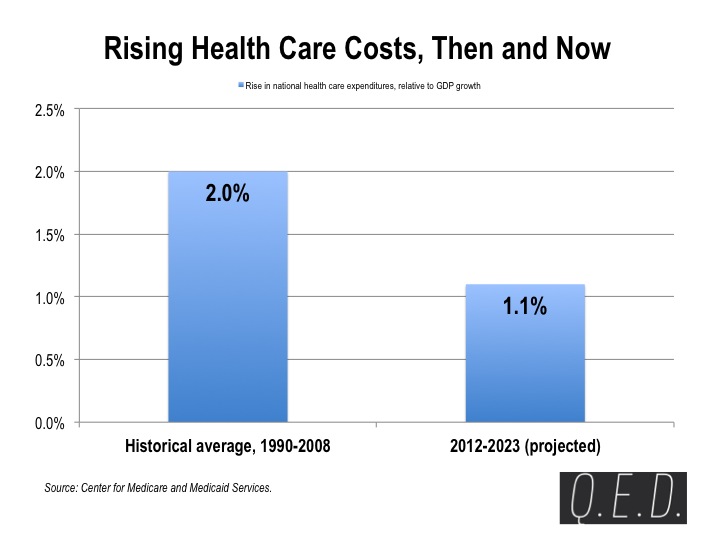
Medicare actuaries expect that health care costs will outpace economic growth by 1.1 percent. That’s not ideal; most health economists would like to see the two numbers grow at the exact same pace. But it’s still a smaller gap than what has existed historically. Between 1990 and 2008, health cost growth outpaced the economy by 2 percent.

This is big. The Medicare actuaries are saying that, while they do expect a slight rebound in medical spending post-recession, they don’t think we’re headed back to the super-fast growth that, for decades, has been a hallmark of the health care industry. And when health care eats up a smaller chunk of the economy (and the federal budget) that leaves more money to spend on other important things like education and infrastructure.

The War Over The Core, Ctd

by Dish Staff

One-time Common Core supporter Bobby Jindal found himself squaring off against his former allies once more last week, when he filed a lawsuit against the Department of Ed alleging that the standards “effectively nationalize [the] education curriculum” and are “patently incompatible with the Tenth Amendment.” Although many view the move as political theater ahead of the ’16 elections and few expect the suit to succeed on its merits, Max Ehrenfreund characterizes it as “an escalation” of the campaign against the standards. In a lengthy article about the conservative backlash against the Core, Tim Murphy notes that its drafters “always anticipated a learning curve – just not a political insurgency intent on destroying the program before it had a chance to produce results”:

The trajectory of Common Core just might wind up resembling that of the Affordable Care Act.

Once the hysteria passes, it’s likely to be viewed as a genuine improvement to the education system– even if the vision of a national standard isn’t fully realized. “The [original] promise was, ‘Wow, this is nearly every state in the country!'” the New America Foundation’s [Anne] Hyslop says. “We may not have that moving forward, but we’re at least going to have a good 25 or 30 states.” From the perspective of the policymakers who pushed for Common Core seven years ago, that would still be a success story.

But it came at a heavy cost: The grand bipartisan consensus has been cut clean to the bone, offering a preview of the obstacles facing future reform efforts. If you thought math and reading standards were a hard sell, try biology. And activists are already taking aim at [Common Core co-drafter David] Coleman’s new Advanced Placement tests, administered by the College Board—tests they fear have been infected with the ills of Common Core.

The political consequences are still unfolding. In June, the Pew Research Center released new evidence that the gap within the GOP had closed: self-identified “business” conservatives opposed Common Core at the same rate as “steadfast conservatives” (61 percent). If that holds true, the 2014 midterms, where many candidates have staked out anti-Core positions, just might determine the standards’ fate in many states. Common Core now faces the highest-stakes test of all—the ballot box.

All Dish coverage of Common Core here.