The NFL Tackles Domestic Violence

by Dish Staff

The NFL announced (NYT) a new policy yesterday:

N.F.L. Commissioner Roger Goodell said Thursday that he had mishandled the Ray Rice case, in which the Baltimore Ravens running back was suspended for two games after being accused of assaulting his fiancée. … Goodell said that effective immediately any N.F.L. employee — not only a player — who is found to have engaged in assault, battery, domestic violence or sexual assault that involved physical force will be suspended without pay for six games for a first offense. Second-time offenders will be banished from the league for at least one year.

Ian Crouch states, reasonably enough, that “Thursday’s announcement should be the beginning of the N.F.L.’s response to domestic violence, not the end”:

The players need to be involved in the league’s attempts to combat violence against women, not simply as the potential recipients of fines and suspensions but as participants in its prohibition and enforcement.

In a recent column for ESPN, Jane McManus argued that owners and players should insert regulations relating to violence and sexual assault directly into the collective-bargaining agreement. (The current one doesn’t expire until 2021, but this particular change could be made without opening the entire document up for renegotiation.) The C.B.A. already includes rules against taking performance-enhancing drugs and driving while intoxicated. Adding the kinds of punishments that Goodell introduced today to a document that both players and owners have signed on to would demonstrate that all sides appreciate the seriousness of the problem within their own ranks, and also that they recognize the N.F.L.’s opportunity, as a major part of the culture, to be not just an object lesson but an advocate for change.

Kavitha A. Davidson’s take:

This came about purely because of the sustained backlash against the league’s paltry two-game suspension of Ray Rice, and despite numerous attempts to defend itself while hiding behind the lack of a comprehensive domestic violence policy. As [Jessica] Luther notes, this also means that the NFL must have talked and actually listened to advocacy groups that tout prevention over punishment. This happened because feminists, and especially feminist sportswriters including Luther and Jane McManus (who brilliantly outlined how the commish could get domestic violence written into the league’s disciplinary measures) simply wouldn’t go away.

She adds that, “Instead of patting Goodell on the back for his far-too-late admission that he “got it wrong,” we need to stay on his case to make sure he actually gets it right.” Last but not least, Alyssa Rosenberg considers how the NFL treats women more generally. She admits, “Being a female sports fan can be a difficult thing”:

There are little indignities, like the cheesy pink gear that suggests our enthusiasms are second to our wardrobe choices. There are bigger ones, like the ongoing employment of scantily-clad cheerleaders to act as inducement to presumptively straight male players and eye candy for presumptively straight, male crowds. And to add injury to irritant, these women are subject to wage theft and degrading employment conditions.

And beyond that, there is the challenge of the players themselves. It is one thing to think that bad men can make great art, or that bad men can throw beautiful spiral passes or lay down devastating hits. It is another to root for men who occasionally act in ways that suggest that they think women are garbage, or that the truest way for a woman to be a fan is to be sexually available. I hesitate a little every time I buy a new Patriots jersey, worried that the man whose name I emblazon across my back might end up acting in a way that casts shame on my enthusiasm for him. Most of the time, I pick out gear with nobody’s name on the back.
Darknet Visible

by Sue Halpern

grams

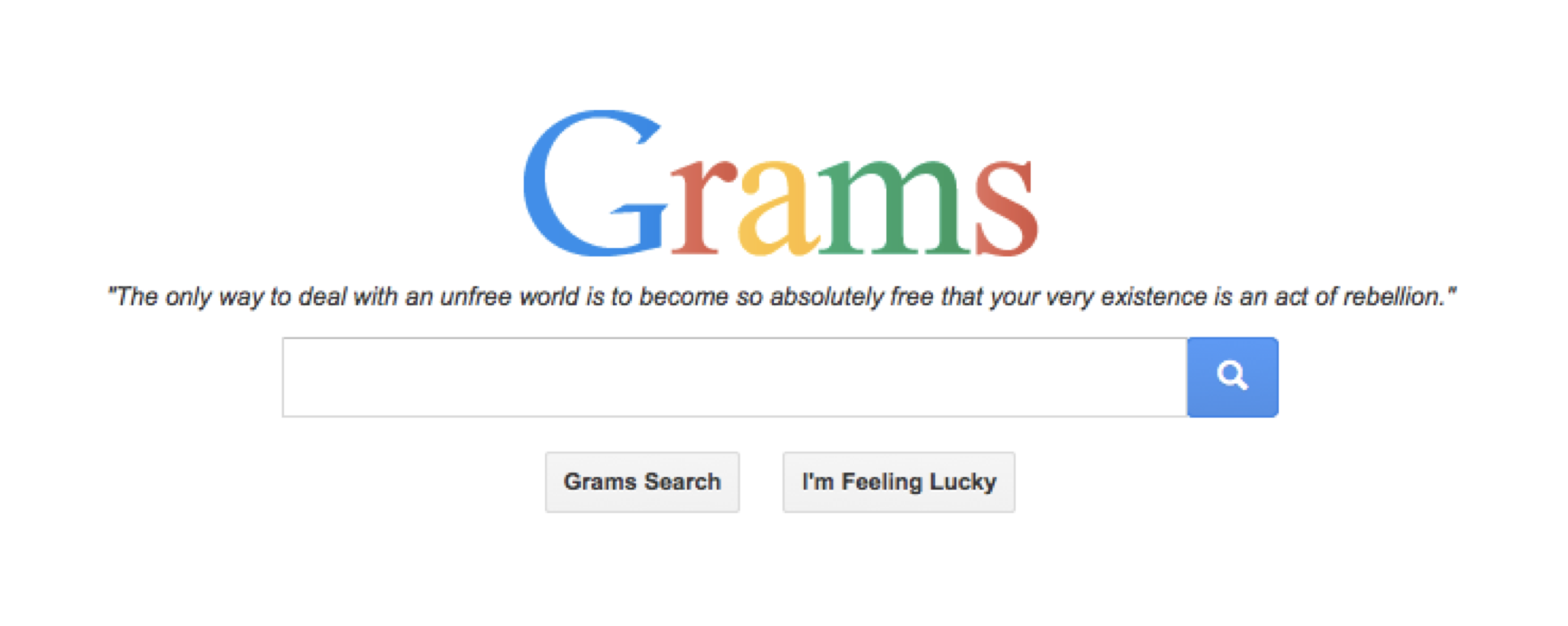
It turns out the NSA’s ICREACH search engine, the one that may be sharing the intimate details of your life among a thousand analysts, isn’t the only secret, Google-inspired search engine out there. Say you’re interested in buying  some of those credit card numbers that Russian hackers are so good at lifting from American banks like J.P. Morgan. Or some meth or heroin or the services of a hitman. All these things have long been available through the Internet’s “darknet,” but tricky to get at. They become much more accessible with the “GRAMS” search engine, which looks just like Google (and ICREACH) (why mess with a winner?), and works essentially the same way. Type in the word “weed” and you will be offered 5 grams of Santa Maria weed from a vendor in Germany, a pound of “chronic outdoor low grade” weed from a seller in the United States, and so on. Type in the word “handguns,” and the first two listings are for “The Terrorist Handbook” and “The Terrorist Encyclopedia” which are all about making explosives from various substances available at the hardware store. The third listing is for the latest CAD files for making 3D printed guns. Like eBay, each listing has a link for other items in the vendor’s virtual store and comments from buyers:

Stars Review Freshness
ok 1 day ago
Exceptional 1 day ago
Perfect, thanks ! 1 day ago
Great feedback! Recommend 1 day ago
got wat i paid for 1 day ago
Everything ok – honest seller as expected! Thanks! 1 day ago
Good service fast delivery. 1 day ago
Thanks mate. Great product! 1 day ago

To get to GRAMS, and to the Darknet more generally, you have to go through Tor, the anonymizing browser developed by the US Naval Research Laboratory, which is now an open source project. Because Tor hands off each message in pieces to many different relays–there are 3000 in all–it makes those messages very difficult to trace and to read in transit. As a consequence, TOR has been useful for journalists needing to shield a source, or dissidents working against oppressive regimes, or victims of domestic violence, or ordinary people concerned with government overreach.  It’s also been very good for cyber criminals, drug dealers and pedophiles.

You might expect that Tor traffic would be fertile ground for NSA spying, and it would be if it could crack the encryption and de-anonymize users, but it’s been challenging. One of the NSA documents leaked by Edward Snowden was called “Tor Stinks,” and detailed all the mostly failed attempts to get into Tor. But since the Snowden leaks, there have been lots of speculation about the NSA’s growing abilities to crack it. On July 4th, when Tor administrators warned users that the service had been breached, fingers didn’t point at the government directly, but at a group of computer scientists at a Carnegie-Mellon lab funded by the government. From the July 31 WSJ:

In a blog post, Tor said outsiders “affected” some users in the first half of the year.

“Unfortunately, it’s still unclear what ‘affected’ includes,” the post said. “While we don’t know when they started doing the attack, users who operated or accessed hidden services from early February through July 4 should assume they were affected.”

Users who act as Tor relays, or hop points, should update their software, the group said. At the Black Hat hacker conference in Las Vegas next week, the Carnegie-Mellon researchers planned to demonstrate a hack that allowed them to unmask some Tor users. They relied on techniques similar to the tactics unveiled by Tor on Wednesday. Lawyers for the university cancelled the talk last week.

Fast-forward to earlier this week when former Health and Human Services employee Timothy DeFoggi was convicted on child pornography charges after a lengthy investigation by the FBI, which had broken into a darknet website run by a man in Nebraska named Aaron McGrath:

The FBI installed malware remotely on the machines of visitors of McGrath’s websites which could identify computers’ IP addresses, as well as its MAC addresses, directly identifying PCs’ networking cards, and other identifying data.

The malware and other FBI techniques “successfully revealed the true IP addresses of approximately 25 domestic users who accessed the sites (a small handful of domestic suspects were identified through other means, and numerous foreign-based suspect IPs were also identified)”, prosecutors wrote in a court document.

DeFoggi, like many pedophiles, thought he was safe from view because McGrath’s site, “Pedobard,” was run through Tor. DeFoggi’s job at HHS? Chief of Cybersecurity.

“We Don’t Have A Strategy Yet”

by Dish Staff

That line from Obama’s address last night is garnering a lot of attention, especially from critics who say it encapsulates the core problem with his foreign policy in general and his approach to ISIS in particular. Ackerman reports on how US officials are interpreting the no-strategy strategy:

Some current and former administration officials, speaking on background, have expressed frustration with Obama for not yet forming a comprehensive approach to Isis, and especially for not attempting to take territory in eastern Syria away from the jihadi group. Others contend that the administration’s options are inherently limited if it seeks not to Americanize yet another Middle Eastern war. Still others have said they expect Obama’s military operations against Isis to eventually expand in scope, mission and geographic reach. Obama was initially reluctant about the Afghanistan surge, the Libya air war and the arming of Syrian rebels, only to eventually embrace all those options.

One reason for the lack of a strategy, Eli Lake And Josh Rogin report, may be that the cabinet can’t agree on one:

There were deep divisions inside the administration’s deliberations over Syria. One set of officials advocated for a campaign to decimate ISIS in both countries by striking ISIS targets across Syria. This camp pushed for hitting near Aleppo where they are advancing, and with at least some coordination with the moderate Syrian rebels. The group, which included officials from State Department, intelligence community and some parts of the military, came up with extensive targeting options for the president that included not only ISIS military assets, but their infrastructure, command and control, and their financial capabilities. Even the oil pipelines they use to export crude for cash were on the target list.

Another group of officials — led by White House and National Security staffers but also including some intelligence and military officials — favored a more cautious approach that spurned any cooperation with the Free Syrian Army and focused strikes inside Syria on targets near the Iraqi border. The objective: cut off ISIS supply lines to Iraq. That strategy would fall more squarely within the existing limited missions that Obama has already outlined for his war.

Mollie Hemingway provides the distilled attack from the right:

[T]he problem isn’t just the lack of strategy for a situation that should not have caught us by surprise but the decision to be extremely public about being tentative. There is just absolutely no reason to hand that kind of morale boost and public relations victory to all of your enemies. … Something tells me “no strategy” will stick to Obama in the same way that “read my lips” did to George H.W. Bush or “heckuva job” did to George W. Bush or “depends on what the meaning of is is” did to Bill Clinton. Sometimes there are phrases that so perfectly encapsulate what’s wrong with a presidency that they are forever linked. And while President Obama has always had clear personal political ambition and strategy for election or re-election, his foreign policy has been confused and aimless for the duration.

But Zack Beauchamp offers a more charitable interpretation of the line:

Viewed in context with the rest of his remarks, Obama’s point might be that there is no good strategy available for fully defeating ISIS in both Iraq and Syria — which is both consistent with his approach the crisis in those countries, in which he has primarily avoided risky escalation, and perhaps true. Throughout Obama’s addresses on ISIS, including this press conference, he’s emphasized the need for a political strategy to defeat ISIS, one that focuses not on Washington but on Baghdad and, in an ideal world, Damascus. Barring political reform in the Iraqi government, and the development of some sort of peace in Syria, it’ll be really hard to fully defeat ISIS. In a changing, complicated situation, Obama’s thinking has long seemed to be, it’s better not to prematurely commit to a specific problem that might not fit the changing situation. You can’t have a strategy for what can’t be done, in other words.

And Beinart argues that Obama does indeed have a strategy, specifically one of “fierce minimalism”:

Understanding Obama’s fierce minimalism helps explain the evolution of his policy toward Syria and Iraq. For years, hawks pushed him to bomb Assad and arm Syria’s rebels. They also urged him to keep more U.S. troops in Iraq to stabilize the country and maintain American leverage there. Obama refused because these efforts—which would have cost money and incurred risks—weren’t directly aimed at fighting terrorism. But now that ISIS has developed a safe haven in Iraq and Syria, amassed lots of weapons and money, killed an American journalist, recruited Westerners, and threatened terrorism against the United States, Obama’s gone from dove to hawk. He’s launched air strikes in Iraq and may expand them to Syria. As the Center for American Progress’s Brian Katulis has noted, the Obama administration is also trying to strengthen regional actors who may be able to weaken ISIS. But the administration is doing all this to prevent ISIS from killing Americans, not to put Syria back together again. Yes, there’s a humanitarian overlay to Obama’s anti-ISIS campaign: He’s authorized air strikes to save Yazidis at risk of slaughter. But the core of his military effort in Iraq and Syria, and throughout the greater Middle East, is narrow but aggressive anti-terrorism.

Why Oil Companies Are Rogue Actors

by Bill McKibben

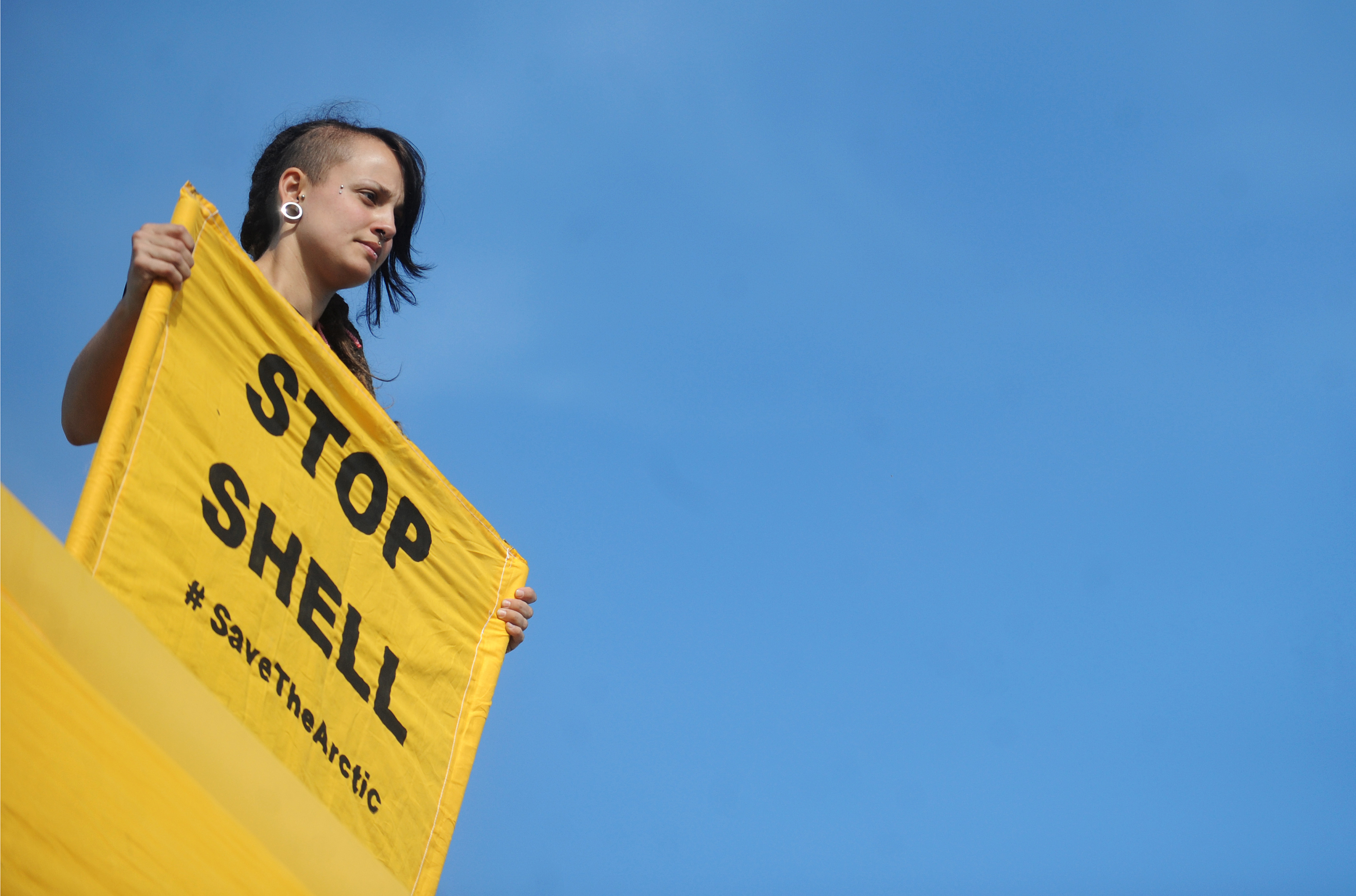
A Greenpeace activist holds a banner dur

A reader writes to complain that fossil fuel divestment is a pointless waste of time:

What divestment does do is make people feel good. That they’re “doing something”, without having to do the thing that they actually need to do: use much less fossil fuel. It’s like a room full of chain smokers advocating tobacco divestment.

This is a reasonable complaint, or at least it would be if having individual people decide to use less fossil fuel could actually cure global warming in the time that physics allows us. But it can’t, because the problem is structural: given that the fossil fuel industry is allowed to pour carbon into the atmosphere for free, they have a huge incentive to keep us on the current path. And since they’re the richest industry on earth, they have the means as well as the motive. (Chevron, for instance, offered the largest corporate campaign contribution post-Citizens United two weeks before the last federal election). If we’re going to do anything about carbon, we’re going to have to break the power of the fossil fuel industry first, which is why divestment from high-profile places is so important (just as it was in the South Africa fight). Nelson Mandela journeyed to the University of California shortly after his release to thank students and faculty there, and by extension at 155 other campuses, for pressing the case so effectively.

Here’s an example from the days news of why oil companies are rogues.  You’ll recall that on Monday a leaked draft of a new report from the world’s climate scientists stated that

 companies and governments had identified reserves of these fuels at least four times larger than could safely be burned if global warming is to be kept to a tolerable level. That means if society wants to limit the risks to future generations, it must find the discipline to leave the vast majority of these valuable fuels in the ground, the report said.

So, demonstrating the exact opposite of that discipline, Shell yesterday filed for the right to become the first big driller in the Alaskan Arctic. It’s actually a followup to their first attempt a couple of years ago, which went tragicomically wrong when a drilling rig ran aground in a storm. But forget the myriad local dangers. The real story is, the world already has four times more hydrocarbons than they can use, but Shell (and its brethren) are busy searching for more. This is like nuclear overkill, except that they’re planning to sell every bit of the oil they find. It’s business as usual, and it’s insane–and anyone who invests in it, make no mistake, is profiting from the wrecking of the planet.

“These people are paid to play and not to watch,” said Fadel Gheit, a senior oil company analyst at Oppenheimer & Company. “After all the hiccups and bad luck, the company has decided that the upside potential is greater than the downside risk and its worth another shot.”

All a game, with the only planet we’ve got hanging in the balance. Oh, and Chevron, with its mighty campaign warchest?  Check out this new piece from Rolling Stone if you’d like to see how they play. (Rough).

(Photo. A Greenpeace activist holds a banner during a protest on May 10, 2012. By Michal Cizek/AFP/Getty Images)

Two Beautiful People Wed

by Dish Staff

As the magazines by the supermarket checkout would have told you soon enough, Brangelina just made things official. Brandon Ambrosino notes the same-sex marriage connection to these opposite-sex nuptials:

In 2006, Pitt said he and Jolie would not tie the knot until marriage was allowed for both LGBT and non-LGBT Americans. When DOMA was struck down on June 26, gossip swirled that the power couple would soon begin planning their wedding. … Some opponents of marriage equality argue that same-sex marriage will undermine the integrity of marriage in society overall. But for Brangelina and Krax, marriage equality did just the opposite: for them, gay marriage made them want to enter into a “traditional” marriage.

Brian Moylan, however, accuses Brad Pitt and Angelina Jolie of not waiting long enough:

I’m sorry, Brangelina, but real fighters for civil rights don’t buckle under pressure when it gets hard. The couple says that their legal union means a lot to the children and that’s why they did it. What about teaching their children about standing up for what you believe in, even when it’s tough and unpopular? What if one of their children grows up to be gay and still can’t get legally hitched? What about all the gay and lesbian couples out there they inspired? What about all the straight mothers and fathers and siblings they enlisted to fight for marriage equality with their once-selfless act? What about the other celebs like Charlize Theron and Kristen Bell who have taken a similar pledge? Well, they don’t have to stick by their word either anymore. In 2013, a year after Brad and Angelina announced their engagement, Kristen Bell and Dax Shepard got hitched too. Now that the biggest celebrities in the Hollywood firmament aren’t keeping their pledge, looks like no one else has to either.

Others, including Alyssa Rosenberg and Alexandra Petri, weigh in on the feminist implications:

[Alexandra:] Marriage — especially with the recent tour — has become a big part of the [Beyonce and Jay Z] brand. And it wasn’t with Brangelina, you’re right … What struck me in the coverage I was reading was that Pitt said it meant a lot to the kids.

Alyssa: Yes, which I think is something we hear a lot when famous people make normative decisions about marriage and family. Women change their names so their kids won’t be confused. Brangelina get married so their kids feel their relationship is valid, etc. The power of kids, who are supposed to be the future in some sort of nebulous way, to pull us towards convention is considerable.

Amanda Hess, meanwhile, calls out the double-standard driving the media’s obsession with how Pitt’s ex Jennifer Aniston must be feeling:

Poor Billy Bob. News broke this morning that Thornton’s ex-wife, Angelina Jolie, finally married her longtime partner Brad Pitt in a secret Saturday ceremony at a Provence chateau. How is Thornton holding up? Probably poorly, as he braces for another day of “how are you holding up” looks from his friends. Because if celebrity tabloids have taught us anything over the past decade, it’s that Jolie and Pitt’s happiness is inversely related to Billy Bob Thornton’s sense of self-worth. The wedding will only remind Thornton that he used to be married to somebody really pretty, but now she is married to somebody equally pretty—somebody far prettier than Billy Bob Thornton will ever be—and now every personal and professional accomplishment Thornton achieves will be forever dwarfed by the expansiveness of Brad and Angelina’s love for one another.

Yep, This Sure Looks Like An Invasion, Ctd

by Dish Staff

29-08_eng

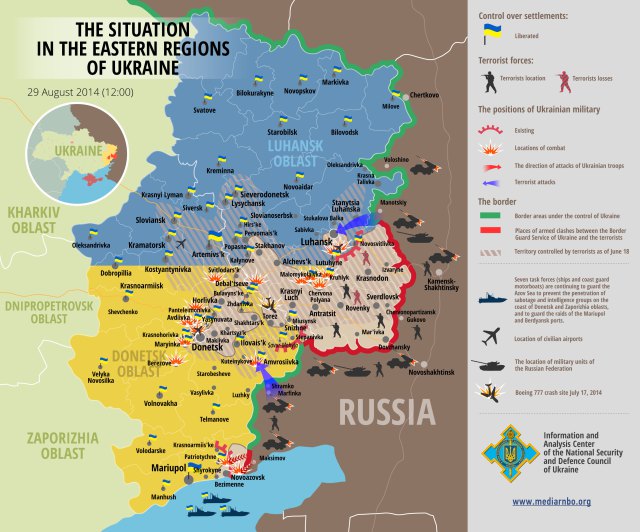
Jason Karaian and Heather Timmons bring us up to speed on the latest developments in Russia’s invasion of Ukraine:

On the ground, Ukraine troops in the southeastern city of Novoazovsk told Vice News that they’re not getting the support they need to repel invading fighters. Russia Today released a video of a separatist flag being raised over a Novoazovsk state building. And Ukraine’s security council distributed a video of what it said was a Russian tank in Novoazovsk[.]

Overnight, Russian president Vladimir Putin issued an appeal to the separatist groups to create a “humanitarian corridor” in order to allow besieged Ukrainian troops to return “to their mothers, wives and children.” But in addressing the rebels as the “Novorossiya militia,” he employed a provocative Czarist era term that implies Russian ownership of a big chunk of modern-day Ukraine. A separatist leader said that his forces would grant safe passage for Ukrainian troops to flee the fighting, on the condition that they left all of their weapons behind.

Max Fisher is perturbed by Putin’s use of the term “Novorossiya” or “New Russia”:

The statement itself was otherwise banal, but in giving the rebels this name, he is seemingly not just referring to them as an extension of Russia (everybody already knew this) and not just adopting the heavily loaded imperial terminology, but endorsing that the rebels and the land they stand on are, in a sense, part of Russia. In other words, Putin’s choice of phrasing — and picking such a hotly political phrase is no accident — sounds an awful lot like a rhetorical step toward annexing all or part of the rebel-held territory. Significantly, earlier this week Russian forces invaded a part of Ukraine where there had been no previous fighting, along the southeastern-most coast with the Black Sea. That is not a rebel-held area, but it is prime Novorossiya territory.

Linda Kinstler observes that the Kremlin is still pretending it has nothing to do with the events in Ukraine:

At Thursday’s UN Security Council emergency meeting, Russian UN envoy Vitaliy Churkin said, “The current escalation is a direct effect of Kiev’s criminal polices and war being waged against its own people”it has nothing to do with Russia, the Kremlin line goes. The Russian Foreign Ministry is claiming that the only reason Kiev has sounded the alarm of a full-fledged Russian invasion this week is because the Ukrainian “anti-terrorist operation” is failing in the east, RIA Novosti reports, leaving aside the obvious reason why the Ukrainian military has suffered setbacks recently, which is that Russia opened up a new front in southeastern Ukraine this week. Izvestia reports that Ukraine is accusing Russia of invading only because the “President of Ukraine is looking for an external enemy” to fend off domestic disapproval.

This absurd commitment to denial leads Joshua Keating to label the invasion “postmodern”:

The Russian government continues to deny that Russian forces are crossing the border or that the government is arming the rebels. One can only imagine what creative explanations they’ll come up with next. Just a few weeks ago, in the wake of the MH17 crash, the conflict seemed on the verge of being snuffed out with Ukrainian forces rapidly regaining rebel-held territory. Now, even as Ukrainian forces close in on the rebel strongholds of Donetsk and Luhanks, Russian troops appear to have opened a new front of the battle along the southeastern portion of the border. Incredibly, this has been done in such a way that President Vladimir Putin can continue denying that Russia is playing a direct military role in the conflict while holding talks this week with Ukrainian President Poro Petroshenko.

Elias Groll and Reid Standish get the sense that Putin is making up his strategy as he goes along:

“Putin has been throughout this crisis a bit of a gambler,” said Jonathan Eyal, the international director at the Royal United Services Institute, a British think tank. “We underestimate the element of improvisation within the Russian decision-making in this crisis.” … Regardless of whether Putin expands the offensive, the Russian leader in the meantime achieves his short-term goal of propping up the separatists he backs. “He wants a failed, destroyed Ukrainian state and to prevent Ukraine from falling in the Western sphere of influence,” Eyal said. “The strategy is to not have a strategy.”

Leonid Bershidsky is pessimistic:

As a Russian, I get a sinking feeling when I think about my country winning this war. It is being fought against a peaceful, Russian-speaking people whose only transgression is a desire to be part of the European Union rather than a Russian client state. They even managed to topple a corrupt dictatorship — a task in which the Russian people have failed. A military victory against Ukraine would bring Russia no glory and cost many lives. “We can stop this,” billionaire and former political prisoner Mikhail Khodorkovsky said today. “It’s enough to just take to the streets and threaten a strike. The authorities will deflate immediately, they are cowardly.” That may be true, but it’s not likely to happen, because most people in Russia believe Putin’s propaganda. Unless the death toll mounts so that everyone knows a dead or injured soldier, this is not a war that protests inside Russia are likely to stop.

Brian Whitmore compares this episode with Georgia and fears it will end up the same way:

When Russian-backed separatists seized control of Georgia’s Abkhazia and South Ossetia regions in the early 1990s, it didn’t make international headlines. Likewise, when separatist fighters in Moldova’s Transdniester region took control of that strip of territory with Moscow’s implicit blessing, it was largely met with a collective yawn in the international community. The script and the playbook have been the same as has the result: exploiting a local ethnic conflict, the Kremlin has repeatedly used local proxies, and then its own troops to seize de facto control of a breakaway region in a former Soviet state. And all the while Moscow has maintained a semblance of plausible deniability that it was the conflicts’ principal instigator. The result was a series of “frozen conflicts” that Moscow has been able to use to influence and pressure its neighbors.

So Random

by Phoebe Maltz Bovy

Jesse Singal laments the decline of the traditional college roommate experience, in which you’re paired with a random classmate:

It’s unlikely a circa-2014 college freshman will ever have to go more than a few hours without having a chance to communicate with distant loved ones. All of which only makes the rando roommate more important.

Just ask Bruce Sacerdote, a Dartmouth economist and one of the leading researchers into the effects college roommates have on each other. Sacerdote is a fan of random roommate assignment. Partially, that’s because it’s exactly the sort of event just about all social scientists love: a predictably timed injection of randomness. In what other situation could a researcher — ethically, at least — say, “Hey, let’s see what happens when you have a white Midwesterner live in close quarters with a Vietnamese immigrant for a year!” Since colleges have loads of data about who kids were before they matriculated — and since it’s easy to keep track of them in the years that follow — random roommate assignment is a unique opportunity to study how humans influence one another.

Singal goes on to cite research showing how beneficial roommates-of-difference can be:

According to Sacerdote, research shows that rooming with someone from a lower socioeconomic class “impacts your attitudes about financial aid, about redistribution,” leading to greater support for policies that help close the wealth game. It’s easy to see why: Rich kids tend to come from rich towns, and as a result don’t have much of a sense of what it means to struggle economically. But if you live with someone who is living financial aid check to financial aid check, things will (hopefully) snap into perspective pretty quickly.

This is well and good, until you consider how it goes for the learning-experience-providing roommate.

If you’re the black student brought in to diminish the endemic racism in a sheltered white one, the poor student offered up to teach a rich kid that not everyone winters in Switzerland, the gay kid who will gosh darn it help rid his roommate of homophobia… this is maybe a bit much to ask of a college freshman. The learning-experience model seems geared towards the relatively-advantaged roommate. (And to social scientists.) What’s in it for Mr. or Ms. Learning Experience? Singal briefly turns to the advantages for the have-not:

None of this is to imply that these rando roommates exist solely as plot devices to educate their whiter or richer roommates (and they may be doing just as much griping to their friends back home about their own rando roommate — the concept of rando is, of course, relative). They, too, can derive benefits from living with someone different with them — from exposure to social networks they wouldn’t have had access to otherwise (if you’re a recent grad from a low-income background trying to get financial support for a business venture, imagine how much easier that will be if you roomed with the son of a hedge-fund manager your freshman year), or to the aforementioned contagious effects of interests or ideology. In many of these instances, the benefits flow in both directions.

This ignores the stress – on top of everything else you’re doing first-term freshman year – of being a representative of your kind. The “benefits” would seem to flow primarily towards the already-more-advantaged roommate.

Am I, then, a proponent of self-segregation via app? No. What I’d advocate is random matching in halls or suites, but without the bedroom-sharing requirement. No one should have to be on call at all hours to provide a taste of authentic Otherness.

The President And The Fashion Police

by Dish Staff

Obama wore a tan suit to a big press conference. Was it a fashion don’t or the height of chic? Danielle Kurtzleben rounds up a bunch of tweets fashion-shaming the President, under a headline deeming the controversy “a promising sign of gender equality.” An example Kurtzleben cites:

Eric Dodds defends the choice as within the range of normal business attire:

The tan suit is just another suit that happens to be a slightly different color than the ones he normally wears. It was, in no way, a fashion statement.

Here is a brief list of fashion choices that would have been “bold” or “wack-ass” that the President could have made yesterday:

1. T-shirt with suit and sleeves rolled up (aka the “Miami Vice“).

2.Whatever Austin Mahone was wearing at the VMAs.

3. Crocs.

But the President did not wear any of those things. Nor did he wear a three-piece suit, a seersucker suit or a white suit. Hell, he didn’t even opt for the Reagan mullet suit (business on the top, lounging on the bottom).

But what did the suit mean? Elahe Izadi asks a fashion journalist:

But this suit was TAN. So, what message is he trying to send exactly? We consulted our in-house fashion expert – Pulitzer prize winner Robin Givhan – to answer just that question.  “There is nothing wrong with that suit – well, except it’s a little big,” Givhan said. “As they always are.” She added:

It says more about official, federal, political Washington that anything other than a dark suit with a white shirt and red tie counts as some sort of aesthetic heresy. That is a conservative two-button suit in a color that is perfectly appropriate for the time of year and the occasion. This was not a ‘formal’ news conference. Honestly, people are responding like he showed up in Pharrell Williams’ short suit. I’m appalled by the Twitter feeds.

“No. No. No.” Ctd

by Dish Staff

A reader writes:

I felt a slow-creeping horror building in the pit of my stomach when I read your reader’s incredibly brave essay “No. No. No.” It wasn’t the same visceral horror the men who wrote to you felt, though I’m grateful the piece could shed some light for them. Instead, my horror came from the fact that all I could summon up from this harrowing story of trauma was a dull, familiar ache.

I know this story.

To be more accurate: I know several versions of this story. One of my closest friends told it to me, twice, and is currently telling it to a team of therapists after years of abusive relationships and self-destruction. Another told it to me with a practiced shrug, like that’s how she meant to lose her virginity all along. I tell it to myself as a cautionary tale whenever I go out, because getting away from the guy who drugged me before it was too late doesn’t mean I’ll get that lucky again — as if “luck” has anything to do with conscious decisions that cowards make.

These are just the assaults I know of that included drugged drinks.

And I’m just so tired.

This shit is exhausting. The shame and the fear, the second-guessing, the disbelief that the after-school special everyone laughed through in health class might have actually happened to you. Then, should you choose to share, the inevitable reaction: a mixture of sympathy, pity, horror, and, as always, doubt.

And I keep thinking about how the friend of this woman’s rapist said, “he can be a little aggressive.” It’s true. He can be a lot aggressive, because he can get away with it. Because there’s the steadfast contingent that insists “ladies could still pay more attention to their surroundings,” never mind that all ladies do is pay attention to their surroundings whether they realize it or not. Whenever I walk anywhere alone – no matter if I’m in an unfamiliar neighborhood or right outside my apartment – I slide my keys in between my knuckles, quicken my step, and listen for telltale footsteps behind me. It’s an instinct that goes back as far as I can remember. Sometimes I make sure to have a cigarette, because I figure if the person with those footsteps becomes a problem, I can put it out on the fucker’s face.

It’s a cruel joke that women always have to watch themselves this closely, even when they’re out with their friends trying to have fun, or forget just for a second how bullshit this world can be sometimes. Because everyone’s been directed to question what victims could have done to prevent their assaults instead of the piece of shit that decided to carry them out. Because when we talk about our assaults, we so often let the perpetrator off with the passive voice: “I was assaulted” instead of “someone assaulted me.” Because this story is so common that we basically accept it as a fact of life. Because when reading “No no no,” I felt a dull, familiar ache that meant I’d adopted that same resigned mindset: “It’s horrible, but it happens.”

And that’s just completely fucking unacceptable.

A Sand Wedge Issue, Ctd

by Dish Staff

PresidentObamaGolf

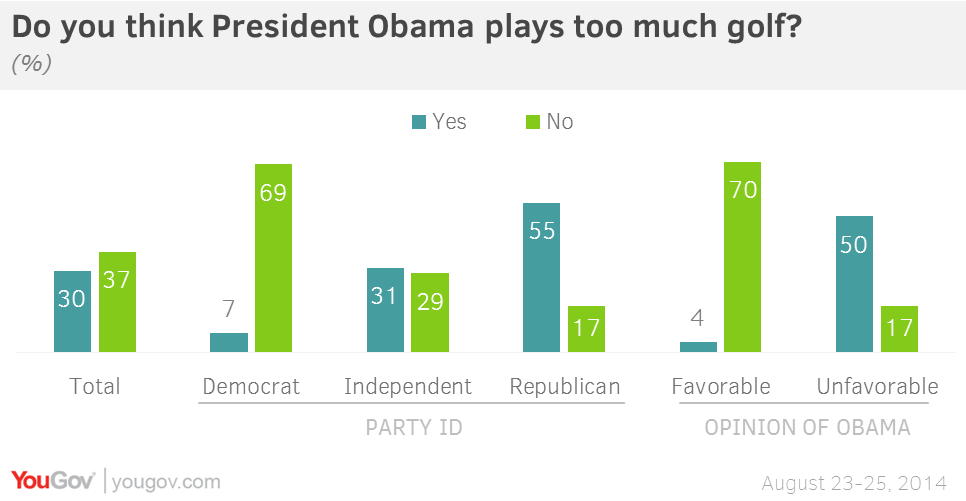
The public isn’t buying criticism of Obama’s golf habit, but as usual, there’s a distinct partisan split:

The opinions of Republicans, who mostly think Obama plays too much golf, and independents, who are split on the question, look a bit more like the current president’s favorability numbers when his name is mentioned. However, compared to the 87% of Republicans in the survey who have an unfavourable opinion of Obama, the 55% who say he plays too much golf could seem small. Among all the respondents who have overall negative opinions about President Obama, only half go on to say he plays “too much” golf, revealing a significant number of Americans who are otherwise unhappy with the president, but unprepared to extend their opprobrium to his golf habit. By contrast, only 4% of those who see the president favorably think he plays too much golf.

Michael Brendan Dougherty joins the chorus rolling their eyes at this line of attack:

In truth, Obama’s golf habit, along with his newer practice of enjoying long dinners with people he finds interesting, is one of the best things about his presidency. Unconsciously, President Obama is doing a good thing for the American Republic. He’s helping us to disgorge an overly symbolic view of the presidency, in which the president is the ever-present lawman, the people’s official therapist, and the embodiment of the public mood. Obama golfing is a sign that the American presidency is still a job, not a divine office. … Early presidents like James Madison and Thomas Jefferson took months off at a time. John Adams left Washington for over half a year to tend to his wife. While presidents today could hardly go to these extremes, they could surely be more leisurely than they are.

But Dougherty’s argument doesn’t do much for Allahpundit:

That argument would be easier to swallow if Obama had sought to downsize the presidency in any other way. Instead he’s done the opposite — wars without congressional authorization, treaties without Senate approval, and a looming amnesty for millions of people while the legislature is trying to find its way on immigration. Hitting the links every weekend doesn’t turn a guy like that into Calvin Coolidge. On the contrary: It feels like kingly disengagement, the habit of a man who could be using his time to try to build legislative consensus for his policies but would rather practice putting between issuing the day’s royal decrees on Syria and climate change and immigration.