Who’s Really Making Marijuana Users ‘Lab Rats’?

by Elizabeth Nolan Brown

The state of Colorado has just launched an asinine campaign to keep kids off marijuana. The initiative’s first tack, unveiled Monday, involves a cadre of nine-foot-tall rat cages staged around Denver, “with messages communicating the potential damage marijuana has on a teen’s brain and the notion that Colorado’s youth are the test subjects for continued observation,” according to a press release.

The “Don’t Be a Lab Rat” campaign will also feature television commercials (example above) and a website with warnings like the following:

Is Mother Nature’s miracle plant as harmless as most teens think? Maybe not. In fact, many early studies have shown the exact opposite. Scientists from Duke to Cambridge have uncovered a laundry list of troubling side effects.

Schizophrenia. Permanent IQ loss. Stunted brain growth.

Still, some people question this research. Claiming the studies need to go deeper. Look further. But who will be their guinea pigs?

Who’s going to risk their brains to find out once and for all what marijuana really does?

Don’t be a lab rat.

Marijuana Policy Project communications director Mason Tvert obviously disapproves of the ads. He told CBS Denver:

You don’t have to say, ‘You’re going to become a lab rat and it’s going to destroy you.’ This is the same type of fear-mongering that’s failed to prevent teen marijuana use for decades.

Seeing as many teens know older adults (possibly even their parents) who smoked pot as young adults and didn’t become developmentally-stunted schizophrenics, the warnings probably won’t ring too true. But the thing is, anyone who uses marijuana – medically or recreationally – is essentially a “lab rat” right now.

We don’t have a ton of research on how marijuana affects teen brains, glaucoma patients, veterans with PTSD, or anyone else. And there is precisely one reason we do not: because of federal drug policy.

American doctors and scientists have been clamoring to study marijuana’s health benefits and risks more closely. Yet the U.S. Drug Enforcement Agency still classifies marijuana as a Schedule 1 controlled substance with “no accepted medical use,” which makes it incredibly hard for researchers to study it. (Other Schedule 1 drugs – including LSD and Ecstasy – also face regulatory hurdles that limit their medical potential, though studying these drugs is slightly less difficult than studying weed.) Among other things, would-be marijuana researchers must get special dispensation from multiple federal agencies and buy their supply from a federal grow facility that’s perpetually understocked. The New York Times recently detailed the hoops these researchers must jump through:

To obtain the drug legally, researchers … must apply to the Food and Drug Administration, the Drug Enforcement Administration and the National Institute on Drug Abuse — which, citing a 1961 treaty obligation, administers the only legal source of the drug for federally sanctioned research, at the University of Mississippi. … The process is so cumbersome that a growing number of elected state officials, medical experts and members of Congress have started calling for loosening the restrictions. In June, a letter signed by 30 members of Congress, including four Republicans, called the extra scrutiny of marijuana projects “unnecessary,” saying that research “has often been hampered by federal barriers.”

(…) Despite the mounting push, there is little evidence that either Congress or the Obama administration will change marijuana’s status soon. In public statements, D.E.A. officials have made their displeasure known about states’ legalizing medical and recreational marijuana.

When state governments and anti-drug crusaders warn folks not to be lab rats, let’s remember who’s keeping them that way.

Robin Williams, RIP, Ctd

by Dish Staff

People Leave Tributes To Robin Williams Outside Mork & Mindy House

Megan Garber honors the comedy legend:

[Robin Williams] has been with us—and next to us, and above us—for more than 40 years, not just on the screens of multiplexes, but in our living rooms and in our lives. There’s Good Morning, Vietnam, on Netflix. There’s Mrs. Doubtfire, on TBS. There are those reruns of his stand-up on Comedy Central. There are all those clips on YouTube. …

We refer to our actors—the big ones, at least—as “stars.” We do that mostly because it’s a convenient cliche. But we do it as well because celebrities have a kind of cosmic constancy in our lives. The people we put on our screens—the people we elevate and exaggerate, the people whose likenesses we watch, huddled together in darkened rooms—form their own kind of firmament. Ancient humans used the stars to navigate the world; we ask our own stars to do similar work. We look to them not necessarily to guide us, but to orient us.

What are your thoughts about Mrs. Doubtfire? How funny is the Genie? Do you think that “words and ideas can change the world“? However you answer those questions, they will reveal something about you and your place in the universe.

A bit more down to Earth, Alyssa reflects on Williams’ remarkable range, which “resonated in radically different ways”:

Williams excelled in bring out the strength in characters who initially appeared weak, and in bringing dignity to people mired in hopelessly undignified situations. He also slyly exposed the weakness and selfishness in people who seemed to be strong, even when he was only acting with his voice. As the Genie in Disney’s gorgeous animated movie “Aladdin,” Williams beautifully captured the dilemmas of a being who had access to tremendous power, but had to manipulate other people to get closer to his own heart’s desire. He was critical to making the movie more than kids’ stuff.

Marlow Stern adds:

[Williams] didn’t just play a huge role in the lives of children; he was a malleable, adaptable comedian who could cater to audiences young and old, gay and straight. Take his outré turn as gay Miami nightclub owner Armand Goldman in Mike Nichols’ The Birdcage (a personal favorite), which saw him shift from flamboyant scenery-chewer to composed pseudo-Republican parent at the drop of a hat. Or as Joey, the sleazy, besieged used car salesman in Cadillac Man.

A good glimpse at Robin’s range:

But Damon Linker sees the darker edge of that versatility:

In his manic and maniacal stand-up routines no less than in his greatest dramatic acting, Williams danced on a tightrope over the abyss.

He behaved like a man desperately trying to distract attention from an emptiness within himself. The possibility that he ended his own life leaves me feeling terribly sad. But it also feels somehow fitting, like the confirmation of a half-acknowledged hunch — or the fulfillment of an awful prophesy barely perceived or understood.

On stage Williams could be exhilarating, and exhausting, as he hurtled through a kaleidoscopic array of characters, some impressions of famous people, most of them conjured from the depths of his own slightly deranged and riotous imagination. In well over an hour of frenzied free-association, Williams would careen through the world, making bizarre connections, heaving forth fragments of ideas and clumps of observations from what must have been a tortuous unconscious.

When it was over, I was invariably worn out by laughter — but I also felt slightly unnerved, aware on some level that I’d just been entertained by one man’s utterly distinctive form of self-abuse. It was less a comedy routine than a comedic seizure.

That spectacular energy came from “not just natural genius,” Willa Paskin points out, “but also cocaine, drugs, emotional pain”:

At his best, and also at his worst, there was something uncontrollable about Williams. Even perfectly in control of his body, of his impersonations, of his timing, he seemed powerless—or scared—to stop being a fount of funny, to turn it off. His non-stop energy often had a childlike quality to it—Peter Pan in Hook; an overgrown boy in Jack; even Mork, who like all Orkans aged backwards—but also something more substantial, more dangerous, and more unhinged. … Performers’ deaths, especially the unnatural ones, often color, at least for a little while, their work. Amy Winehouse’s “Rehab” is not a song you could listen to the same way after she drank herself to death.

J. Cohn hopes that Williams’ death raises more awareness of depression and the risk of suicide:

Although we’re accustomed to hearing about artists and their hidden “demons,” Williams was such an effervescent, joyous presence that his struggles could put into sharper relief just how life-altering and devastating mental illness can be. If he couldn’t conquer it on his own, who could? The lesson would be one last, great contribution from an artist who made so many already. …

We’ve come a long way since the days when we treated the mentally ill as freaks—covering up and denying their problems, holding them singularly responsible for their conditions, or locking them up far away in institutions. We’ve also learned a great deal about the interaction with addiction—and the extent to which both afflictions can have deep genetic roots or be shaped by experience very early in infancy and childhood. But we still treat it as a second-class disease. It’s evident in the choices we make as a society and, too often, in our actions as individuals. The stigma, though far less potent, lingers.

Comedian Jim Norton can relate:

So many comics I know seem to struggle with the demons of self-hatred and self-destruction. While my physically self-destructive days ended when I got sober, the thought of suicide has always been there, as an option, behind a glass that I could someday break in case of an emergency. I glamorized the idea of constructing my own exit. …

The funniest people I know always seem to be the ones surrounded by darkness. And that’s probably why they’re the funniest. The deeper the pit, the more humor you need to dig yourself out of it.

Read all of our RIP coverage here.

(Photo: A makeshift memorial for Robin Williams is set up in front of a home in Boulder, Colorado on August 11, 2014. The exterior of the house was used in the opening credits for “Mork & Mindy,” the comedy based in Boulder that catapulted Williams’ career. By Marc Piscotty/Getty Images)

Medical Services On Aisle Five

by Dish Staff

McArdle sees the logic of Walmart getting into the healthcare business:

The company is piloting what it hopes will be a broad network of primary-care clinics. The company already has urgent-care clinics in about 100 stores, but the new facilities will provide much broader services such as chronic-disease management that are normally provided at a doctor’s office. And it is doing so at an admirably low cost: A doctor’s visit at one of its primary-care clinics costs just $40, in cash — the only insurance they take is their corporate health plan and Medicare.

This model makes a lot of sense to me.

Doctor’s offices are, as the Affordable Care Act’s designers frequently stressed, remarkably inefficient compared to most of the rest of the economy. There are a lot of efficiencies that can be brought to the market by a big company employing staff physicians and centrally coordinating things such as purchasing and information technology. And what is Wal-Mart very good at? Central coordination of purchasing and IT.

Jonathan Cohn tentatively supports Walmart’s efforts:

Walmart’s famously ruthless approach to cost-cutting has its downsides. It’s easy to imagine the company treating its medical employees badly or, maybe even worse, creating a system of medical care that isn’t very good for patients. But the company also has a chance to be innovative, in ways that could benefit the public. It can make medical care easier to get, simply by providing routine care at more convenient times (like a Sunday afternoon, when your doctor’s office probably isn’t open). Walmart can also use its buying power to bargain for better prices from drug makers and suppliers. As Dan Diamond of the Advisory Board notes, the two South Carolina clinics are in two of the poorest parts of the statewhere the need for cheap health care is greatest, particularly since South Carolina hasn’t expanded its Medicaid program.

Arming The Kurds, Ctd

by Dish Staff

Spencer Ackerman examines the logic behind the Obama administration’s decision to arm Iraq’s Kurds:

The idea of arming the Kurds has been the subject of weeks of internal deliberation and official silence by president Barack Obama’s foreign policy advisers. It is a fateful step in Iraq’s current crisis, one that risks facilitating the long-term disintegration of Iraq. Several administrations over decades have refrained from arming the peshmerga due to concerns about reprisals from Saddam Hussein and his successors. US officials have demurred for days when asked about the deliberations. It provides an opportunity for Obama to use a proxy for confronting Isis on the ground – a step Obama has said he is unwilling to take with US forces – which defense analysts consider the only way to dislodge Isis from territory in north and central Iraq the group has seized since June. …

The danger is that arming the peshmerga will facilitate a permanent fragmentation of Iraq, something the Kurds consider a national aspiration.

Several disputed and multi-ethnic cities in northern Iraq complicate any peaceful cleavage, as do major oil holdings in both Kurdish and contested territory. The Peshmerga used the June disintegration of Iraqi army forces running from Isis as an opportunity to seize disputed areas like oil-rich Kirkuk.

While ISIS’s offensive across northern Iraq has shattered the conventional wisdom of the peshmerga as an unbeatable fighting force, the Kurdish fighters’ recent losses are not quite their fault, either:

Michael Knights, the Lafer fellow at the Washington Institute for Near East Policy and an expert on the military and security affairs of Iraq, dismissed the new conventional wisdom that the Peshmerga have caved. “I wouldn’t put it that way,” he said. “The premise is slightly off. It’s a very easy sell to report it that way. Nothing really crumbled quickly. There’s been nonstop fighting … for a number of weeks. They have been in combat with [the Islamic State] for two to three weeks. This has been a breakpoint.” For instance, from Aug. 1 to 3, the Islamic State launched an offensive in Iraq’s western Nineveh province that forced the Peshmerga to retreat. At the same time, the Peshmerga was fighting the militants for the cities of Jalula and Saadiya in Diyala province — areas that are “very difficult to defend,” according to Knights, stretching forces thin.

In fact, Mohammed Salih suggests, the Kurds are itching to make a comeback with American help:

Abdullah and other Kurdish commanders say that despite recent defeats, they can stop the Islamic State. The successful campaign to take back Makhmour and Gwer may signal that Kurds are able to push the militants back. The Peshmerga are especially counting on U.S. assistance these days. Their morale got a boost after U.S. F/A-18 aircraft bombed Islamic State positions on Friday, Aug. 8. Repeated U.S. airstrikes since have targeted Islamic State positions and convoys around Erbil and in western Nineveh. In parallel, Kurds have been strengthening their positions, and Kurdish reinforcements are coming in from across the region to help.

Peshmerga commanders say they have been outgunned in recent weeks. The Peshmerga have not been in a true battle since helping fight Saddam Hussein’s army during the U.S. invasion in 2003. Even then, most of the fight was carried out from the air by U.S. warplanes and missiles. The Islamic State’s crack fighting force, on the other hand, has been honing its skills over the past two years in Syria and Iraq. Around 150 Peshmerga troops have been killed and 500 others wounded in the latest fighting, according to Kurdish government statistics.

A bit awkward for the US, though, is that some of those “reinforcements … from across the region” are from Turkey’s outlawed PKK:

This initiative doesn’t just involve the pesh merga affiliated with the government of Iraqi Kurdistan, but a whole constellation of Kurdish units drawn from Turkey, Syria, Iraq and Iran. One of the main organizations in the counteroffensive against the Islamic State is the Turkish-based Kurdistan Workers’ Party, known by its acronym, PKK. Because of its history of militancy and violence in Turkey, it is still recognized by the U.S. State Department as a terrorist organization.

That reality echoes awkwardly with the present. Last week, as my colleague Loveday Morris reported, the PKK called for collaboration between an alphabet soup of oft-fractious Kurdish factions. One of the main outfits safeguarding Yazidi escape routes into Syria and retrieving the refugees at the border is the YPG, the armed wing of the Syrian Kurdish PYD party, which is itself an offshoot of the PKK. The YPG has fought both Islamist rebels in Syria, as well as the forces of embattled Syrian President Bashar al-Assad. Portraits of Abdullah Ocalan, the jailed founder of the PKK and a hero to many Kurdish nationalists, are ubiquitous in YPG camps, reports Al-Monitor.

Playing The Prostitution Shame Game, With A Little Help From Hyperbole And Fear

by Elizabeth Nolan Brown

FRANCE -PROSTITUTION-POLITICS-LAW-RIGHTS

Comedian Jim Norton admits that he “cannot even fathom a guess as to how much money” he has spent on paid sex in the past few decades. He isn’t ashamed of his habit, and he doesn’t think other johns should be either. But he does worry that the criminal status of sex work invites violence:

By keeping prostitution illegal because we find it “morally objectionable,” we allow (or, more accurately, you allow) sex workers to constantly be put into dangerous situations. Studies have shown that rapes and STDs dropped drastically between 2003 and 2009 in Rhode Island after the state accidentally legalized it. The American Journal of Epidemiology showed that the homicide rate for prostitutes is 50 times higher than the next most dangerous job for a woman, working in a liquor store. You don’t need a Masters in sociology to understand it would be much safer for sex workers if they were permitted to work in places that provided adequate security. Legalizing prostitution would also alleviate the fear a sex worker may have about reporting the abusive behavior of a john out of fear of arrest.

…. By keeping prostitution illegal and demonizing all of its parties, we (you) are empowering pimps and human traffickers and anyone else who wants to victimize sex workers because they feel helpless under the law.

These are all arguments I make frequently (as do organizations like Amnesty International, the United Nations Development Programme, and Open Society Foundations). Criminalizing consensual sex between adults not only harms the sex workers and johns engaged in it but also the actual victims of sex trafficking, from whom resources are being diverted in order to conduct large, interstate stings on men like Norton. Dan Savage recently criticized such tactics, in response to an organization called Seattle Against Slavery and its Men’s March to End Demand:

The Men’s March organizers said in an e-mail that they hoped to get 75 men (and women and families) at the Men’s March to End Demand. But even if 75,000 men (and women and families) marched tomorrow—even if 750,000 men, women, and families marched—men (and some women) will continue to buy for sex from women (and some men). There have always been sex workers and there always will be sex workers. Sex workers have always had clients and they always will. Marching to “end the demand” for sex work is like marching to end the demand for illegal drugs. Marchers may burn a few calories, and they may leave feeling as if they’ve done something, but people will go right on paying for sex and using drugs.

393px-Have_You_A_Girl_to_Spare_-_The_Great_War_on_White_SlaverySeattle Against Slavery subscribes to the popular, delusional conception that all prostitution is “sex trafficking.” This delusion was recently promulgated by journalist Charlotte Alter in response to Norton’s anti- john-shaming essay. After telling Norton and everyone else they “should be ashamed” to pay for sex – after all, men aren’t “entitled to sex, but women are entitled to human dignity” – Alter asserts:

No amount of rationalization can get around the basic principle of market economics: if people like you didn’t buy girls, they wouldn’t be sold, and if they couldn’t be sold, they wouldn’t be trafficked and abused.

If Norton had said he pays girls for sex, I could see Alter’s point. But he didn’t. Norton wrote about paying for consensual sex with adult women working in the sex industry. Alter responded by accusing him of raping abused girls.

This is a popular tactic from the anti-sex work crowd. It can be hard to convince Americans, with their strong support of individual liberties, that the whys and hows of private adult sex is a proper matter of state concern. But if you can tie adult prostitution to the criminal trafficking of teens and children, more people’s ears start to perk up. And Alter tries her darndest, letting unsubstantiated allegations and spurious statistics fly:

Did you ever consider, Jim, whether these girls … might have slept with you only because they would get beaten if they didn’t make a certain amount of money that night. And if you thought they enjoyed it, they were probably faking, because that’s exactly what you pay them to do. Sure, some woman do choose this line of work, and sex-workers unions argue that prostitution can be a freely made choice, but that’s not the case for the vast majority: U.S. State Department estimates that 80% of the 600,000 to 800,000 people trafficked across international borders every year are trafficked for sex.

This statistic is false. To substantiate it, Alter links not to actual State Department statistics but to a page from the advocacy organization Half the Sky – and even that doesn’t say what Alter says it does:

The U.S. State Department … estimates that between 600,000 and 800,000 people are trafficked across international borders each year. Eighty percent of those trafficked are women and girls, mostly for sexual exploitation.

Half the Sky doesn’t provide any links or citations to back up these claims, either. According to a 2014 report from the State Department, however, only 44,758 victims of any sort of human trafficking were identified worldwide in 2013. Obviously not all or even most of those who are trafficked are identified by global governments, but I do wonder how we leap from less than 50,000 identified victims to an annual estimate of 600,000 and 800,000 victims, not including those who don’t cross country lines.

Of the identified victims, there were people who had been sold into prostitution, domestic labor, farm labor, military subscription, and a number of sectors. While the state department data doesn’t break it down, the International Labor Organization estimates that about 3 times as many people are trafficked into labor as are trafficked into the sex trade, and less if you include those trafficked by state or rebel groups and not just private individuals or enterprises. Women and girls make up a little more than half of total human trafficking victims.

Perhaps Half the Sky’s claim that trafficking is mostly girls and women being sexually exploited comes from the Bureau of Justice, which says that 80 percent of trafficking victims identified by U.S. federal investigations in 2008-2010 were sex trafficking victims. But it would be dangerous to assume the amount identified here reflects the trafficking population as a whole, since U.S. law enforcement puts much more effort into fighting the sex trade (especially these days) than it does cracking down on, say, forced domestic labor.

People like Alter ignore non-sexual trafficking victims in service of their anti-prostitution agenda, then have the audacity to question the motives of men like Norton who want to decriminalize sex work. Writes Alter:

Norton claims that legalizing prostitution would help solve (violence against sex workers), but what he really means is that it would be easier for him to buy sex without his pesky conscience getting in the way of his peskier penis. Because even though there are valid arguments for the legalization of prostitution, I’m finding it hard to believe that Norton really has the best interests of sex workers in mind.

While it’s neat that Alter thinks she can read minds, I guess, there’s nothing in Norton’s text to support her interpretation. He states that he feels no shame about paying for sex, doesn’t think anyone should feel ashamed about it, does not feel bothered by its illegality, and would not buy more sex if it was legal. I don’t see why we have any reason to think that Norton’s stated reason – making the whole business safer, especially for sex workers themselves – is suspect. That is unless, like Allen, you can’t conceive of a world in which anyone could purchase sexual services from someone and still respect their humanity.

(Photo: A demonstrator holds a placard reading ‘yes to the freedom to prostitute oneself’ on November 29, 2013 in Paris during a protest against a bill that would punish clients of prostitutes. By Joel Saget/AFP/Getty Images)

Clinton Out-Hawks Obama

by Dish Staff

How Jeffrey Goldberg characterizes his recent interview with Hillary Clinton:

President Obama has long-ridiculed the idea that the U.S., early in the Syrian civil war, could have shaped the forces fighting the Assad regime, thereby stopping al Qaeda-inspired groups—like the one rampaging across Syria and Iraq today—from seizing control of the rebellion. In an interview in February, the president told me that “when you have a professional army … fighting against a farmer, a carpenter, an engineer who started out as protesters and suddenly now see themselves in the midst of a civil conflict—the notion that we could have, in a clean way that didn’t commit U.S. military forces, changed the equation on the ground there was never true.”

Well, his former secretary of state, Hillary Rodham Clinton, isn’t buying it. In an interview with me earlier this week, she used her sharpest language yet to describe the “failure” that resulted from the decision to keep the U.S. on the sidelines during the first phase of the Syrian uprising.

But Andrew Sprung disagrees with Goldberg’s framing:

I’ve seen more than one tweet this morning to the effect that Hillary Clinton “threw Obama under an ISIS-driven Humvee” in a long, probing, interview with Jeffrey Goldberg.  I think that’s a wrong impression created by Goldberg’s introductory overview, which overstates her actual and implied criticisms of Obama.

It’s no secret that Clinton advocated for early U.S. support of allegedly moderate factions in the Syrian opposition. And it’s necessary and prudent for Hillary to distance herself from Obama, or position herself to do so, in that a) she genuinely is more interventionist, and b) the world could blow up on Obama and doom her chances if she’s seen as a continuation. But it’s also in Hillary’s DNA to hedge, both from a desire to cover both sides and an ability to see complexity (except with regard to Israel, to which she pandered without inhibition). And in at least three instances, Goldberg emphasized just one side of her equation.

Francis Wilkinson seconds Sprung:

The skill and elasticity of her rhetoric was impressive. She spoke at length, and seemingly without restraint, yet it’s hard to find specific acts of the Obama administration that she has clearly renounced or endorsed, or firm positions of her own to which she irrevocably committed. … Clinton drew a clear distinction with Obama on Syria, pointing out that she had wanted more vigorous support for the non-jihadists among the Syrian opposition. But she made no claim that her preferred approach would have succeeded. She also compared herself very favorably with her successor, John Kerry, in moving Israeli and Palestinian leaders toward compromise, casting Kerry’s subsequent efforts in a diminished light. But much of Clinton’s foreign policy analysis fell under the rubric of “time will tell.”

Cillizza sees Clinton’s comments as baldy political:

Clinton wants people to remember she never always agreed with Obama. One of the challenges Clinton will face in 2016 — although not the biggest challenge — is her association with Obama, particularly on foreign policy. (She was, after all, the top diplomat in the Obama Administration for his first term.) What Clinton does not want to do, however, is be forced to own every decision the President made — especially those that she disagreed with. On Afghanistan, Clinton — along with Secretary of Defense Robert Gates — advocated for putting more troops in the country. On Libya , Clinton was a lead voice making the case for a military intervention to topple Muammar Gaddafi. And, in the interview with Goldberg, Clinton calls the U.S.’s decision to not actively involve itself in the early days of the uprising in Syria a “failure”.  There will be plenty on the foreign policy front that Clinton will have to own — “pushing the reset button” with Russia, anyone? — but she also wants to make very clear that had she been president, our foreign policy might have looked very different over the past six years.

Matt K. Lewis calls out-hawking Obama politically brilliant but his argument is relatively flimsy:

Pundits love to say that people vote their pocketbooks, not foreign policy. Well, what Clinton is doing here transcends foreign policy. It’s about restoring America’s swagger. And I think there’s a real hunger for this.

Larison more convincingly argues that Clinton’s hawkishness will backfire:

There are many things one could call Clinton’s recent foreign policy remarks in this Goldberg interview, but politically savvy or brilliant is *not* one of them. The foreign policy she outlined in the interview is one that would replicate all of Obama’s major errors (e.g., intervention in Libya, arming foreign rebels, etc.) while expanding on and adding to them. She is clearly currying favor with foreign policy analysts and pundits that already think Obama has been too passive on Syria, Ukraine, etc., and she is doing that by reciting many of their unpersuasive arguments.

Clinton has “brilliantly” identified herself as the hawk that she has always been, which puts her sharply at odds with most people in her own party and most Americans of all political affiliations. That’s not triangulation at all.

Dougherty fears the worst:

Clinton’s strategy of trying to say that she would have embraced Obama’s foreign policy — But harder! And bigger! — amounts to admitting she would double down on failures, engage in drive-by wars, and get America stuck in confusing entanglements with gun-wielding losers and child-beheaders. Will some Democrat with an ounce of sense speak up and try to defeat Clinton before we get George W. Bush’s third term?

Josh Marshall thinks thinks Hillary is playing a dangerous game:

[T]here’s an element of Hillary’s strategic distancing I’ve not seen widely mentioned. President Obama is not popular at the moment. His popularity is at best in the low 40s. But among the people who choose Democratic nominees – that is, partisan Democrats – he remains quite popular. And even for many Democrats who feel disappointed, let down or just worn out by the whole six year journey, President Obama represents something that transcends how they may feel about him at just this moment.

Quite apart from the pros and cons of particular foreign policy strategies, I believe the great majority of partisan Democrats feel protective of the President. So it’s a delicate, perilous thing to criticize him so publicly, particularly at a politically vulnerable moment, especially when the nature of the criticism mirrors that of many of the President’s most dogged and aggrieved foes.

And, lastly, looking beyond Clinton’s rhetoric, Marc Lynch pushes back on Clinton’s suggestion that we should have armed Syria’s rebels. Among his reasons for rejecting that step:

The idea that these rebel groups could be vetted for moderation and entrusted with advanced weaponry made absolutely no sense given the realities of the conflict in Syria. These local groups frequently shifted sides and formed alliances of convenience as needed. As MIT’s Fotini Christia has documented in cases from Afghanistan to Bosnia, and the University of Virginia’s Jonah Shulhofer-Wohl has detailed in Syria, rebel groups that lack a legitimate and effective over-arching institutional structure almost always display these kinds of rapidly shifting alliances and “blue on blue” violence. A “moderate, vetted opposition” means little when alliances are this fluid and organizational structures so weak.

Andrew’s take on the interview is here.

The View From Your Window Contest: Winner #217

by Chris Bodenner

vfyw_8-9

After more than four years running the VFYW Contest (a feature increasingly innovated by Chas, aka Special Teams), I thought I would finally throw my own view into the ring. A reader writes:

Somewhere in Barcelona. I had a very similar view from a hotel there once.

Another:

Paraguay, because of “Chacarita” on the bus. (Chacarita is a barrio, or neighborhood, in Asunción, the capital of Paraguay.)

Another asks, “How about Chacarita, Costa Rica?” Another stands by his principles:

SW Rome. I don’t believe in researching these!

Another notices a key detail:

Winter clothing and the portable propane patio heater tell us we are looking at the Southern Hemisphere.

Another gets the right city:

Unless I’m missing something, this one had a surprisingly HUGE giveaway: the graphics on the bus – Chacaritas – clearly place the photo in Buenos Aires, Argentina. I’m putting it in the Colegiales neighborhood on Calle Maure, but being an underachiever with three kids in tow to boot, I’ll leave it to another Dishhead to take this one home!

Another shares a great memento:

A few years ago, my family went on a vacation to celebrate my dad’s 60th birthday in Buenos Aires, the location of this week’s VFYW.  This photo transported me back on Sunday morning when I saw it, with its architecture, foliage and of course, the bus. While there, one souvenir I purchased was a small coffee table book, El Libro de los Colectivos, a book celebrating the unique styles and culture of the city’s buses:

LibrodelosColectivos

The colectivo 39, without a doubt, is the major clue in his week’s photo (although according to the book, number 39 seems have have changed its look since this book came out).  Looks like it used to have a red and black color scheme, different than today’s mud and cola colors.  Both still have gold accents.

Another goes for the right neighborhood:

After hoping that someday there might be a VFYW pic with a clue so obvious that it might as well have been written on the broad side of a bus, there it was, right in front of me. But I’m still uncertain. I’ll go with the neighborhood of Chacarita in Buenos Aires, Argentina. More specifically, a view from the Hotel Torre at the corner of Avenues Corrientes and Olleros.  Late afternoon Southern Hemisphere fall shadows agree with that intersection’s orientation,  but there is still something not quite right with the hotel’s location at that corner.  But I will stand firmly in quicksand with my guess.

Another adds, “The famous Chacarita Cemetery is the largest cemetery in Argentina with many notable interments.” Another reader:

Gut feeling says “Buenos Aires.” I was there a couple of years ago and this looks like the neighborhoods I walked through.  I won’t go for the intersection (let alone the exact window), but let’s say it’s in the Recoleta neighborhood, near the cemetery where Eva Peron is entombed.

Another notices a detail no one else did:

The jacaranda trees and architecture told me it was Buenos Aires, probably the Palermo neighborhood, before I even tracked down the bus that features so prominently in the photo.

Palermo it is. Another reader:

Welp, everyone is going to get this week’s window location, I think.  Googling “chacarita 39” brings up this route map for the bus in the picture as the very first hit:

Screen Shot 2014-08-12 at 11.51.01 AM

If I were motivated to find the exact window, I’d just take that map and – noting that the bus is turning right – find all the right turns on the route and zoom in on them. But I’m not, because thinking of Buenos Aires reminds me of my favorite author, the master Jorge Luis Borges (who was born there), and I find a parallel between the VFYW contest and his tale of the Zahir: that thing that possesses the power to induce an overwhelming obsession in those who see it, slowly consuming them until they lose all sense of reality, until finally “(they) will have to be fed and dressed, (they) will not know whether it is morning or night, (they) will not know who (they were).”

Many are the Saturdays that I have spent long hours seeking out the location of a fascinating View window. Is it possible that this contest has become my Zahir?

Another moves along:

If you think I’m going to follow the 39 Chacarita bus line through it’s entire route looking for this corner, you’re nuts.

Another gives it a shot:

I’m not super familiar with Buenos Aires, but based on the fact that the bus is turning right and on the tree-lined street, I’m guessing Avenida Santa Fe in the (trendy!) Palermo district, taken at the intersection of Santa Fe and Vidt.  From a 5th-floor window in the building on the northeast side of the street.

Another tried another tool:

So, I’ve chased every turn the #39 Chacarita bus makes as it winds through the streets of Buenos Aires and failed miserably. Even tried searching through the photos of each hotel listed on the route in the Time Out guide. I’m exhausted and my head hurts!

Chas helped me plot many of the other guesses:

better-screen

Another scratches his head:

I thought the geometry of this intersection was peculiar. There were three vehicles in motion at this intersection. The photo shows that the vehicles are traveling on a one way street. The vehicle to the right (in the photo – it is left in relation to the other vehicles in the real world) is making a left-hand turn, while the bus and the car next to it are going straight through the intersection. To the left are parked cars facing the opposite direction from the car turning left, which indicates that this street might be two ways.

Another nails the right intersection:

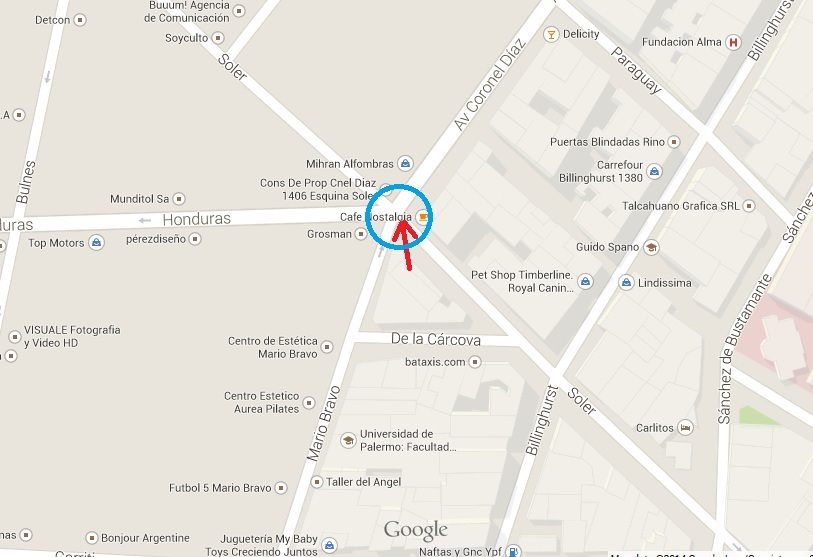
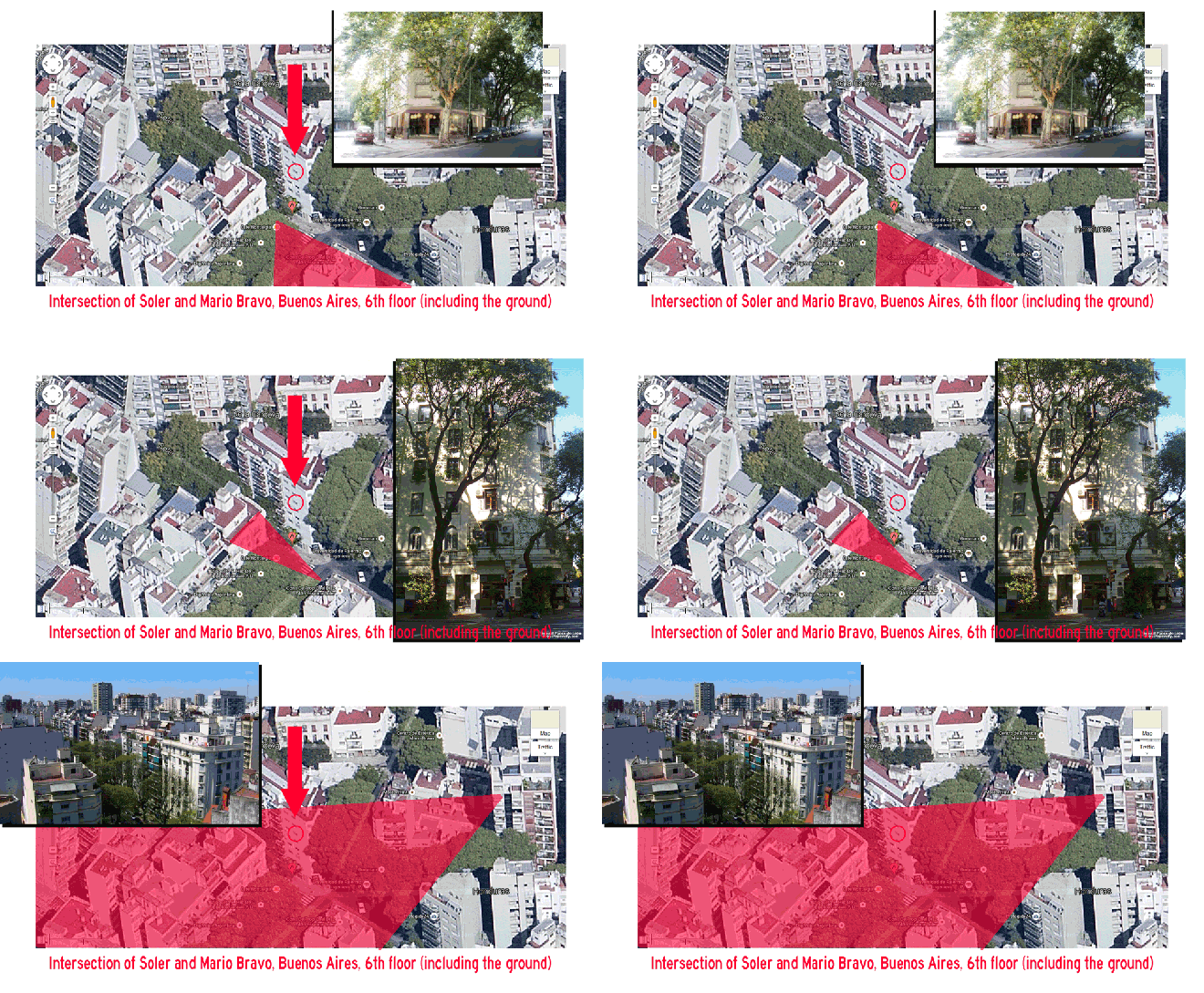
First-time entrant, long time astonished observer here.  I think this was taken from the fifth-floor window (fourth-floor in European counting, i.e. ground+4) of the building on the corner of Mario Bravo and Soler in Buenos Aires (3600 Soler? Can’t figure out an exact address), on the five-way intersection of Soler, Honduras, Mario Bravo, and Coronel Diaz.

Another provides a visual of the five-way:

The #39 bus to Chacarita!  Google search for “Chacarita” led me to Buenos Aires, and from there I found a detailed route map of the #39.  So I just have to use Street View to check out all the intersections on the route where the #39 bus turns, right?  Wrong – there’s no Street View for Buenos Aires yet. But Google Earth is a good enough substitute, and it led me to this intersection:
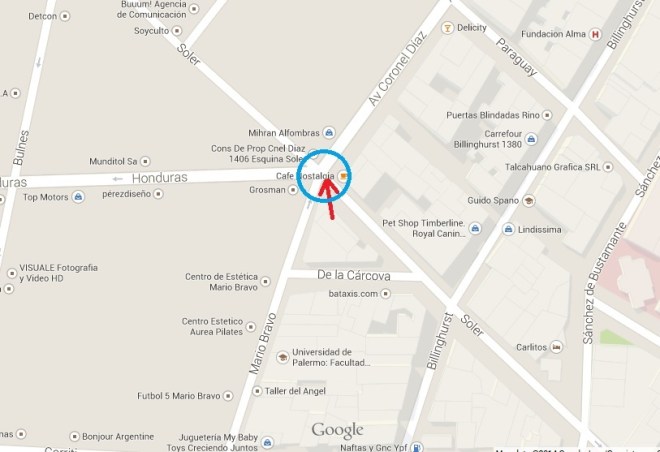
VFYW Buenos Aires Map

The photo looks like it was taken from the triangular building on the south side of Soler, and the photo is catching the bus turning onto Soler from Av Coronel Diaz. I couldn’t find the address for the building where the photo was taken, so I assume it’s residential – I’m guessing the window is on the 6th floor of the building.

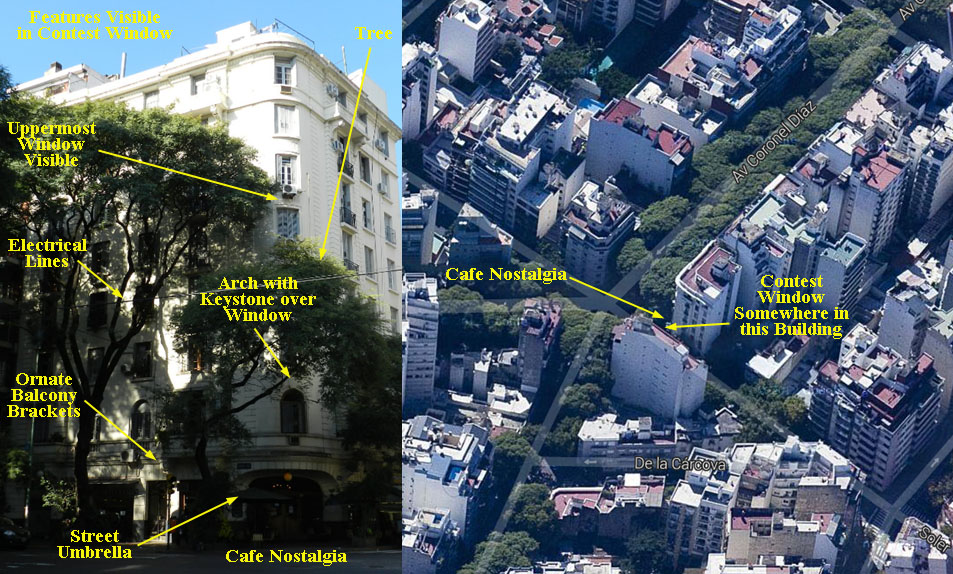
Another has a great photo of that triangular building:

My city! Finally! At first sight, it looked like the snobbish Palermo neighborhood. With the 39 line bus clue, and the street that changes its direction (Soler Street), it was a piece of cake to deduce the exact corner. I know this city better than my palm. It’s a similar size to NYC, and it does have a somewhat similar vibe, but it has fewer green spaces (in that sense, it is the worst in Latin America) and a worse public transport system. It’s a worse city than New York, but I love it.

This was the building in which the picture was taken, and I’m guessing the fifth floor:

getFoto

Another walks us through:

The two-steps-forward-and-one-step-back of this week’s contest:

1. Easily spot Chacarita 39 on bus in picture… Yay!

2. Note that this damn bus line in Buenos Aires runs through pretty big portion of the city… Grrr

3. Easily find a block-by-block bus route on a satellite image-enabled map… Yay!

4. Waste precious time trying to find a spot on the route where the bus turns sharply right… Grr

5. Using both the bus line website and Googlemaps, locate the slight turn (a right turn!) on from Avenida Coronel Diaz, across Soler, onto Honduras that appears to fit the bill… Yay!

6. Realize that Google Streetview is not avialable in Buenos Aires… WTF?!

My best guess is that the picture was taken from an apartment building with the address “De la Carcova 3501-3599” in the Palermo section of Buenos Aires. The view looks due north from the fifth floor across Soler towards Avenida Coronel Diaz.

One of the best visual entries:

aerial

Another didn’t get that far:

Looks like a South American city. Somewhere I’ve been. Best guess: Buenos Aires. It may be winter there, but it’s a gorgeous summer day here, so I’m done. (I’ll leave finding the details and winning the book to someone else.) Gonna go out and enjoy myself in Central Park, in that wonderful city that you hate so much and that apparently makes so many people so miserable.

Rest assured there won’t be any gratuitous NYC bashing while Andrew is away this month. And by the way, the winters down in Buenos Aires are pretty gorgeous too; 65-degree sunny days are common. How a reader describes it:

It’s a strange place: Warm as hell but resembling a German city at times.

Another:

It turns out it’s actually more frustrating when you know the city! I have spent a lot time in Buenos Aires so I knew immediately. I suspect I’ve even taken the Line 39 Chacarita Bus. If I were a more patient individual I could trace the route of the bus but I’m not that patient. Anyway, I’m guessing somewhere in the Palermo neighborhood. I await the efforts of a more obsessive person to identify the exact corner, and window.

Another obsessive:

Screen Shot 2014-08-12 at 12.41.49 PM

Another notes:

Riding those buses years ago was one of my highlights of living there. Drivers would “drive,” shift gears, smoke, talk to their girlfriends (seated behind or next to them), give tickets, make change, yell at passengers, debate passengers, and, usually, avoid minor fender benders with other vehicles and pedestrians.

Another also knows the area:

The #39 bus to Chacarita (a fabulous neighborhood where many gays have moved since the gentrification of Palermo) veers right at this intersection onto Calle Honduras. Hope I’m right!  And I hope the “rational default” doesn’t further destabilize an already highly volatile economic / employment situation in Argentina.

Another has fond memories of the city:

I spent six months studying in Buenos Aires while I was in college and lived in the Palermo neighborhood with a lovely old couple, and I woke up to a similar more often than not. After I got married last year, I traveled there on my honeymoon where I tried to relive some of the magic of that city. Now, the number 39 route (which I did ride on occasion) goes through several neighborhoods, but the feeling on the street reminds me of Palermo. Thanks for reminding me once again of this great place.

Another:

It’s a tremendous coincidence that you selected this precise location, since it not only inspired great nostalgia in me as a former resident of Buenos Aires, but in fact the lower-right corner of the photo contains a view of Café Nostalgia, located at the corner of Av. Coronel Díaz and Soler in the neighborhood of Palermo.Café Nostalgia

My nostalgia was further enhanced by the fact that I used to live about ten blocks away, on the border of Palermo and Recoleta, and that I used to ride that very bus (the 39 Line to Chacarita) with great frequency while attending classes in the Faculty of Social Sciences at the University of Buenos Aires.

Great choice – thanks for the wonderful memory!

Another adds, “Café-Bar Nostalgia is described here as ‘a space in which you can revel in the antiquated whilst observing the modern,’ complete with a crowd-pleasing ‘barrelful of monkey nuts’ – yum!”  … meaning a barrel of peanuts from which they serve you a bowl at your table. Another reader:

The neighborhood sounds interesting and perhaps a bit ritzy. A review of the restaurant across the street gushes about the $35-$40 main courses and the excellent people watching.

That review was written in January 2010, and prices at Cafe Nostalgia are actually much lower now. I’ve had many amazing steak dinners there with another person, sharing a bottle of wine, and I’ve rarely spent more than $50 USD. Update from a reader:

By the way, if you want a fancy (somewhat expensive by BA standards) and amazing meal, try Paraje Arevalo.  We went late last year and loved it.

Just the kind of recommendation I was hoping to get by posting my view this week. And I’m finally getting a two-week vacation this month, after many years without a break from the Dish longer than a week, so keep the recommendations coming! My favorite entry this week:

I recognized Bs As right away – same as I did last time you had this city: there’s something so distinct of its aesthetic. I used to to live there back in ’09-’10. I googled the bus line and that confirmed it (as recently as 2010 there was no website like that and you had to carry around a city-issued byzantine pocket-guide). Out of the path on that route it felt like the neighborhood of Almagro to me.

cafenostalgia02

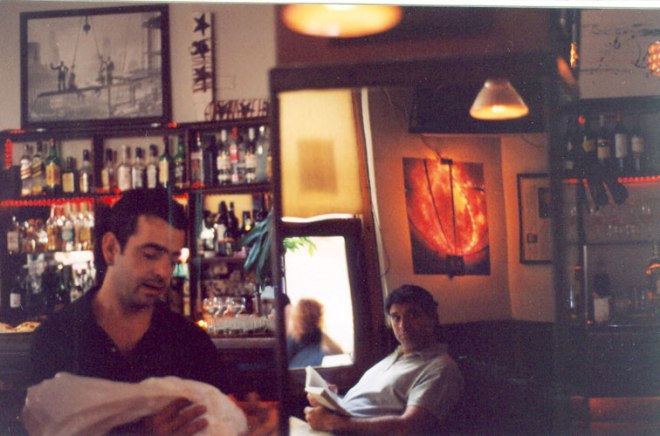
I started looking along “Honduras” and when I cam across the corner of Colonel Diaz I saw “Cafe Nostalgia” pop up. Back in Bs As I worked part-time as a photographer for The Argentina Independent, a small English language newspaper. I’d photographed Cafe Nostalgia for them as part of a project on the then-54 Bares Notables (bars and cafes with a sort of historical landmark status from the city). Two of my photos [seen above and below] still come up as some of the first google image results for “Cafe Nostalgia.

cafenostalgia01

I went back and looked through the rest of that roll (all film) and even though there wasn’t any smoking gun pic, I do think that that green awning in the bottom right is Cafe Nostalgia. Maybe it’s just wishful thinking for this whole coincidence to be the case, but I’ll make my guess for that corner: Universidad de Palermo – Ingenieria, Mario Bravo 1300, Almagro, Buenos Aires, Argentina. Let’s say 4th floor.

Truly an amazing coincidence that the photographer is a Dish reader, since his photos were widely cited by other players this week. Another:

So easy!!! Since this is my hometown :)  The giveaway was the bus. The “39”. Anybody who has ever visited BA knows that the city is crowded with buses everywhere, each with their different numbers and their distinctive colors. The 39 passes by my old school (University of Buenos Aires) and of course I took it many times to go places in the city. The “Chacarita” written in the top of the bus signifies the last stop, one of the biggest cemeteries in the city. So I’m guessing that you will get tons of correct answers this week. I can’t give you the exact window but it doesn’t matter, it was definitely nice to see my city in the contest this week, I really miss it. “Mi Buenos Aires querido”.

Another also reflects:
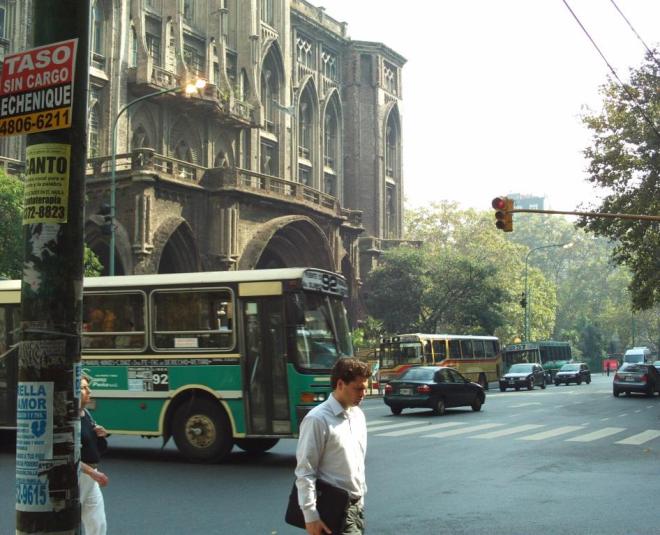
?????????????

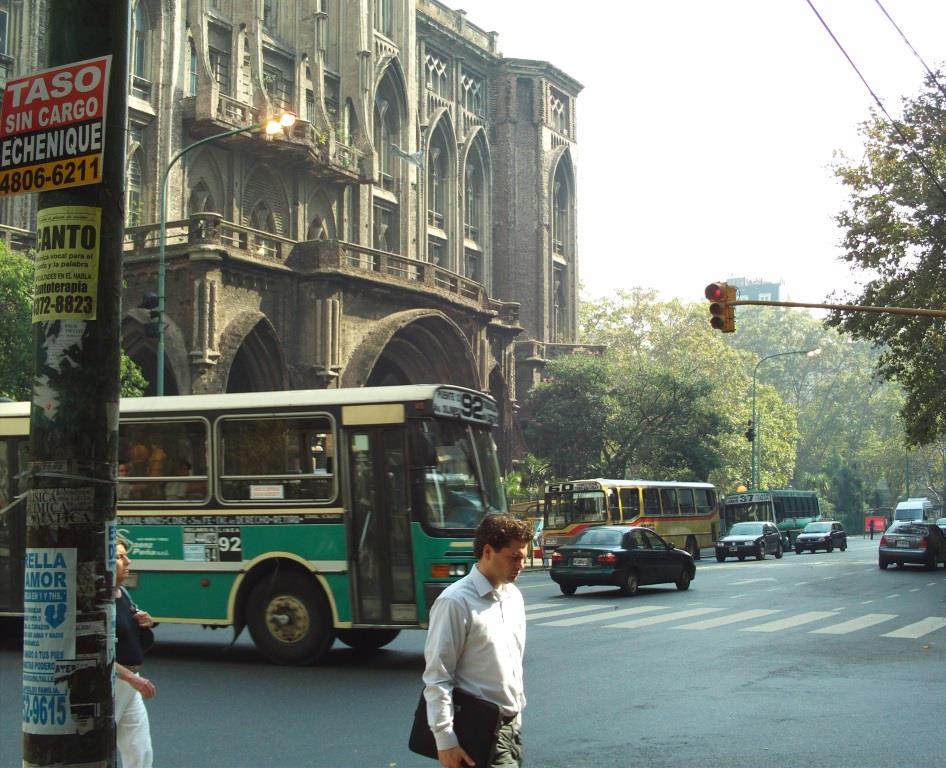
Identifying the city was easy.  I went on holiday to Buenos Aires with friends in 2008, and I snapped a street scene in the containing buses with similar numbering, attached here, which helped me identify this photo location.  The distinctive multi-story European architecture and signs in Castilian Spanish were also good clues.

Another wants to go:

I came across the El Ateneo book store while googling along the route 39 bus line and then stopped searching as I didn’t want it to be anyplace else. Beautiful. Thanks for adding another location to the bucket list!

Another goes for the right window:

More specifically, it’s the building located at -34.594237, -58.414353.  The view is looking roughly due north (Chini will probably tell you it’s looking N at 2.278 degrees or some shit).  And I’m guessing the window is on the sixth floor, maybe the seventh.  No idea what the unnamed (2)room number is.  The building is located in the triangle between Mario Bravo, Soler and De la Carcova streets.  It took me about 20 minutes to find the building.  Then I spent the next three hours trying to figure out something about the building.  Nada.  I’m guessing it’s an apartment building since there seems to be a bunch of rentals nearby.  You can always check out the nearby Lovers and Fuckers, if you’re in the neighborhood.
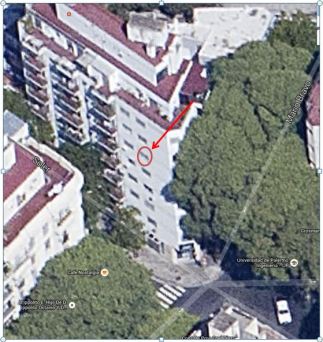
After having wasted more than a few Saturday afternoons trying to figure out the VFYW contest, I’ve now decided that if I can’t figure out a lead within 1-2 minutes, then I have to get on my life.  Sometimes I’ve been able to get the city, but not the building.  Other times, I have a gut feeling that I’ve been to the town or city in the picture, but can’t quite figure it out.  I nailed #157, but so did everybody else.  #177 was especially frustrating since it looked so familiar, I’d recently been on vacation there and had gone to college nearby.

When I looked at this VFYW pic, my immediate reaction was “WTF?”, like usual.  But then I noticed the bus and realized that it offered a ton of clues.  Sure enough, it lead me to this building.

(The above image is actually from a different reader.) Another suspects that “Doug Chini is fuming with boredom.” Let’s see:

To steal a line from Whittier, “it might have been.” If your viewer had waited a few seconds longer to take this week’s image just finding the right city would have been a battle, much less the exact spot. But they didn’t, and that #39 bus passing through center frame means that the Dish staff is gonna be buried under a landslide of responses.

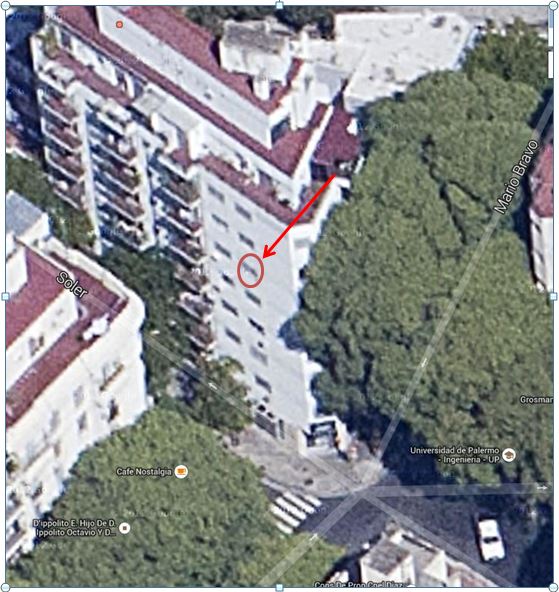
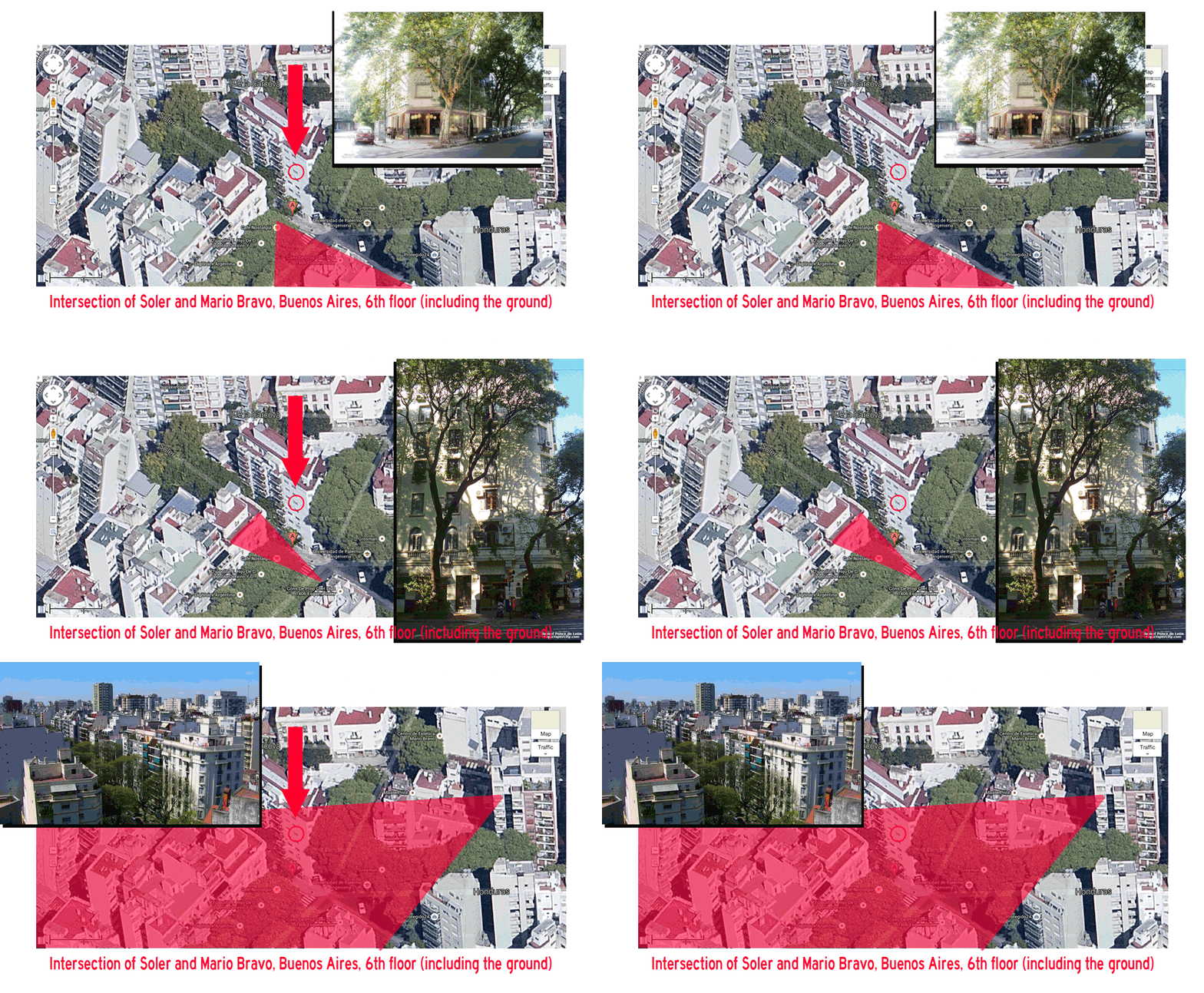
This week’s view comes from Buenos Aires, Argentina. The picture was taken from roughly the fifth floor of a building on the 3500 block of Esquinas Soler and looks almost due north along a heading of 348.3 degrees. Bird’s eye and overhead views are attached along with a shot of the video game store just below your viewer’s window:

VFYW Buenos Aires Store Front - Copy

Another great entry:

This one gave my roommate and me a good, solid two hours of bonding time. You usually don’t give as many hints as you did here! A full bus number and name, that’s something. He’s been to Argentina, so he noticed the architecture right away, too. From there, it was scouring the bus line for an intersection where the 39 takes a right from a one-way street onto a two-way street. It’s where Av Coronel Diaz meets Soler and Honduras here. The 3500 block of Soler. We haven’t had this much fun together since we used to smoke pot and play frisbee in the park, thank you!

About 95% of the contestants this week correctly answered Buenos Aires, and dozens guessed the right floor in the triangle building at 3594 Soler, where I’m living for two months while Dishing full-time. So picking a winner was tough this week. But the prize goes to one of our favorite new contestants this year, better known as the GIF guy, for his inimitable entry:
buenos-aires-bitch

The GIF guy, like Chini, has become such a great staple of the window contest that I asked permission to use his real name (since the Dish has a default anonymity policy of course). So welcome Blake Fall-Conroy to the pantheon of the VFYWC. Little surprise that Blake is an artist. Another creative reader wraps up this week’s contest with a short story:

The Chacarita 39

The late afternoon light was fading along Soler street, but enough of it filtered in to softly illuminate the small apartment with the dingy windows on the 6th floor. The low hum of traffic and street chatter drifted up from below and a few birds whistled loudly to each other.

Fernando’s eyes blinked open. What time was it?

He glanced over at the clock by the bed. The numbers were red and blurry, but he could make out 7:32. That couldn’t be right. Had he really slept for 3 hours?

He sat up panicked and looked down at his clothes. He was still wearing the wrinkled khakis and blue t-shirt that he had on in his engineering class that morning. The classes at Palermo were always long and boring and he was still hung over from Chasco’s party. He thought he could get a short nap in before meeting Maricela at the café across the street.

“I’ll give you one last chance,” she had said, sipping her Torrontés, her mischievous eyes sparkling from the blue party lights. “Meet me at six at Nostalgia and we’ll talk about it.” He had grinned stupidly at her as she left the party, and she had smiled back.

Fernando put his head in his hands. How had he let himself sleep through it? Would she still be there?

The answer came from the low rumble of a diesel bus overtaking the clatter of conversations from the café patio. He ran to the window and peered down at the intersection. Through the trees he could see the Chacarita 39 – Maricela’s bus – pulling out from in front of the café. He was too late. He grabbed his phone and snapped a picture as it turned onto Honduras street. The bus faded out of his view, taking Maricela across Buenos Aires and out of his life.

(Archive: Text|Gallery)

On Behalf Of Israel’s Foul-Weather Fans …

by Jonah Shepp

In a response to the repeated assertions by the likes of Jonathan Chait, Ezra Klein, and Peter Beinart that Israel’s actions are making it harder for liberal Zionists like themselves to defend their positions, Shmuel Rosner accuses these writers of being “fair-weather fans” of the Jewish state:

Sometimes it feels as if liberal Zionist critics are trying to ensure that Israel’s deeds do not rub off on them. At other times, it feels as if they’re trying to clear their conscience of something for which they feel partially responsible. They seem to believe that the implied threat that Israel might lose Jewish supporters abroad will somehow convince the government to alter its policies. This is a self-aggrandizing fantasy and reveals a poor grasp of the way Israel operates. To put it bluntly: These Jews are very important, but not nearly important enough to make Israelis pursue policies that put Israeli lives at risk.

Let me be clear: I believe Israel’s relations with Jews around the world are crucially important. Indeed, I’ve devoted a great deal of my career to thinking and writing about this topic. I often find myself preaching to Israelis about the need to be more considerate of more liberal Jewish views on issues ranging from religious conversion to women’s prayer at Jerusalem’s Western Wall. But I would never expect Israelis to gamble on our security and our lives for the sake of accommodating the political sensitivities of people who live far away.

Rosner is clearly letting his passions get in the way of his reasoning here. We Jews who criticize Israel aren’t asking Israelis to “gamble on their security”; indeed, the point liberal Zionists have been trying to get across for decades now is that the policy of complete disregard for Palestinian rights and grievances that Israel has adopted is, in fact, gambling on the security of Israelis and Jews everywhere by calling the Zionist project’s long-term sustainability into question. We’re not asking Israel to be less heavy-handed and more conciliatory out of concern for our own consciences, but rather out of recognition that Israel cannot be secure as a Jewish homeland if it continues to lash out reactively at Palestinian resistance rather than honestly and justly addressing the catastrophe that befell the Palestinians as a result of its creation and the ongoing suffering that engenders that resistance. Chait hits back at Rosner, who he says mischaracterizes his argument entirely by conflating feelings with opinions:

My Zionism — that is, my belief that the Jewish people, like other people, deserve a homeland where they can live free of persecution — is immutable. My disposition as a defender of Israel depends on the character of the Israeli state. A decade ago, I’d argue, it was a fair reading of the facts to view Israel as a state that mostly desired peace and whose use of force was mostly justifiable. I think that argument has weakened substantially in the intervening years.

To provide a corresponding example, right now I’d describe myself as pro-Ukraine — my analysis is that Ukraine is mostly within its rights, and that the cause of its current conflict lies mostly in the aggressive intentions of Russia. It is possible the world will change in such a way that I no longer regard this as true. Now, I lack the sort of personal and cultural attachment to Ukraine that I have to Israel. But the emotional component is not all that matters.

Responding to John Podhoretz, who applauds Rosner’s piece, Larison finds the line of thinking that Rosner and Podhoretz advance disturbing:

I have often cited the Russian proverb that Solzhenitsyn used, “The yes-man is your enemy, but your friend will argue with you.” … The main mistake that Rosner and Podhoretz make, unsurprisingly, is that they consider otherwise sympathetic critics to be “fair-weather” friends when these are potentially some of the best friends that Israelis have precisely because they don’t simply back whatever the Israeli government happens to do. Considering the stifling of dissent inside Israel that has been taking place lately, that would seem to be all the more valuable. But then one would have to understand the value of dissent against reckless and hawkish policies to appreciate that, and naturally Podhoretz doesn’t.

The odd thing about these complaints is that there is less sympathy for Israel around the world now than at almost any time that I can remember in the last twenty years. One would think that “pro-Israel” hawkish Americans and Israelis would be more appreciative of the sympathizers that Israel does have, including the critical ones, but instead the latter are treated dismissively and berated for having the temerity to express their concern. As this rate, there will continue to be fewer sympathizers as it becomes clear that friendly criticism is just falling on deaf ears.

My fear is that Larison is absolutely right about this, and that the Israeli state and its polity have both become so convinced of their categorical righteousness that legitimate criticism becomes impossible to imagine. This sensitivity speaks to the existential paranoia that underpins Zionism, and while that paranoia is understandable given what we Jews have been through, it leaves Israel operating in an alternate reality in which all criticism of Israel is anti-Zionism, all anti-Zionism is anti-Semitism, and thus anti-Semitism becomes the sole and sufficient cause of all criticism of Israel, even from Jews!

Not only is this perception incorrect, it’s also self-destructive. There’s no point pretending that Israel does no wrong, has no hard choices to make, and faces no uncertainty in its future. And that’s why, like Chait, Klein, and Beinart, I criticize Israel for the same reason Israel gives for doing the things I criticize: out of concern for my safety as a Jew on this earth.

The Myth Of Pretext-Free Anti-Semitism

by Phoebe Maltz Bovy

Protests on Al-Quds Day in Berlin

Alongside the coverage of Gaza, on the Dish and beyond, has been a steady stream of coverage of a kind of shadow issue: European anti-Semitism. Writes Jon Henley:

Across Europe, the conflict in Gaza is breathing new life into some very old, and very ugly, demons. This is not unusual; police and Jewish civil rights organisations have long observed a noticeable spike in antisemitic incidents each time the Israeli-Palestinian conflict flares. During the three weeks of Israel’s Operation Cast Lead in late 2008 and early 2009, France recorded 66 antisemitic incidents, including attacks on Jewish-owned restaurants and synagogues and a sharp increase in anti-Jewish graffiti. But according to academics and Jewish leaders, this time it is different. More than simply a reaction to the conflict, they say, the threats, hate speech and violent attacks feel like the expression of a much deeper and more widespread antisemitism, fuelled by a wide range of factors, that has been growing now for more than a decade.

“These are the worst times since the Nazi era,” Dieter Graumann, president of Germany’s Central Council of Jews, told the Guardian. “On the streets, you hear things like ‘the Jews should be gassed’, ‘the Jews should be burned’ – we haven’t had that in Germany for decades. Anyone saying those slogans isn’t criticising Israeli politics, it’s just pure hatred against Jews: nothing else. And it’s not just a German phenomenon. It’s an outbreak of hatred against Jews so intense that it’s very clear indeed.”

Observers who don’t happen to be Jewish may see this and think, hmm. At a time when there are all these people being killed by Jews, is anti-Semitism really worth discussing? Indeed, it’s quite possible to be Jewish and to share this entirely understandable sentiment. (I’m Jewish and don’t share it, but more on that in a moment.) While right-thinking people balk when anti-Zionism crosses the line, it can seem just… odd, as if one is conflating the armchair bigotry Jews are experiencing on the continent that, yes, yes, hosted a genocide against them, but ages ago, when right now, there are dead Palestinian children. When Hadley Freeman, who normally writes about fashion, took on this issue, writing, “Clearly, a film festival being cancelled is not on a par with civilian deaths,” while I didn’t share the Guardian commenters’ collective eye-roll, I did understand it.

Yet anti-Semitism is intricately tied up with the situation in the Middle East, just not in quite the ways people seem to think.

Here’s what the popular conception of anti-Semitism gets wrong: The assumption seems to be that once upon a time – Nazi Germany, the Spanish Inquisition – Jew-hatred existed absent any particular justification. It was religious bigotry! Racial pseudoscience! Or, if the Jews in question were poor immigrants, hatred of the underdog! It was, people imagine, just this kind of generic bad, like racism, sexism, and homophobia, with innocent victims of ignorance. Whereas now, well, we can’t possibly be witnessing any anti-Semitism, because… look at Israel!

We see a version of this in Owen Jones’s intervention on the topic. Jones acknowledges that there are occasional snippets of anti-Semitism posing as anti-Zionism, but is dismissive of those, insisting, “The vast majority of pro-Palestinian sentiment is driven by a sense of solidarity with an oppressed people subjected to occupation, siege and a brutal military onslaught.” The real anti-Semitism comes from… basically anywhere other than the Western European left:

Take Greece, where the neo-Nazi Golden Dawn has thrived amid economic trauma. Back in May, 16% of Athenian voters opted for the Golden Dawn candidate for the city’s mayor. According to a recent study, 69% of Greeks had antisemitic views; in Poland – despite suffering some of the Nazis’ worst horrors – it was 48%, Spain 53%. In Hungary the antisemitic party Jobbik won a fifth of the vote in April’s parliamentary elections. Like most of Europe’s far right, France’s Front National focuses its bile against Muslims, but the party’s roots are deep in antisemitism; and a few months ago it topped the country’s European parliamentary elections.

While my knowledge of Jobbik’s exact platform is limited, I suspect that Hungarian anti-Semites don’t hate Jews for the heck of it, but that they, like other anti-Semites (including those whose interest in the ‘Palestinian cause’ far outweighs any interest in the Palestinian cause), have their reasons. Such as… well what do you know?

Anti-Semitism has always been about the notion of Jews having too much power. This has nothing specifically to do with Israel, let alone with anything this particular Israeli government has done. I’m quite sure the 1840s French writers holding forth about the Rothschilds weren’t reacting to anything the not-yet-existent Israel would do more than a century later. And it typically points – selectively – to real instances of Jews behaving badly. No, the deal with anti-Semitism is, it’s about highlighting Jews’ bad behavior; seeing only that; inventing some more; while at the same time ignoring good Jewish behavior as well as bad behavior on the part of non-Jews. We all know the refrain: Not all criticism of Israel is anti-Semitism. But the presence of legitimate criticisms often hangs out within a broader ideology that puts The Jew at the center of absolutely everything terrible that’s ever happened.

Palestinians’ actual enemies thus overlap substantially with anti-Semites’ imagined ones, but this doesn’t make Palestinians who fight for their own cause anti-Semites. If you’re Palestinian, and you have objections to Israeli policies, chances are this is not because of some ambient anti-Jewish sentiment you’ve absorbed, but rather because you don’t enjoy occupation, bombing, and discrimination. (For exact ratios of how much one is to blame Israel, how much Hamas, one or two other people have addressed the topic; I’ll pass.) If you’re not convinced by ‘there are greater tragedies in the world’ arguments, it’s not because you’re putting Israel at the center of everything. It’s because Israel is rather central to your own situation.

At the same time, there’s this preexisting set of people who aren’t Palestinian, who may have nothing to do with any Jews, Israeli or otherwise, but who imagine Jews are responsible for everything that’s gone wrong in their lives, and who sit waiting for their aha! moment. For the moment when Jew-bashing and nodding approvingly and synagogue-vandalizing becomes acceptable in polite society.

All of this, then, puts Palestinians in a bind. They honest-to-goodness are being oppressed in a Jewish state. And they have this built-in base of support in anti-Semites the world over. Those who call Hamas “anti-Semitic” sort of miss the point. It’s not that Hamas hasn’t embraced whichever tropes, playing at the above-mentioned audience. But the more relevant issue is that the Palestinian cause needs to be truly separated from the ‘Palestinian cause’ for real progress to occur.

(Photo: Members of the German riot police allegedly confiscated an Israeli flag while it was waved to protest against a demonstration for Al-Quds Day, an event intended to express solidarity with the Palestinian people, on July 25, 2014 in Berlin, Germany. By Carsten Koall/Getty Images)

The Man Who Would Not Be Maliki

by Dish Staff

Iraqi Minister of Communication Haider a

Adam Taylor provides some background on Iraqi prime minister-designate Haider al-Abadi:

Born in Baghdad in 1952, Abadi was educated at the University of Baghdad and later received a doctorate from the University of Manchester in Britain. He lived in Britain for many years after his family was targeted by Saddam Hussein’s Baathist regime. He was trained as an electrical engineer, but he entered politics after the U.S.-led invasion of Iraq in 2003. He became minister of communications in the Iraqi Governing Council in September 2003, then was a key adviser to Maliki in Iraq’s first post-invasion elected government. Just weeks ago, he was elected deputy speaker of parliament, and he has been considered a contender for prime minister after the past two elections.

The bigger question, however, is whether Abadi will be able to overcome the challenges confronting Iraq more successfully than Maliki. Like Maliki, he’s a Shiite Muslim and is a member of the ruling State of Law coalition. One of the chief criticisms of Maliki was that he entrenched Iraq’s sectarian politics, filling the government with Shiite politicians and limiting Sunni and Kurdish power.

Eli Lake claims that Abadi’s nomination was the result of an American push for “regime change”:

The American push—which has not been previously reported—wasn’t the only factor that led to al-Abadi’s rise. Iraq’s deterioration in recent months led some of Maliki’s Shi’ite backers to pull their support of him. Last month, Grand Ayatollah Ali Sistani, the most senior cleric of the Shi’ite sect, wrote a letter to Maliki asking him not to seek a third term as prime minister. But al-Abadi has been the United States’ preferred candidate since late June to replace Maliki, a man who Obama himself blamed over the weekend for creating the conditions for the current catastrophe that is engulfing Iraq. U.S. and Iraqi officials tell The Daily Beast that U.S. Ambassador to Iraq Robert Beecroft and Brett McGurk, the deputy assistant secretary of state for Iraq and Iran, have pushed Iraqi politicians behinds the scenes to consider al-Abadi as a new Iraqi head of state.

Of course, the administration rejects that account. But Iran might also have had a hand in Abadi’s ascent, Saeed Kamali Dehghan suggests:

Ali Shamkhani, the secretary of Iran‘s powerful Supreme National Security Council, was quoted by the official IRNA news agency congratulating the Iraqi people and their leaders for choosing Haider al-Abadi as their new prime minister. … Hossein Rassam, a London-based Iranian analyst, said Shamkhani’s statement reflect Tehran’s hand in al-Abadi’s appointment: “His appointment could not have materialised without Iran’s cooperation. This is the result of a series of negotiations and bargaining for the past number of days, it’s not something that has been decided overnight.”

According to Rassam, Iran’s top priority in Iraq has been to avoid a power vacuum in Baghdad and ensure the appointment of a prime minister sympathetic to Tehran. “With Abadi’s appointment, Iran has achieved both,” he said.

Suadad al-Salhy takes the temperature of Iraq’s political parties. While Abadi’s nomination has divided the Shiites in parliament, Sunni Arab politicians see him as a major improvement over Maliki:

Iraq’s Sunni blocs, who are strongly opposed to Maliki, expressed their satisfaction at Ibadi’s nomination. “We are backing this nomination. What happened today was a big change,” said Mohammed Iqbal, a senior Sunni lawmaker. “We are blessed to nominate Ibadi. He is well-educated, efficient and has good relations with everyone, and there is no negative points registered against him with regard to his political history,” Iqbal told Al Jazeera.

Kurdish leaders added, however, that Ibadi must fix persisting problems between the Kurdish region and the central government, particularly arrangements over oil and gas revenues and the annual budget. Meanwhile, Iraqi Kurds, who are fighting Islamic State group fighters who have advanced towards Erbil, capital of the Kurdish region, over the last two weeks, said that they were not opposed to Ibadi.

The threat of a coup by Maliki still hangs over the transition. Josh Voorhees outlines what a disaster that would be:

The situation is unfolding rather quickly, but as of right now it appears that Maliki may do whatever it takes to stay in power, and that could mean a coup. For starters, such a move could throw Iraq back into a bloody civil war at a time when the government is struggling mightily to push back the advances of ISIS in the north. There are a number of factions within the Iraqi military, and it remains to be seen how each would align itself in the event that Maliki does attempt to use the nation’s military to hold on to power. But it is clear that any soldier engaged on either side of such a standoff would be one that wouldn’t be fighting ISIS.

“Maliki’s coup is good news for the Kurds and Yazidis, though,” Allahpundit reckons:

Until now, the White House has clung to the idea that Iraq should remain unified and that all aid, especially military aid, should go through the central government in Baghdad. That’s one reason why the Kurds are undersupplied; Maliki’s going to siphon off whatever he gets from the U.S. for Shiite use. Now that he’s betrayed Iraqi democracy, though, the White House can cut him loose, refuse to recognize his legitimacy, and deal directly with the Kurds.That means arms (and maybe military advisors?), and that means a Kurdistan that’s secure from ISIS. If Maliki wants southern Iraq to be a Iranian protectorate there’s little we can do to stop him, but we can help build a counterweight in the north. Let’s get on with it.

But Douglas Ollivant doubts Maliki will go through with it in the end:

Ollivant, who formerly served as the top Iraq policy official on the National Security Council, said there was “very little” the United States could do to push Maliki out of power, but he said he didn’t think the Iraqi leader would resort to violence to stay in office. “I really think it’s all done but the shouting,” Ollivant said. “He’s going to talk tough and play out his last legal card, but he doesn’t want to be an international pariah. If we pull away, his only friends would be Iran and Syria, and even Maliki doesn’t want that.”

Maliki is losing the support of the Iranian-backed Shiite militias, and has apparently withdrawn his loyalist forces back inside the Green Zone, so a coup attempt is indeed looking less likely. Even so, Kirk Sowell warns of some major political challenges ahead:

More broadly, Sunni provinces will have to deal with the fact that Shiite Islamists have an outright majority in parliament, and the next government, whatever its precise contours, will reflect this. But Nineveh, the heart of the battleground with IS, will be especially difficult: It has been the scene of almost constant violent conflict since 2003, in part due to the fact that under Saddam Hussein’s Baathist regime, the Arab population was both a major recruitment source for the army and taught to view Kurds as an ethnic enemy. The Iraq Oil Report and others have reported that a number of local residents who aren’t Islamic militants are willing to work with IS for reasons of racial and sectarian enmity.

(Photo: Haider al-Abadi by Jean-Philippe Kziazek/AFP/Getty Images)