It’s OK Not To Feel Anything When A Celebrity Dies

by Elizabeth Nolan Brown

Yesterday Robin Williams died, seemingly from suicide. Scrolling through Facebook a few hours after the news broke, I found myself in a sea of RIP and this is so sad! and other, lengthier expressions of mourning for the beloved actor. One update stood out, from a friend of a friend. After acknowledging that it may sound cold, she wrote:

I just want to put it out there that it is also ok not to have any feelings when something bad happens to a celebrity.

This was met with initial, emphatic approval from a few, quickly followed by admonitions. Didn’t she get the memo that we were all supposed to be using this as a PSA about mental health? They bet she wouldn’t be singing this tune if she or someone she knew had suffered from depression!Las Vegas Hosts International Consumer Electronics Show
Now there’s nothing wrong with using the surprising (apparent) suicide of a surface-happy comedian as a catalyst for discussing mental health issues. But how absurd to suggest it’s wrong not to. Maybe some people would prefer to remember the man’s life and work rather than his demons. Maybe some people who are intimately aware of the toll depression can take (or the pain a loved one’s suicide can cause) are loathe to latch their very personal pain to online discussions of a stranger with strangers. Maybe not everybody has to react in the same emotional tones.

But then why say something at all? That was another criticism hurled at this Facebook poster. Why couldn’t she have just kept her big non-mourning mouth shut?

Permit me a brief digression. As a college theater major, I once auditioned for a play that would be directed by a visiting Nigerian professor, Esiaba Irobi. For this play, Professor Irobi decided to eschew traditional callbacks and instead gather us all together and watch while we engaged in various games and activities. Near the end of the audition, we were all invited in a circular procession around the room, repeating after Irobi as he sung out some sort of call-and-response funeral dirge.

We were explicitly told not to act—this wasn’t an exercise to see how well we could feign grief. The professor said he wanted to see how we moved. There were drums. And there were quickly tears, all around me. Not just soft, subtle tears dotting my classmates’ cheeks but big, loud, hearty sobs. It confused the hell out of me. We weren’t actually at a funeral. We didn’t even have a fictional backstory for this procession, nor could we understood a word Irobi sang. Sure, his voice could carry emotion well, but I felt skeptical that the crying crew, which made up about half the room of auditioners, weren’t putting on a bit of a show.

Later, I brought this up with my then-boyfriend, who had also been at the auditions. He assured me his grief and that of those he’d talked to had been genuine. Then he told me it was sad that I was so closed off from my emotions that I couldn’t experience what they had. He felt sorry for me.

Because I was young, it genuinely stung and worried me. I am far from an emotionally repressed person, nor a non-demonstrative one. I’ve been known to cry at country songs and Law & Order episodes. So why couldn’t I feel sad over this imaginary scenario that had so tugged at my classmates’ heartstrings? What was wrong with my emotional response?

Nothing, is obviously the answer. There is no correct way to grieve. There is no correct way to mourn those you love, or to mourn acquaintances, or to mourn celebrities and strangers. And trying to conjure an inauthentic emotional response will only make you feel worse. But even knowing this, I admit—when popular public figures die, there’s always a moment in which I feel just like I did in that audition. Why does everyone seem so much more upset than I am? Why am I not reacting the same way? 

This is why I’m glad my Facebook friend didn’t keep her mouth shut. There is nothing wrong with feeling genuine sadness over the passing of an entertainer you enjoy and admire. There is nothing wrong with being stung by the way Williams seems to have went. There is nothing wrong with posting Mrs. Doubtfire stills to Instagram and heartfelt missives on your Twitter timeline in response, if the spirit moves you. And the “normalcy” of these responses is shown in the likes and retweets and expressions of solidarity with which they’re met. Collective catharsis exerts a powerful pull.

But in the age of all this public emoting—some no doubt genuine, some signaling—it can be very easy to forget that not everyone is “deeply saddened” by the news of Williams’ death. Some aren’t even moderately saddened. And that’s okay, too.


Update: Readers responded to this post here. You can also view all the Dish’s coverage of Robin William’s death here.

(Photo by Ethan Miller/Getty Images)
What Everyone Misunderstands About the ‘Libertarian Moment’

by Elizabeth Nolan Brown

Pew Millenials

David Frum – shock – doesn’t think the “libertarian moment” has arrived:

Despite the self-flattering claims of libertarians, the Republicans’ post-2009 libertarian turn is not a response to voter demand. The areas where the voting public has moved furthest and fastest in a libertarian direction—gay rights, for example—have been the areas where Republicans have moved slowest and most reluctantly. The areas where the voting public most resists libertarian ideas—such as social benefits—are precisely the areas where the GOP has swung furthest and fastest in a libertarian direction.

This, of course, entirely misses the point of Robert Draper’s recent New York Times Magazine piece on libertarians. For all the Ron and Rand Paul mania, there’s little evidence the GOP has taken much of a “post-2009 libertarian turn” at all. So Frum is right that Republicans haven’t been ushering in some sort of libertarian era, I’m just not sure who’s arguing they have.

Draper’s piece—and those quoted in it, including Reason.com editor-in-chief (and my boss) Nick Gillespie—mostly suggests that, with rare exceptions, Republicans are stubbornly resisting embracing more libertarian ideals, despite the fact that it’s pretty much killing the party. “The Republicans will definitely have to move to the left on social issues,” my colleague Emily Ekins, polling guru for the Reason Foundation, says in Draper’s article. “They just don’t have the numbers otherwise.”

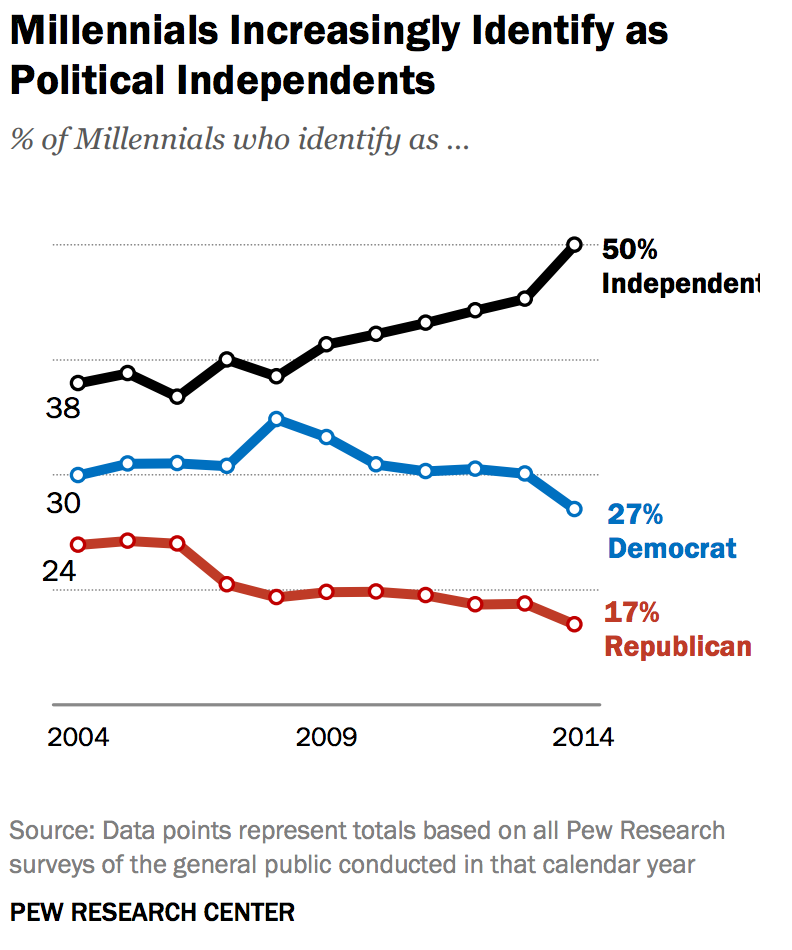
More than ever before, young people are defining themselves as politically independent, according to Pew Research Center and just about everyone else who polls them. But millennials identify as Democrats in similar proportions to older generations; it’s the GOP that’s bleeding young voters into the independent ether.

When libertarians talk about this generation’s potential, it’s not that we’re counting all these independent millennials as libertarian (as some have suggested). Nor do we think that most would identify as libertarian if only they read more about it on Wikipedia. Sure, I think libertarianism might have a bit more appeal to a generation raised on the seemingly endless and indistinguishable Bush/Clinton empire, but I’m not expecting young people to start adopting the libertarian label in droves.

Yet there is possibility for new consensuses, many of which would be appealing from a libertarian standpoint. In an electorate that doesn’t necessarily subscribe to old party divides, there’s potential to rally young liberals and conservatives together on issues like same-sex marriage, privacy, drug policy, and criminal justice reform, to name just a few. These aren’t “libertarian issues”—we’re not trying to own them (as critics also suggest)—but they are areas we’ve been keen on addressing, and it’s great to have allies of whatever stripe.

Frum snidely suggests that “the ‘libertarian moment’ will last as long as, and no longer than, it takes conservatives to win a presidential election again.” And if we’re talking about mainstream modern Republicans dressing themselves up in the label, no doubt. But again, that seems to be something only Frum is talking about. The “libertarian moment”, in so far as any of us think it exists, is about looking beyond party lines. It’s about working and coming together in new ways.

“I have no idea who will be the next president of the United States,” wrote Gillespie Sunday, but it “will matter far less than the broad currents in American society”:

That’s one of the main trends that Reason picked up in its poll of Millennials—not some self-congratulatory discovery that the kids today are junior-varsity libertarians—and folks who don’t want to grapple with that and all its implications will have less and less relevant to say about politics, culture, and ideas.

Or, as Jack Hunter wrote at Rare: “There is a significant difference between trying to make every American a libertarian and making America more libertarian. The former is impossible. The latter is happening.”

“An Anonymous Face”

by Phoebe Maltz Bovy

OLYMPUS DIGITAL CAMERA

Anemona Hartocollis reports (NYT) that the strong arm of the law is coming for your adorable baby photos. (Pet photos are safe, for now.) But not the ones you share on Facebook, or that you might select to illustrate a magazine essay you might choose to pen about your child. The law – as far as I know – would be fine with you going around town bearing a placard with your child’s mid-tantrum face captioned with a quote of the darndest thing he or she ever uttered. No, the only ones under attack are the photos doctors traditionally used in their office decor:

For generations, obstetricians and midwives across America have proudly posted photographs of the babies they have delivered on their office walls. But this pre-digital form of social media is gradually going the way of cigars in the waiting room, because of the federal patient privacy law known as Hipaa. Under the law, the Health Insurance Portability and Accountability Act, baby photos are a type of protected health information, no less than a medical chart, birth date or Social Security number, according to the Department of Health and Human Services. Even if a parent sends in the photo, it is considered private unless the parent also sends written authorization for its posting, which almost no one does.

Hartocollis notes that some doctors don’t see these photos as a violation:

“For me, the face of a baby, that is really an anonymous face,” said Dr. Pasquale Patrizio, director of the Yale Fertility Center in New Haven. “It was representative of so much happiness, so much comfort, so much reassurance. It is purely a clinical office now.”

At what age, then, does the face cease to be anonymous? Because this doesn’t seem to just be about baby photos:

Jacques Moritz, director of the division of gynecology at Mount Sinai Roosevelt in Manhattan, still displays baby pictures in an exam room. “There’s not a day that goes by that somebody doesn’t come in with a picture of the kid — up until 17, 18, 19 and 20,” he said.

It would be nice to think that, by high school, your photo would not be showcased at your mother’s gynecologist. At the very least.

Anyway, what struck me about this story was that it’s a rare case of children’s right to privacy being rounded up, not down.

The parental overshare wave has seemed unstoppable, and consists, to a large degree, of articles by parents, about their own children. A move towards demolishing taboos when it comes to sensitive medical diagnoses – brave and admirable when it comes to adults being open about their own health – has led to it seeming absolutely normal for a parent to publish an essay on his or her child’s mental or physical illnesses. The child is seen as an extension of the parent, not as a person who will grow up and have to contend with whichever information being readily available to future partners, employers, insurers. The child’s story, then, is seen as the parent’s to tell, the child’s medical records the parents’ property to share however widely, in a way that would never fly if a writer decided to hold forth about the medical complaints of an identifiable adult friend or relative. (Exception: the person being written about suffers from a condition that makes it impossible for them to read or be read to.) While there are clearly times when it’s not just acceptable but necessary for a parent to share a child’s medical information – with the child’s doctor, say, or with a support group, a school employee, etc. – we no longer seem to recognize that there might be limits. That, in other words, anything other than the limits of good taste should bar a parent from writing a confessional piece about the exact consistency of their child’s last… trip to the facilities.

The Hipaa concerns don’t challenge parental overshare head-on, of course, given that the loophole is that a photo’s OK to show if the parent explicitly says it is. And it’s arguably quite a bit worse for your mom to write a magazine cover story about your unusual digestive condition than for there to be some relatively small-scale photographic evidence that your mother went to an OBGYN. But it’s nevertheless good news that children’s medical histories are, in some small way, being recognized as their own.

(Photo by Daniel Lobo)

Robin Williams, RIP, Ctd

by Dish Staff

Some immediate reaction from Twitter, including many clips of Williams’ greatest moments, here. Several more clips after the jump. A reader writes a moving eulogy:

I’m sure that I’m just one of many Dishheads writing in about the horribly sad death of Robin Williams. I’m a child of the ’90s, and he was a constant fixture of my cultural world through childhood and into adulthood. Not only was he a genuine comedic genius – his bit on the invention of golf [seen above] was legendary long before today, as was his 2001 appearance on Inside the Actors Studio, to name a few drops in the bucket. But his joy, sincerity and warmth of personality left a mark that I am now surprised to find was so deep.

He was consistently open about his struggles with depression, addiction and alcoholism, and it sucks that some combination of those demons managed to overpower him, despite all the effort he put into fighting his battles and helping the rest of us fight our own. His approach to humor was so unusual among comics of this era: it was never based on cynicism or complaint, but rather, predominantly, on sharing the things that made him irrepressibly happy. He was such a transparently compassionate person that if he’d had any inkling of the outpouring of collective mourning that took place [last night], things might have gone another way.

I’ve never seen a larger or more visceral mass response to a celebrity death.

On Twitter alone, I follow close to 200 accounts, from a wide range of countries, cultures and sub-cultures, and I swear almost every single one came out of the woodwork, some of whom had been silent for years before tonight. And Twitter’s “trending” topics were completely dominated by subjects related to his life, career and death. It occurred to me that this might have to do with the fact that Robin Williams, whose filmography spans from Mork & Mindy (1978) to Night at the Museum (latest installment in post-production), is one of the few figures who looms just as large for my parents’ generation as he does for mine.

It’s really odd – I didn’t even consider myself a great fan of his, but he was a part of my life all the same, and this gutted emotional state I’m in is clear proof of that. I’ll miss him. Fuck depression.

Another points out:

If you weren’t already aware of it, I thought I would link to a WHO document [pdf] about responsible media coverage of suicide.  I learned about it through this podcast.  It’s being reported that Robin Williams killed himself, and celebrity suicides can cause a string of copycat suicides.  How the suicide is reported can influence how many copycat suicides occur and this is true for famous and not famous alike.  This is known as the Werther Effect. I’m not being critical of your coverage, but thought that you should be made aware of the WHO document.

Jennifer Michael Hecht, author of Stay: A History of Suicide and the Philosophies Against It, discussed the Werther Effect and much more in her “Ask Anything” videos for the Dish. Meanwhile, as another reader notes, Robin Williams’ performance in Bobby McFerrin’s “Don’t Worry Be Happy” music video has a dark irony this week:

A happier ending:

If you’ve never seen the standup bit of Robin Williams simulating cunnilingus, then you haven’t seen the full range of his comic genius.  It makes my cheeks hurt from laughter every time I seen it (and might have a good tie-in with your recent coverage of hirsute men):

Another reader ties in another recent thread:

Last week I was going to send Williams’ and McFerrin’s version of “Come Together”, since it is one of my fave covers, but it didn’t seem quite outre enough. Now it’s a no brainer. No video, but it does have nice pictures of Robin:

And another touches upon another Dish theme:

You covered Robin Williams’ tragic, untimely death, but I think you failed to include a video that has him mentioning a number of favorite Dish topics, including Catholicism and gay marriage:

Hard-Working To A Fault?

by Dish Staff

Patience Schell considers research that says overwork actually makes us dumber:

The authors of Scarcity: Why Having Too Little Means So Much (2013), Sendhil Mullainathan and Eldar Shafir, demonstrate that the chronically busy work less efficiently owing to a profound shortage of cognitive capacity, resulting in poor decision-making. Their research indicates that this shortage of cognitive capacity, caused by extreme lack of time (it can also be caused by extreme lack of money), measurably reduces an individual’s fluid intelligence, hampering performance. Without what they call the mental “slack” of time away from work and away from thinking about work, we will make poor decisions. We’re dumber when we don’t take a break, and it shows.

Reviewing a study published in the Stanford Social Innovation Review (“Reversing burnout,” Winter 2005), Schell finds that even disaster response workers are advised to take breaks while tending to emergencies:

[The study] uses the American Red Cross’ new management approach to highlight the necessity of breaks, even among disaster response workers. Before, Red Cross workers put in as many hours as necessary until the job was finished. Now the Red Cross recognises that workers need breaks in order to be able to respond effectively to the humanitarian crises they face. The new approach follows advice given by the American Psychological Association, whose mental health workers had supported Red Cross disaster response teams. So even the Red Cross, in emergencies, recognises that without breaks, leisure and time off, we don’t work as well as we could, we are less intelligent, we make poor decisions and we are at risk of hurting ourselves and shortening our lives.

Cody Delistraty also condemns the cult of overwork:

Busyness implies hard work, which implies good character, a strong education, and either present or future affluence. The phrase, “I can’t; I’m busy,” sends a signal that you’re not just an homme sérieux, but an important one at that. There is also a belief in many countries, the United States especially, that work is an inherently noble pursuit. Many feel existentially lost without the driving structure of work in their life—even if that structure is neither proportionally profitable nor healthy in a physical or psychological sense.

Everyone would likely agree with Aristotle that “we work to have leisure, on which happiness depends.” The motivation for employees to work hard is the carrot of a relaxing retirement. Yet this cause-and-effect often gets flipped such that we fit our lives into our work, rather than fitting our work into our lives. The widespread belief that happiness and life satisfaction can be found exclusively through hard work is at a heart more a management myth meant to motivate workers than it is a philosophical truism.

Why Intervene In Iraq And Not Syria? Ctd

by Jonah Shepp

Aki Peritz believes that ISIS poses a genuine terrorist threat to the US, and on that basis, suspects that Obama will eventually see fit to target the group in Syria as well as Iraq:

It is well and good that the president said he won’t “rule out anything,” but the reality is that multiple jihadist groups already have a permanent foothold in Syria. … Will ISIL, or another Syria-based jihadi group, try to strike American targets before Obama leaves office in January 2017? If past actions predict future behavior, then the answer is probably yes. Would the administration respond to a terror attack on America or Americans with airstrikes—or perhaps more—of its own? That too is likely in the cards, given that the United States just bombed Islamic State positions to help our Kurdish allies.

Hopefully, America’s airstrikes near Irbil will prove to be the high-water mark for ISIL’s ability to export its fanatical ideology. But the group has shown itself to be an adaptable, ruthless foe bent on destroying its enemies—including the United States. Since that’s the case, it’s only a matter of time before this White House decides that America must strike Syria as well.

And maybe it will, but the argument that it should fails on two levels. First, if ISIS wants to attack Americans, deploying more American soldiers in its areas of operation makes the targeting of Americans more likely, not less (and creates a justification for it, at least in the militants’ own view). And second, if ISIS wants to carry out an attack on US soil, it won’t do so with the soldiers and materiel in Syria that Peritz would have us bomb. Rather, that threat would likely take the form of a few fanatics with American or European passports, and I don’t see how airstrikes would address that, short of killing every single ISIS member and sympathizer in Syria and Iraq (and not only there – Peritz might want to start ginning up support for airstrikes on London and New Jersey as well).

No, this conflict is not ultimately about US homeland security; it remains, first and foremost, a regional power struggle. Certainly, some of the Syrian rebels would like us to get involved:

Moderate Syrian rebels argue that, in order to challenge ISIS in Iraq, it would be necessary to tackle them in Syria too. “To protect [the Iraqi city of] Irbil from ISIS, you need to hit ISIS hard in the Euphrates river valley in Syria,” said Oubai Shahbandar, spokesman for the opposition Syrian National Coalition. “Stopping ISIS expansion requires a ground game. U.S. needs to coordinate with the tribes and the Free Syrian Army that have been fighting ISIS since January.”

“Airstrikes won’t deny ISIS territorial gain,” Shahbandar said. “U.S. needs to support those forces like FSA and tribes in Syria already on the ground fighting ISIS.”

But others, Hassan Hassan reports, appear to have joined forces with the jihadists:

According to Samer al-Ani, an opposition media activist from Deir Ezzor, several fighting groups affiliated to the western-backed Military Council worked discreetly with Isis, even before the group’s latest offensive. Liwa al-Ansar and Liwa Jund al-Aziz, he said, pledged allegiance to Isis in secret, with reports that Isis is using them to put down a revolt by the Sha’itat tribe near the Iraqi border.

He warned that money being sent through members of the National Coalition to rebels in Deir Ezzor risks going to Isis. Another source from Deir Ezzor said that these groups pledged loyalty to Isis four months ago, so this was not forced as a result of Isis’s latest push, as happened elsewhere. Such collaboration was key to the takeover of Deir Ezzor in recent weeks, especially in areas where Isis could not defeat the local forces so easily.

This complication reveals how facile and ignorant the neo-neocon case for intervention in Syria is. Simply sussing out who our friends and enemies are within the fragmented rebel “coalition” has always been a much more daunting task than the hawks were willing to admit. We don’t have the intelligence to conduct such an intervention, well, intelligently, and there’s just no getting it now. Compare that to Iraq: it’s a mess, sure, but at least our friends (Kurds), enemies (ISIS), and liabilities (Baghdad) are much more clearly defined. That’s why Michael Totten finds the question in the headline of this post sort of boring:

The Kurds of Iraq are our best friends in the entire Muslim world. Not even an instinctive pacifist and non-interventionist like Barack Obama can stand aside and let them get slaughtered by lunatics so extreme than even Al Qaeda disowns them. There is no alternate universe where that’s going to happen. Iraqi Kurdistan is a friendly, civilized, high-functioning place. It’s the one part of Iraq that actually works and has a bright future ahead of it. Refusing to defend it would be like refusing to defend Poland, Taiwan, or Japan. We have no such obligation toward Syria.

That’s it. That’s the entire answer. Washington is following the first and oldest rule of foreign policy—reward your friends and punish your enemies.

In any case, ISIS’s positions in eastern Syria are already being bombed by the Assad regime, with much collateral damage:

Militants from the Al-Qaeda splinter group are fighting on a multitude of fronts in Syria’s complex civil war – against an array of rebel groups, regime forces, and the Kurdish YPG militia – while also being targeted by locals in the eastern province of Deir al-Zor. When ISIS entered Deir al-Zor last month, it seized a number of towns and villages along the Euphrates River, often by making agreements with locals. Since then, attacks have been staged against the jihadists, who have been accused of breaking their word and detaining residents of the area. Regime forces have only recently begun targeting ISIS positions in several provinces, while anti-regime activists say the strikes have led mainly to civilian casualties.

That’s another reason why, I suspect, Obama remains set against getting involved. A war of attrition between Assad and ISIS is very bad news for the Syrian people, but as soon as American bombs begin to fall, those civilian deaths accrue to us, and those terror attacks on Americans that Peritz fears start looking like a much more attractive option for ISIS and its allies.

How Sexually Fluid Are Women Really? Ctd

by Phoebe Maltz Bovy

My earlier post on female sexual fluidity-or-lack-thereof has caused some controversy on Twitter. Some are upset that I’m questioning the caller’s own label:

People should, of course, identify as they see fit, and that includes Zen Heathen. I’d merely point out that a) the caller expressed 0% sexual interest in men (we don’t learn what she thinks about the 10% of the time she’s not thinking of women – for all we know it’s that she has to pick up her dry-cleaning – and she could well be with a man because of the social pressures to be with one), and b) if you’re pairing off with someone, and their variant of bisexuality involves preferring the gender you are not virtually all the time, this is maybe a red flag. Or maybe not – by all means, if you find the one person of a particular gender you’re attracted to, enjoy! – but people certainly think so when it comes to men.

Others point out that fantasies don’t necessarily reflect what people want:

This is a fair point. What was clear from the call, but not my post, is that this is a woman who has wanted to date women for years but been too shy. That’s a little different from someone simply having this or that pop into their head during sex. I’d also repeat here, though, that I wonder how blasé and hey-people-fantasize we’d be if this were a man fantasizing 90% of the time about other men. I’d also, while I’m repeating myself, reiterate that fetishes, etc., are different from sexual orientation. Someone might fantasize about scenarios or individuals they’d want nothing to do with in real life. But always picturing men, or always women, or close-to-always, would seem to indicate something.

Oh, and allow me a starstruck moment: Savage himself replied!

Since these other responses arrived only after Savage’s tweets, I for a moment wasn’t quite sure what he meant by “shit storm”-producing “#bisexual activists.” Then I was accused of not believing anyone could be bisexual by a bunch of Twitter users, all because I didn’t think this one woman sounded like she had any interest in men, and of hating bi people and gay people and women and… I think I see what he meant:

https://twitter.com/MegKBax/status/498892998865084416

Noted.

So how might Savage have answered the call differently, without bi-erasing anyone’s experiences? He might have done what another Twitter user suggests:

The idea isn’t for the caller to be officially declared a lesbian (as if such a thing were possible), but for her to consider – and, if she sees fit, to reject! – the possibility. She is, after all, soliciting advice. But the main thing I’d have emphasized is that this call would have been received entirely differently if it had come from a man. I mean, there might have been a nod to the possibility that the man was bisexual, but a nod would also surely have been given to the ever-so-slight chance that a self-identified bisexual man with a female partner, but who can’t stop thinking about Idris Elba, is in the closet. I find it hard to believe that – outside whichever limited sphere of bisexual activists – anyone would object to throwing “gay” out there as a possibility.

Not Again

by Dish Staff

Mark Berman summarizes the big news out of Ferguson, Missouri:

An unarmed black teenager named Michael Brown was shot and killed Saturday by a police officer in suburban St. Louis. People protested Saturday and Sunday, with large crowds of protesters and police facing off multiple times since the shooting. Some rioting and looting also broke out late Sunday night. Federal authorities are monitoring the shooting as groups and officials call for investigations.

The circumstances surrounding the shooting appear to be somewhat unclear. Police said Saturday that the shooting followed an encounter involving a police officer, Brown and another person Saturday afternoon, but additional confirmed details are scarce. Jon Belmar, chief of the St. Louis County police, said that the episode began with “a physical confrontation.” Belmar did not explain what prompted the confrontation, but he said that the officer was pushed back into his squad car during the episode and that one shot was fired from the officer’s weapon inside the car. Brown was shot multiple times – “more than just a couple,” Belmar said – on the street nearby, and all shell casings matched the officer’s gun. It’s not known yet why the officer shot him, nor why lethal force was used.

Jonathan Capehart hears echoes of the Trayvon Martin shooting:

When I wrote first wrote about Martin’s killing, I said that one of the burdens of being a black male was bearing the heavy weight of other people’s suspicions. The McBride murder shows that such suspicion knows no gender. I also wrote about the lessons my mother taught me growing up. How I shouldn’t run in public, lest I arouse undue suspicion. How I most definitely should not run with anything in my hands, lest anyone think I stole something. The lesson included not talking back to the police, lest you give them a reason to take you to jail – or worse. …

When you’re black and especially male – in the United States – you have to go to these seemingly overboard, extra lengths in the off-chance they might save your life. But none of those things would have helped me if I were in the shoes of Michael Brown or Renisha McBride or Trayvon Martin. We don’t know yet if Brown was asked for identification, but we know the other two weren’t. Perhaps their assailants saw all they needed to know. What frightens me more than anything in the world is that the chances are very high that one day I might be in their shoes and might meet their tragic end. The so-called victims of the nonexistent “war on whites” have absolutely NO idea what living under that kind of siege, that kind of very real threat, is like.

Capehart also has some choice words for the looters:

This is not how you protest the shooting of an unarmed teenager. This is not how you show support for his grieving family. This is not how you make authorities understand your anger and concern. This is not how you get others to join your cause. Perhaps I’m being too generous when it comes to those knuckleheads who used a tragedy to trash businesses and scurry off with bottles of wine, among other things. Perhaps I’m giving the looters too much credit by presuming they actually care about what happened to Michael Brown and how to prevent it from happening again. But there are plenty of people who do care and want answers. The actions of selfish and opportunistic looters must not distract us from getting them.

Meanwhile, Bill Chappell examines the rise of #IfTheyGunnedMeDown:

The use of different photos to portray shooting victim Michael Brown, who was killed by a police officer Saturday, prompted an interesting phenomenon on Twitter Monday: Users are posting “dueling” photos of themselves – one where the subject looks wholesome, and another where the same person might look like a troublemaker – with the hashtag #IfTheyGunnedMeDown. Behind the trend is the question of which photo the media would seize upon, if the posters had a run-in with police. For some, it’s another way this episode calls to mind the shooting death of Trayvon Martin – and the various photos used to portray both the teenager and his killer, George Zimmerman.

James Poniewozik calls #IfTheyGunnedMeDown a “a simple, ingenious DIY form of media criticism”:

It was a brilliant media critique, and while Twitter and other platforms may have no magical power to stop shootings or catch warlords, one thing they are very good at is catching the attention of the media. Journalists pay attention to Twitter–disproportionate attention, maybe–and that makes it a very, very good place to deliver the modern version of a letter to the editor. You could say similar of #YesAllWomen, or of the #BringBackOurGirls hashtag of earlier this year: no, it didn’t have the power to free the Nigerian schoolgirls abducted by Boko Haram, but it did put the story on homepages and newscasts often resistant to overseas news, especially from sub-Saharan Africa.

Yesha Callahan sighs:

It’s safe to say that Brown has become a victim of what I like to refer to as the “Trayvon Martin effect” in the media. Trayvon, who was killed by George Zimmerman, was depicted as a gold-grill-wearing, weed-smoking teenager in the photos used by the media. There were no photos of Trayvon smiling with his family members or being just your average happy teen, which his family members said he was. Similarly, the photos of Brown that have been picked up by the media included him throwing up a peace sign, which conservative media has translated into a “gang sign.” You’d be hard-pressed to find mainstream media showing Brown at his high school graduation or with members of his family. … Unfortunately, because of Ferguson police, we’ll never be able to see a photo of Brown attending his first day of college today.

Rescuing The Yazidis

by Jonah Shepp

More than half of the 40,000 Yazidis trapped on Mount Sinjar by ISIS militants have managed to escape through a safe passage opened by Iraqi and Syrian Kurdish militias, but many still remain in danger:

The refugees, all members of the Yazidi sect, began streaming back into Iraqi Kurdistan on Sunday after a perilous journey past Islamic State militants who had vowed to kill them and had surrounded their hideout on Mount Sinjar after storming the area. The day-long trek took them first over a mountain range into Syria, then through the Peshkhabour crossing three hours north-west of Irbil, where Kurdish officials were rushing to provide food and shelter.

Fleeing Yazidis said their escape had been aided by the YPG, a Syrian Kurdish rebel faction, and by US air strikes on Islamic State (Isis) positions which had forced the jihadists to withdraw for around six hours on Saturday. Their retreat gave a window for thousands of Yazidis, all desperately low on food and water, to begin streaming down the mile-high mountain and north across the Nineveh plains, which have been an ancient homeland of Iraqi minorities.

It’s important to remember that “rescuing” the Yazidis means, for now, sending them to save havens far from home. They are refugees, part of a massive wave of displacement, and will require consistent support while in exile and at some point (hopefully) in returning to their homes. I stress this because refugees have a tendency to get buried in our consciousness of protracted conflicts, especially in the Middle East. Esther Yu-Hsi Lee tallies the Iraqis displaced in the current conflict, who number over 1 million:

Just this week alone, the rapid advance of ISIL forces in several cities of Iraq has forced the internal displacement of about 195,000 refugees, including adherents of the religious Yazidi sect, Palestinians, and Turkmen living in Iraq — a move that has sent neighboring countries and international agencies scrambling to accommodate the refugee crisis within Iraq. …

Overall, nearly 200,000 internally displaced people have fled away from major cities, like Qaraqosh, the largest Christian city captured by ISIL this week, with the greatest concentration of people fleeing towards the northern provinces of Dahuk, Erbil, and Kirkuk, and Sulaymaniyah, near Turkey. Between January and July, there were at least 1.2 million displaced refugees within Iraq. And in June, the United Nations upgraded Iraq’s crisis to a level 3 humanitarian disaster — the most severe rating it has.

There’s really no overstating how catastrophic this situation is. Hundreds of thousands of refugees is one thing; hundreds of thousands more refugees, on top of multiple, unresolved refugee crises involving millions of people, is quite another. The sheer scale of the displacement is hard for us as Americans to comprehend, which makes it equally hard to appreciate the outsized role refugees have played in the history of the modern Middle East and the conflicts playing out there today. Some Arab communities, particularly the Palestinians, have suffered the trauma of being shuffled from one conflict zone to another over the course of three generations. That has to take a toll on one’s psychological wellbeing as well as one’s worldview: it’s really no shocker that people in such an intractable predicament are prone to radicalization and have a hard time building democratic states and civil societies.

Obama’s Iraq Strikes And Executive Power, Ctd

by Dish Staff

Republicans are making somewhat incoherent political hay out of Obama’s decision to carry out air strikes on ISIS targets in Iraq, arguing on the one hand that his objectives are too broad and on the other that they’re too narrow. But on the third hand – and you don’t read this very often on the Dish – Ted Cruz has a point here:

Cruz said he does not believe the 2002 Authorization for Use of Military Force in Iraq or the War Power Act provide Obama the authority to continue airstrikes against ISIS. “I believe initiating new military hostilities in a sustained basis in Iraq obligates the president to go back to Congress and to make the case and to seek congressional authorization,” Cruz said. “I hope that if he intends to continue this that he does that.”

As Yishai Schwartz points out, however, the administration doesn’t think it has authority to re-intervene in Iraq under the AUMF either. Instead, as Jack Goldsmith observed last week, they appear to be claiming a constitutional power to do so. In Schwartz’s view, this is extremely dangerous:

The problem, however, with relying on the Constitution alone is that this constitutional power is vague and open-ended. What exactly can’t the president order under his authority as commander-in-chief?

Especially after the Bush presidency’s extreme claims of executive war powers, Obama and many of his legal advisors are wary of relying on this vague and unrestricted constitutional power. If anything, they would like to see it clearly limited and defined. So the administration is caught in a dilemma: as Islamists butcher minorities in Iraq, it sees a moral and humanitarian imperative to act. But without specific congressional permission, a purely humanitarian intervention would set a virtually open-ended precedent for an American president to act militarily anytime, anywhere.

Furthermore, Ilya Somin doesn’t buy the argument that the need for immediate action hindered Obama from seeking Congressional approval for the intervention:

[T]his case – like the 2011 Libya intervention – is not a situation where a crisis developed so quickly that the president had no time to seek congressional authorization for the use of force. ISIS has been gaining ground against Iraqi government and Kurdish forces for many weeks, and its murderous and genocidal intentions have also been clear for a long time. President Obama had plenty of time to seek congressional authorization during that period. To be sure, some specific aspects of the tactical situation have only emerged recently, such as ISIS’ siege of thousands of Yazidi civilians on a mountaintop. But the possibility that ISIS would threaten large numbers of civilians in a position where local forces could not save them was readily foreseeable long before then.

He’s also deeply skeptical of the notion that air strikes don’t count as “war”:

To be sure, Obama also assures us that he will not deploy US ground forces against ISIS. During the 2011 Libya conflict, the administration argued that an intervention limited to air strikes alone does not require congressional authorization under the War Powers Act of 1973 if it does not “involve sustained fighting or active exchanges of fire with hostile forces.” Similar reasoning can be used to claim that such air strikes do not qualify as a “war” that requires congressional authorization under Article I of the Constitution. But such strained arguments did not pass the laugh test in 2011, and have not improved with age since then. The use of airpower in a “long-term campaign” clearly qualifies as warfare under any reasonable definition of the term.

P.M. Carpenter, on the other hand, wonders whether Obama promised a long-term campaign at all:

Perhaps my reception of Obama’s words was wildly imperfect, but what I heard in “we’re [not] going to solve this problem in weeks; this is going to be a long-term project” was this: untangling the political mess created by Maliki and his sectarian brutes is likely to span months. Not our military involvement, but rather the mess itself is the “long-term project.”  A months-long U.S. air campaign increases almost exponentially the odds of a downed, captive pilot, and I can’t see President Obama taking that risk.