Hackers, Hawkers, And Hacks

A security company claims to have uncovered a ring of Russian hackers that carried out the largest theft of usernames, passwords, and e-mail addresses to date:

Security experts have determined that a crime ring out of Russia has stolen a whooping 1.2 billion username and password combinations. They also got away with 500 million email addresses. To date, this is the single largest theft of login information. Initially, Hold Security, who spotted the breach, thought they were “run-of-the-mill spammers.” But overtime, the gang upped its thievery and went after SQL servers. Alex Holden, chief information security officer at Hold Security, told USA Today that the e-gang used malicious code to infiltrate 420,000 websites, and was then able to steal their databases. Holden found his own login and password information were compromised in this theft.

Technically, the gang could be brought to justice as Hold Security has both the location and names of the criminals. However, Holden believes this won’t occur, “The perpetrators are in Russia so not much can be done. These people are outside the law.”

But Bruce Schneier recommends taking this news with a grain of salt:

As expected, the hype is pretty high over this. But from the beginning, the story didn’t make sense to me. There are obvious details missing:

are the passwords in plaintext or encrypted, what sites are they for, how did they end up with a single criminal gang? The Milwaukee company that pushed this story, Hold Security, isn’t a company that I had ever heard of before. (I was with Howard Schmidt when I first heard this story. He lives in Wisconsin, and he had never heard of the company before either.) The New York Times writes that “a security expert not affiliated with Hold Security analyzed the database of stolen credentials and confirmed it was authentic,” but we’re not given any details. This felt more like a PR story from the company than anything real.

Russell Brandom heaps on the doubt:

The biggest problem, as Forbes‘s Kashmir Hill and The Wall Street Journal‘s Danny Yadron have noted, is that Hold Security is already capitalizing on the panic, charging a $120-per-year subscription to anyone who wants to check if their name and password are on the list. Hold says it’s just trying to recoup expenses, but there’s something unseemly about stoking fears of cybercrime and then asking concerned citizens to pay up. It also gives Hold a clear incentive to lie to reporters about how large and significant the finding is. …

Both Perlroth’s article and Hold Security’s description stop short of saying the group actually stole all 1.2 billion passwords. They just “eventually ended up” with them. We already know the gang started out by buying data from earlier hacks, but it’s remarkably unclear where the bought data ends and the stolen data begins. Many of the passwords could have been old data from someone else’s hack.

A War Without A Winner

https://twitter.com/samwithaner/statuses/497337372149678080

Israel may have technically “won” the Gaza war by weakening Hamas and destroying its tunnel infrastructure, but David Rothkopf argues that this “win” carries with it an even greater loss in terms of its image:

If Israel’s goal was to delegitimize Hamas, whatever it achieved during these last three weeks came at the expense of its own reputation. No matter how many articulate, pommy-accented spokespeople Israel rolls out to discuss human shields, they are trumped by the images of dead and wounded women and children, the stories of displaced families, the ground truth of an advanced, technologically sophisticated, militarily powerful nation laying waste to a land it occupies in order to root out a small cadre of fighters who pose little strategic threat to it. In short, Israel was waging a military action against an adversary that was waging a political campaign and thus adopted the wrong tactics and measured their progress by the wrong metrics. In fact, there is no denying that the Israeli tactics (it seems very unlikely there was any real strategizing going on) in this war do not pass the most basic tests available by which to assess them, those of morality, proportionality, and effectiveness.

Hamas’ defeat hasn’t been categorical either, Ishaan Tharoor observes:

Operation Protective Edge, as my colleagues report, has badly damaged Hamas’s operational capabilities, dismantling tunnels by which Hamas could launch attacks on Israel, destroying command centers and killing hundreds of supposed Hamas fighters. The group’s arsenal of rockets is also now considerably depleted. … But for Hamas, to mangle Clausewitz, the firing of rockets was politics by other means. “For Hamas, the choice wasn’t so much between peace and war,” writes Nathan Thrall, Jerusalem-based analyst for the International Crisis Group, “as between slow strangulation and a war that had a chance, however slim, of loosening the squeeze.” With Israel now at the negotiating table, there’s a chance that gamble paid off.

But Saletan suspects that many Gazans won’t soon forgive Hamas for putting them through another war unless they get something out of the ceasefire negotiations:

Gazans will judge the war based on postwar concessions. As things stand, they see the war as a loss. But that calculation assumes the continuation of the blockade. “All the industries are dying, and there are no jobs for the young,” laments a Gaza City man. “It’s a kind of suffocation. So if we can’t change that, this has all been for nothing.”

On the other hand, he admits, that will require Israel to be clearheaded about its strategic interests in easing the Gaza blockade:

[T]he cost of granting concessions is less than the cost of not granting them. Yes, if Gaza’s borders are opened, its people will celebrate. Yes, they might applaud Hamas, and they might conclude that belligerence works. But if the borders aren’t opened, the people might radicalize and explode. That’s the warning in those prewar surveys about the political effects of the blockade. Hamas and its violent inclinations might gain more support from the blockade than from its relaxation.

Whatever deal, if any, comes out of these negotiations, Matt Duss emphasizes that it could and should have been done months ago, before 1,800 people were killed and hundreds of thousands displaced:

In a press conference on Wednesday, Netanyahu indicated that he would be open to the possibility of the PA taking control of the Rafah crossing. It’s a tragedy that this option wasn’t explored earlier. At the time the unity government was announced, Israeli security analysts Kobi Michael and Udi Dekel recommended that Israel take the opportunity to empower the PA by “focus[ing] on rebuilding and developing the Gaza Strip, with the PA in charge of the Gaza Strip crossings” – precisely what’s being considered now, 1800 deaths later. Maybe the United States should have second-guessed Netanyahu earlier, and more forcefully, on this point.

Grading the parties to the conflict on how well they fared, Aaron David Miller gives top marks to Egypt:

Egypt’s new government under President Abdel Fattah al-Sisi actually comes out of this round faring better than anyone else — in part, because it was only semi-invested. The Egyptians had no illusions about this conflict. They wanted to cut Hamas down to size, keep the Qataris and the Turks out of the equation, and marginalize U.S. Secretary of State John Kerry, too, for that matter. Indeed, it was Egypt that produced what appears to be the successful cease-fire. And Cairo is now the venue for the follow-on negotiations at a longer-term agreement. Egypt once again demonstrated its centrality in Arab-Israeli politics by maintaining good ties with Netanyahu and the PA. Even Hamas understands that it needs Cairo’s assistance to maintain control of Gaza. That said, if talks in Cairo falter and Gaza spirals back into conflict, Egypt could lose some prestige. But Sisi still will have bolstered key regional ties with Saudi Arabia, the UAE, and with the Israelis. And a successful outcome might improve delicate relations with Washington, too.

DC Will Vote On Legalization

Know dope:

The D.C. Board of Elections has officially certified Ballot Initiative 71 for November’s general election. If passed by a majority of D.C. voters, Initiative 71 will repeal all criminal and civil penalties for the personal possession and limited, private cultivation of marijuana. Passage of this initiative will be yet another step towards sensible marijuana policies in our nation’s capital, so make sure your voter registration is current if you are a D.C. resident so you can vote “yes” on November 4.

But Jon Walker reminds everyone that, “Even if the voters approve the initiative, it is possible for Congress to overturn it, similar to what they did to the district’s medical marijuana initiative in 1998”:

[T]he initiative would only legalize possession of up to two ounces for adults over 21 and limited home growing. Due to the unusual rules governing the D.C. initiative process, the campaign was not able to include provisions for the regulated and taxed sale of marijuana. Allowing adult use sales will still take an act of the D.C. Council, but several members of the Council plan to move forward with a bill if the voters support this initiative.

Assuming our politicians don’t interfere, the district should soon legalize marijuana. A Washington Post poll found 63 percent of registered voters in D.C. support legalization.

Should the initiative pass, Abby Haglage wonders, “Will Congress be allowed to get stoned?”

The short answer is—yes. If passed, Initiative 71 will allow D.C. residents above the age of 21 to possess up to 2 ounces of marijuana, cultivate up to six cannabis plants at home, and transfer, not sell, up to 1 ounce. Assuming that members of Congress who live in D.C. are adults, they, too, will be permitted to get stoned at their leisure.

But don’t start dreaming of hot-boxing the Capitol. “This initiative changes D.C. law,” says Bill Piper, the director of public affairs for the Drug Policy Alliance. “Marijuana possession would still be illegal on federal property.” Until cannabis is removed from the Schedule I substance list, it will not be allowed on federal property. So, members of Congress couldn’t light up at work—but they could if they live in the district.

Has The Animal-Rights Movement Overlooked Fish? Ctd

A reader lends his expertise to the question:

I’m a marine fisheries biologist who just returned from a research trip on a commercial fishing vessel in the Gulf of Maine. I have tremendous respect for the intelligence of fish; they are smarter than most can think, and Culum Brown overlooks some research that shows fish can remember information for more than a year.  I do have some doubts over whether they feel pain, but I am convinced they can suffer.

That said, if one chooses to eat animal protein, then fish may be the most moral choice.

Wild fish are born and live in their natural environment. They are unconfined, eat natural prey, and managed in most places so that they can reproduce at least once in their lifetimes. Depending on the fishing method, during capture they may experience fatigue, crowding and surprise, among other emotions. In my long experience, only in some trawl fisheries are they crushed. Most or many fish brought to the surface are still alive. Once on deck, most suffocate because they cannot acquire oxygen from the air, but the experience has been theorized by some to be like falling asleep would be for humans. Although I’m no expert on the slaughter of pigs, cattle, or chickens, I would assume that fish suffer less than domesticated animals, over the course of their lives.

Fish provide important sources of protein around the world. I presume eliminating or reducing consumption of fish in favor of a vegetarian diet may place more pressure on limited arable land, leading to clearing that would kill or eliminate habitat for terrestrial animals. All the choices are bad, but eating wild fish may be one of the least bad choices.

Another notes:

PETA has not overlooked fish. Watch its video starring Joaquin Phoenix here.

In the food industry, the killing of marine animals far outnumbers the killing of all other beings. One very conservative estimate is 90 billion (yes, with a “B”) individuals killed per year. Check out the kill counter here, and watch the comparative numbers grow before your eyes.

A Genocide Is Being Committed In The Middle East

Some 40,000 Iraqi Yazidis, whose hometown of Sinjar was overwhelmed by ISIS militants on Saturday, are stranded on a mountain with little food or water after fleeing the city and being trapped there by the jihadists below, who consider them heretics:

UN groups say at least 40,000 members of the Yazidi sect, many of them women and children, have taken refuge in nine locations on Mount Sinjar, a craggy, mile-high ridge identified in local legend as the final resting place of Noah’s ark. At least 130,000 more people, many from the Yazidi stronghold of Sinjar, have fled to Dohuk, in the Kurdish north, or to Irbil, where regional authorities have been struggling since June to deal with one of the biggest and most rapid refugee movements in decades.

Sinjar itself has been all but emptied of its 300,000 residents since jihadists stormed the city late on Saturday, but an estimated 25,000 people remain. “We are being told to convert or to lose our heads,” said Khuldoon Atyas, who has stayed behind to guard his family’s crops. “There is no one coming to help.”

The Yazidis, Bobby Ghosh explains, are one of several Iraqi minority groups in danger of persecution and genocide by the murderous “caliphate”:

Many Shi’ites can flee—some already have—southward, and find refuge among family and those of their own sect; many of my Shi’ite friends in Baghdad are currently sheltering northerners sent to them by religious organizations. Kurds, likewise, have been streaming into the Kurdish-dominated areas to the north and west of ISIL-controlled territory. Yet another minority, the Assyrians, most whom are Christians, have also fled south, and now await succor from the West, especially from groups of well-established Iraqi Christians in the US, who themselves fled previous spasms of persecution. But other minorities, just as vulnerable to the wrath of ISIL, have neither international support nor nearby refuge. And ISIL seems to have identified them for special persecution.

ISIS has also captured the largest Christian town in Iraq. Razib Khan argues that these minorities’ days are numbered. To him, “the rise of the Islamic State, and the past 10 years of chaos and violence, suggest that this is the end of the persistence of ethno-religious sects such as the Yezidi across most of the Fertile Crescent”:

The Jacobites Christians, Assyrians, and Yezidi, lack powerful patrons and protectors. Though most Sunni and Shia would not countenance genocide, they are focused more on the exigencies of their own internecine conflicts. Many minorities already have large Diaspora populations Europe. Tens of thousands of Yezidi live in Germany, and tens of thousands of Assyrians live in Sweden. The most practical short term solution would be extend refugee status selectively to ethno-religious minorities to prevent them from being eliminated by genocide. …

Of course a final irony is that the migration of the ancient Middle Eastern minorities to the West will likely result in their diminishing over the generations. The corporatist straight-jacket of the Middle Eastern milieu was constricting, but it allowed for a communal identity to maintain itself. In the individualist West these small communities are unlikely to be able to self segregate in large enough ghettos where their cultural norms are dominant. This means that identity will become a choice, and over time intermarriage will likely result in a decrease in numbers. Though the Yezidi are rightly objects of sympathy, their cultural norms are quite retrograde in many ways. These folkways were adaptive in the circumstances of Kurdistan, a persecuted minority which had to maintain a high level of group cohesion. But in the West they are often impediments to full flourishing, and produce inter-generational conflicts.

Jacob Seigel notes that “Kurdish forces from Syria and Turkey have crossed the border, forming a rare alliance with the Peshmerga inside Iraq that has already begun clashing with ISIS to recapture the ground lost over the weekend”:

Tens of thousands of Iraqis now stranded in the mountains are awaiting the outcome of those battles. As for the United States, it is “working urgently and directly with officials in Baghdad and Erbil to coordinate Iraqi airdrops to people in need,” the Defense Department said. On Wednesday, it was 106 degrees in Mosul. There may be 25,000 children trapped in the mountains, according to the United Nations’ children’s relief agency. Forty of them have died already.

George Packer discusses what we might do to help the Yazidis:

Yesterday, a senior U.S. official told me that the Obama Administration is contemplating an airlift, coördinated with the United Nations, of humanitarian supplies by C-130 transport planes to the Yazidis hiding in the Sinjar mountains. There are at least twenty thousand and perhaps as many as a hundred thousand of them, including some peshmerga militiamen providing a thin cover of protection.  The U.N. has reported that dozens of children have died of thirst in the heat. ISIS controls the entrance to the mountains. Iraqi helicopters have dropped some supplies, including food and water, but the refugees are hard to find and hard to reach.

It was encouraging to learn that humanitarian supplies might be on the way, but we always seem to be at least a step behind as ISIS rolls over local forces and consolidates power. ISIS is not Al Qaeda. It operates like an army, taking territory, creating a state. The aim of the Sinjar operation seems to be control of the Mosul Dam, the largest dam in Iraq, which provides electricity to Mosul, Baghdad, and much of the country. According to one expert, if ISIS takes the dam, which is located on the Tigris River, it would have the means to put Mosul under thirty metres of water, and Baghdad under five.

But Morrissey wants more than that:

ISIS has purged Christians from their ancient communities in Mosul and the Nineveh province over the last several months. The war in Gaza has distracted the West for the last few weeks, but with that war now paused at the very least, perhaps it’s time to start shifting our gaze back to the much more dangerous situation in Iraq and Syria, where the death tolls already dwarf what has been seen in Gaza. We’ve spent a lot of time intervening in the Gaza war. What has the US done about ISIS, which poses much more of a threat to the US and the West, in a country where our presence might have made a difference?


Are We Abetting Central American Gangs? Ctd

Tomasky thinks we need to take a hard look at our own role in Central America’s descent into violence:

So in the three crisis countries, or at least in two of them (Guatemala and El Salvador), there’s a pattern. U.S.-sponsored civil wars tore the country apart in the 1980s. What happened next? As Ryan Grim and Roque Planas put it in a terrific Huffington Post piece tracing this history in greater depth, “With wars come refugees.” Terrified citizens of these nations started running to the United States by the tens of thousands.

When they got here, there was nothing for them. Depending on how old they were, they or their kids formed gangs in Los Angeles and elsewhere in the 1990s. We responded to that by “getting tough” on crime, throwing thousands of them in jail. Then when they got out of jail, we deported them back. We escalated the drug war—we had some success in Colombia, which merely pushed much of the cocaine trade into Central America. The ex-gang members we deported created extremely violent societies, societies where 10-year-old kids are recruited into new gangs and threatened with death if they don’t join, and it’s from those societies that today’s children are fleeing.

But Robert Brenneman stresses that the situation there is not as hopeless in as the prevailing narrative would have you believe:

While it is true that many of the children who reach the US border have grown up in difficult and even dangerous situations and ought to be granted a hearing to determine whether or not they should be granted asylum, I have Central American friends (including some from Honduras) who might bristle at the suggestion that every child migrating northward is escaping life in hell itself. The idea that all Central American minors ought to be pronounced refugees upon arrival at the border rests on the mistaken assumption that these nations are hopelessly mired in violence and chaos, and it encourages the US government to throw in the towel with regard to advocating for economic and political improvements in the region.

True, a great deal of violence and hopelessness persists in the marginal urban neighborhoods of San Salvador and Tegucigalpa, but these communities did not evolve by accident. They are the result of years of under-investment in social priorities such as public education and public security compounded by the entrance in the late 1990s of a furious scramble among the cartels to establish and maintain drug movement and distribution networks across the isthmus in order to meet unflagging US demand. At the same time as we work to ensure that all migrant minors are treated humanely and with due process, we ought to use this moment to take a hard look at US foreign policy both past and present in order to build a robust aid package aimed at strengthening institutions and promoting more progressive tax policy so that these nations can promote human development, not just economic growth. It is time we take the long view with regard to our neighbors to the south.

Previous Dish on our role in the Central American crisis here and here.

The Decline Of American Entrepreneurialism

Startups

Annie Lowrey leafs through a new Brookings study on :

Robert A. Litan of the Brookings Institution and Ian Hathaway of Ennsyte Economics provide some scary data points in two research papers they have released in the last few months.

  • The share of all companies comprised by start-ups under a year old fell by half between 1978 and 2011
  • The proportion of private-sector workers employed at older firms has increased from 60 percent to 72 percent since 1992
  • The proportion of workers employed at young firms has declined over the same period
  • Companies under a year old are failing more often, with the “failure rate” for start-ups climbing to 27 percent from 16 percent in the early 1990s
  • The “failure rate” has increased for all but the longest-established businesses

Even the vaunted high-tech sector is seeing the same trends: The share of tech companies that are 16 years old or older has risen from roughly 15 percent to 25 percent since 1992, while the proportion of the industry that works in such firms has increased, too.

Yglesias wonders if demographics are to blame:

One possibility is that the link to population aging is quite literal. A study by Vivek Wadhwa, Raj Aggarwal, Krisztina Holly, and Alex Salkever that looked specifically at “high-growth” industries found that the typical successful founder is 40. Not someone who’s at the tail-end of his career, but not someone who’s fresh out of school either. That’s in part because “professional networks were important to the success of their current business for 73 percent of the entrepreneur,” and it takes time to achieve that success. Mark Zuckerberg founded a great company when he was in college, but that kind of super-young founder is the exception not the rule — most people need some practical experience and contacts to succeed.

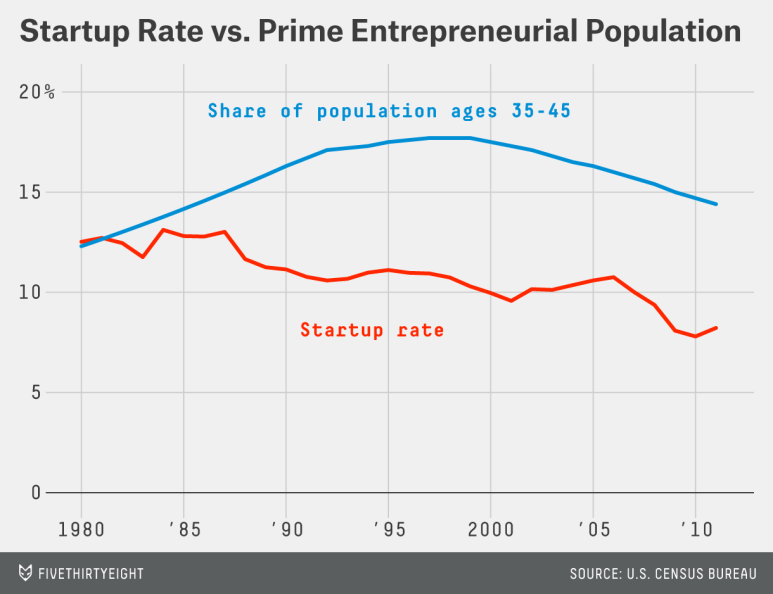
And back in the early 1990s, there were a lot of people in their late-thirties and early forties: Nowadays that cohort of people’s prime founding years are behind them. There is another large cohort of people coming up, but right now they’re too young to be peak entrepreneurs.

Casselman, who provides the above chart, thinks it’s clear the decline in the start-up rate “began long before the boomers began to age out of their prime entrepreneurial years”:

There is other evidence that America’s aging population can’t explain its aging businesses. Self-employment rates, for example, have declined for all age groups (other than teenagers) over the past 20 years. And as Hathaway and Litan showed in an earlier paper, the decline in entrepreneurship is remarkably constant across regions and industries, hitting youth-heavy tech hubs and graying industrial cities alike. Demographics may be contributing to the problem, but they aren’t the primary cause.

A Cure For Ebola? Ctd

Brian Till objects to the disparity between the treatment American Ebola patients Nancy Writebol and Kent Brantly are receiving, including an experimental antibody therapy called ZMapp, and the little to no care afforded African patients:

The inequality in care couldn’t be starker. When a doctor and aid worker from the United States are stricken with a horrific disease, an erstwhile unknown cure is sent from freezers at the National Institutes of Health in suburban Washington, D.C., to a hospital on the other side of the world, and a Gulfstream jet outfitted for medevac is arranged to deliver them to one of the world’s premier medical centers. But when two Liberian nurses working at the same hospital are stricken with the same disease, they are treated with the standard of care that other affected Africansthose lucky enough to receive any medical attention at allhave been afforded for the past seven months: saline infusions and electrolytes to keep them hydrated. …

The Obama administration has not said whether it will allow ZMapp to go into production. Mapp Biopharmaceuticals published a statement to their website late Monday stating that the company is working “with appropriate government agencies to increase production as quickly as possible.” (An executive at BioProcessing, a Kentucky firm that produces at least one component of ZMapp, told an industry publication last August that his company can produce the proteins for ZMapp in two weeks.)

A TPM reader with a background in bioethics speculates about why the experimental drug was given to these two aid workers, and no, it’s probably not because they’re white:

It’s hard to overstate how unusual it is for a drug at this stage of development to be given to humans.

This CNN piece suggests that they’ve only tried it on eight macaques so far. That’s a small number; they’d normally do significantly more testing in primates (or some other good animal model) before moving on to humans. Then when they did move to humans, they’d begin by testing for safety, then do various complicated further tests on larger numbers of people, and only then, if it had proved to be safe and effective, would they be able to apply for FDA approval.

This means, first, that this probably wouldn’t have been considered a “treatment” yet, just a promising lead. But second: trying a drug at this stage on humans has serious ethical risks. You’d want to be really, really sure that the people in question had given informed consent, and that that informed consent included their being absolutely clear that this drug not only might not work, but that it might actually be harmful to them. You’d want to be sure that they understood what it means for a drug to be at this preliminary stage of testing, and that they fully appreciated the fact that they were taking a huge gamble. … I think that this (along with the fact that the drug seems to require careful handling of the sort that would best be provided in a serious hospital, and the fact that there seems to have been only a limited amount of the drug available) would argue strongly in favor of trying the drug first on doctors, and specifically doctors who understand how much of the normal testing process was being bypassed, and what that meant.

Julia Belluz deflates the ZMapp hype, pointing out that just because the two Americans who received the drug appear to be doing well so far, that doesn’t prove anything about its efficacy:

[T]his drug has never undergone testing in people, only monkeys. The data on the efficacy of ZMapp in monkeys has never even been published. Studies on similar drugs are not entirely confidence inducing, either. In this study, two of the four monkeys given monoclonal antibodies 48 hours after exposure to Ebola survived. In this second study, the animals had a 43 percent survival rate when given the drug cocktail after the onset of symptoms. So even though the treatment of monoclonal antibodies decreased the mortality rate — if given close to exposure of the illness —  scientists haven’t moved past these tiny animal studies to testing in actual people.

Mapp Biopharmaceuticals is also just one of some 25 labs in seven countries working on these antibody cocktails for Ebola, and none of them have entered a phase one trial in humans, according to the journal Science. For this reason Dr. Martin Hirsch, a Harvard virologist, told Vox, “It’s too premature to say that the patients being treated miraculously improved.”

Olga Khazan explains why scientists are looking for an ebola treatment rather than a vaccine:

Vaccines don’t work that well in fast-moving epidemics. There are a few things you can do with a vaccine once an outbreak starts. One is immunizing healthcare workers and the families of infected patients. Sometimes doctors try “ring vaccination,” or targeting residents of villages on the perimeter of the outbreak in an attempt to isolate and quash it.

But most vaccines take a few weeks to provide immunity, and even then, they don’t always control the disease’s spread. Donald Allegra, chair of infection control at Newton Medical Center in New Jersey, remembers trying to halt the advance of measles in a Cambodian refugee camp in the 1970s. “We vaccinated 10,000 kids, but didn’t have an effect on the outbreak,” he said. “Vaccines and acute outbreaks don’t work very well together.”

Putting A Price On Your Pet’s Life, Ctd

A reader adds to the growing thread:

When our late cockapoo was 10 years old, he was diagnosed with diabetes and very shortly after went blind. This meant two shots of insulin a day for the rest of his life, and our choice of a blind dog or a $3,200 cataract operation that would restore his sight. After several months of watching him getting increasingly more depressed about his blindness (and suffering our own depression from it), we sprung for the cataract surgery. Without doubt, it was the best $3,200 we ever spent. The look on his face the day after the surgery, when we took him out for the first time, was priceless. Like a puppy! The psychic relief that it gave my wife and me, and our two daughters, was priceless.

cockapoo

And despite the inconvenience of dealing with a diabetic dog (injecting him with insulin twice a day, other geriatric illnesses and conditions that flow from diabetes, urinary incontinence that got worse over time, inability to board him for vacations, and so forth), he lived five more years, all but the last six months or so of it with a very high quality of life. We put him to sleep at 15 1/2, when we knew he was giving up and would be gone within a few weeks, and it was still the toughest day of our collective lives.

I mention this because, when I tell this story to friends who are from rural areas, they laugh and tell me what a bunch of softies we are, that they would never spend $3,200 on an operation for a dog, that dogs will adapt to blindness. They see spending $3,200 on cataract surgery for a dog as nothing short of preposterous. But I can’t imagine living with him being blind, knowing we could do something about it.

A reader shares a resource for those facing life-or-death decisions for their pets:

Since I don’t have children, I sense that I would likely go overboard to care for my border collie. When I came across this quality-of-life scale for pets a few years ago, I bookmarked it so I could be more objective when the time comes. I hope other Dishheads may find it helpful.

Another raises an eyebrow:

I’m surprised your reader thinks that giving a dog chemotherapy will make it “very sick” and is “like torture.” Actually, at least with the kind given to my dog – which gave us another 15 months of very high quality life with her – it is very rare that an animal will get sick, or indeed suffer any side effects whatsoever. Mine had none. I’m sure a vet or two will weigh on the subject, but I just wanted to make this point.

Another nods, with many other readers sharing their stories and photos:

A reader pointed out that “chemo is awful” when discussing why he or she would not subject her family cat to it. I would suggest that she talk with her veterinarian about it before assuming that human chemotherapy treatment and pet chemotherapy treatments are perfectly analogous. In general, the side effects of pet chemotherapy are much, much less severe. My dog lost his leg to cancer about 20 years ago, and we put him on chemotherapy at the time. Of course we can never truly know what was going on in his head, but externally he was as happy, goofy, and active as ever during his treatment, and he loved going to the treatment center. And he ended up living three more years (his pre-chemo prognosis was three to six months).

Another updates us on his dog’s chemo experience, chronicled in “The Last Lesson We Learn From Our Pets”:

1044795_10201205134237952_1267167286_nLast summer I wrote to you about my dog Jack, who had recently completed chemo. At the time of treatment, we were told that our investment would likely get us a year, give or take, with the dog. A year came and went this past October, and Jack continues to be the happy, goofy, if old dog we had hoped he’d become. You may remember him from the photo that ran last summer [seen to the right].

Since then – and this is where we tie into the current thread – we’ve had to euthanize both cats in the house. The first cat became very ill, very quickly. The vet recommended tests, surgery, and ultimately a feeding tube. All of this was done with the understanding the cat would recover and live for several more years. Instead, we subjected the cat to incredible suffering for the better part of a week before we had to call it quits. My wife and I vowed that we would not repeat this.

When the other cat began his downhill slide, we discussed with the vet that our focus was on quality of life, not quantity of treatment. She was completely on board with this, and the cat had a glorious last week. One of the things we did was let him out in the yard to hunt, under supervision, and let his inner warrior get a one long, wonderful taste of life. When it was time to end things with this pet, we knew the suffering had been minimized, and therefore the experience was much, much easier. We have no regrets, and have planned a similar sendoff for the dog.

Another reader:

Several weeks ago, our beloved nine-year-old dog was diagnosed with a melanoma tumor in her mouth. As you know, this is one of the most aggressive cancers. We live on one of the Neighbor Islands in Hawaii, and our vet told us we would have to fly her to Honolulu for specialty treatment as there were no facilities for the required surgery where we live. Within two days we were on a plane to Honolulu with Gwendolyn to meet with the doggie oncologist at the specialty hospital.

2013-12-22_02-52-08_489

Following examination, including a cat scan, the doctors determined that it was in the early stages and gave us the option of surgical removal of part of the bone and teeth in her upper jaw. The surgery was performed and she was back home and feeling fine two days later. She is also receiving a very promising new melanoma vaccine that is used for both canines and humans. So far her prognosis is excellent. Other than a slight dent in the side of her face, you would never know she had had such a procedure. She has fully recovered.

So far the treatment, including travel, has cost in excess of $13,000. We are very fortunate that we can afford it and consider the cost about the equivalent to a really nice vacation. We will enjoy whatever time we have with Gwennie far more than that. We are realistic enough to know that if the cancer recurs we will most likely not pursue this course further, but we felt we had to give her the chance for more life. As a life-long animal lover, I know that there can be no greater pain for some of us than losing a well-loved pet. I also wish that we humans were treated with the same compassion when our time comes as we extend to our furry family members.

An equally loving pet owner chose the opposite approach:

PupsI have two 13-year-old dogs who are as dear to me as any family member (more so than a few). A recent trip to the vet with revealed congestive heart failure in one and possible Cushing’s disease in the other. The dog with congestive heart failure also has bad teeth that if treated would cost between $700 and $800. Both diagnosing and treating Cushing’s disease would require multiple trips to the vet. I am lucky to have a vet who understood completely why I declined treatment for both dogs.

I have been down this road before, once spending $700 on an ill and elderly rabbit who died on the operating table. I also spent $1,300 on a guinea pig’s teeth until realizing I would be shelling out $500 every six months. The guinea pig was euthanized.

I love my pets and cherish the way they have enhanced my life. But the sad truth is that they are approaching an age from which they will surely die of something. I doubt it will be either tooth decay or Cushing’s disease. I am not poor and could probably afford the treatments for my dogs with some economizing. But they are comfortable, they are treated for pain twice a day, and I will do all I can to make the last years of their lives comfortable. For me, declining treatment is an act of love and acceptance.

Another takes issue with the reader who wrote, “I understand that there is a sentimental component to the decision to forego a $5,000 operation for your pet, but from a moral standpoint I have no hesitation. Given that there is an oversupply of dogs and cats, putting one down simply means you can drive to the humane society and save another”:

Intellectually, I agree 100-percent with this. However, until it happens to you, you just cannot know to what lengths you will go for a pet. One of my dogs suffered a back injury. He was in great pain. I took him to a specialist who, after a $2,500 MRI, determined that he was a good candidate for successful back surgery. There were no guarantees, needless to say, but Homer was only six and a half years old at the time. I decided he was worth it and took money out of my retirement savings to get him the surgery.

Yes, he was on the end of a six-foot leash for two months. He didn’t like it. I slept with him on the living room floor for the first six weeks, then we built some kick-ass stairs for him to walk up to the mattress on my platform bed, where I tied a scarf around my wrist to his collar and he continued recuperating without being allowed to jump down, and believe me, his personality would dictate that he jump down. He has recovered beautifully, and even seems to have learned the benefit of using the stairs to get up and down from my too-high bed.

IMG_4915

Would I do it again? I don’t know. My other two dogs are just fine. I do get them dentals as needed, and they do go to the vet more than your average dogs. Homer has developed seizures, so we’re working through medications and dosages to keep them at a minimum.

I guess the answer on just how far you will go for your pets is so personal and individual that there might not be all that much point in discussing it. If someone told me to my face that I was stupid for spending the money that I spent on him (we call Homer the “Eight-Thousand-Dollar Dog,” though altogether I am sure I spent more like $10,000), I would call them something far worse than stupid.  Certainly financial circumstances can change enough as I get closer to retirement that the choice will be taken from me.  For now, I’m happy to spend the money to keep any one of my dogs happy and healthy and with me.
Looking East From Africa

20140809_gdc460_2

President Obama is hosting 51 current and former African leaders in Washington this week for a grand summit on revitalizing American engagement on the continent. Reviewing Obama’s mixed record on this issue, Jay Newton-Small sees the summit as an attempt to make good on some of the expectations he raised early in his presidency. But like most issues in international politics these days, it’s also about China:

As the U.S. is pivoting to Asia, Asia is pivoting to Africa. China’s investments in Africa surpassed those of the U.S. in 2010 and are now five times as big—$15 billion to U.S.’s $3 billion. China’s investment in the raw-resource laden continent is expected to reach as high as $400 billion over the next half century. While, Obama says “the more the merrier,” as he told The Economist, “my advice to African leaders is to make sure that if, in fact, China is putting in roads and bridges, number one, that they’re hiring African workers; number two, that the roads don’t just lead from the mine, to the port to Shanghai.”

To that end, Obama has a distinctly American message for African leaders. He has seized upon the conference to underline the power of democracy for emerging nations. It is not by accident that he invited so many former African leaders: a message to Africa’s many aging dictators that it’s okay to step aside and give someone else a chance. Obama has proven that he isn’t Africa’s savior, and there’s only so much he can do.

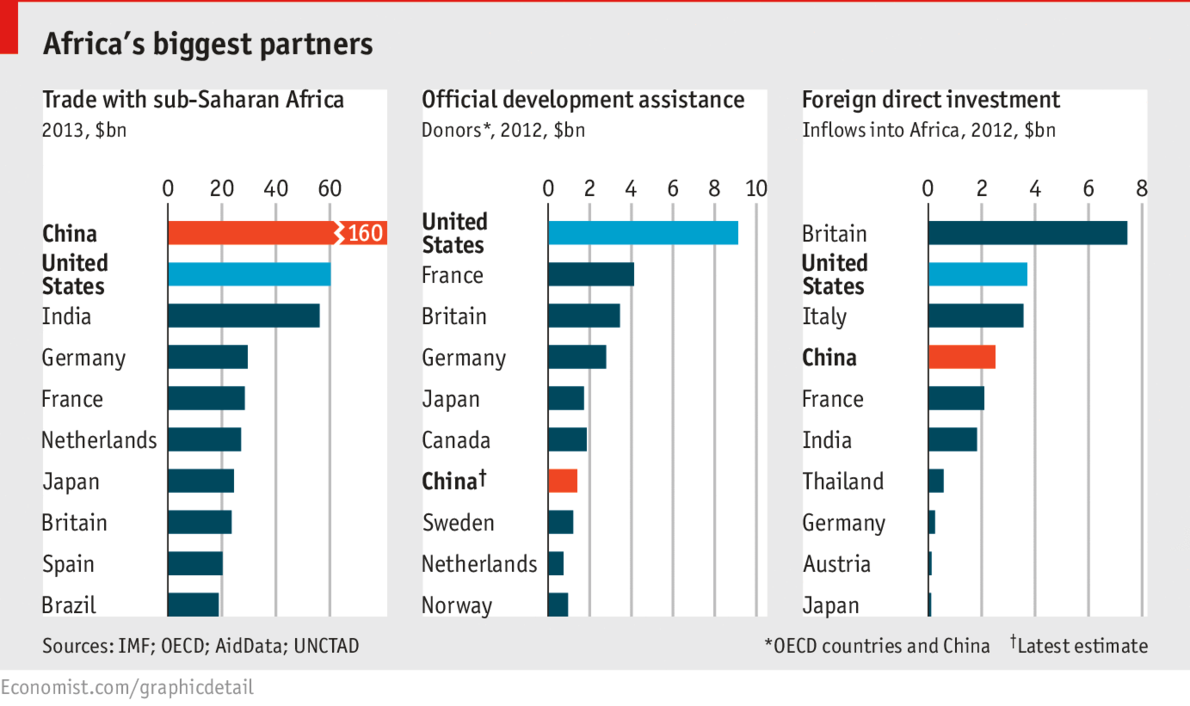
Max Nisen assesses how our aid, trade, and investment in Africa measure up to China’s:

Evaluating just how much China’s businesses and government have invested in Africa is tough, especially given the opacity of Chinese government dealings. Though the US still leads in UNCTAD’s tallies of direct investments in Africa, that’s declining. One study estimated that China invested as much as $75 billion in unrecorded projects alone from 2000 to 2011. That would boost the figures below from China dramatically:

China’s FDI has grown at about 53% a year since 2001, compared to 14% for the US. Less than 1% of US FDI investment goes to Africa, and $14 billion won’t do much to change that. By contrast, China invests 3.4% of its worldwide FDI stock in Africa. Its massive investments in infrastructure dwarf US efforts. Since China surpassed the US in 2009 to become the continent’s biggest trading partner, the gap has only grown. Last year, the US had about $85 billion in bilateral trade with Africa; China reported more than double that with $210 billion.

Stephen Mihm looks to history to explain why the US isn’t as robustly invested in Africa as it is in other parts of the world:

By the early 20th century, the U.S. had managed to get a foothold in places such as South Africa, but in general, its trade paled compared with that of Britain. Moreover, it was lopsided. Americans, in other words, didn’t actually buy a whole lot from Africa. The continent was instead viewed simply as a dumping ground for U.S. products. In 1901, for instance, goods from Africa constituted a mere 1.2 percent of total U.S. imports. That figure barely budged in the succeeding years.

And actual direct investment in Africa was negligible, with the exception of Firestone’s investment in rubber plants in Liberia before the outbreak of World War II. Africa, when it appeared on the radar of U.S. businessmen, was a place to sell, not a place to make long-term investments. That job fell to imperial powers such as Britain, which had little interest in, say, setting up a competing manufacturing power in a colony.

Gordon Adams explores the US-Africa relationship from a security standpoint:

The money, equipment, training, counseling, intelligence, and operating support the United States provides in Africa will only be reinforcing the militaries as institutions in their countries. These militaries already have, at best, a mixed history of corruption, political domination, and seizure of power. And U.S. military investments provide these militaries with additional arms and operational training, making it even more difficult for civilian governments to restrain the military’s assertion of political power.

This deeper issue is a central one in Africa, and the one payoff of all the U.S. investment that we should put above all others — above development, above social services, above stronger security forces — is the issue of “governance.” Governance is what this summit should be about, above all else. Supporting governance in Africa might be discussed this week, but it is a goal only weakly reflected in U.S. assistance programs in Africa.

(Chart via The Economist)