Slaughtered For Satire, Ctd

A reader writes:

I’m a former Muslim who grew up in Saudi Arabia as the daughter of Pakistani expatriates. I left everything to come to the US and created a wonderful life that has involved practicing as an 10899542_1531240417130999_737500267_nattorney. Several years ago, I worked out my Islamic demons via a blog focusing on my apostasy – still a capital crime in Saudi Arabia – but Islam has become largely irrelevant to my life in recent years. That is, until something like the Charlie Hebdo attack happens.

I found myself thinking that I don’t want them to win, and they win so much, everyday. I grew up in a country that bans philosophy books because they might encourage free thought. When people are killed for speech, speech is silenced. I can‘t stand the thought that fewer people might draw silly cartoons because of Islamism.

So I created drawingislam.com, which will post drawings, cartoons and sketches sent in by anyone who has anything to say about Islam and Muhammad. I’m hoping it will generate enough material that the best of it can be published in a book that Saudi Arabia will have to ban.

I was one of your earliest readers, back in Saudi as a teenager. Thank you for your honesty about Islam. I’m a socialist-level liberal, and I find the liberal cowardice around speaking out about Islamism disgusting. Here’s to speaking the truth, even if it’s in the form of satirical cartoons.

Another counters Chait:

“One cannot defend the right without defending the practice.” I’m sorry – what? As an atheist who personally has no problem with blasphemy, I still don’t think this statement makes any sense.

In a liberal society, we routinely “defend the right” to express all sorts of awful opinions – racist, homophobic, etc. My guess is that Chait would defend the rights of groups like the Westboro Baptist Church or even the Klan to express their vile views. Does that mean that he also defends the practice? That there is no room to say that such views have no place in a civilized society, but that at the same time we will allow people to express them? (And in fact that we must allow them to, or risk repression of vital and valuable discourse as well.)

I am not familiar enough with Charlie Hebdo to know whether their publications warrant the same sort of public contempt as those of hate groups. My guess is that they do not. It could well be that I would defend their practices as well as their rights. But it’s a question of degree, and it does not follow from defending their right to publish that we must also defend their practices.

Another isn’t alone:

I’m missing Hitch. His voice is needed regarding France. His words regarding Denmark will have to make the point:

Hitch’s words – about how religious fundamentalists of all stripes defend each other when it comes to secular free speech – prove prescient:

Bill Donohue, president of the Catholic League, a U.S. organization that “defends the rights of Catholics,” issued a statement [yesterday] titled “Muslims are right to be angry.” In it, Donohue criticized the publication’s history of offending the world’s religiously devout, including non-Muslims. The murdered Charlie Hebdo editor Stephane Charbonnier “didn’t understand the role he played in his [own] tragic death,” the statement reads. “Had [Charbonnier] not been so narcissistic, he may still be alive,” Donohue says, in what must be one of the more offensive and insensitive comments made on this tragic day.

Another reader flags a much longer video from Hitch on free speech. Another shifts gears and wildly speculates about the motives of the massacre:

In thinking about the horrible attack today, the typically dormant conspiracy theorist part of me wondered if this really was an act of Islamic Fundamentalist terror, or if it was only intended to look like one. You posted a snippet of Juan Cole’s message, saying that that this played into the hands of both Al-Qaeda and the “Islamophobic French Right wing.”  Why are we so sure it wasn’t some hardcore nationalists who wanted to create the very kind of backlash the attack is likely to create?

Now, obviously the likeliest scenario is that it was, in fact, perpetrated by three (including the driver) Islamic Fundamentalist terrorists, but two things have made me question it apart from the multiple parties who had motive.

First, the terrorists told the woman opening the door for them that they were Al-Qaeda, in unaccented French, and then they started screaming Allahu Akbar as they perpetrated their assault.  It all seemed too stereotypically like Islamic Fundamentalist terror.  Of course, maybe that’s a stereotype because that’s how it happens, but it made me question things a bit. Second, and this is very tenuous, the skin of the attackers under their masks look very white.  (Yes, there are obviously also light-skinned and/or white Islamic Fundamentalists).

Anyway, that’s my conspiracy theory for the year.  I wish it had to do with something far less sad and horrible.

Follow all Dish coverage of the Charlie Hebdo attack here. Update from a reader:

The discussion around the attack has focused around freedom of speech, and whether or not we should lionize the magazine despite its baiting tactics. Some voices emphasize the need to defend freedom of speech at all costs. The others say that Charlie Hebdo was a little over the top – their cartoons weren’t critiques so much as racist slurs. The problem with both stances is they still limit this attack to an attack on free speech. And while I think that’s a part of this cultural tension, I don’t think it’s the whole story, or even the central one.

Maybe Charlie Hebdo wasn’t attacked because of its cartoons but instead because of larger political forces at work. Maybe people don’t become radicalized because of ideas or teachers, but rather because of living conditions and/or identity politics.  Few commentators have mentioned how European Muslims are statistically poorer and less culturally integrated than Muslim Americans. I haven’t seen any of the write ups discuss the 2010 banning of face coverings, the strict anti-immigration policies that are common throughout Europe, or the lack of Muslim representation in European governments.

Do crazies pick up guns and shoot people sometimes? Of course. But if this is terrorism (and not simply a killing spree), we can not stick our heads in the sand and retreat to cliches like “They hate us for our freedom.” Not only is that an oversimplified approach, it also prevents us from healing the wounds that continue to haunt us. Political violence cannot exist in a vacuum. Talking about this awful crime like it’s simply the product of a few cartoons is unproductive, and leads to deeper lines drawn in the sand.

(Illustration details here)
Geotagging Genghis Khan

1420481244494136

Among archaeologists, the burial place of Genghis Khan is akin to the Holy Grail: a secret lost to time that would be a history-making find if discovered. When the Mongol leader died in 1227, his body was buried in accordance with custom in an unmarked grave. Unfortunately, nobody knows where it is, as everyone who witnessed the burial was killed to protect the secret of his gravesite. A vast area surrounding the probable location, known as Ikh Khorig or “the Great Taboo”, was declared sacred and sealed off to outsiders for nearly 800 years until archaeologists were finally allowed to start excavating there in 1989. Ben Richmond highlights one researcher who is taking a novel approach to the search by crowdsourcing the task to armchair archaeologists working from satellite images:

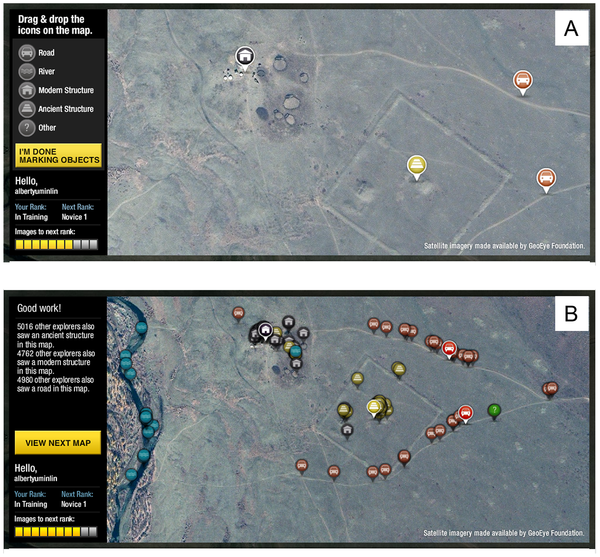
Albert Yu-Min Lin, from the Center for Interdisciplinary Science in Art, Architecture, and Archaeology at the University of California, San Diego, devised a way to hunt for Genghis Khan’s tomb without touching or toppling anything: Have anyone who’s interested in doing so tag potential sites of investigation from the comfort of their own homes, on images taken from the respectful distance of satellite orbit.

“Explorers” were welcome to map rivers and roads, and flag modern structures, as well as potentially ancient structures on thousands of ultra-high resolution satellite images of the region. There was a lot of ground to cover—6,000 square kilometers, but there were also a lot of volunteers. The system was launched in June 2010, and in just its first 90 days, 5,838 people had contributed more than 1.2 million tags. By the end of the year, over 10,000 participants had generated 2.3 million tags—contributing a total of 30,000 hours of human visual analytics to the images, according to the study’s initial results, just published in the journal PLOS One.

Anthropologist Jack Weatherford touches on this mystery in his 2005 book Genghis Khan and the Making of the Modern World, an eminently readable narrative account of the great Khan’s life and its aftermath, based primarily on The Secret History of the Mongols, a near-contemporary folkloric biography.

“Take Your Medicine” Taken To An Extreme

A 17-year-old in Connecticut is fighting for the right to refuse cancer treatment:

Known as “Cassandra C.” in court papers, the teenager has Hodgkin lymphoma. Doctors say her survival rate is 80-85 percent with chemotherapy, and she will die without it. Cassandra says she believes chemo is “poison,” and wants to discontinue treatment. Her mother, Jackie Fortin, supports her decision, telling NBC News: “My daughter does not want to poison her body. This is her constitutional right as a human being.” … [C]hild protective services became involved after [Cassandra] missed several doctor’s appointments and stopped going to tests. She was removed from her home, and is now in a monitored room at Connecticut Children’s Medical Center.

In the process, she was forced to undergo two chemo sessions. Nicholas St. Fleur provides context to the “legal battle over whether a 17-year-old can make medical decisions about her own body”:

In the U.S., adults have the right to bodily integrity, meaning they can refuse life-saving medical treatment. … Only a few states allow the “mature minor doctrine” which lets 16 and 17-year-olds argue in court whether they are mature enough to make medical decisions. In 1989, Illinois had a case where a 17-year old Jehovah’s Witness with leukemia who was allowed to refuse life-saving blood transfusions. Normally this doctrine is used when children want to receive treatment that their parents are refusing, but in this case the girl’s parents also agreed in accordance with their religious beliefs. The court decided in favor of her right to refuse treatment under the mature minor doctrine.

Ironically, the girl survived her bout with leukemia because she had already received a transfusion before the court made its decision. It’s unclear if Cassandra’s appeal, which will be Connecticut’s first case calling for the “mature-minor doctrine,” will face similar judicial impediments.

Update from a reader:

This story recalls a somewhat different one in Canada recently, where the aboriginal parents of a young girl (pre-teen, if I remember) refused the chemo that doctors said was necessary and would be successful in favour of traditional aboriginal medicine. The judge in the case sided with the parents on the basis of constitutional aboriginal rights. The parents brought their child to a holistic treatment centre in Florida (one which did not provide particularly aboriginal therapies), but made it clear subsequently that if her condition deteriorated they would agree to a more “Western” medical approach. Needless to say, despite the differences with the case you discuss, it generated considerable debate in the country.

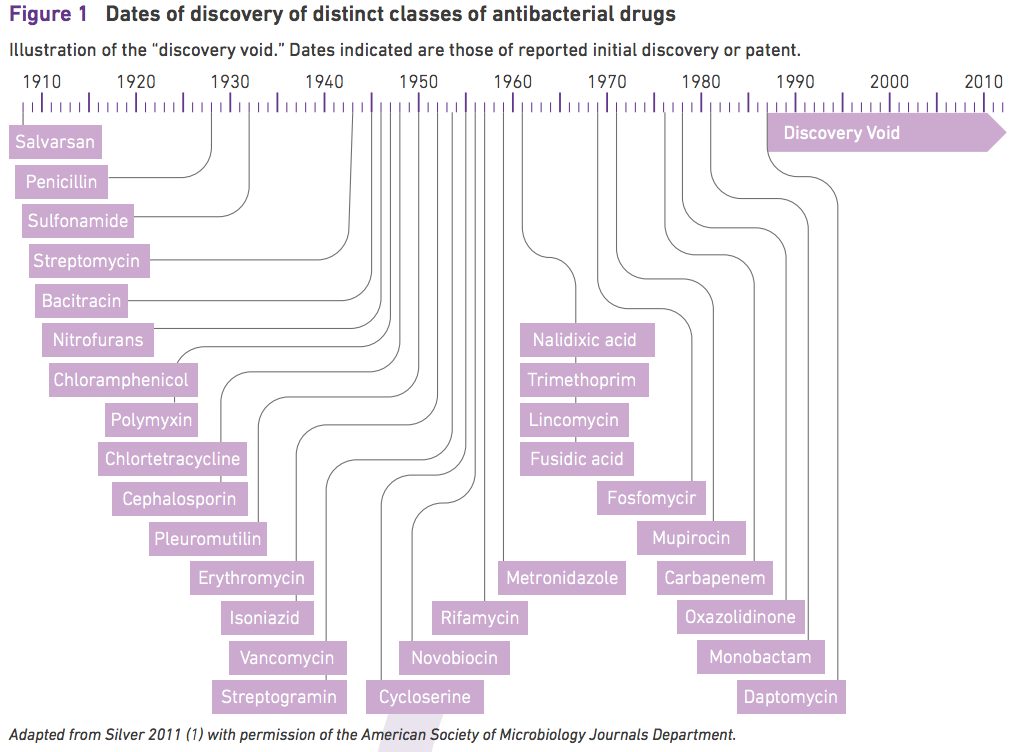
Is The Antibiotic Discovery Void Finally Over?

We hadn’t found a new class of antibiotics in decades:

antibiotics-discoveries

Which is what makes this news so exciting:

A new antibiotic – the first in nearly 30 years – has been discovered by scientists who claim it appears to be as good, or even better, than many existing drugs with the potential to work against a broad range of fatal infections such as pneumonia and tuberculosis. Laboratory tests have shown the new antibiotic, called teixobactin, can kill some bacteria as quickly as established antibiotics and can cure laboratory mice suffering from bacterial infections with no toxic side-effects.

How teixobactin was discovered is likely to be more important than the drug itself. Heidi Ledford explains:

Many of the most successful antibiotics were found in the mid-twentieth century by scientists who trawled microbial communities for bacteria capable of killing their brethren. But the researchers missed the type that produces teixobactin, Eleftheria terrae, plus many other potential candidates — known collectively as microbial ‘dark matter’ — because of their reluctance to adapt to life on a petri dish.

[Kim] Lewis and his Northeastern colleague Slava Epstein discovered E. terrae’s potential with a device they call the iChip. It works by sorting individual bacterial cells harvested from soil into single chambers. The device is then buried back in the ground. Several molecules in that environment are able to diffuse into the iChip, allowing the bacteria to thrive in a more natural setting than a petri dish. Typically, only about 1% of microbes in a soil sample are able to grow in the lab. The iChip expands that fraction to 50%.

Ed Yong is enthusiastic about iChip:

Teixobactin is a fish; the iChip is the rod. Having the rod guarantees that we’ll get more fish—and we desperately need more.

Bacteria have been fighting each other for billions of years before we arrived, so environmental microbes are a rich source of potential new antibiotics. The problem is that 99 percent of them won’t grow in lab conditions. So, why not bring the environment into the lab?

That’s what the iChip does.

Sarah Zhang takes a closer look at teixobactin:

As for teixobactin, it’s promising, but don’t expect it to be a game-changer all by itself. It works by inhibiting the growth the cell walls in bacteria, a mechanism that is difficult (but not impossible!) for bacteria to evolve resistance against. But that also means teixobactin only works against bacteria without another membrane around those cell walls. That includes bacteria like MRSA and TB, but not other worrisome ones like Klebsiella and E. coli, which have evolved a lot of resistance to existing antibiotics.

Teixobactin will still have to be tested in humans for safety and efficacy. It will have to be easy to synthesize in large quantities and ideally ingestible rather than only injectable. There are many characteristics of a good antibiotic beyond just being able to kill bacteria. Don’t expectteixobactin to be available for several years, and that’s assuming it pans out.

Arielle Duhaime-Ross puts the discovery in context:

Henry Chambers, an infectious disease researcher at the University of California, San Francisco, who didn’t participate in the study, thinks the researchers’ new approach is interesting. But the fact that the antibiotic isn’t effective against most Gram-negative bacteria is slightly disappointing. “There are now plenty of drugs for infections caused by Gram-positive,” he said, “and the more pressing need is for resistant Gram-negatives.”

Chambers also cautions against getting too excited about the idea of a new antibiotic. It’s “too early to get excited for yet to be proven clinical utility,” Chambers says. And even if the drug is approved for human use, it won’t solve the current problem of widespread antibiotic resistance — a problem that stems from overuse in both medicine and food production. “If an antibiotic is used enough, resistance ultimately will emerge.” For example, although it took 40 years for resistance to develop against vancomycin — another antibiotic that works in a similar way — resistance did eventually occur. Still, if teixobactin is approved for human use in a few years, that will be good news, Chambers says. “New potent and effective antibiotics belonging to a novel class are welcome, even for Gram-positives.”

The researchers believe it will take decades for bacteria to become resistant to teixobactin:

While widespread resistance to new drugs typically takes anywhere from weeks to years, Lewis anticipates that resistance to teixobacitn may take decades to develop, citing vancomycin, a drug often used to treat MRSA infections, and considered a drug of last resort—one typically saved unless there are no other options. Developed in England in the 1960s, vancomycin, which also targets a bacterial cell-wall polymer rather than a protein, only began to encounter resistance in the 1990s. “So that gives us an idea of how long it will take for resistance to develop to teixobactin,” he says. “It should take more than 30 years.” 

Judy Stone is skeptical of such claims:

The researchers are too glowingly optimistic about the likelihood of resistance emerging, I believe. In fact, the compound is being touted as “resistant to resistance” based on lab testing. Bacteria are always smarter than the people who develop and use them. While it may have taken 30+ years for Vancomycin resistance to develop, in part that is likely because we didn’t use that much of it until the last decade. …

My biggest concern, should Teixobactin make it to market, is that it will be squandered as every other good new antibiotic has been, and so resistance will rapidly emerge as the drug is overused. I have particularly been disappointed to see this with the other novel antibiotics developed during my career—Linezolid (Pfizer) and Daptomycin. I see both marketed irresponsibly (including promoting use to Social Service case workers) because they are convenient to use. Medicare has not been willing to pay for home IV antibiotics, so many of us use Daptomycin, which can be given once-daily in an outpatient clinic, so that our patients won’t have to go to a nursing home to receive antibiotics. As a result, we’re creating bacteria resistant to one of our few remaining effective antibiotics. Similarly, Linezolid is wasted for convenience, since it can be given orally; it has also been promoted for inappropriate uses, as treating colonization in wounds or in nursing home patients, rather than infection.

A Mother Who Can’t Pick Up Her Child

Sarah Erdreich shares how her chronic pain has made parenting nearly impossible:

My daughter is healthy and happy, but my own health has gotten much worse. The early months of changing diapers and clothes, nursing, and lifting her in and out of her crib caused irreparable damage to my wrist and shoulders. I can’t push her stroller much farther than the three blocks between home and day care. I can’t dress her by myself, or tie her shoes. I can’t make the appropriate hand motions to accompany “Itsy Bitsy Spider,” write out the alphabet, or brush her hair. But all that feels like mere window dressing for what I really can’t do: feel at all confident that I can take care of my child alone for more than an hour. On the few occasions that I’ve had to, the time passed in a blur that left me incapacitated and in tears. …

If I had known how tough this would be before getting pregnant, would I have made the same choice? I want to say yes without hesitation or qualification, but that’s not the honest answer. The honest answer is, I don’t know. I love my daughter. That has never been in doubt. But I hate what a toxic combination motherhood and chronic pain are for me. Perhaps the best way to answer that question is to say this: My daughter will never have siblings. Both my husband and I do, and I wish that she could know what that relationship is like. But raising another child would take a much greater toll on my health than I am willing to accept.

Houellebecq’s Nightmare

Charlie-Hebdo-Secondary2-320The massacre at the offices of Charlie Hebdo this morning coincided with the publication of controversial author Michel Houellebecq’s latest novel, Submission, which today’s Charlie either lampoons or praises (or both) in the cover seen to the right. Today’s attack was so clearly planned and premeditated that it likely wasn’t a response to Houellebecq’s book or Charlie‘s cover thereof, but there are plenty of parallels between Submission, which critics have derided as an anti-Muslim screed, and the offensive material that made the satirical weekly a target for Islamic fundamentalists. Ishaan Tharoor explains what the book is about:

“Submission” tells the story of France in the near future — 2022 — where a Muslim wins a presidential election against a far-right candidate and presides over the Islamization of French society. Persian Gulf monarchies pump in funds into new Islamic schools; teachers at the Sorbonne are compelled to convert to Islam; women slowly disappear from the workplace; polygamy becomes legally permissible. …

Houellebecq says his book leaves “unresolved” the question of “what we are meant to be afraid of” — Islamists or nativists. Ironically, the rule of a Muslim president in his book leads to stability and an improved economic outlook for France. But the premise certainly feeds into an already overheated conversation in Europe and sketches the disturbing end point for a polarization already taking place, even if its predicted outcome is completely implausible.

Bershidsky discusses how Houellebecq’s paranoid vision of the future, which far-right leader Marine Le Pen called “a fiction that could one day become reality”, fits into France’s ongoing culture war:

The point “Submission” makes isn’t so much political as cultural. It turns the integration debate on its head. Many in Europe want Muslim immigrants to merge into the host society on its terms. This is especially pronounced in France: the country has a profound shortage of mosques, and it bans wearing of Muslim face-covering scarves in public. What, the novel asks, if the French were told to integrate with the Muslims on the latter’s terms? What if the traditional parties had to join a coalition with an Islamic element? And what if ordinary people had to accept some Muslim traditions as part of living in a Muslim-run society — adopt polygamy, for example, bar women from working or convert to Islam to be able to teach school or college? Houellebecq posits that the French would submit. Why not, if unemployment among men is eliminated in the process and men could have three wives instead of resorting to prostitutes? …

No wonder the European far right portrays integration as a zero-sum game, in which one side must submit to the other — after all, isn’t that what the Muslims are after?

Submission is currently number one on amazon.fr’s bestseller list, and today’s events aren’t likely to hurt sales. But Houellebecq also faces some harsh criticism for what his detractors are calling a contribution to the wave of right-wing nationalist xenophobia currently making European Muslims nervous:

One German newspaper critic warned the novel could be seized on by anti-Islam protesters in Dresden as proof they are right to voice concern. Laurent Joffrin, editor-in-chief of left-leaning French newspaper Libération, argued that the novel “will mark the date in history when the ideas of the far-right made a grand return to serious French literature”.

“This is a book that ennobles the ideas of the Front National,” he added. Alain Jakubovitch, president of the anti-racism group LICRA, said: “This is the best Christmas present Marine Le Pen could wish for.” Houellebecq retorted that he could “see no novel that has changed the course of history” and that besides, “Marine Le Pen doesn’t need this. Things are working pretty well for her already.”

But Jonathon Sturgeon notes that Houellebecq, who once called Islam “the most stupid religion” and the Koran “badly written”, has softened his anti-Muslim edge of late:

More recently, Houellebecq appears to have shed his own atheism and disdain for religion, including Islam. In a recent interview with The Paris Review, the novelist admits that his atheism hasn’t “survived” in recent years, and, against a statement he made about the Koran thirteen years ago, he concedes:

…the Koran turns out to be much better than I thought, now that I’ve reread it—or rather, read it. The most obvious conclusion is that the jihadists are bad Muslims.

Although the new novel won’t be released in the US for some time, it’s clear that Houellebecq doesn’t consider it an affront to Islam. On the contrary, he sees it as a thought experiment meant to reflect the absence of political representation for Muslims in France. … With no present English translation, it’s impossible to tell whether Houellebecq’s new novel is a skilled experiment in political modality, or a thinly veiled attack on religion disguised as a mea culpa. In either case, Houellebecq may have seriously misjudged the power of novels to affect history.

ISIS On The Run?

Daveed Gartenstein-Ross lays out the evidence that the jihadist group is losing steam:

The most obvious sign of ISIS’s decline is that the group is no longer conquering territory, seizing no major towns or cities since Hit (and this hasn’t been for lack of effort on its part). ISIS continues to capture villages from time to time; for example, on December 27 it gained control of 14 villages in Anbar after Iraqi security forces withdrew from the area. But those villages aren’t equivalent to a major urban area and had been taken from ISIS by Iraqi forces just two days earlier. In October, ISIS advanced ominously on the Syrian city of Kobane; the French philosopher Bernard-Henri Levy declared in The New Republic that “Kobane will fall. In a matter of hours.” It has yet to fall, and Kurdish forces now appear to have the advantage, though the town remains contested.

ISIS has even been losing ground, albeit unevenly. In December, the group pulled its forces from Iraq’s Sinjar district, home to one of ISIS’s main resupply routes from Syria into Iraq (the other being Tal Afar). This has threatened to isolate ISIS-held Mosul.

But Lina Khatib doubts ISIS will disappear any time soon:

What is likely to change in the coming year is the way the organization operates.

The year 2014 saw a number of terrorist attacks in countries outside Syria and Iraq that were linked to the Islamic State by the assailants, even though the attacks were not necessarily directed by the Islamic State itself. In many of these cases, the Islamic State gave its blessing to the attacks after the fact, with the latest example being the lone terrorist attack in Australia in December 2014. These scenarios are likely to lead to more copycat incidents across the globe, especially by groups and individuals pledging allegiance to the Islamic State in a bid to gain power, notoriety, and resources. As the Islamic State embraces more and more such entities, it will be forced to change from a centralized organization into a franchise. Transformation rather than extinction, then, is the likely scenario for the Islamic State in the coming year.

And even if ISIS’s fortunes have taken a turn for the worse, that alone doesn’t necessarily mean America’s war against them is going well. Nancy A. Youssef points out that the Pentagon doesn’t know how many ISIS soldiers, or civilians, it has actually killed. What’s more, they don’t seem all that concerned about it:

[P]rogress in this war continues to be measured on fluid standards—where ISIS is trying to go, whether it can go there, and if local forces can fend them off. It is not a decisive war, with a single, signature victory, but a war of attrition. But there is no consensus about what the attrition of ISIS looks like. Success—and failure—is in the eye of the beholder. In the northern Syrian city of Kobani, for example, which, according to TheWall Street Journal, has seen 31 percent of U.S. and coalition strikes, Kurdish and local forces appear to be taking back parts of the city. But how much they have regained or how durable their hold is remains unclear. Kirby said that while the Kurdish forces control the majority of the city, it “remains contested.”

Breaking the will of ISIS, the military argues, is not a statistic. And too much of a focus on numbers can obscure strategic truths. Take the chief metric of the war in Vietnam—body counts, which ultimately did not answer whether the strategy was working.

An Actual Nanny State?

Nico Hines passes along news that the British government is considering some extreme lengths to protect young children from their Jihadist-sympathizing parents:

Alarming images of young British children pictured with weapons in the so-called Islamic State prompted officials in London to say they would consider taking into care the offspring of men and women who had travelled abroad to join ISIS. Then, on New Year’s Eve, police took the two children, who landed at Luton airport with their mother, under child protection laws.

Plans drawn up by the Home Office would further extend the remit of child protection officials to include toddlers at risk of radicalization on home soil.  A 39-page document that accompanies the Counter-Terrorism and Security Bill being considered by parliament says nurseries and early childcare providers, as well as universities and prisons, have a duty “to prevent people being drawn into terrorism.”

Charles C. W. Cooke admits that, in this particular instance, “on the face of it, the state may well have a case here.” But he’s worried about where this leads:

All in all, this does not quite come up to the level of asking the citizens to inform on their neighbors, but it is still a little too redolent of the “see something, say something” approach for my tastes. It is one thing for a nation in crisis to encourage the citizenry to be on the lookout for German spies, or for Irishmen boasting about planting bombs, or wannabe martyrs who are using their local mosque as a recruitment and training tool; but it is quite another for the state to recruit as its informants those men and women who have been charged with taking care of the country’s toddlers. Are staff “supposed to report some toddler who comes in praising a preacher deemed to be extreme?” the Conservative MP, David Davis, inquired derisively in the Telegraph this week. “I don’t think so.”

In all likelihood they will not, which raises a rather important question: What, exactly, does the government expect will change under this heightened level of suspicion? Had a child come into a British daycare a few weeks ago boasting that his parents were hoping to blow up a subway train or to move the whole family to Mesopotamia in search of honey and virgins, would his teachers not have made further inquiries?

America’s First Bullet Train

California broke ground on it yesterday. Scott Shackford is against the project, which is estimated to cost $68 billion:

The state only has $12 billion on hand for the project and is planning for another $8 billion. The rest is absolutely nowhere to be found. California got $3 billion from the Obama administration as part of the stimulus package, but it’s pretty safe to say they’re not going to see another cent from the federal government for at least the next two years. There is no sign of any private investment coming. The California High Speed Rail Authority is taking the “If you build it, they will come” mantra as a permanent motto. Its chairman, Dan Richard, is hoping they can raise money from selling advertisement and real estate development rights along the route or that the feds will chip in again later.

Katrina Trinko raises other objections:

Backers say the train will be able to make the trip between San Francisco and Los Angeles in under 2 hours, 40 minutes. However, according to a 2013 Reason Foundation study, it’s likely the trip will ultimately take around 4 hours (and sometimes closer to 5 hours) for various reasons (for example, the high-speed train will share tracks with slower trains). To put that into context, consider this:

a flight from San Francisco to Los Angeles is about 1 hour, 15 minutes. Driving, if there isn’t traffic, takes a little under six hours—more time than the train would take, it’s true, but you also have a vehicle at the end of your trip.

Update from a reader:

Sure, a flight between LAX and SFO might take 1 1/4 or 1 1/2 hours, but that does not take into account the hours required for checking in, going thru security, boarding early, and possibly baggage claim at destination, to say nothing of transit from the airport to the city proper.

Eric Holthaus believes that “it’s probably better to just focus on improving the transportation systems we already have, rather than creating a whole new one from scratch”:

Given the incredible pressure that global warming is inflicting, we can’t waste precious resources on high-speed rail. It’s impractical to hope that truly high-speed rail—the kind that will compete with air travel—will arrive in time to do much good.

Instead, limited public transportation funds should be prioritized for climate-friendly projects that will pay off more than high-speed rail in the same time frame. Some options for politicians: 1) Expand the use of upscale electric buses, 2) support self-driving vehicle technology, and 3) regulate airline emissions.

Fallows, on the other hand, supports the project:

1) America is direly short on infrastructure; the financial and political resistance to remedying that is powerful (for reason Mancur Olson once laid out) and usually prevails. China is biased toward wastefully building infrastructure it doesn’t need. The U.S. is biased the opposite way. So when there’s is a real chance to build something valuable in America, I start out in favor of it.

2) The counties of the Central Valley of California, where the first stages of the construction will begin, are not just the poorest part of a rich state but also, taken on their own, would constitute the poorest state in the entire country. Of the five poorest metro areas in the United States, three are there. Most dynamic analyses of the effects of the rail project indicate that it would bring new jobs to a region that most needs them, while chewing up less farmland than normal sprawl and freeway expansion would destroy. Which leads to …

3) The state’s population is growing, and so is the demand for intra-state travel. Any other way of getting California’s 30+ million people from north to south, via cars on new (or more crowded) freeways or planes to new (or more crowded) airports, will be more destructive of the state’s finances, its farmland, and its environment than a rail system.

Slaughtered For Satire, Ctd

https://twitter.com/thekarami/statuses/552898632320831489

Tony Barber’s reaction to the massacre at Charlie Hebdo has been criticised for seeming to blame the victim:

Charlie Hebdo is a bastion of the French tradition of hard-hitting satire. It has a long record of mocking, baiting and needling Muslims. Two years ago the magazine published a 65-page strip cartoon book portraying the Prophet’s life. And this week it gave special coverage to Soumission (“Submission”), a new novel by Michel Houellebecq, the idiosyncratic author, which depicts France in the grip of an Islamic regime led by a Muslim president. This is not in the slightest to condone the murderers, who must be caught and punished, or to suggest that freedom of expression should not extend to satirical portrayals of religion. It is merely to say that some common sense would be useful at publications such as Charlie Hebdo, and Denmark’s Jyllands-Posten, which purport to strike a blow for freedom when they provoke Muslims.

This is a toned-down version of Barber’s original post, which called Charlie “not the most convincing champion of the principle of freedom of speech” and accused it of “editorial foolishness”. Chait follows that line of argument to its logical conclusion, which he finds dangerous:

On the one hand, religious extremists should not threaten people who offend their beliefs. On the other hand, nobody should offend their beliefs. The right to blasphemy should exist but only in theory.

They do not believe religious extremists should be able to impose censorship by issuing threats, but given the existence of those threats, the rest of us should have the good sense not to risk triggering them.

The line separating these two positions is perilously thin. The Muslim radical argues that the ban on blasphemy is morally right and should be followed; the Western liberal insists it is morally wrong but should be followed. Theoretical distinctions aside, both positions yield an identical outcome. The right to blaspheme religion is one of the most elemental exercises of political liberalism. One cannot defend the right without defending the practice.

Jesse Walker puts it more bluntly:

If there is an unconvincing champion here, it is not Charlie Hebdo. It’s Mr. Barber, a man who seems to think “the principle of freedom of speech” is best represented by speakers with views so inoffensive that no one would want to censor them in the first place.

Ezra cautions against framing this atrocity in terms of the magazine’s editorial choices or how offensive they are to Muslims:

What happened today, according to current reports, is that two men went on a killing spree. Their killing spree, like most killing sprees, will have some thin rationale. Even the worst villains believe themselves to be heroes. But in truth, it was unprovoked slaughter. The fault lies with no one but them and their accomplices. Their crime isn’t explained by cartoons or religion. Plenty of people read Charlie Hebdo’s cartoons and managed to avoid responding with mass murder. Plenty of people follow all sorts of religions and somehow get through the day without racking up a body count. The answers to what happened today won’t be found in Charlie Hebdo’s pages. They can only be found in the murderers’ sick minds.

Juan Cole posits that an anti-Islam backlash is exactly what the terrorists who carried out the attack are hoping to produce:

Al-Qaeda wants to mentally colonize French Muslims, but faces a wall of disinterest. But if it can get non-Muslim French to be beastly to ethnic Muslims on the grounds that they are Muslims, it can start creating a common political identity around grievance against discrimination. …

The operatives who carried out this attack exhibit signs of professional training. They spoke unaccented French, and so certainly know that they are playing into the hands of Marine LePen and the Islamophobic French Right wing. They may have been French, but they appear to have been battle hardened. This horrific murder was not a pious protest against the defamation of a religious icon. It was an attempt to provoke European society into pogroms against French Muslims, at which point al-Qaeda recruitment would suddenly exhibit some successes instead of faltering in the face of lively Beur youth culture (French Arabs playfully call themselves by this anagram). Ironically, there are reports that one of the two policemen they killed was a Muslim.

Poniewozik fears that this incident, like the threats surrounding the release of The Interview, will only further encourage self-censorship:

Terrorism, by definition, is never just aimed at its direct victims. The slaughter in Paris was aimed at every news organization that now has to decide whether to show the cartoons. It’s aimed at anyone who reports the next story like this. The Sony hack was aimed at anyone considering another movie that might offend radicals. (Already, one thriller about North Korea has been cancelled in advance.) It’s all aimed at any media corporation that looks at the headlines of shootings and hacking, thinks of the danger, however remote—not to mention the potential legal liability—and decides, you know what, not worth the trouble.

And it works. That’s not the inspiring, uplifting thing I want to say right now. But unless all of us reject the kowtowing and the playing-it-safe, it absolutely has worked and will work again.

Alyssa also sees parallels with The Interview, and meditates on what these incidents tell us about the price of free expression – and why it’s worth paying:

These are difficult equations of governance and freedom; how to express respect for the beliefs of others without sanctioning attacks on those who offend those beliefs; how to exhort private individuals and companies to courage while also protecting anyone who might suffer as a result of their actions. And as we experiment with our calculations, we reach different and unpredictable results. In the United States, “The Interview” has inadvertently become an advertisement for a new model of movie development, netting $31 million in online sales and rental fees. It’s as much a lesson about commerce as about courage. But in France, at least twelve people are dead.

In the attacks on Charlie Hebdo and the hack of Sony Pictures, we see the costs of making provocative art and protecting the people who make and distribute it. But we shouldn’t let these consequences blind us to the very high price we would pay for backing away from such a defense: a grayer, duller, smaller society, in which much milder challenges to orthodoxy and taste are met with ugliness and violence.

Last but not least, Slate reprints Hitchens’ reaction to the Prophet Muhammad cartoon controversy from 2006:

Islam makes very large claims for itself. In its art, there is a prejudice against representing the human form at all. The prohibition on picturing the prophet—who was only another male mammal—is apparently absolute. So is the prohibition on pork or alcohol or, in some Muslim societies, music or dancing. Very well then, let a good Muslim abstain rigorously from all these. But if he claims the right to make me abstain as well, he offers the clearest possible warning and proof of an aggressive intent. This current uneasy coexistence is only an interlude, he seems to say. For the moment, all I can do is claim to possess absolute truth and demand absolute immunity from criticism. But in the future, you will do what I say and you will do it on pain of death.

I refuse to be spoken to in that tone of voice, which as it happens I chance to find “offensive.”