Obama’s Imperial Presidency?

Over the weekend, Douthat claimed that “the president is contemplating — indeed, all but promising — an extraordinary abuse of office: the granting of temporary legal status, by executive fiat, to up to half the country’s population of illegal immigrants.” Posner pushes back:

The executive branch spends a lot of time not enforcing laws. Congress has illegalized an enormous amount of activity without giving the president the resources to enforce the laws, so the executive has no choice but to make a list of priorities and devote its attention to law violations that, in its opinion, are the most serious. Thus, the IRS doesn’t audit paupers very often. The Justice Department ignores a lot of anticompetitive behavior that might raise prices a bit but not much. The DEA focuses on criminal syndicates rather than ordinary drug users, although both violate federal law. And so on.

Nearly all of this non-enforcement takes place with implicit congressional acquiescence; once in a while, Congress complains because the president’s priorities are not the same as its own. But the president has no obligation to listen to these complaints.

The Constitution gave him executive power while preventing Congress from compelling the president to act except by issuing the extreme and usually non-credible threat of impeachment. This is the separation of powers. People like Douthat wrongly think that separation of powers means that the president must do what Congress decides. That’s not the principle of separation of powers; that’s the principle of legislative supremacy, embodied in parliamentary systems like Britain’s, which America’s founders rejected.

Beutler finds Douthat’s crowing recklessly premature given that “we don’t know what Obama’s going to do”:

This tendency to assume the legal high ground follows naturally from a political strategy of playing up unilateral executive actions as evidence of presidential lawlessness. It’s tempting and convenient for conservatives to treat these as open and shut cases. But outside the right, it’s best to view their efforts as sophisticated attempts to work the refs rather than as judicious and conclusive interpretations of fact.

Drum weighs in:

As it happens, I think the current Republican obsession with presidential overreach is fairly pointless because their examples are so trivial. Extending the employer mandate might very well go beyond Obama’s powers, but who cares? It’s a tiny thing. Alternatively, the mini-DREAM executive action is fairly substantial but also very unlikely to represent any kind of overreach. Ditto for recent EPA actions.

Presidents do things all the time that push the envelope of statutory authority. To be worth any serious outrage, they need to be (a) significant and (b) fairly clearly beyond the scope of the president’s powers. I don’t think Obama has done anything like this yet, but if Republicans want to test that proposition in court, they should go right ahead. That’s what courts are for.
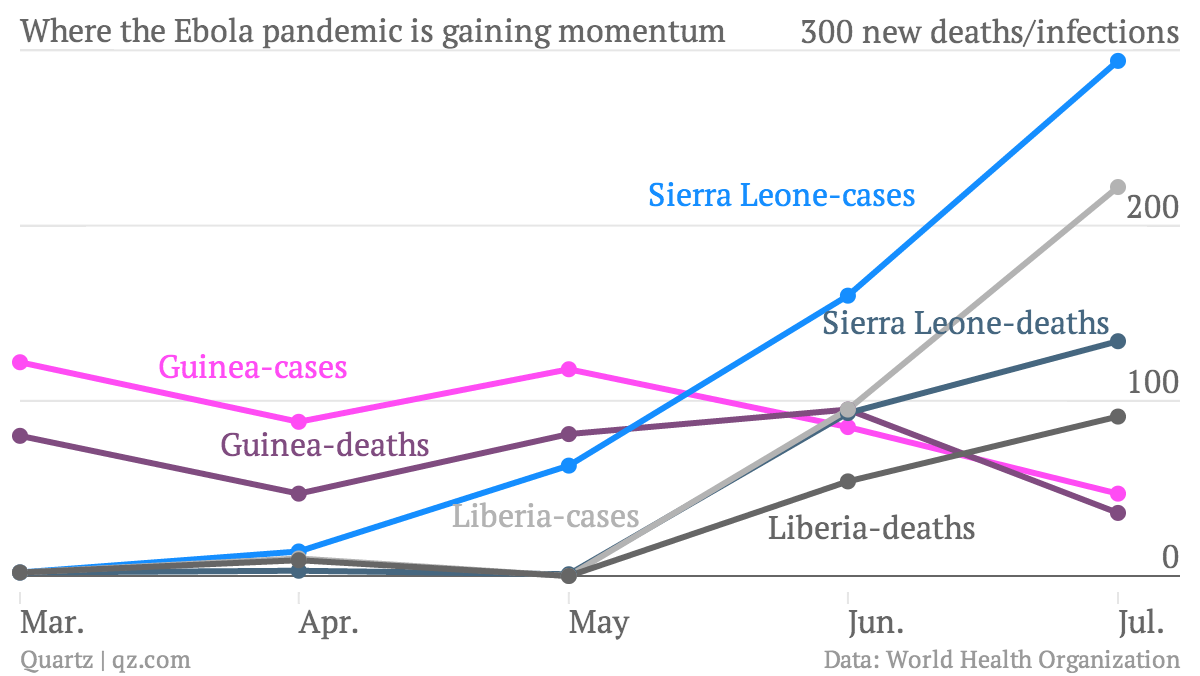
Why Is This Ebola Outbreak Different From All The Other Ones?

where-the-ebola-pandemic-is-gaining-momentum-guinea-cases-guinea-deaths-sierra-leone-cases-sierra-leone-deaths-liberia-cases-liberia-deaths_chartbuilder

Gwynn Guilford looks into it:

[A]s viral public health menaces go, Ebola should be easy to contain. Unlike airborne viruses like, say, swine flu, it’s not exactly sneaky. Ebola is spread only when infected bodily fluids come into contact with someone’s mucus membranes or open cuts. And it tends to broadcast the risk of infection pretty clearly; the symptoms include vomiting, diarrhea and, in some cases, hemorrhaging of mucus membranes. That made Ebola relatively easy to contain when it flared up in remote forests of central and eastern Africa, which are sparsely populated. But this new pandemic is a totally different story …

Why is that?

For one, Sierra Leone, Guinea and Liberia all have dreadful medical infrastructure. Sierra Leone has a single laboratory capable of Ebola testing. Earlier this week, Monrovia, Liberia’s capital, ran out of hospital space to quarantine Ebola patients. And that’s in its biggest city, where infrastructure is most robust. In other parts of Liberia, as well and in Guinea and Sierra Leone, hospitals simply aren’t available, according to data from Afrobarometer, a survey group.

Furthermore, Julia Belluz adds, a shortage of medical workers means many patients are not identified:

Ebola specialists believe one of the key reasons this outbreak has spread so far is because of the shortage of health-care personnel to deal with it: if you don’t have enough people on the ground doing the labor-intensive job of tracing the contacts of positive patients and ensuring they are identified before becoming ill too, each missed case is the new beginning of more human-to-human spread. Those missed cases are what worries Tarik Jasarevic, a World Health Organization worker on the ground in Guinea. He says that because of the geographic dispersal of the current outbreak—the demand for so many specialists in a relatively rare disease over several countries—mobilizing people and getting systems in place to care for everyone is problematic.

The doctors caring for ebola patients are also getting sick and dying:

Since the disease is transmitted through direct exposure to bodily fluids—from vomit to blood and sweat—health-care workers are advised to wear face masks, goggles, gowns and gloves while caring for patients. The trouble is, health workers in the developing-country context—especially those working in some of the poorest countries on earth, where the disease emerged this time—don’t always have access to this protective gear.

It’s important to note that they are also the ones who have died in this outbreak. Of the 60 deaths so far, none involved foreign workers (though two Americans are currently battling the virus, and one is a doctor). Foreign aid agencies such as Doctors Without Borders—which apply stringent precautions for all their health personnel—have never lost members of their teams to Ebola. So the problem this time is as much about size of the outbreak as it is about resources.

Putin’s Anti-Americanism

David Remnick captures how it has grown significantly during Putin’s time in power. Remnick talks at length with former US Ambassador to Russia Michael McFaul:

Although McFaul feels a deep sense of outrage about Putin, he also understood the mind-set of resentment and conspiracy. “I didn’t go to foment revolution,” he said. “I went to take the reset to the next stage. That was my mandate.” He added, “Obama people don’t sponsor color revolutions. Other Administrations had done this. Has the U.S. used covert operations to foment regime change? The answer is yes. I don’t want to get in trouble or go to jail, but has the U.S. supported the opposition to bring about political change? Serbia is a paradigmatic case: direct money to the opposition to destabilize things, and it was successful.” He also cited the overthrow of Mossadegh, in 1953, in Iran, and the support for the Nicaraguan Contras.

“Putin has a theory of American power that has some empirical basis,” McFaul went on. “He strongly believes this is a major component of U.S. foreign policy. He has said it to the President, to Secretary Kerry. He even believes we sparked the Arab Spring as a C.I.A. operation. He believes we use force against regimes we don’t like. . . . By the way, he damn well knows that the government of the Soviet Union used covert support. He worked for one of the instruments of that policy. He really does kind of superimpose the way his system works onto the way he thinks our system works. He grossly exaggerates the role of the C.I.A. in the making of our foreign policy. He just doesn’t get it. Or maybe he does get it and doesn’t portray it that way. I struggle with that: is he really super-clever and this is his psych op, or does he believe it? I think he does believe that we are out to get him.”

Dreher is most interested in Remnick’s “series of interviews with prominent Russian figures in Putin’s sphere.” One passage Dreher is struck by:

The world, for [Aleksandr] Dugin, is divided between conservative land powers (Russia) and libertine maritime powers (the U.S. and the U.K.)—Eternal Rome and Eternal Carthage. The maritime powers seek to impose their will, and their decadent materialism, on the rest of the world. This struggle is at the heart of history. For Dugin, Russia must rise from its prolonged post-Soviet depression and reassert itself, this time as the center of a Eurasian empire, against the dark forces of America. And this means war. Dugin rejects the racism of the Nazis, but embraces their sense of hierarchy, their romance of death. “We need a new party,” he has written. “A party of death. A party of the total vertical. God’s party, the Russian analogue to the Hezbollah, which would act according to wholly different rules and contemplate completely different pictures.”

In other Russian news, Ioffe finds it ironic that Russia is cracking down on any mention of Siberian self-determination:

All these months, Russia has been supporting Russian separatists in Crimea and eastern Ukraine, trumpeting the principle of self-determination. “The right to self-determination is formalised as one of the most important goals of the UN Charter,” said Russian foreign minister Sergei Lavrov before the Russian parliament. “As to Crimea, as you know, its autonomy was restricted several times in the past against the will of the Crimeans. After the armed coup by persons, who seized power in Kiev, actions were undertaken, which even more aggravated the possibilities of the Crimeans to exercise their right to self-determination within the Ukrainian state.”

But, in the Kremlin’s understanding, self-determination begins where Russia ends.

Did Snowden Tip Off Al-Qaeda’s Cryptographers?

The terrorist group and its allies appear to have changed their encryption systems in response to the Snowden leaks, according to a new report by the intelligence firm Recorded Future:

The report concludes that “it’s pretty clear” that there is an “increased pace of innovation in encryption technology by Al-Qaeda post Snowden.” The encryption, the report added, “is based on best practice, off the shelf, algorithms.” What’s more, the latest crypto tools follow other crypto programs terrorists have developed following the Snowden leaks. Recorded Future reported in May that three of the tools were created within five months of The Guardian first publishing the Snowden leaks in June 2013.

Though it’s not quite a “smoking gun”, Jazz Shaw urges anyone who thinks Snowden is an unmitigated hero to read the report:

None of this sounds terribly surprising and likely just serves as confirmation that the terrorists are keenly aware of international news headlines and respond to whatever information they can get accordingly. It’s also worth noting – as another analyst in the story mentions – that this isn’t absolute proof of a causal relationship between the two events. It’s possible that they just felt the software was long past due for an overhaul and would have done it anyway. But that’s relying awfully heavily on coincidence.

Of course, the real questions about the Snowden leaks go unanswered in this report. The fact that they upgraded their software is interesting, but what we still don’t know – and may never know, for obvious reasons – is how much other damage was done. How many agents had to be moved around or removed for protection? How many foreign informants supplying us with information were compromised, or simply disappeared? What opportunities were lost which our intelligence agencies clearly can’t talk about in public?

On the other hand, the jihadists’ new crypto might not make much difference:

Whatever the reason, [Bruce] Schneier says, al-Qaida’s new encryption program won’t necessarily keep communications secret, and the only way to ensure that nothing gets picked up is to not send anything electronically. Osama bin Laden understood that. That’s why he ended up resorting to couriers. Upgrading encryption software might mask communications for al-Qaida temporarily, but probably not for long, Schneier said.

“It is relatively easy to find vulnerabilities in software,” he added. “This is why cybercriminals do so well stealing our credit cards. And it is also going to be why intelligence agencies are going to be able to break whatever software these al-Qaida operatives are using.”

Patient Zero? Not So Fast

Dr. Kent Brantly, a US citizen who contracted ebola in Liberia, was evacuated to Emory University Hospital in Atlanta on Saturday for treatment in a special isolation unit. His colleague Nancy Writebol is also expected to arrive there this week. The usual suspects are busy fearmongering:

But Susannah Locke defuses fears:

Transmission of Ebola will be prevented using standard protocols, and health officials say that the two pose very little risk to the general public. Even if there were some terrible, unforeseen accident with one of these patients, Ebola wouldn’t be likely to spread very far. First, Ebola doesn’t jump from person to person through the air, but through close contact by touching bodily fluids such as sweat, vomit, or blood. The outbreak in West Africa is so severe for a number of key reasons, including a lack of resources, inadequate infection-control measures, and mistrust of health workers. The United States, by contrast, has far better public-health infrastructure. And that makes all the difference.

And Emory is taking every precaution to ensure that those fears aren’t realized:

[Dr. Bruce Ribner, the head of the unit,] went on to explain that Emory would be providing what he called “supportive care,” which consists of “carefully tracking a patient’s symptoms, vital signs and organ function and taking measures, such as blood transfusions and dialysis, to keep him or her as stable as possible.” “We just have to keep the patient alive long enough in order for the body to control this infection,” he explained. In the meantime, Brantly and Writebol will be separated from healthy people by a plate-glass window, and communication with non-medical personnel will mostly happen via intercom and telephone.

So, for now, it seems that Donald Trump and those who share his concerns don’t have much to worry about. At the very least, it seems that the people in charge of handling Ebola’s new American presence are being significantly more careful than the CDC was with that anthrax.

Kent Sepkowitz outlines the logic behind the evacuation:

[W]ith the move, the CDC, or whoever made the decision, is betting that high-tech American care using Ebola-inexperienced medical staff is better than not-so-high-tech care with remarkably experienced staff. This high-low discordance often is seen in tropical medicine. For example, many are taught in medical school that the best place to be treated for severe malaria is not the tertiary care medical palace on the American hill where a case is seen every year or two but the run-down clinic in the local country where malaria is as common as a stubbed toe and the staff knows every trick of the trade.

For Ebola treatment, though, I suspect the decision is correct: Writebol and Brantly are better off here. Much about the disease and its related conditions, called collectively the “viral hemorrhagic fevers,” is not well studied for the very reason a patient is being flown home. The resources simply are not available to articulate and record, to take extra blood, and to perform additional X-rays—all necessary to fully define any disease.

“How Miscarriage Deepened My Thoughts On Abortion”

A reader opens up:

Once I became pregnant, and even more after I miscarried at six weeks, my pro-choice position deepened that much further. If there’s one message I have, it’s this:

The capriciousness of miscarriage lays bare the tenuousness of life at that stage of development. It’s extremely hard to express just how dehumanizing it is to ban the loss of a pregnancy only if the person actually going through the pregnancy has any say in the process.

Something like 10-20% of known pregnancies end in miscarriage (so says the Mayo Clinic), and possibly 50% of undiagnosed pregnancies (according to the March of Dimes). The body rejects an embryo early if something is wrong. Why, when it’s so easy for the body to reject a zygote or embryo, should women be forbidden from jump-starting a process that the body so often does simply as a matter of course?

Why should it be strictly up to the vagaries of chemistry and biology to decide that an embryo, or the environment it would come into, is unfit? Nature’s capable enough to make this decision, but a human being isn’t?

A miscarriage, AKA spontaneous abortion, is both the most natural thing and an incredible betrayal from your own body, in large part because you have no control over it. If you could ban bodies from terminating pregnancies, banning doctors from terminating them might make a tiny bit more sense, at least intellectually. But you can’t, and it doesn’t.

I saw the embryo after it passed. And at that stage, it does not even look like a proto-person. Saying my miscarriage “ended human life” is a big stretch – and I’m the one it unwillingly happened to! I was sad, obviously. But having seen what an embryo looks like at that stage, and how fragile and non-human it is at six weeks, the thought of anyone valuing a reticulated clump of tissue over the experience of an actual living, breathing person infuriates me. At my miscarriage, it was only two steps past ovulation. Some pregnancies are lost so early that a miscarriage is mistaken for a period. People don’t mourn over a lost egg. Mourning the loss of something one or two steps past that so intently that you want to ban anything that induces it is just ludicrous.

After I came back to work after being in the hospital, I told my boss I was doing okay, and that it’s such a common thing – a fact known almost exclusively to only two groups of people: doctors, and people who have had miscarriages. And she said, “No. It’s a big deal.” And I’m like, who the hell are you to tell me whether it’s a big deal or not? I feel the exact way about people who want to ban abortions.

Many more reader experiences in our long-running thread, “The Misery Of Miscarriage“.

Book Club: Was Montaigne A New Atheist?

A reader welcomes him into the fold:

You ask if Montaigne was an atheist or Christian. Montaigne was most certainly atheist, and his atheism, though concealed for obvious concern about the consequences of opposing the opinions of those “stronger in number.” Montaigne’s atheism shines through in his Apology for Raymond Sebond, written in the wake the French Wars of Religion in which thousands were slaughtered in a sectarian conflict.

montaigneIn his Apology, Montaigne, by placing words in the mouths of others, openly ridicules the promise of heaven and knowledge of divine beings. One example: “The philosopher Antisthenes, as he was being initiated in the mysteries of Orpheus, the priest telling him, ‘That those who professed themselves of that religion were certain to receive perfect and eternal felicity after death,’—’If thou believest that,’ answered he, ‘why dost thou not die thyself?'”

Two more examples from the Apology: “‘Tis Socrates’s opinion, and mine too, that the best judging of heaven is not to judge of it at all.” And: “Nothing is made of nothing, God therefore could not make the world without matter. What! has God put into our hands the keys and most secret springs of his power? Is he obliged not to exceed the limits of our knowledge?”

Montaigne is, of course, cautious, with numerous references to the trial and execution of Socrates for disbelief in the gods, all expressed in a way that undermines any divine authority:

“For that which our reason advises us to, as the most likely, is generally for every one to obey the laws of his country, as was the advice of Socrates, inspired, as he says, by a divine counsel; and by that, what would it say, but that our duty has no other rule but what is accidental?”

Were Montaigne living today and free from the threat of persecution for his beliefs, his detractors would call him a “New” atheist.

Well, since this is a book club, we can now bring on Marshall MacLuhan the author Sarah Bakewell, to address the question. Here’s her response to the email:

Thank you for raising this fascinating topic! It’s one that I puzzled over constantly while writing the book, and I still feel that the answer is open to interpretation. To some extent (as with other areas) it depends partly on what one wants to read into Montaigne, because he is quite capable of pointing us in several different directions at once.

I am an atheist myself and therefore quite inclined to look for an atheist Montaigne. On the other hand, I came to feel that this would be an over-simplification.

By temperament and general world-view, Montaigne was extremely skeptical, and this inclined him towards atheism. But he was skeptical about all claims to a single truth about the world – both religious claims and what we might now call scientific ones. (The modern notion of “science”, let alone “scientific method”, did not exist in his day, which I think is relevant to this debate; it’s dangerously easy to impose our own categories on the sixteenth century).

montaigne.jpgBut “the New Atheism”, as I understand it, is a movement that calls not for the suspension or withholding of belief, but for active opposition to religious world-views. It calls particularly for opposing religion through rational and scientific arguments. This, I think, would have turned Montaigne off, because he was skeptical about the capacity of human reason to give us any certainty about anything at all.

The main thrust of the “Apology for Raymond Sebond” leads in that direction. He sets out to defend Sebond against attacks based on reason, by demonstrating the limitations of reason in general (never mind the fact that Sebond himself was a proponent of “rational” theology). Montaigne emerges in this essay as very much the Pyrrhonian Skeptic – a form of skepticism which casts doubt on the possibility of being certain of anything, even one’s own lack of certainty.

(Also, it seems weird to us, but this kind of Skepticism was quite acceptable to the Church authorities of Montaigne’s time, because it helped to shore them up against Reformists who put more emphasis on rational or privately derived beliefs.)

Having said all this, I always had the impression when reading Montaigne that he was FAR more interested in what went on in this world than anything that might happen in the beyond. He was fascinated by the natural world, by history, by the quirks of human behavior, by social variety – particularly by the beliefs of other cultures, which he seemed to find neither more nor less convincing than those of his own.

I think I’d sum up my impression of Montaigne by saying that he was not necessarily an atheist (still less a New one) – but that he was profoundly, enthusiastically, gloriously secular.

Read the whole Book Club discussion here.

The Makings Of A Third Intifada?

PALESTINIAN-ISRAEL-CONFLICT-DEMO

David Kenner takes the pulse of the West Bank, where the Gaza bombings have inspired a wave of recent demonstrations, raising fears of a general uprising:

A massive protest last week seemed to momentarily challenge the conventional wisdom that the West Bank was not ready for another uprising. In the largest West Bank demonstration in decades, thousands of Palestinians marched to the Qalandiya checkpoint, where they clashed with Israeli security forces — at least two Palestinians were killed in the violence, and the shops nearby were gutted by fire. The demonstration showed the undeniable Palestinian anger at the war in Gaza, which has so far claimed over 1,400 Palestinian lives. The dynamics of how it was organized, however, suggest that it may prove difficult to replicate. …

There are still demonstrations in the West Bank, but in the absence of active support by the upper echelons of the political leadership, they have remained relatively small and easy for Israeli forces to disperse. Around midafternoon on Aug. 1, dozens of protesters gathered at Ofer Prison, which holds roughly 1,000 Palestinian prisoners and is a common flashpoint for protests. No Fatah flags were in evidence, though many people who dotted the demonstrations carried Hamas’s green flag.

But eventually, David Shulman imagines, the protest movement may become too big for Israel to manage:

Qalandia was one dramatic event, quickly followed by others in Bethlehem, Beit Umar (where three Palestinians were killed), Husan (two killed), and elsewhere. Even if the army somehow manages to suppress the protests now, the Qalandia march shows us what may happen sometime soon. Those of us who are familiar with the situation in the territories have known for years that the thin veil of stability could be torn away at any moment, revealing the volatile reality underneath; and we have also known, as do the grassroots leaders in the villages and towns, that the Occupation will perhaps end when some form of mostly nonviolent resistance achieves large numbers. Tens of thousands of Palestinians may someday be able to wash over the army’s barricades, no doubt at considerable cost in lives; Israel has no viable answer to such a process. No one should, however, assume that when this happens—a third Intifada—it will be entirely Gandhian in tone. And what begins as peaceful civil resistance can swiftly change its color. It could begin tomorrow, or in a year or two, or five.

(Photo: A Palestinian protester holds an Islamic flag walking towards Israeli forces during clashes in the West Bank town of Hebron on August 1, 2014 following a demonstration against Israel’s military operation in the Gaza Strip and in support of Gaza’s people. By Hazem Bader/AFP/Getty Images)

Who Counts As Female?

Michelle Goldberg observes how radical feminists and transgender activists are quarreling over that question:

Trans women say that they are women because they feel female – that, as some put it, they have women’s brains in men’s bodies. Radical feminists reject the notion of a “female brain.” They believe that if women think and act differently from men it’s because society forces them to, requiring them to be sexually attractive, nurturing, and deferential. In the words of Lierre Keith, a speaker at Radfems Respond, femininity is “ritualized submission.”

In this view, gender is less an identity than a caste position. Anyone born a man retains male privilege in society; even if he chooses to live as a woman – and accept a correspondingly subordinate social position – the fact that he has a choice means that he can never understand what being a woman is really like. By extension, when trans women demand to be accepted as women they are simply exercising another form of male entitlement. All this enrages trans women and their allies, who point to the discrimination that trans people endure; although radical feminism is far from achieving all its goals, women have won far more formal equality than trans people have.

Sonny Bunch criticizes trans activists’ harassment of “TERFs,” or “trans-exclusionary radical feminists,” at conferences and online:

As an interested observer with no real horse in the fight – I am neither a radfem nor a trans activist, believe it or not – I do wonder whether or not it’s self-defeating for the transfolk and their allies to behave in such a way. Bullying to gain acceptance, rather than persuading those who do not understand who you are or what you have gone through, is a tactic that could easily backfire on a community that comprises roughly one thousandth of one percent of the population. Then again, perhaps the transfolk have an understanding of how outré their cause appears to the rest of us and believe that persuasion is impossible.

But Mari Brighe slams Goldberg’s piece as “a disturbingly one-sided view of the situation that relies on heavily anecdotal evidence … and ignores the extended campaign of harassment and attack that the the trans community has endured at the hands of radical feminists”:

Let’s start with the numbers. In the piece, Goldberg mentions the names of 14 radical feminist activists (frequently providing physical descriptions), and provides quotes from nine of them — including two from books penned by radfems. In contrast, she mentions and quotes a total of four trans women (zero from books), and two of them are quoted to supporting the radical feminist position. The problem isn’t necessarily that Goldberg appears to side with the radical feminist viewpoint; that’s perfectly within her rights, and perfectly within The New Yorker’s right to print it. The real issue is that Ms Goldberg gives the impression that she’s covering the conflict between the trans rights movement and radical feminism – after all, the piece is subtitled “The dispute between radical feminism and transgenderism”– but gives only passing lip service to the transgender community’s side of this situation.

The problem, as Brighe sees it:

Beyond their work to influence policy in a manner that harms the trans community, trans-exclusionary radical feminists have engaged (and still do) in numerous campaigns of personal harassment against trans women, particularly vocal trans activists. The previously mentioned Cathy Brennan is thought to be connected to some of the ugliest of the harassment, including revealing personal information about trans women (a practice often known as doxxing), as well as contacting doctors, employers, and parents of any individual who dares challenge her or disagree with her. The blog Gender Identity Watch, which Brennan is rumored to be connected with, engages in extensive harassment of trans woman, including posting their “dead-name” (pre-transition name) and pre-transition photos. They also engage in systematic harassment of trans women and trans allies on twitter, most by repeating their same tired rhetoric: “trans women are men” and “penis is male”. They also engaged in an extended harassment campaign targeting Against Me! singer and trans woman Laura Jane Grace. Earlier this year, Tina Vasquez penned a lengthy piece on for Bitch Magazine running down dozens of examples of harassment perpetrated by radical feminists against both trans activists and trans allies, including herself.

Julia Serano adds:

When Goldberg interviewed me for the piece, I talked extensively about TERF attacks on trans people: About the hateful speech I (and other trans women) regularly receive from TERFs on my Twitter feed, blog comments, etc., and how much of it is of a sexualizing nature. I talked at great length about Cathy Brennan, who is notorious for her personal attacks and outing of trans people, her various websites where she engages in smear campaigns against trans women (once again, usually of a sexualizing nature). I mentioned how, after my appearance at a SF Dyke March forum on age diversity and gender fluidity – which was designed to build bridges between trans-positive queer women and those (often of older generations) who are trans unaware, and which resulted in respectful and constructive dialogue on all sides – several TERFs crashed the Facebook page and spewed so much hateful speech that they had to shut the whole thread down.

None of this made it into the story, which will likely lead uninformed readers to presume that trans people are simply mean and out of control, rather than reacting to the transphobia/trans-misogyny/sexualizing comments we constantly face from TERFs.

Meanwhile, Mona Chalabi tries to nail down how many trans Americans there are in the first place:

[C]ounting the transgender population nationally remains a steep challenge. The US Census Bureau doesn’t ask who is transgender, nor do the Centers for Disease Control and Prevention. But even if they did, the responses might not be reliable because some people are afraid to answer, while others disagree on what “transgender” even means. If you see someone cite a statistic about transgender people in the United States, you’re seeing a rough estimate at best.

Gary Gates is an LGBT demographer at the University of California Los Angeles School of Law’s Williams Institute, which studies sexual orientation and gender identity law and public policy. He is responsible for one of the most frequently cited estimates of the transgender population – 700,000, about 0.3 percent of U.S. adults. That figure is based on data from two surveys. One, conducted in Massachusetts in 2007 and 2009, found that 0.5 percent of respondents ages 18 to 64 identified as transgender. The other, done in California in 2003 to look at trends in LGBT tobacco use, found that 0.1 percent of adults in California identified as transgender. Using the surveys to get to the 0.3 percent estimate “takes a lot of statistical gymnastics,” Gates said.

The Dish’s long thread on transgender identity is here.

Putting A Price On Your Pet’s Life, Ctd

Readers lend their perspectives to this post:

There is another lens through which to view expensive and invasive veterinary procedures: 2013-05-199514_33_15__perfectlyclear_0002quality of life. If vets counseled their clients about the chances of treatment’s success and the potential impact on the pet’s remaining life, it may make the wrenching choice to forego treatment easier.  Your dog has cancer?  Sure, Vets ‘R Us can offer chemo and radiation for $10,000, but Fido will be very sick for eight weeks with no understanding of why you are subjecting him to this torturous process and there is only a 30% chance of your beloved pet surviving six months.

But we aren’t even having these discussions about treatment for ourselves, so I hold out little hope it will happen for our pets.

Another is on the same page:

Chemo is awful. It’s painful, draining and generally unpleasant. But as humans, we go into it with an appreciation of our own mortality – yes, this is really going to suck, but it will be worth it if I can get an extra 2, 3 or 10 years out of it to spend with my family. But our dogs and cats have no such knowledge of their mortality. To them, they’re essentially being tortured for no apparent reason. Our lovable, sassy, fat cat has a family history of cancer, and to my wife and I, the only humane option if she falls victim is to put her down gently so she doesn’t suffer.

A few more readers:

Last week I almost sent the Dish an email hoping you would present my difficulty coming to a decision about having an operation on a growth next to my dog’s nose.

It emerged rather quickly in June. So I took her to the vet to see what it was. I didn’t get her usual vet at the two-person clinic; I got the one with whom I have a disconnect. Because the animal can’t verbalize what’s going on, communication with their health professional and you is important.

After a scrape of the skin cells, the vet came to me and indicated that she saw round cells, and with the growth’s “aggressiveness” she recommended excision. Since my dog would be out for this procedure, we should do a dental cleaning and perhaps extraction. She had an estimate in hand, which put the range at $700 to $1000. I left thinking I would move quickly and have this done, but I soon began questioning whether I wanted to put a 14-year-seven-month-old dog through this.

Days later I was able to talk to her regular vet, who framed the situation more realistically: “Do I want to put her through this and gain X amount of time? Or do I see this as the beginning of the end?” I brought my dog back to the vet for x-rays of her lungs (the most likely place for a primary cancer), and there was nothing to indicate something else was going on that would bring her down. My stress over whether to act ratcheted up. If what was on her face was cancer, did I want a tumor to keep growing on her face? Would it enter the bone?

As a freelance writer, I wasn’t able to focus on work. Finally last week, a black piece of skin came off her crusty nose, and I returned to the vet, after a discussion of biopsy … could it be a fungal infection? The vet looked at my dog and said that the original growth had healed nicely and she was no longer concerned. Perhaps it had even been a bee or wasp sting. I was delighted but also an emotional puddle.

In reading David Grimm’s piece, I acknowledge that his topic is one that speaks to a lot of people, but I would like to add another element to the discussion: even if one can afford the cost, is the treatment always something that we want to put our beloved pets through? I had always told myself that I wouldn’t take extreme measures – that I wouldn’t initiate chemotherapy treatments, for example – but this was something that fell short of that and yet could be the first sign of her decline and death. How was I to make the right decision based on her quality of life?

Another considers another calculus:

I understand that there is a sentimental component to the decision to forego a $5,000 operation for your pet, but from a moral standpoint I have no hesitation. Given that there is an oversupply of dogs and cats, putting one down simply means you can drive to the humane society and save another from being euthanized. Sure, it may be more painful for you, but from a broader perspective of the worldwide dog or cat population, and even from a personal karma perspective, you come out even to slightly ahead.

(Photo of a reader’s dying dog from one of our most popular threads last year, “The Last Lesson We Learn From Our Pets“)