Noah Smith hails the congressman’s anti-poverty plan as “a sea change in the way Republicans see the role of government”:
In his first inaugural address, Ronald Reagan famously declared: “In this present crisis, government is not the solution to our problem; government is the problem.” Over the next 2 1/2 decades, Republicans and conservatives tended to drop the “in the present crisis” part. They’ve treated government as an obstacle to human welfare always and everywhere, instead of a tool that can sometimes be used to improve things. Ryan’s plan is the first glimmer of a big awakening on the right — the realization that the crisis we now face isn’t the same as the one we faced in 1981. Perhaps a decade-and-a-half of falling real incomes and falling mobility has finally cracked the hard shell of triumphal post-Reaganism. If so, the fear that the conservative movement would degenerate forever into obstructionist self-parody — that the Tea Party is the future — has proven unfounded.
Think about it: In 2014, the Republican Party’s main idea man — who just two years ago ran for vice president on the same ticket as a man who called the poorer half of America “takers” — is now proposing to use a government bureaucracy to send social workers to help poor people make more money, while simultaneously mailing them government checks. That is a big, big deal. Compared with that epochal shift, the particulars of Ryan’s plan hardly matter.
Ryan’s plan — along with Dave Camp’s tax plan and proposals by Sens. Marco Rubio, Rand Paul, and Mike Lee on a range of issues — reveals that at least some in the GOP are moving beyond the party’s “You didn’t build that,” anti-47 percent posturing. These proposals constitute green shoots in what had been a policy-thinking desert for the Obama-era right. If I had my druthers, some enterprising senator would pick up a few of Jon Huntsman’s proposed financial reforms.
Democrats may accuse all these proposals of being a mere performance put on for the benefit of grandee policy commentators. But what exactly is the policy agenda Hillary Clinton wants to enact? So far, all we have are gloomy reports about her difficulty balancing how she talks about the go-go 1990s. The GOP has a long way to go, but the latest Ryan proposal is a sign that at least it’s moving.
Jonathan Bernstein hopes Congress might at least start having a substantive conversation about some of these issues:
Policy experts analyzing Ryan’s anti-poverty agenda seem to think that there’s a viable policy here. Given that Ryan remains in some ways the heart of the House Republican conference, it’s good news if Ryan’s contradictions include at least one policy containing genuine substance. Of course, liberals aren’t going to endorse much of that substance. But a debate (or, even better, a legislative clash) between substantive liberal and substantive conservative policy proposals has the potential to produce something worthwhile. In any case, it would be a vast improvement over the symbolic posturing that consumes most of Congress’ time.
Could it all be, as Krugman says, a con? Sure. Ryan doesn’t enter this discussion with much credibility. Republican efforts to pass appropriations based on his budget proved to be a fiasco. But perhaps he’s earned some credibility with his new proposal. Meanwhile, those of us concerned with the effects of a broken Republican Party (as opposed to those who simply want to enact liberal policy) should encourage any positive signs we see.
The idea of letting states decide how to spend federal anti-poverty money has long divided the parties. Republicans assume that states will act in the best interest of their poorest citizens. Democrats assume the opposite. The trouble for Ryan is that, over the last few years, the United States has conducted a vast experiment that has proven his assumption wrong in the most horrifying way possible. Supreme Court Justice John Roberts allowed states to opt out of accepting Medicaid money to give health insurance to their poorest citizens. The money is, essentially, free. Washington would pay 90 percent of the cost of enrolling a person in Medicaid, and the remaining 10 percent would be made up, or more than made up, by the reduced cost of sick uninsured people showing up at the emergency room. In a display of almost fanatical indifference to the well-being of their most vulnerable citizens, nearly every Republican-controlled state government has eschewed this free money. Not only have state-level Republicans failed to display deep concern for the poor, they seem to actually enjoy subjecting them to intense physical and financial distress.
Meanwhile, McArdle pushes back on Jamelle Bouie and Jordan Weissmann’s claim that it’s a mistake to focus, as Ryan does, on long-term poverty when most Americans who fall into the safety net only do so temporarily:
[C]hronically poor people are more likely to require extra government benefits because they don’t have any of the assets that the temporarily poor bring with them from the middle class: reliable cars, houses, savings accounts, credit cards, friends and family who have spare cash to help out. The chronically poor will need more help, for longer, than folks who are struggling through a temporary job loss or divorce. Which means that, at the very least, they take up a disproportionate share of resources. It seems entirely possible — perhaps even likely — that the chronically poor still account for the majority of spending in many programs.
So, mathematically, I think the argument being made by Bouie and Weissman fails; it obviously makes a lot of sense to focus on the group that generates a disproportionate share of our entitlement spending. At the very least, we should consider the strong possibility that those struggling with chronic poverty might need very different kinds of help than those dealing with a temporary income problem — rather than suggesting, as Bouie does, that we should obviously focus on doing whatever is best for people having an acute poverty episode because they’re the majority.
German Lopez voxplains Congress’ plan to fix the VA, which was unveiled yesterday with much bipartisan back-patting:
The bill sets $10 billion for a pilot program that reimburses private care for veterans who live more than 40 miles from a VA facility or experience long wait times. It also allocates another $5 billion for the VA to hire more doctors and nurses and upgrade medical facilities. And it gives the VA permission to enter into 27 major medical facility leases across the country. The bill also allows the VA secretary to quickly dismiss or demote senior executive employees for misconduct and poor performance, and it forbids the VA from attaching bonus payments to wait time goals. Legislators estimate the bill costs $17 billion. About $12 billion of that is new spending, while $5 billion will be paid for with offsets from the rest of the VA.
The idea is to improve the VA’s ability to see patients in a timely manner within the VA system. If that’s not possible or a patient can’t access a VA facility, a private option is offered as an alternative. In any remaining situations where the VA can’t get patients into care quickly, there will also be less of a financial incentive to manipulate records. And it will be easier for the VA secretary to hold those who continue engaging in fraudulent behavior accountable, even if they hold senior positions.
But Vinik worries that the “fix” might not fix much:
Most of the political press has greeted this bipartisan breakthrough with cheers, but it’s not clear that this legislation makes sense. Earmarking money to hire more medical personnel is undoubtedly important, but Phil Longman, who knows more about the VA system than almost anybody, told me recently that allowing veterans to seek non-VA care could undermine the system. Excellent VA hospitals, which already have a lack of patients, may be forced to close if veterans go elsewhere. The current deal only sets up a two-year pilot program, but Republicans will certainly look to extend it before it expires. As Longman warned, this legislation, which the House and Senate are expected to pass later this week, could be a “Trojan horse” for privatization.
Drum’s just encouraged that Congress managed to do anything at all:
All things considered, it would be a good sign if this bill passed. The VA, after all, isn’t an inherently partisan issue. Just the opposite, since both parties support vets about equally and both should, in theory, be more interested in helping vets than in prolonging chaos for political reasons. In other words, if there’s anything that’s amenable to a basically technocratic solution and bipartisan support, this is it. In a way, it’s a test of whether our political system is completely broken or just mostly broken. “Mostly” would be something of a relief.
Take a look at what characterizes the VA issue. First, there was a dramatic and troubling scandal. Second, the scandal involved victims that everyone in both parties wants to be seen supporting. Third, the way to fix the problem, at least in the short term, was fairly obvious. Fourth, that solution involved at most some mild ideological discomfort for both parties, but nothing they couldn’t tolerate. Finally and most importantly, addressing the problem involved zero political cost to either party. How often does an issue like that come around? Once or twice a decade? But that, apparently, is what’s required to actually pass meaningful legislation to get government functioning properly.
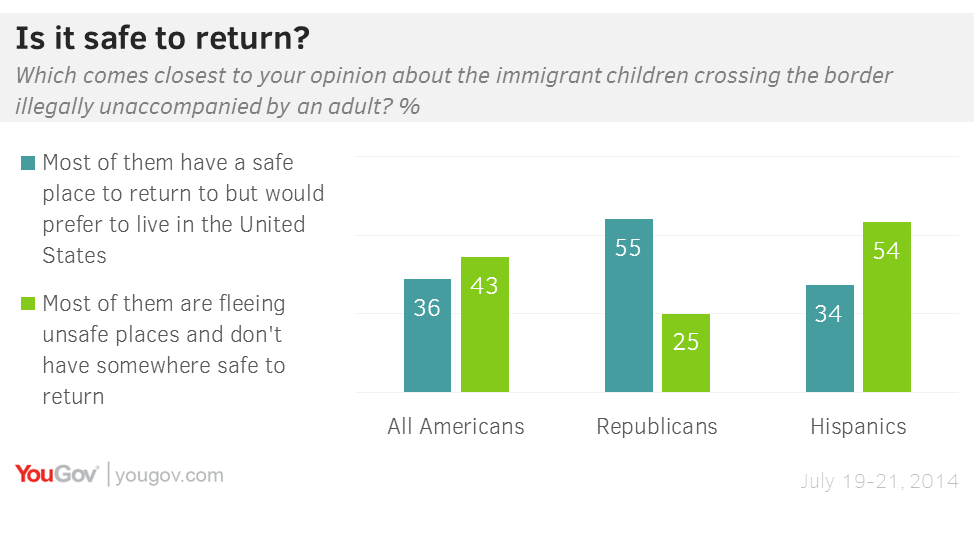
While most say they have at least some sympathy for the children, a majority of Republicans reports little or no sympathy. More than three in four Hispanics say they are sympathetic, and a majority of Hispanics report “a lot” of sympathy for the children. That reflects the large differences in these groups in how they judge the children and their motivations in coming to the United States. Overall the country is closely divided on whether the children now coming to the United States illegally are fleeing unsafe situations in their home country or have safe homes but would just rather live in the United States. Republicans see the children as coming from safe places; Hispanics, and a plurality of the public overall, do not.
This apparent nativist turn augurs poorly for the GOP, Molly Ball believes:
In the past, contrary to popular belief, support for immigration reform has seldom been toxic in Republican primaries. (A notable exception came four years ago in Georgia, when Nathan Deal ran to the right on immigration on the way to winning his gubernatorial primary and the governorship.) But the current crisis on the border has inflamed the perpetual hot-button issue, particularly among the vocal minority of the Republican base for whom the only acceptable “reform” is mass deportation. And candidates like [David] Perdue are exploiting the issue as a wedge.
That’s bad for immigration reform, which was already stalled largely because of House Republicans’ fear of just this sort of political backlash. And it’s probably bad for the long-term prospects of the Republican Party, whose elites are convinced its future national success rests on increasing its share of the Hispanic vote—a process they believe must start with passing immigration reform. Here’s a representative take from Tom Donohue, president of the (100 percent, openly pro-amnesty) Chamber of Commerce: “If the Republicans don’t do it, they shouldn’t bother to run a candidate in 2016,” he said in May.
But George Will wants to welcome the child migrants with open arms and make them into Americans:
I’d like to second the motion. If America cannot find a place for children fleeing terror and crime and violence, then America is no longer America. Hugh Hewitt, to his great credit, put forth a similar proposal earlier this month. Will and Hewitt may be on to something, Zach McDade explains, because children of immigrants now make up the majority of American children:
It’s a demographic fact that gets surprisingly little attention—the fact that, if not for immigrants and their children, the U.S. child population would be shrinking. There are more than 17 million children with at least one immigrant parent in the U.S. They represent over a quarter of the 70 million people under 18 years old. Their proportion will grow over time, as the number of children born to non-immigrant parents declines—in both relative and absolute terms.
This matters, because today’s young people make up tomorrow’s productive workforce, generating economic activity and supporting retirees. We already face a declining young-to-old population ratio, putting huge strain on Social Security and other safety net programs. The children of immigrants will provide a crucial and growing buffer against this demographic shift.
In response to the NYT’s pro-pot announcement, Nate Silver calculates that around 77 percent of Americans who fit the NYT editorial board’s demographic profile support legalization:
[P]eople with this demographic profile are somewhere around 25 or 30 percentage points more supportive of marijuana legalization than the average American. That implies that back in 2000, when only about 30 percent of Americans supported legalization, perhaps 55 or 60 percent of these people did. The margin of error on this estimate is fairly high — about 10 percent — but not enough to call into question that most people like those on the Times’ editorial board have privately supported legalization for a long time. The question is why it took them so long to take such a stance publicly.
And if you want to know why no one watches Meet The Press, check out their boomer pundit-fest above in which they could find no proponent of legalization at all, along with the familiar condescension and dated “jokes”. Nate’s too right that “there’s a particularly large gap between elite and popular opinion on marijuana policy”:
Consider that, according to The Huffington Post, none of the 50 U.S. governors or the 100 U.S. senators had endorsed fully legal recreational marijuana as of this April — even though some of them are very liberal on other issues, and even though an increasing number of them represent states where most voters support legalizing pot.
Perhaps some of this is smart politics — older Americans are less likely to support marijuana legalization and more likely to vote. But there’s also a more cynical interpretation: racial minorities, low-income Americans and young people are disproportionately more likely to be arrested for marijuana offenses than senators or newspaper editorial board members (or their sons and daughters). The elites may be setting the policy, but they’re out of touch with its effects.
Update from a reader:
Like you, I wholly believe that we shouldn’t shy away from disturbing images and videos when they’re reporting things that have actually taken place. But for God’s sake, did you have to post that horrible, terrible, terrifying, nauseating video? I’m speaking, of course, about the cadre of grey-haired idiots debating pot legalization on Meet the Press, a program I swear to God I forgot existed.
So, c’mon, trigger warning next time? Something simple, like, “Warning: this video may cause you to vomit all over yourself uncontrollably.”
You know what’s good for nausea? Another reader gets serious:
That MTP clip is unreal. If I were the father or son or spouse of one of the millions of marijuana users whose life has been irrevocably ruined by The War On Drugs and I saw those comfortable Beltway insiders having a silly pun-fest while wondering what the rush is on legalization, I would probably have thrown my laptop out the window in anger and disgust. Fuck them.
The outbreak is unprecedented both in infection numbers and in geographic scope. And so far, it’s been a long battle that doesn’t appear to be slowing down. The Ebola virus has now hit four countries: Sierra Leone, Guinea, Liberia, and recently Nigeria, according to the country’s ministry of health. The virus — which starts off with flu-like symptoms and often ends with horrific hemorrhaging — has infected 1,201 people and killed an estimated 672 since this winter, according to the numbers on July 23 from the World Health Organization.
Dish alum Gwynn Guilford is alarmed by the spread of Ebola to Lagos:
So far, Ebola has been confined to Guinea, Sierra Leone, and Liberia—war-torn and largely rural west African countries. But Lagos is different; not only is it Africa’s biggest city, with 21 million people. It’s also one of the world’s most densely populated. And perhaps scariest of all, it’s a center for international travel—meaning that if it’s not contained, the virus could easily go global. [Patrick] Sawyer’s was the first-ever recorded case of Ebola in Nigeria, according to the Nigerian Tribune.
So far, the Nigerian government’s efforts to contain it inspire little confidence.
The Bloomberg editors call for a Pan-African response to the outbreak:
There is a reservoir of talent elsewhere in Africa — the doctors, nurses, epidemiologists, lab technicians and administrators in Uganda, Republic of the Congo, Democratic Republic of the Congo and Gabon who have been through this and know how to handle Ebola. By organizing teams of them to help with the current epidemic and pass their skills on to their counterparts in Guinea, Sierra Leone and Liberia, the World Health Organization could establish a pan-African partnership that central and east Africa could, in turn, rely on down the road.
International donors such as the U.S. and the European Union could help fund and provision the African teams. They could enlist the help of international mining companies present in Guinea, which have certainly extracted value from these countries and have both a humanitarian and an economic interest in stability and ending the epidemic.
Ishaan Tharoor finds that one “of the continuing challenges is getting local populations to abide by the edicts of government authorities and foreign health workers.” A reason this has proven difficult:
The hysteria caused by the spread of Ebola has led also to the spread of rumor and conspiracy theories. Angry crowds have accused foreigners of bringing the virus in their midst: In April, the threat of violence forced [Paris-based medical NGO] MSF to evacuate all its staff from a treatment center in Guinea. In Sierra Leone, which has the largest number of Ebola cases at present, thousands protested over the weekend outside the country’s main Ebola treatment facility in the eastern city of Kenema.
Police had to disperse the crowd with tear gas and a 9-year-old was injured in the leg by a police bullet, Reuters reports. The demonstration was sparked, the news agency claims, by a rumor spread in a nearby market that the disease was a ruse used to justify “cannibalistic rituals” being carried out in the hospital.
Abby Haglage explains that a “full 42 days (double the potential incubation time of the disease) without any new infected are needed before the CDC can declare the outbreak officially over”:
“The concern is the outbreak can be reseeded much like a forest fire with sparks,” says [Stephan] Monroe [of the CDC]. “Until we can identify and interrupt every chain of transmission, we won’t be able to interrupt the outbreak,” he says, reinforcing the need to track those who may have come in contact with carriers. “Until we get all the fires put out, there’s still a possibility that it will reignite.”
Yesterday, Virginia’s marriage equality ban bit the dust. Burroway charts the progress of the gay rights movement:
Emma Green explains what makes the VA ruling stand out:
The question of “rights” is exactly what makes this decision significant, said Claire Guthrie Gastañaga, the executive director of the American Civil Liberties Union of Virginia. Unlike some other cases on same-sex-union laws, Bostic examines whether couples have a fundamental right to marriage. The judges applied strict scrutiny, the highest standard of legal review, under which the government has to show a compelling interest for limiting the plaintiffs’ ability to marry. “This court says very clearly: This is a fundamental right, and the government just didn’t meet their burden of explaining why there should be a [ban on] same-sex marriage,” Gastañaga said.
Dale Carpenter observes that the ruling referred to the ban as a form of “segregation”:
The idea that laws limiting marriage to opposite-sex couples are a form of segregation is historically loaded, especially for a court sitting in the heart of the old Confederacy. Analogies to the black civil rights movement, and in this context specifically to anti-miscegenation laws and second-class status, have become a staple of gay-rights political and legal arguments. Rarely have they gained quite this explicit an endorsement from a prominent court.
Mark Joseph Stern describes the striking down of Virginia’s gay marriage ban as “the latest victory for marriage equality in a unbroken string of triumphs since the Supreme Court overturned DOMA in 2013.” On what the opinion could mean for other states:
Although the court struck down only Virginia’s marriage ban, the 4th Circuit also has jurisdiction over Maryland, West Virginia, South Carolina, and North Carolina. The latter three states still ban gay marriage—but today’s ruling throws those laws in serious jeopardy.
Two Israeli government officials told The Daily Beast that Israel could not agree to the Kerry draft proposal because it felt it would constrain the Israeli Defense Forces from finishing their mission to destroy the tunnels in Gaza. Yet Kerry’s proposal explicitly did not include a call for the IDF to withdraw from Gaza during the ceasefire. What’s more, U.S. officials told the Israeli government that tunnel work would be able to continue during the ceasefire, as it had during the previous short-term pauses in the fighting.
The Israeli government was not confident the IDF would be able to continue tunnel destruction inside Gaza during the ceasefire. The officials in Jerusalem were not willing to commit to any timeline for completing the tunnel mission because they were still discovering the extent of the tunnel network and thought the mission could take as long as three weeks to complete.
Saletan considers that demand a reasonable one, given the extent of Hamas’ tunnel complex:
One possible compromise might be a cease-fire that forbids further IDF movement in Upper Gaza but allows the IDF to continue demolishing Lower Gaza. No more tunnel hunting on the surface, but you can finish imploding the bunkers and passages you’ve already found. Both armies would object, but civilians on each side would be protected. If Hamas refused the deal, the IDF would keep moving through Upper Gaza to hit Lower Gaza. Israel would have to be held accountable, to make sure it respects the distinction and pulls out expeditiously.
In the longer term, each side needs more. Gazans need reconstruction aid, open borders, and autonomy. Israelis need an end to rocket attacks. All of these goals could be served by destroying the tunnels and weakening Hamas.
So what then could possibly explain the foul insults that senior Israeli officials leaked to the press? The proposal was a “strategic terror attack?” Jon Stewart noticed the contempt last night (see above), and he’s not the only one. You’d think the Israelis might have some appreciation for, say, the Iron Dome, which was made possible in part by Obama’s initiative and millions of US aid. But nah. The more US money the Israelis get, the more contempt they exhibit toward the US. Adam Taylor rounds up some of the commentary:
On Sunday, Ynetnews the English-language Israeli Web site of Israel’s most-read newspaper, Yedioth Ahronoth, published an article titled “Obama’s wars on Israel.” The author, Guy Bechor, also singled Kerry out:
This isn’t the first time Kerry is caught smiling at Israel while inciting against it behind the scenes. But not just towards Israel. This is also a betrayal of the moderate axis of the Middle East – Egypt, Jordan and Saudi Arabia – as well as encouraging and rewarding jihadist terror, and a betrayal of all the real American values.
At the Times of Israel, a Web site that boasts of its independent politics, analyst Avi Issacharoff wondered if Kerry was “merely naive,” or if the United States was now aligning itself with the Muslim Brotherhood.
Apparently in response to Israel’s conniptions, the US declined to veto a “presidential statement” from the UN Security Council demanding an immediate ceasefire:
A U.N.-based European diplomat … said Washington’s move was “an expression of discontent” and a signal that the United States might be willing to go further in taking action against Israel than before. It was the first time that the U.N. Security Council had taken a formal action on the Israeli-Palestinian conflict since January 2009, when George W. Bush’s administration abstained on a resolution calling for a “durable” cease-fire to pave the way for Israel’s military withdrawal from Gaza. At the time, U.S. Secretary of State Condoleezza Rice said the United States essentially agreed with the goal of that resolution, which was supported by the council’s other 14 members, but that U.N. action threatened to harm mediation efforts in Egypt to resolve the crisis.
More, please. Keating sees a faint glimmer of hope – maybe:
I suspect that some of the anger being directed at Kerry is just deflecting attention from the fact that the two sides have what still seem to be irreconcilable demands. Kerry’s dialogue with Qatar and Turkey began only after Hamas rejected an earlier, Egypt-backed proposal. If Kerry had stuck with pushing the Egypt plan, he might have avoided becoming a punching bag in the Israeli media over the weekend, but it likely would have been equally useless in terms of the goal of stopping the bloodshed.
The only good news is that even without much chance of a permanent cease-fire, the two sides do seem to be putting out signals about de-escalating the conflict, though they haven’t been on the same page about the timing and terms.
Skepticism is not nihilism. It doesn’t posit that there is no truth; it merely notes that if truth exists, it is inherently beyond our ultimate grasp. And accepting those limits is the first step toward sanity, toward getting on with life. This is what I mean by conservatism.
I am a lifelong liberal, perhaps for genetic reasons (as some recent studies have proposed), but most certainly because conservatism in America has, as you say elsewhere in your piece, degenerated into reactionary, xenophobic, fundamentalist, hate-inspired lunacy. So, yes, I am a lifelong liberal (also because as a gay man, now in his seventies, the liberal left always seemed to me to be more favorably disposed to accepting me and our kind, though slowly and reluctantly.)
But I tell you, I heartily and wholeheartedly agree with your statement. So I guess I’m a conservative too, at least one of your kind. Can you confess that maybe you’re a liberal too? The progressive objection to the way of Montaigne?
I haven’t met a leftist ideologue who thought there were “true” solutions since the sixties. You, fighting leftist gays when you were arguing for gay marriage and they were for rejecting your “virtually normal” ideas, may have soured your views of the left, but believe me, there were millions throughout the country who just wanted their rights, to be as lawfully legitimate as our heterosexual brothers and sisters. And we have prevailed, spectacularly.
The key here, it seems to me, is understanding conservatism as a disposition rather than as a fixed ideology. That suggests, of course, that it might pragmatically express itself, at times, as a form of political liberalism as we understand it.
One of the aha! moments I had in reading Oakeshott (who was deeply influenced by Montaigne) was when he actually described progressivism as an integral part of the Western conversation – one that a true conservative would not seek to extinguish, but rather respect and nurture. The genius of the modern European state was that it contained two core impulses – collective action and individual liberty – and the conservative mission was to find the right balance between them, at the right time, with a little preference for liberty.
That requires prudential judgment and a light, pragmatic touch. Oakeshott’s vision of the conservative politician was a “trimmer” – someone who trims the sails on a ship to exploit the current winds and weather. The point is merely to keep the ship afloat – not to reach the perfect desert island or to conquer distant lands, but for the sake of the coherence and steadiness of the whole. And when you look at Montaigne’s own political predilections, he fits smack dab in the middle of just such a disposition.
Bakewell, in How To Live, vividly brings to life the era of zeal and religious conflict that Montaigne lived in.
It was like Iraq in the last decade, the bodies piled high from sectarian murder and chaos and fanaticism and hatred (see the depiction of the Saint Bartholomew’s Day Massacre above). The human atrocities wrought in the name of ultimate truth and personal salvation beggar belief. And throughout it all, despite being enmeshed in politics at times, Montaigne kept his independence and perspective and balance. Bobbing and weaving between Protestant and Catholic, and finding the extremism of both distasteful, he homed in on the key failing of his time:
Our zeal does wonders when it is seconding our leaning towards hatred, cruelty, ambition, avarice, detraction, rebellion. Against the grain, toward goodness, benignity, moderation, unless as by a miracle some rare nature bears it, it will neither walk nor fly.
He embraced moderation as a way of life:
The most beautiful lives, to my mind, are those that conform to the common human pattern, with order, but without miracle and without eccentricity.
He sought ordinariness, acceptance of reality (including the reality of one’s own nature), an aversion to heroism and conquest, and the long view of human affairs (he was, after all, dependent for much of his learning on men who lived thousands of years before). That’s partly why he was derided by some as a “politique“, which translated pretty much to Oakeshott’s notion of the “trimmer.” And what motivated both Montaigne and Oakeshott was a preference for “present laughter” over “utopian bliss”. Yes, reforms may well be necessary; yes, there are times for collective action; but a political regime that leaves people alone in their consciences and allows us the task of ordinary living is the best regime. In that sense, Montaigne was stranded in the wrong country. While France was convulsed with the blood of religious conflict, England was benefiting from that very politique Queen, Elizabeth I.
As for our time, an attachment to a fixed ideology called conservatism (which is currently suffused with the zeal and passion Montaigne so deeply suspected) or to an ideology called progressivism (which increasingly regards most of its opponents as mere bigots) does not exhaust the possibilities. A disposition for moderation and pragmatism, for the long view over the short-term victory, for maintaining the balance in American life in a polarized time: this remains a live option. You can see how, influenced by this mindset, I have had little difficulty supporting a Democratic president as the most conservative figure, properly speaking, now on the national stage. You can see why I have become so hostile to neoconservatism whose unofficial motto is “Toujours l’audace!” And you can see why, after an important reform like marriage equality, I am deeply suspicious of those on the left seeking to remake society in its wake and to obliterate bigotry in our time.
Another reader writes:
Reading PM Carpenter‘s entry into the Montaigne discussion, the ending thought jumped out, as it did to you probably.
“So what of my underlying if not uneasily irrepressible socialism? What of Sullivan’s conservatism? In effect they’re indistinguishable, which is somewhat mind-blowing. But then again, so was Montaigne.”
It made me immediately remember a passage from Eric Hobsbawn, who has a thing or two to say about how to live and how to doubt. This is from The Age of Extremes: The Short Twentieth Century:
It may well be that the debate which confronted capitalism and socialism as mutually exclusive and polar opposites will be seen by future generations as a relic of the twentieth-century ideological Cold Wars of Religion. It may turn out to be as irrelevant to the third millennium as the debate between Catholics and various reformers in the sixteenth and seventeenth centuries on what constituted true Christianity proved to be in the eighteenth and nineteenth.
I’m addicted to your weekly window contest. It is challenging, fun, and a great distraction. But there might be more practical uses for the skills involved in solving the contest. Recently, several bloggers have been using a photo posted on Twitter to figure out where the BUK missile system that Ukraine’s Russian separatist rebels had misplaced has been traveling. KoreaDefense.com has this post explaining how it and other bloggers found the location.
Another reader turns to the difficulty of this week’s missile-less contest:
Earth has two hemispheres, and this view is clearly on one of them. Seriously, the EU license plates (and I should know better than to get fixated on license plates) and French vehicles had me checking every remaining Western Hemisphere colonial enclave, before finally deciding that those white buildings = Portugal. So Lisbon, and it’s wrong. When it turns out to be Morocco I’mma throw something.
Another aims south of the border:
Hoping proximity counts on this one. I cannot pinpoint the city, but it is very reminiscent of Playa del Carmen in Quintana Roo, Mexico.
Or farther south?
Quito, Ecuador. It looks like the old city, perhaps on or near Guayaquil.
Another must live in New York:
No idea, but it looks like you could eat off that street; it’s so clean!
Another:
Had to be in the south of France somewhere. I looked up the last few stages of the Tour de France and decided this must be Maubourguet, starting point for stage 19. But it could easily have been somewhere else in the south: Nice, or Cap d’Antibes, or something like that. Beautiful light.
Getting there. Another reader:
This is my very first entry for the VFYW contest. I saw English words, European traffic signs, and Mediterranean style roofing slate. I googled “English speaking Mediterranean countries” and came up with Gozo, Malta. Then I got lost in all the gorgeous photos of the land and art and couldn’t be bothered to track down where the photo was taken. I randomly chose Victoria because it’s in the center of the island and “Victoria Gozo Malta” sounds goofy when you say it out loud. I don’t know if I’m even close, but it was worth it for the photo tour alone.
The Mediterranean it is. Another reader nails the right country with this exhaustive entry:
Spain.
A more detailed response:
All I know for sure is, it’s one of the White Towns of Andalusia, Spain. Ronda seems as good a guess as any:
(1) Googled “Tourneo” (back of the white car/van): said it’s a Ford model used mainly in Europe.
(2) Looked up the formats of European license plates by country; the only match was Spain.
(3) Googled “Spain red tiled roofs” and found lots of stuff about the White Towns of Andalusia.
From there I was stuck. The sign in the foreground appears to be for a restaurant. It’s hard to tell what the second row of the sign says: begins with a C or G, and the third letter is probably Ñ. I went through an enormous list of restaurants in Andalusia on TripAdvisor, found some possibilities, but came up empty.
Andalusia was this week’s most popular incorrect guess:
EU license plates, looks to be on or near the Mediterranean, most likely in a country where the word for “restaurant” starts with “R-E-S-T”, which is basically all of them except Italy and Malta. The two readable license plates are in the four digit, three numeral format which is apparently unique to Spain.
I recently spent two lovely weeks in Barcelona, and only really ventured briefly out of the city to Girona and Figueres. This isn’t Barcelona (the sidewalks are too narrow, the streets too wide) but it could be one of the other two, or any of dozens of other small cities in Spain. But I’m actually inclined to say that this isn’t likely anywhere in Catalonia, because there are no Catalan flags to be seen, and I saw them EVERYWHERE when I was there.
Is this one of the famed “White Towns” of Andalusia? It sure looks like it. But which one? The fact that we have a fairly modern street (asphalt, not cobblestones, wide enough to park cars on both sides, and in a fairly grid-like configuration) may narrow it down a bit to the larger towns. And the convergence of opposing one-ways onto another street seems a pretty unusual configuration. That should be easy to spot … but it isn’t.
I’m liking Ubrique, for its size and layout, and the surrounding landscape looks right. But I can’t quite seem to nail this one down. Algodonales looks exactly right for the surrounding landscape, but again, I can’t seem to find the exact spot. Ditto Grazalema. And Prado del Rey. So, I’m going to go with my gut and stick with Ubrique.
No matter: browsing the White Towns on Street View was a great deal more enjoyable than looking at Sports Authorities in the Northeast! And I really need to get back to Spain.
This one is driving me crazy! The truck in the foreground has Spanish plates but all the signs are in English. This makes me think the most obvious place would be Gibraltar. After rooting around in Google maps I found similar looking road signs, and the architecture seems like a fit, but I can’t for the life of me find a road that matches the one pictured. So I’m just going to have to say Gibraltar somewhere off of Main street. Although I’m sure I’m off by miles and that this is some obvious yet obscure region that several Dishheads will have vacationed. Tuesday can’t come fast enough!
The best incorrect entry we received this week:
Since today is national dance day in the US and I just this afternoon read that Father “Pepe” Jose Planas Moreno dances the sevillanas with his parishioners at his church in Campanilla in the Malaga district of Spain (seen below) – I’m going with that town. I wish I had time to delve more deeply into the search but will be seriously happy with myself if I’m this close to correct!
But this reader correctly identifies the type of Spanish land mass we’re looking for:
This week’s contest is massively frustrating, I’m haunted that I am missing some clear clue as to the location. For a while I was stuck on the French Riviera, based on the white houses, red roofs, and appearance of the stop sign. But I eventually started investigating the licenses plates and found that 4 digit/3 letter combination is unique to Spain. But I couldn’t find anything else in the image to focus my search.
After looking at Pamplona (given the recent running of the bulls) and not finding any likely hits, I went further afield. It appears that the Canary Islands are rife with one-way streets, occasionally have the word stop printed along crosswalks, has a predilection for green shutters, and has a terrain that may match the background. But zooming around the islands in maps and street view hasn’t helped in isolating the location. For some reason, I still feel strongly that the Canary Islands are it, so I’m guessing Santa Cruz de Tenerife, prepared to find out that I missed some obvious hint and that the location is actually on the mainland in Spain.
Yes, an island, but the Canaries are much too southwest. Another reader starts paddling us in the right direction:
I’m sure that there are contributors with hi-res screens who can read a phone number on what looks like a restaurant menu posted on the left, but all I have to go on is a Citroen sedan with a Euro-style plate. Having Googled the number/letter sequence I’ve narrowed it down to Spain. And with the Mediterranean look of the buildings I will make the wildly general guess of Ibiza, Spain.
Another gets closer still:
Last week’s Sherlock Holmes here. I’m going to play the game like I play GeoGuessr. In GeoGuessr you can, if you want, travel in the scene until you get to a place where there are clues to where the picture was taken. Instead, I usually try to go solely on gut, and whatever clues are in that frame and only in that frame.
With this VFYWC, I could spend hours googling “red tile roof” or try to find out what countries the Ford Tourneo is sold in. (If that’s even the right model of the mini-van in lower right of this week’s view.) I could invest the rest of this lovely Saturday searching for that white “R” on a red background to see if I can figure out if it is associated with a specific location.
Instead, I will once again go with my gut and say Mallorca, Spain. The cars look European – where else do they still sell Citroens, after all? The license plates are from the EU, I think. Plus, the scene has sort of an island feel to me. The red tile roofs feel Spanish. So, Mallorca.
I realize I’ll never win the book this way. But life is filled with disappointments.
A former winner almost got the right island but veered away at the last moment:
The house is a cheap-looking Spanish colonial with a Mediterranean color scheme. It appears to be an old farm (olives or wine ?) with several buildings that has been converted to apartments. I deduce that from the exterior wall connected them and the lack of a balcony on the building on the right. Also, there is an old stone horse trough that’s being used as a planter, but possible it was previously used for actual horses or as a water reservoir to clean the olives or grapes. So based on the horse trough I am narrowing my search to Spain, Portugal, or nearby islands, where horses were common. It looks like water in the background, so I am guessing that’s the ocean. I can’t imagine unpaved rundown apartments being that close to the ocean – at least not in mainland Spain or Portugal.
So how about Mallorca, or Minorca or one of the Balearic Islands? Possibly, but the color scheme doesn’t fit, and the those islands have mostly hipped roofs or higher pitched roofs and brighter colors.
However, Madeira does have some dull colored unpaved properties close to the water with hilly populated areas visible from a window – specifically Funchal, Madeira, Portugal. Wish I could make out the three numbers above the exterior doorway, but I only participate by iPhone with no access to photo enhancement. So my guess is Funchal.
In case there was ever any doubt, this week’s contest definitely proves why Chini is the VFYWC Grand Champion; he was the only player to get the correct town, let alone the exact location and window:
Aw man. Last week, when I had free time, the view was dead simple. Then this week we get a good one and I’m swamped getting ready for a two-day trip. So I had to be selective with my time, but what to focus on? The license plates were Spanish, clearly, but what next? The hills in the distance? The street markings, the architecture? It was almost too much to pick from, until I remembered a similar view from last summer. And then the path became clear …
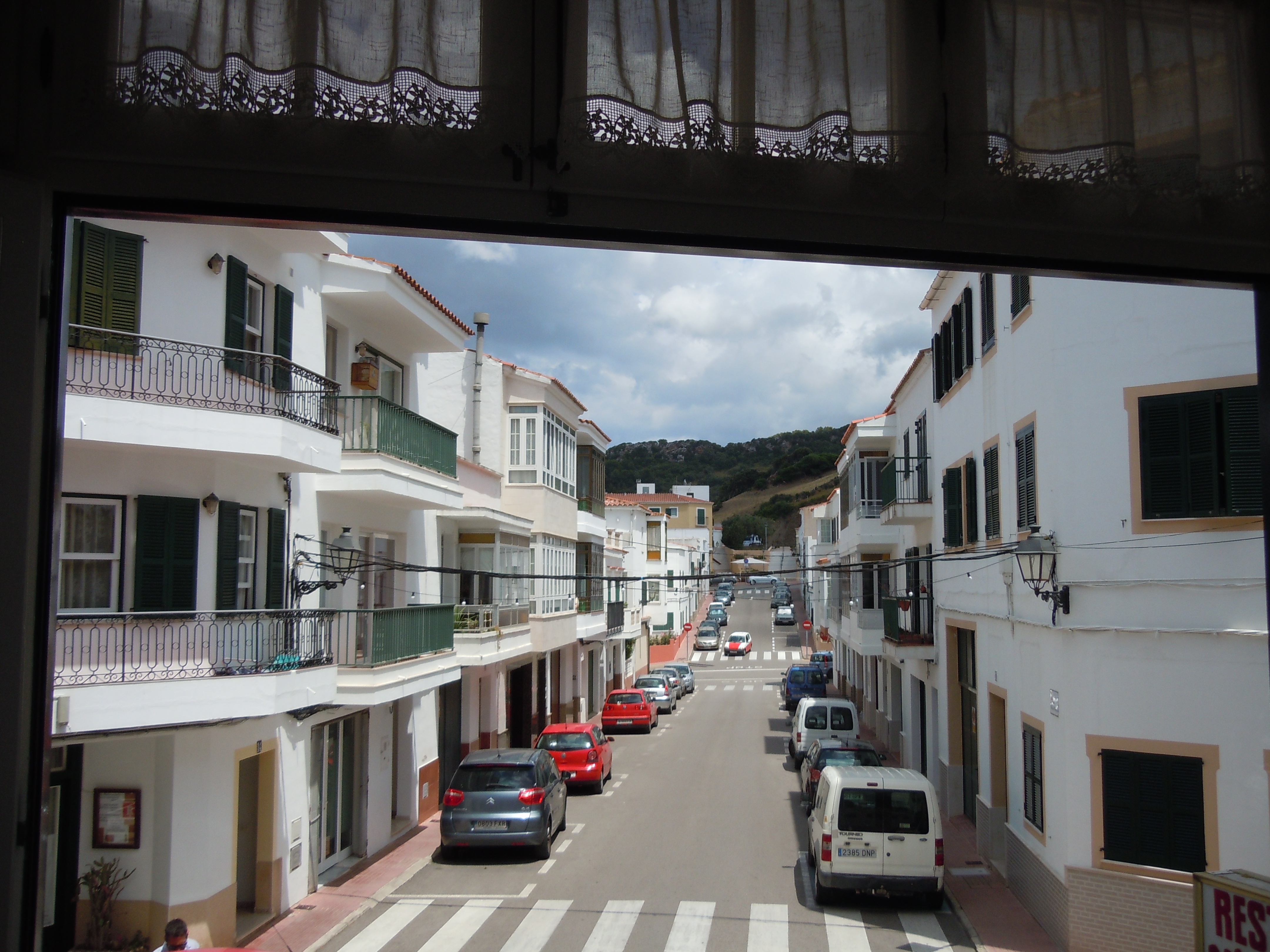
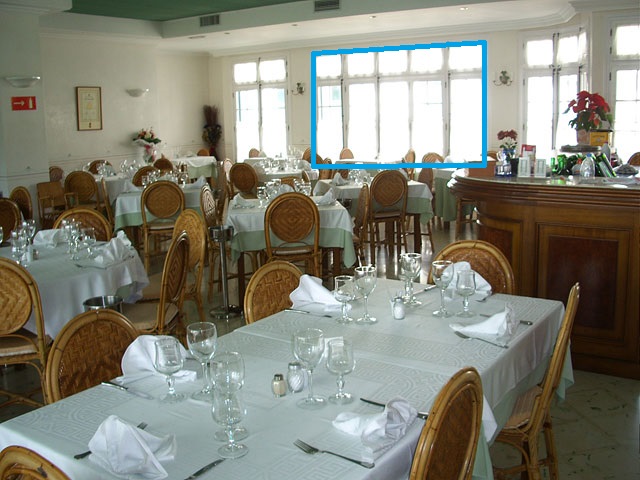
This week’s view comes from the town of Es Mercadal on the island of Minorca, Spain. More precisely, the picture was taken from the front dining-room windows of the Restaurante Ca N’Aguadete and looks east northeast along a heading of 71.92 degrees towards El Toro, Minorca’s highest point.
Respect. This week’s winner was the only other reader to correctly identify the island:
Well, looks like for the second time in around a month living in Spain is having its advantages for this contest. The plates are Spanish. An eagle-eyed reader might be able to get the “E” as the country code on the plate, but the 1234 BCD format is how things have been done here since around 2000. This leads to the key clue to be found on the red Seat Ibiza. Prior to the current format there was a province code followed by 4 numbers and one or two letters. The Ibiza, quite aptly, has the code IB for “Islas Baleares” meaning we are looking at Menorca, Mallorca, Ibiza, or Formentera.
I have been driving myself crazy trying to figure out what town it could be, though. There is terrain, but not big enough mountains to be Western Mallorca. A particular style and abutting one way streets. Perhaps not even Balearic islands at all and the number plate is a red herring.
Either way, I just don’t have it this week, but I will go with my gut of the towns I looked at and say it’s Ferries, Menorca. Wish I could get an exact window, but not this time.
Close enough for a win. From the submitter:
I’m thrilled you chose the photo, my first submission. It’s from the second floor (European “1st”) of Restaurant Ca N’Aguedet, Carrer Lepanto 30, Es Mercadal. We shot the image from just to the right of the perpendicular “restaurant” sign that’s just visible in the picture.
We were in Menorca to celebrate a significant birthday of mine and because my husband had lived in the capital, Mahon, as a child. The restaurant, where we ate on a friend’s recommendation, is outstanding; its chef is dedicated to reviving and preserving traditional dishes of the island.
Thanks so much to the more than 70 readers who challenged themselves with this week’s contest, including many stumped veteran players. Here are everyone’s guesses on the OpenHeatMap, a cool app created by Dishhead Pete Warden:
This embed is invalid
And for our newer players, don’t worry – the views are rarely this hard. Until Saturday!
But one last thing: the WaPo’s indispensable Christopher Ingraham wrote to the Dish over the weekend:
Inspired in part by the VFYW Contest, Wonkblog started running a contest of sorts whereby we present a map or other visual sans labels and ask readers to identify the data behind it. This week’s installment is here; here is last week‘s and the answer post. Thought you might enjoy.
Their latest contest closed yesterday and a new one will be up this Friday at noon. Check it out, VFYW nerds.
Previous VFYWC inspiration felt by the NYT and CNN.
Manfred Mann’s “Blinded by the Light.” Very few people actually realize this song was originally written and recorded by Bruce Springsteen. Manfred‘s version is dramatically different:
Another:
I would like to nominate The Beatles cover of “Twist and Shout”, which was originally recorded by the Top Notes in 1961 and the by The Isley Brothers in 1962. The Beatles version changed the form of the original and John Lennon gives us one of the greatest vocal performances. The Beatles version has become the standard:
The Boys had the savvy to not only repeat the bridge and buildup but to parlay the latter into a slow-triplet-bound complete ending. This gives the overall thrust of the song a much greater sense of teleology, of having “arrived” somewhere; the Isleys sounds in comparison more like just static vamping.




 The Dish