A Gift To Obamacare Foes, Ctd

In 2012, Obamacare advisor Jon Gruber said, “if you’re a state and you don’t set up an exchange, that means your citizens don’t get their tax credits,” an interpretation of the ACA that supports the anti-Obamacare Halbig ruling. He made this point more than once. Nicholas Bagley dismisses the fracas over these comments:

[I]f you think what Gruber said is some evidence about what the ACA means, you can’t ignore other, similar evidence. That’s cherry-picking. So go ask John McDonough, who was intimately involved in drafting the ACA and is as straight a shooter as there is: “There is not a scintilla of evidence that the Democratic lawmakers who designed the law intended to deny subsidies to any state, regardless of exchange status.” Or ask Senator Max Baucus’s chief health adviser, Liz Fowler. She says the same thing. Or ask Doug Elmendorf, the current CBO Director: “To the best of our recollection, the possibility that those subsidies would only be available in states that created their own exchanges did not arise during the discussions CBO staff had with a wide range of Congressional staff when the legislation was being considered.” …

Better still, ask the states, which were on the receiving end of the supposed threat. According to a report from the Georgetown University Health Policy Institute, there’s no contemporaneous evidence that the states feared that declining to set up an exchange might lead to a loss of tax credits. How can it be that Congress unambiguously threatened the states with the possible loss of tax credits if the states never understood that threat?

How Ezra views this controversy:

Gruber’s comments aren’t getting so much attention because anyone actually believes them. They’re getting so much attention because some people want other people to believe them.

It would be much simpler if the argument about Obamacare could simply be about what it’s actually about: some people believe the Patient Protection and Affordable Care Act is a good law. Others believe it’s a bad law and they would like to see it repealed.

The problem is that the people who believe it’s a bad law haven’t won the elections necessary to repeal it. So they’ve turned, in desperation, to the courts. But the Supreme Court doesn’t strike laws down for being bad. It strikes them down for being unconstitutional, or incomprehensible. And that’s forced Obamacare’s critics to make some very weird and very weak arguments.

Adrianna McIntyre chimes in:

Though the controversy over what Gruber said — and what he did or didn’t mean by what he said — has been newsy and potentially embarrassing, it’s not actually very consequential, legally. Courts put much more stock in the words that Congress chose when enacting the law, and the context in which Congress put those words, than what people say about the law.

While Gruber was certainly a key advisor during the Obamacare debate, he was not a member of Congress who voted to pass the actual law. And that likely gives his words less weight than those of legislators in front of the courts.

Weigel thinks the “timing of the speech is important”:

Gruber said this in January 2012. It wasn’t until May 2012 that the IRS issued a rule, clarifying that subsidies would also be available to the states that joined the federal exchange. And it wasn’t until July 2012 that Cannon and Adler published their paper making the argument that the language of the law forbade any such mulligan for states.

But this bolsters the libertarians’ case. Gruber is acknowledged, by everyone, as an architect of the ACA. There is, to date, no evidence that he flogged the carrot/stick subsidies idea on Congress, and as Cannon writes in a piece at Forbes, Gruber has done hours of scoffing at the rationale behind Halbig. It just happens that in early 2012, when Cannon was barnstorming states to get them to avoid creating exchanges, Gruber was telling them they had better create exchanges or they wouldn’t get subsidies.

Ben Domenech celebrates:

It’s rare that a piece of video evidence comes along which, in an instant, so clearly and thoroughly undermines the case that one faction has made so consistently. I’m a little shocked myself, and interested to see how the people who’ve been calling Michael Cannon nuts for years offer their mea culpas. Because they will do that, right?

McArdle makes simular remarks:

We can draw two conclusions from this: First, the reading of the law by Halbig’s plaintiffs is clearly not ridiculous or dishonest; if it is a mistake, it is a mistake that one of the law’s chief architects could make. And second, we should be very skeptical of people who are now telling us, four years later, what the legislative intent was. Memory really is extraordinarily unreliable, and as we see here, it’s very easy to forget what you believed even a couple of years ago. This is one reason that courts ignore post-facto statements about intent and concentrate on the legal text and the legislative history.

But Scott Galupo calls the controversy “pure unmitigated cuckoo cockamamie BS”:

The cherry-picking of off-the-cuff remarks isn’t the worst thing about this absurdist drama. Take a step back: Michael Cannon, the Cato mastermind, basically went on a fishing expedition to find someone with standing in the Halbig case. His lightbulb: the average citizen has standing! And now this bombshell video: the Gruber remarks were the first and so far only piece of documentary evidence I’ve seen that anyone actually believed subsidies weren’t intended to be offered via the federal exchanges. This evidence was discovered two years after the lawsuit was filed.

Waldman piles on:

If this was actually what Congress thought the law would do, then liberals would have been freaking out about this provision for years, because it would mean that millions of people wouldn’t be able to get coverage. And conservatives would have been crowing about it for years, for the same reason. But nobody on either side was, because it was never part of Congress’s intent. It was a mistake, and one contradicted by multiple other provisions in the law.

I have no doubt that when the Halbig case is re-argued before the full D.C. Circuit, either the plaintiffs’ attorneys or one of the conservative judges will bring up Gruber’s 2012 comments. Let’s just hope it gets shot down like the baloney it is.

Inching Toward A Ceasefire?

The Gaza war continues, despite an uneasy calm during the Eid al-Fitr holiday, which began today, and renewed calls for a more permanent ceasefire. During the halt in the fighting on Saturday, Gazans assessed the damage to their homes and neighborhoods, discovering scenes like the one above:

Some Shejaiya residents had held out hope their homes would be spared only to find utter devastation. Ahmed al-Jamal, a 60-year-old grandfather, sat on a plastic chair in front of the wreckage of his home. “I had no idea it was destroyed,” he said. He stared at the floor, picking absently at a piece of wire by his foot. “I came to get my things during the cease-fire and I found nothing. I don’t know where we’ll go.”

Meanwhile, Israelis have reacted with fury to John Kerry’s proposal for a cease-fire, which includes an easing of the blockade of people and goods in the Israeli-occupied urban prison. Kerry’s crime was to include Hamas’ regional allies, Turkey and Qatar, in the negotiations, to be based on the 2012 Egyptian proposal. The president also reiterated to Netanyahu that he wanted any cease-fire to allow for a normal life for Gaza’s residents. The Israeli cabinet leaked Kerry’s proposals and leading Israeli figures could not believe what they were reading. Actual relief for Gazans? Negotiations with Hamas’ allies even as Israel is on the verge of “victory”? Here is alleged moderate Ari Shavit letting it rip:

The Obama administration proved once again that it is the best friend of its enemies, and the biggest enemy of its friends. The man of peace from Massachusetts intercepted with his own hands the reasonable cease-fire that was within reach, and pushed both the Palestinians and Israelis toward an escalation that most of them did not want … If Israel is forced to ultimately undertake an expanded ground operation in which dozens of young Israelis and hundreds of Palestinian civilians could lose their lives, it would be appropriate to name the offensive after the person who caused it: John Kerry.

What the Obama administration proved is that the US and the world would prefer not to have to keep witnessing these bloodbaths and want to get to the real roots of the conflict. It’s understandable that the Israelis simply believe that US foreign policy is about backing them and paying them for the privilege, but this administration has at least attempted to forge a policy in America’s rather than Greater Israel’s interests.

David Bernstein has a similar take on Kerry’s proposal, now backed by all 15 members of the UN Security Council:

It’s truly awful; it meets most of Hamas’s demands, and none of Israel’s. Even the left-wing Ha’aretz carries this commentary from its diplomatic correspondent: “The draft Kerry passed to Israel on Friday shocked the cabinet ministers not only because it was the opposite of what Kerry told them less than 24 hours earlier, but mostly because it might as well have been penned by Khaled Meshal (leader of Hamas). It was everything Hamas could have hoped for.”

Adam Taylor offers a less tendentious take:

To understand why Kerry’s cease-fire plan failed, it helps to understand what a “cease-fire” really means in the reality of the current Israel-Palestinian conflict. While it’s not exactly a war, the conflict has been escalating and de-escalating for years, occasionally flaring up into full warfare at points. In this context, Kerry’s cease-fire doesn’t really look like a chance for a return to peace: It looks like a break from fighting and a return to a lower, yet still uncomfortable, level of hostilities that will probably soon flare up again. Israel has targeted Gaza, with the hope of crushing Hamas, four times since the Palestinian Islamist group came to power in 2007. Even if a cease-fire is agreed on soon, a betting man might predict the two sides will be trying to reach another one in a couple of years.

That’s a big problem. Numerous public opinion polls have shown that for all the international criticism of Israel’s offensive in Gaza, it remains popular within Israel. … “Israel must be permitted to crush Hamas,” is how Michael Oren, Israel’s ambassador to the United States from 2009 to 2013, put it in an op-ed for The Post published Thursday. Reports that Israel hopes to expand its ground operation suggest that may be the way things are heading.

In any case, Juan Cole argues, a ceasefire is not enough:

Gaza is not a country, that Israel can be at war with it. It is a tiny strip of land surrounded by Israel from land, sea and air, which is kept from exporting its made goods for the most part, faces severe restrictions on imports, and therefore has had imposed on it a 40% or so unemployment rate. Some 56% of Palestinians in Gaza are food insecure. Gaza is recognized by the international community as an occupied territory, with Israel being the occupying power. If being occupied by Israel were so great, by the way, why is Gaza so badly off?

Hamas keeps rejecting any ceasefire that does not include a provision for the lifting of the siege of the civilian population. I heard the French foreign minister, Laurent Fabius, speaking after the meeting of diplomats in Paris, and he spoke about a settlement that allowed for the social and economic development of the Palestinians. What a joke! France has done nothing practical to end the blockade or allow Palestinians to develop. So a cease-fire that does not include an end to the blockade on Gaza by Israel is not a cease-fire, it is a pause in the war.

The Grey Lady Endorses Legal Weed

Over the weekend, the NYT editorial board declared that the “federal government should repeal the ban on marijuana”:

There are no perfect answers to people’s legitimate concerns about marijuana use. But neither are there such answers about tobacco or alcohol, and we believe that on every level — health effects, the impact on society and law-and-order issues — the balance falls squarely on the side of national legalization. That will put decisions on whether to allow recreational or medicinal production and use where it belongs — at the state level.

Well, now that Sarah Palin has picked the online subscription route and the NYT has embraced marijuana legalization, our work here at the Dish is nearly done. But sheesh, the whole hoop-la over there about it almost makes you think they’re ahead of the curve, as opposed to about twenty years too late. Almost twenty years since National Review endorsed it! Nonetheless, it’s not nothing:

It is worth noting this is the exact same way alcohol prohibition ended. The 21st amendment gave states the power to decide how alcohol is treated within their borders. While many states ended their own alcohol prohibitions right after some states keep their bans on alcohol going for years and even decades later. It wasn’t until 1966 when Mississippi become the last state to end its prohibition.

Hamilton Nolan needles the Times for being behind the times:

The only reason the Times gets attention for expressing this opinion is because it is the Times. This is not thought leadership. It is thought following. The Times’ endorsement of legal weed is remarkable not because we look to the Times for new or thought-provoking opinions, but because the Times is such a self-conscious, careerist, and cautious institution that if they want to legalize drugs, you know that shit is really mainstream now. It is the same sort of importance that you would attach to the Republican Party endorsing the legalization of marijuana.

Yep, there has been a sea change:

There is a shift going on in this debate, and it isn’t just that mainstream politicians and newspapers can now support legalization. It’s also that the central question of the debate has changed, and changed to what legalization advocates have been asking for a long time. Instead of asking “Is smoking marijuana good or bad?”, we’re now asking “Is marijuana prohibition better or worse than the alternative?”

The latter question doesn’t lend itself as easily to scare tactics or “This is your brain on drugs” rhetoric. And don’t get me wrong—the effect of marijuana on individuals is something we should keep talking about and researching. … But the policy debate should be about, well, policy. And policy is always about choices.

Mark Kleiman, as is his wont, wishes for a different sort of cannabis legalization:

As a matter of practical politics, our only choices may be a badly-implemented prohibition or a badly-implemented legalization.  (If so, I’m inclined to try the Devil I don’t know.)  So far, my attempts to put political and organizational muscle behind the idea of smart legalization have merely illustrated the wisdom of Ralph Yarborough’s maxim, “They ain’t nuthin’ in the middle of the road but yaller lines and dead armadillas.”  I don’t find life as political roadkill especially uncomfortable, but it does get frustrating. It’s not just that continued prohibition and commercial legalization are both bad ideas; it’s that the arguments for those two bad ideas leave no media space, or mindspace, for discussion of the good ideas that might lie between them.

The Fruits Of Liberal Interventionism

The US embassy in Libya was evacuated over the weekend:

The U.S. Embassy in Libya evacuated its personnel on Saturday because of heavy militia violence raging in the capital, Tripoli, the State Department said. About 150 personnel, including 80 U.S. Marines were evacuated from the embassy in the early hours of Saturday morning and were driven across the border into Tunisia, U.S. officials confirm to CNN.

Jamie Dettmer sees reason to believe the the embassy won’t be back to its usual operations anytime soon:

Classified documents, databases and sensitive equipment were either destroyed or taken along to Tunisia, which suggests that despite U.S. Secretary of State John Kerry’ insistence that the closing of the embassy is only temporary, Libya could be without U.S. diplomatic representation for weeks and even months.

Freddie uses the upheaval in Libya to condemn liberals who supported the Libyan intervention:

When it comes to foreign policy, American political journalists and analysts fall into two camps: those who support every conceivable military operation imaginable, and those who take a kind of tick-tock approach to warmaking, being sure to balance their rejection of one conflict with the aggressive embrace of another, in order to prove how Very Serious they are in the village that is elite political media. A potential third alternative– a profoundly necessary alternative, given the last decade and a half of American failure– is a set of pundits and journalists who recognize that military intervention is almost always a disaster for both America and the people on whose behalf our military supposedly intervenes, and who therefore oppose military adventurism and aggressive foreign policy as a matter of principle. This third alternative essentially does not exist within connected, elite media. …

Libya is in chaos. Nothing was finished. Nothing was successful. The country is broken, utterly broken. The political apparatus is in shambles. Basic governance has failed. Militias vie for control. Ordinary citizens lack any control of their country and suffer without basic services. All of this was predictable. Some of us warned as much at the time. Like me!

Hayes Brown brings us the latest developments:

A massive oil complex in Libya was set ablaze this weekend due to a stray missile, with the resulting fire quickly raging out of control. The inferno serves as a perfect metaphor for a country in which militants and militias vie with the government for dominance in a system that hasn’t managed to rebuild after years of a dictator’s rule.

For more than two weeks now, rival militias have struggled for control of Tripoli International Airport in Libya’s capital. It was in the midst of that fighting that a tanker containing more than six million liters of petroleum caught fire when a missile one of the groups launched hit it directly, according to Libya’s state-owned National Oil Corporation (NOC). Making matters all the worse, the tanker is located near an area that “contains 90 million liters of fuel and cooking gas, hence there is a risk of a huge explosion should the fire spread,” the Wall Street Journal reports an oil official as saying.

Recent Dish on the battle for Libya’s airport here.


The Lie Behind The War, Ctd

After the Israeli police spokesman gaffed to the BBC that the casus belli of Netanyahu’s latest war on Gaza was a lie – that Hamas orchestrated the murders of three teens – Eli Lake sprang into action. You can tell where Eli is coming from by his opening sentence:

Over the weekend it appeared that an Israeli official conceded something very valuable to Hamas.

Actually something very valuable to anyone trying to figure out the truth. And the worries come from people of good faith around the world not just “pro-Palestinian activists,” as Lake describes all those outraged by the Netanyahu government’s collective punishment. So Lake re-reported the news. He couldn’t get the spokesman to repeat what he had told the BBC, but then concedes:

At issue is whether or not the two Hamas suspects were acting on orders from the group’s Gaza leadership. To date no Israeli officials have asserted that.

That’s the defense?

So, to recap: an Israeli spokesman said that the teen murders were done by a lone cell without authorization from Hamas in Gaza, and with no proof of any official Hamas involvement – indeed they denied having given the go-ahead. Yet Netanyahu simply declared “Hamas is responsible, and Hamas will pay,” withheld critical information about the murder, whipped up public support, and used it to sweep across the West Bank, imprisoning hundreds of Hamas suspects – and all with no smoking gun at all. I mean you might be forgiven for thinking that Netanyahu, stung by a reconciliation between the PA and Hamas, decided to use the incident for yet another assault on the West Bank, to teach the PA a lesson, and then provoke a Hamas response from Gaza allowing him to blow the place to smithereens. None of this excuses Hamas’ war crimes against Israeli citizens. But it sure casts a darker hue to the motives in Jerusalem.

Banking On Change

The BRICS countries recently established $100-billion development bank that some say could rival the World Bank. Ali Burak Güven believes it could shake up the world of development financing:

[I]f its evolution even remotely parallels that of the World Bank, it might end up having a formative impact on economic policy-making and overall development strategy in the Global South.

To begin, while there is no shortage of national and regional development banks as well as private financiers of infrastructure projects, there is still a massive gap in development finance, estimated to be as high as $1 trillion per year. Many developing countries encountered significant financing problems during the global crisis of the late 2000s. This shortfall necessitated a surge in World Bank commitments, from an annual $25 billion in 2007 to about $60 billion in 2010. But commitments declined just as swiftly over the past few years, and as of 2013 stood at about $30 billion. Given these figures, the New Development Bank’s readily available $10 billion in paid-up capital and the extra $40 billion available upon request are not exactly pocket money for development financing.

Yet just as the World Bank was never simply a money lender, so too will the new bank represent far more than a mere pool of funds. The existing geostrategic and policy inclinations of its founding stakeholders imply a bigger role to play for the institution. In the process, it is bound to offer a formidable challenge to the World Bank’s financial prominence and so influence policy in the developing world.

Dingding Chen describes the BRICS bank as “a direct challenge” – though not a threat – to the IMF and World Bank:

Many view (here and here) the new BRICS bank as a response to the failed reforms at the IMF and World Bank as developing countries like China and India cannot increase their influence within those institutions. However, it should be kept in mind that the BRICS bank is not currently challenging the international liberal economic order. China and India are perhaps the two greatest beneficiaries of an open liberal economic order; and thus the BRICS bank should try to push the IMF and World Bank to be more open and transparent. Ultimately the competition between the BRICS bank and the IMF and World Bank should be about efficiency rather than a struggle between liberal vs. alternative economic philosophies. In this sense, there is a strong complementary relationship between the BRICS bank, the IMF and the World Bank.

Branko Milanovic wonders whether the bank can develop a “coherent ideological package to rival the Washington consensus policies”:

In their new bank, the BRICS will have a similarly cheap and useful instrument with which to wean former Third World countries off their dependence on Washington and impose their own agenda instead. The challenge will be to provide a similarly coherent ideological package to rival the Washington consensus policies of balanced budgets, currency convertibility and privatization. A shared economic and political ideology, very much present among the Western countries, from Bretton Woods in 1944 to the euro crisis now, is totally lacking among the BRICS. It is not even present in an embryonic form. Chinese economic policies and Chinese development precepts for the rest of the world (if they exist at all) have little in common with Brazilian or South African policies. In order to be really useful to its founders, the BRICS bank will have to not only learn to practice multilateralism but also define its own approach to development.

This likely lack of either procedural or economic rules for lending is the biggest threat to the BRICS bank. If its only ideology is to be anti-Washington and to do things by pure pragmatism – that is, to lend to whomever the sufficiently important members decide to support – it will fail ignominiously.

Meanwhile, Benn Steil and Dinah Walker are skeptical of the venture:

The irony is that India and China are the biggest beneficiaries of the current development bank architecture. They are the World Bank’s largest borrowers. And Brazil is number 9. … [T]hese three nations have $66 billion in World Bank loans outstanding, 32 percent more than the new BRICS bank’s entire initial subscribed capital of $50 billion. So it would appear that for the foreseeable future the World Bank will remain a considerably more important source of development financing for the BRICS than their own development bank.

Hathos Red Alert

Yes, there is now an online video channel for the former half-term governor. (Conor watches so you don’t have to.) The subscription costs ten five times the Dish’s. Not even Roger Ailes can cramp her style now. Twitter? Well … #PalinTVShows is going strong:

Update from Rob Tisinai’s Facebook page:

“The Sarah Palin Channel, which costs $9.95 per month or $99.95 for a one-year subscription…” Which will actually be 6-month subscription when she quits halfway through.

Update from the math department: I screwed up yet again on a very basic math calculation. I’m like Montaigne …

Doing Right By Dairy

Josh Harkinson considers the environmental costs of no-kill dairies:

If all dairies became slaughter-free, we’d need three to four times as many dairy cows to produce the same amount of milk, which would mean adding at least 27 million additional cows to our herds. Those added cows would each year produce greenhouse gas emissions equivalent to four large coal-fired power plants. We’d also need more meat cows to keep up with the demand for products such as veal and dog food. Pasturing all of these cows would displace wildlife or agricultural crops, straining biodiversity and increasing food prices.

Perhaps bioengineered vegan gouda is the answer?

The journey towards vegan cheese began a few years ago, when synthetic biologist Marc Juul started thinking about the genetic engineering possibilities. Now, Juul and a group of people from two Bay Area biohacker spaces, Counter Culture Labs and BioCurious, are trying to create a finished product in time for the International Genetically Engineered Machine competition – a global synthetic biology competition–in October. … In order to get baker’s yeast to produce milk proteins, the team scoured animal genomes to come up with milk-protein genetic sequences. Those sequences are then inserted into yeast, where they can produce milk protein. Once the protein is purified, it needs to be mixed with a vegan milk-fat replacement, sugar (not lactose, so that the cheese will be edible by the lactose intolerant among us), and water to create vegan milk. Then the normal cheese-making process can commence. The team wants to start with a cheddar or gouda to satisfy vegan cravings for hard cheese.

The Rise Of Agriculture

dish_verticalfarm

Tim Heath and Yiming Shao see it in vertical farming:

It has been suggested that a 30-story, 27,800,000-square-meter vertical farm could be achieved within one New York City block. That farm could feed 50,000 people, providing 2,000 calories for every person each day. With results like that as a prospect, it’s easy to see why enthusiasts see vertical farms as the future. … Vertical farms do indeed have many advantages. They would enable us to produce crops all year round using 70 percent less water. We wouldn’t need to use agro-chemicals and could avoid the adverse environmental factors that affect yield and quality in more traditional farming. And if food were grown in urban areas in the first place, we could eliminate the financial and environmental costs of importing food into towns and cities.

And in fact, we have the technology to do it:

We can already cultivate plants without soil and recycle the water used to deliver clean indoor farming, for example. Hydroponics, where plant roots are grown in nutrients dissolved in water, is one option. This plant-growing technique can be combined with traditional aquaculture to raise fish or prawns – a farming technique known as aquaponics. Another way to grow plants is aeroponics, which involves growing suspended plants by spraying the roots with a nutrient-rich water solution.

But even though it has been more than than 20 years since the concept was first proposed and the pressure of climate change continues to mount, vertical farming is still not a reality. The two biggest problems have been financial and technological viability, particularly when it comes to actually building these high-rise spaces.

Previous Dish on vertical farming here.

(Image of 4 vertical farms surrounding a couryard in a Shanghai Sustainable Masterplan model via Except Integrated Sustainability)

Flipping The Burger Biz

dish_burgerking

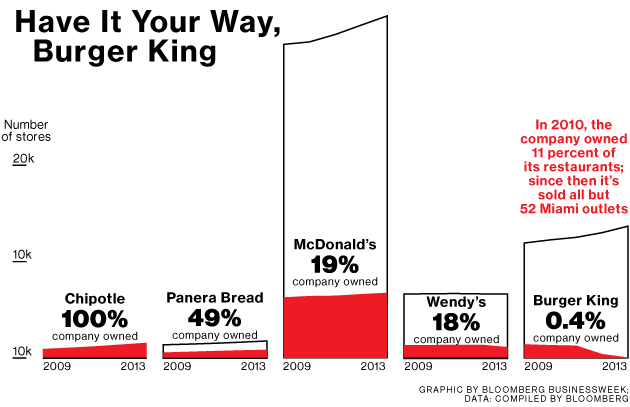
In 2010, the Brazilian private equity firm 3G Capital acquired Burger King for $4 billion. Regime change has since led to a “ferocious approach to cost reduction”:

McDonald’s owned 19 percent of its 35,429 restaurants worldwide in 2013. Wendy’s owned 18 percent of its 6,557 outlets. Historically, Burger King operated much the same way: When 3G bought the chain in 2010 it owned 11 percent of its 12,174 restaurants around the world. Since then, Burger King has sold all but 52; it keeps the last few for training executives and testing products.

That’s such a departure from the way its competitors operate that some people are questioning the company’s strategy. …

After unloading more than 1,200 restaurants, the company’s corporate head count has fallen from 38,884 to 2,425 in 2013. Now its income flows almost entirely from royalty fees from franchisees, on average 4 percent of franchisees’ monthly revenue. That’s less money than before overall, but Burger King has become a cash machine. And 3G hasn’t been shy about helping itself to some of that money. …

Wall Street has responded enthusiastically. Burger King went public again in June 2012 in an offering that put a $4.6 billion value on the company. As of early July, its market cap had risen to more than $9 billion. The doubters are in the minority now, and many in the investment community would like McDonald’s and Wendy’s to mimic the kids at Burger King. “These things are seemingly working at Burger King and causing questions to be asked about the strategy of others in fast food,” says David Palmer, an analyst who covers the restaurant industry for RBC Capital Markets (RY). “Like, why aren’t you doing what they’re doing?”