How Americans See The Border Crisis

immigration2c

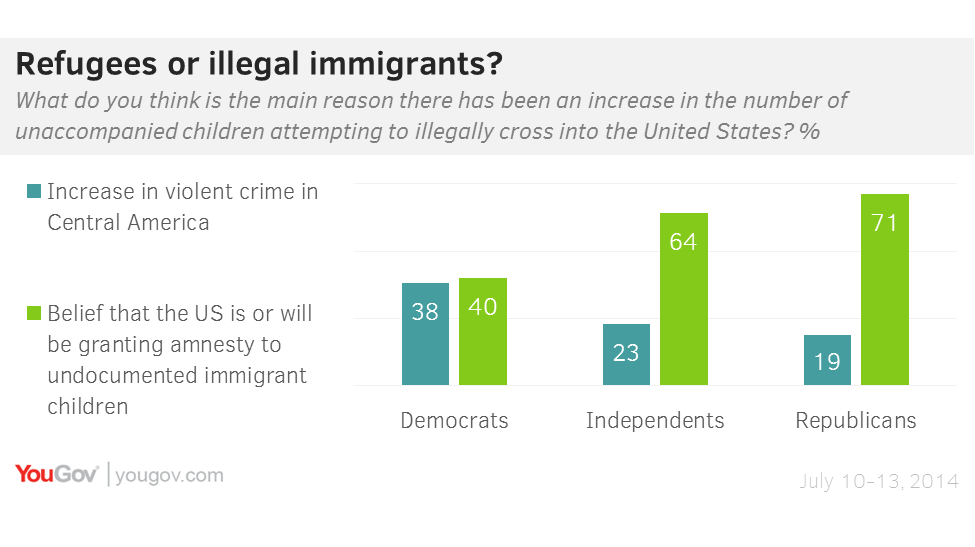
A new YouGov poll shows that more Americans attribute it to US immigration policy than to Central American gang violence:

The latest research from YouGov shows that most Americans (58%) think that the main reason behind the surge in child illegal immigration is a belief that the US is or soon will be granting amnesty to children. Only 27% think that the main cause is the increase in violent crime in Central America.

The same poll finds that 58 percent disapprove of the president’s handling of the situation and that 47 percent believe that deporting the migrant children as soon as possible should be a top priority. Dara Lind scrutinizes this last finding:

More than anything, the poll shows that Americans don’t agree on the right policy response because they don’t agree on the facts.

Americans are split on whether or not children would be safe in their home countries; 39 percent think they’re fleeing unsafe places, while 36 percent think they have somewhere safe to return. … It’s easy to look at this sort of confusion and take away the idea that Americans generally want tens of thousands of kids to be deported. The poll does show that’s true, to an extent. But that’s also because Americans are looking at the confusion in Washington and on the border and gravitating toward the option that seems most decisive — and in this case, that’s throwing more money at the border, and fast and furious deportations.

Western Values

Larison makes the case that Israel doesn’t really have such values anymore:

[Douglas] Murray … says that Israel “takes western values seriously and fights for the survival of those values,” but that seems to be almost exactly the opposite of what has been happening in Israeli politics over the last ten or fifteen years. Some of this may depend on what Murray wants to include as “Western values” and what he thinks it means to “fight” for them, but it would be fair to say that Israel under its last two governments has become increasingly illiberal domestically and even more heavy-handed in its dealings with its immediate neighbors. The occupation has become more entrenched than it was at the turn of the century, and support for a negotiated settlement with the Palestinians has dwindled significantly. If Murray is right that this is what being a “Western country” involves, then I suspect most people in the West would rather be something else.

And it’s not getting any better anytime soon. Recent research by Anna Getmansky and Thomas Zeitzoff forecasts that the political upshot of the current conflict will be to move Israel even further to the right:

In research that is forthcoming in the American Political Science Review, we use variation in the range of rockets from Gaza to Israel to estimate the effect of terrorism on voting in the Israeli elections from 2003 through 2009. During this period, the rockets’ range has continuously increased, allowing us to examine what happens to voters who come into the range of rockets from Gaza compared to similar voters who live outside that range. We find that the vote-shares of right-wing parties that typically oppose concessions to Palestinians increase by 2-7 percentage points among voters within range of rockets. We further argue that voters “reward” right-wing incumbents electorally even if rocket range increases while they are in office, because right-wing parties are perceived to be more competent in dealing with security threats. …

So what does the current round of violence mean for the future of the Israeli-Palestinian conflict following the recent round of violence? Our research as well as other studies would suggest a pessimistic outcome. Given the increase in the number of Israelis who are within the range of rockets, and the high number of Palestinian casualties, the recent round of fighting is likely to cause individuals on both sides to harden their attitudes towards each other, making a peaceful resolution of the conflict less likely.

And as Keating points out, Netanyahu is actually to the left of the most vocal members of his cabinet:

One aspect of the situation that’s gotten comparatively little attention is that hardline members of Prime Minister Benjamin Netanyahu’s Cabinet seem to be pushing the Israeli government toward a more aggressive campaign. Netanyahu is hardly pushing for accommodation, but the most aggressive political pushback he’s gotten during this campaign is from the right, not the left. Yesterday, Netanyahu fired his deputy defense minister, Danny Danon, a member of his own Likud party, for saying that the short-lived cease-fire yesterday had humiliated Israel. Netanyahu had faced heavy criticism in the Cabinet for accepting the Egyptian-proposed cease-fire, particularly from Danon, Foreign Minister Avigdor Liberman, and Economy Minister Naftali Bennett of the right-wing Jewish Home party.

Meanwhile, Yglesias flags a recent poll suggesting that neither the Israelis nor the Palestinians really want two states:

Strikingly, this conclusion that 27 percent of Palestinians and 35 percent of Israelis favor a two-state solution is likely an overstatement of the actual level of popular support. …

[T]he international community’s comforting image of a tragic conflict being driven by misguided extremists on both sides is somewhat obsolete. Mainstream opinion on both sides now shows a decided lack of enthusiasm for foreigners’ favored solution. Which by no means makes a Two-State Solution impossible — public opinion is somewhat malleable, a real peace treaty in the hand might seem more appealing than a hypothetical one, and even in democracies unpopular measures are enacted all the time. But it’s wrong to simply assume that if the current wave of violence dies down, the larger conflict will naturally proceed to resolution.

Perhaps that’s why Bernard Avishai hopes for a major American intervention in the peace talks:

What the Obama Administration seems unable to grasp, or finds inconvenient to admit, is that the peace process cannot just be paused; to say that the parties to the conflict must want peace more than Americans is to condemn them to leaders who, in the short run, benefit from conflict, and hand Americans, and everyone else, an insufferable future. Obama reiterated, this week, that the status quo is unsustainable. But what is he prepared to do about it, other than offer Kerry as a mediator? Kerry must persist in demanding a ceasefire, of course—but, if he gets one, he must seize the moment to finally publish an American plan for a larger peace.

Such a plan, endorsed by all world powers, can at least temporarily redeem Abbas’s leadership by giving hope—what Obama has called a “horizon”—to young Palestinians who, watching Gaza but not only Gaza, are thinking apocalyptically. Netanyahu says he will stop the operation when he can be assured of “quiet,” which sounds reasonable enough. But it is morally reckless to think that peace is the same thing as quiet, which can be purchased, if only temporarily, with intimidation.

Good luck. Read my take on the permanence of the Greater Israel project here.

(Update: A tweet that was briefly live on the post contained an image that was from Lebanon in 2006, not current day Gaza: “Israeli girls write messages such as “to (Hezbollah leader Sheikh Hassan) Nasrallah with love from Israel and Daniele” on shells destined for targets in southern Lebanon. Photo: Afp Ap”)

Understanding The Permanence Of Greater Israel, Ctd

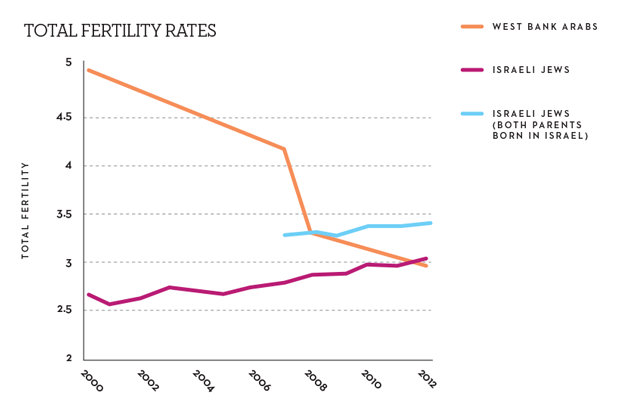
fertility-620

The great hope of many Israelis on the far right (which these days means the center) is that demography – far from forcing them to come to terms with the occupation – is actually the major impetus behind the de jure annexation of the entire West Bank. A recent piece in Tablet By David Goldman brings that into focus. Money quote:

Israel is the great exception to the decline in fertility from North Africa to Iran, as I argued in a 2011 essay for Tablet magazine. The evidence is now overwhelming that a Jewish majority between the Jordan River and the sea is baked in the cake. The CIA World Factbook estimates total fertility of Arabs in Judea, Samaria, and Gaza at just 2.83 in 2014, versus 3.05 in 2011. The total fertility of Israeli Jews, meanwhile, has risen above three children per female … Jewish immigration is consistently positive and accelerating, while Palestinian emigration, at an estimated 10,000 per year since 1967, is reducing the total Arab population west of the Jordan River.

Palestine Authority data exaggerated Arab numbers in Judea and Samaria by about 30 percent, or 648,000 people, as of the 1997 census. As Caroline Glick observes in her 2014 book The Israeli Solution, Jews will constitute a 60 percent majority between the river and the sea, and “some anticipate that due almost entirely to Jewish immigration, Jews could comprise an 80 percent majority within the 1949 armistice lines and Judea and Samaria by 2035.” Israel therefore has little fear demographically from annexation.

I’m not an expert so I cannot judge these demographic predictions. They seem somewhat dubious to me. But in some respects, that’s not the point. The point is that many Israelis, especially those in its current government, believe this scenario and at the same time see the vast upheaval in the Arab and Muslim world as a golden opportunity to achieve the radical Zionist goal from the very beginning: control of all the land between the river and the sea.

You saw this in Netanyahu’s brusque dismissal of the two-state solution as impossible because of the renewed threat of Jihadism unleashed by the Arab Spring and the Iraqi and Syrian civil wars. And that, on top of alleged demographics, is what fuels Israel’s otherwise baffling desire to settle the West Bank and East Jerusalem at the expense of any other objective. (Netanyahu was prepared to release scores of convicted murderers of Jews than remove one brick from Greater Israel’s foundations in Judea and Samaria.)

Far from encouraging the Israelis to make peace as soon as possible, the spiraling chaos in the Arab world has emboldened many to intensify and accelerate the settlements and the colonization, and to press the war against the desperate and isolated Hamas with cold-blooded dominance. Here’s how David Goldman sees it:

The inability of the Palestine Authority to govern, the inability of Hamas to distance itself from its patron in Tehran, and the collapse of the surrounding states eventually will require Israel to assume control over the West Bank. This time the Israelis will stay. Israel can’t rely on the PA to conduct counterterrorism operations against Hamas, its coalition partner. Israel’s border with the Hashemite Kingdom in the Jordan Valley, meanwhile, has become a strategic pivot. ISIS is now operating in strength at the common border of Israel, Syria, Jordan, and occupied Iraqi-Syrian border towns close to the common frontier with Jordan. Jordan’s own security requires a strong IDF presence on its western border.

When Israel absorbs Judea and Samaria—and it is a when, not an if—the chancelleries of the West will wag their fingers, and the Gulf States will breathe a sigh of relief.

The two-state solution is dead. Greater Israel is here to stay. And it’s just a matter of time before an American administration embraces it.

What The Hell Just Happened Over The Skies Of Ukraine?

https://twitter.com/varlamov/status/489804742068277248

https://twitter.com/MaximEristavi/status/489798171649114112

From the prime minister of Malaysia:

https://twitter.com/jc_stubbs/status/489818073546108929

https://twitter.com/MaximEristavi/status/489806504045084672

https://twitter.com/mike_giglio/status/489798640735903744

https://twitter.com/MatevzNovak/status/489805405565243392

https://twitter.com/DavidKlion/status/489797501088964608

https://twitter.com/shaunwalker7/status/489809889901166592

An unconfirmed report:

https://twitter.com/strobetalbott/status/489809871475593216

The Guardian is live-blogging.

Poseur Alert

“At the start of every dance, my heart would lift again, noting some marvelous feature of Bolshoi style. The communicative generosity of manner! The thick-cream legato flow and keen dynamic sense! The juicy red-meat richness of texture! The unaffectedly erect posture of the torsos and their gorgeous pliancy! The easy amplitude of line! The powerful sweep through space! Yet nothing availed. Each dance soon grew monotonous,” – Alastair Macaulay, NYT.


Update from a reader:

There are plenty of pretentious twits out there to go after but your condemnation of Macaulay’s Bolshoi review is unfair.  This is a DANCE review and Macaulay was using ballet aesthetic terminology to describe the performance, which to non-dance fans sounds ridiculous.  You might say the same about a medical journal written for fellow doctors.  Are they poseurs?


The Rank, Pathetic Failure Of Hamas

Gaza hospital strike by Israeli missiles

William Saletan argues that life under the Islamist militant group has been “disastrous” for Gaza:

Critics accused Israel of violating the laws of war in practice. But Hamas flouted those laws explicitly. It fired rockets on every city within reach, declaring, “All Israelis have now become legitimate targets.” Weapons launched by Hamas and its allies have hit citizens in Gaza. They’ve hit Palestinian homes and buildings in the West Bank. They’ve hit Gaza’s power lines twice, knocking out 20 percent of the strip’s electricity. All this while managing, with more than 1,200 rockets, to kill only one Israeli.

The vast majority of the damage in Gaza has been inflicted by Israel. Yet Hamas has contrived to make the carnage worse. It has encouraged Gazans to stand in the way of Israeli missiles. When Israel advised 100,000 Gazans to evacuate an area targeted for invasion, Hamas instructed them to ignore the warnings. It added: “To all of our people who have evacuated their homes—return to them immediately and do not leave the house.”

And these nihilist tactics aren’t getting them anywhere either. As Michael Totten remarks, “Hamas is losing and everyone knows it”:

That’s almost certainly the reason Hamas rejected the Egypt-proposed cease-fire agreement. So far it has accomplished practically nothing. A small band of serial killers on the West Bank managed to murder more Israelis a couple of weeks ago than Hamas can manage with its entire missile arsenal now. It’s pathetic, really, and must be extraordinarily humiliating.

The Middle Eastern habit of declaring victory after getting your ass kicked has a long pedigree. Egypt did it after losing the 1973 Yom Kippur War. North Korea built a hysterical propaganda museum in Cairo commemorating that make-believe victory, but at least that particular fantasy is based on something. The Egyptian army did well against Israel for the first couple of days even though it lost in the end. Hezbollah declared victory in the 2006 war despite the fact that entire swaths of its infrastructure were obliterated, but Hezbollah did inflict some serious damage and triggered a refugee crisis. Hamas couldn’t possibly base a victory boast on anything now.

Michael Koplow adds that Hamas’s leadership structure, such as it is, makes it hard for the group to negotiate an end to the crisis:

Hamas is an organization fractured between the Gaza leadership and the international leadership based in Qatar, and so it is unclear what it actually wants and who has the authority to make a deal. Signs point to Khaled Meshal following the military leaders right now than the other way around, and the military guys in Gaza appear to be averse to ending the fighting anytime soon. The atmosphere is very different now than it was in 2012, and while I will for the second time in a week emphasize that internal Palestinian politics are not my expertise, I have the sense that Meshal will be subject to the Gaza leadership’s veto on any deal he is involved in brokering. There is also the complicating factor of Gazans wanting a ceasefire and whether this will create any pressure on Hamas’s Gaza wing to at some point acquiesce.

They’re also likely to run out of rockets pretty soon:

Simply extrapolating the current tempo of operations on both sides would suggest that missile stocks in Gaza will be getting very low within a fortnight. However, that assumes that Israel is not running out of targets, as it did after only a week of Operation Pillar of Defence in 2012. The IDF says that it still has plenty of targets to work on, but the pressure to find more if the missiles keep on coming could yet lead to a limited ground assault. That is something Israel still wants to avoid. But the problems for Hamas and Islamic Jihad are more acute. They need to find a way of quitting while they retain some firepower, particularly as building a new arsenal of rockets will be much harder than before given the close security co-operation between the new al-Sisi government in Egypt and Israel. The military logic on both sides suggests that the end of this bout of fighting is not far off.

Previous Dish on Hamas’s objectives in the current conflict here.

(Photo:  Israeli air missiles hit al-Wafa Hospital, the rehabilitation center, which currently serves patients in Gaza city, Gaza on July 16, 2014. Following the strike, Hospital administrators moved all patients from the top floor. By Mohammed Talatene/Anadolu Agency/Getty Images.)

That Time Rhode Island Accidentally Decriminalized Prostitution

RI-07-14_at_2.59.05_PM

Ben Leubsdorf flags a study showing what happened:

A loophole in Rhode Island law that effectively decriminalized indoor prostitution in 2003 also led to significant decreases in rape and gonorrhea in the state, according to a new analysis published by the National Bureau of Economic Research. “The results suggest that decriminalization could have potentially large social benefits for the population at large – not just sex market participants,” wrote economists Scott Cunningham of Baylor University and Manisha Shah of the University of California, Los Angeles, in a working paper issued this month.

Mr. Cunningham and Ms. Shah got an opportunity to study the effects of decriminalized prostitution on crime and public health because Rhode Island lawmakers made a mistake. A 1980 change to state law dealing with street solicitation also deleted the ban on prostitution itself, in effect making the act legal if it took place indoors. The loophole apparently went unnoticed until a 2003 court decision, and remained open until indoor prostitution was banned again in 2009.

Adrianna McIntyre delves into the data:

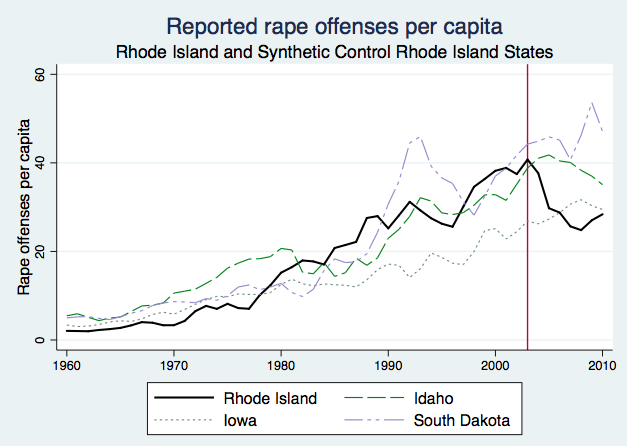
The authors found evidence that, after decriminalization, size of the indoor sex market increased – as expected – and prices commensurately fell. More surprising was the finding that forcible rape offenses fell by 31 percent in Rhode Island from 2004 to 2009, as decriminalized indoor sex work scaled up in the state. This translates to 824 fewer reported rapes. The majority of the reduction in rapes came from Providence, where the state’s sex work is concentrated.

The chart [above] depicts reported rape offenses (per 100,000 people) in Rhode Island (the black line) compared to similar control states. The red line demarcates 2003, when decriminalization took place – and only Rhode Island’s offenses drop off steeply after that.

Peter Weber adds:

[The researchers] speculate that the up to 31-percent drop in per capita rape cases was “due to men substituting away from rape toward prostitution,” and the drop in sexually transmitted diseases is likely because indoor prostitutes tend to be safer sexually than outdoor ones.

Meanwhile, Elizabeth Nolan Brown slams the FBI for shutting down MyRedBook.com, “a popular San Francisco-area website used by sexual service providers (and seekers) of all sorts”:

By almost all accounts, it was a space that not only connected sex workers with clients but also served as a sort of community forum, one which enabled sex workers to vet clients, warn about predators, and offer advice to one another. The website’s shutdown – visit MyRedBook.com and you’ll see only the seals of the FBI, Department of Justice, and Internal Revenue Service – has produced ample outrage from sex workers, who see it not only as a financial hit but also a strike against their safety. … [S]hutting down web forums where sex workers advertise isn’t going to actually stop people from buying or selling sex. But they sell this shit in the language of heroes, speaking to all the women and children they’re helping. They are liars.

The First Round of The 2016 Debates

Senators Gather To Caucus Over Hagel Nomination

That’s how Margaret Carlson characterizes Rick Perry’s and Rand Paul’s foreign policy dust-up:

For now, Paul and Perry are the proxies in the war for the foreign-policy soul of the party between the neo-isolationist/Tea Party/libertarians and the strong-on-defense establishment types. When Megyn Kelly of Fox News tells Cheney that “history has proven that you got it wrong,” you know Republicans are no longer knee-jerk hawks. Wading into this briar patch is perfect for Perry and Paul. Both need to prove they’re broader than their current resumes suggest. As governor, all Perry had to do was keep Texas safe from an invasion by Mexico. As a senator, all Paul has to do is run his mouth.

But that debate is the only real one going on right now – and it’s one that might actually have some impact. On the one hand, the Republicans cannot surely run in 2016 on a Cheney platform, as Marco Rubio appears to be planning. On the other, the Greater Israel lobby will do all it can to make sure that any recalibration toward realism and retrenchment is nipped in the bud. My bet, given reform conservatism’s complete wuss-out on the issue, is that the money will have the edge, for reasons explained by Justin Logan:

To put it bluntly, the portion of the GOP donor class that cares about foreign policy is wedded to a militaristic foreign policy, particularly in but not limited to the Middle East. Tens of millions of dollars every year are pumped into an alphabet soup of magazines, think tanks, fellowships, lobby groups and other outfits in Washington to ensure that conservative foreign policy stays unreformed. If we conceive of the Right broadly, comparatively dovish voices on the Right consist of Rand Paul, those writing at theAmerican Conservative, and the foreign and defense policy staff at the Cato Institute, the latter of which Wall Street Journal editorial page editor Paul Gigot once derisively but not entirely inaccurately referred to as “four or five people in a phone booth.” (We have actual offices, for the record.) But until there is some larger countervailing force in the conservative movement, the well-financed and well-entrenched status quo will persist.

Michael Brendan Dougherty is nonetheless hopeful that foreign policy, “one of the areas where American presidents still have relatively free rein to pursue their own course,” is shaping up to be a focal point of the next presidential election:

One of the faults of the American system of governance is that the public tends to elect presidents based on feelings about the economy. Every single poll from Gallup leading into 2012 showed that voters listed the economy as their top issue. But the truth is that presidents can do relatively little to improve the economy. Whether they want a major new executive branch program, a round of stimulus spending, or revisions to the tax code, they have to go through Congress, a body that is in the habit of resisting large-scale transformations of the American state. Usually less than 5 percent of voters claim foreign policy is a paramount issue (although some 30 percent or more will say “terrorism” is on their minds). But foreign policy is what presidents can do.

Which makes a Rand Paul-style makeover in office slightly more likely, if he isn’t Sheldoned out long before that. Kilgore looks forward to how this debate will develop as other contenders stake out their positions:

GOP divisions on foreign policy are very likely to sharpen as we move into the 2016 cycle, partially for competitive reasons but also because the candidates will be forced to project their own vision of America’s role in the world and not simply play off Obama’s record. And while Paul and Perry have staked out early and sharply divergent turf (as has to a lesser extent Marco Rubio, another neocon favorite), it’s possible other candidates will find intermediary positions–viz. Ted Cruz’s claim that he stands “halfway between” John McCain and Rand Paul on foreign policy. It will be quite the contrast from the 2012 cycle, in which the entire field lined up in support of traditional conservative positions favoring higher defense spending and aggressive confrontation with Iran, Russia and China, with the lonely exception of Rand’s father Ron.

Molly Ball observes that Paul’s opponents in this debate are not longstanding hawks:

Perhaps more interesting than this hawks-versus-libertarians dispute, which is an old argument, is who Paul’s antagonists have been. Both Perry and Cruz are politicians who’ve long been associated with the Tea Party, as Paul has. Perry, in his ill-fated 2012 campaign, warned of “military adventurism,” called for withdrawal from Afghanistan, and advocated cutting off aid to Pakistan. Cruz was lumped in with Paul in the category McCain derided as “wacko birds” after Paul’s 2013 drone filibuster. Yet both Perry and Cruz are anxious to differentiate themselves from Paul by turning him into a peacenik caricature.

Because they’re following the money! For now, anyway. Gillespie takes the opportunity to advocate for a libertarian foreign policy. To him, that means getting the government out of the business of shaping our influence around the world, and letting American liberty speak for itself:

The most powerful weapon the United States has for expanding peace and enlarging prosperity has nothing to do with guns and bullets and everything to do with the way in which we have created a nation of 300 million-plus people who generally get along peacefully while pursuing radically different visions of the good life. To the extent that we share our culture and commerce with the world rather than our drones and disdain, we will not only protect ourselves more effectively, we will actually help more people.

During the Cold War, the United States wasted millions if not billions of dollars on highly mannered, pathetic “cultural exchanges” designed to show that the “free world” could compete against communism in areas such as chess, and classical music. Yet no dissidents ever named a revolution after piano prodigy Van Cliburn; they named their revolution after the Velvet Underground.

(Photo: Alex Wong/Getty)
How Gay Is America?

Not very, according to the CDC:

The National Health Interview Survey, which is the government’s premier tool for annually assessing Americans’ health and behaviors, found that 1.6 percent of adults self-identify as gay or lesbian, and 0.7 percent consider themselves bisexual. The overwhelming majority of adults, 96.6 percent, labeled themselves as straight in the 2013 survey. An additional 1.1 percent declined to answer, responded “I don’t know the answer,” or said they were “something else.”

The figures offered a slightly smaller assessment of the size of the gay, lesbian and bisexual population than other surveys, which have pegged the overall proportion at closer to 3.5 or 4 percent. In particular, the estimate for bisexuals was lower than in some other surveys.

Eugene Volokh notes that, according to the CDC, lesbian and bisexual women slightly outnumber their male counterparts:

1.8 percent of men self-identify as gay and 0.4 percent as bisexual, and 1.5 percent of women self-identify as lesbian and 0.9 percent as bisexual. The results are generally in the same ballpark as past estimates — and far below the long-debunked 10 percent estimate. But past data that I’ve seen had suggested that there were about twice as many gay or bisexual men as lesbian or bisexual women; this data suggests that there is no such gender gap.

Meanwhile, Arit John considers the importance of framing:

The survey comes up with a number that’s lower than the 3.5 to 4 percent figure found in other surveys. And as we’ve seen from past surveys, what’s asked matters. Specifically, the broadness of the answers available to respondents makes a difference.

In 2007, researchers at Cornell University interviewed 20,000 individuals in 80 communities. “Mostly heterosexual” was an option for respondents, and the results showed a higher percentage of nonheterosexuality, especially among women:

85.1 percent of the young women identified as heterosexual; 0.5 percent reported no sexual identity; and the remaining 14.4 percent were sexual but not strictly heterosexual, i.e. either lesbian or bisexual. Among young men, 94.0 percent identified themselves as heterosexual; 0.4 percent of the men reported no sexual identity; and the remaining 5.6 percent identified as gay or bisexual.

Meanwhile, the study showed that gay and lesbian Americans were healthier than US heterosexuals in some respects and less so in others – more likely to drink, for example, but also more likely to exercise.

The Internet Is For Sleuthing

Peter Baker interviews author Deborah Halber about her book on amateur detectives who use the Internet to solve cold cases:

“An unidentified corpse is the Blanche DuBois of the forensic world: completely dependent on the kindness of strangers,” says Deborah Halber in her book about amateur Web sleuths who solve cold cases. According to a 2004 survey—the first and only of its kind—there are at least 13,486 Blanches nationwide, with about a thousand more added to the rolls each year. Amateur sleuths congregate online, swapping information and theories, looking for details or connections, poring over facial reconstructions, dental records, and serial numbers on breast implants and artificial joints. Halber says these forums have “propelled a remarkable shift in the number of cases solved, and in the relationship between the public and law enforcement.”

America has always loved the amateur detective, or the pro gone rogue. … Add the Internet to this strain of American do-it-yourself amateurism and you get the group of Web gumshoes Halber calls “the Skeleton Crew.” She recounts several cold cases, and she profiles active hunters. Some know the hurt of going years without information about a missing relative, and take satisfaction in relieving others from that pain. (This almost always means letting them know the person in question is definitely dead—a comforting if not happy finality. “I’m trying to help families get closure, because I don’t seem to be able to get it for myself,” says one sleuth.) Some are men fixated on the corpses of pretty women. Some read about a case in the news, then get sucked in by the online vortex of possibly relevant evidence, the connections radiating in every direction, the allure of scoring a “solve.” Many amateurs find, online, possibilities for creative thinking and meaning they lack in the drudgery of daily life.